DEVELOPMENT OF NEW
ANTITUBERCULAR AGENTS
1
Dr Akhil Nagar
RCP-IPER
Shirpur
Introduction to Tuberculosis
Tuberculosis (TB) remains the leading cause of death
worldwide from a single infectious disease agent. Indeed
many of the world's population is infected with TB. About
1.5 million people died from TB in 2018. The registered
number of new cases of TB worldwide roughly correlates
with economic conditions: the highest incidences are seen
in those countries of Africa, Asia, and Latin America with
the lowest gross national products. WHO estimates that
eight million people get TB every year, of whom 95% live
in developing countries. An estimated 2 million people die
from TB every year.
2
TB is an ancient infectious disease caused by
Mycobacterium tuberculosis.
It has been known since 1000 B.C., so it not a new
disease. Since TB is a disease of respiratory
transmission, optimal conditions for transmission
include:
Overcrowding
 poor personal hygiene
 poor public hygiene
3
• Mycobacterium referred as acid fast organism, to family
Mycobacteriaceae, include organism of TB and Leprosy.
• Test for detection are 14C, antigenic assay, ELISA, DNA
probes.
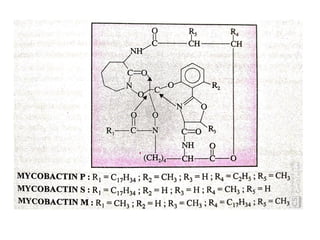
• Mycosides are glycolipids and peptidoglycolipids.
They have common terminal saccharide group with
Rhamnoses (O-methylated deoxy sugar) at different
positions.
• They are of two groups
i. phenolic glycolipids ii. Peptidoglucolipids
Mycobectins are also of three types:
i. Mycobactin P ii. Mycobactin S and iii. Mycobactin M
4
Sulfanilamide had weak bacteriostatic properties, later
sulfone derivative dapsone was investigated clinically,
which is still considered one of the most effective drugs
for the treatment of leprosy and also has useful
antimalarial properties, was considered too toxic
because of the high dosages used.
The discovery of the antitubercular activity of the
aminoglycoside antibiotic streptomycin was a modern
era, followed by discoveries of the antitubercular
properties of p-aminosalicylic acid (PAS) first and then,
in 1952, of isoniazid.
Later, the usefulness of the synthetic drug ethambutol
and, eventually, of the semisynthetic antibiotic rifampin
was discovered
Combination therapy, with the use of two or more
antitubercular drugs, has been well documented.
The choice of antitubercular combination depends on
various factors, including the location of the disease
(pulmonary, urogenital, gastrointestinal, or neural).
For some time, a combination of isoniazid and
ethambutol, with or without streptomycin, was the
preferred choice of treatment.
The synthetic drug pyrazinamide, because of its
sterilizing ability, is also considered a first-line agent
and is frequently used in place of ethambutol in
combination therapy.
Second-line agents for tuberculosis include the
antibiotics cycloserine, kanamycin, and capreomycin
and the synthetic compounds ethionamide and PAS.
Clinical studies indicated that when rifampin is
included in the regimen, particularly in combination
with isoniazid and ethambutol (or pyrazinamide), the
period required for successful therapy is shortened
significantly.
Previous treatment schedules without rifampin
required maintenance therapy for at least 2 years,
whereas those based on the isoniazid– rifampin
combination achieved equal or better results in 6 to 9
months.
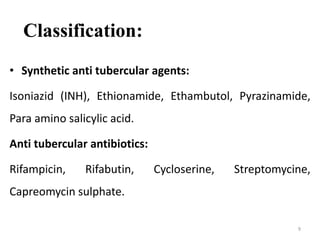
Classification:
• Synthetic anti tubercular agents:
Isoniazid (INH), Ethionamide, Ethambutol, Pyrazinamide,
Para amino salicylic acid.
Anti tubercular antibiotics:
Rifampicin, Rifabutin, Cycloserine, Streptomycine,
Capreomycin sulphate.
9
Isonicotinic acid hydrazide, isonicotinyl hydrazide, or INH
(Nydrazid), It is prepared by reacting the methyl ester of
isonicotinic acid with hydrazine.
It is not, however, uniformly effective against all forms of the
disease.
Its action, which is considered bactericidal, is to cause the bacilli
to lose lipid content by a mechanism.
The most generally accepted theory suggests that the principal
effect of isoniazid is to inhibit the synthesis of mycolic acids,
high–molecular-weight, branched –hydroxy fatty acids that
constitute important components of the cell walls of
mycobacteria.
A mycobacterial catalase–peroxidase enzyme complex is required
for the bioactivation of isoniazid, A reactive species, generated
through the action of these enzymes on the drug, is believed to
attack a critical enzyme required for mycolic acid synthesis in
mycobacteria.
• The target for the action of INH has recently been
identified as an enzyme that catalyzes the NADH-
specific reduction of 2-trans-enoylacyl carrier
protein, an essential step in fatty acid elongation.
• This enzyme is encoded by a specific gene, inhA, in
M. tuberculosis.
• Coadministration of pyridoxine is reported to
prevent the
• symptoms of peripheral neuritis, suggesting that this
adverse effect may result from antagonism of a
coenzyme action of pyridoxal phosphate.
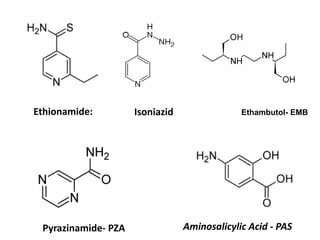
Ethionamide: Isoniazid Ethambutol- EMB
Pyrazinamide- PZA Aminosalicylic Acid - PAS
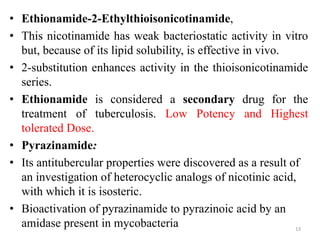
• Ethionamide-2-Ethylthioisonicotinamide,
• This nicotinamide has weak bacteriostatic activity in vitro
but, because of its lipid solubility, is effective in vivo.
• 2-substitution enhances activity in the thioisonicotinamide
series.
• Ethionamide is considered a secondary drug for the
treatment of tuberculosis. Low Potency and Highest
tolerated Dose.
• Pyrazinamide:
• Its antitubercular properties were discovered as a result of
an investigation of heterocyclic analogs of nicotinic acid,
with which it is isosteric.
• Bioactivation of pyrazinamide to pyrazinoic acid by an
amidase present in mycobacteria 13
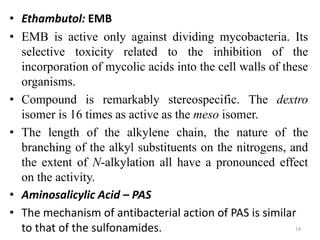
• Ethambutol: EMB
• EMB is active only against dividing mycobacteria. Its
selective toxicity related to the inhibition of the
incorporation of mycolic acids into the cell walls of these
organisms.
• Compound is remarkably stereospecific. The dextro
isomer is 16 times as active as the meso isomer.
• The length of the alkylene chain, the nature of the
branching of the alkyl substituents on the nitrogens, and
the extent of N-alkylation all have a pronounced effect
on the activity.
• Aminosalicylic Acid – PAS
• The mechanism of antibacterial action of PAS is similar
to that of the sulfonamides. 14
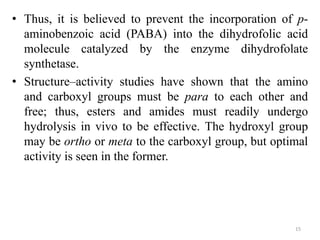
• Thus, it is believed to prevent the incorporation of p-
aminobenzoic acid (PABA) into the dihydrofolic acid
molecule catalyzed by the enzyme dihydrofolate
synthetase.
• Structure–activity studies have shown that the amino
and carboxyl groups must be para to each other and
free; thus, esters and amides must readily undergo
hydrolysis in vivo to be effective. The hydroxyl group
may be ortho or meta to the carboxyl group, but optimal
activity is seen in the former.
15
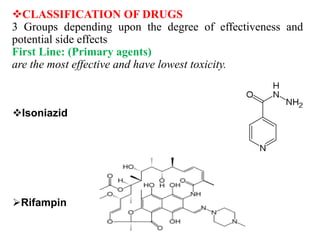
Isoniazid
Rifampin
CLASSIFICATION OF DRUGS
3 Groups depending upon the degree of effectiveness and
potential side effects
First Line: (Primary agents)
are the most effective and have lowest toxicity.
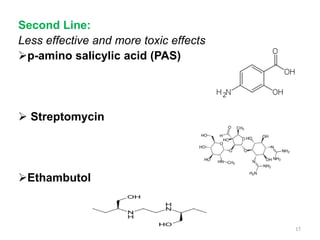
Second Line:
Less effective and more toxic effects
p-amino salicylic acid (PAS)
 Streptomycin
Ethambutol
17
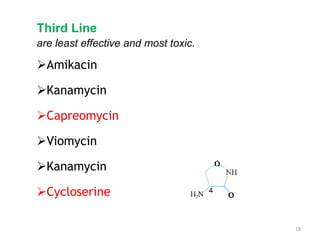
Third Line
are least effective and most toxic.
Amikacin
Kanamycin
Capreomycin
Viomycin
Kanamycin
Cycloserine
18
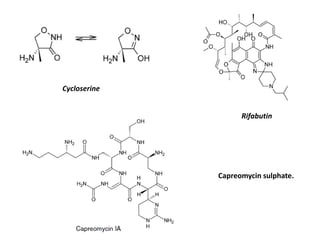
Rifabutin
Cycloserine
Capreomycin sulphate.
Rifamycin
• All of the rifamycins (A, B, C, D, and E) are biologically
active.
• Some of the semisynthetic derivatives of rifamycin B are the
most potent known inhibitors of DNAdirected RNA
polymerase in bacteria.
• Their net effect is to inhibit the formation of the virus particle,
apparently by preventing a specific polypeptide conversion.
• Rifamycins bind to the subunit of bacterial DNA-dependent
RNA polymerases to prevent chain initiation.
• Rifampin: Most active, highly active against staphylococci
and used with the combination only.
• Hepatotoxicity was significantly higher when rifampin was
combined with isoniazid. 20
• Combination with ethambutol, are less toxic.
• Rifampin is a powerful inducer of hepatic cytochrome
P450 oxygenases.
• When it is used in the treatment of leprosy, rifampin should
be combined with dapsone or some other leprostatic agent
to minimize the emergence of resistant strains of M. leprae.
• Rifampin has its primary metabolite, deacetylrifampin,
which is also biologically active and get reabsorbed. The
concentration of drug remain long time in body.
• It can also give reddish orange discoloration of the urine,
stool, saliva, tears.
• Dose is 600mg and available in parentral form also.
21
• Rifabutin: Rifabutin, the spiroimidazopiperidyl derivative of
rifamycin B.
• Rifabutin is a very lipophilic compound with a high affinity
for tissues.
• Cycloserine: 4-Amino-3-isoxazolidinone (Seromycin), both
isomers D and L are active.
• Cycloserine is presumed to exert its antibacterial action by
preventing the synthesis of cross-linking peptide in the
formation of bacterial cell walls.
• it is an antimetabolite for alanine and alanine racemase.
• Irreversible inactivation of the enzyme thereby deprives the
cell of the D-alanine required for the synthesis of the cross-
linking peptide.
22
• Capreomycin Sulfate: Four capreomycins, designated IA,
IB, IIA, and IIB, have been isolated, clinical agent
contains primarily IA and IB.
• It is useful in resistant or treatment failure TB when
given with ethambutol or INH.
• Common side effect is hearing loss, rashes and fever.
23

Antitubercular agents (Anti-TB agents)

  • 1.
    DEVELOPMENT OF NEW ANTITUBERCULARAGENTS 1 Dr Akhil Nagar RCP-IPER Shirpur
  • 2.
    Introduction to Tuberculosis Tuberculosis(TB) remains the leading cause of death worldwide from a single infectious disease agent. Indeed many of the world's population is infected with TB. About 1.5 million people died from TB in 2018. The registered number of new cases of TB worldwide roughly correlates with economic conditions: the highest incidences are seen in those countries of Africa, Asia, and Latin America with the lowest gross national products. WHO estimates that eight million people get TB every year, of whom 95% live in developing countries. An estimated 2 million people die from TB every year. 2
  • 3.
    TB is anancient infectious disease caused by Mycobacterium tuberculosis. It has been known since 1000 B.C., so it not a new disease. Since TB is a disease of respiratory transmission, optimal conditions for transmission include: Overcrowding  poor personal hygiene  poor public hygiene 3
  • 4.
    • Mycobacterium referredas acid fast organism, to family Mycobacteriaceae, include organism of TB and Leprosy. • Test for detection are 14C, antigenic assay, ELISA, DNA probes. • Mycosides are glycolipids and peptidoglycolipids. They have common terminal saccharide group with Rhamnoses (O-methylated deoxy sugar) at different positions. • They are of two groups i. phenolic glycolipids ii. Peptidoglucolipids Mycobectins are also of three types: i. Mycobactin P ii. Mycobactin S and iii. Mycobactin M 4
  • 6.
    Sulfanilamide had weakbacteriostatic properties, later sulfone derivative dapsone was investigated clinically, which is still considered one of the most effective drugs for the treatment of leprosy and also has useful antimalarial properties, was considered too toxic because of the high dosages used. The discovery of the antitubercular activity of the aminoglycoside antibiotic streptomycin was a modern era, followed by discoveries of the antitubercular properties of p-aminosalicylic acid (PAS) first and then, in 1952, of isoniazid. Later, the usefulness of the synthetic drug ethambutol and, eventually, of the semisynthetic antibiotic rifampin was discovered
  • 7.
    Combination therapy, withthe use of two or more antitubercular drugs, has been well documented. The choice of antitubercular combination depends on various factors, including the location of the disease (pulmonary, urogenital, gastrointestinal, or neural). For some time, a combination of isoniazid and ethambutol, with or without streptomycin, was the preferred choice of treatment. The synthetic drug pyrazinamide, because of its sterilizing ability, is also considered a first-line agent and is frequently used in place of ethambutol in combination therapy.
  • 8.
    Second-line agents fortuberculosis include the antibiotics cycloserine, kanamycin, and capreomycin and the synthetic compounds ethionamide and PAS. Clinical studies indicated that when rifampin is included in the regimen, particularly in combination with isoniazid and ethambutol (or pyrazinamide), the period required for successful therapy is shortened significantly. Previous treatment schedules without rifampin required maintenance therapy for at least 2 years, whereas those based on the isoniazid– rifampin combination achieved equal or better results in 6 to 9 months.
  • 9.
    Classification: • Synthetic antitubercular agents: Isoniazid (INH), Ethionamide, Ethambutol, Pyrazinamide, Para amino salicylic acid. Anti tubercular antibiotics: Rifampicin, Rifabutin, Cycloserine, Streptomycine, Capreomycin sulphate. 9
  • 10.
    Isonicotinic acid hydrazide,isonicotinyl hydrazide, or INH (Nydrazid), It is prepared by reacting the methyl ester of isonicotinic acid with hydrazine. It is not, however, uniformly effective against all forms of the disease. Its action, which is considered bactericidal, is to cause the bacilli to lose lipid content by a mechanism. The most generally accepted theory suggests that the principal effect of isoniazid is to inhibit the synthesis of mycolic acids, high–molecular-weight, branched –hydroxy fatty acids that constitute important components of the cell walls of mycobacteria. A mycobacterial catalase–peroxidase enzyme complex is required for the bioactivation of isoniazid, A reactive species, generated through the action of these enzymes on the drug, is believed to attack a critical enzyme required for mycolic acid synthesis in mycobacteria.
  • 11.
    • The targetfor the action of INH has recently been identified as an enzyme that catalyzes the NADH- specific reduction of 2-trans-enoylacyl carrier protein, an essential step in fatty acid elongation. • This enzyme is encoded by a specific gene, inhA, in M. tuberculosis. • Coadministration of pyridoxine is reported to prevent the • symptoms of peripheral neuritis, suggesting that this adverse effect may result from antagonism of a coenzyme action of pyridoxal phosphate.
  • 12.
    Ethionamide: Isoniazid Ethambutol-EMB Pyrazinamide- PZA Aminosalicylic Acid - PAS
  • 13.
    • Ethionamide-2-Ethylthioisonicotinamide, • Thisnicotinamide has weak bacteriostatic activity in vitro but, because of its lipid solubility, is effective in vivo. • 2-substitution enhances activity in the thioisonicotinamide series. • Ethionamide is considered a secondary drug for the treatment of tuberculosis. Low Potency and Highest tolerated Dose. • Pyrazinamide: • Its antitubercular properties were discovered as a result of an investigation of heterocyclic analogs of nicotinic acid, with which it is isosteric. • Bioactivation of pyrazinamide to pyrazinoic acid by an amidase present in mycobacteria 13
  • 14.
    • Ethambutol: EMB •EMB is active only against dividing mycobacteria. Its selective toxicity related to the inhibition of the incorporation of mycolic acids into the cell walls of these organisms. • Compound is remarkably stereospecific. The dextro isomer is 16 times as active as the meso isomer. • The length of the alkylene chain, the nature of the branching of the alkyl substituents on the nitrogens, and the extent of N-alkylation all have a pronounced effect on the activity. • Aminosalicylic Acid – PAS • The mechanism of antibacterial action of PAS is similar to that of the sulfonamides. 14
  • 15.
    • Thus, itis believed to prevent the incorporation of p- aminobenzoic acid (PABA) into the dihydrofolic acid molecule catalyzed by the enzyme dihydrofolate synthetase. • Structure–activity studies have shown that the amino and carboxyl groups must be para to each other and free; thus, esters and amides must readily undergo hydrolysis in vivo to be effective. The hydroxyl group may be ortho or meta to the carboxyl group, but optimal activity is seen in the former. 15
  • 16.
    Isoniazid Rifampin CLASSIFICATION OF DRUGS 3Groups depending upon the degree of effectiveness and potential side effects First Line: (Primary agents) are the most effective and have lowest toxicity.
  • 17.
    Second Line: Less effectiveand more toxic effects p-amino salicylic acid (PAS)  Streptomycin Ethambutol 17
  • 18.
    Third Line are leasteffective and most toxic. Amikacin Kanamycin Capreomycin Viomycin Kanamycin Cycloserine 18
  • 19.
  • 20.
    Rifamycin • All ofthe rifamycins (A, B, C, D, and E) are biologically active. • Some of the semisynthetic derivatives of rifamycin B are the most potent known inhibitors of DNAdirected RNA polymerase in bacteria. • Their net effect is to inhibit the formation of the virus particle, apparently by preventing a specific polypeptide conversion. • Rifamycins bind to the subunit of bacterial DNA-dependent RNA polymerases to prevent chain initiation. • Rifampin: Most active, highly active against staphylococci and used with the combination only. • Hepatotoxicity was significantly higher when rifampin was combined with isoniazid. 20
  • 21.
    • Combination withethambutol, are less toxic. • Rifampin is a powerful inducer of hepatic cytochrome P450 oxygenases. • When it is used in the treatment of leprosy, rifampin should be combined with dapsone or some other leprostatic agent to minimize the emergence of resistant strains of M. leprae. • Rifampin has its primary metabolite, deacetylrifampin, which is also biologically active and get reabsorbed. The concentration of drug remain long time in body. • It can also give reddish orange discoloration of the urine, stool, saliva, tears. • Dose is 600mg and available in parentral form also. 21
  • 22.
    • Rifabutin: Rifabutin,the spiroimidazopiperidyl derivative of rifamycin B. • Rifabutin is a very lipophilic compound with a high affinity for tissues. • Cycloserine: 4-Amino-3-isoxazolidinone (Seromycin), both isomers D and L are active. • Cycloserine is presumed to exert its antibacterial action by preventing the synthesis of cross-linking peptide in the formation of bacterial cell walls. • it is an antimetabolite for alanine and alanine racemase. • Irreversible inactivation of the enzyme thereby deprives the cell of the D-alanine required for the synthesis of the cross- linking peptide. 22
  • 23.
    • Capreomycin Sulfate:Four capreomycins, designated IA, IB, IIA, and IIB, have been isolated, clinical agent contains primarily IA and IB. • It is useful in resistant or treatment failure TB when given with ethambutol or INH. • Common side effect is hearing loss, rashes and fever. 23