

INFECTIOUS DISEASES

 Tuberculosis
   Dr. Farooq Ahamd
    Assistant Professor
      Community Medicine
    Rawalpindi Medical College
           Rawalpindi
WHO Slogan for 2009


24 March commemorates the day in 1882 when Dr Robert Koch astounded
the scientific community by announcing that he had discovered the cause
                    of tuberculosis, the TB bacillus
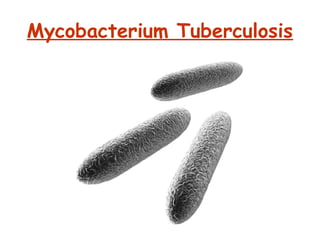
Mycobacterium Tuberculosis
Epidemiology World
Epidemiology Pakistan
• Estimated incidence of TB is around 250,000 per year in
  Pakistan & existing patient population of around 1.8 million.
• TB kills 64,000 people in Pakistan each year, accounting for
  26% of the nation's avoidable deaths
• Most patients are ages 15 to 45; 52% are males; and 48% are
  females, according to government figures
• Pakistan ranks 6th among the 22 high burden countries of TB in
  the world
• It has declared TB as national emergency in 2001
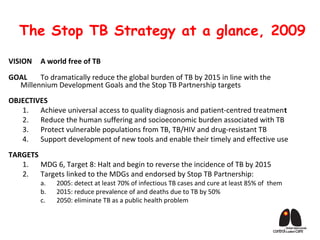
The Stop TB Strategy at a glance, 2009
VISION   A world free of TB

GOAL    To dramatically reduce the global burden of TB by 2015 in line with the
  Millennium Development Goals and the Stop TB Partnership targets
OBJECTIVES
   1. Achieve universal access to quality diagnosis and patient-centred treatment
   2. Reduce the human suffering and socioeconomic burden associated with TB
   3. Protect vulnerable populations from TB, TB/HIV and drug-resistant TB
   4. Support development of new tools and enable their timely and effective use
TARGETS
   1. MDG 6, Target 8: Halt and begin to reverse the incidence of TB by 2015
   2. Targets linked to the MDGs and endorsed by Stop TB Partnership:
         a.   2005: detect at least 70% of infectious TB cases and cure at least 85% of them
         b.   2015: reduce prevalence of and deaths due to TB by 50%
         c.   2050: eliminate TB as a public health problem
Important Definitions
•   Prevalence of Infection
•   Annual infection rate (incidence of infection)
•   Case Rate ( Prevalence of disease)
•   Incidence of new case
•   Prevalence of suspect cases
•   Prevalence of drug resistant case
•   Mortality rate
Important Definitions

1.   Sputum Smear           7. Failure Case
2.   Smear Positive TB      8. Return after default
3.   Smear Negative TB      9. Transfer in
4.   Adherence/Compliance   10.Transfer out
5.   New Case               11.Cured
6.   Relapse                12. Treatment Completed
Agent, Host & Environment
Tuberculin test
The tuberculin skin test (TST) is not a test for
immunity to TB, but rather a measure of the
degree of tuberculin hypersensitivity as
measured by a cell-mediated immune
response. The Mantoux test, the Heaf test and
the tuberculin tine test—all variants of the
tuberculin skin test—can deliver tuberculin
PPD into the skin.
Tuberculin test
   False Negative Tuberculin Skin Test
• Out-of-date tuberculin is used.
• Tuberculin leaks at the injection site.
• Testing is undertaken too early in cases of primary
   exposure, before hypersensitivity has developed. (A
   hypersensitivity reaction generally takes six to eight
   weeks to develop.)
• The injection is too deep.
• The test reading is undertaken too early (before 48 hours)
   or too late (after one week).
• The person has an inter current viral infection (such as
   measles) or has had a recent live viral immunisation.
• The person is undergoing corticosteroid therapy
   (especially if long term) or immunosuppressive therapy.
Tuberculin test
   False Negative Tuberculin Skin Test
• The person is suffering from malnutrition, perhaps from a
   period in a refugee or prison camp, or from significant
   cachexia.
• The person is elderly.
• The person has a medical condition that may result in
   partial immunosuppression, such as diabetes,
   sarcoidosis, advanced alcoholism, renal failure, massive
   trauma or burns.
• The person is an injecting drug user.
• The person has any malignancies, especially lymphoma.
• The person has HIV/ AIDS.
• The person is seriously ill, including when they have
   advanced or miliary TB.
Tuberculin test
False Positive Tuberculin Skin Test
A false positive TST can occur as a result of:
   • Recent BCG vaccination
   • A ruptured small venule at the time of
     injection
   • Faulty test interpretation, such as the
     measurement of erythema rather than of
     induration.
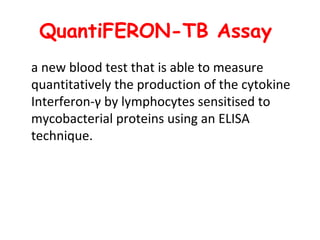
QuantiFERON-TB Assay
a new blood test that is able to measure
quantitatively the production of the cytokine
Interferon-γ by lymphocytes sensitised to
mycobacterial proteins using an ELISA
technique.
TB Control
Case finding
ATT
Patients who interrupt Treatment
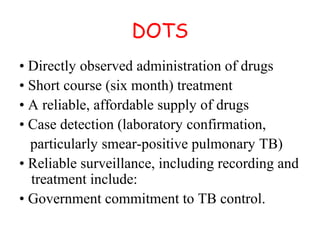
DOTS
• Directly observed administration of drugs
• Short course (six month) treatment
• A reliable, affordable supply of drugs
• Case detection (laboratory confirmation,
  particularly smear-positive pulmonary TB)
• Reliable surveillance, including recording and
  treatment include:
• Government commitment to TB control.
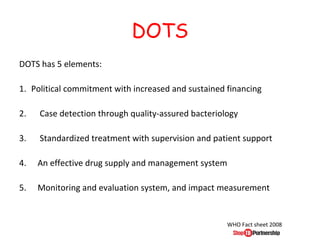
DOTS
DOTS has 5 elements:

1. Political commitment with increased and sustained financing

2.   Case detection through quality-assured bacteriology

3.   Standardized treatment with supervision and patient support

4.   An effective drug supply and management system

5.   Monitoring and evaluation system, and impact measurement


                                                     WHO Fact sheet 2008
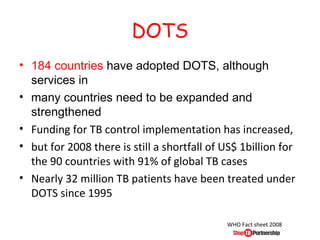
DOTS
• 184 countries have adopted DOTS, although
  services in
• many countries need to be expanded and
  strengthened
• Funding for TB control implementation has increased,
• but for 2008 there is still a shortfall of US$ 1billion for
  the 90 countries with 91% of global TB cases
• Nearly 32 million TB patients have been treated under
  DOTS since 1995

                                             WHO Fact sheet 2008
Chemoprophylaxis
BCG
NTP

Tb

  • 1.
    INFECTIOUS DISEASES Tuberculosis Dr. Farooq Ahamd Assistant Professor Community Medicine Rawalpindi Medical College Rawalpindi
  • 2.
    WHO Slogan for2009 24 March commemorates the day in 1882 when Dr Robert Koch astounded the scientific community by announcing that he had discovered the cause of tuberculosis, the TB bacillus
  • 3.
  • 4.
  • 5.
    Epidemiology Pakistan • Estimatedincidence of TB is around 250,000 per year in Pakistan & existing patient population of around 1.8 million. • TB kills 64,000 people in Pakistan each year, accounting for 26% of the nation's avoidable deaths • Most patients are ages 15 to 45; 52% are males; and 48% are females, according to government figures • Pakistan ranks 6th among the 22 high burden countries of TB in the world • It has declared TB as national emergency in 2001
  • 6.
    The Stop TBStrategy at a glance, 2009 VISION A world free of TB GOAL To dramatically reduce the global burden of TB by 2015 in line with the Millennium Development Goals and the Stop TB Partnership targets OBJECTIVES 1. Achieve universal access to quality diagnosis and patient-centred treatment 2. Reduce the human suffering and socioeconomic burden associated with TB 3. Protect vulnerable populations from TB, TB/HIV and drug-resistant TB 4. Support development of new tools and enable their timely and effective use TARGETS 1. MDG 6, Target 8: Halt and begin to reverse the incidence of TB by 2015 2. Targets linked to the MDGs and endorsed by Stop TB Partnership: a. 2005: detect at least 70% of infectious TB cases and cure at least 85% of them b. 2015: reduce prevalence of and deaths due to TB by 50% c. 2050: eliminate TB as a public health problem
  • 7.
    Important Definitions • Prevalence of Infection • Annual infection rate (incidence of infection) • Case Rate ( Prevalence of disease) • Incidence of new case • Prevalence of suspect cases • Prevalence of drug resistant case • Mortality rate
  • 8.
    Important Definitions 1. Sputum Smear 7. Failure Case 2. Smear Positive TB 8. Return after default 3. Smear Negative TB 9. Transfer in 4. Adherence/Compliance 10.Transfer out 5. New Case 11.Cured 6. Relapse 12. Treatment Completed
  • 9.
    Agent, Host &Environment
  • 10.
    Tuberculin test The tuberculinskin test (TST) is not a test for immunity to TB, but rather a measure of the degree of tuberculin hypersensitivity as measured by a cell-mediated immune response. The Mantoux test, the Heaf test and the tuberculin tine test—all variants of the tuberculin skin test—can deliver tuberculin PPD into the skin.
  • 11.
    Tuberculin test False Negative Tuberculin Skin Test • Out-of-date tuberculin is used. • Tuberculin leaks at the injection site. • Testing is undertaken too early in cases of primary exposure, before hypersensitivity has developed. (A hypersensitivity reaction generally takes six to eight weeks to develop.) • The injection is too deep. • The test reading is undertaken too early (before 48 hours) or too late (after one week). • The person has an inter current viral infection (such as measles) or has had a recent live viral immunisation. • The person is undergoing corticosteroid therapy (especially if long term) or immunosuppressive therapy.
  • 12.
    Tuberculin test False Negative Tuberculin Skin Test • The person is suffering from malnutrition, perhaps from a period in a refugee or prison camp, or from significant cachexia. • The person is elderly. • The person has a medical condition that may result in partial immunosuppression, such as diabetes, sarcoidosis, advanced alcoholism, renal failure, massive trauma or burns. • The person is an injecting drug user. • The person has any malignancies, especially lymphoma. • The person has HIV/ AIDS. • The person is seriously ill, including when they have advanced or miliary TB.
  • 13.
    Tuberculin test False PositiveTuberculin Skin Test A false positive TST can occur as a result of: • Recent BCG vaccination • A ruptured small venule at the time of injection • Faulty test interpretation, such as the measurement of erythema rather than of induration.
  • 14.
    QuantiFERON-TB Assay a newblood test that is able to measure quantitatively the production of the cytokine Interferon-γ by lymphocytes sensitised to mycobacterial proteins using an ELISA technique.
  • 15.
  • 16.
  • 17.
  • 18.
    DOTS • Directly observedadministration of drugs • Short course (six month) treatment • A reliable, affordable supply of drugs • Case detection (laboratory confirmation, particularly smear-positive pulmonary TB) • Reliable surveillance, including recording and treatment include: • Government commitment to TB control.
  • 19.
    DOTS DOTS has 5elements: 1. Political commitment with increased and sustained financing 2. Case detection through quality-assured bacteriology 3. Standardized treatment with supervision and patient support 4. An effective drug supply and management system 5. Monitoring and evaluation system, and impact measurement WHO Fact sheet 2008
  • 20.
    DOTS • 184 countrieshave adopted DOTS, although services in • many countries need to be expanded and strengthened • Funding for TB control implementation has increased, • but for 2008 there is still a shortfall of US$ 1billion for the 90 countries with 91% of global TB cases • Nearly 32 million TB patients have been treated under DOTS since 1995 WHO Fact sheet 2008
  • 21.
  • 22.
  • 23.