Shadan Institute of Medical Sciences
Department of SPM
Genezens 2k15
www.genezens.weebly.com
Horrock’s Test
Shadan Institute of Medical Sciences, Department of SPM
Genezens 2k15: www.genezens.weebly.com
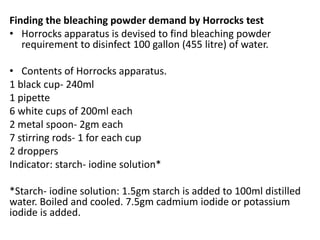
Finding the bleaching powder demand by Horrocks test
• Horrocks apparatus is devised to find bleaching powder
requirement to disinfect 100 gallon (455 litre) of water.
• Contents of Horrocks apparatus.
1 black cup- 240ml
1 pipette
6 white cups of 200ml each
2 metal spoon- 2gm each
7 stirring rods- 1 for each cup
2 droppers
Indicator: starch- iodine solution*
*Starch- iodine solution: 1.5gm starch is added to 100ml distilled
water. Boiled and cooled. 7.5gm cadmium iodide or potassium
iodide is added.
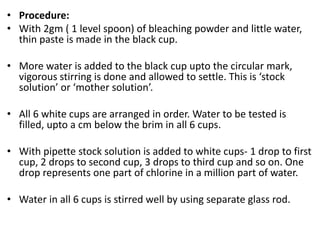
• Procedure:
• With 2gm ( 1 level spoon) of bleaching powder and little water,
thin paste is made in the black cup.
• More water is added to the black cup upto the circular mark,
vigorous stirring is done and allowed to settle. This is ‘stock
solution’ or ‘mother solution’.
• All 6 white cups are arranged in order. Water to be tested is
filled, upto a cm below the brim in all 6 cups.
• With pipette stock solution is added to white cups- 1 drop to first
cup, 2 drops to second cup, 3 drops to third cup and so on. One
drop represents one part of chlorine in a million part of water.
• Water in all 6 cups is stirred well by using separate glass rod.
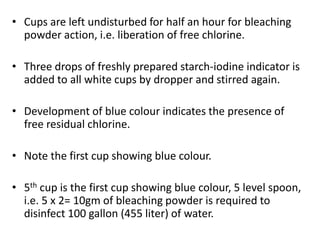
• Cups are left undisturbed for half an hour for bleaching
powder action, i.e. liberation of free chlorine.
• Three drops of freshly prepared starch-iodine indicator is
added to all white cups by dropper and stirred again.
• Development of blue colour indicates the presence of
free residual chlorine.
• Note the first cup showing blue colour.
• 5th cup is the first cup showing blue colour, 5 level spoon,
i.e. 5 x 2= 10gm of bleaching powder is required to
disinfect 100 gallon (455 liter) of water.
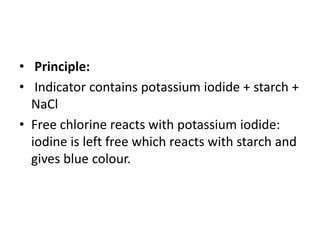
• Principle:
• Indicator contains potassium iodide + starch +
NaCl
• Free chlorine reacts with potassium iodide:
iodine is left free which reacts with starch and
gives blue colour.
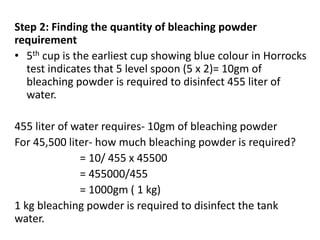
Step 2: Finding the quantity of bleaching powder
requirement
• 5th cup is the earliest cup showing blue colour in Horrocks
test indicates that 5 level spoon (5 x 2)= 10gm of
bleaching powder is required to disinfect 455 liter of
water.
455 liter of water requires- 10gm of bleaching powder
For 45,500 liter- how much bleaching powder is required?
= 10/ 455 x 45500
= 455000/455
= 1000gm ( 1 kg)
1 kg bleaching powder is required to disinfect the tank
water.
Question 1
Shadan Institute of Medical Sciences, Department of SPM
Genezens 2k15: www.genezens.weebly.com
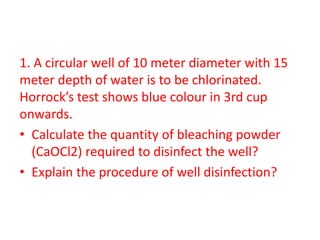
1. A circular well of 10 meter diameter with 15
meter depth of water is to be chlorinated.
Horrock’s test shows blue colour in 3rd cup
onwards.
• Calculate the quantity of bleaching powder
(CaOCl2) required to disinfect the well?
• Explain the procedure of well disinfection?
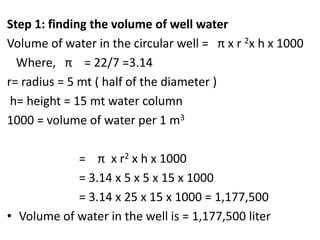
Step 1: finding the volume of well water
Volume of water in the circular well = π x r 2x h x 1000
Where, π = 22/7 =3.14
r= radius = 5 mt ( half of the diameter )
h= height = 15 mt water column
1000 = volume of water per 1 m3
= π x r2 x h x 1000
= 3.14 x 5 x 5 x 15 x 1000
= 3.14 x 25 x 15 x 1000 = 1,177,500
• Volume of water in the well is = 1,177,500 liter
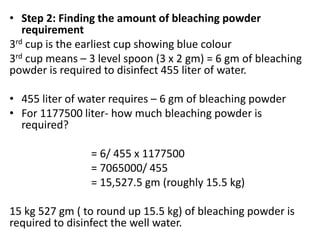
• Step 2: Finding the amount of bleaching powder
requirement
3rd cup is the earliest cup showing blue colour
3rd cup means – 3 level spoon (3 x 2 gm) = 6 gm of bleaching
powder is required to disinfect 455 liter of water.
• 455 liter of water requires – 6 gm of bleaching powder
• For 1177500 liter- how much bleaching powder is
required?
= 6/ 455 x 1177500
= 7065000/ 455
= 15,527.5 gm (roughly 15.5 kg)
15 kg 527 gm ( to round up 15.5 kg) of bleaching powder is
required to disinfect the well water.
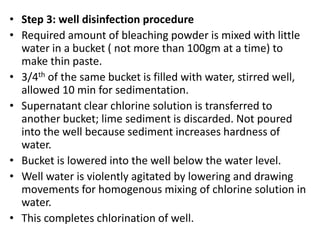
• Step 3: well disinfection procedure
• Required amount of bleaching powder is mixed with little
water in a bucket ( not more than 100gm at a time) to
make thin paste.
• 3/4th of the same bucket is filled with water, stirred well,
allowed 10 min for sedimentation.
• Supernatant clear chlorine solution is transferred to
another bucket; lime sediment is discarded. Not poured
into the well because sediment increases hardness of
water.
• Bucket is lowered into the well below the water level.
• Well water is violently agitated by lowering and drawing
movements for homogenous mixing of chlorine solution in
water.
• This completes chlorination of well.
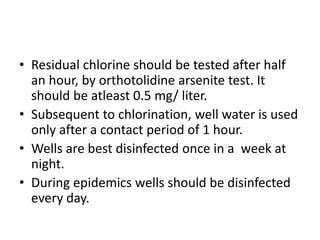
• Residual chlorine should be tested after half
an hour, by orthotolidine arsenite test. It
should be atleast 0.5 mg/ liter.
• Subsequent to chlorination, well water is used
only after a contact period of 1 hour.
• Wells are best disinfected once in a week at
night.
• During epidemics wells should be disinfected
every day.
Question 2
Shadan Institute of Medical Sciences, Department of SPM
Genezens 2k15: www.genezens.weebly.com
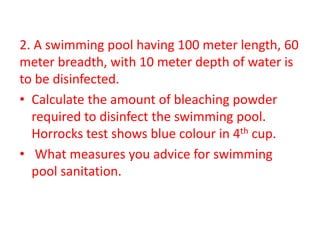
2. A swimming pool having 100 meter length, 60
meter breadth, with 10 meter depth of water is
to be disinfected.
• Calculate the amount of bleaching powder
required to disinfect the swimming pool.
Horrocks test shows blue colour in 4th cup.
• What measures you advice for swimming
pool sanitation.
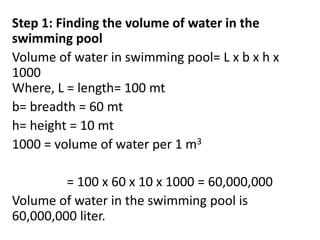
Step 1: Finding the volume of water in the
swimming pool
Volume of water in swimming pool= L x b x h x
1000
Where, L = length= 100 mt
b= breadth = 60 mt
h= height = 10 mt
1000 = volume of water per 1 m3
= 100 x 60 x 10 x 1000 = 60,000,000
Volume of water in the swimming pool is
60,000,000 liter.
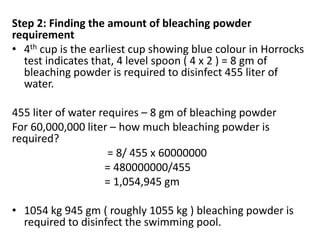
Step 2: Finding the amount of bleaching powder
requirement
• 4th cup is the earliest cup showing blue colour in Horrocks
test indicates that, 4 level spoon ( 4 x 2 ) = 8 gm of
bleaching powder is required to disinfect 455 liter of
water.
455 liter of water requires – 8 gm of bleaching powder
For 60,000,000 liter – how much bleaching powder is
required?
= 8/ 455 x 60000000
= 480000000/455
= 1,054,945 gm
• 1054 kg 945 gm ( roughly 1055 kg ) bleaching powder is
required to disinfect the swimming pool.
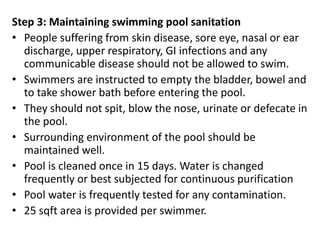
Step 3: Maintaining swimming pool sanitation
• People suffering from skin disease, sore eye, nasal or ear
discharge, upper respiratory, GI infections and any
communicable disease should not be allowed to swim.
• Swimmers are instructed to empty the bladder, bowel and
to take shower bath before entering the pool.
• They should not spit, blow the nose, urinate or defecate in
the pool.
• Surrounding environment of the pool should be
maintained well.
• Pool is cleaned once in 15 days. Water is changed
frequently or best subjected for continuous purification
• Pool water is frequently tested for any contamination.
• 25 sqft area is provided per swimmer.
Question 3
Shadan Institute of Medical Sciences, Department of SPM
Genezens 2k15: www.genezens.weebly.com
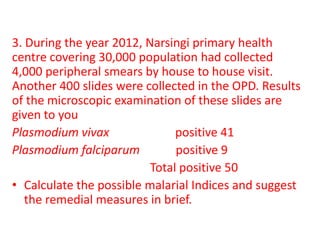
3. During the year 2012, Narsingi primary health
centre covering 30,000 population had collected
4,000 peripheral smears by house to house visit.
Another 400 slides were collected in the OPD. Results
of the microscopic examination of these slides are
given to you
Plasmodium vivax positive 41
Plasmodium falciparum positive 9
Total positive 50
• Calculate the possible malarial Indices and suggest
the remedial measures in brief.
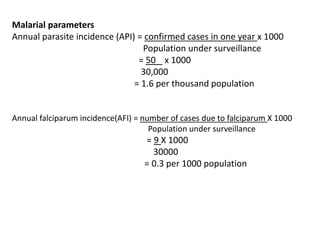
Malarial parameters
Annual parasite incidence (API) = confirmed cases in one year x 1000
Population under surveillance
= 50 x 1000
30,000
= 1.6 per thousand population
Annual falciparum incidence(AFI) = number of cases due to falciparum X 1000
Population under surveillance
= 9 X 1000
30000
= 0.3 per 1000 population
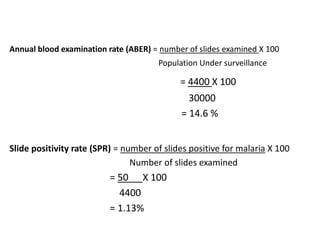
Annual blood examination rate (ABER) = number of slides examined X 100
Population Under surveillance
= 4400 X 100
30000
= 14.6 %
Slide positivity rate (SPR) = number of slides positive for malaria X 100
Number of slides examined
= 50 X 100
4400
= 1.13%
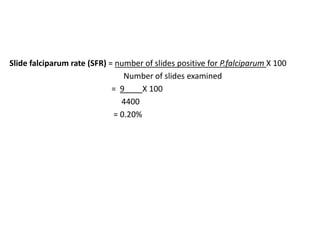
Slide falciparum rate (SFR) = number of slides positive for P.falciparum X 100
Number of slides examined
= 9 X 100
4400
= 0.20%
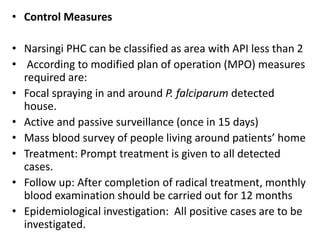
• Control Measures
• Narsingi PHC can be classified as area with API less than 2
• According to modified plan of operation (MPO) measures
required are:
• Focal spraying in and around P. falciparum detected
house.
• Active and passive surveillance (once in 15 days)
• Mass blood survey of people living around patients’ home
• Treatment: Prompt treatment is given to all detected
cases.
• Follow up: After completion of radical treatment, monthly
blood examination should be carried out for 12 months
• Epidemiological investigation: All positive cases are to be
investigated.
Question 4
Shadan Institute of Medical Sciences, Department of SPM
Genezens 2k15: www.genezens.weebly.com
4. In the year 2011, API of a tribal district was
3/1000. Falciparum malaria cases had been
reported with 10 deaths. How will you strengthen
the surveillance and containment of malaria in that
area?
• Early diagnosis & radical treatment
• Case based surveillance & rapid response
• Integrated vector management
 Indoor residual spraying
 Long lasting insecticidal nets / insecticide treated bed nets
 Larval source management
• Epidemic preparedness and early response
• Monitoring & evaluation
• Advocacy, coordination & partnerships
• Behaviour change communication and community
mobilization.
• Programme planning and management.
Usually malaria surveillance is done by:
• Active case finding
• Passive case finding
• Rapid fever survey
• Mass fever survey
Active case finding:
• Carried out by multipurpose health workers working under PHC.
• Every fortnight periodicity of house to house visits.
• Fortnight visits are done to catch most of secondary cases.
• Search for all fever cases.
• If cases have fever – collect blood films (thick and thin on same slide)
• If cases are positive for malaria, radical treatment is provided.
Passive surveillance :
• All the fever cases attending hospitals are screened for malaria and
treated accordingly.
• Medical officer with the help of PHC staff should carry out mapping of
private clinics, under guidance of district malaria officer.
• Various malaria clinics are to be established in all health institutions in
high risk areas.
• MPHW male should contact all fever treatment dispensaries for drug
replacement (fortnightly)
Rapid fever survey:
• House to house visits are undertaken and all
fever cases screened by blood smears.
• Blood smears are to be examined at earliest in
the temporary field lab at village level
Mass survey:
• Carried out for entire population in suspected
epidemic zone.
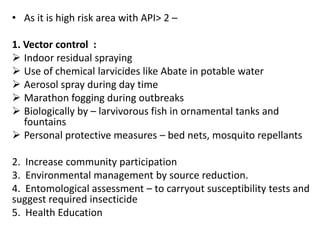
• As it is high risk area with API> 2 –
1. Vector control :
 Indoor residual spraying
 Use of chemical larvicides like Abate in potable water
 Aerosol spray during day time
 Marathon fogging during outbreaks
 Biologically by – larvivorous fish in ornamental tanks and
fountains
 Personal protective measures – bed nets, mosquito repellants
2. Increase community participation
3. Environmental management by source reduction.
4. Entomological assessment – to carryout susceptibility tests and
suggest required insecticide
5. Health Education
Question 5
Shadan Institute of Medical Sciences, Department of SPM
Genezens 2k15: www.genezens.weebly.com
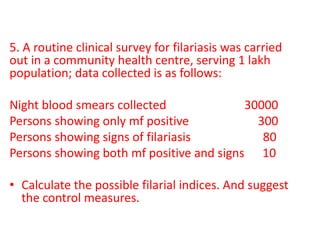
5. A routine clinical survey for filariasis was carried
out in a community health centre, serving 1 lakh
population; data collected is as follows:
Night blood smears collected 30000
Persons showing only mf positive 300
Persons showing signs of filariasis 80
Persons showing both mf positive and signs 10
• Calculate the possible filarial indices. And suggest
the control measures.
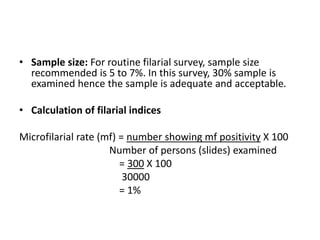
• Sample size: For routine filarial survey, sample size
recommended is 5 to 7%. In this survey, 30% sample is
examined hence the sample is adequate and acceptable.
• Calculation of filarial indices
Microfilarial rate (mf) = number showing mf positivity X 100
Number of persons (slides) examined
= 300 X 100
30000
= 1%
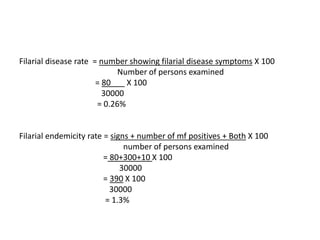
Filarial disease rate = number showing filarial disease symptoms X 100
Number of persons examined
= 80 X 100
30000
= 0.26%
Filarial endemicity rate = signs + number of mf positives + Both X 100
number of persons examined
= 80+300+10 X 100
30000
= 390 X 100
30000
= 1.3%
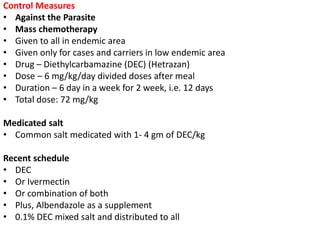
Control Measures
• Against the Parasite
• Mass chemotherapy
• Given to all in endemic area
• Given only for cases and carriers in low endemic area
• Drug – Diethylcarbamazine (DEC) (Hetrazan)
• Dose – 6 mg/kg/day divided doses after meal
• Duration – 6 day in a week for 2 week, i.e. 12 days
• Total dose: 72 mg/kg
Medicated salt
• Common salt medicated with 1- 4 gm of DEC/kg
Recent schedule
• DEC
• Or Ivermectin
• Or combination of both
• Plus, Albendazole as a supplement
• 0.1% DEC mixed salt and distributed to all
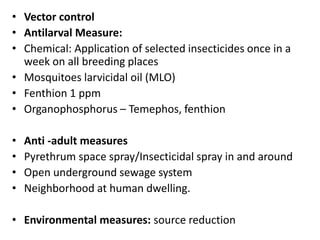
• Vector control
• Antilarval Measure:
• Chemical: Application of selected insecticides once in a
week on all breeding places
• Mosquitoes larvicidal oil (MLO)
• Fenthion 1 ppm
• Organophosphorus – Temephos, fenthion
• Anti -adult measures
• Pyrethrum space spray/Insecticidal spray in and around
• Open underground sewage system
• Neighborhood at human dwelling.
• Environmental measures: source reduction
• Integrated vector control
• Personal prophylaxis
• Other measures
Maintenance of local hygiene of affected organ (leg)
Primary health care approach
• Periodic night blood examination
• Blood examination: by taking capillary blood by
deep finger prick between 8.30 pm to 12 mid night.
• Health education: dynamic health education,
campaign is organized to motivate the people, to co-
operate in anti- filarial activities and to take
complete treatment.
• Surveillance
Question 6
Shadan Institute of Medical Sciences, Department of SPM
Genezens 2k15: www.genezens.weebly.com
6. In an antenatal clinic of tertiary care hospital,
a primi aged 21 year was found HIV positive.
Her husband works as a truck driver, and is
repeatedly falling ill for the past few months.
What measures do you suggest?
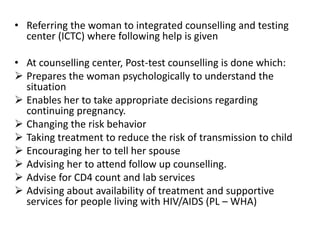
• Referring the woman to integrated counselling and testing
center (ICTC) where following help is given
• At counselling center, Post-test counselling is done which:
 Prepares the woman psychologically to understand the
situation
 Enables her to take appropriate decisions regarding
continuing pregnancy.
 Changing the risk behavior
 Taking treatment to reduce the risk of transmission to child
 Encouraging her to tell her spouse
 Advising her to attend follow up counselling.
 Advise for CD4 count and lab services
 Advising about availability of treatment and supportive
services for people living with HIV/AIDS (PL – WHA)
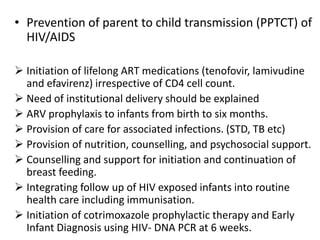
• Prevention of parent to child transmission (PPTCT) of
HIV/AIDS
 Initiation of lifelong ART medications (tenofovir, lamivudine
and efavirenz) irrespective of CD4 cell count.
 Need of institutional delivery should be explained
 ARV prophylaxis to infants from birth to six months.
 Provision of care for associated infections. (STD, TB etc)
 Provision of nutrition, counselling, and psychosocial support.
 Counselling and support for initiation and continuation of
breast feeding.
 Integrating follow up of HIV exposed infants into routine
health care including immunisation.
 Initiation of cotrimoxazole prophylactic therapy and Early
Infant Diagnosis using HIV- DNA PCR at 6 weeks.
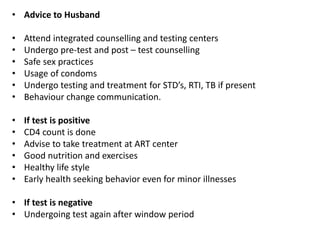
• Advice to Husband
• Attend integrated counselling and testing centers
• Undergo pre-test and post – test counselling
• Safe sex practices
• Usage of condoms
• Undergo testing and treatment for STD’s, RTI, TB if present
• Behaviour change communication.
• If test is positive
• CD4 count is done
• Advise to take treatment at ART center
• Good nutrition and exercises
• Healthy life style
• Early health seeking behavior even for minor illnesses
• If test is negative
• Undergoing test again after window period
Question 7
Shadan Institute of Medical Sciences, Department of SPM
Genezens 2k15: www.genezens.weebly.com
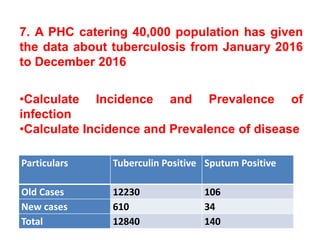
Particulars Tuberculin Positive Sputum Positive
Old Cases 12230 106
New cases 610 34
Total 12840 140
7. A PHC catering 40,000 population has given
the data about tuberculosis from January 2016
to December 2016
•Calculate Incidence and Prevalence of
infection
•Calculate Incidence and Prevalence of disease
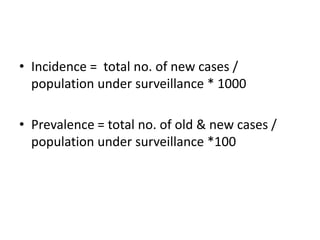
• Incidence = total no. of new cases /
population under surveillance * 1000
• Prevalence = total no. of old & new cases /
population under surveillance *100
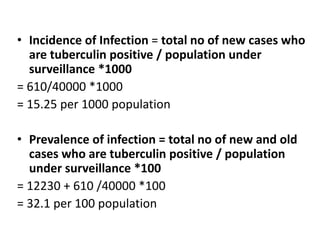
• Incidence of Infection = total no of new cases who
are tuberculin positive / population under
surveillance *1000
= 610/40000 *1000
= 15.25 per 1000 population
• Prevalence of infection = total no of new and old
cases who are tuberculin positive / population
under surveillance *100
= 12230 + 610 /40000 *100
= 32.1 per 100 population
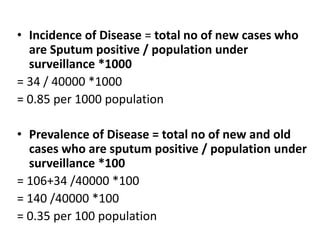
• Incidence of Disease = total no of new cases who
are Sputum positive / population under
surveillance *1000
= 34 / 40000 *1000
= 0.85 per 1000 population
• Prevalence of Disease = total no of new and old
cases who are sputum positive / population under
surveillance *100
= 106+34 /40000 *100
= 140 /40000 *100
= 0.35 per 100 population
Question 8
Shadan Institute of Medical Sciences, Department of SPM
Genezens 2k15: www.genezens.weebly.com
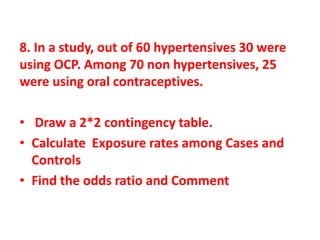
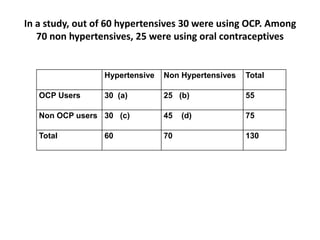
8. In a study, out of 60 hypertensives 30 were
using OCP. Among 70 non hypertensives, 25
were using oral contraceptives.
• Draw a 2*2 contingency table.
• Calculate Exposure rates among Cases and
Controls
• Find the odds ratio and Comment
In a study, out of 60 hypertensives 30 were using OCP. Among
70 non hypertensives, 25 were using oral contraceptives
Hypertensive Non Hypertensives Total
OCP Users 30 (a) 25 (b) 55
Non OCP users 30 (c) 45 (d) 75
Total 60 70 130
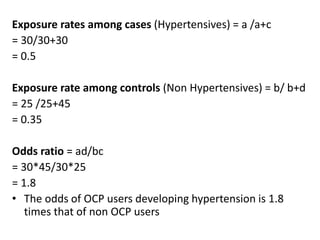
Exposure rates among cases (Hypertensives) = a /a+c
= 30/30+30
= 0.5
Exposure rate among controls (Non Hypertensives) = b/ b+d
= 25 /25+45
= 0.35
Odds ratio = ad/bc
= 30*45/30*25
= 1.8
• The odds of OCP users developing hypertension is 1.8
times that of non OCP users
Question 9
Shadan Institute of Medical Sciences, Department of SPM
Genezens 2k15: www.genezens.weebly.com
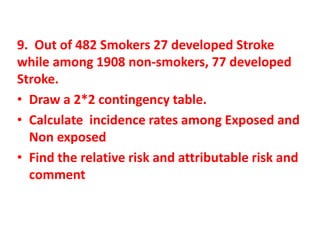
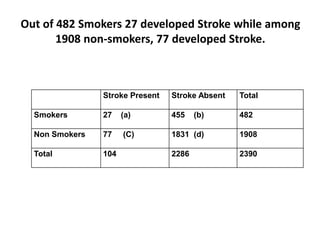
9. Out of 482 Smokers 27 developed Stroke
while among 1908 non-smokers, 77 developed
Stroke.
• Draw a 2*2 contingency table.
• Calculate incidence rates among Exposed and
Non exposed
• Find the relative risk and attributable risk and
comment
Out of 482 Smokers 27 developed Stroke while among
1908 non-smokers, 77 developed Stroke.
Stroke Present Stroke Absent Total
Smokers 27 (a) 455 (b) 482
Non Smokers 77 (C) 1831 (d) 1908
Total 104 2286 2390
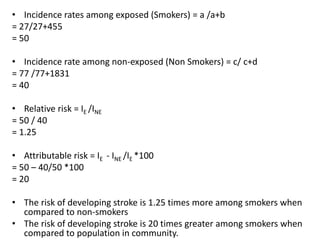
• Incidence rates among exposed (Smokers) = a /a+b
= 27/27+455
= 50
• Incidence rate among non-exposed (Non Smokers) = c/ c+d
= 77 /77+1831
= 40
• Relative risk = IE /INE
= 50 / 40
= 1.25
• Attributable risk = IE - INE /IE *100
= 50 – 40/50 *100
= 20
• The risk of developing stroke is 1.25 times more among smokers when
compared to non-smokers
• The risk of developing stroke is 20 times greater among smokers when
compared to population in community.
Question 10
Shadan Institute of Medical Sciences, Department of SPM
Genezens 2k15: www.genezens.weebly.com
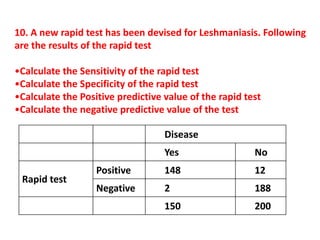
Disease
Yes No
Rapid test
Positive 148 12
Negative 2 188
150 200
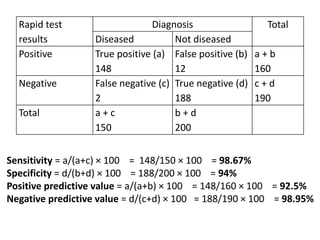
10. A new rapid test has been devised for Leshmaniasis. Following
are the results of the rapid test
•Calculate the Sensitivity of the rapid test
•Calculate the Specificity of the rapid test
•Calculate the Positive predictive value of the rapid test
•Calculate the negative predictive value of the test
Rapid test
results
Diagnosis Total
Diseased Not diseased
Positive True positive (a)
148
False positive (b)
12
a + b
160
Negative False negative (c)
2
True negative (d)
188
c + d
190
Total a + c
150
b + d
200
Sensitivity = a/(a+c) × 100 = 148/150 × 100 = 98.67%
Specificity = d/(b+d) × 100 = 188/200 × 100 = 94%
Positive predictive value = a/(a+b) × 100 = 148/160 × 100 = 92.5%
Negative predictive value = d/(c+d) × 100 = 188/190 × 100 = 98.95%

Epidemiological Exercises: Q1 to Q10

  • 1.
    Shadan Institute ofMedical Sciences Department of SPM Genezens 2k15 www.genezens.weebly.com
  • 2.
    Horrock’s Test Shadan Instituteof Medical Sciences, Department of SPM Genezens 2k15: www.genezens.weebly.com
  • 3.
    Finding the bleachingpowder demand by Horrocks test • Horrocks apparatus is devised to find bleaching powder requirement to disinfect 100 gallon (455 litre) of water. • Contents of Horrocks apparatus. 1 black cup- 240ml 1 pipette 6 white cups of 200ml each 2 metal spoon- 2gm each 7 stirring rods- 1 for each cup 2 droppers Indicator: starch- iodine solution* *Starch- iodine solution: 1.5gm starch is added to 100ml distilled water. Boiled and cooled. 7.5gm cadmium iodide or potassium iodide is added.
  • 4.
    • Procedure: • With2gm ( 1 level spoon) of bleaching powder and little water, thin paste is made in the black cup. • More water is added to the black cup upto the circular mark, vigorous stirring is done and allowed to settle. This is ‘stock solution’ or ‘mother solution’. • All 6 white cups are arranged in order. Water to be tested is filled, upto a cm below the brim in all 6 cups. • With pipette stock solution is added to white cups- 1 drop to first cup, 2 drops to second cup, 3 drops to third cup and so on. One drop represents one part of chlorine in a million part of water. • Water in all 6 cups is stirred well by using separate glass rod.
  • 5.
    • Cups areleft undisturbed for half an hour for bleaching powder action, i.e. liberation of free chlorine. • Three drops of freshly prepared starch-iodine indicator is added to all white cups by dropper and stirred again. • Development of blue colour indicates the presence of free residual chlorine. • Note the first cup showing blue colour. • 5th cup is the first cup showing blue colour, 5 level spoon, i.e. 5 x 2= 10gm of bleaching powder is required to disinfect 100 gallon (455 liter) of water.
  • 6.
    • Principle: • Indicatorcontains potassium iodide + starch + NaCl • Free chlorine reacts with potassium iodide: iodine is left free which reacts with starch and gives blue colour.
  • 7.
    Step 2: Findingthe quantity of bleaching powder requirement • 5th cup is the earliest cup showing blue colour in Horrocks test indicates that 5 level spoon (5 x 2)= 10gm of bleaching powder is required to disinfect 455 liter of water. 455 liter of water requires- 10gm of bleaching powder For 45,500 liter- how much bleaching powder is required? = 10/ 455 x 45500 = 455000/455 = 1000gm ( 1 kg) 1 kg bleaching powder is required to disinfect the tank water.
  • 8.
    Question 1 Shadan Instituteof Medical Sciences, Department of SPM Genezens 2k15: www.genezens.weebly.com
  • 9.
    1. A circularwell of 10 meter diameter with 15 meter depth of water is to be chlorinated. Horrock’s test shows blue colour in 3rd cup onwards. • Calculate the quantity of bleaching powder (CaOCl2) required to disinfect the well? • Explain the procedure of well disinfection?
  • 10.
    Step 1: findingthe volume of well water Volume of water in the circular well = π x r 2x h x 1000 Where, π = 22/7 =3.14 r= radius = 5 mt ( half of the diameter ) h= height = 15 mt water column 1000 = volume of water per 1 m3 = π x r2 x h x 1000 = 3.14 x 5 x 5 x 15 x 1000 = 3.14 x 25 x 15 x 1000 = 1,177,500 • Volume of water in the well is = 1,177,500 liter
  • 11.
    • Step 2:Finding the amount of bleaching powder requirement 3rd cup is the earliest cup showing blue colour 3rd cup means – 3 level spoon (3 x 2 gm) = 6 gm of bleaching powder is required to disinfect 455 liter of water. • 455 liter of water requires – 6 gm of bleaching powder • For 1177500 liter- how much bleaching powder is required? = 6/ 455 x 1177500 = 7065000/ 455 = 15,527.5 gm (roughly 15.5 kg) 15 kg 527 gm ( to round up 15.5 kg) of bleaching powder is required to disinfect the well water.
  • 12.
    • Step 3:well disinfection procedure • Required amount of bleaching powder is mixed with little water in a bucket ( not more than 100gm at a time) to make thin paste. • 3/4th of the same bucket is filled with water, stirred well, allowed 10 min for sedimentation. • Supernatant clear chlorine solution is transferred to another bucket; lime sediment is discarded. Not poured into the well because sediment increases hardness of water. • Bucket is lowered into the well below the water level. • Well water is violently agitated by lowering and drawing movements for homogenous mixing of chlorine solution in water. • This completes chlorination of well.
  • 13.
    • Residual chlorineshould be tested after half an hour, by orthotolidine arsenite test. It should be atleast 0.5 mg/ liter. • Subsequent to chlorination, well water is used only after a contact period of 1 hour. • Wells are best disinfected once in a week at night. • During epidemics wells should be disinfected every day.
  • 14.
    Question 2 Shadan Instituteof Medical Sciences, Department of SPM Genezens 2k15: www.genezens.weebly.com
  • 15.
    2. A swimmingpool having 100 meter length, 60 meter breadth, with 10 meter depth of water is to be disinfected. • Calculate the amount of bleaching powder required to disinfect the swimming pool. Horrocks test shows blue colour in 4th cup. • What measures you advice for swimming pool sanitation.
  • 16.
    Step 1: Findingthe volume of water in the swimming pool Volume of water in swimming pool= L x b x h x 1000 Where, L = length= 100 mt b= breadth = 60 mt h= height = 10 mt 1000 = volume of water per 1 m3 = 100 x 60 x 10 x 1000 = 60,000,000 Volume of water in the swimming pool is 60,000,000 liter.
  • 17.
    Step 2: Findingthe amount of bleaching powder requirement • 4th cup is the earliest cup showing blue colour in Horrocks test indicates that, 4 level spoon ( 4 x 2 ) = 8 gm of bleaching powder is required to disinfect 455 liter of water. 455 liter of water requires – 8 gm of bleaching powder For 60,000,000 liter – how much bleaching powder is required? = 8/ 455 x 60000000 = 480000000/455 = 1,054,945 gm • 1054 kg 945 gm ( roughly 1055 kg ) bleaching powder is required to disinfect the swimming pool.
  • 18.
    Step 3: Maintainingswimming pool sanitation • People suffering from skin disease, sore eye, nasal or ear discharge, upper respiratory, GI infections and any communicable disease should not be allowed to swim. • Swimmers are instructed to empty the bladder, bowel and to take shower bath before entering the pool. • They should not spit, blow the nose, urinate or defecate in the pool. • Surrounding environment of the pool should be maintained well. • Pool is cleaned once in 15 days. Water is changed frequently or best subjected for continuous purification • Pool water is frequently tested for any contamination. • 25 sqft area is provided per swimmer.
  • 19.
    Question 3 Shadan Instituteof Medical Sciences, Department of SPM Genezens 2k15: www.genezens.weebly.com
  • 20.
    3. During theyear 2012, Narsingi primary health centre covering 30,000 population had collected 4,000 peripheral smears by house to house visit. Another 400 slides were collected in the OPD. Results of the microscopic examination of these slides are given to you Plasmodium vivax positive 41 Plasmodium falciparum positive 9 Total positive 50 • Calculate the possible malarial Indices and suggest the remedial measures in brief.
  • 21.
    Malarial parameters Annual parasiteincidence (API) = confirmed cases in one year x 1000 Population under surveillance = 50 x 1000 30,000 = 1.6 per thousand population Annual falciparum incidence(AFI) = number of cases due to falciparum X 1000 Population under surveillance = 9 X 1000 30000 = 0.3 per 1000 population
  • 22.
    Annual blood examinationrate (ABER) = number of slides examined X 100 Population Under surveillance = 4400 X 100 30000 = 14.6 % Slide positivity rate (SPR) = number of slides positive for malaria X 100 Number of slides examined = 50 X 100 4400 = 1.13%
  • 23.
    Slide falciparum rate(SFR) = number of slides positive for P.falciparum X 100 Number of slides examined = 9 X 100 4400 = 0.20%
  • 24.
    • Control Measures •Narsingi PHC can be classified as area with API less than 2 • According to modified plan of operation (MPO) measures required are: • Focal spraying in and around P. falciparum detected house. • Active and passive surveillance (once in 15 days) • Mass blood survey of people living around patients’ home • Treatment: Prompt treatment is given to all detected cases. • Follow up: After completion of radical treatment, monthly blood examination should be carried out for 12 months • Epidemiological investigation: All positive cases are to be investigated.
  • 25.
    Question 4 Shadan Instituteof Medical Sciences, Department of SPM Genezens 2k15: www.genezens.weebly.com
  • 26.
    4. In theyear 2011, API of a tribal district was 3/1000. Falciparum malaria cases had been reported with 10 deaths. How will you strengthen the surveillance and containment of malaria in that area?
  • 27.
    • Early diagnosis& radical treatment • Case based surveillance & rapid response • Integrated vector management  Indoor residual spraying  Long lasting insecticidal nets / insecticide treated bed nets  Larval source management • Epidemic preparedness and early response • Monitoring & evaluation • Advocacy, coordination & partnerships • Behaviour change communication and community mobilization. • Programme planning and management.
  • 28.
    Usually malaria surveillanceis done by: • Active case finding • Passive case finding • Rapid fever survey • Mass fever survey
  • 29.
    Active case finding: •Carried out by multipurpose health workers working under PHC. • Every fortnight periodicity of house to house visits. • Fortnight visits are done to catch most of secondary cases. • Search for all fever cases. • If cases have fever – collect blood films (thick and thin on same slide) • If cases are positive for malaria, radical treatment is provided. Passive surveillance : • All the fever cases attending hospitals are screened for malaria and treated accordingly. • Medical officer with the help of PHC staff should carry out mapping of private clinics, under guidance of district malaria officer. • Various malaria clinics are to be established in all health institutions in high risk areas. • MPHW male should contact all fever treatment dispensaries for drug replacement (fortnightly)
  • 30.
    Rapid fever survey: •House to house visits are undertaken and all fever cases screened by blood smears. • Blood smears are to be examined at earliest in the temporary field lab at village level Mass survey: • Carried out for entire population in suspected epidemic zone.
  • 31.
    • As itis high risk area with API> 2 – 1. Vector control :  Indoor residual spraying  Use of chemical larvicides like Abate in potable water  Aerosol spray during day time  Marathon fogging during outbreaks  Biologically by – larvivorous fish in ornamental tanks and fountains  Personal protective measures – bed nets, mosquito repellants 2. Increase community participation 3. Environmental management by source reduction. 4. Entomological assessment – to carryout susceptibility tests and suggest required insecticide 5. Health Education
  • 32.
    Question 5 Shadan Instituteof Medical Sciences, Department of SPM Genezens 2k15: www.genezens.weebly.com
  • 33.
    5. A routineclinical survey for filariasis was carried out in a community health centre, serving 1 lakh population; data collected is as follows: Night blood smears collected 30000 Persons showing only mf positive 300 Persons showing signs of filariasis 80 Persons showing both mf positive and signs 10 • Calculate the possible filarial indices. And suggest the control measures.
  • 34.
    • Sample size:For routine filarial survey, sample size recommended is 5 to 7%. In this survey, 30% sample is examined hence the sample is adequate and acceptable. • Calculation of filarial indices Microfilarial rate (mf) = number showing mf positivity X 100 Number of persons (slides) examined = 300 X 100 30000 = 1%
  • 35.
    Filarial disease rate= number showing filarial disease symptoms X 100 Number of persons examined = 80 X 100 30000 = 0.26% Filarial endemicity rate = signs + number of mf positives + Both X 100 number of persons examined = 80+300+10 X 100 30000 = 390 X 100 30000 = 1.3%
  • 36.
    Control Measures • Againstthe Parasite • Mass chemotherapy • Given to all in endemic area • Given only for cases and carriers in low endemic area • Drug – Diethylcarbamazine (DEC) (Hetrazan) • Dose – 6 mg/kg/day divided doses after meal • Duration – 6 day in a week for 2 week, i.e. 12 days • Total dose: 72 mg/kg Medicated salt • Common salt medicated with 1- 4 gm of DEC/kg Recent schedule • DEC • Or Ivermectin • Or combination of both • Plus, Albendazole as a supplement • 0.1% DEC mixed salt and distributed to all
  • 37.
    • Vector control •Antilarval Measure: • Chemical: Application of selected insecticides once in a week on all breeding places • Mosquitoes larvicidal oil (MLO) • Fenthion 1 ppm • Organophosphorus – Temephos, fenthion • Anti -adult measures • Pyrethrum space spray/Insecticidal spray in and around • Open underground sewage system • Neighborhood at human dwelling. • Environmental measures: source reduction
  • 38.
    • Integrated vectorcontrol • Personal prophylaxis • Other measures Maintenance of local hygiene of affected organ (leg) Primary health care approach • Periodic night blood examination • Blood examination: by taking capillary blood by deep finger prick between 8.30 pm to 12 mid night. • Health education: dynamic health education, campaign is organized to motivate the people, to co- operate in anti- filarial activities and to take complete treatment. • Surveillance
  • 39.
    Question 6 Shadan Instituteof Medical Sciences, Department of SPM Genezens 2k15: www.genezens.weebly.com
  • 40.
    6. In anantenatal clinic of tertiary care hospital, a primi aged 21 year was found HIV positive. Her husband works as a truck driver, and is repeatedly falling ill for the past few months. What measures do you suggest?
  • 41.
    • Referring thewoman to integrated counselling and testing center (ICTC) where following help is given • At counselling center, Post-test counselling is done which:  Prepares the woman psychologically to understand the situation  Enables her to take appropriate decisions regarding continuing pregnancy.  Changing the risk behavior  Taking treatment to reduce the risk of transmission to child  Encouraging her to tell her spouse  Advising her to attend follow up counselling.  Advise for CD4 count and lab services  Advising about availability of treatment and supportive services for people living with HIV/AIDS (PL – WHA)
  • 42.
    • Prevention ofparent to child transmission (PPTCT) of HIV/AIDS  Initiation of lifelong ART medications (tenofovir, lamivudine and efavirenz) irrespective of CD4 cell count.  Need of institutional delivery should be explained  ARV prophylaxis to infants from birth to six months.  Provision of care for associated infections. (STD, TB etc)  Provision of nutrition, counselling, and psychosocial support.  Counselling and support for initiation and continuation of breast feeding.  Integrating follow up of HIV exposed infants into routine health care including immunisation.  Initiation of cotrimoxazole prophylactic therapy and Early Infant Diagnosis using HIV- DNA PCR at 6 weeks.
  • 43.
    • Advice toHusband • Attend integrated counselling and testing centers • Undergo pre-test and post – test counselling • Safe sex practices • Usage of condoms • Undergo testing and treatment for STD’s, RTI, TB if present • Behaviour change communication. • If test is positive • CD4 count is done • Advise to take treatment at ART center • Good nutrition and exercises • Healthy life style • Early health seeking behavior even for minor illnesses • If test is negative • Undergoing test again after window period
  • 44.
    Question 7 Shadan Instituteof Medical Sciences, Department of SPM Genezens 2k15: www.genezens.weebly.com
  • 45.
    Particulars Tuberculin PositiveSputum Positive Old Cases 12230 106 New cases 610 34 Total 12840 140 7. A PHC catering 40,000 population has given the data about tuberculosis from January 2016 to December 2016 •Calculate Incidence and Prevalence of infection •Calculate Incidence and Prevalence of disease
  • 46.
    • Incidence =total no. of new cases / population under surveillance * 1000 • Prevalence = total no. of old & new cases / population under surveillance *100
  • 47.
    • Incidence ofInfection = total no of new cases who are tuberculin positive / population under surveillance *1000 = 610/40000 *1000 = 15.25 per 1000 population • Prevalence of infection = total no of new and old cases who are tuberculin positive / population under surveillance *100 = 12230 + 610 /40000 *100 = 32.1 per 100 population
  • 48.
    • Incidence ofDisease = total no of new cases who are Sputum positive / population under surveillance *1000 = 34 / 40000 *1000 = 0.85 per 1000 population • Prevalence of Disease = total no of new and old cases who are sputum positive / population under surveillance *100 = 106+34 /40000 *100 = 140 /40000 *100 = 0.35 per 100 population
  • 49.
    Question 8 Shadan Instituteof Medical Sciences, Department of SPM Genezens 2k15: www.genezens.weebly.com
  • 50.
    8. In astudy, out of 60 hypertensives 30 were using OCP. Among 70 non hypertensives, 25 were using oral contraceptives. • Draw a 2*2 contingency table. • Calculate Exposure rates among Cases and Controls • Find the odds ratio and Comment
  • 51.
    In a study,out of 60 hypertensives 30 were using OCP. Among 70 non hypertensives, 25 were using oral contraceptives Hypertensive Non Hypertensives Total OCP Users 30 (a) 25 (b) 55 Non OCP users 30 (c) 45 (d) 75 Total 60 70 130
  • 52.
    Exposure rates amongcases (Hypertensives) = a /a+c = 30/30+30 = 0.5 Exposure rate among controls (Non Hypertensives) = b/ b+d = 25 /25+45 = 0.35 Odds ratio = ad/bc = 30*45/30*25 = 1.8 • The odds of OCP users developing hypertension is 1.8 times that of non OCP users
  • 53.
    Question 9 Shadan Instituteof Medical Sciences, Department of SPM Genezens 2k15: www.genezens.weebly.com
  • 54.
    9. Out of482 Smokers 27 developed Stroke while among 1908 non-smokers, 77 developed Stroke. • Draw a 2*2 contingency table. • Calculate incidence rates among Exposed and Non exposed • Find the relative risk and attributable risk and comment
  • 55.
    Out of 482Smokers 27 developed Stroke while among 1908 non-smokers, 77 developed Stroke. Stroke Present Stroke Absent Total Smokers 27 (a) 455 (b) 482 Non Smokers 77 (C) 1831 (d) 1908 Total 104 2286 2390
  • 56.
    • Incidence ratesamong exposed (Smokers) = a /a+b = 27/27+455 = 50 • Incidence rate among non-exposed (Non Smokers) = c/ c+d = 77 /77+1831 = 40 • Relative risk = IE /INE = 50 / 40 = 1.25 • Attributable risk = IE - INE /IE *100 = 50 – 40/50 *100 = 20 • The risk of developing stroke is 1.25 times more among smokers when compared to non-smokers • The risk of developing stroke is 20 times greater among smokers when compared to population in community.
  • 57.
    Question 10 Shadan Instituteof Medical Sciences, Department of SPM Genezens 2k15: www.genezens.weebly.com
  • 58.
    Disease Yes No Rapid test Positive148 12 Negative 2 188 150 200 10. A new rapid test has been devised for Leshmaniasis. Following are the results of the rapid test •Calculate the Sensitivity of the rapid test •Calculate the Specificity of the rapid test •Calculate the Positive predictive value of the rapid test •Calculate the negative predictive value of the test
  • 59.
    Rapid test results Diagnosis Total DiseasedNot diseased Positive True positive (a) 148 False positive (b) 12 a + b 160 Negative False negative (c) 2 True negative (d) 188 c + d 190 Total a + c 150 b + d 200 Sensitivity = a/(a+c) × 100 = 148/150 × 100 = 98.67% Specificity = d/(b+d) × 100 = 188/200 × 100 = 94% Positive predictive value = a/(a+b) × 100 = 148/160 × 100 = 92.5% Negative predictive value = d/(c+d) × 100 = 188/190 × 100 = 98.95%