Computation Techniques for Maclaurin Expansions
Direct computation of the Mac–series can be messy
via derivatives.
Computation Techniques for Maclaurin Expansions
Direct computation of the Mac–series can be messy
via derivatives. In this section we show some of the
algebraic techniques for computing the Mac–series.
Computation Techniques for Maclaurin Expansions
Direct computation of the Mac–series can be messy
via derivatives. In this section we show some of the
algebraic techniques for computing the Mac–series.
Theorem: Let F(x) and G(x) be the Mac–series of
f(x) and and g(x) respectively.
Computation Techniques for Maclaurin Expansions
Direct computation of the Mac–series can be messy
via derivatives. In this section we show some of the
algebraic techniques for computing the Mac–series.
Theorem: Let F(x) and G(x) be the Mac–series of
f(x) and and g(x) respectively.
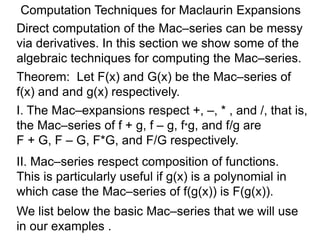
I. The Mac–expansions respect +, –, * , and /, that is,
the Mac–series of f + g, f – g, f*g, and f/g are
F + G, F – G, F*G, and F/G respectively.
Computation Techniques for Maclaurin Expansions
Direct computation of the Mac–series can be messy
via derivatives. In this section we show some of the
algebraic techniques for computing the Mac–series.
Theorem: Let F(x) and G(x) be the Mac–series of
f(x) and and g(x) respectively.
I. The Mac–expansions respect +, –, * , and /, that is,
the Mac–series of f + g, f – g, f*g, and f/g are
F + G, F – G, F*G, and F/G respectively.
II. Mac–series respect composition of functions.
This is particularly useful if g(x) is a polynomial in
which case the Mac–series of f(g(x)) is F(g(x)).
Computation Techniques for Maclaurin Expansions
Direct computation of the Mac–series can be messy
via derivatives. In this section we show some of the
algebraic techniques for computing the Mac–series.
Theorem: Let F(x) and G(x) be the Mac–series of
f(x) and and g(x) respectively.
I. The Mac–expansions respect +, –, * , and /, that is,
the Mac–series of f + g, f – g, f*g, and f/g are
F + G, F – G, F*G, and F/G respectively.
II. Mac–series respect composition of functions.
This is particularly useful if g(x) is a polynomial in
which case the Mac–series of f(g(x)) is F(g(x)).
We list below the basic Mac–series that we will use
in our examples .
Summary of the Mac–series
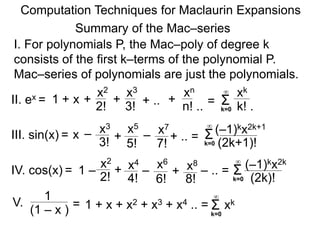
I. For polynomials P, the Mac–poly of degree k
consists of the first k–terms of the polynomial P.
Mac–series of polynomials are just the polynomials.
II. ex = Σk=0 k! .
xk∞
x +
2!
1 +
x2
+ .. ++
3!
x3
n! ..
xn
=
Σk=0 (2k+1)!
(–1)kx2k+1∞
x –
3!
x3
+
5!
x5
+ .. =
7!
x7
–III. sin(x) =
IV. cos(x) = Σk=0 (2k)!
(–1)kx2k∞
+
4!
x4
6!
x6
8!
x8
+1 – – – .. =
2!
x2
V.
(1 – x )
1
1 + x + x2 + x3 + x4 .. = Σk=0
∞
xk
Computation Techniques for Maclaurin Expansions
=
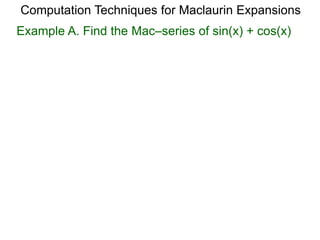
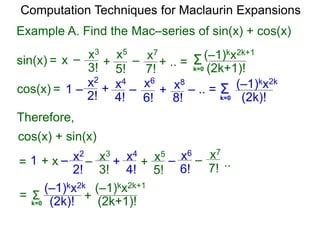
Example A. Find the Mac–series of sin(x) + cos(x)
Computation Techniques for Maclaurin Expansions
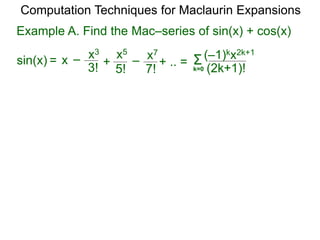
Example A. Find the Mac–series of sin(x) + cos(x)
Computation Techniques for Maclaurin Expansions
Σk=0 (2k+1)!
(–1)kx2k+1
x –
3!
x3
+
5!
x5
+ .. =
7!
x7
–sin(x) =
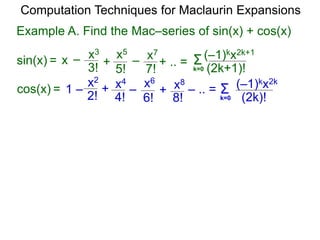
Example A. Find the Mac–series of sin(x) + cos(x)
Computation Techniques for Maclaurin Expansions
Σk=0 (2k+1)!
(–1)kx2k+1
x –
3!
x3
+
5!
x5
+ .. =
7!
x7
–sin(x) =
cos(x) = Σ
(2k)!
(–1)kx2k
+
4!
x4
6!
x6
8!
x8
+1 – – – .. =
2!
x2
k=0
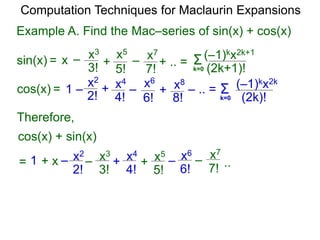
Example A. Find the Mac–series of sin(x) + cos(x)
Computation Techniques for Maclaurin Expansions
Therefore,
cos(x) + sin(x)
1 + x –
2!
x2
–
3!
x3
+
4!
x4
+
5!
x5
6!
x6
–
7!
x7
– ..
Σk=0 (2k+1)!
(–1)kx2k+1
x –
3!
x3
+
5!
x5
+ .. =
7!
x7
–sin(x) =
cos(x) = Σk=0 (2k)!
(–1)kx2k
+
4!
x4
6!
x6
8!
x8
+1 – – – .. =
2!
x2
=
Example A. Find the Mac–series of sin(x) + cos(x)
Computation Techniques for Maclaurin Expansions
Therefore,
cos(x) + sin(x)
1 + x –
2!
x2
–
3!
x3
+
4!
x4
+
5!
x5
6!
x6
–
7!
x7
– ..
Σk=0 (2k+1)!
(–1)kx2k+1
x –
3!
x3
+
5!
x5
+ .. =
7!
x7
–sin(x) =
cos(x) = Σk=0 (2k)!
(–1)kx2k
+
4!
x4
6!
x6
8!
x8
+1 – – – .. =
2!
x2
= Σk=0 (2k+1)!
(–1)kx2k+1
+(2k)!
(–1)kx2k
=
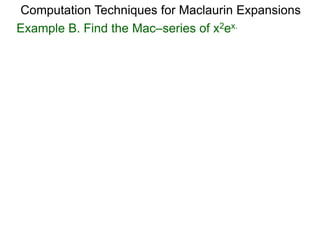
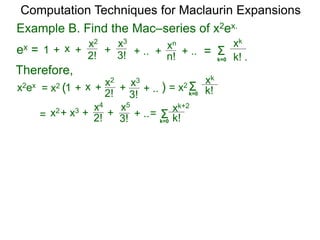
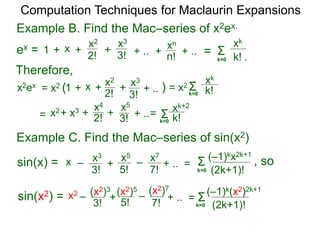
Example B. Find the Mac–series of x2ex.
Computation Techniques for Maclaurin Expansions
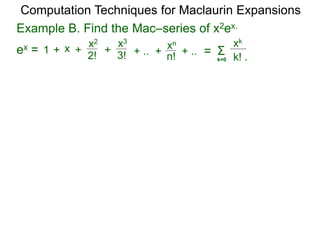
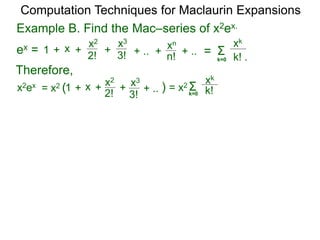
Example B. Find the Mac–series of x2ex.
Computation Techniques for Maclaurin Expansions
ex = Σ
k=0 k! .
xk
x +
2!
1 +
x2
+ .. ++
3!
x3
n!
xn
=+ ..
Example B. Find the Mac–series of x2ex.
Computation Techniques for Maclaurin Expansions
ex = Σ
k=0 k! .
xk
x +
2!
1 +
x2
+ .. ++
3!
x3
n!
xn
=+ ..
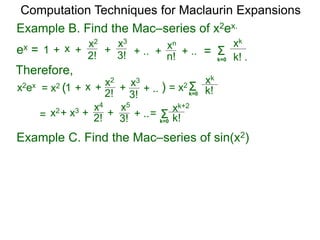
Therefore,
x2ex = x2 Σk=0 k!
xk
x +
2!
1 +
x2
+ ..+
3!
x3
)= x2 (
Example B. Find the Mac–series of x2ex.
Computation Techniques for Maclaurin Expansions
ex = Σ
k=0 k! .
xk
x +
2!
1 +
x2
+ .. ++
3!
x3
n!
xn
=+ ..
Therefore,
x2ex = x2
+ 2!x2+ x3 x4
+ ..+
3!
x5
Σk=0 k!
xk+2
=
Σk=0 k!
xk
=
x +
2!
1 +
x2
+ ..+
3!
x3
)= x2 (
Example B. Find the Mac–series of x2ex.
Computation Techniques for Maclaurin Expansions
ex = Σ
k=0 k! .
xk
x +
2!
1 +
x2
+ .. ++
3!
x3
n!
xn
=+ ..
Therefore,
x2ex = x2
+ 2!x2+ x3 x4
+ ..+
3!
x5
Σk=0 k!
xk+2
=
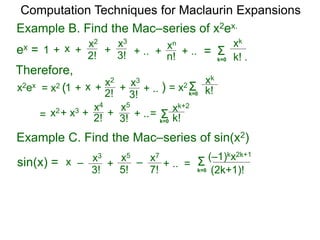
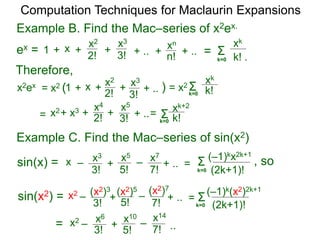
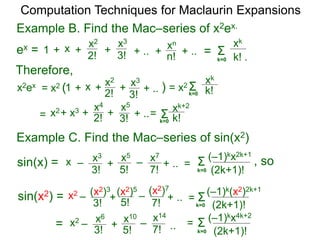
Example C. Find the Mac–series of sin(x2)
Σk=0 k!
xk
=
x +
2!
1 +
x2
+ ..+
3!
x3
)= x2 (
Example B. Find the Mac–series of x2ex.
Computation Techniques for Maclaurin Expansions
ex = Σ
k=0 k! .
xk
x +
2!
1 +
x2
+ .. ++
3!
x3
n!
xn
=+ ..
Therefore,
x2ex = x2
+ 2!x2+ x3 x4
+ ..+
3!
x5
Σk=0 k!
xk+2
=
Example C. Find the Mac–series of sin(x2)
Σ
k=0 (2k+1)!
(–1)kx2k+1
x –
3!
x3
+
5!
x5
+ .. =
7!
x7
–sin(x) =
Σk=0 k!
xk
=
x +
2!
1 +
x2
+ ..+
3!
x3
)= x2 (
Example B. Find the Mac–series of x2ex.
Computation Techniques for Maclaurin Expansions
ex = Σ
k=0 k! .
xk
x +
2!
1 +
x2
+ .. ++
3!
x3
n!
xn
=+ ..
Therefore,
x2ex = x2
+ 2!x2+ x3 x4
+ ..+
3!
x5
Σk=0 k!
xk+2
=
Example C. Find the Mac–series of sin(x2)
Σ
k=0 (2k+1)!
(–1)kx2k+1
x –
3!
x3
+
5!
x5
+ .. =
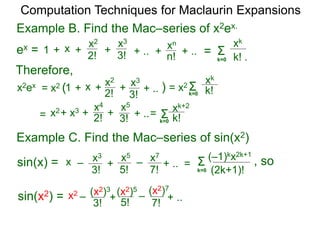
7!
x7
–sin(x) =
sin(x2) =
Σk=0 k!
xk
=
x2
–
3!
(x2)3
+ 5!
(x2)5
+ ..
7!
(x2)7
–
x +
2!
1 +
x2
+ ..+
3!
x3
)= x2 (
, so
Example B. Find the Mac–series of x2ex.
Computation Techniques for Maclaurin Expansions
ex = Σ
k=0 k! .
xk
x +
2!
1 +
x2
+ .. ++
3!
x3
n!
xn
=+ ..
Therefore,
x2ex = x2
+ 2!x2+ x3 x4
+ ..+
3!
x5
Σk=0 k!
xk+2
=
Example C. Find the Mac–series of sin(x2)
Σ
k=0 (2k+1)!
(–1)kx2k+1
x –
3!
x3
+
5!
x5
+ .. =
7!
x7
–sin(x) =
sin(x2) = = Σk=0 (2k+1)!
(–1)k(x2)2k+1
Σk=0 k!
xk
=
x2
–
3!
(x2)3
+ 5!
(x2)5
+ ..
7!
(x2)7
–
x +
2!
1 +
x2
+ ..+
3!
x3
)= x2 (
, so
Example B. Find the Mac–series of x2ex.
Computation Techniques for Maclaurin Expansions
ex = Σ
k=0 k! .
xk
x +
2!
1 +
x2
+ .. ++
3!
x3
n!
xn
=+ ..
Therefore,
x2ex = x2
+ 2!x2+ x3 x4
+ ..+
3!
x5
Σk=0 k!
xk+2
=
Example C. Find the Mac–series of sin(x2)
Σ
k=0 (2k+1)!
(–1)kx2k+1
x –
3!
x3
+
5!
x5
+ .. =
7!
x7
–sin(x) =
sin(x2) =
=
= Σk=0 (2k+1)!
(–1)k(x2)2k+1
Σk=0 k!
xk
=
x2
–
3!
(x2)3
+ 5!
(x2)5
+ ..
7!
(x2)7
–
x2
–
3!
x6
+
5!
x10
7!
x14
– ..
x +
2!
1 +
x2
+ ..+
3!
x3
)= x2 (
, so
Example B. Find the Mac–series of x2ex.
Computation Techniques for Maclaurin Expansions
ex = Σ
k=0 k! .
xk
x +
2!
1 +
x2
+ .. ++
3!
x3
n!
xn
=+ ..
Therefore,
x2ex = x2
+ 2!x2+ x3 x4
+ ..+
3!
x5
Σk=0 k!
xk+2
=
Example C. Find the Mac–series of sin(x2)
Σ
k=0 (2k+1)!
(–1)kx2k+1
x –
3!
x3
+
5!
x5
+ .. =
7!
x7
–sin(x) =
sin(x2) =
=
= Σk=0 (2k+1)!
(–1)k(x2)2k+1
= Σ
k=0 (2k+1)!
(–1)kx4k+2
Σk=0 k!
xk
=
x2
–
3!
(x2)3
+ 5!
(x2)5
+ ..
7!
(x2)7
–
x2
–
3!
x6
+
5!
x10
7!
x14
– ..
x +
2!
1 +
x2
+ ..+
3!
x3
)= x2 (
, so
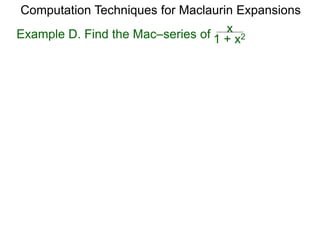
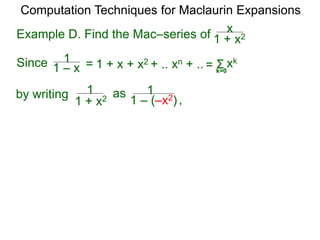
Example D. Find the Mac–series of
Computation Techniques for Maclaurin Expansions
1 + x2
x
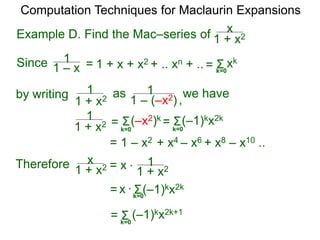
Example D. Find the Mac–series of
Computation Techniques for Maclaurin Expansions
Since = 1 + x + x2 + .. xn + .. Σ xk
=
1 + x2
x
1 – x
1
by writing
1 + x2
1 as
1 – (–x2)
1
k=0
,
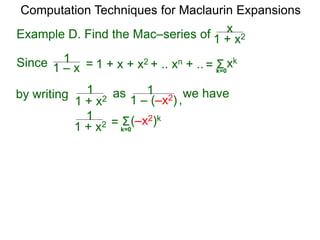
Example D. Find the Mac–series of
Computation Techniques for Maclaurin Expansions
Since = 1 + x + x2 + .. xn + .. Σ
k=0
xk
=
1 + x2
x
1 – x
1
by writing
1 + x2
1 as
1 – (–x2)
1
1 + x2
1 Σ(–x2)k
=
k=0
we have
,
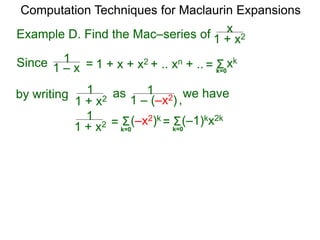
Example D. Find the Mac–series of
Computation Techniques for Maclaurin Expansions
Since = 1 + x + x2 + .. xn + .. Σ
k=0
xk
=
1 + x2
x
1 – x
1
by writing
1 + x2
1 as
1 – (–x2)
1
1 + x2
1 Σ(–x2)k
= Σ(–1)kx2k
= k=0
k=0
we have
,
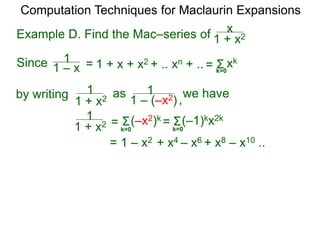
Example D. Find the Mac–series of
Computation Techniques for Maclaurin Expansions
Since = 1 + x + x2 + .. xn + .. Σ
k=0
xk
=
1 + x2
x
1 – x
1
by writing
1 + x2
1 as
1 – (–x2)
1
1 + x2
1
= 1 – x2 + x4 – x6 + x8 – x10 ..
Σ(–x2)k
= Σ(–1)kx2k
= k=0
k=0
we have
,
Example D. Find the Mac–series of
Computation Techniques for Maclaurin Expansions
Since = 1 + x + x2 + .. xn + .. Σ
k=0
xk
=
1 + x2
x
1 + x2
1
1 – x
1
by writing
1 + x2
1 as
1 – (–x2)
1
1 + x2
1
= 1 – x2 + x4 – x6 + x8 – x10 ..
Σ(–x2)k
= Σ(–1)kx2k
=
Therefore 1 + x2
x = x *
k=0
k=0
we have
,
Example D. Find the Mac–series of
Computation Techniques for Maclaurin Expansions
Since = 1 + x + x2 + .. xn + .. Σ
k=0
xk
=
1 + x2
x
= x
1 + x2
1
1 – x
1
by writing
1 + x2
1 as
1 – (–x2)
1
1 + x2
1
= 1 – x2 + x4 – x6 + x8 – x10 ..
Σ(–x2)k
= Σ
k=0
(–1)kx2k
=
Therefore 1 + x2
x = x *
Σ
k=0
(–1)kx2k
k=0
we have
*
,
Example D. Find the Mac–series of
Computation Techniques for Maclaurin Expansions
Since = 1 + x + x2 + .. xn + .. Σ
k=0
xk
=
1 + x2
x
= x
1 + x2
1
1 – x
1
by writing
1 + x2
1 as
1 – (–x2)
1
1 + x2
1
= 1 – x2 + x4 – x6 + x8 – x10 ..
Σ
k=0
(–x2)k
= Σ
k=0
(–1)kx2k
=
Therefore 1 + x2
x = x *
Σ
k=0
(–1)kx2k
Σ
k=0
(–1)kx2k+1
=
we have
*
,

30 computation techniques for maclaurin expansions x

  • 1.
    Computation Techniques forMaclaurin Expansions
  • 2.
    Computation Techniques forMaclaurin Expansions Direct computation of the Mac–series can be messy via derivatives.
  • 3.
    Computation Techniques forMaclaurin Expansions Direct computation of the Mac–series can be messy via derivatives. In this section we show some of the algebraic techniques for computing the Mac–series.
  • 4.
    Computation Techniques forMaclaurin Expansions Direct computation of the Mac–series can be messy via derivatives. In this section we show some of the algebraic techniques for computing the Mac–series. Theorem: Let F(x) and G(x) be the Mac–series of f(x) and and g(x) respectively.
  • 5.
    Computation Techniques forMaclaurin Expansions Direct computation of the Mac–series can be messy via derivatives. In this section we show some of the algebraic techniques for computing the Mac–series. Theorem: Let F(x) and G(x) be the Mac–series of f(x) and and g(x) respectively. I. The Mac–expansions respect +, –, * , and /, that is, the Mac–series of f + g, f – g, f*g, and f/g are F + G, F – G, F*G, and F/G respectively.
  • 6.
    Computation Techniques forMaclaurin Expansions Direct computation of the Mac–series can be messy via derivatives. In this section we show some of the algebraic techniques for computing the Mac–series. Theorem: Let F(x) and G(x) be the Mac–series of f(x) and and g(x) respectively. I. The Mac–expansions respect +, –, * , and /, that is, the Mac–series of f + g, f – g, f*g, and f/g are F + G, F – G, F*G, and F/G respectively. II. Mac–series respect composition of functions. This is particularly useful if g(x) is a polynomial in which case the Mac–series of f(g(x)) is F(g(x)).
  • 7.
    Computation Techniques forMaclaurin Expansions Direct computation of the Mac–series can be messy via derivatives. In this section we show some of the algebraic techniques for computing the Mac–series. Theorem: Let F(x) and G(x) be the Mac–series of f(x) and and g(x) respectively. I. The Mac–expansions respect +, –, * , and /, that is, the Mac–series of f + g, f – g, f*g, and f/g are F + G, F – G, F*G, and F/G respectively. II. Mac–series respect composition of functions. This is particularly useful if g(x) is a polynomial in which case the Mac–series of f(g(x)) is F(g(x)). We list below the basic Mac–series that we will use in our examples .
  • 8.
    Summary of theMac–series I. For polynomials P, the Mac–poly of degree k consists of the first k–terms of the polynomial P. Mac–series of polynomials are just the polynomials. II. ex = Σk=0 k! . xk∞ x + 2! 1 + x2 + .. ++ 3! x3 n! .. xn = Σk=0 (2k+1)! (–1)kx2k+1∞ x – 3! x3 + 5! x5 + .. = 7! x7 –III. sin(x) = IV. cos(x) = Σk=0 (2k)! (–1)kx2k∞ + 4! x4 6! x6 8! x8 +1 – – – .. = 2! x2 V. (1 – x ) 1 1 + x + x2 + x3 + x4 .. = Σk=0 ∞ xk Computation Techniques for Maclaurin Expansions =
  • 9.
    Example A. Findthe Mac–series of sin(x) + cos(x) Computation Techniques for Maclaurin Expansions
  • 10.
    Example A. Findthe Mac–series of sin(x) + cos(x) Computation Techniques for Maclaurin Expansions Σk=0 (2k+1)! (–1)kx2k+1 x – 3! x3 + 5! x5 + .. = 7! x7 –sin(x) =
  • 11.
    Example A. Findthe Mac–series of sin(x) + cos(x) Computation Techniques for Maclaurin Expansions Σk=0 (2k+1)! (–1)kx2k+1 x – 3! x3 + 5! x5 + .. = 7! x7 –sin(x) = cos(x) = Σ (2k)! (–1)kx2k + 4! x4 6! x6 8! x8 +1 – – – .. = 2! x2 k=0
  • 12.
    Example A. Findthe Mac–series of sin(x) + cos(x) Computation Techniques for Maclaurin Expansions Therefore, cos(x) + sin(x) 1 + x – 2! x2 – 3! x3 + 4! x4 + 5! x5 6! x6 – 7! x7 – .. Σk=0 (2k+1)! (–1)kx2k+1 x – 3! x3 + 5! x5 + .. = 7! x7 –sin(x) = cos(x) = Σk=0 (2k)! (–1)kx2k + 4! x4 6! x6 8! x8 +1 – – – .. = 2! x2 =
  • 13.
    Example A. Findthe Mac–series of sin(x) + cos(x) Computation Techniques for Maclaurin Expansions Therefore, cos(x) + sin(x) 1 + x – 2! x2 – 3! x3 + 4! x4 + 5! x5 6! x6 – 7! x7 – .. Σk=0 (2k+1)! (–1)kx2k+1 x – 3! x3 + 5! x5 + .. = 7! x7 –sin(x) = cos(x) = Σk=0 (2k)! (–1)kx2k + 4! x4 6! x6 8! x8 +1 – – – .. = 2! x2 = Σk=0 (2k+1)! (–1)kx2k+1 +(2k)! (–1)kx2k =
  • 14.
    Example B. Findthe Mac–series of x2ex. Computation Techniques for Maclaurin Expansions
  • 15.
    Example B. Findthe Mac–series of x2ex. Computation Techniques for Maclaurin Expansions ex = Σ k=0 k! . xk x + 2! 1 + x2 + .. ++ 3! x3 n! xn =+ ..
  • 16.
    Example B. Findthe Mac–series of x2ex. Computation Techniques for Maclaurin Expansions ex = Σ k=0 k! . xk x + 2! 1 + x2 + .. ++ 3! x3 n! xn =+ .. Therefore, x2ex = x2 Σk=0 k! xk x + 2! 1 + x2 + ..+ 3! x3 )= x2 (
  • 17.
    Example B. Findthe Mac–series of x2ex. Computation Techniques for Maclaurin Expansions ex = Σ k=0 k! . xk x + 2! 1 + x2 + .. ++ 3! x3 n! xn =+ .. Therefore, x2ex = x2 + 2!x2+ x3 x4 + ..+ 3! x5 Σk=0 k! xk+2 = Σk=0 k! xk = x + 2! 1 + x2 + ..+ 3! x3 )= x2 (
  • 18.
    Example B. Findthe Mac–series of x2ex. Computation Techniques for Maclaurin Expansions ex = Σ k=0 k! . xk x + 2! 1 + x2 + .. ++ 3! x3 n! xn =+ .. Therefore, x2ex = x2 + 2!x2+ x3 x4 + ..+ 3! x5 Σk=0 k! xk+2 = Example C. Find the Mac–series of sin(x2) Σk=0 k! xk = x + 2! 1 + x2 + ..+ 3! x3 )= x2 (
  • 19.
    Example B. Findthe Mac–series of x2ex. Computation Techniques for Maclaurin Expansions ex = Σ k=0 k! . xk x + 2! 1 + x2 + .. ++ 3! x3 n! xn =+ .. Therefore, x2ex = x2 + 2!x2+ x3 x4 + ..+ 3! x5 Σk=0 k! xk+2 = Example C. Find the Mac–series of sin(x2) Σ k=0 (2k+1)! (–1)kx2k+1 x – 3! x3 + 5! x5 + .. = 7! x7 –sin(x) = Σk=0 k! xk = x + 2! 1 + x2 + ..+ 3! x3 )= x2 (
  • 20.
    Example B. Findthe Mac–series of x2ex. Computation Techniques for Maclaurin Expansions ex = Σ k=0 k! . xk x + 2! 1 + x2 + .. ++ 3! x3 n! xn =+ .. Therefore, x2ex = x2 + 2!x2+ x3 x4 + ..+ 3! x5 Σk=0 k! xk+2 = Example C. Find the Mac–series of sin(x2) Σ k=0 (2k+1)! (–1)kx2k+1 x – 3! x3 + 5! x5 + .. = 7! x7 –sin(x) = sin(x2) = Σk=0 k! xk = x2 – 3! (x2)3 + 5! (x2)5 + .. 7! (x2)7 – x + 2! 1 + x2 + ..+ 3! x3 )= x2 ( , so
  • 21.
    Example B. Findthe Mac–series of x2ex. Computation Techniques for Maclaurin Expansions ex = Σ k=0 k! . xk x + 2! 1 + x2 + .. ++ 3! x3 n! xn =+ .. Therefore, x2ex = x2 + 2!x2+ x3 x4 + ..+ 3! x5 Σk=0 k! xk+2 = Example C. Find the Mac–series of sin(x2) Σ k=0 (2k+1)! (–1)kx2k+1 x – 3! x3 + 5! x5 + .. = 7! x7 –sin(x) = sin(x2) = = Σk=0 (2k+1)! (–1)k(x2)2k+1 Σk=0 k! xk = x2 – 3! (x2)3 + 5! (x2)5 + .. 7! (x2)7 – x + 2! 1 + x2 + ..+ 3! x3 )= x2 ( , so
  • 22.
    Example B. Findthe Mac–series of x2ex. Computation Techniques for Maclaurin Expansions ex = Σ k=0 k! . xk x + 2! 1 + x2 + .. ++ 3! x3 n! xn =+ .. Therefore, x2ex = x2 + 2!x2+ x3 x4 + ..+ 3! x5 Σk=0 k! xk+2 = Example C. Find the Mac–series of sin(x2) Σ k=0 (2k+1)! (–1)kx2k+1 x – 3! x3 + 5! x5 + .. = 7! x7 –sin(x) = sin(x2) = = = Σk=0 (2k+1)! (–1)k(x2)2k+1 Σk=0 k! xk = x2 – 3! (x2)3 + 5! (x2)5 + .. 7! (x2)7 – x2 – 3! x6 + 5! x10 7! x14 – .. x + 2! 1 + x2 + ..+ 3! x3 )= x2 ( , so
  • 23.
    Example B. Findthe Mac–series of x2ex. Computation Techniques for Maclaurin Expansions ex = Σ k=0 k! . xk x + 2! 1 + x2 + .. ++ 3! x3 n! xn =+ .. Therefore, x2ex = x2 + 2!x2+ x3 x4 + ..+ 3! x5 Σk=0 k! xk+2 = Example C. Find the Mac–series of sin(x2) Σ k=0 (2k+1)! (–1)kx2k+1 x – 3! x3 + 5! x5 + .. = 7! x7 –sin(x) = sin(x2) = = = Σk=0 (2k+1)! (–1)k(x2)2k+1 = Σ k=0 (2k+1)! (–1)kx4k+2 Σk=0 k! xk = x2 – 3! (x2)3 + 5! (x2)5 + .. 7! (x2)7 – x2 – 3! x6 + 5! x10 7! x14 – .. x + 2! 1 + x2 + ..+ 3! x3 )= x2 ( , so
  • 24.
    Example D. Findthe Mac–series of Computation Techniques for Maclaurin Expansions 1 + x2 x
  • 25.
    Example D. Findthe Mac–series of Computation Techniques for Maclaurin Expansions Since = 1 + x + x2 + .. xn + .. Σ xk = 1 + x2 x 1 – x 1 by writing 1 + x2 1 as 1 – (–x2) 1 k=0 ,
  • 26.
    Example D. Findthe Mac–series of Computation Techniques for Maclaurin Expansions Since = 1 + x + x2 + .. xn + .. Σ k=0 xk = 1 + x2 x 1 – x 1 by writing 1 + x2 1 as 1 – (–x2) 1 1 + x2 1 Σ(–x2)k = k=0 we have ,
  • 27.
    Example D. Findthe Mac–series of Computation Techniques for Maclaurin Expansions Since = 1 + x + x2 + .. xn + .. Σ k=0 xk = 1 + x2 x 1 – x 1 by writing 1 + x2 1 as 1 – (–x2) 1 1 + x2 1 Σ(–x2)k = Σ(–1)kx2k = k=0 k=0 we have ,
  • 28.
    Example D. Findthe Mac–series of Computation Techniques for Maclaurin Expansions Since = 1 + x + x2 + .. xn + .. Σ k=0 xk = 1 + x2 x 1 – x 1 by writing 1 + x2 1 as 1 – (–x2) 1 1 + x2 1 = 1 – x2 + x4 – x6 + x8 – x10 .. Σ(–x2)k = Σ(–1)kx2k = k=0 k=0 we have ,
  • 29.
    Example D. Findthe Mac–series of Computation Techniques for Maclaurin Expansions Since = 1 + x + x2 + .. xn + .. Σ k=0 xk = 1 + x2 x 1 + x2 1 1 – x 1 by writing 1 + x2 1 as 1 – (–x2) 1 1 + x2 1 = 1 – x2 + x4 – x6 + x8 – x10 .. Σ(–x2)k = Σ(–1)kx2k = Therefore 1 + x2 x = x * k=0 k=0 we have ,
  • 30.
    Example D. Findthe Mac–series of Computation Techniques for Maclaurin Expansions Since = 1 + x + x2 + .. xn + .. Σ k=0 xk = 1 + x2 x = x 1 + x2 1 1 – x 1 by writing 1 + x2 1 as 1 – (–x2) 1 1 + x2 1 = 1 – x2 + x4 – x6 + x8 – x10 .. Σ(–x2)k = Σ k=0 (–1)kx2k = Therefore 1 + x2 x = x * Σ k=0 (–1)kx2k k=0 we have * ,
  • 31.
    Example D. Findthe Mac–series of Computation Techniques for Maclaurin Expansions Since = 1 + x + x2 + .. xn + .. Σ k=0 xk = 1 + x2 x = x 1 + x2 1 1 – x 1 by writing 1 + x2 1 as 1 – (–x2) 1 1 + x2 1 = 1 – x2 + x4 – x6 + x8 – x10 .. Σ k=0 (–x2)k = Σ k=0 (–1)kx2k = Therefore 1 + x2 x = x * Σ k=0 (–1)kx2k Σ k=0 (–1)kx2k+1 = we have * ,