NUMERICAL METHODS
FDM 2034:
COMPUTATIONAL METHODS
May 2017
1
Introduction to
Numerical Methods
2
What is a Numerical Method (NM)?
 A method of solving complex engineering
problems when analytical methods fail to
provide a solution.
 Opposite of NM is Analytical
Method.
3
Problem:
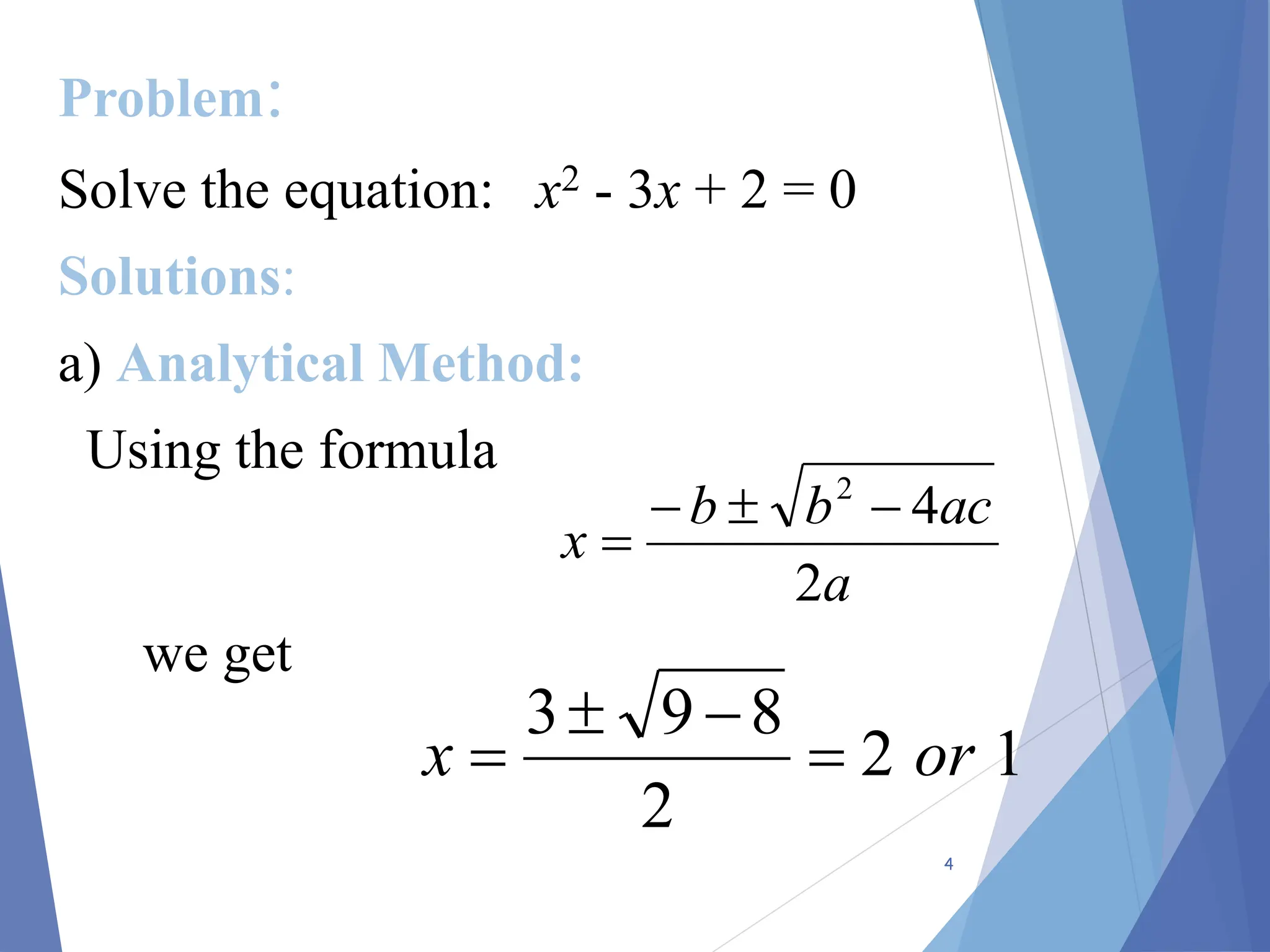
Solve the equation: x2 - 3x + 2 = 0
Solutions:
a) Analytical Method:
Using the formula
we get
4
a
ac
b
b
x
2
4
2




1
2
2
8
9
3
or
x 



NUMERICAL METHOD
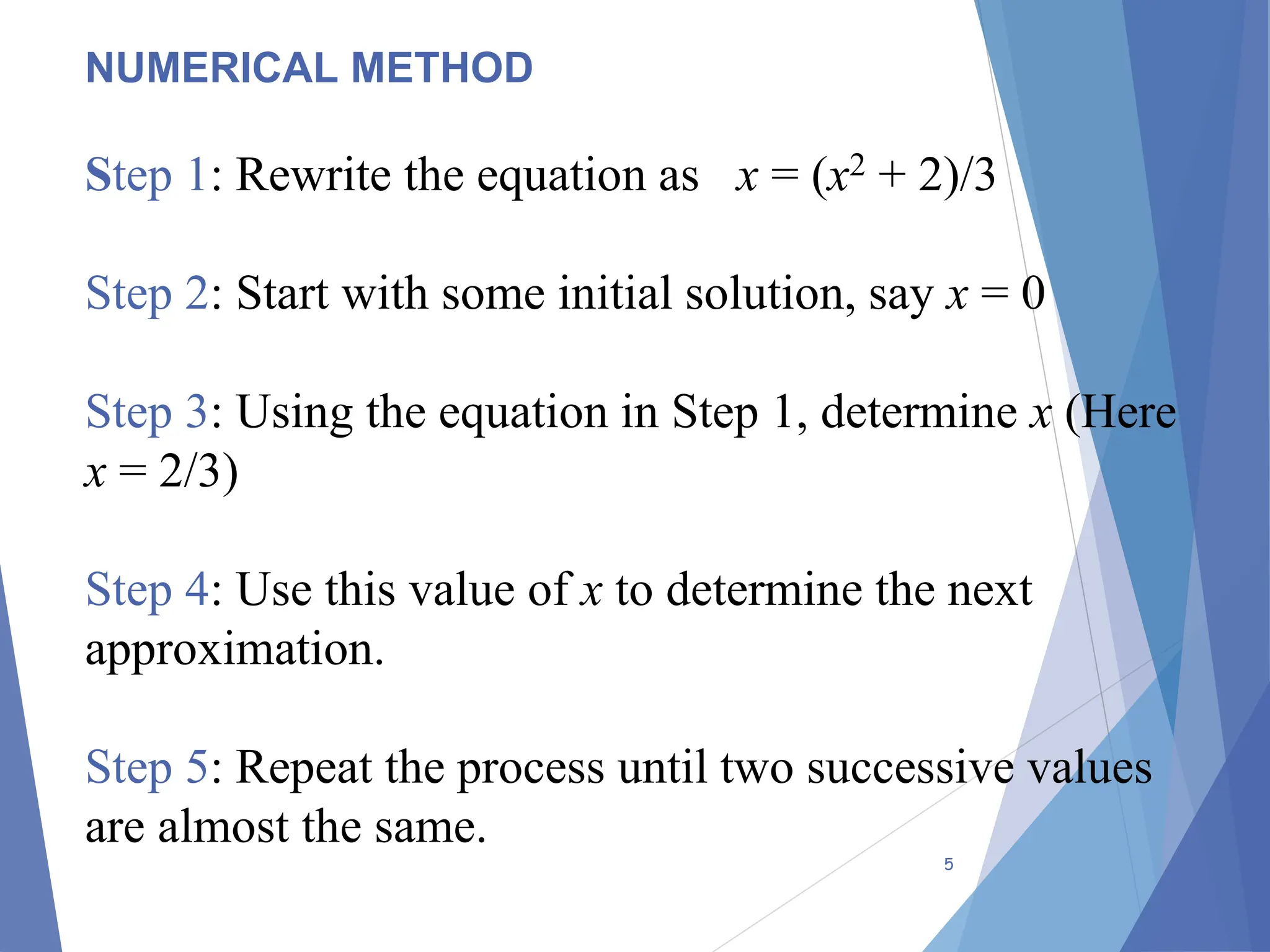
Step 1: Rewrite the equation as x = (x2 + 2)/3
Step 2: Start with some initial solution, say x = 0
Step 3: Using the equation in Step 1, determine x (Here
x = 2/3)
Step 4: Use this value of x to determine the next
approximation.
Step 5: Repeat the process until two successive values
are almost the same.
5
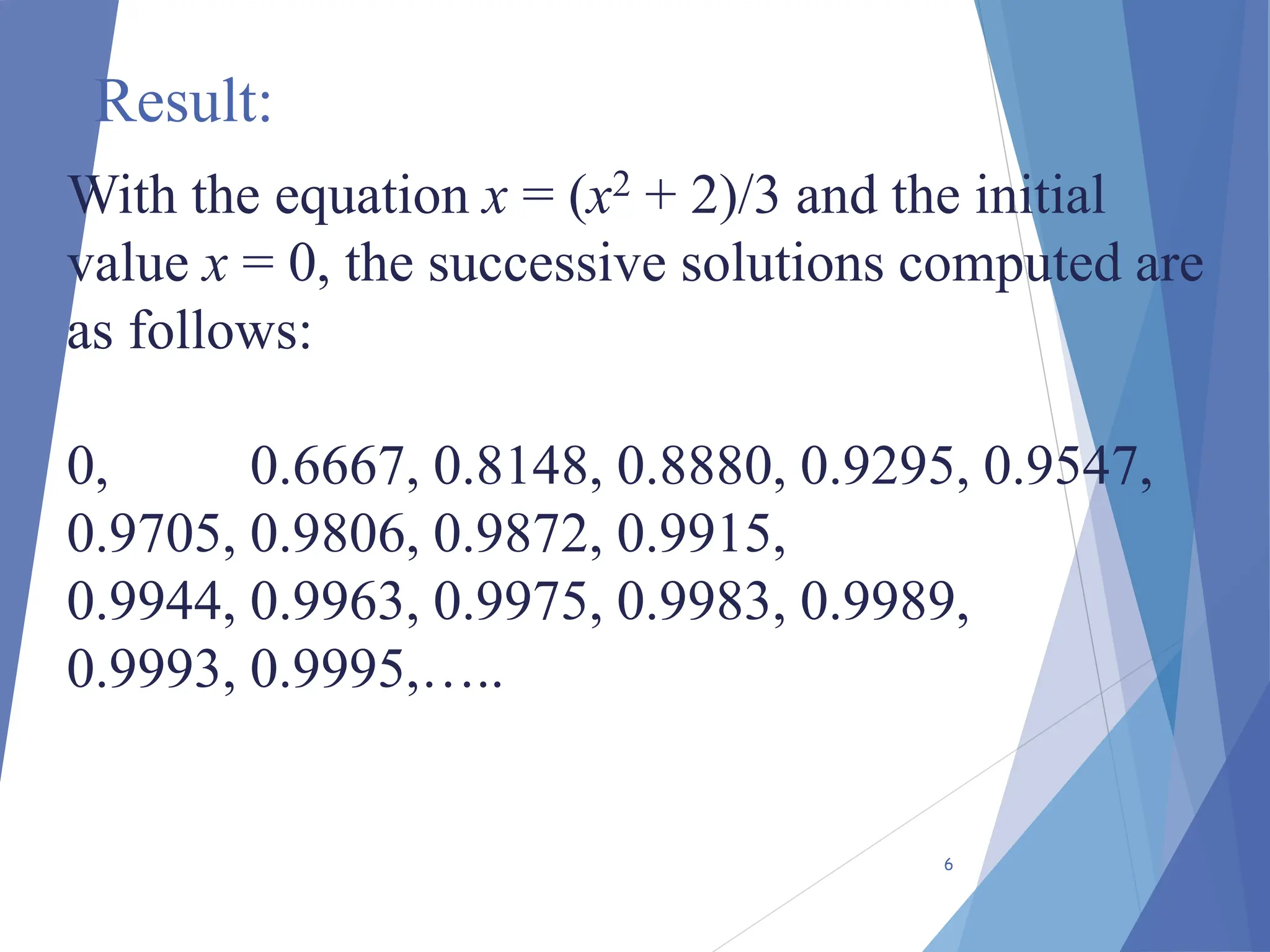
Result:
With the equation x = (x2 + 2)/3 and the initial
value x = 0, the successive solutions computed are
as follows:
0, 0.6667, 0.8148, 0.8880, 0.9295, 0.9547,
0.9705, 0.9806, 0.9872, 0.9915,
0.9944, 0.9963, 0.9975, 0.9983, 0.9989,
0.9993, 0.9995,…..
6
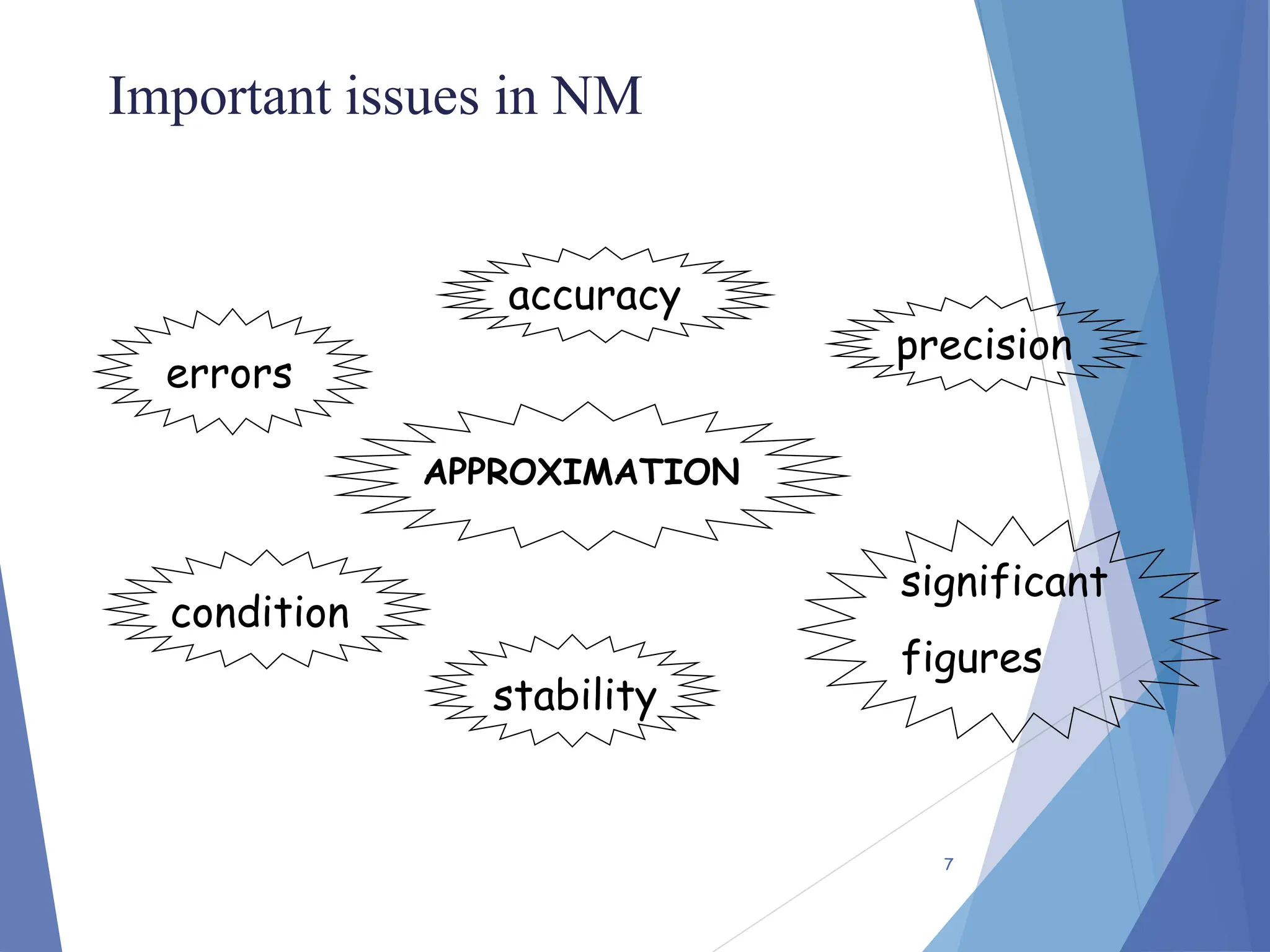
Important issues in NM
7
APPROXIMATION
errors
accuracy
condition
stability
significant
figures
precision
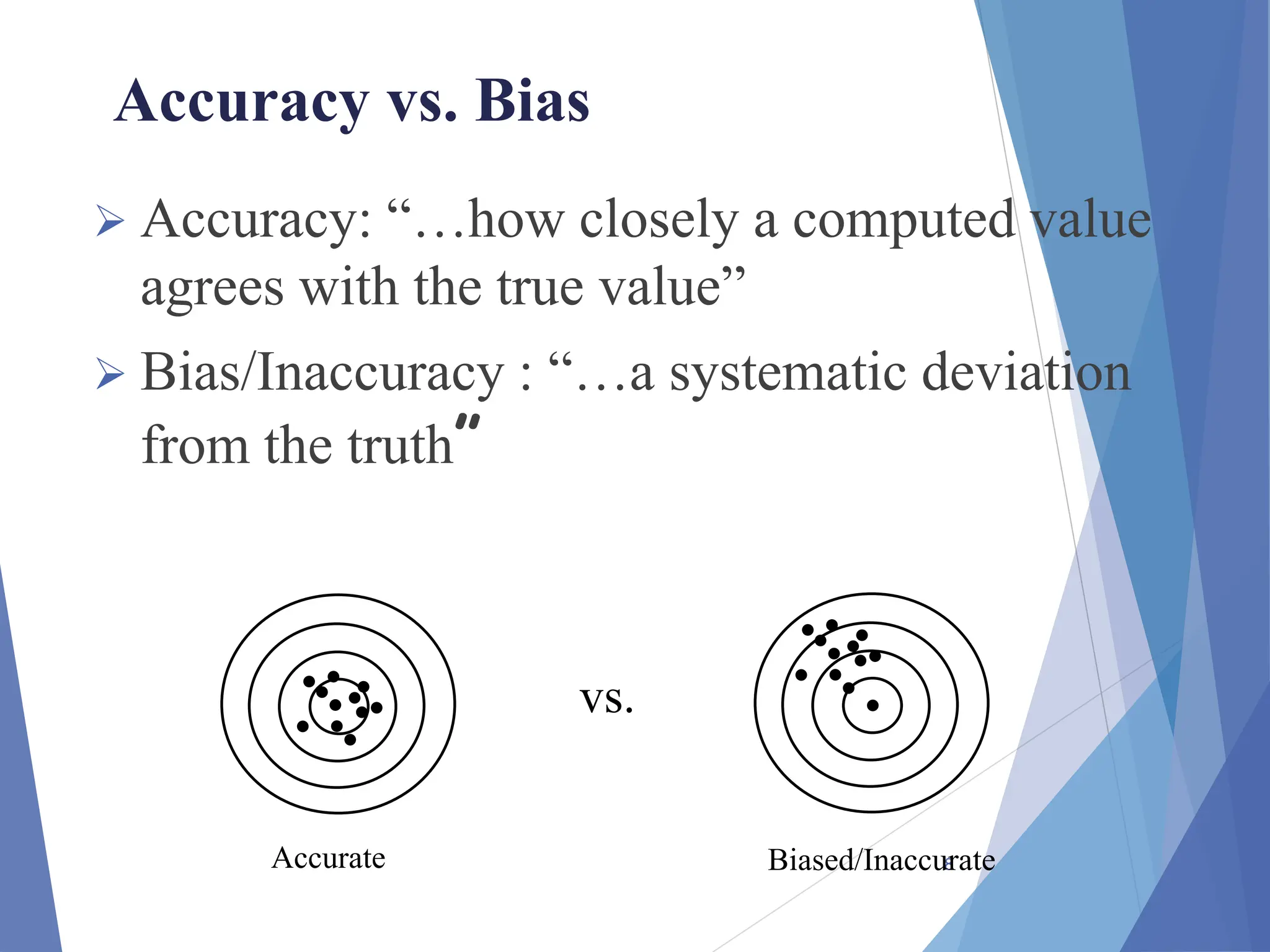
Accuracy vs. Bias
 Accuracy: “…how closely a computed value
agrees with the true value”
 Bias/Inaccuracy : “…a systematic deviation
from the truth”
8
vs.
Accurate Biased/Inaccurate
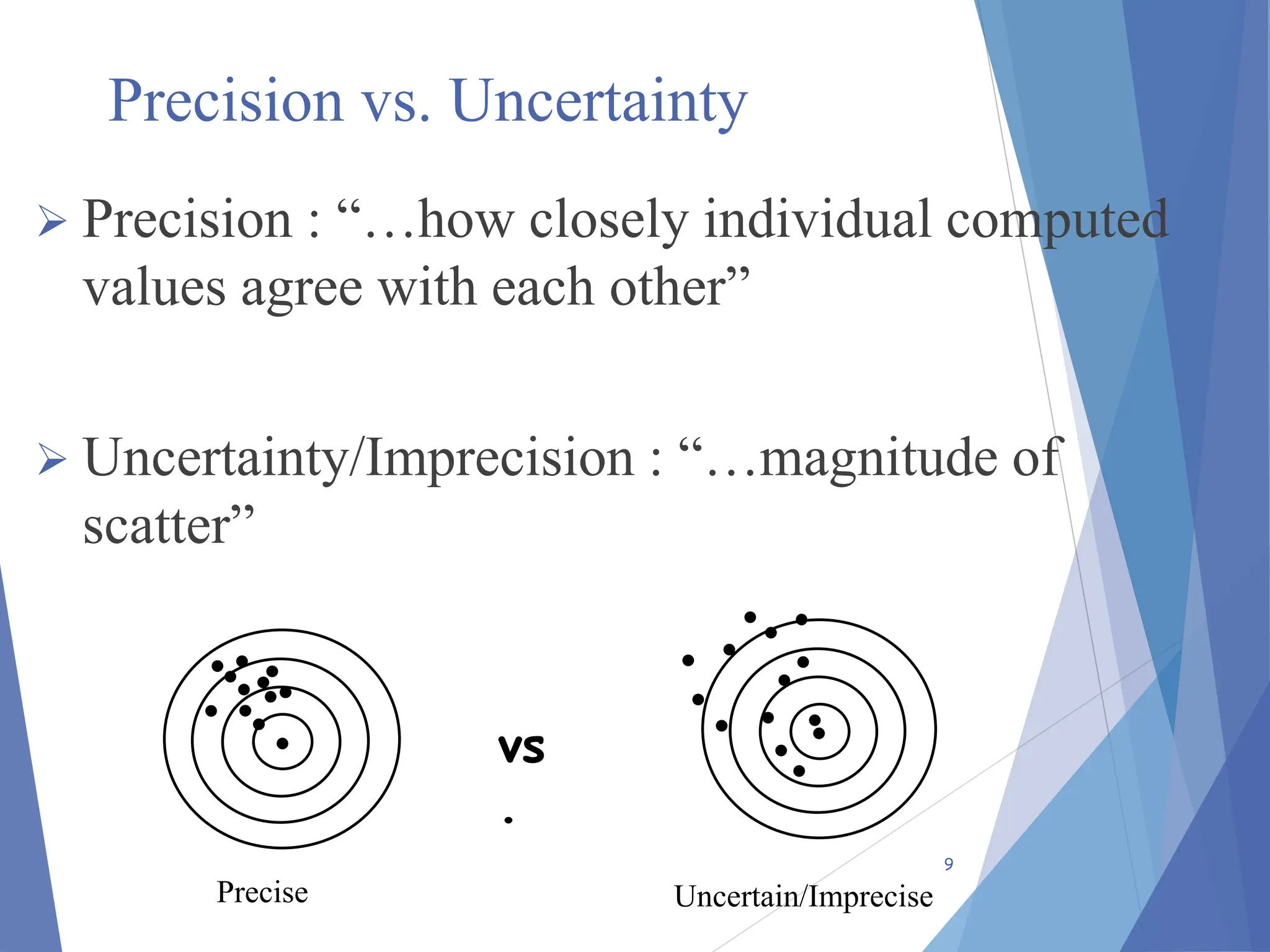
Precision vs. Uncertainty
 Precision : “…how closely individual computed
values agree with each other”
 Uncertainty/Imprecision : “…magnitude of
scatter”
9
vs
.
Precise Uncertain/Imprecise
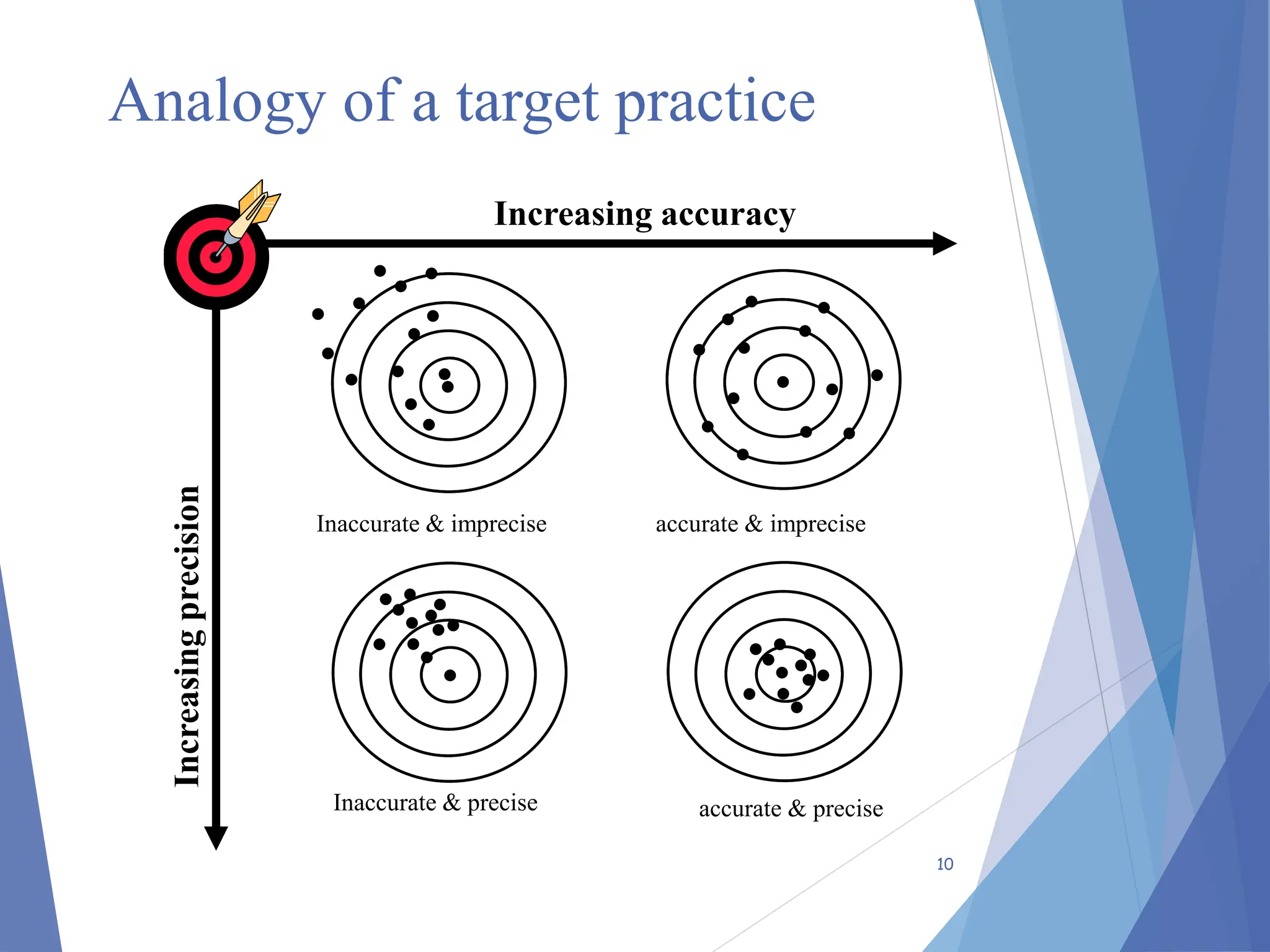
Analogy of a target practice
10
accurate & precise
accurate & imprecise
Inaccurate & precise
Increasing accuracy
Increasing
precision
Inaccurate & imprecise
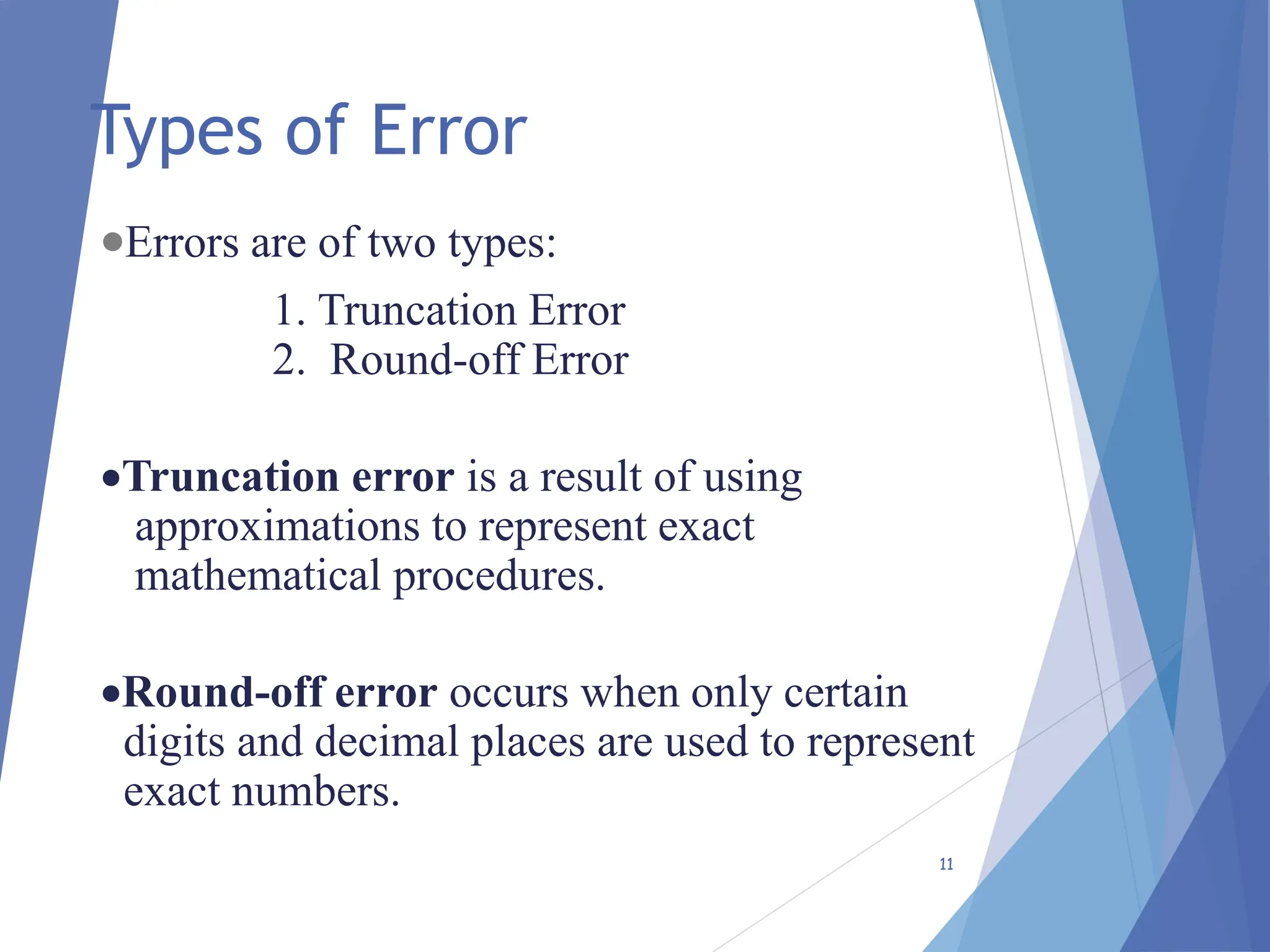
Types of Error
Errors are of two types:
1. Truncation Error
2. Round-off Error
Truncation error is a result of using
approximations to represent exact
mathematical procedures.
Round-off error occurs when only certain
digits and decimal places are used to represent
exact numbers.
11
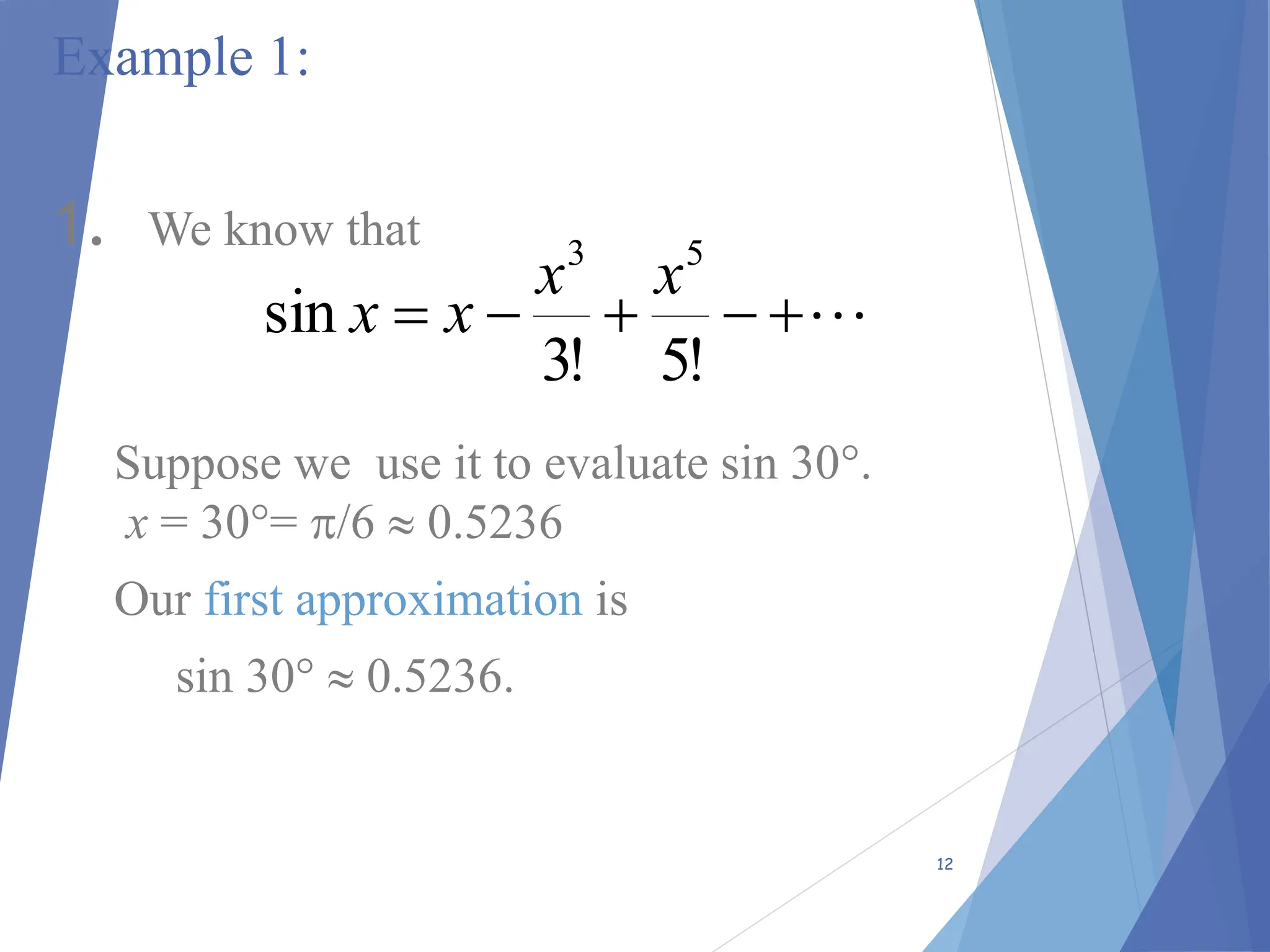
Example 1:
1. We know that
Suppose we use it to evaluate sin 30°.
x = 30°=/6  0.5236
Our first approximation is
sin 30°  0.5236.
12






!
5
!
3
sin
5
3
x
x
x
x
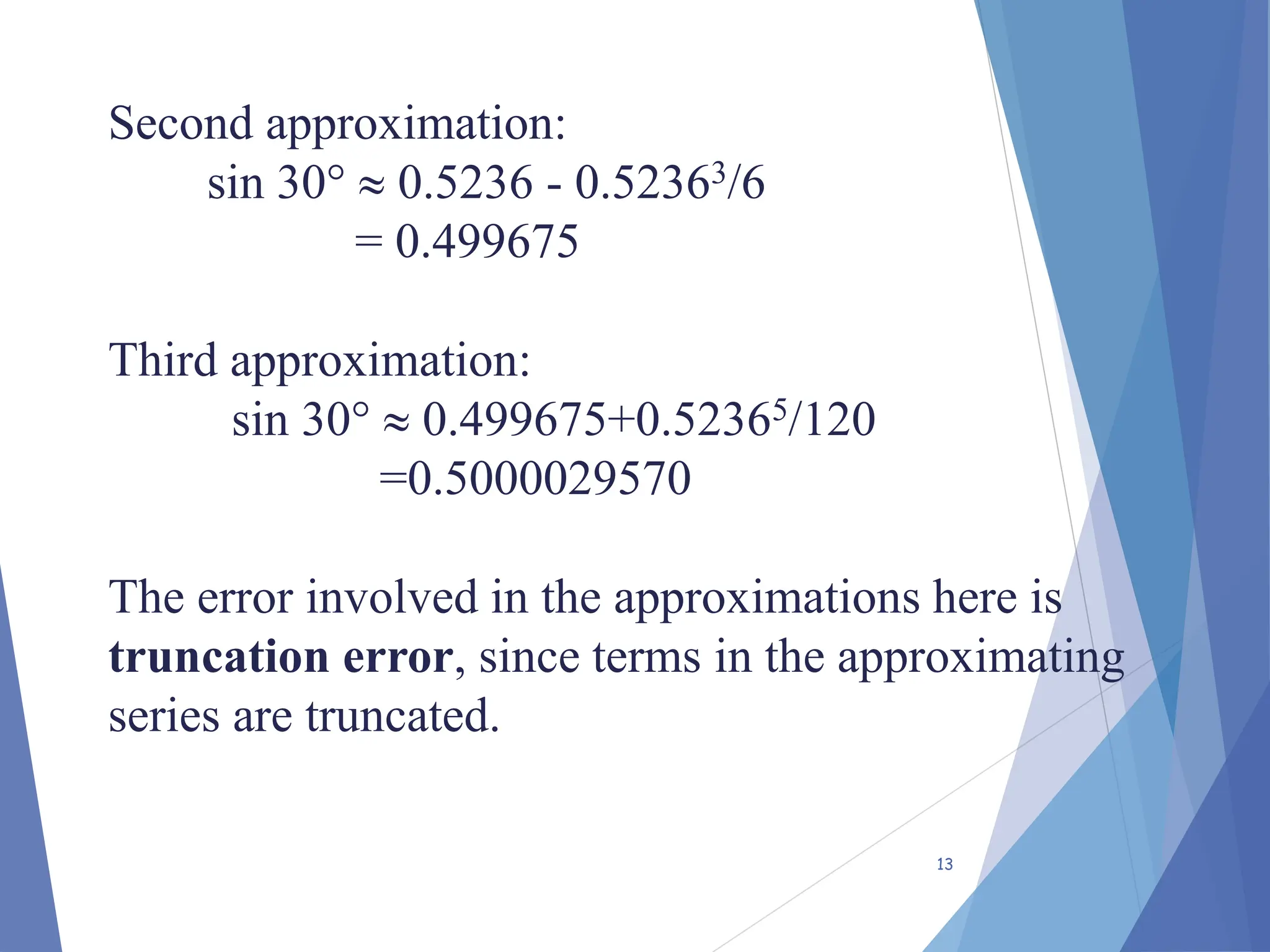
Second approximation:
sin 30°  0.5236 - 0.52363/6
= 0.499675
Third approximation:
sin 30°  0.499675+0.52365/120
=0.5000029570
The error involved in the approximations here is
truncation error, since terms in the approximating
series are truncated.
13
Example 2:
 Consider the number 3.12746
 If the number is written correct to 3 decimal
places, then it is approximated as 3.127
 If the number is written correct to 4 decimal
places, then it is approximated as 3.1275
 The error involved in this kind of
approximation is called round-off error.
14
Measurement of Errors:
 Precision and accuracy are important criteria
for the assessment of approximate solutions.
 There are formulae to measure these
characteristics.
 When the current solution is compared with
the true solution, the error involved is called
true error.
 When the current solution is compared with
the solution obtained in the previous iteration,
the error involved is called approximate error.
15
1. True Error:
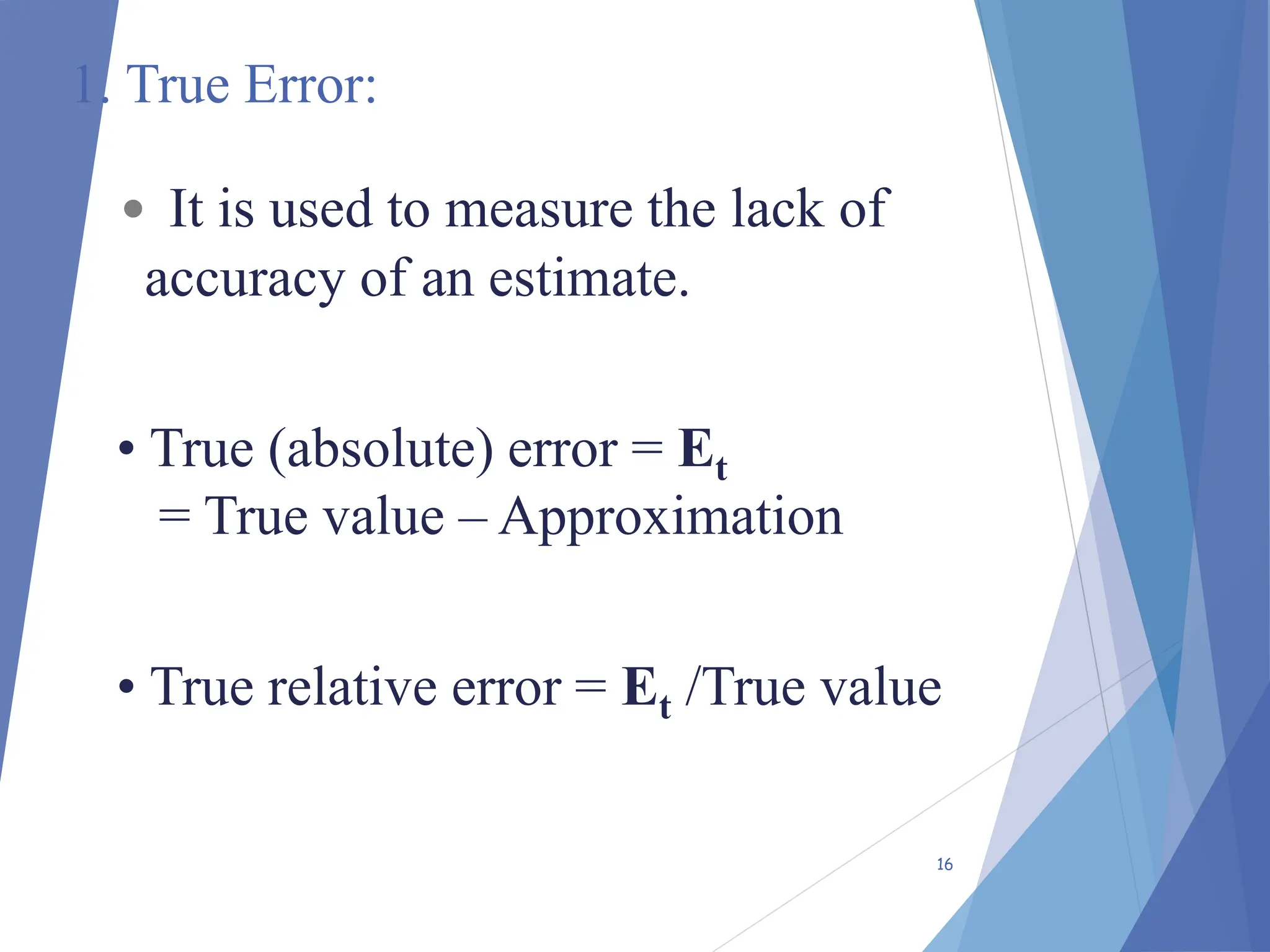
• It is used to measure the lack of
accuracy of an estimate.
• True (absolute) error = Et
= True value – Approximation
• True relative error = Et /True value
16
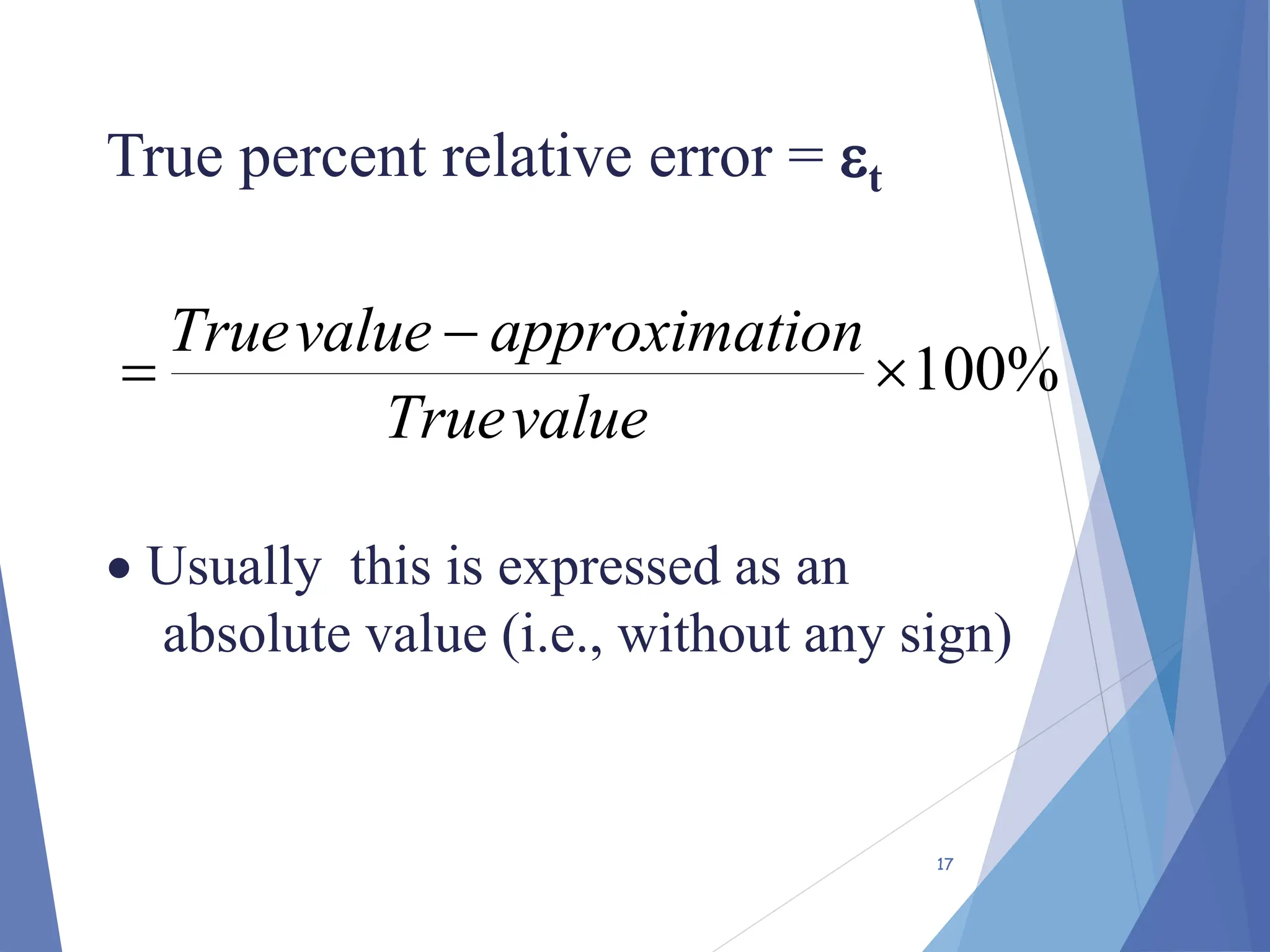
True percent relative error = t
 Usually this is expressed as an
absolute value (i.e., without any sign)
17
%
100



value
True
ion
approximat
value
True
Approximate Error:
• used to measure the lack of precision of an estimate.
• Approximate (absolute) error
Ea = Current approximation - Previous approximation
• Approximate relative error = Ea/Current app
18
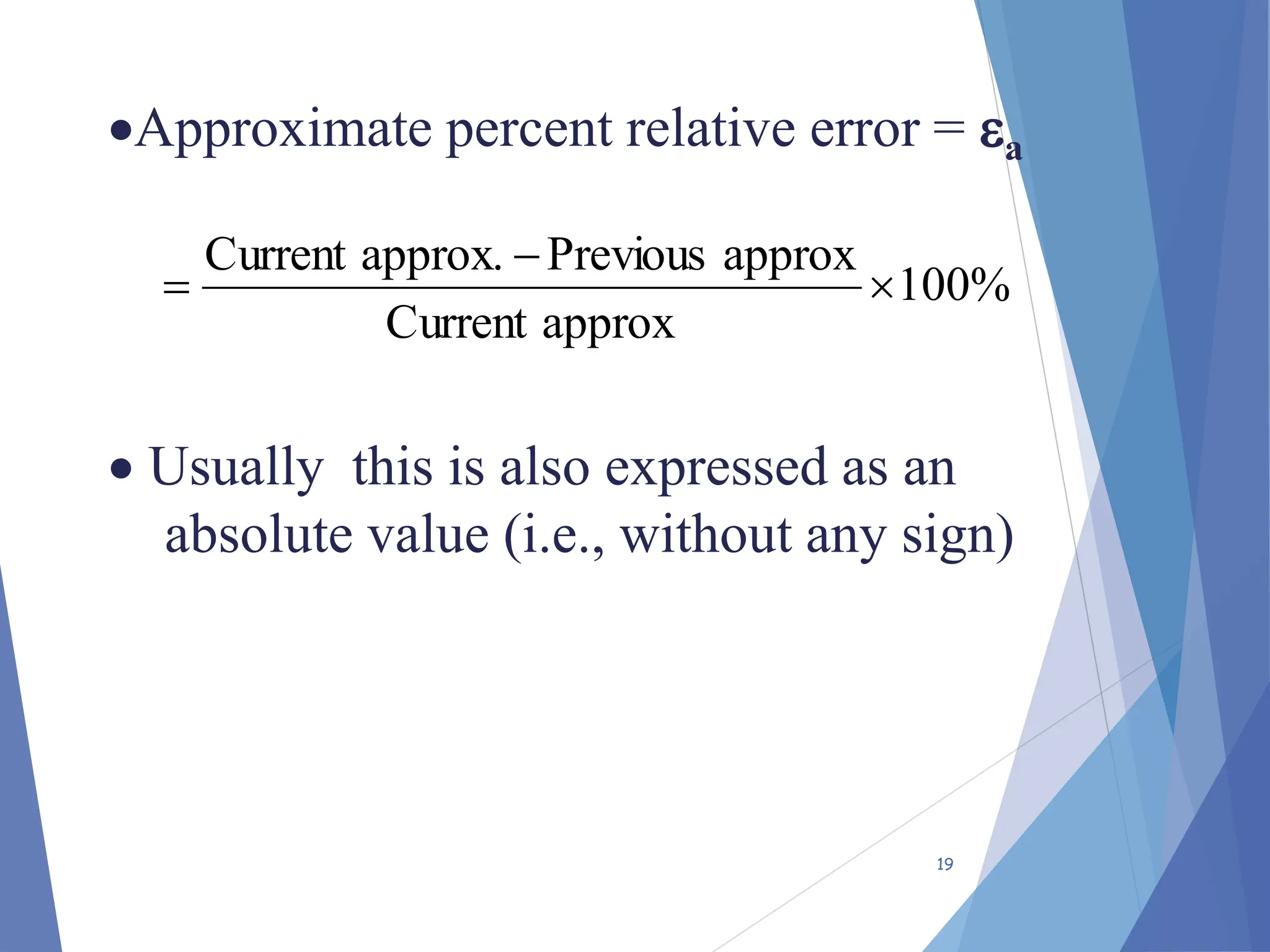
Approximate percent relative error = a
 Usually this is also expressed as an
absolute value (i.e., without any sign)
19
%
100
approx
Current
approx
Previous
approx.
Current



Exercise (HW 1)
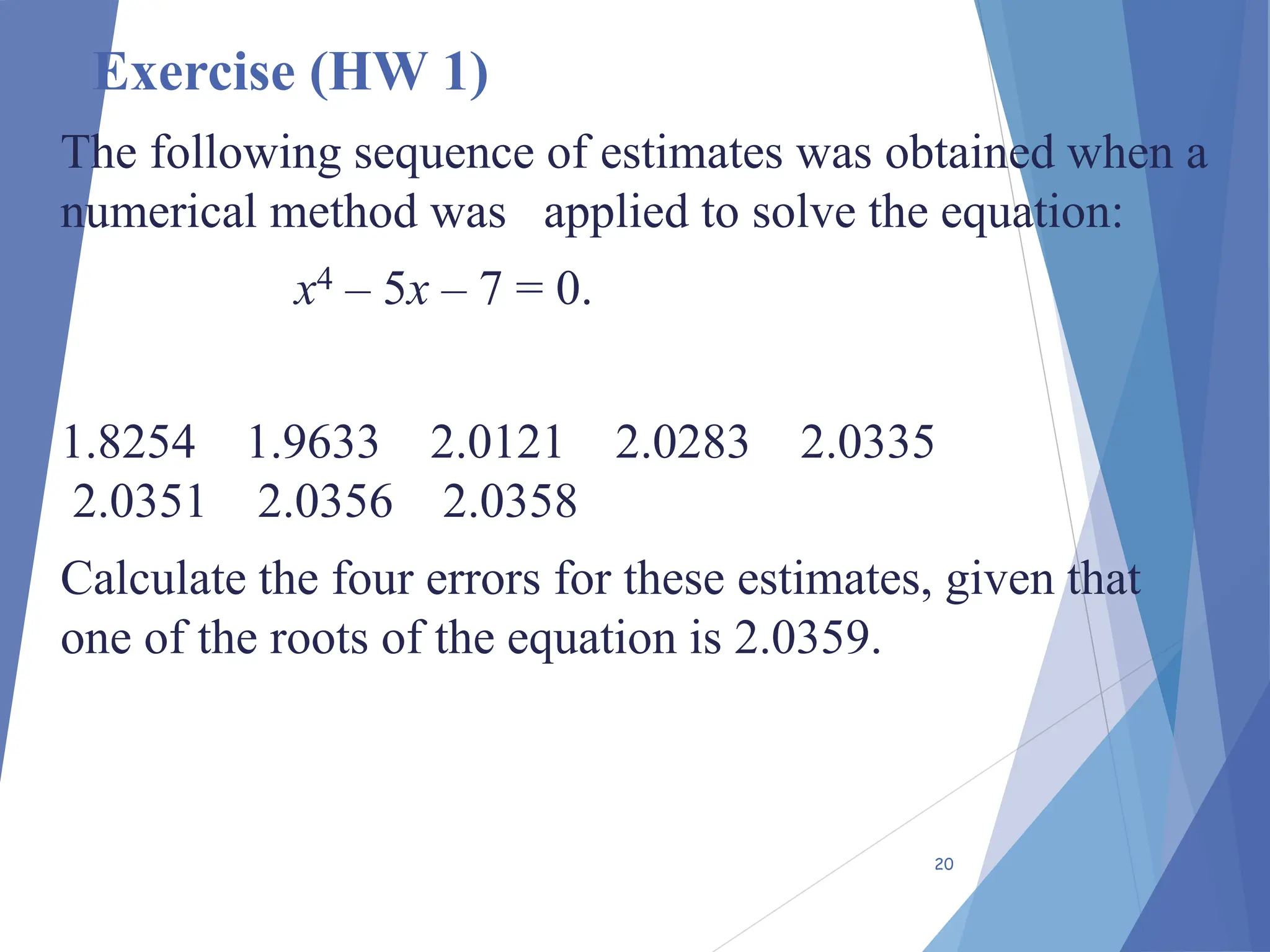
The following sequence of estimates was obtained when a
numerical method was applied to solve the equation:
x4 – 5x – 7 = 0.
1.8254 1.9633 2.0121 2.0283 2.0335
2.0351 2.0356 2.0358
Calculate the four errors for these estimates, given that
one of the roots of the equation is 2.0359.
20
Significant Figures
 Usually computation is repeated until the
• approximate percent relative error (|a| ) is
within the pre-specified acceptable level
( denoted by s ) i.e., until |a|< s
• s is usually determined by specifying the
number of significant figures required.
• If the number of significant figures required is at least
n, then s must be
(0.510 2-n)%
21
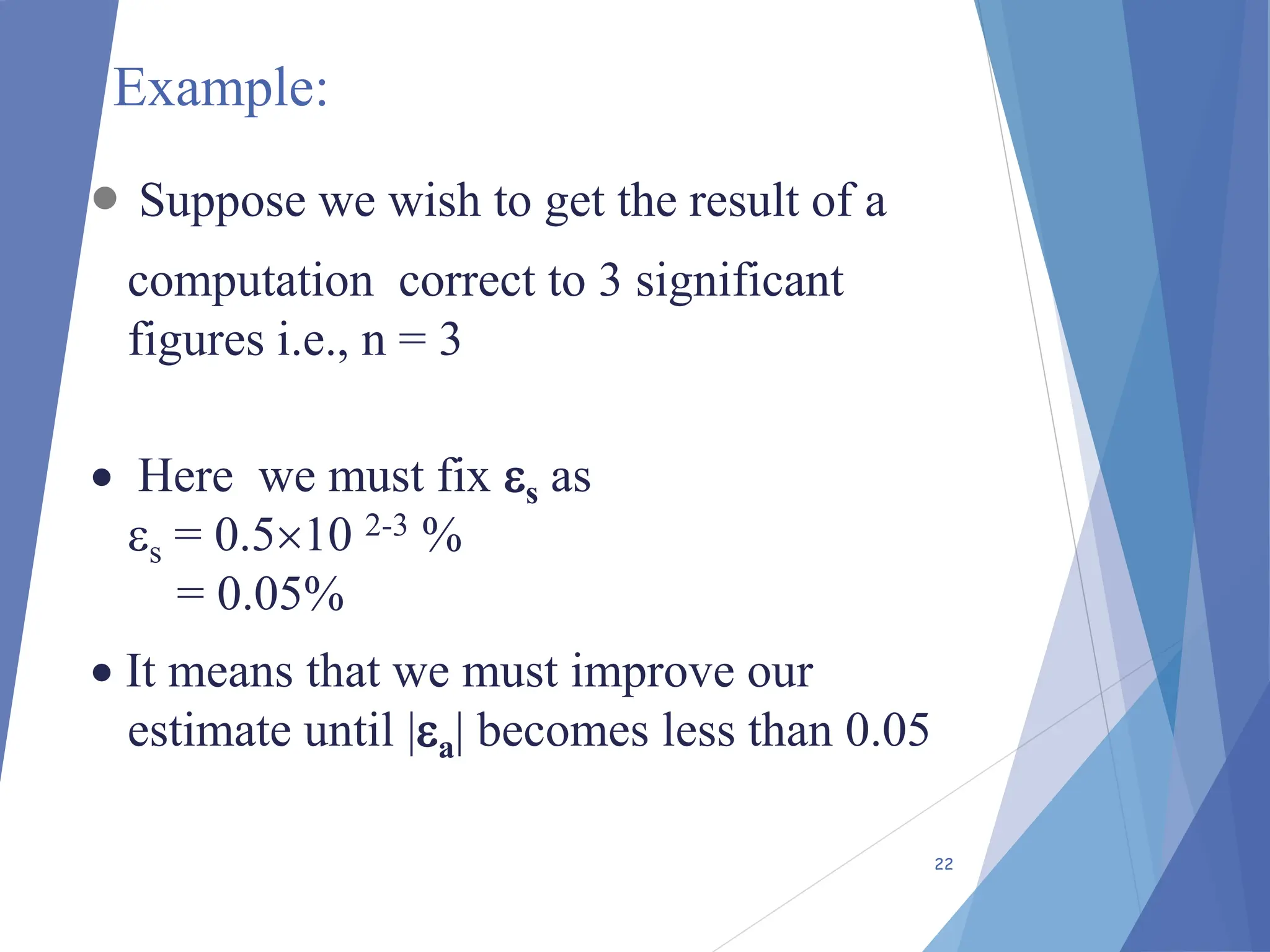
Example:
 Suppose we wish to get the result of a
computation correct to 3 significant
figures i.e., n = 3
 Here we must fix s as
s = 0.510 2-3 %
= 0.05%
 It means that we must improve our
estimate until |a| becomes less than 0.05
22
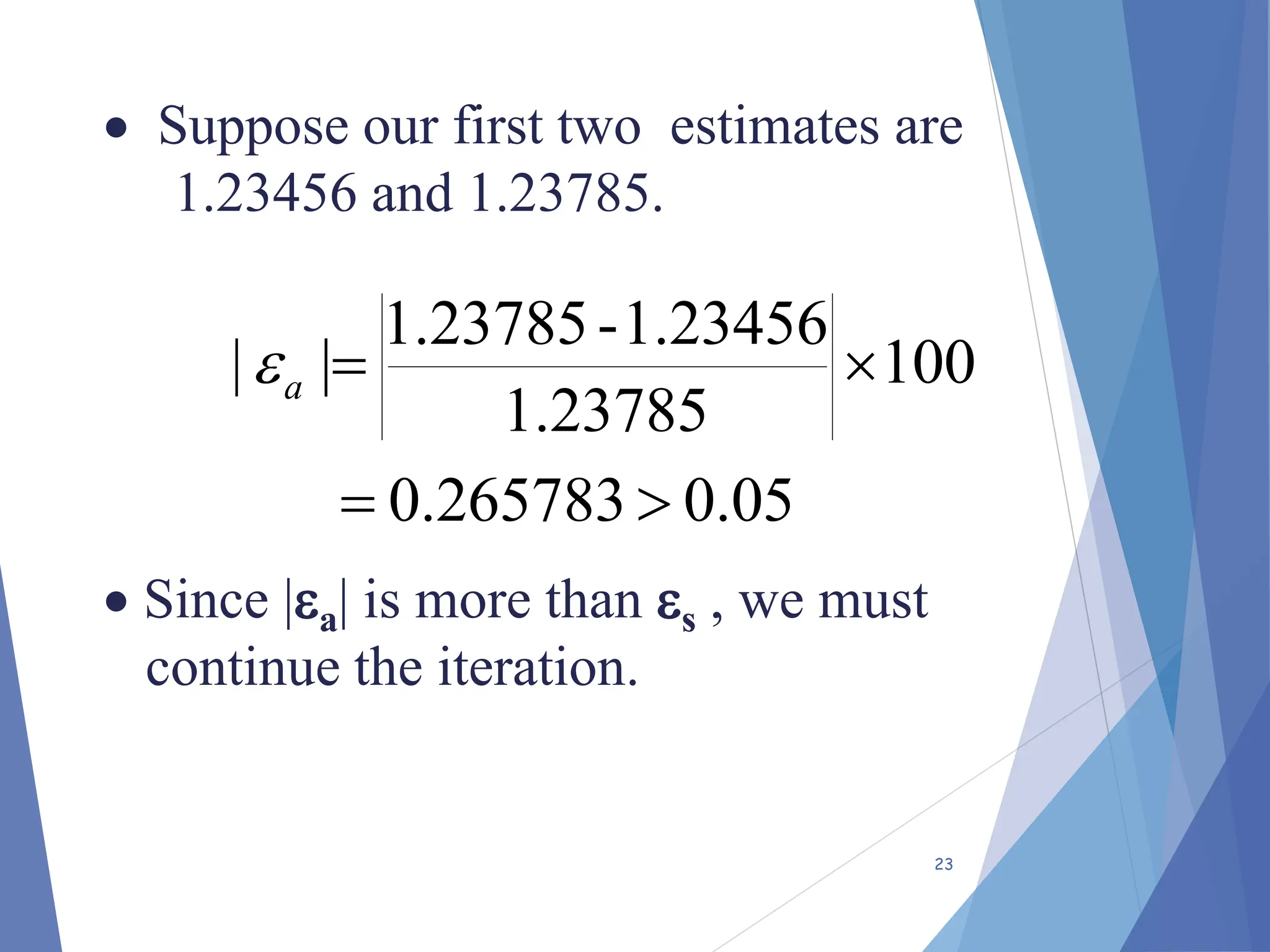
 Suppose our first two estimates are
1.23456 and 1.23785.
 Since |a| is more than s , we must
continue the iteration.
23
0.05
0.265783
100
1.23785
1.23456
-
1.23785
|
|




a

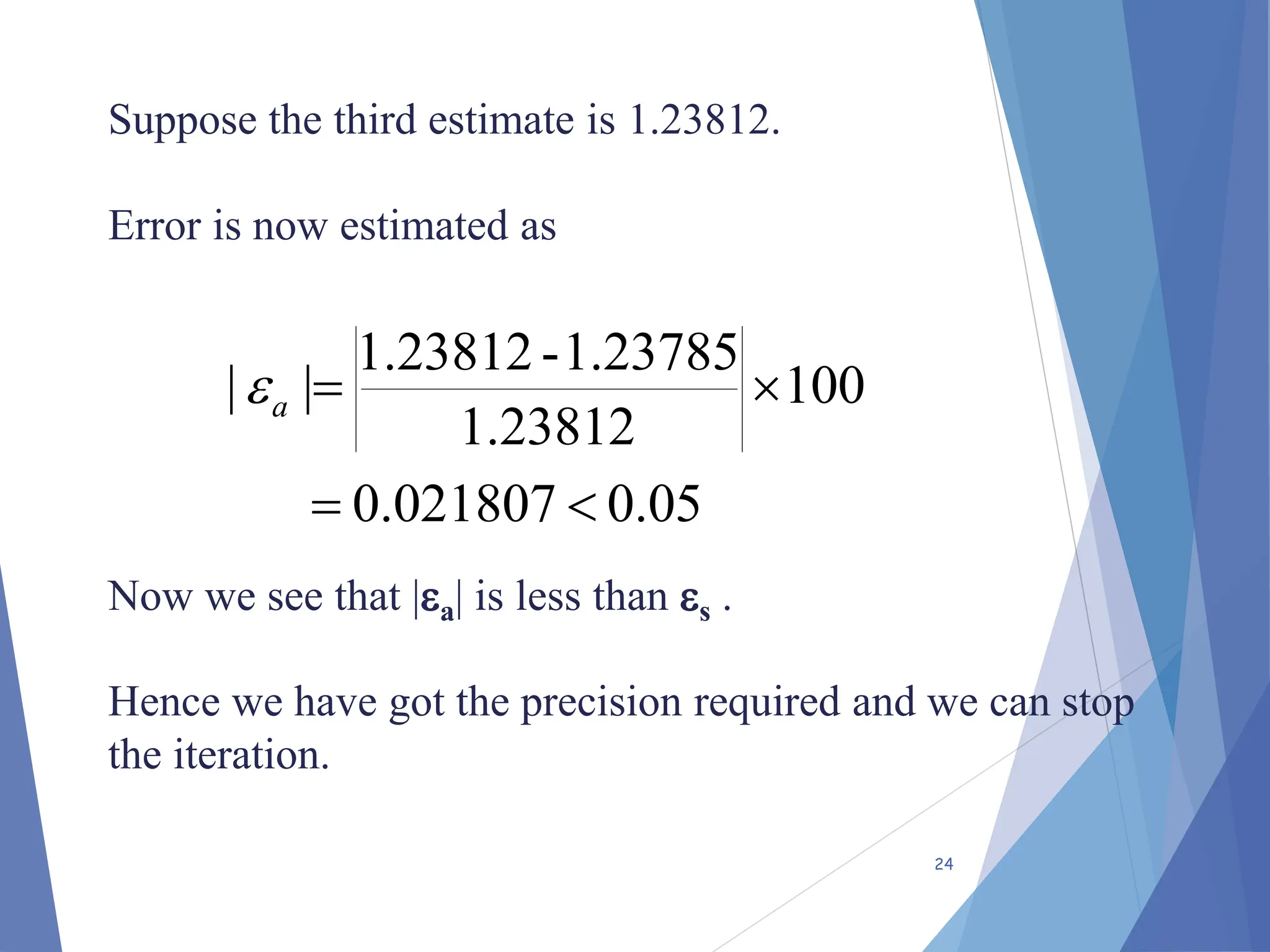
Suppose the third estimate is 1.23812.
Error is now estimated as
Now we see that |a| is less than s .
Hence we have got the precision required and we can stop
the iteration.
24
0.05
0.021807
100
1.23812
1.23785
-
1.23812
|
|




a

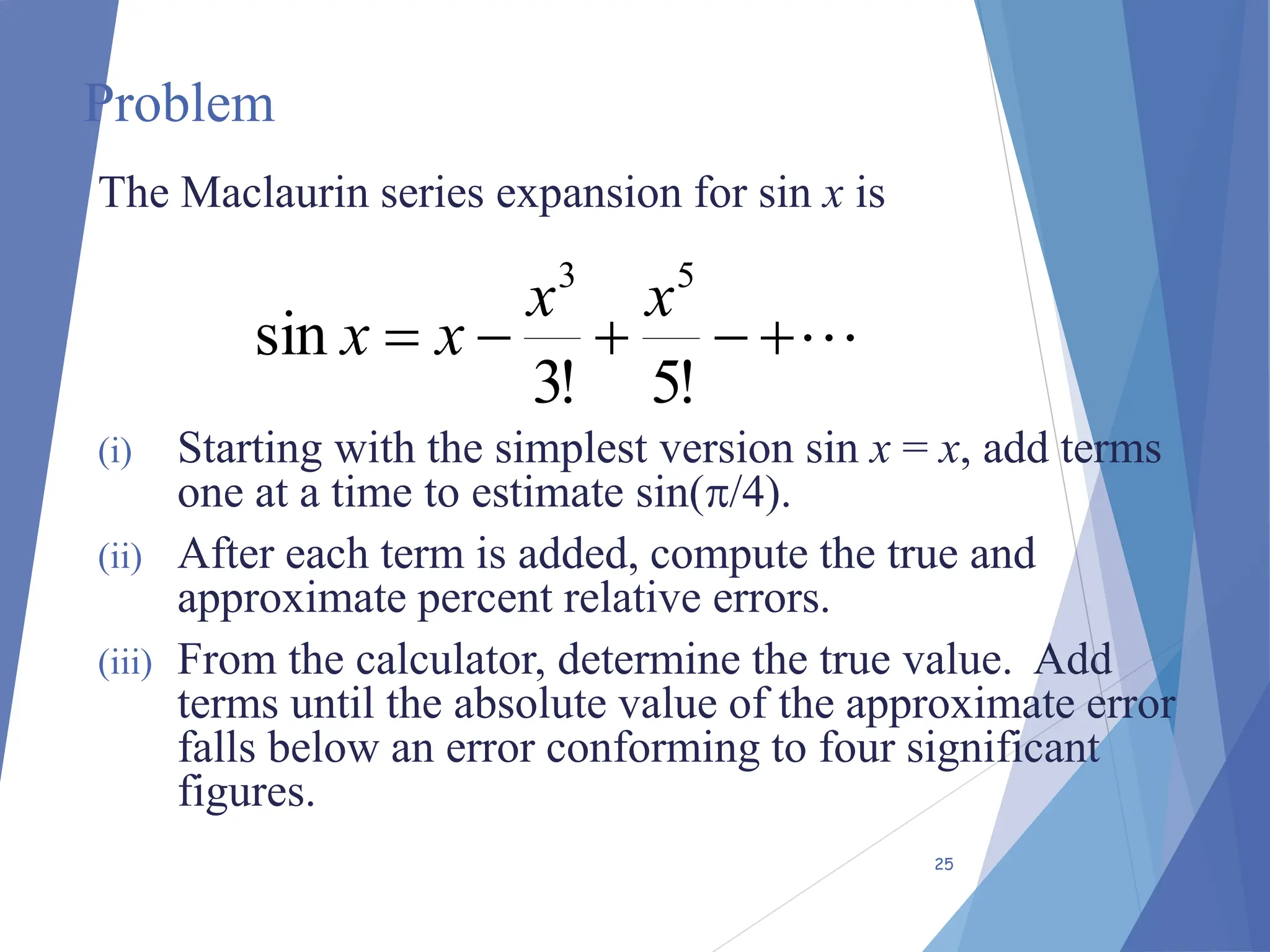
Problem
The Maclaurin series expansion for sin x is
(i) Starting with the simplest version sin x = x, add terms
one at a time to estimate sin(/4).
(ii) After each term is added, compute the true and
approximate percent relative errors.
(iii) From the calculator, determine the true value. Add
terms until the absolute value of the approximate error
falls below an error conforming to four significant
figures.
25






!
5
!
3
sin
5
3
x
x
x
x
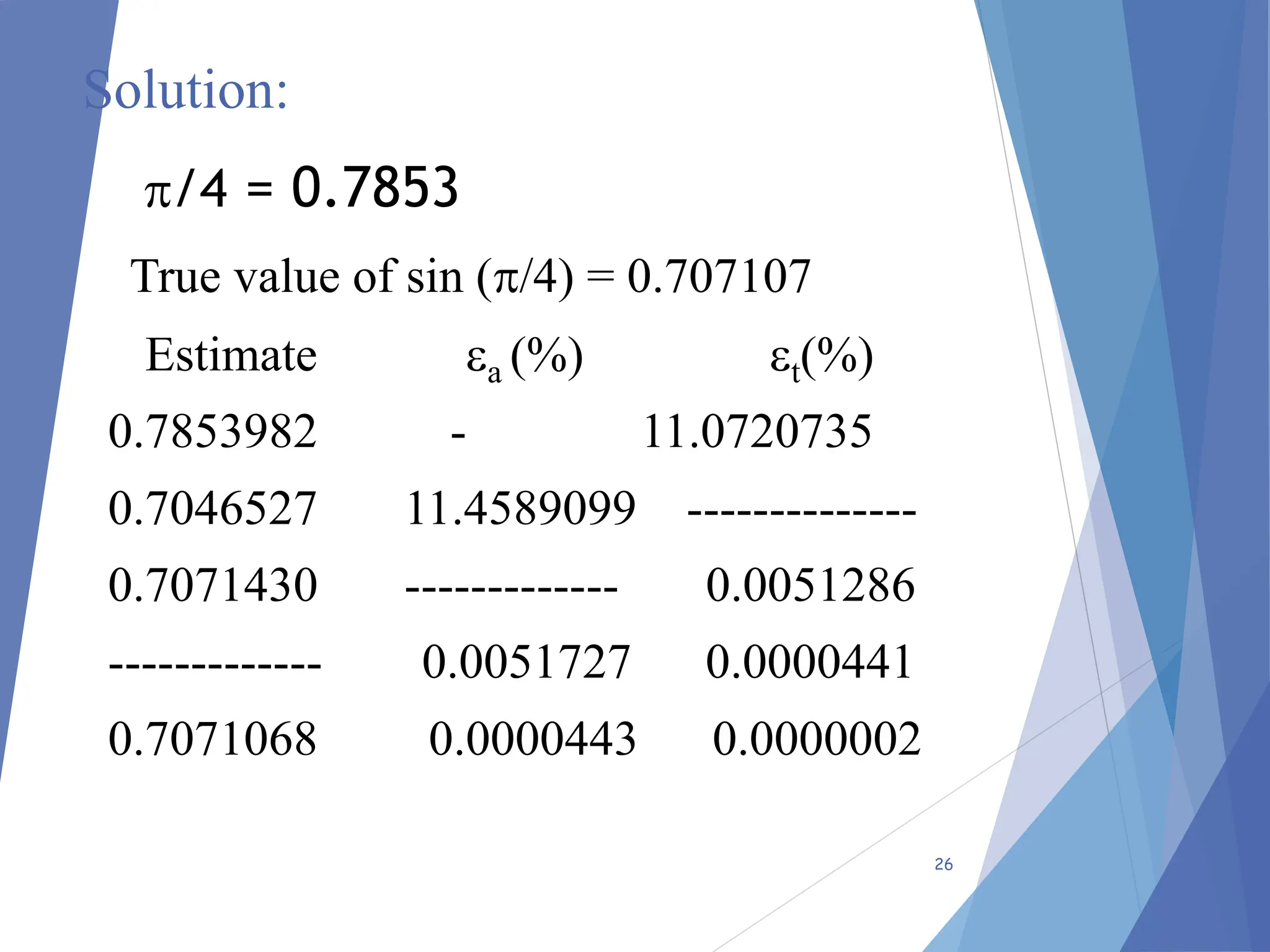
Solution:
/4 = 0.7853
True value of sin (/4) = 0.707107
Estimate a (%) t(%)
0.7853982 - 11.0720735
0.7046527 11.4589099 --------------
0.7071430 ------------- 0.0051286
------------- 0.0051727 0.0000441
0.7071068 0.0000443 0.0000002
26
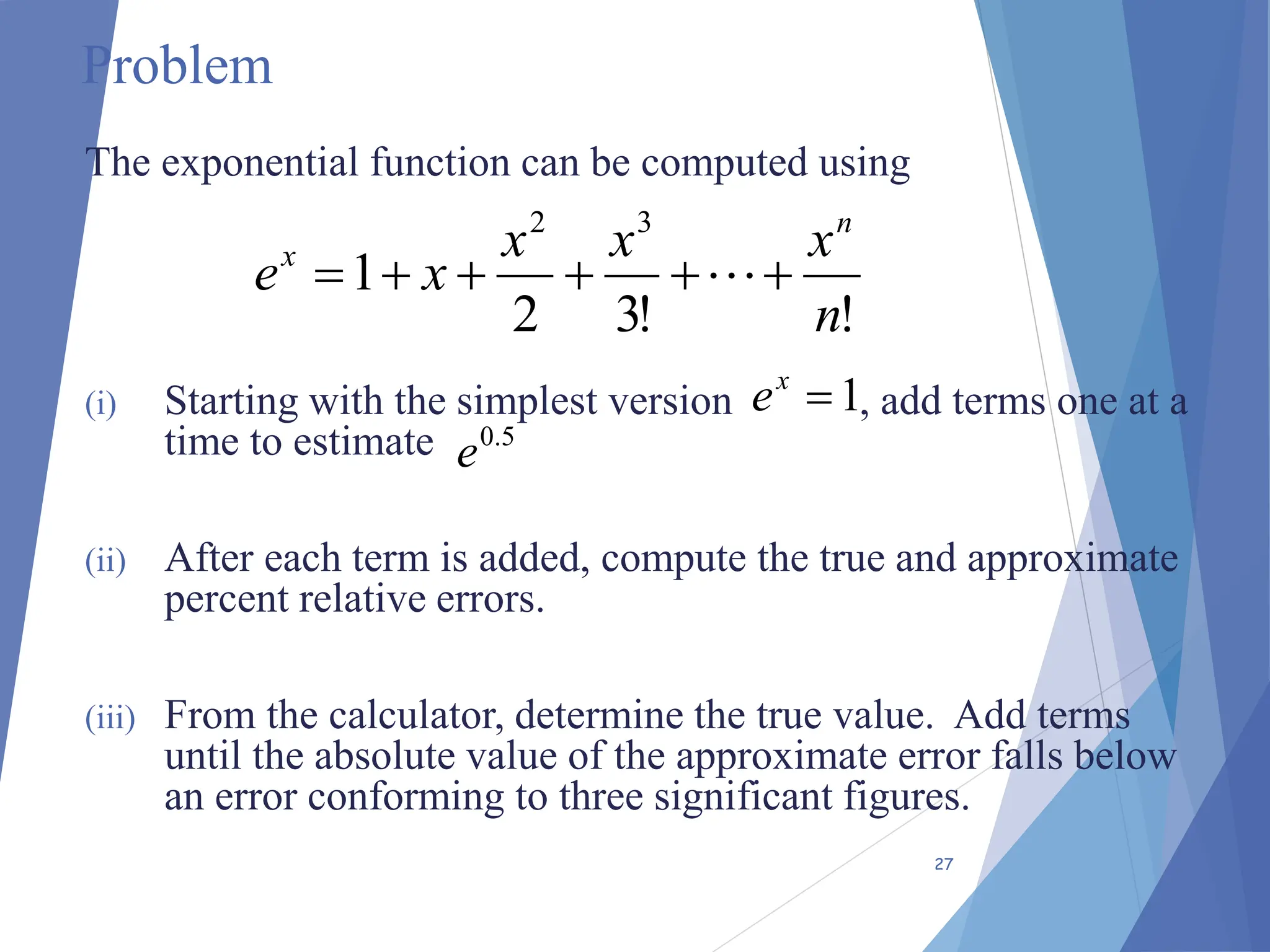
Problem
The exponential function can be computed using
(i) Starting with the simplest version , add terms one at a
time to estimate
(ii) After each term is added, compute the true and approximate
percent relative errors.
(iii) From the calculator, determine the true value. Add terms
until the absolute value of the approximate error falls below
an error conforming to three significant figures.
27
!
!
3
2
1
3
2
n
x
x
x
x
e
n
x





 
1

x
e
5
.
0
e
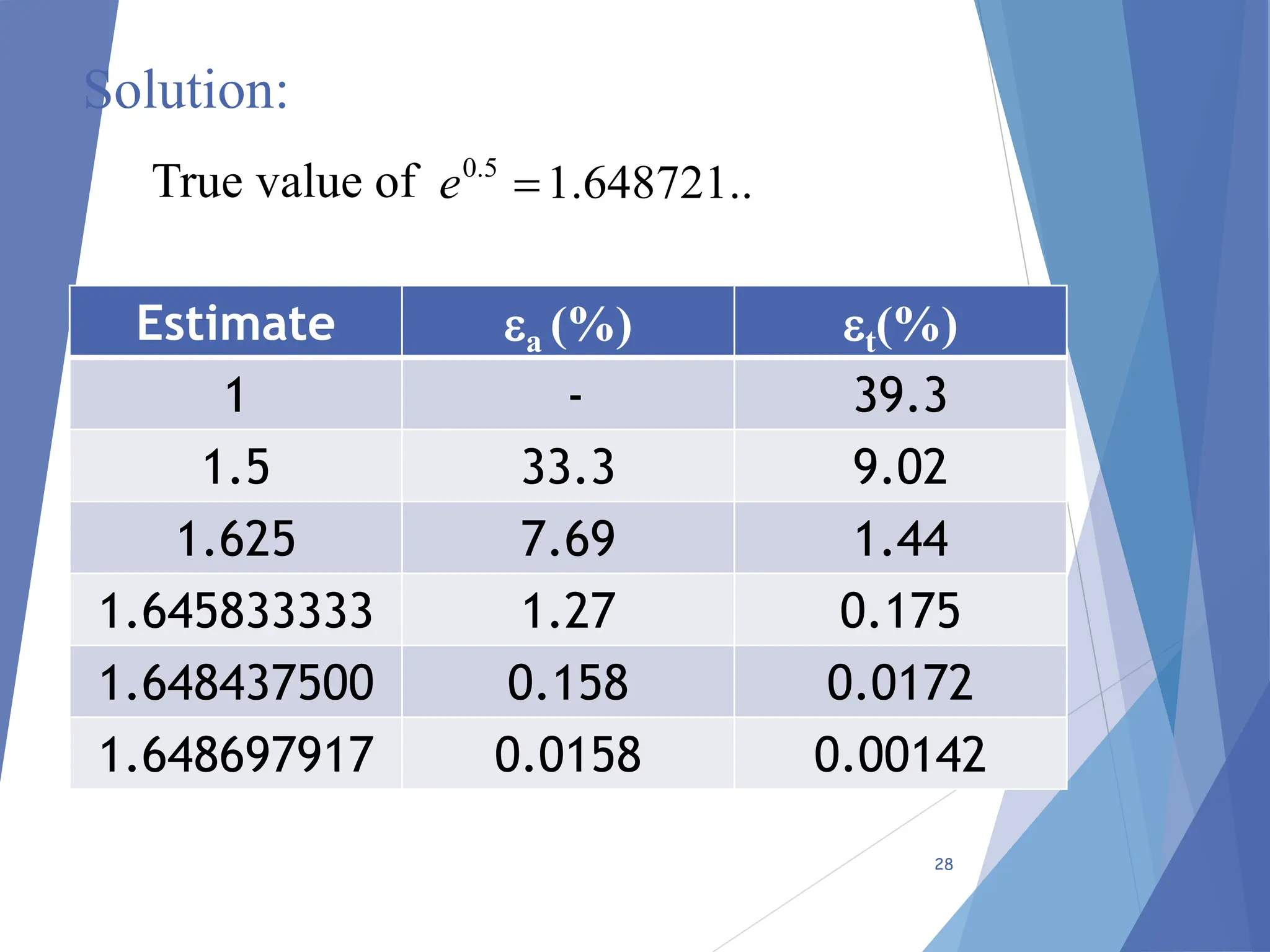
Solution:
True value of
28
..
648721
.
1
5
.
0

e
Estimate a (%) t(%)
1 - 39.3
1.5 33.3 9.02
1.625 7.69 1.44
1.645833333 1.27 0.175
1.648437500 0.158 0.0172
1.648697917 0.0158 0.00142
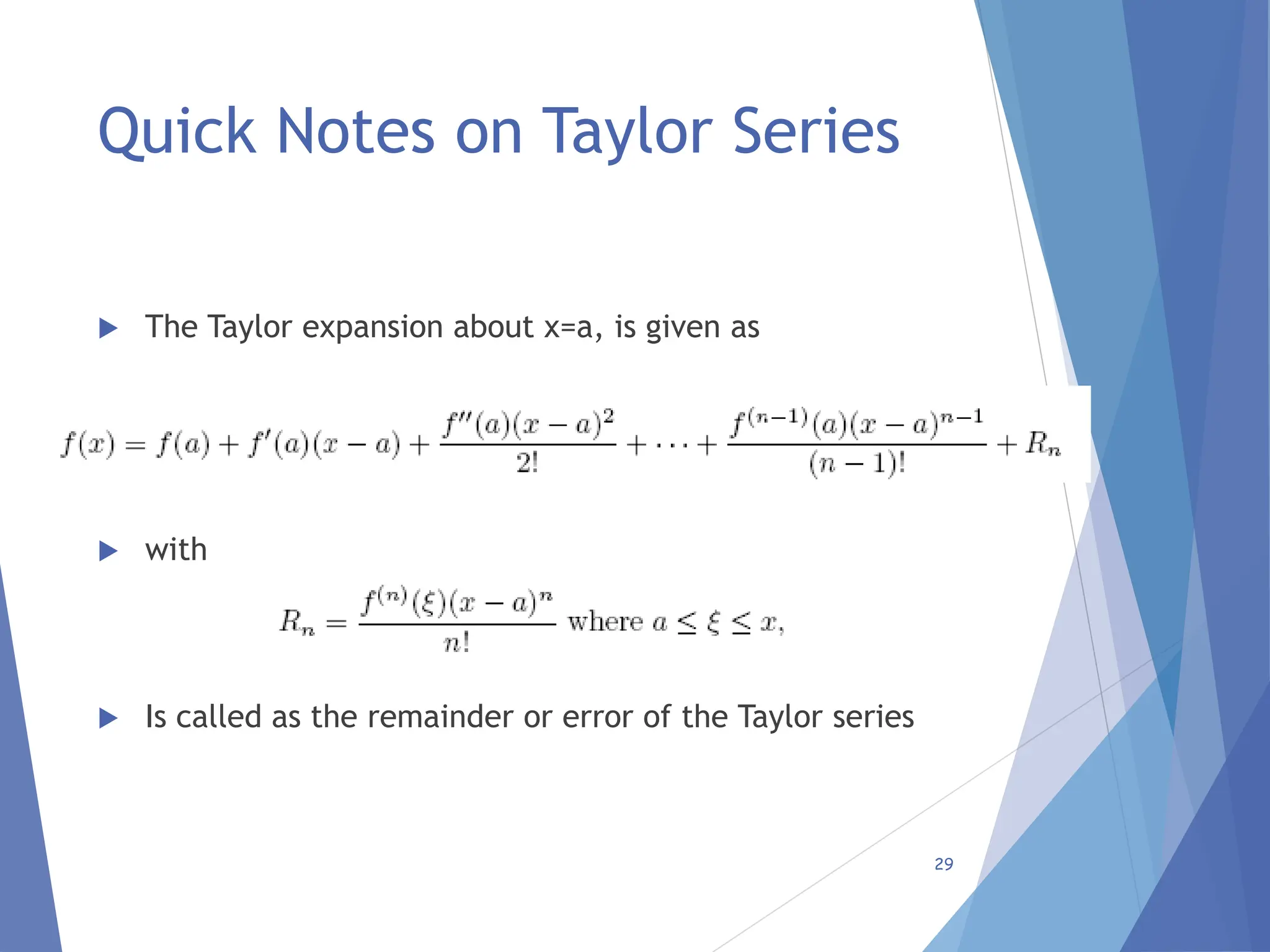
Quick Notes on Taylor Series
 The Taylor expansion about x=a, is given as
 with
 Is called as the remainder or error of the Taylor series
29
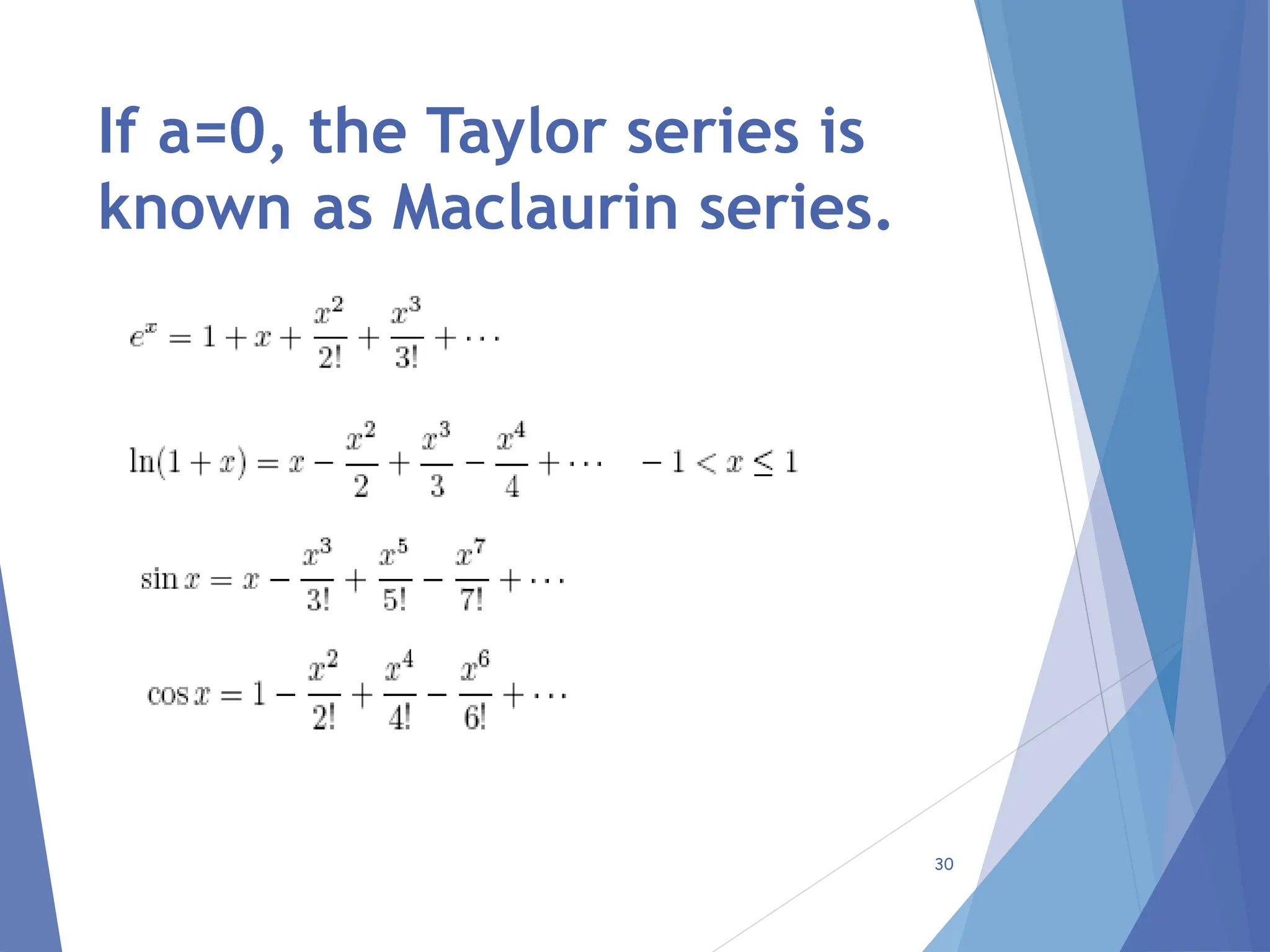
If a=0, the Taylor series is
known as Maclaurin series.
30
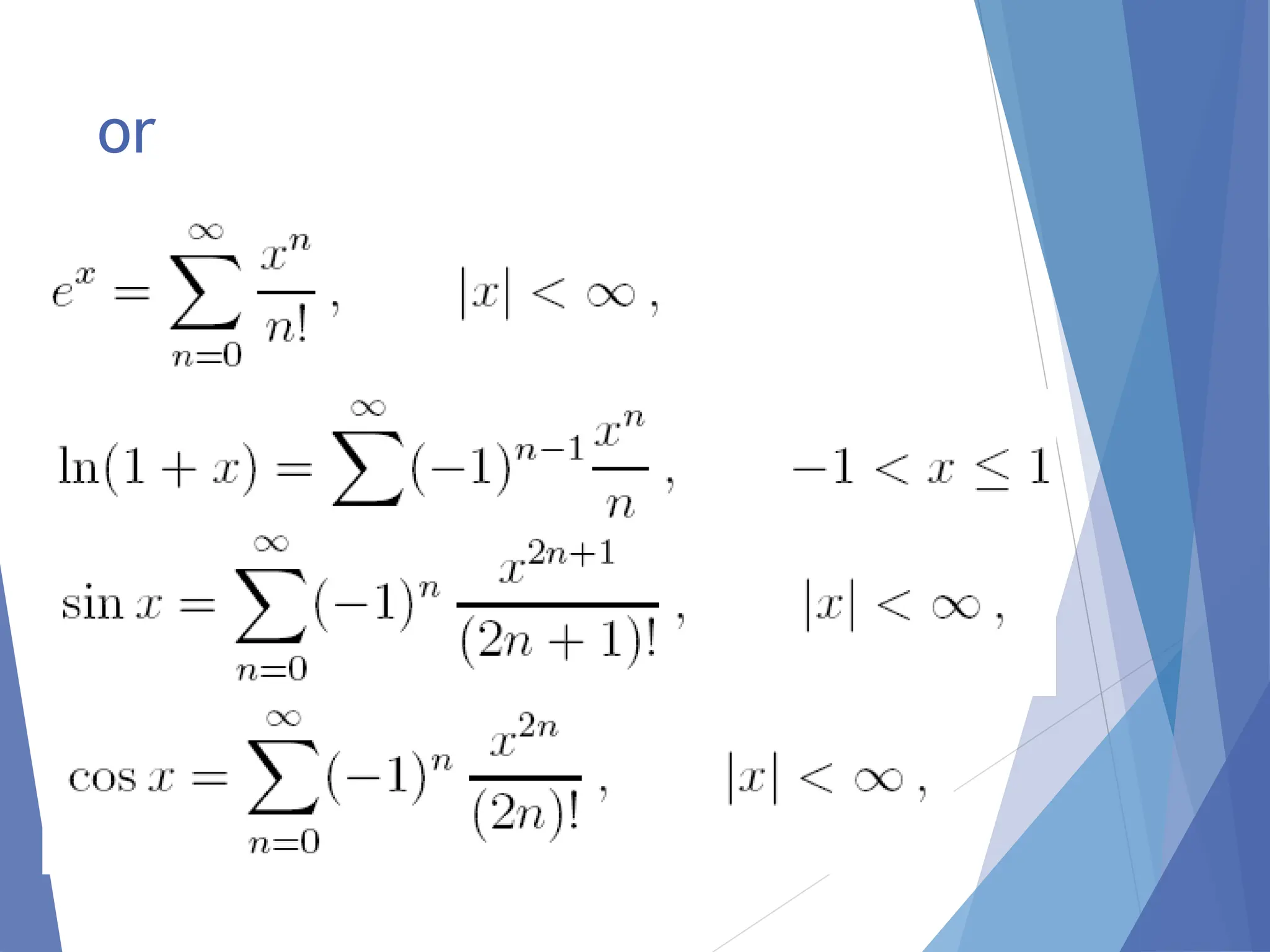
or
31
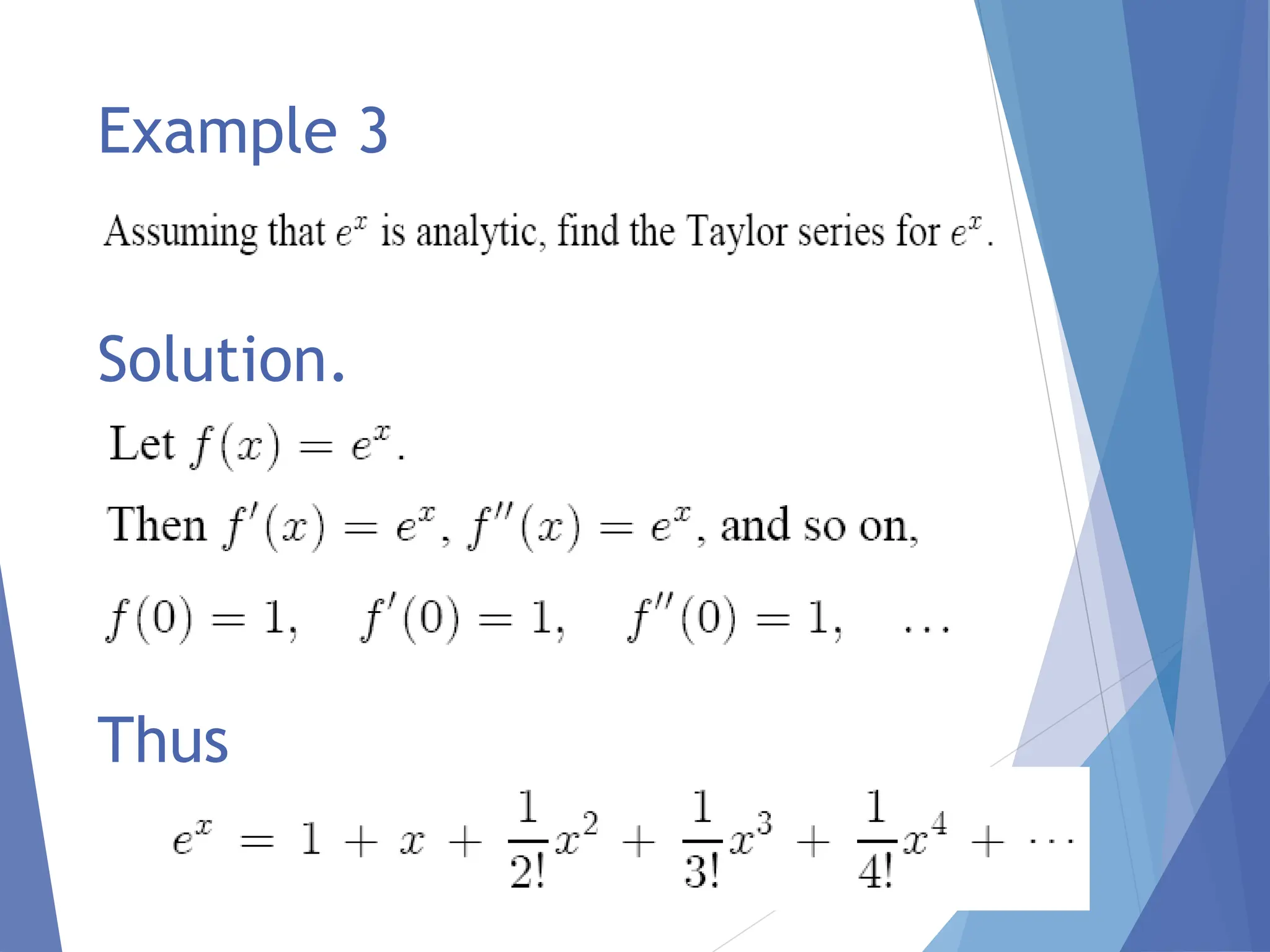
Example 3
Solution.
Thus
32
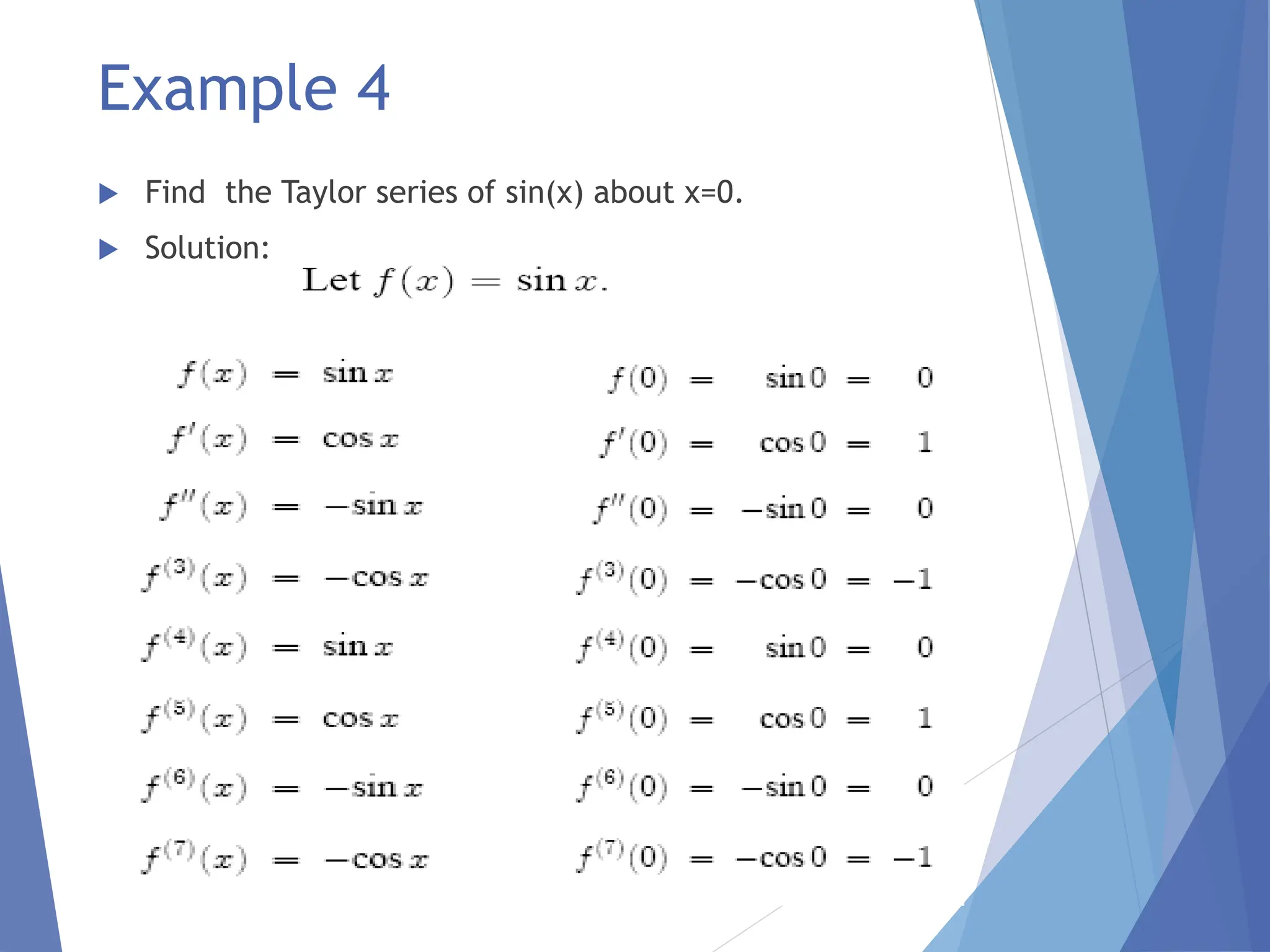
Example 4
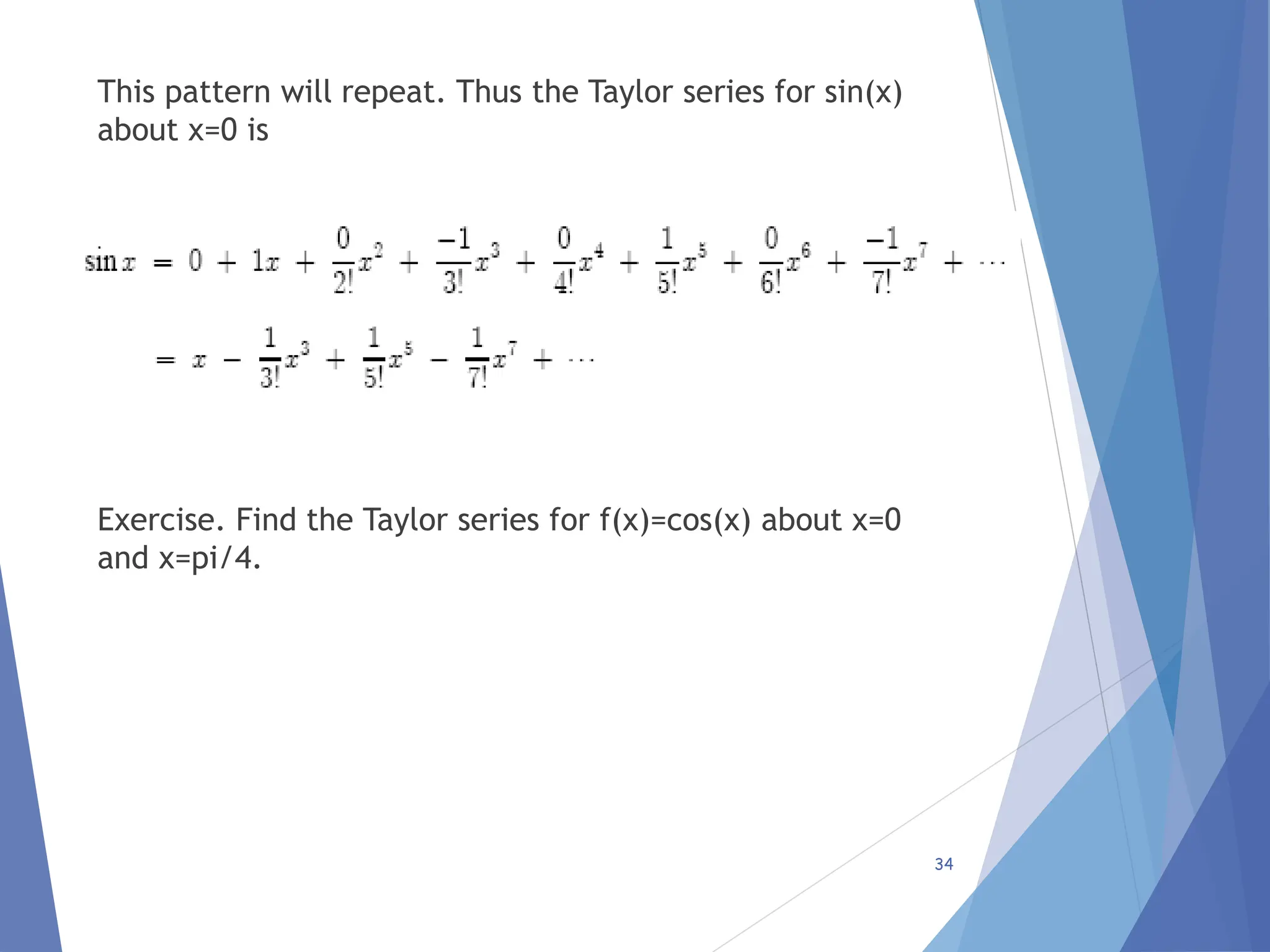
 Find the Taylor series of sin(x) about x=0.
 Solution:
33
34
This pattern will repeat. Thus the Taylor series for sin(x)
about x=0 is
Exercise. Find the Taylor series for f(x)=cos(x) about x=0
and x=pi/4.

Unit One - Solved problems on error analysis .ppt

  • 1.
  • 2.
  • 3.
    What is aNumerical Method (NM)?  A method of solving complex engineering problems when analytical methods fail to provide a solution.  Opposite of NM is Analytical Method. 3
  • 4.
    Problem: Solve the equation:x2 - 3x + 2 = 0 Solutions: a) Analytical Method: Using the formula we get 4 a ac b b x 2 4 2     1 2 2 8 9 3 or x    
  • 5.
    NUMERICAL METHOD Step 1:Rewrite the equation as x = (x2 + 2)/3 Step 2: Start with some initial solution, say x = 0 Step 3: Using the equation in Step 1, determine x (Here x = 2/3) Step 4: Use this value of x to determine the next approximation. Step 5: Repeat the process until two successive values are almost the same. 5
  • 6.
    Result: With the equationx = (x2 + 2)/3 and the initial value x = 0, the successive solutions computed are as follows: 0, 0.6667, 0.8148, 0.8880, 0.9295, 0.9547, 0.9705, 0.9806, 0.9872, 0.9915, 0.9944, 0.9963, 0.9975, 0.9983, 0.9989, 0.9993, 0.9995,….. 6
  • 7.
    Important issues inNM 7 APPROXIMATION errors accuracy condition stability significant figures precision
  • 8.
    Accuracy vs. Bias Accuracy: “…how closely a computed value agrees with the true value”  Bias/Inaccuracy : “…a systematic deviation from the truth” 8 vs. Accurate Biased/Inaccurate
  • 9.
    Precision vs. Uncertainty Precision : “…how closely individual computed values agree with each other”  Uncertainty/Imprecision : “…magnitude of scatter” 9 vs . Precise Uncertain/Imprecise
  • 10.
    Analogy of atarget practice 10 accurate & precise accurate & imprecise Inaccurate & precise Increasing accuracy Increasing precision Inaccurate & imprecise
  • 11.
    Types of Error Errorsare of two types: 1. Truncation Error 2. Round-off Error Truncation error is a result of using approximations to represent exact mathematical procedures. Round-off error occurs when only certain digits and decimal places are used to represent exact numbers. 11
  • 12.
    Example 1: 1. Weknow that Suppose we use it to evaluate sin 30°. x = 30°=/6  0.5236 Our first approximation is sin 30°  0.5236. 12       ! 5 ! 3 sin 5 3 x x x x
  • 13.
    Second approximation: sin 30° 0.5236 - 0.52363/6 = 0.499675 Third approximation: sin 30°  0.499675+0.52365/120 =0.5000029570 The error involved in the approximations here is truncation error, since terms in the approximating series are truncated. 13
  • 14.
    Example 2:  Considerthe number 3.12746  If the number is written correct to 3 decimal places, then it is approximated as 3.127  If the number is written correct to 4 decimal places, then it is approximated as 3.1275  The error involved in this kind of approximation is called round-off error. 14
  • 15.
    Measurement of Errors: Precision and accuracy are important criteria for the assessment of approximate solutions.  There are formulae to measure these characteristics.  When the current solution is compared with the true solution, the error involved is called true error.  When the current solution is compared with the solution obtained in the previous iteration, the error involved is called approximate error. 15
  • 16.
    1. True Error: •It is used to measure the lack of accuracy of an estimate. • True (absolute) error = Et = True value – Approximation • True relative error = Et /True value 16
  • 17.
    True percent relativeerror = t  Usually this is expressed as an absolute value (i.e., without any sign) 17 % 100    value True ion approximat value True
  • 18.
    Approximate Error: • usedto measure the lack of precision of an estimate. • Approximate (absolute) error Ea = Current approximation - Previous approximation • Approximate relative error = Ea/Current app 18
  • 19.
    Approximate percent relativeerror = a  Usually this is also expressed as an absolute value (i.e., without any sign) 19 % 100 approx Current approx Previous approx. Current   
  • 20.
    Exercise (HW 1) Thefollowing sequence of estimates was obtained when a numerical method was applied to solve the equation: x4 – 5x – 7 = 0. 1.8254 1.9633 2.0121 2.0283 2.0335 2.0351 2.0356 2.0358 Calculate the four errors for these estimates, given that one of the roots of the equation is 2.0359. 20
  • 21.
    Significant Figures  Usuallycomputation is repeated until the • approximate percent relative error (|a| ) is within the pre-specified acceptable level ( denoted by s ) i.e., until |a|< s • s is usually determined by specifying the number of significant figures required. • If the number of significant figures required is at least n, then s must be (0.510 2-n)% 21
  • 22.
    Example:  Suppose wewish to get the result of a computation correct to 3 significant figures i.e., n = 3  Here we must fix s as s = 0.510 2-3 % = 0.05%  It means that we must improve our estimate until |a| becomes less than 0.05 22
  • 23.
     Suppose ourfirst two estimates are 1.23456 and 1.23785.  Since |a| is more than s , we must continue the iteration. 23 0.05 0.265783 100 1.23785 1.23456 - 1.23785 | |     a 
  • 24.
    Suppose the thirdestimate is 1.23812. Error is now estimated as Now we see that |a| is less than s . Hence we have got the precision required and we can stop the iteration. 24 0.05 0.021807 100 1.23812 1.23785 - 1.23812 | |     a 
  • 25.
    Problem The Maclaurin seriesexpansion for sin x is (i) Starting with the simplest version sin x = x, add terms one at a time to estimate sin(/4). (ii) After each term is added, compute the true and approximate percent relative errors. (iii) From the calculator, determine the true value. Add terms until the absolute value of the approximate error falls below an error conforming to four significant figures. 25       ! 5 ! 3 sin 5 3 x x x x
  • 26.
    Solution: /4 = 0.7853 Truevalue of sin (/4) = 0.707107 Estimate a (%) t(%) 0.7853982 - 11.0720735 0.7046527 11.4589099 -------------- 0.7071430 ------------- 0.0051286 ------------- 0.0051727 0.0000441 0.7071068 0.0000443 0.0000002 26
  • 27.
    Problem The exponential functioncan be computed using (i) Starting with the simplest version , add terms one at a time to estimate (ii) After each term is added, compute the true and approximate percent relative errors. (iii) From the calculator, determine the true value. Add terms until the absolute value of the approximate error falls below an error conforming to three significant figures. 27 ! ! 3 2 1 3 2 n x x x x e n x        1  x e 5 . 0 e
  • 28.
    Solution: True value of 28 .. 648721 . 1 5 . 0  e Estimatea (%) t(%) 1 - 39.3 1.5 33.3 9.02 1.625 7.69 1.44 1.645833333 1.27 0.175 1.648437500 0.158 0.0172 1.648697917 0.0158 0.00142
  • 29.
    Quick Notes onTaylor Series  The Taylor expansion about x=a, is given as  with  Is called as the remainder or error of the Taylor series 29
  • 30.
    If a=0, theTaylor series is known as Maclaurin series. 30
  • 31.
  • 32.
  • 33.
    Example 4  Findthe Taylor series of sin(x) about x=0.  Solution: 33
  • 34.
    34 This pattern willrepeat. Thus the Taylor series for sin(x) about x=0 is Exercise. Find the Taylor series for f(x)=cos(x) about x=0 and x=pi/4.