Represented By : Arijit Dhali
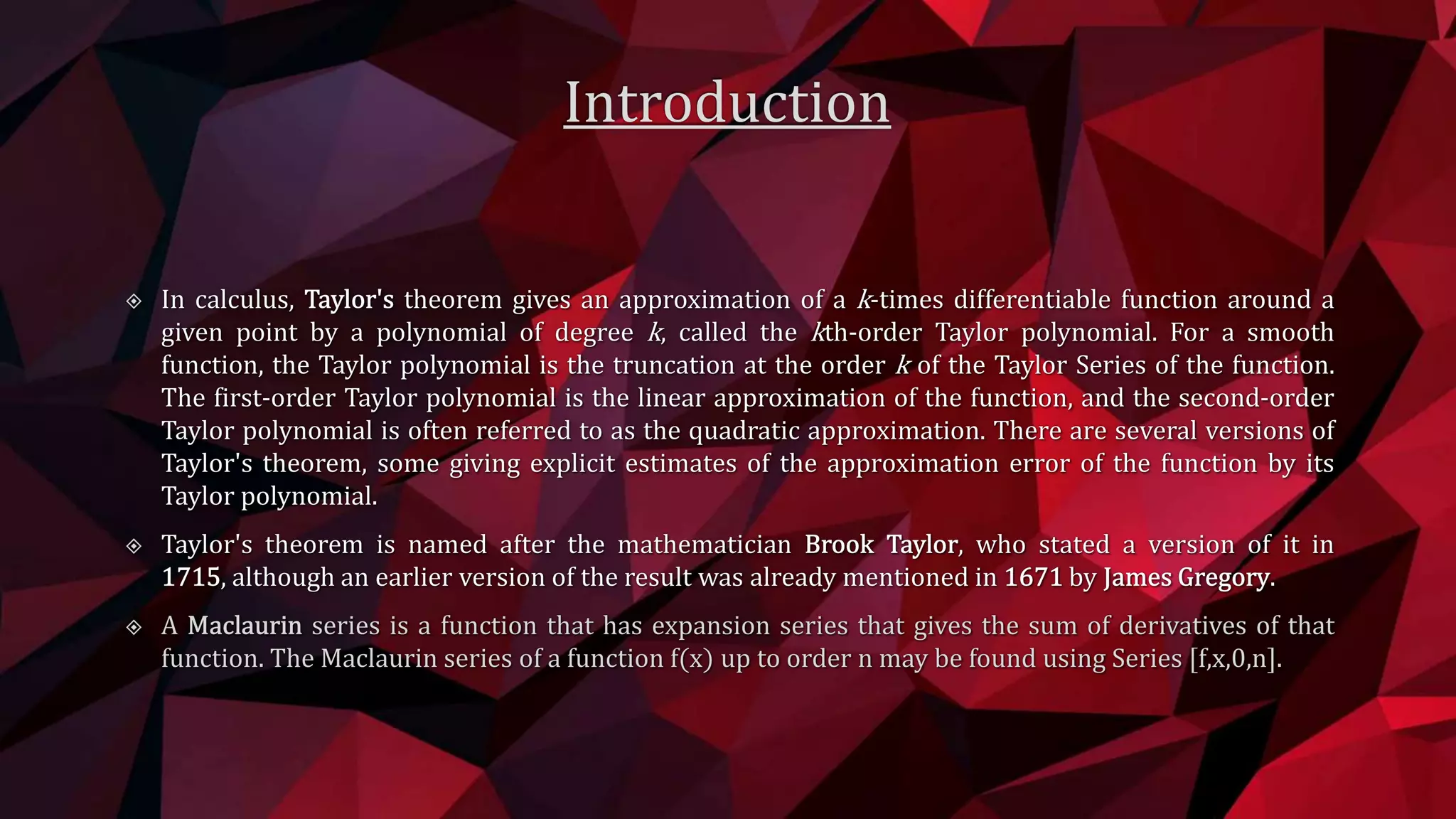
• Continuity:
Continuity is the formulation of the intuitive concept of a function that varies with no abrupt
breaks or jumps.
• Derivative:
Derivative of a function of a real variable measures the sensitivity to change of the function
value with respect to a change in its argument.
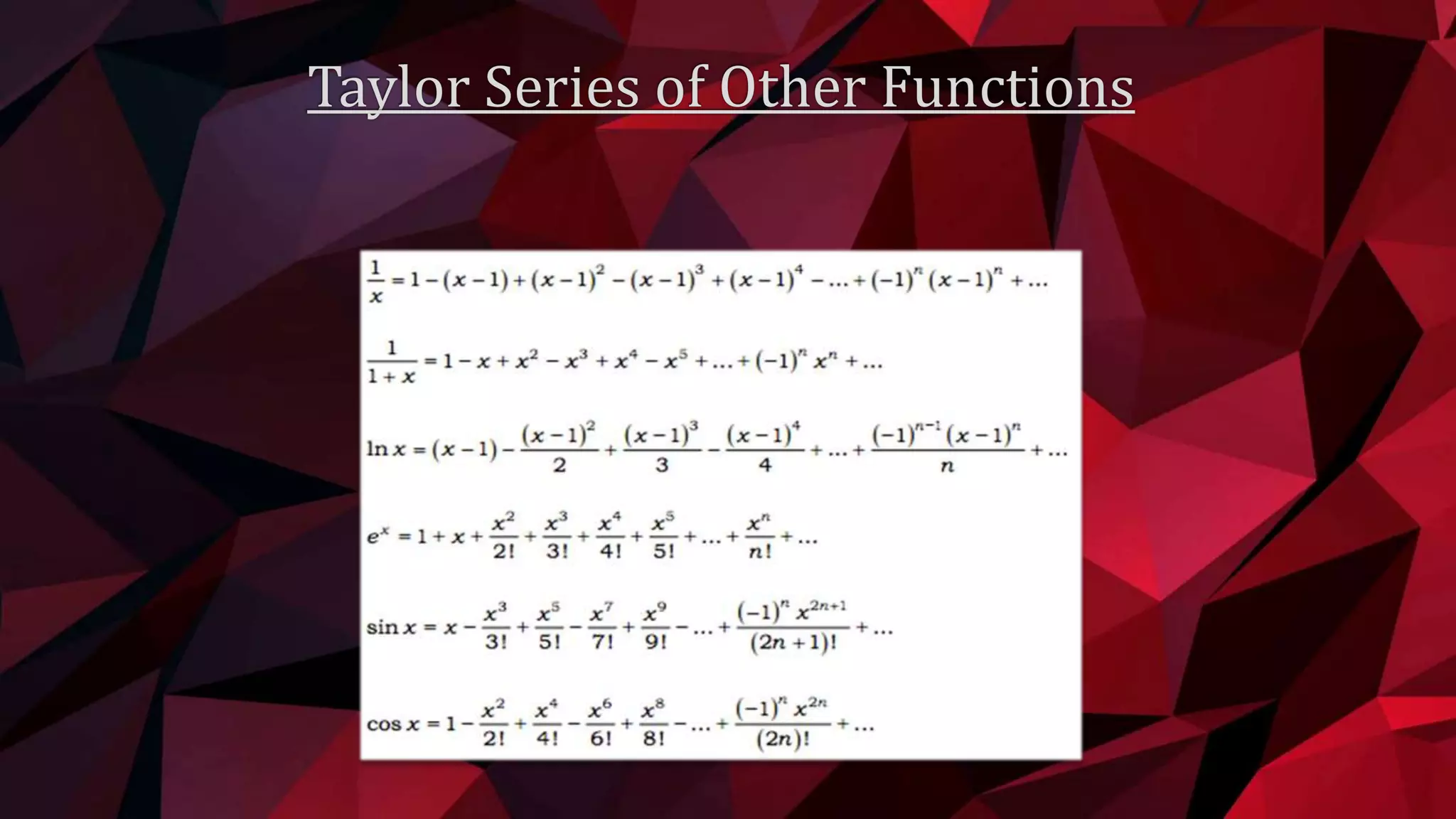
• Taylor Series:
Taylor series of a function is an infinite sum of terms that are expressed in terms of the
function's derivatives at a single point.
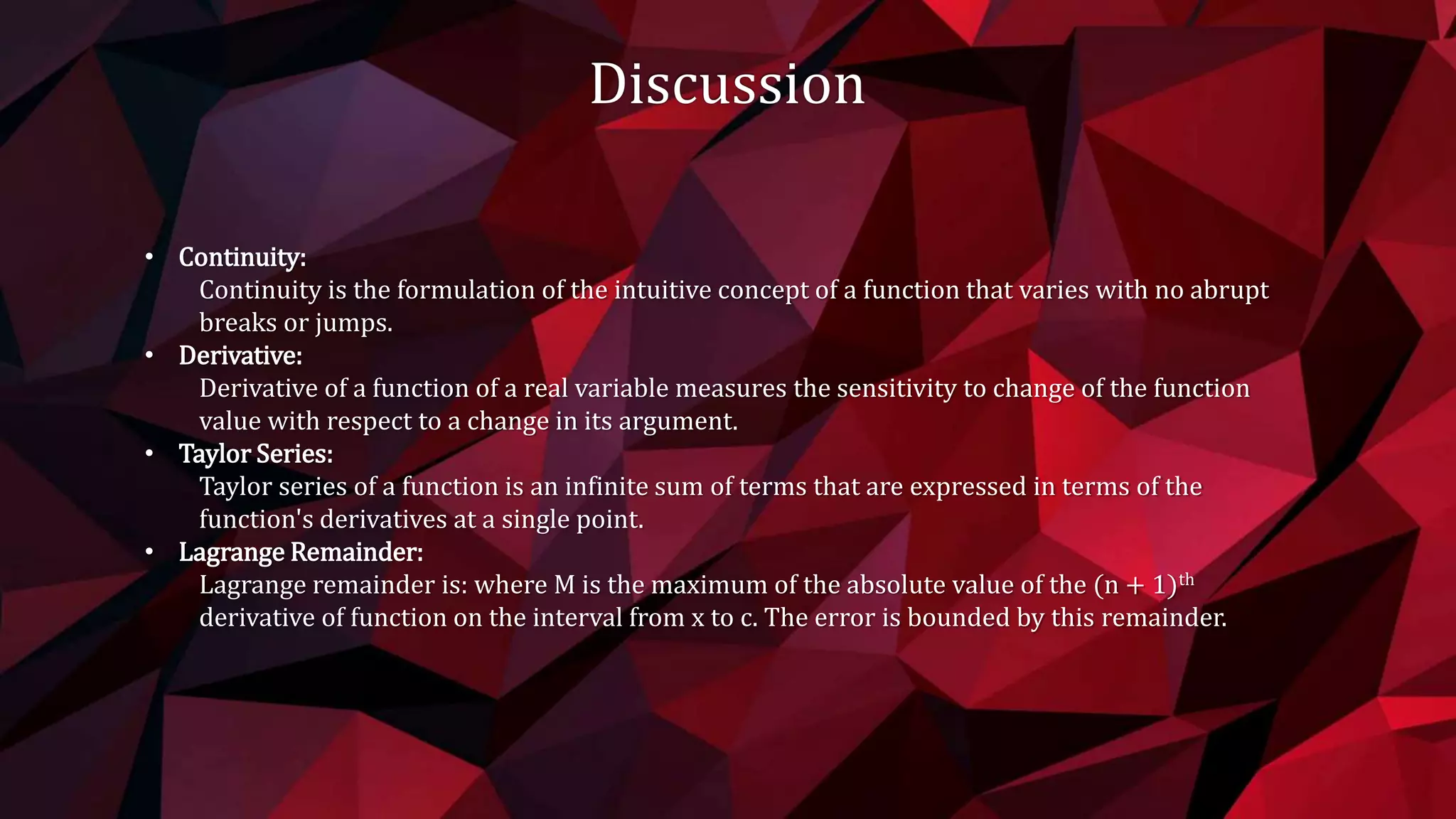
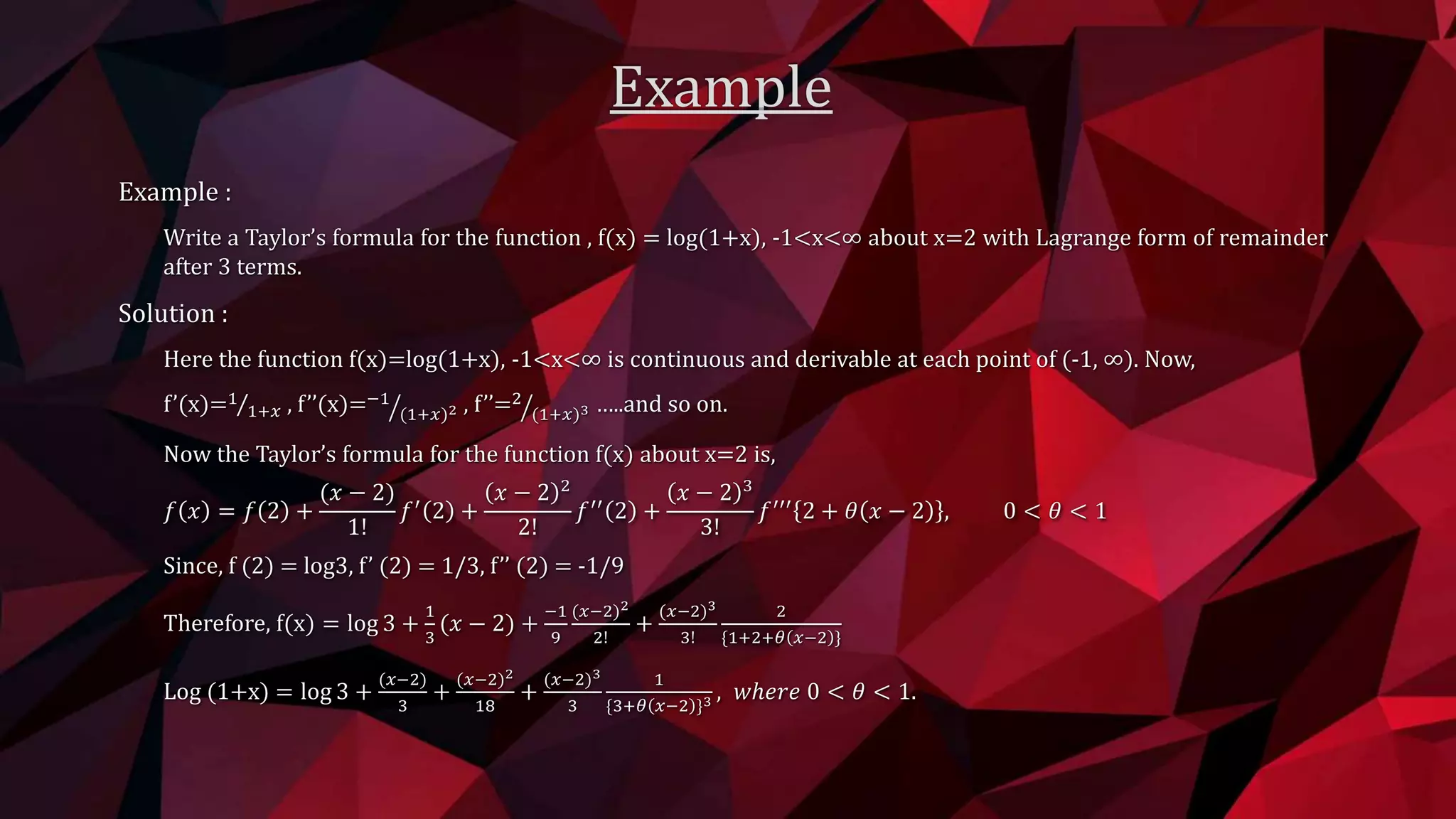
• Lagrange Remainder:
Lagrange remainder is: where M is the maximum of the absolute value of the (n + 1)th
derivative of function on the interval from x to c. The error is bounded by this remainder.
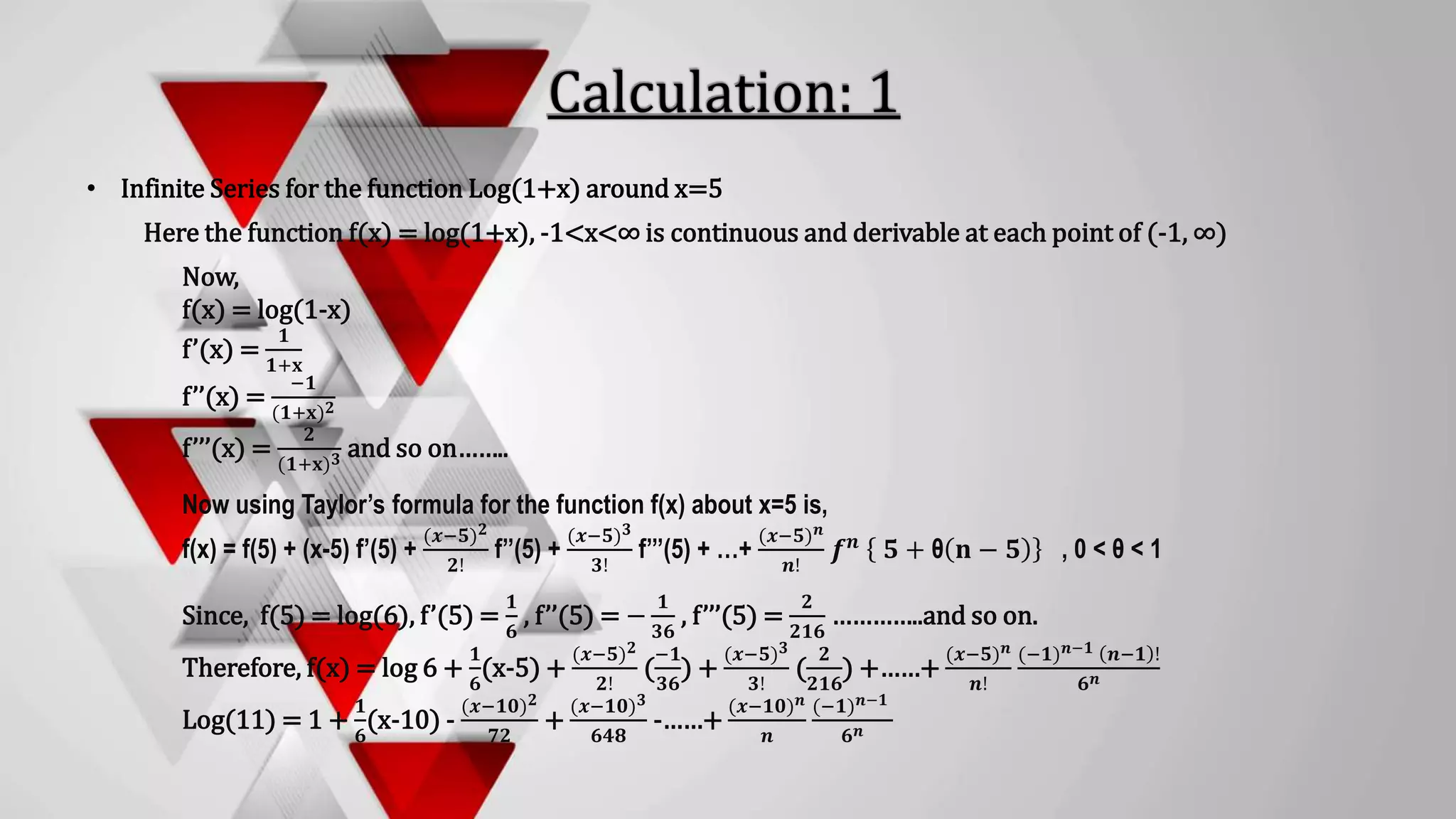
• Infinite Series for the function Log(1+x) around x=5
Here the function f(x) = log(1+x), -1<x<∞ is continuous and derivable at each point of (-1, ∞)
Now,
f(x) = log(1-x)
f’(x) =
𝟏
𝟏+𝐱
f’’(x) =
−𝟏
(𝟏+𝐱)𝟐
f’’’(x) =
𝟐
(𝟏+𝐱)𝟑 and so on……..
Now using Taylor’s formula for the function f(x) about x=5 is,
f(x) = f(5) + (x-5) f’(5) +
(𝒙−𝟓)𝟐
𝟐!
f’’(5) +
(𝒙−𝟓)𝟑
𝟑!
f’’’(5) + …+
(𝒙−𝟓)𝒏
𝒏!
𝒇𝒏 𝟓 + θ 𝐧 − 𝟓 , 0 < θ < 1
Since, f(5) = log(6), f’(5) =
𝟏
𝟔
, f’’(5) = −
𝟏
𝟑𝟔
, f’’’(5) =
𝟐
𝟐𝟏𝟔
…………..and so on.
Therefore, f(x) = log 6 +
𝟏
𝟔
(x-5) +
(𝒙−𝟓)𝟐
𝟐!
(
−𝟏
𝟑𝟔
) +
(𝒙−𝟓)𝟑
𝟑!
(
𝟐
𝟐𝟏𝟔
) +……+
(𝒙−𝟓)𝒏
𝒏!
(−𝟏)𝒏−𝟏 𝒏−𝟏 !
𝟔𝒏
Log(11) = 1 +
𝟏
𝟔
(x-10) -
(𝒙−𝟏𝟎)𝟐
𝟕𝟐
+
(𝒙−𝟏𝟎)𝟑
𝟔𝟒𝟖
-……+
(𝒙−𝟏𝟎)𝒏
𝒏
(−𝟏)𝒏−𝟏
𝟔𝒏
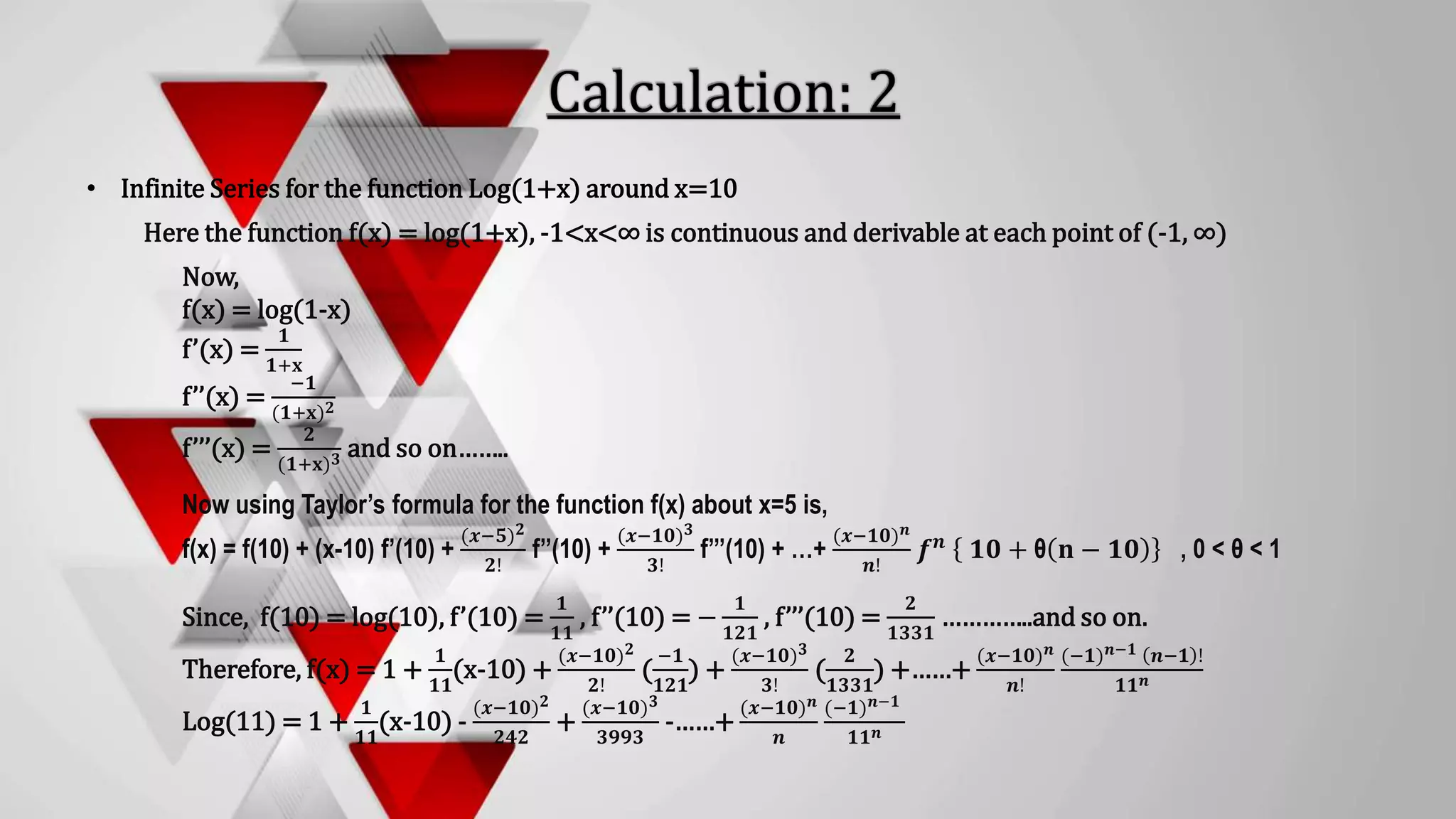
• Infinite Series for the function Log(1+x) around x=10
Here the function f(x) = log(1+x), -1<x<∞ is continuous and derivable at each point of (-1, ∞)
Now,
f(x) = log(1-x)
f’(x) =
𝟏
𝟏+𝐱
f’’(x) =
−𝟏
(𝟏+𝐱)𝟐
f’’’(x) =
𝟐
(𝟏+𝐱)𝟑 and so on……..
Now using Taylor’s formula for the function f(x) about x=5 is,
f(x) = f(10) + (x-10) f’(10) +
(𝒙−𝟓)𝟐
𝟐!
f’’(10) +
(𝒙−𝟏𝟎)𝟑
𝟑!
f’’’(10) + …+
(𝒙−𝟏𝟎)𝒏
𝒏!
𝒇𝒏 𝟏𝟎 + θ 𝐧 − 𝟏𝟎 , 0 < θ < 1
Since, f(10) = log(10), f’(10) =
𝟏
𝟏𝟏
, f’’(10) = −
𝟏
𝟏𝟐𝟏
, f’’’(10) =
𝟐
𝟏𝟑𝟑𝟏
…………..and so on.
Therefore, f(x) = 1 +
𝟏
𝟏𝟏
(x-10) +
(𝒙−𝟏𝟎)𝟐
𝟐!
(
−𝟏
𝟏𝟐𝟏
) +
(𝒙−𝟏𝟎)𝟑
𝟑!
(
𝟐
𝟏𝟑𝟑𝟏
) +……+
(𝒙−𝟏𝟎)𝒏
𝒏!
(−𝟏)𝒏−𝟏 𝒏−𝟏 !
𝟏𝟏𝒏
Log(11) = 1 +
𝟏
𝟏𝟏
(x-10) -
(𝒙−𝟏𝟎)𝟐
𝟐𝟒𝟐
+
(𝒙−𝟏𝟎)𝟑
𝟑𝟗𝟗𝟑
-……+
(𝒙−𝟏𝟎)𝒏
𝒏
(−𝟏)𝒏−𝟏
𝟏𝟏𝒏
• This project has been beneficial for us , as it enabled us to gain a lot of knowledge about the use
of Taylor Series about a appoint , as well as its applications. It also helped us to develop a better
coordination among us as we shared different perspectives and ideas regarding the sub-topics
we organized in this project .
• https://en.wikipedia.org/wiki/Taylor_series
• https://math.stackexchange.com
• https://www.quora.com/What-is-the-expansion-of-log-1-x
• Engineering Mathematics I – B.K.Pal & K.Das
Taylor Series Expansion of Log(1+x)

Taylor Series Expansion of Log(1+x)

  • 1.
    Represented By :Arijit Dhali
  • 5.
    • Continuity: Continuity isthe formulation of the intuitive concept of a function that varies with no abrupt breaks or jumps. • Derivative: Derivative of a function of a real variable measures the sensitivity to change of the function value with respect to a change in its argument. • Taylor Series: Taylor series of a function is an infinite sum of terms that are expressed in terms of the function's derivatives at a single point. • Lagrange Remainder: Lagrange remainder is: where M is the maximum of the absolute value of the (n + 1)th derivative of function on the interval from x to c. The error is bounded by this remainder.
  • 9.
    • Infinite Seriesfor the function Log(1+x) around x=5 Here the function f(x) = log(1+x), -1<x<∞ is continuous and derivable at each point of (-1, ∞) Now, f(x) = log(1-x) f’(x) = 𝟏 𝟏+𝐱 f’’(x) = −𝟏 (𝟏+𝐱)𝟐 f’’’(x) = 𝟐 (𝟏+𝐱)𝟑 and so on…….. Now using Taylor’s formula for the function f(x) about x=5 is, f(x) = f(5) + (x-5) f’(5) + (𝒙−𝟓)𝟐 𝟐! f’’(5) + (𝒙−𝟓)𝟑 𝟑! f’’’(5) + …+ (𝒙−𝟓)𝒏 𝒏! 𝒇𝒏 𝟓 + θ 𝐧 − 𝟓 , 0 < θ < 1 Since, f(5) = log(6), f’(5) = 𝟏 𝟔 , f’’(5) = − 𝟏 𝟑𝟔 , f’’’(5) = 𝟐 𝟐𝟏𝟔 …………..and so on. Therefore, f(x) = log 6 + 𝟏 𝟔 (x-5) + (𝒙−𝟓)𝟐 𝟐! ( −𝟏 𝟑𝟔 ) + (𝒙−𝟓)𝟑 𝟑! ( 𝟐 𝟐𝟏𝟔 ) +……+ (𝒙−𝟓)𝒏 𝒏! (−𝟏)𝒏−𝟏 𝒏−𝟏 ! 𝟔𝒏 Log(11) = 1 + 𝟏 𝟔 (x-10) - (𝒙−𝟏𝟎)𝟐 𝟕𝟐 + (𝒙−𝟏𝟎)𝟑 𝟔𝟒𝟖 -……+ (𝒙−𝟏𝟎)𝒏 𝒏 (−𝟏)𝒏−𝟏 𝟔𝒏
  • 10.
    • Infinite Seriesfor the function Log(1+x) around x=10 Here the function f(x) = log(1+x), -1<x<∞ is continuous and derivable at each point of (-1, ∞) Now, f(x) = log(1-x) f’(x) = 𝟏 𝟏+𝐱 f’’(x) = −𝟏 (𝟏+𝐱)𝟐 f’’’(x) = 𝟐 (𝟏+𝐱)𝟑 and so on…….. Now using Taylor’s formula for the function f(x) about x=5 is, f(x) = f(10) + (x-10) f’(10) + (𝒙−𝟓)𝟐 𝟐! f’’(10) + (𝒙−𝟏𝟎)𝟑 𝟑! f’’’(10) + …+ (𝒙−𝟏𝟎)𝒏 𝒏! 𝒇𝒏 𝟏𝟎 + θ 𝐧 − 𝟏𝟎 , 0 < θ < 1 Since, f(10) = log(10), f’(10) = 𝟏 𝟏𝟏 , f’’(10) = − 𝟏 𝟏𝟐𝟏 , f’’’(10) = 𝟐 𝟏𝟑𝟑𝟏 …………..and so on. Therefore, f(x) = 1 + 𝟏 𝟏𝟏 (x-10) + (𝒙−𝟏𝟎)𝟐 𝟐! ( −𝟏 𝟏𝟐𝟏 ) + (𝒙−𝟏𝟎)𝟑 𝟑! ( 𝟐 𝟏𝟑𝟑𝟏 ) +……+ (𝒙−𝟏𝟎)𝒏 𝒏! (−𝟏)𝒏−𝟏 𝒏−𝟏 ! 𝟏𝟏𝒏 Log(11) = 1 + 𝟏 𝟏𝟏 (x-10) - (𝒙−𝟏𝟎)𝟐 𝟐𝟒𝟐 + (𝒙−𝟏𝟎)𝟑 𝟑𝟗𝟗𝟑 -……+ (𝒙−𝟏𝟎)𝒏 𝒏 (−𝟏)𝒏−𝟏 𝟏𝟏𝒏
  • 11.
    • This projecthas been beneficial for us , as it enabled us to gain a lot of knowledge about the use of Taylor Series about a appoint , as well as its applications. It also helped us to develop a better coordination among us as we shared different perspectives and ideas regarding the sub-topics we organized in this project .
  • 12.
    • https://en.wikipedia.org/wiki/Taylor_series • https://math.stackexchange.com •https://www.quora.com/What-is-the-expansion-of-log-1-x • Engineering Mathematics I – B.K.Pal & K.Das