Hypothermic Resuscitation

  Sombat Muengtaweepongsa M D
         Muengtaweepongsa, M.D.
       Division of Neurology
        Faculty of Medicine
      Thammasat University
Scope
• Therapeutic hypothermia after cardiac arrest
• Therapeutic hypothermia in ischemic stroke
• Fever control in critical care neurology
2005 ILCOR
• There seems to be good evidence (level
  1) to recommend the use of induced
   )
  mild hypothermia in comatose
  survivors of out hospital cardiac arrest
            of-out-hospital
  caused by VF.
Level 1 evidence indicates one or more randomized clinical trials in which
benefit was shown
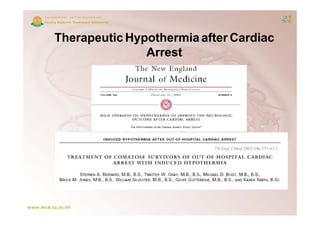
Therapeutic Hypothermia after Cardiac
               Arrest


                           (N Engl J Med 2002;346:557-63.)
The
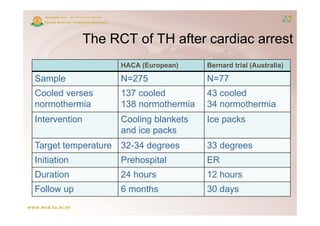
               Th RCT of TH after cardiac arrest
                       f     ft      di        t
                     HACA (European)    Bernard trial (Australia)

Sample               N=275              N=77
Cooled verses        137 cooled         43 cooled
normothermia         138 normothermia   34 normothermia
Intervention         Cooling blankets   Ice packs
                     and ice packs
Target temperature   32-34 degrees      33 degrees
Initiation           Prehospital
                           p            ER
Duration             24 hours           12 hours
Follow up            6 months           30 days
Benefit
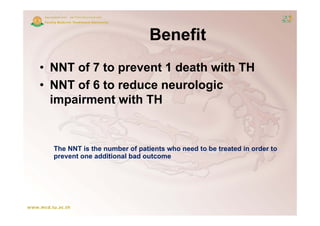
• NNT of 7 to prevent 1 death with TH
• NNT of 6 to reduce neurologic
  impairment with TH


  The NNT is the number of patients who need to be treated in order to
  prevent one additional bad outcome
HACA study group, 2002. New England Journal of
                                           Medicine 346(8).


                    Adverse E
                    Ad      Events
                                t
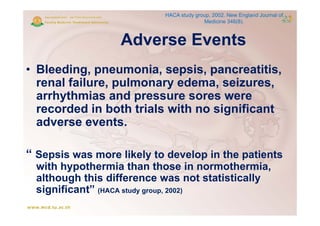
• Bleeding, pneumonia, sepsis, pancreatitis,
  renal failure, pulmonary edema, seizures,
               ,p         y       ,         ,
  arrhythmias and pressure sores were
                                    g
  recorded in both trials with no significant
  adverse events.

“ Sepsis was more likely to develop in the patients
  with h pothermia than those in normothermia
    ith hypothermia                    normothermia,
  although this difference was not statistically
  significant
  significant” (HACA study group 2002)
                           group,
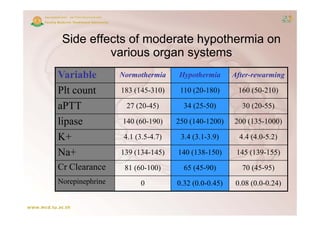
Side ff t f
 Sid effects of moderate hypothermia on
                  d t h      th   i
         various organ systems
Variable         Normothermia     Hypothermia       After-rewarming

Plt count
        t        183 (145-310)     110 (20-180)      160 (50-210)

aPTT              27 (20-45)        34 (25-50)         30 (20-55)

lipase           140 (60-190)     250 (140-1200)    200 (135-1000)

K+                4.1 (3.5-4.7)
                      (3.5 4.7)    3.4 (3.1-3.9)
                                       (3.1 3.9)      4.4 (4.0-5.2)
                                                          (4.0 5.2)

Na+              139 (134-145)    140 (138-150)      145 (139-155)
Cr Clearance
C Cl              81 (60-100)       65 (45-90)         70 (45-95)
Norepinephrine         0          0.32 (0.0-0.45)    0.08 (0.0-0.24)
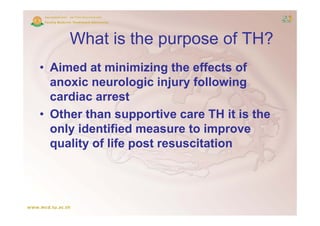
What is the purpose of TH?
• Aimed at minimizing the effects of
  anoxic neurologic injury following
                   g     j y         g
  cardiac arrest
• Other than supportive care TH it is the
  only identified measure to improve
  quality of life post resuscitation
           f f
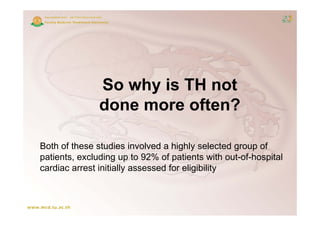
So why is TH not
               done more often?

Both of these studies involved a highly selected group of
patients, excluding up to 92% of patients with out-of-hospital
cardiac arrest initially assessed for eligibility
Suggested Inclusion Criteria
      gg
• TH is indicated if the patient meets all of the
   following criteria:
1. Witnessed arrest
2. Initial rhythm VF or pulseless VT…. But
3. Time to ACLS was less than 15 minutes and total
    of ACLS time less than 60 minutes
4. GCS of 8 or below
5. SBP of > 90 with or without vasopressors
6.
6 Less than 8 hours have elapsed since return of
    spontaneous circulation (ROSC)
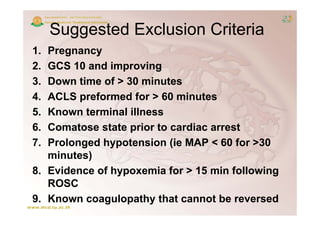
Suggested Exclusion Criteria
       gg
1. Pregnancy
2. GCS 10 and improving
3. Down time of > 30 minutes
4. ACLS preformed for > 60 minutes
5.
5  Known terminal illness
6. Comatose state prior to cardiac arrest
7.
7  Prolonged hypotension (ie MAP < 60 f >30
   P l      dh    t    i   (i           for 30
   minutes)
8. Evidence of hypoxemia for > 15 min following
   ROSC
9. Known coagulopathy that cannot be reversed
Mechanisms of neuroprotection by
     M h i           f         t ti b
                  hypothermia
• counteract ischemic brain damage by
  several mechanisms
  – prevention of the blood–brain-barrier
    disruption
  – oxygen-based free-radical production
  –  excitotoxicneurotransmitter release
  – anti-inflammatory action
  – delayed apoptosis
Historical Observations
• Not Dead till Warm and Dead
  – Cold patients would wake up in the Morgue
         p                    p           g
• Kids / Hockey Players- fall through ice,
  long rescue times but good recovery
              times,
• Hibernation: state of low oxygen, acidosis,
                               yg
  low energy supply
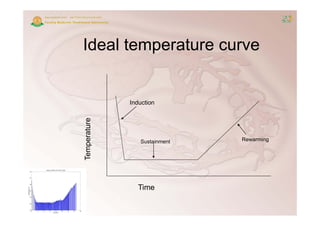
Ideal temperature curve


              Induction
    erature


                               Rewarming
Tempe


                 Sustainment


                 Time
                    e
Methods to Control Brain
 Temperature in Stroke
       Patients
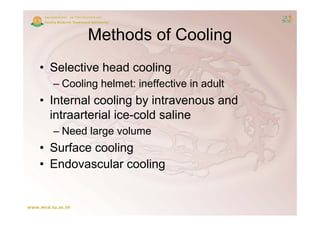
Methods of Cooling
• Selective head cooling
  – Cooling helmet: ineffective in adult
          g
• Internal cooling by intravenous and
  intraarterial ice-cold saline
                ice cold
  – Need large volume
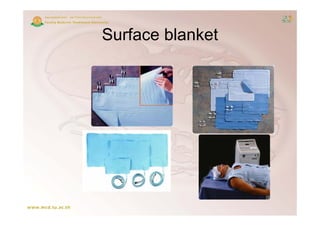
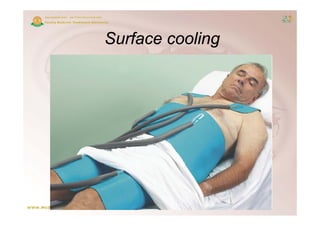
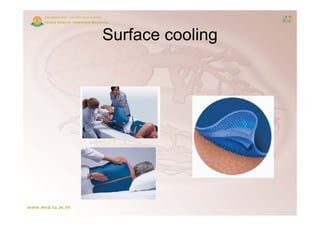
• Surface cooling
• Endovascular cooling
Surface blanket
Surface cooling
Surface cooling
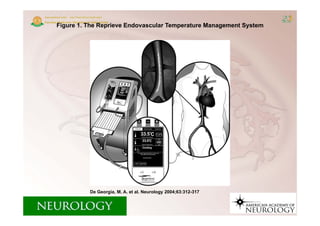
Figure 1. The Reprieve Endovascular Temperature Management System


          De Georgia, M. A. et al. Neurology 2004;63:312-317
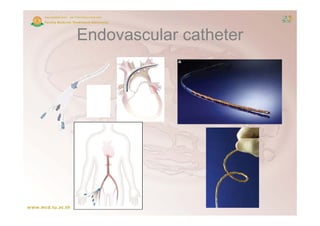
Endovascular catheter
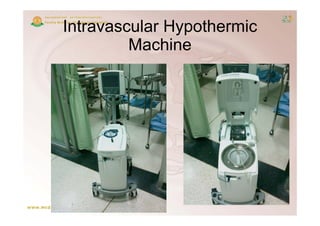
Intravascular Hypothermic
         Machine
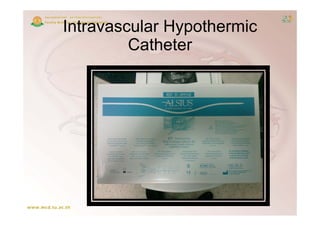
Intravascular Hypothermic
         Catheter
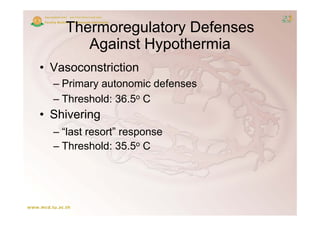
Thermoregulatory Defenses
       Against Hypothermia
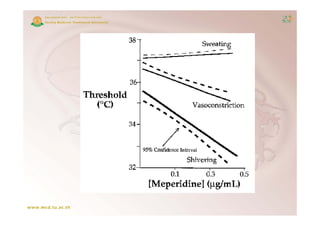
• Vasoconstriction
  – Primary autonomic defenses
          y
  – Threshold: 36.5o C
• Shivering
  – “last resort” response
  – Threshold: 35.5o C
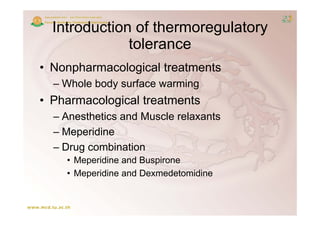
Introduction of thermoregulatory
              tolerance
• Nonpharmacological treatments
  – Whole body surface warming
             y               g
• Pharmacological treatments
  –AAnesthetics and M
        th ti     d Muscle relaxants
                        l    l    t
  – Meperidine
  – Drug combination
    • Meperidine and Buspirone
        p               p
    • Meperidine and Dexmedetomidine
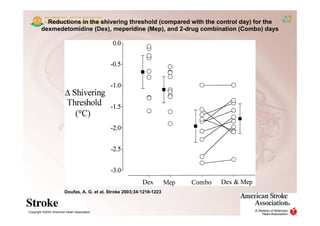
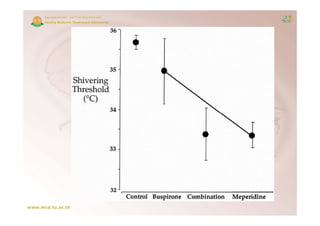
Reductions in the shivering threshold (compared with the control day) for the
        dexmedetomidine (Dex), meperidine (Mep), and 2-drug combination (Combo) days


                        Doufas, A. G. et al. Stroke 2003;34:1218-1223


Copyright ©2003 American Heart Association
Rewarming
• Th most critical period of risk related t
  The     t iti l     i d f i k l t d to
  therapeutic hypothermia
• Vasodilation
• Hypermetabolic response
  – Systemic inflammatory response syndrome
    (SIRS)
• Passive controlled rewarming
    Stepwise rewarming rate: 0 1 0 5 oC per h
  – St   i         i     t 0.1-0.5          hr
Rewarming
• C b l side effects
  Cerebral id ff t
  – Rebound edema and ICP elevation
• E
  Extracerebral side effects
           b l id ff
  – Infection
     • P
       Pneumonia
              i
     • Sepsis
  – Cardiopulmonary
     • Elevation of catecholamines: arrhythmia
  – Hematologic
     • Induced thrombosis
Therapeutic Hypothermia
           for
    Ischemic Stroke
A case scenario

69 y/o woman presented to an outside
  hospital with sudden onset of right sided
  h    it l ith dd           t f i ht id d
  weakness and speech impairment. She
  arrived at the OSH at 20 minutes after
  onset. CT brain was negative. TPA was
          CT-brain
  started at 90 minutes after the onset
  before she was transferred to SLUH
                                 SLUH.
A case scenario (cont )
                       (cont.)
She
Sh was alert and awake, b t aphasic.
        l t d       k but h i
NIHSS was 8 with:
  LOCb 2,
  partial hemianopia
          hemianopia,
  right arm drifting,
  some effort against gravity on right leg
                                        leg,
  partial sensory loss on the left side
  moderate aphasia.
             aphasia
A case scenario (cont )
                      (cont.)
Without ith i t b ti
With t either intubation or sedation,
                              d ti
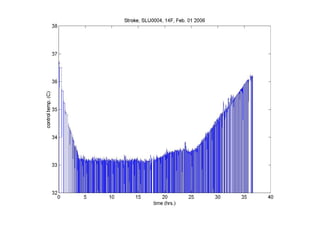
 therapeutic hypothermia with
 endovascular cooling technique was
 started at 5 hours after onset. Target core
 temperature of 33oC was reached within 3
 hrs. Shivering was under control with
 combination of surface warming and
 meperidine p
    p         plus buspirone. Gradual
                      p
 rewarming was applied after target
 temperature was maintained for 24 hrs.
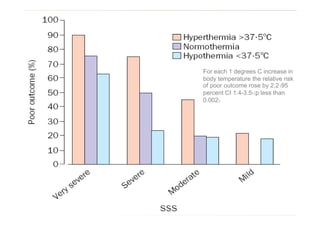
Temperature and stroke
For each 1 degrees C increase in
body temperature the relative risk
of poor outcome rose by 2.2 (95
percent CI 1.4-3.5) (p less than
0.002).
She was discharged to a rehab after 5 days
  of admission with NIHSS of 5 and mRS of
  3.
At day 30 She walked by herself to follow
       30,
  up at DOB. NIHSS was only 3 including
  hemianopia and partial sensory loss. mRSS
  was 2.
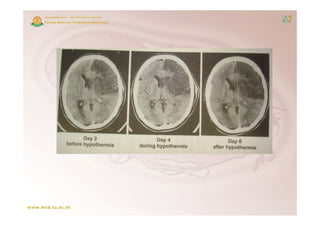
Hypothermia for Malignant
     MCA Infarction
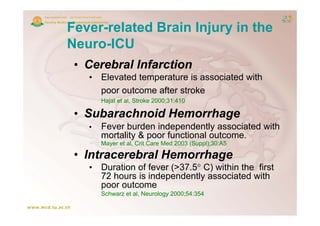
Fever-related Brain Injury in the
Neuro-ICU
 • C b l I f ti
   Cerebral Infarction
   • Elevated temperature is associated with
     poor outcome after stroke
            t      ft    t k
       Hajat et al, Stroke 2000;31:410

 • Subarachnoid Hemorrhage
   •   Fever burden independently associated with
       mortality & poor functional outcome.
               y p
       Mayer et al, Crit Care Med 2003 (Suppl);30:A5

 • Intracerebral Hemorrhage
   • D ti of f
     Duration f fever (>37.5° C) within th fi t
                      ( 37 5°     ithi the first
     72 hours is independently associated with
     poor outcome
       Schwarz et al, Neurology 2000;54:354
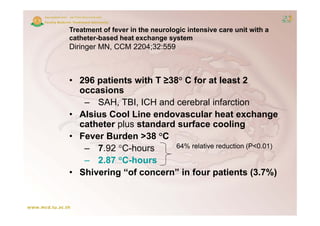
Treatment of fever in the neurologic intensive care unit with a
catheter-based heat exchange system
  th t b      dh t       h        t
Diringer MN, CCM 2204;32:559


• 296 patients with T ≥38° C for at least 2
  occasions
        i
   – SAH, TBI, ICH and cerebral infarction
• Alsius Cool Line endovascular heat exchange
  catheter plus standard surface cooling
• Fever Burden >38 °C
                  38 C
   – 7.92 °C-hours       64% relative reduction (P<0.01)

   – 2.87 °C-hours
• Shivering “of concern” in four patients (3.7%)
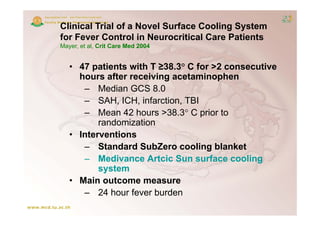
Clinical Trial of a Novel Surface Cooling System
for Fever Control in Neurocritical Care Patients
Mayer, et al, Crit Care Med 2004


   • 47 patients with T ≥38.3° C for >2 consecutive
     hours after receiving acetaminophen
      – Median GCS 8 0 8.0
      – SAH, ICH, infarction, TBI
      – Mean 42 hours >38 3° C prior to
                         >38.3
          randomization
   • Interventions
      – Standard SubZero cooling blanket
      – Medivance Artcic Sun surface cooling
          system
   • Main outcome measure
      – 24 h hour f
                  fever b d
                        burden
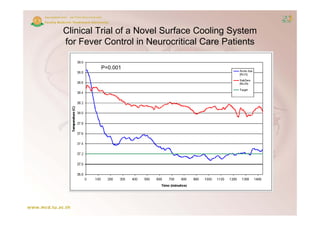
Clinical Trial of a Novel Surface Cooling System
for Fever Control in Neurocritical Care Patients

         P=0.001
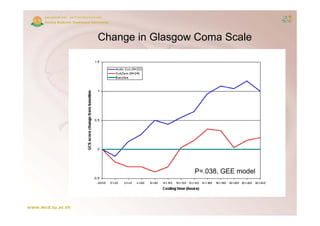
Change in Glasgow Coma Scale


                 P=.038, GEE model
Conclusion
• TH is a standard treatment in selected
  patients after cardiac arrest.
  p
• TH should be benefit for penumbra
  salvaging in acute ischemic stroke
                                 stroke.
• TH is one of treatments for increase ICP.
• Fever control is essential, particularly in
                            conditions.
  such a bad neurological conditions
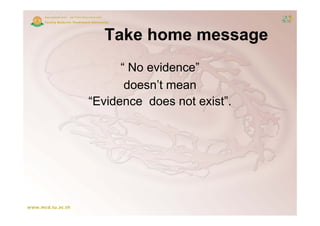
Take home message
      “ No evidence”
       doesn t
       doesn’t mean
“Evidence does not exist”.
Thank you for your attention

Hypothermic resuscitation sombat

  • 1.
    Hypothermic Resuscitation Sombat Muengtaweepongsa M D Muengtaweepongsa, M.D. Division of Neurology Faculty of Medicine Thammasat University
  • 2.
    Scope • Therapeutic hypothermiaafter cardiac arrest • Therapeutic hypothermia in ischemic stroke • Fever control in critical care neurology
  • 4.
    2005 ILCOR • Thereseems to be good evidence (level 1) to recommend the use of induced ) mild hypothermia in comatose survivors of out hospital cardiac arrest of-out-hospital caused by VF. Level 1 evidence indicates one or more randomized clinical trials in which benefit was shown
  • 5.
    Therapeutic Hypothermia afterCardiac Arrest (N Engl J Med 2002;346:557-63.)
  • 6.
    The Th RCT of TH after cardiac arrest f ft di t HACA (European) Bernard trial (Australia) Sample N=275 N=77 Cooled verses 137 cooled 43 cooled normothermia 138 normothermia 34 normothermia Intervention Cooling blankets Ice packs and ice packs Target temperature 32-34 degrees 33 degrees Initiation Prehospital p ER Duration 24 hours 12 hours Follow up 6 months 30 days
  • 7.
    Benefit • NNT of7 to prevent 1 death with TH • NNT of 6 to reduce neurologic impairment with TH The NNT is the number of patients who need to be treated in order to prevent one additional bad outcome
  • 8.
    HACA study group,2002. New England Journal of Medicine 346(8). Adverse E Ad Events t • Bleeding, pneumonia, sepsis, pancreatitis, renal failure, pulmonary edema, seizures, ,p y , , arrhythmias and pressure sores were g recorded in both trials with no significant adverse events. “ Sepsis was more likely to develop in the patients with h pothermia than those in normothermia ith hypothermia normothermia, although this difference was not statistically significant significant” (HACA study group 2002) group,
  • 9.
    Side ff tf Sid effects of moderate hypothermia on d t h th i various organ systems Variable Normothermia Hypothermia After-rewarming Plt count t 183 (145-310) 110 (20-180) 160 (50-210) aPTT 27 (20-45) 34 (25-50) 30 (20-55) lipase 140 (60-190) 250 (140-1200) 200 (135-1000) K+ 4.1 (3.5-4.7) (3.5 4.7) 3.4 (3.1-3.9) (3.1 3.9) 4.4 (4.0-5.2) (4.0 5.2) Na+ 139 (134-145) 140 (138-150) 145 (139-155) Cr Clearance C Cl 81 (60-100) 65 (45-90) 70 (45-95) Norepinephrine 0 0.32 (0.0-0.45) 0.08 (0.0-0.24)
  • 10.
    What is thepurpose of TH? • Aimed at minimizing the effects of anoxic neurologic injury following g j y g cardiac arrest • Other than supportive care TH it is the only identified measure to improve quality of life post resuscitation f f
  • 11.
    So why isTH not done more often? Both of these studies involved a highly selected group of patients, excluding up to 92% of patients with out-of-hospital cardiac arrest initially assessed for eligibility
  • 12.
    Suggested Inclusion Criteria gg • TH is indicated if the patient meets all of the following criteria: 1. Witnessed arrest 2. Initial rhythm VF or pulseless VT…. But 3. Time to ACLS was less than 15 minutes and total of ACLS time less than 60 minutes 4. GCS of 8 or below 5. SBP of > 90 with or without vasopressors 6. 6 Less than 8 hours have elapsed since return of spontaneous circulation (ROSC)
  • 13.
    Suggested Exclusion Criteria gg 1. Pregnancy 2. GCS 10 and improving 3. Down time of > 30 minutes 4. ACLS preformed for > 60 minutes 5. 5 Known terminal illness 6. Comatose state prior to cardiac arrest 7. 7 Prolonged hypotension (ie MAP < 60 f >30 P l dh t i (i for 30 minutes) 8. Evidence of hypoxemia for > 15 min following ROSC 9. Known coagulopathy that cannot be reversed
  • 14.
    Mechanisms of neuroprotectionby M h i f t ti b hypothermia • counteract ischemic brain damage by several mechanisms – prevention of the blood–brain-barrier disruption – oxygen-based free-radical production –  excitotoxicneurotransmitter release – anti-inflammatory action – delayed apoptosis
  • 15.
    Historical Observations • NotDead till Warm and Dead – Cold patients would wake up in the Morgue p p g • Kids / Hockey Players- fall through ice, long rescue times but good recovery times, • Hibernation: state of low oxygen, acidosis, yg low energy supply
  • 16.
    Ideal temperature curve Induction erature Rewarming Tempe Sustainment Time e
  • 17.
    Methods to ControlBrain Temperature in Stroke Patients
  • 18.
    Methods of Cooling •Selective head cooling – Cooling helmet: ineffective in adult g • Internal cooling by intravenous and intraarterial ice-cold saline ice cold – Need large volume • Surface cooling • Endovascular cooling
  • 19.
  • 20.
  • 21.
  • 22.
    Figure 1. TheReprieve Endovascular Temperature Management System De Georgia, M. A. et al. Neurology 2004;63:312-317
  • 23.
  • 24.
  • 25.
  • 26.
    Thermoregulatory Defenses Against Hypothermia • Vasoconstriction – Primary autonomic defenses y – Threshold: 36.5o C • Shivering – “last resort” response – Threshold: 35.5o C
  • 27.
    Introduction of thermoregulatory tolerance • Nonpharmacological treatments – Whole body surface warming y g • Pharmacological treatments –AAnesthetics and M th ti d Muscle relaxants l l t – Meperidine – Drug combination • Meperidine and Buspirone p p • Meperidine and Dexmedetomidine
  • 29.
    Reductions in theshivering threshold (compared with the control day) for the dexmedetomidine (Dex), meperidine (Mep), and 2-drug combination (Combo) days Doufas, A. G. et al. Stroke 2003;34:1218-1223 Copyright ©2003 American Heart Association
  • 31.
    Rewarming • Th mostcritical period of risk related t The t iti l i d f i k l t d to therapeutic hypothermia • Vasodilation • Hypermetabolic response – Systemic inflammatory response syndrome (SIRS) • Passive controlled rewarming Stepwise rewarming rate: 0 1 0 5 oC per h – St i i t 0.1-0.5 hr
  • 32.
    Rewarming • C bl side effects Cerebral id ff t – Rebound edema and ICP elevation • E Extracerebral side effects b l id ff – Infection • P Pneumonia i • Sepsis – Cardiopulmonary • Elevation of catecholamines: arrhythmia – Hematologic • Induced thrombosis
  • 33.
    Therapeutic Hypothermia for Ischemic Stroke
  • 34.
    A case scenario 69y/o woman presented to an outside hospital with sudden onset of right sided h it l ith dd t f i ht id d weakness and speech impairment. She arrived at the OSH at 20 minutes after onset. CT brain was negative. TPA was CT-brain started at 90 minutes after the onset before she was transferred to SLUH SLUH.
  • 35.
    A case scenario(cont ) (cont.) She Sh was alert and awake, b t aphasic. l t d k but h i NIHSS was 8 with: LOCb 2, partial hemianopia hemianopia, right arm drifting, some effort against gravity on right leg leg, partial sensory loss on the left side moderate aphasia. aphasia
  • 36.
    A case scenario(cont ) (cont.) Without ith i t b ti With t either intubation or sedation, d ti therapeutic hypothermia with endovascular cooling technique was started at 5 hours after onset. Target core temperature of 33oC was reached within 3 hrs. Shivering was under control with combination of surface warming and meperidine p p plus buspirone. Gradual p rewarming was applied after target temperature was maintained for 24 hrs.
  • 38.
  • 39.
    For each 1degrees C increase in body temperature the relative risk of poor outcome rose by 2.2 (95 percent CI 1.4-3.5) (p less than 0.002).
  • 41.
    She was dischargedto a rehab after 5 days of admission with NIHSS of 5 and mRS of 3. At day 30 She walked by herself to follow 30, up at DOB. NIHSS was only 3 including hemianopia and partial sensory loss. mRSS was 2.
  • 42.
  • 45.
    Fever-related Brain Injuryin the Neuro-ICU • C b l I f ti Cerebral Infarction • Elevated temperature is associated with poor outcome after stroke t ft t k Hajat et al, Stroke 2000;31:410 • Subarachnoid Hemorrhage • Fever burden independently associated with mortality & poor functional outcome. y p Mayer et al, Crit Care Med 2003 (Suppl);30:A5 • Intracerebral Hemorrhage • D ti of f Duration f fever (>37.5° C) within th fi t ( 37 5° ithi the first 72 hours is independently associated with poor outcome Schwarz et al, Neurology 2000;54:354
  • 46.
    Treatment of feverin the neurologic intensive care unit with a catheter-based heat exchange system th t b dh t h t Diringer MN, CCM 2204;32:559 • 296 patients with T ≥38° C for at least 2 occasions i – SAH, TBI, ICH and cerebral infarction • Alsius Cool Line endovascular heat exchange catheter plus standard surface cooling • Fever Burden >38 °C 38 C – 7.92 °C-hours 64% relative reduction (P<0.01) – 2.87 °C-hours • Shivering “of concern” in four patients (3.7%)
  • 47.
    Clinical Trial ofa Novel Surface Cooling System for Fever Control in Neurocritical Care Patients Mayer, et al, Crit Care Med 2004 • 47 patients with T ≥38.3° C for >2 consecutive hours after receiving acetaminophen – Median GCS 8 0 8.0 – SAH, ICH, infarction, TBI – Mean 42 hours >38 3° C prior to >38.3 randomization • Interventions – Standard SubZero cooling blanket – Medivance Artcic Sun surface cooling system • Main outcome measure – 24 h hour f fever b d burden
  • 48.
    Clinical Trial ofa Novel Surface Cooling System for Fever Control in Neurocritical Care Patients P=0.001
  • 49.
    Change in GlasgowComa Scale P=.038, GEE model
  • 50.
    Conclusion • TH isa standard treatment in selected patients after cardiac arrest. p • TH should be benefit for penumbra salvaging in acute ischemic stroke stroke. • TH is one of treatments for increase ICP. • Fever control is essential, particularly in conditions. such a bad neurological conditions
  • 51.
    Take home message “ No evidence” doesn t doesn’t mean “Evidence does not exist”.
  • 52.
    Thank you foryour attention