Sedation, Analgesia and Paralysis
in ICU
DR ANKIT GAJJAR
INTENSIVIST
ICU Sedation
• ICU sedation is a complex clinical problem
• Current therapeutic approaches all have
potential adverse side effects
• Agitated patients are often hypertensive,
increase stress hormones, and require more
intensive nursing care
The Need for Sedation
• Anxiety
• Pain
• Acute confusional status
• Mechanical ventilation
• Treatment or diagnostic procedures
• Psychological response to stress
• Patient comfort
• Control of pain
• Anxiolysis and amnesia
• Blunting adverse autonomic and
hemodynamic responses
• Facilitate nursing management
• Facilitate mechanical ventilation
• Avoid self-extubation
• Reduce oxygen consumption
Goals of sedation in the ICU
Characteristics of an ideal sedation agents
for the ICU
• Lack of respiratory depression
• Analgesia, especially for surgical patients
• Rapid onset, titratable, with a short elimination
half-time
• Sedation with ease of orientation and arousability
• Anxiolytic
• Hemodynamic stability
• The optimal level of sedation for most patients
is that which offers comfort while allowing for
interaction with the environment
The Challenges of ICU Sedation
• Assessment of sedation
• Altered pharmacology
• Tolerance
• Delayed emergence
• Withdrawal
• Drug interaction
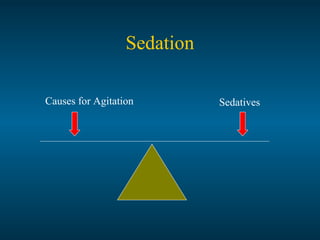
Sedation
SedativesCauses for Agitation
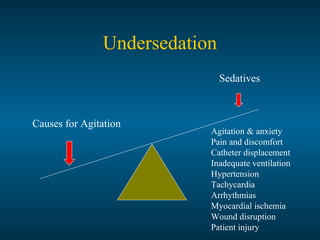
Undersedation
Sedatives
Causes for Agitation
Agitation & anxiety
Pain and discomfort
Catheter displacement
Inadequate ventilation
Hypertension
Tachycardia
Arrhythmias
Myocardial ischemia
Wound disruption
Patient injury
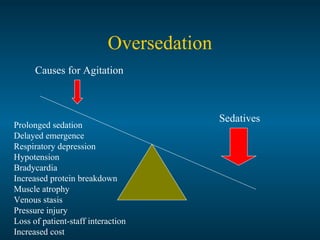
Oversedation
Sedatives
Causes for Agitation
Prolonged sedation
Delayed emergence
Respiratory depression
Hypotension
Bradycardia
Increased protein breakdown
Muscle atrophy
Venous stasis
Pressure injury
Loss of patient-staff interaction
Increased cost
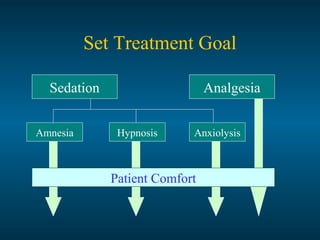
Set Treatment Goal
Sedation Analgesia
Amnesia AnxiolysisHypnosis
Patient Comfort
Pain
Assess Pain Separately
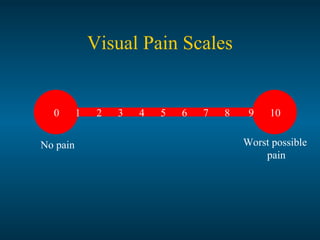
Visual Pain Scales
0 1 2 3 4 5 6 7 8 9 10
No pain Worst possible
pain
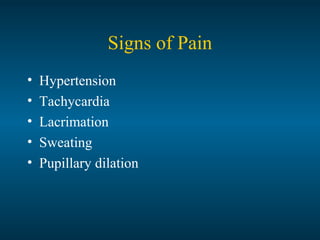
Signs of Pain
• Hypertension
• Tachycardia
• Lacrimation
• Sweating
• Pupillary dilation
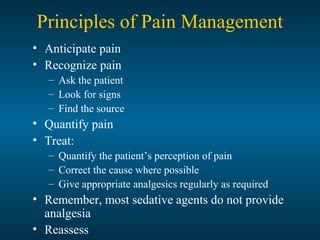
Principles of Pain Management
• Anticipate pain
• Recognize pain
– Ask the patient
– Look for signs
– Find the source
• Quantify pain
• Treat:
– Quantify the patient’s perception of pain
– Correct the cause where possible
– Give appropriate analgesics regularly as required
• Remember, most sedative agents do not provide
analgesia
• Reassess
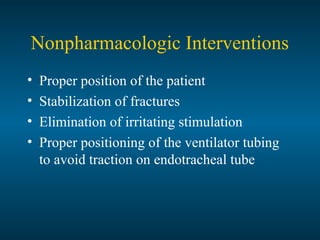
Nonpharmacologic Interventions
• Proper position of the patient
• Stabilization of fractures
• Elimination of irritating stimulation
• Proper positioning of the ventilator tubing
to avoid traction on endotracheal tube
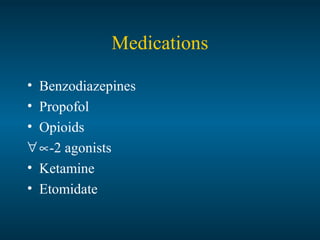
Medications
• Benzodiazepines
• Propofol
• Opioids
∀∝-2 agonists
• Ketamine
• Etomidate
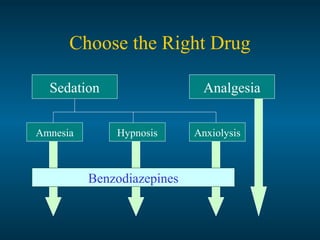
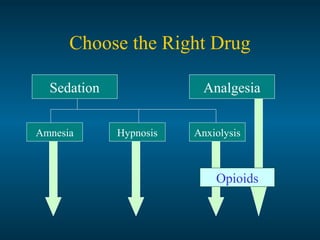
Choose the Right Drug
Sedation Analgesia
Amnesia AnxiolysisHypnosis
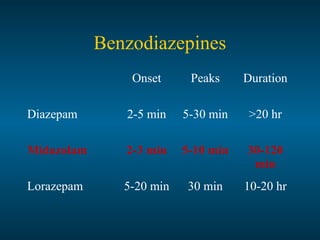
Benzodiazepines
Benzodiazepines
Onset Peaks Duration
Diazepam 2-5 min 5-30 min >20 hr
Midazolam 2-3 min 5-10 min 30-120
min
Lorazepam 5-20 min 30 min 10-20 hr
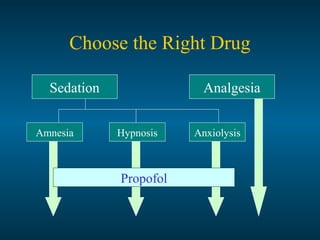
Choose the Right Drug
Sedation Analgesia
Amnesia AnxiolysisHypnosis
Propofol
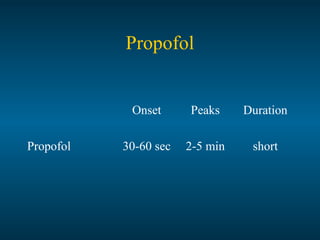
Propofol
Onset Peaks Duration
Propofol 30-60 sec 2-5 min short
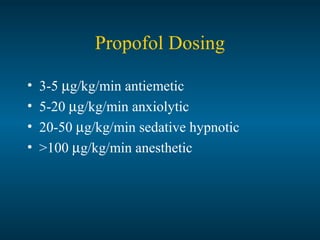
Propofol Dosing
• 3-5 µg/kg/min antiemetic
• 5-20 µg/kg/min anxiolytic
• 20-50 µg/kg/min sedative hypnotic
• >100 µg/kg/min anesthetic
Choose the Right Drug
Sedation Analgesia
Amnesia AnxiolysisHypnosis
Opioids
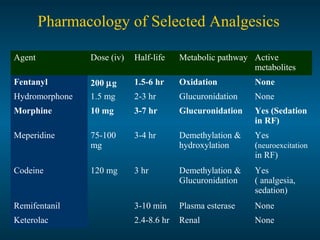
Pharmacology of Selected Analgesics
Agent Dose (iv) Half-life Metabolic pathway Active
metabolites
Fentanyl 200 µg 1.5-6 hr Oxidation None
Hydromorphone 1.5 mg 2-3 hr Glucuronidation None
Morphine 10 mg 3-7 hr Glucuronidation Yes (Sedation
in RF)
Meperidine 75-100
mg
3-4 hr Demethylation &
hydroxylation
Yes
(neuroexcitation
in RF)
Codeine 120 mg 3 hr Demethylation &
Glucuronidation
Yes
( analgesia,
sedation)
Remifentanil 3-10 min Plasma esterase None
Keterolac 2.4-8.6 hr Renal None
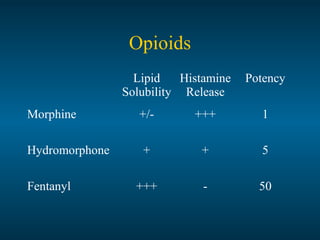
Opioids
Lipid
Solubility
Histamine
Release
Potency
Morphine +/- +++ 1
Hydromorphone + + 5
Fentanyl +++ - 50
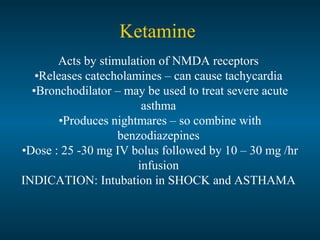
Ketamine
Acts by stimulation of NMDA receptors
•Releases catecholamines – can cause tachycardia
•Bronchodilator – may be used to treat severe acute
asthma
•Produces nightmares – so combine with
benzodiazepines
•Dose : 25 -30 mg IV bolus followed by 10 – 30 mg /hr
infusion
INDICATION: Intubation in SHOCK and ASTHAMA
ETOMIDATE
Indication : Intubation in SHOCK patients
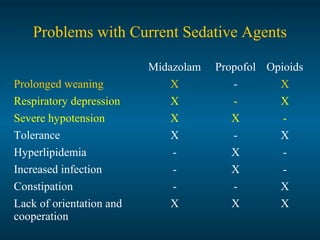
Problems with Current Sedative Agents
Midazolam Propofol Opioids
Prolonged weaning X - X
Respiratory depression X - X
Severe hypotension X X -
Tolerance X - X
Hyperlipidemia - X -
Increased infection - X -
Constipation - - X
Lack of orientation and
cooperation
X X X
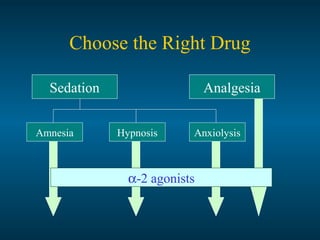
Choose the Right Drug
Sedation Analgesia
Amnesia AnxiolysisHypnosis
α-2 agonists
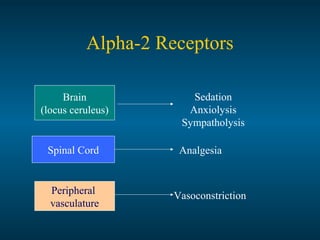
Alpha-2 Receptors
Brain
(locus ceruleus)
Spinal Cord
Peripheral
vasculature
Sedation
Anxiolysis
Sympatholysis
Analgesia
Vasoconstriction
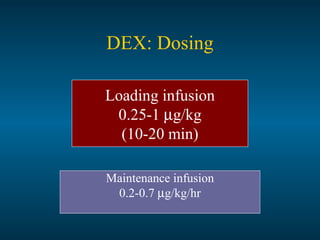
DEX: Dosing
Loading infusion
0.25-1 µg/kg
(10-20 min)
Maintenance infusion
0.2-0.7 µg/kg/hr
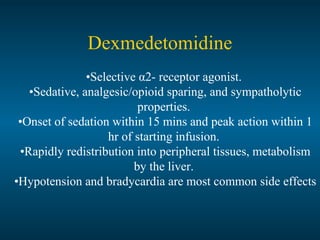
Dexmedetomidine
•Selective α2- receptor agonist.
•Sedative, analgesic/opioid sparing, and sympatholytic
properties.
•Onset of sedation within 15 mins and peak action within 1
hr of starting infusion.
•Rapidly redistribution into peripheral tissues, metabolism
by the liver.
•Hypotension and bradycardia are most common side effects
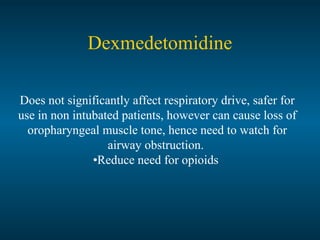
Dexmedetomidine
Does not significantly affect respiratory drive, safer for
use in non intubated patients, however can cause loss of
oropharyngeal muscle tone, hence need to watch for
airway obstruction.
•Reduce need for opioids
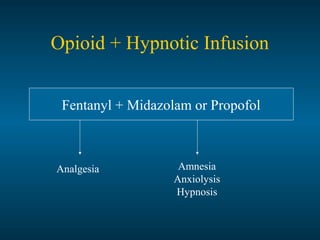
Opioid + Hypnotic Infusion
Fentanyl + Midazolam or Propofol
Analgesia Amnesia
Anxiolysis
Hypnosis
Choose the Right Drug
Sedation Analgesia
Amnesia AnxiolysisHypnosis
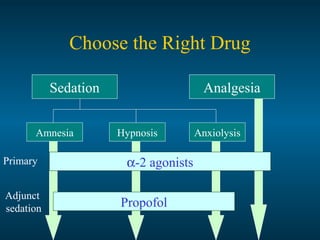
α-2 agonistsPrimary
Adjunct
sedation Propofol
Choose the Right Drug
Sedation Analgesia
Amnesia AnxiolysisHypnosis
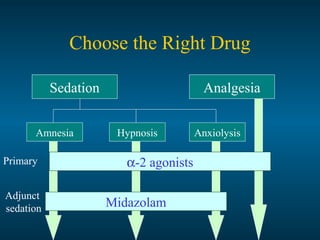
α-2 agonistsPrimary
Adjunct
sedation Midazolam
Choose the Right Drug
Sedation Analgesia
Amnesia AnxiolysisHypnosis
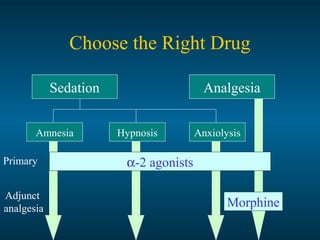
α-2 agonistsPrimary
Adjunct
analgesia Morphine
Choose the Right Drug
Sedation Analgesia
Amnesia AnxiolysisHypnosis
α-2 agonistsPrimary
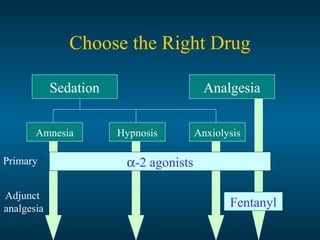
Adjunct
analgesia Fentanyl
MONITORING
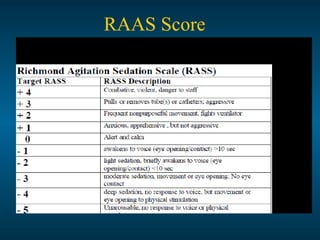
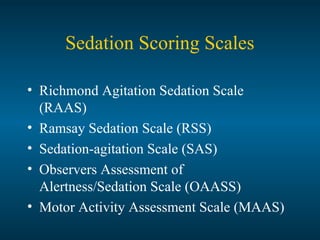
Sedation Scoring Scales
• Richmond Agitation Sedation Scale
(RAAS)
• Ramsay Sedation Scale (RSS)
• Sedation-agitation Scale (SAS)
• Observers Assessment of
Alertness/Sedation Scale (OAASS)
• Motor Activity Assessment Scale (MAAS)
RAAS Score
What Sedation Scales Do
• Provide a semiquantitative “score”
• Standardize treatment endpoints
• Allow review of efficacy of sedation
• Facilitate sedation studies
• Help to avoid oversedation
What Sedation Scales Don’t Do
• Assess anxiety
• Assess pain
• Assess sedation in paralyzed patients
• Predict outcome
Reassess Need
• Use sedation score as endpoint
• Initiate sedation incrementally to desired
level
• Periodically (q day) titrate infusion rate
down until the patient begins to emerge
• Gradually increase infusion rate again to
desired level of sedation
Barr, Donner. Crit Care Clin. 1995;11827
ADVANTAGES
Sedation titrated to subjective scores is associated with
better outcomes
- decreased use of sedatives

- shorter ICU and hospital length of stay
- shorter stay on vent
- less delirium
- less cognitive dysfunction
•Lighter levels of sedation better than deeper levels
Neuromuscular Blockade (NMB)Neuromuscular Blockade (NMB)
(Paralytics) in the Adult ICU(Paralytics) in the Adult ICU
Used most often acutely (single dose) to facilitate
intubation or selected procedures
Indications
• Facilitate mechanical ventilation, especially with
abdominal compartment syndrome, high airway
pressures, and dyssynchrony
• Assist in control of elevated intracranial pressures
• Reduce oxygen consumption
• Prevent muscle spasm in neuroleptic malignant
syndrome, tetanus, etc.
• Protect surgical wounds or medical device placement
Issues
• NO ANALGESIC or SEDATIVE properties
• Concurrent sedation with amnestic effect is paramount
analgesic as needed
• Never use without the ability to establish and/or
maintain a definitive airway with ventilation
• If administering for prolonged period (> 6 - 12 hours),
use an objective monitor to assess degree of paralysis
Potential Contraindications ofPotential Contraindications of
SuccinylcholineSuccinylcholine
• Increases serum potassium by 0.5 to 1 meq/liter in all
patients
• Can cause bradycardia, anaphylaxis, and muscle pain
• Potentially increases intragastric, intraocular, and
intracranial pressure
• Severely elevates potassium due to proliferation of
extrajunctional receptors in patients with denervation
injury, stroke, trauma, or burns of more than 24 hours
• Succinyl Choline : Intubation
• Rocuronium : Intubation
• Vecuronium
• Atracurium
• Cis- Atracurium
• MONITORING – Train of Four
TAKE HOME MESSAGE
1) Sedation, Analgesia & Paralytics are not a
treatment.
Its just an adjunctive therapy
GOAL: Analgesia first
2) Never use Paralytics without sedation &
Analgesia…
Same way never use sedation without analgesia
3) Use right medications, right dose
according to condition of patients
It should be confirm by prescribing doctor
4) Dex + Propofol + Cis-Atra ideal combo but
with limitations
Increase use of Dex & Cis-Atra
Avoid Midazolam as much as possible
5) Etomidate & Succinylcholine /
Rocuronium for intubation
*Use Etomidate & Ketamine for patients in
Shock
6) Label over infusion pump about
medicine, dosage and preparations
• Monitor about under or over sedation
• Monitor Pain score
• Daily sedation inturruption
• Chart target sedation score & inform doctor
if its low or high
• Target sedation score has to decide by
doctor
THANK YOU
FOR
YOUR ATTENTION
QUESTIONS???...

Sedation analgesia in icu

  • 1.
    Sedation, Analgesia andParalysis in ICU DR ANKIT GAJJAR INTENSIVIST
  • 2.
    ICU Sedation • ICUsedation is a complex clinical problem • Current therapeutic approaches all have potential adverse side effects • Agitated patients are often hypertensive, increase stress hormones, and require more intensive nursing care
  • 3.
    The Need forSedation • Anxiety • Pain • Acute confusional status • Mechanical ventilation • Treatment or diagnostic procedures • Psychological response to stress
  • 4.
    • Patient comfort •Control of pain • Anxiolysis and amnesia • Blunting adverse autonomic and hemodynamic responses • Facilitate nursing management • Facilitate mechanical ventilation • Avoid self-extubation • Reduce oxygen consumption Goals of sedation in the ICU
  • 5.
    Characteristics of anideal sedation agents for the ICU • Lack of respiratory depression • Analgesia, especially for surgical patients • Rapid onset, titratable, with a short elimination half-time • Sedation with ease of orientation and arousability • Anxiolytic • Hemodynamic stability • The optimal level of sedation for most patients is that which offers comfort while allowing for interaction with the environment
  • 6.
    The Challenges ofICU Sedation • Assessment of sedation • Altered pharmacology • Tolerance • Delayed emergence • Withdrawal • Drug interaction
  • 7.
  • 8.
    Undersedation Sedatives Causes for Agitation Agitation& anxiety Pain and discomfort Catheter displacement Inadequate ventilation Hypertension Tachycardia Arrhythmias Myocardial ischemia Wound disruption Patient injury
  • 9.
    Oversedation Sedatives Causes for Agitation Prolongedsedation Delayed emergence Respiratory depression Hypotension Bradycardia Increased protein breakdown Muscle atrophy Venous stasis Pressure injury Loss of patient-staff interaction Increased cost
  • 10.
    Set Treatment Goal SedationAnalgesia Amnesia AnxiolysisHypnosis Patient Comfort
  • 11.
  • 12.
    Visual Pain Scales 01 2 3 4 5 6 7 8 9 10 No pain Worst possible pain
  • 13.
    Signs of Pain •Hypertension • Tachycardia • Lacrimation • Sweating • Pupillary dilation
  • 14.
    Principles of PainManagement • Anticipate pain • Recognize pain – Ask the patient – Look for signs – Find the source • Quantify pain • Treat: – Quantify the patient’s perception of pain – Correct the cause where possible – Give appropriate analgesics regularly as required • Remember, most sedative agents do not provide analgesia • Reassess
  • 15.
    Nonpharmacologic Interventions • Properposition of the patient • Stabilization of fractures • Elimination of irritating stimulation • Proper positioning of the ventilator tubing to avoid traction on endotracheal tube
  • 16.
    Medications • Benzodiazepines • Propofol •Opioids ∀∝-2 agonists • Ketamine • Etomidate
  • 17.
    Choose the RightDrug Sedation Analgesia Amnesia AnxiolysisHypnosis Benzodiazepines
  • 18.
    Benzodiazepines Onset Peaks Duration Diazepam2-5 min 5-30 min >20 hr Midazolam 2-3 min 5-10 min 30-120 min Lorazepam 5-20 min 30 min 10-20 hr
  • 19.
    Choose the RightDrug Sedation Analgesia Amnesia AnxiolysisHypnosis Propofol
  • 20.
  • 21.
    Propofol Dosing • 3-5µg/kg/min antiemetic • 5-20 µg/kg/min anxiolytic • 20-50 µg/kg/min sedative hypnotic • >100 µg/kg/min anesthetic
  • 22.
    Choose the RightDrug Sedation Analgesia Amnesia AnxiolysisHypnosis Opioids
  • 23.
    Pharmacology of SelectedAnalgesics Agent Dose (iv) Half-life Metabolic pathway Active metabolites Fentanyl 200 µg 1.5-6 hr Oxidation None Hydromorphone 1.5 mg 2-3 hr Glucuronidation None Morphine 10 mg 3-7 hr Glucuronidation Yes (Sedation in RF) Meperidine 75-100 mg 3-4 hr Demethylation & hydroxylation Yes (neuroexcitation in RF) Codeine 120 mg 3 hr Demethylation & Glucuronidation Yes ( analgesia, sedation) Remifentanil 3-10 min Plasma esterase None Keterolac 2.4-8.6 hr Renal None
  • 24.
  • 25.
    Ketamine Acts by stimulationof NMDA receptors •Releases catecholamines – can cause tachycardia •Bronchodilator – may be used to treat severe acute asthma •Produces nightmares – so combine with benzodiazepines •Dose : 25 -30 mg IV bolus followed by 10 – 30 mg /hr infusion INDICATION: Intubation in SHOCK and ASTHAMA
  • 26.
  • 27.
    Problems with CurrentSedative Agents Midazolam Propofol Opioids Prolonged weaning X - X Respiratory depression X - X Severe hypotension X X - Tolerance X - X Hyperlipidemia - X - Increased infection - X - Constipation - - X Lack of orientation and cooperation X X X
  • 28.
    Choose the RightDrug Sedation Analgesia Amnesia AnxiolysisHypnosis α-2 agonists
  • 29.
    Alpha-2 Receptors Brain (locus ceruleus) SpinalCord Peripheral vasculature Sedation Anxiolysis Sympatholysis Analgesia Vasoconstriction
  • 30.
    DEX: Dosing Loading infusion 0.25-1µg/kg (10-20 min) Maintenance infusion 0.2-0.7 µg/kg/hr
  • 31.
    Dexmedetomidine •Selective α2- receptoragonist. •Sedative, analgesic/opioid sparing, and sympatholytic properties. •Onset of sedation within 15 mins and peak action within 1 hr of starting infusion. •Rapidly redistribution into peripheral tissues, metabolism by the liver. •Hypotension and bradycardia are most common side effects
  • 32.
    Dexmedetomidine Does not significantlyaffect respiratory drive, safer for use in non intubated patients, however can cause loss of oropharyngeal muscle tone, hence need to watch for airway obstruction. •Reduce need for opioids
  • 33.
    Opioid + HypnoticInfusion Fentanyl + Midazolam or Propofol Analgesia Amnesia Anxiolysis Hypnosis
  • 34.
    Choose the RightDrug Sedation Analgesia Amnesia AnxiolysisHypnosis α-2 agonistsPrimary Adjunct sedation Propofol
  • 35.
    Choose the RightDrug Sedation Analgesia Amnesia AnxiolysisHypnosis α-2 agonistsPrimary Adjunct sedation Midazolam
  • 36.
    Choose the RightDrug Sedation Analgesia Amnesia AnxiolysisHypnosis α-2 agonistsPrimary Adjunct analgesia Morphine
  • 37.
    Choose the RightDrug Sedation Analgesia Amnesia AnxiolysisHypnosis α-2 agonistsPrimary Adjunct analgesia Fentanyl
  • 38.
  • 39.
    Sedation Scoring Scales •Richmond Agitation Sedation Scale (RAAS) • Ramsay Sedation Scale (RSS) • Sedation-agitation Scale (SAS) • Observers Assessment of Alertness/Sedation Scale (OAASS) • Motor Activity Assessment Scale (MAAS)
  • 40.
  • 41.
    What Sedation ScalesDo • Provide a semiquantitative “score” • Standardize treatment endpoints • Allow review of efficacy of sedation • Facilitate sedation studies • Help to avoid oversedation
  • 42.
    What Sedation ScalesDon’t Do • Assess anxiety • Assess pain • Assess sedation in paralyzed patients • Predict outcome
  • 43.
    Reassess Need • Usesedation score as endpoint • Initiate sedation incrementally to desired level • Periodically (q day) titrate infusion rate down until the patient begins to emerge • Gradually increase infusion rate again to desired level of sedation Barr, Donner. Crit Care Clin. 1995;11827
  • 44.
    ADVANTAGES Sedation titrated tosubjective scores is associated with better outcomes - decreased use of sedatives - shorter ICU and hospital length of stay - shorter stay on vent - less delirium - less cognitive dysfunction •Lighter levels of sedation better than deeper levels
  • 45.
    Neuromuscular Blockade (NMB)NeuromuscularBlockade (NMB) (Paralytics) in the Adult ICU(Paralytics) in the Adult ICU Used most often acutely (single dose) to facilitate intubation or selected procedures Indications • Facilitate mechanical ventilation, especially with abdominal compartment syndrome, high airway pressures, and dyssynchrony • Assist in control of elevated intracranial pressures • Reduce oxygen consumption • Prevent muscle spasm in neuroleptic malignant syndrome, tetanus, etc. • Protect surgical wounds or medical device placement
  • 46.
    Issues • NO ANALGESICor SEDATIVE properties • Concurrent sedation with amnestic effect is paramount analgesic as needed • Never use without the ability to establish and/or maintain a definitive airway with ventilation • If administering for prolonged period (> 6 - 12 hours), use an objective monitor to assess degree of paralysis
  • 47.
    Potential Contraindications ofPotentialContraindications of SuccinylcholineSuccinylcholine • Increases serum potassium by 0.5 to 1 meq/liter in all patients • Can cause bradycardia, anaphylaxis, and muscle pain • Potentially increases intragastric, intraocular, and intracranial pressure • Severely elevates potassium due to proliferation of extrajunctional receptors in patients with denervation injury, stroke, trauma, or burns of more than 24 hours
  • 48.
    • Succinyl Choline: Intubation • Rocuronium : Intubation • Vecuronium • Atracurium • Cis- Atracurium • MONITORING – Train of Four
  • 49.
  • 50.
    1) Sedation, Analgesia& Paralytics are not a treatment. Its just an adjunctive therapy
  • 51.
    GOAL: Analgesia first 2)Never use Paralytics without sedation & Analgesia… Same way never use sedation without analgesia
  • 52.
    3) Use rightmedications, right dose according to condition of patients It should be confirm by prescribing doctor
  • 53.
    4) Dex +Propofol + Cis-Atra ideal combo but with limitations Increase use of Dex & Cis-Atra Avoid Midazolam as much as possible
  • 54.
    5) Etomidate &Succinylcholine / Rocuronium for intubation *Use Etomidate & Ketamine for patients in Shock
  • 55.
    6) Label overinfusion pump about medicine, dosage and preparations
  • 56.
    • Monitor aboutunder or over sedation • Monitor Pain score • Daily sedation inturruption • Chart target sedation score & inform doctor if its low or high • Target sedation score has to decide by doctor
  • 57.
  • 58.

Editor's Notes

  • #3 Speaker’s Notes: ICU sedation is a complex clinical problem that has posed therapeutic challenges to clinicians. Agitated patients are more difficult to manage, require more intensive nursing care, and have increased biochemical evidence of stress responses.
  • #5 The specific individual goals of sedation are listed in this slide, taken from Dr Ramsay’s slide presentation on dexmedetomidine.com.
  • #6 Speaker’s Notes: The characteristics of an ideal agent to be used for ICU sedation are listed. The lack of respiratory depression is particularly important because most of the available agents produce respiratory depression.