


Kristopher R. Maday, MS, PA-C, CNSC
University of Alabama at Birmingham
Pegasus Emergency Group
Is It Still “Cool” to Cool or Is It “Hot” to Not
• Discuss history of hypothermia in acute
cardiac events
• Evaluate the advantages/disadvantages of
hypothermia in post-arrest management
• Critically evaluate current literature
regarding temperature end-points
• Discuss future trends of TTM
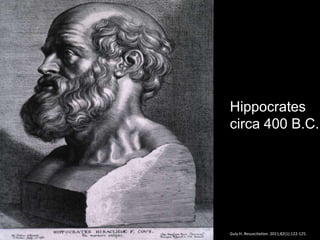
Hippocrates
circa 400 B.C.
Guly H. Resuscitation. 2011;82(1):122-125.
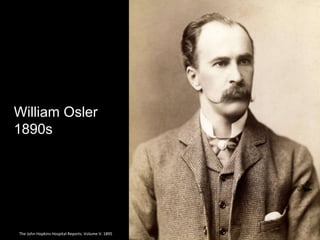
William Osler
1890s
The John Hopkins Hospital Reports. Volume V. 1895
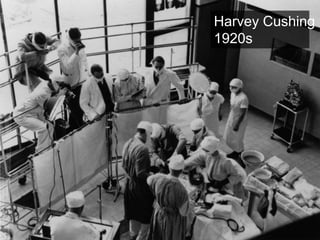
Harvey Cushing
1920s
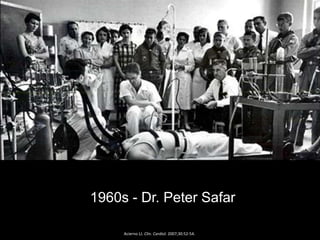
1960s - Dr. Peter Safar
Acierno LJ. Clin. Cardiol. 2007;30:52-54.
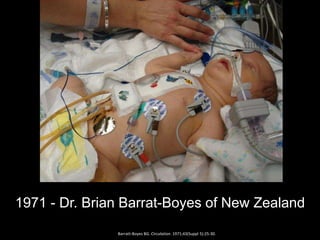
1971 - Dr. Brian Barrat-Boyes of New Zealand
Barratt-Boyes BG. Circulation. 1971;43(Suppl 5):25-30.
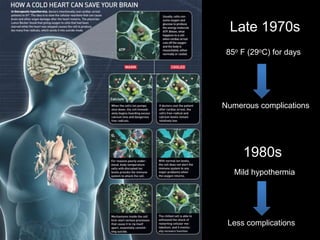
Late 1970s
1980s
85o F (29oC) for days
Mild hypothermia
Numerous complications
Less complications
• 1980 - Annals of Internal Medicine
– 2 case reports of hypothermic immersions
Sekar TS. Arch Intern Med. 1980;140(6):775-779.
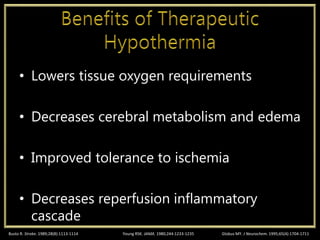
• Lowers tissue oxygen requirements
• Decreases cerebral metabolism and edema
• Improved tolerance to ischemia
• Decreases reperfusion inflammatory
cascade
Young RSK. JAMA. 1980;244:1233-1235 Globus MY. J Neurochem. 1995;65(4):1704-1711Busto R. Stroke. 1989;28(8):1113-1114
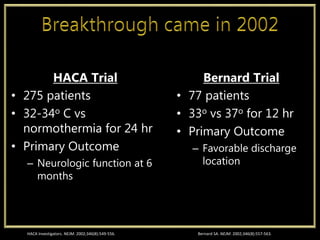
HACA Trial
• 275 patients
• 32-34o C vs
normothermia for 24 hr
• Primary Outcome
– Neurologic function at 6
months
Bernard Trial
• 77 patients
• 33o vs 37o for 12 hr
• Primary Outcome
– Favorable discharge
location
HACA Investigators. NEJM. 2002;346(8):549-556. Bernard SA. NEJM. 2002;346(8):557-563.
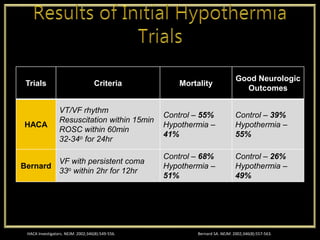
Trials Criteria Mortality
Good Neurologic
Outcomes
HACA
VT/VF rhythm
Resuscitation within 15min
ROSC within 60min
32-34o for 24hr
Control – 55%
Hypothermia –
41%
Control – 39%
Hypothermia –
55%
Bernard
VF with persistent coma
33o within 2hr for 12hr
Control – 68%
Hypothermia –
51%
Control – 26%
Hypothermia –
49%
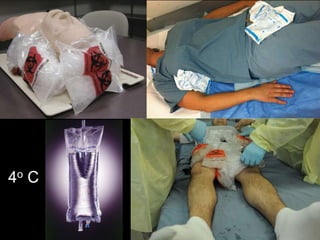
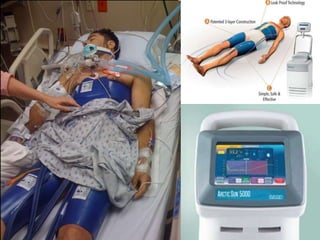
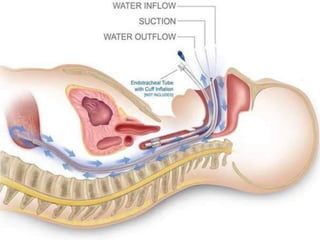
Cooling Apparati
Timing
Medications
Monitoring
4o C
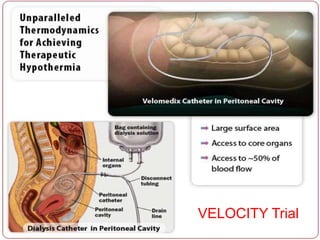
VELOCITY Trial
Nolan JP. Circulation. 2003;108:118-121
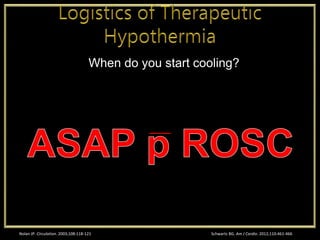
When do you start cooling?
Schwartz BG. Am J Cardio. 2012;110:461-466
Nolan JP. CIrculation. 2003;108:118-121
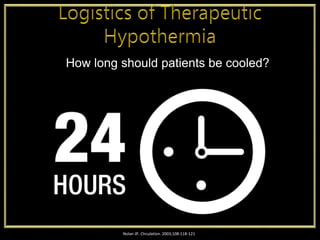
How long should patients be cooled?
Nolan JP. CIrculation. 2003;108:118-121
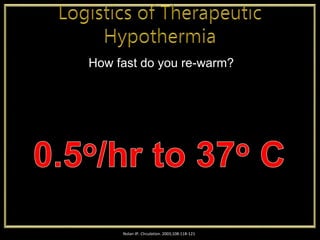
How fast do you re-warm?
Nolan JP. CIrculation. 2003;108:118-121
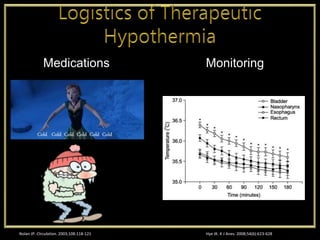
Medications Monitoring
Hye JK. K J Anes. 2008;54(6):623-628
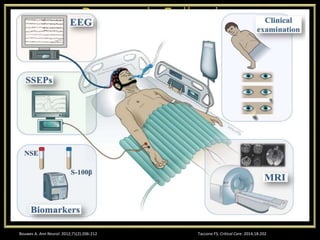
Taccone FS. Critical Care. 2014;18:202Bouwes A. Ann Neurol. 2012;71(2):206-212
Nolan JP. CIrculation. 2003;108:118-121 Schwartz BG. Am J Cardio. 2012;110:461-466
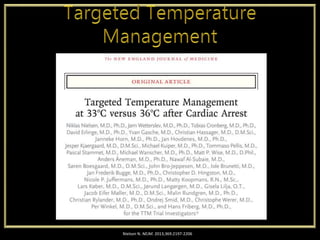
Nielson N. NEJM. 2013;369:2197-2206
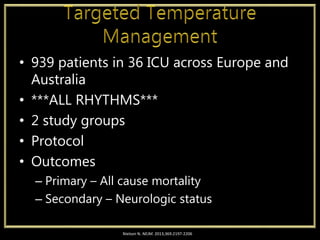
• 939 patients in 36 ICU across Europe and
Australia
• ***ALL RHYTHMS***
• 2 study groups
• Protocol
• Outcomes
– Primary – All cause mortality
– Secondary – Neurologic status
Nielson N. NEJM. 2013;369:2197-2206
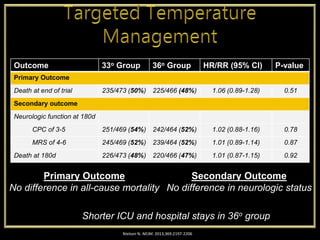
Outcome 33o Group 36o Group HR/RR (95% CI) P-value
Primary Outcome
Death at end of trial 235/473 (50%) 225/466 (48%) 1.06 (0.89-1.28) 0.51
Secondary outcome
Neurologic function at 180d
CPC of 3-5 251/469 (54%) 242/464 (52%) 1.02 (0.88-1.16) 0.78
MRS of 4-6 245/469 (52%) 239/464 (52%) 1.01 (0.89-1.14) 0.87
Death at 180d 226/473 (48%) 220/466 (47%) 1.01 (0.87-1.15) 0.92
Primary Outcome
No difference in all-cause mortality
Secondary Outcome
No difference in neurologic status
Shorter ICU and hospital stays in 36o group
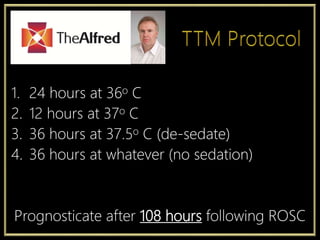
1. 24 hours at 36o C
2. 12 hours at 37o C
3. 36 hours at 37.5o C (de-sedate)
4. 36 hours at whatever (no sedation)
Prognosticate after 108 hours following ROSC
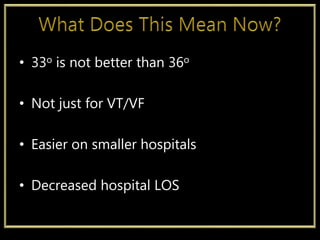
• 33o is not better than 36o
• Not just for VT/VF
• Easier on smaller hospitals
• Decreased hospital LOS
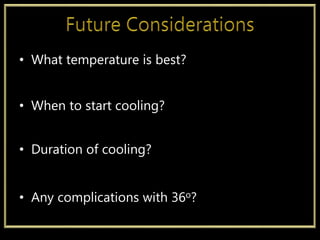
• What temperature is best?
• When to start cooling?
• Duration of cooling?
• Any complications with 36o?
maday@uab.edu
@PA_Maday
www.pamaday.net

Update on Targeted Temperature Management

  • 1.
    Kristopher R. Maday,MS, PA-C, CNSC University of Alabama at Birmingham Pegasus Emergency Group Is It Still “Cool” to Cool or Is It “Hot” to Not
  • 4.
    • Discuss historyof hypothermia in acute cardiac events • Evaluate the advantages/disadvantages of hypothermia in post-arrest management • Critically evaluate current literature regarding temperature end-points • Discuss future trends of TTM
  • 6.
    Hippocrates circa 400 B.C. GulyH. Resuscitation. 2011;82(1):122-125.
  • 7.
    William Osler 1890s The JohnHopkins Hospital Reports. Volume V. 1895
  • 8.
  • 9.
    1960s - Dr.Peter Safar Acierno LJ. Clin. Cardiol. 2007;30:52-54.
  • 10.
    1971 - Dr.Brian Barrat-Boyes of New Zealand Barratt-Boyes BG. Circulation. 1971;43(Suppl 5):25-30.
  • 11.
    Late 1970s 1980s 85o F(29oC) for days Mild hypothermia Numerous complications Less complications
  • 12.
    • 1980 -Annals of Internal Medicine – 2 case reports of hypothermic immersions Sekar TS. Arch Intern Med. 1980;140(6):775-779.
  • 14.
    • Lowers tissueoxygen requirements • Decreases cerebral metabolism and edema • Improved tolerance to ischemia • Decreases reperfusion inflammatory cascade Young RSK. JAMA. 1980;244:1233-1235 Globus MY. J Neurochem. 1995;65(4):1704-1711Busto R. Stroke. 1989;28(8):1113-1114
  • 15.
    HACA Trial • 275patients • 32-34o C vs normothermia for 24 hr • Primary Outcome – Neurologic function at 6 months Bernard Trial • 77 patients • 33o vs 37o for 12 hr • Primary Outcome – Favorable discharge location HACA Investigators. NEJM. 2002;346(8):549-556. Bernard SA. NEJM. 2002;346(8):557-563.
  • 16.
    HACA Investigators. NEJM.2002;346(8):549-556. Bernard SA. NEJM. 2002;346(8):557-563. Trials Criteria Mortality Good Neurologic Outcomes HACA VT/VF rhythm Resuscitation within 15min ROSC within 60min 32-34o for 24hr Control – 55% Hypothermia – 41% Control – 39% Hypothermia – 55% Bernard VF with persistent coma 33o within 2hr for 12hr Control – 68% Hypothermia – 51% Control – 26% Hypothermia – 49%
  • 17.
  • 18.
  • 20.
  • 23.
    Nolan JP. Circulation.2003;108:118-121 When do you start cooling? Schwartz BG. Am J Cardio. 2012;110:461-466
  • 24.
    Nolan JP. CIrculation.2003;108:118-121 How long should patients be cooled?
  • 25.
    Nolan JP. CIrculation.2003;108:118-121 How fast do you re-warm?
  • 26.
    Nolan JP. CIrculation.2003;108:118-121 Medications Monitoring Hye JK. K J Anes. 2008;54(6):623-628
  • 28.
    Taccone FS. CriticalCare. 2014;18:202Bouwes A. Ann Neurol. 2012;71(2):206-212
  • 29.
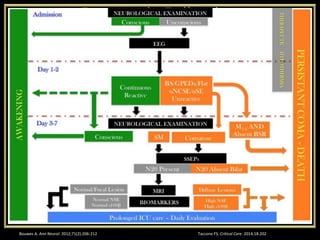
    Taccone FS. CriticalCare. 2014;18:202Bouwes A. Ann Neurol. 2012;71(2):206-212
  • 30.
    Nolan JP. CIrculation.2003;108:118-121 Schwartz BG. Am J Cardio. 2012;110:461-466
  • 32.
    Nielson N. NEJM.2013;369:2197-2206
  • 33.
    • 939 patientsin 36 ICU across Europe and Australia • ***ALL RHYTHMS*** • 2 study groups • Protocol • Outcomes – Primary – All cause mortality – Secondary – Neurologic status Nielson N. NEJM. 2013;369:2197-2206
  • 34.
    Nielson N. NEJM.2013;369:2197-2206 Outcome 33o Group 36o Group HR/RR (95% CI) P-value Primary Outcome Death at end of trial 235/473 (50%) 225/466 (48%) 1.06 (0.89-1.28) 0.51 Secondary outcome Neurologic function at 180d CPC of 3-5 251/469 (54%) 242/464 (52%) 1.02 (0.88-1.16) 0.78 MRS of 4-6 245/469 (52%) 239/464 (52%) 1.01 (0.89-1.14) 0.87 Death at 180d 226/473 (48%) 220/466 (47%) 1.01 (0.87-1.15) 0.92 Primary Outcome No difference in all-cause mortality Secondary Outcome No difference in neurologic status Shorter ICU and hospital stays in 36o group
  • 35.
    1. 24 hoursat 36o C 2. 12 hours at 37o C 3. 36 hours at 37.5o C (de-sedate) 4. 36 hours at whatever (no sedation) Prognosticate after 108 hours following ROSC
  • 36.
    • 33o isnot better than 36o • Not just for VT/VF • Easier on smaller hospitals • Decreased hospital LOS
  • 37.
    • What temperatureis best? • When to start cooling? • Duration of cooling? • Any complications with 36o?
  • 38.

Editor's Notes

  • #7 Advocated packing wounded soldiers with snow or ice to staunch bleeding
  • #8 Recommended placing typhoid fever patients in cold baths
  • #9 Neurosurgeons in the 1930s-1950s experimented with hypothermia to stop cancer cells from multplying and to help with a bloodless field during surgery
  • #10 University of Pittsburgh Widely credited as the Father of CPR and included hypothermia in the recommendations after a patient’s heart was re-started
  • #11 1st to report hypothermia with cardiac arrest in neonates too small for conventional cardiopulonary bypass
  • #12 Theory of the times was the cooler the brain, the less oxyegn it needed. This lead to temperatures as low as 85o and patients were maintained there for up to 5 days. This lead to dysrhythmias, infection, and bleeding Excitement with hypthermia waned because of this. IN the 1980s, Dr. Safar’s lab began animal studies using milder forms of hypthermia and showed that these animals made a good recovery with less complications. Research continued through the 1990s with some success, but no real practical advancements
  • #13 25min and 6min  complete neurologic recovery Hypothesis from these case reports is that the hypothermia protected the brain from hypoxic injury
  • #15 Extends the time a patient can be without circulation Metabolism reduced 5-10% per degree Celsius of core temperature For ever 1o degree over 37, risk of unfavorabel neurologic recovery increases with OR 2.26
  • #16 2 landmark publications in NEJM HACA (Hypothermia After Cardiac Arrest) – VT/VF, resus began with in 15min of collapse and ROSC within 60min, 32-34o for 24hr and passive rewarming mean time to 32-34o was 8hr Bernard – VF with persistant coma, intiating TH within 2hr, 33o for 12hr Favorable Discharge Location – Home or acute rehab vs LTAC or death
  • #17 HACA (Hypothermia After Cardiac Arrest) – VT/VF, resus began with in 15min of collapse and ROSC within 60min, 32-34o for 24hr and passive rewarming mean time to 32-34o was 8hr Bernard – VF with persistant coma, intiating TH within 2hr, 33o for 12hr Favorable Discharge Location – Home or acute rehab vs LTAC or death
  • #19 1 degree per hours and that is debatable
  • #20 Artic sun external cooling system 33o in in average time of 80 minutes
  • #21 8 degree per hour VELOCITY Trial of 2014 showed no benefit
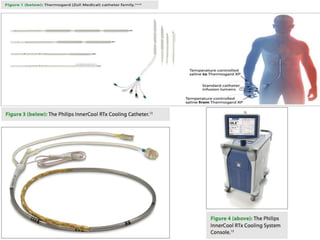
  • #23 1 degree per hour Zoll bought out Phillips
  • #24 ASAP after ROSC…no benefit if started after 6 hours Only patients with persistant coma Ideally reach goal within 4 hours
  • #25 From the time of cooling inititation until the start of rewarming
  • #26 ASAP after ROSC…no benefit if started after 6 hours
  • #27 Deep sedation and paralytics
  • #29 Begin only after 72hr of normothermia Best predictors of poor outcomes neuronspecific enolase (NSE), somatosensory-evoked potentials (SEPs)
  • #30 Begin only after 72hr of normothermia Best predictors of poor outcomes neuronspecific enolase (NSE), somatosensory-evoked potentials (SEPs)
  • #31 Cardiac – bradycardia, prolonged QT, hypotension Infectious Disease - decreased immune function Renal – hypokalemia, cold diuresis Hematology – coagulopathy, decreased platelet function Endocrine – dysglycemias from sporadic insulin release
  • #33 Methodolicgical masterpiece
  • #34 Randomized to 33 or 36 after 20min of ROSC with a GCS < 8 Maintained for 28hr with gradual rewarming to 37o and avoidance of pyrexia for 72hr After 72hr  those still comatose underwent neurological prognostication
  • #35 Cerebral Performance Category Modified Rankin Score 1 – minimal disability 0-no symptoms 2 – moderate 1-no clinical signficant symptoms 3 – severe (requires assistantce) 2-slight diability 4- coma or vegetative state 3-moderate 5-brain death 4-mod/severe (requires assisatnce) 5-bedridden 6-brain death
  • #36 Dr. Stephan Bernard’s hospital
  • #38 33o may be beneficial for non-shockable rhythyms When to start  prehospital, during CPR, after ROSC