
Peter McCanny
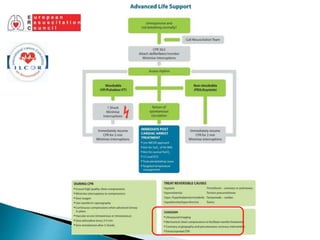
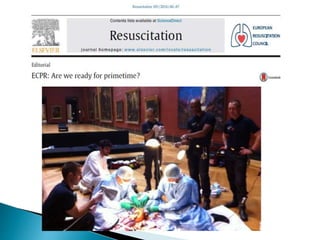
 ……Rapid deployment of VA-ECMO during cardiac arrest,
when conventional CPR has failed to provide return of
spontaneous circulation (ROSC)……
 ……or when repetitive arrests occur without sustained
ROSC……
 ECMO for low output cardiac states
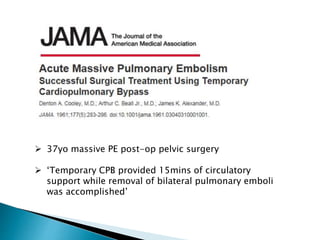
 37yo massive PE post-op pelvic surgery
 ‘Temporary CPB provided 15mins of circulatory
support while removal of bilateral pulmonary emboli
was accomplished’
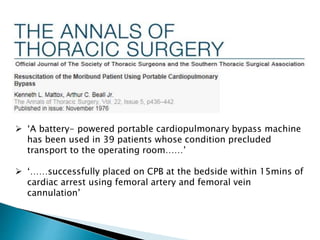
 ‘A battery- powered portable cardiopulmonary bypass machine
has been used in 39 patients whose condition precluded
transport to the operating room……’
 ‘……successfully placed on CPB at the bedside within 15mins of
cardiac arrest using femoral artery and femoral vein
cannulation’
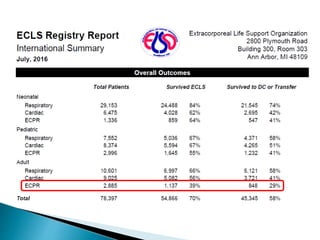
 No RCT comparing ECPR with conventional CPR (CCPR)
 Limited to observational studies, case series
 Propensity- matched modelling to compare ECPR with CCPR
 Recent systematic review and meta-analysis
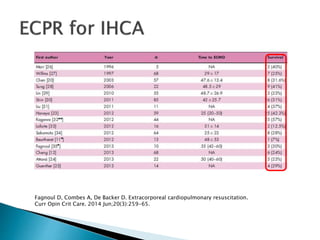
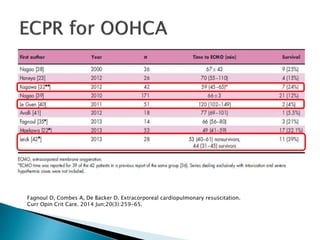
Fagnoul D, Combes A, De Backer D. Extracorporeal cardiopulmonary resuscitation.
Curr Opin Crit Care. 2014 Jun;20(3):259-65.
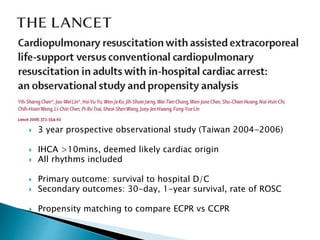
 3 year prospective observational study (Taiwan 2004-2006)
 IHCA >10mins, deemed likely cardiac origin
 All rhythms included
 Primary outcome: survival to hospital D/C
 Secondary outcomes: 30-day, 1-year survival, rate of ROSC
 Propensity matching to compare ECPR vs CCPR
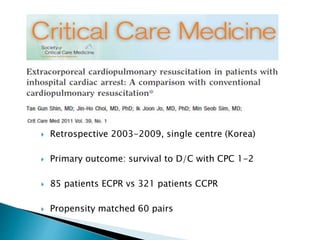
 Retrospective 2003-2009, single centre (Korea)
 Primary outcome: survival to D/C with CPC 1-2
 85 patients ECPR vs 321 patients CCPR
 Propensity matched 60 pairs
Fagnoul D, Combes A, De Backer D. Extracorporeal cardiopulmonary resuscitation.
Curr Opin Crit Care. 2014 Jun;20(3):259-65.
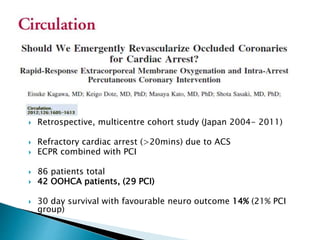
 Retrospective, multicentre cohort study (Japan 2004- 2011)
 Refractory cardiac arrest (>20mins) due to ACS
 ECPR combined with PCI
 86 patients total
 42 OOHCA patients, (29 PCI)
 30 day survival with favourable neuro outcome 14% (21% PCI
group)
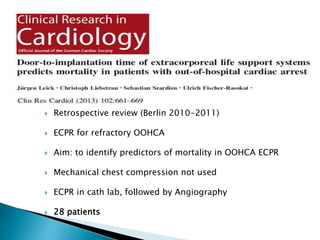
 Retrospective review (Berlin 2010-2011)
 ECPR for refractory OOHCA
 Aim: to identify predictors of mortality in OOHCA ECPR
 Mechanical chest compression not used
 ECPR in cath lab, followed by Angiography
 28 patients
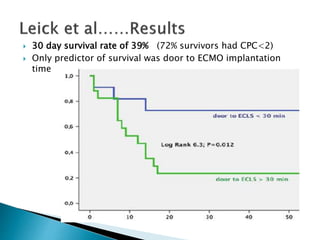
 30 day survival rate of 39% (72% survivors had CPC<2)
 Only predictor of survival was door to ECMO implantation
time
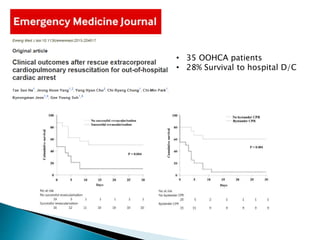
• 35 OOHCA patients
• 28% Survival to hospital D/C
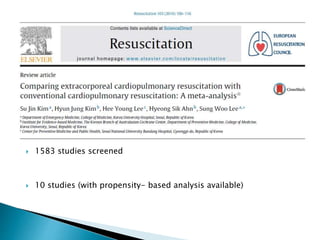
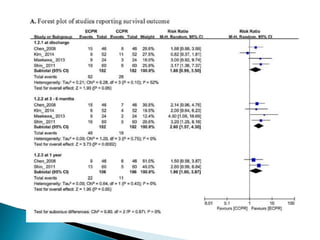
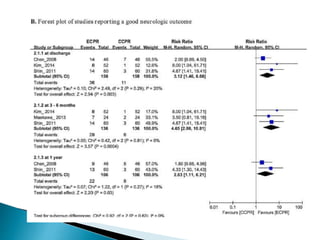
 1583 studies screened
 10 studies (with propensity- based analysis available)
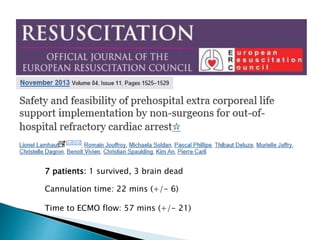
7 patients: 1 survived, 3 brain dead
Cannulation time: 22 mins (+/- 6)
Time to ECMO flow: 57 mins (+/- 21)
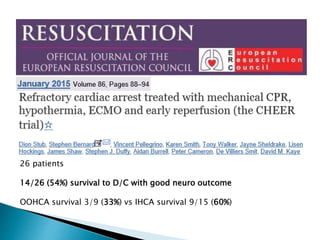
26 patients
14/26 (54%) survival to D/C with good neuro outcome
OOHCA survival 3/9 (33%) vs IHCA survival 9/15 (60%)
 Retrospective review of outcomes for ECPR cases to date.
 Patients identified from ECMO databases in SVH and RPA.
 Data gathered from medical charts, databases, and local IT systems:
- Patient demographics
- Cardiac arrest details (initial rhythm, downtime etc…)
- ECMO details (setting, cannulation, complications, duration..)
- Echo and Cath lab findings
- Intervention details (PCI, CABG, VAD, HTx)
- Outcomes and follow-up data
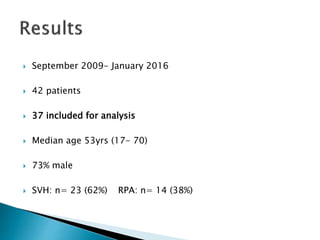
 September 2009- January 2016
 42 patients
 37 included for analysis
 Median age 53yrs (17- 70)
 73% male
 SVH: n= 23 (62%) RPA: n= 14 (38%)
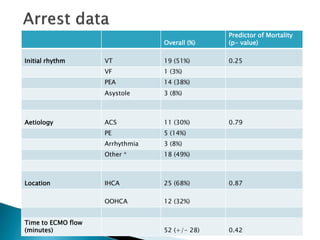
Overall (%)
Predictor of Mortality
(p- value)
Initial rhythm VT 19 (51%) 0.25
VF 1 (3%)
PEA 14 (38%)
Asystole 3 (8%)
Aetiology ACS 11 (30%) 0.79
PE 5 (14%)
Arrhythmia 3 (8%)
Other * 18 (49%)
Location IHCA 25 (68%) 0.87
OOHCA 12 (32%)
Time to ECMO flow
(minutes) 52 (+/- 28) 0.42
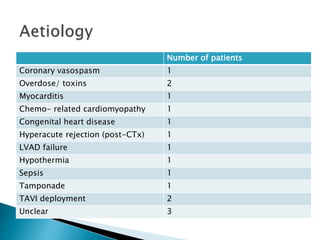
Number of patients
Coronary vasospasm 1
Overdose/ toxins 2
Myocarditis 1
Chemo- related cardiomyopathy 1
Congenital heart disease 1
Hyperacute rejection (post-CTx) 1
LVAD failure 1
Hypothermia 1
Sepsis 1
Tamponade 1
TAVI deployment 2
Unclear 3
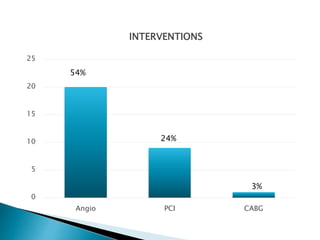
0
5
10
15
20
25
Angio PCI CABG
INTERVENTIONS
54%
24%
3%
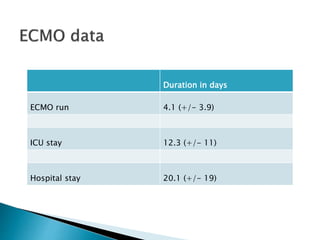
Duration in days
ECMO run 4.1 (+/- 3.9)
ICU stay 12.3 (+/- 11)
Hospital stay 20.1 (+/- 19)
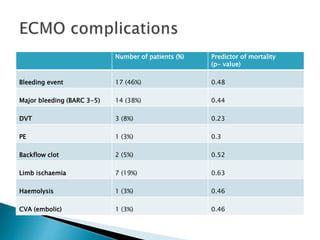
Number of patients (%) Predictor of mortality
(p- value)
Bleeding event 17 (46%) 0.48
Major bleeding (BARC 3-5) 14 (38%) 0.44
DVT 3 (8%) 0.23
PE 1 (3%) 0.3
Backflow clot 2 (5%) 0.52
Limb ischaemia 7 (19%) 0.63
Haemolysis 1 (3%) 0.46
CVA (embolic) 1 (3%) 0.46
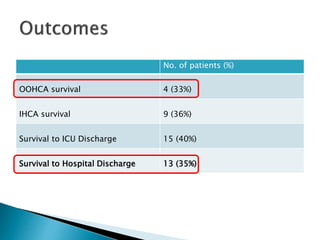
No. of patients (%)
OOHCA survival 4 (33%)
IHCA survival 9 (36%)
Survival to ICU Discharge 15 (40%)
Survival to Hospital Discharge 13 (35%)
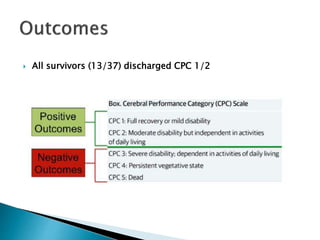
 All survivors (13/37) discharged CPC 1/2
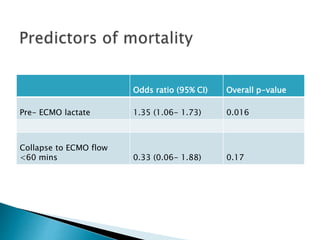
Odds ratio (95% CI) Overall p-value
Pre- ECMO lactate 1.35 (1.06- 1.73) 0.016
Collapse to ECMO flow
<60 mins 0.33 (0.06- 1.88) 0.17
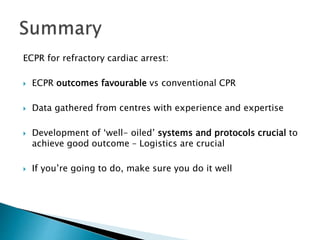
ECPR for refractory cardiac arrest:
 ECPR outcomes favourable vs conventional CPR
 Data gathered from centres with experience and expertise
 Development of ‘well- oiled’ systems and protocols crucial to
achieve good outcome – Logistics are crucial
 If you’re going to do, make sure you do it well

Why would you do ECPR?

  • 1.
  • 2.
     ……Rapid deploymentof VA-ECMO during cardiac arrest, when conventional CPR has failed to provide return of spontaneous circulation (ROSC)……  ……or when repetitive arrests occur without sustained ROSC……  ECMO for low output cardiac states
  • 5.
     37yo massivePE post-op pelvic surgery  ‘Temporary CPB provided 15mins of circulatory support while removal of bilateral pulmonary emboli was accomplished’
  • 6.
     ‘A battery-powered portable cardiopulmonary bypass machine has been used in 39 patients whose condition precluded transport to the operating room……’  ‘……successfully placed on CPB at the bedside within 15mins of cardiac arrest using femoral artery and femoral vein cannulation’
  • 8.
     No RCTcomparing ECPR with conventional CPR (CCPR)  Limited to observational studies, case series  Propensity- matched modelling to compare ECPR with CCPR  Recent systematic review and meta-analysis
  • 9.
    Fagnoul D, CombesA, De Backer D. Extracorporeal cardiopulmonary resuscitation. Curr Opin Crit Care. 2014 Jun;20(3):259-65.
  • 10.
     3 yearprospective observational study (Taiwan 2004-2006)  IHCA >10mins, deemed likely cardiac origin  All rhythms included  Primary outcome: survival to hospital D/C  Secondary outcomes: 30-day, 1-year survival, rate of ROSC  Propensity matching to compare ECPR vs CCPR
  • 12.
     Retrospective 2003-2009,single centre (Korea)  Primary outcome: survival to D/C with CPC 1-2  85 patients ECPR vs 321 patients CCPR  Propensity matched 60 pairs
  • 14.
    Fagnoul D, CombesA, De Backer D. Extracorporeal cardiopulmonary resuscitation. Curr Opin Crit Care. 2014 Jun;20(3):259-65.
  • 15.
     Retrospective, multicentrecohort study (Japan 2004- 2011)  Refractory cardiac arrest (>20mins) due to ACS  ECPR combined with PCI  86 patients total  42 OOHCA patients, (29 PCI)  30 day survival with favourable neuro outcome 14% (21% PCI group)
  • 16.
     Retrospective review(Berlin 2010-2011)  ECPR for refractory OOHCA  Aim: to identify predictors of mortality in OOHCA ECPR  Mechanical chest compression not used  ECPR in cath lab, followed by Angiography  28 patients
  • 17.
     30 daysurvival rate of 39% (72% survivors had CPC<2)  Only predictor of survival was door to ECMO implantation time
  • 18.
    • 35 OOHCApatients • 28% Survival to hospital D/C
  • 19.
     1583 studiesscreened  10 studies (with propensity- based analysis available)
  • 23.
    7 patients: 1survived, 3 brain dead Cannulation time: 22 mins (+/- 6) Time to ECMO flow: 57 mins (+/- 21)
  • 24.
    26 patients 14/26 (54%)survival to D/C with good neuro outcome OOHCA survival 3/9 (33%) vs IHCA survival 9/15 (60%)
  • 25.
     Retrospective reviewof outcomes for ECPR cases to date.  Patients identified from ECMO databases in SVH and RPA.  Data gathered from medical charts, databases, and local IT systems: - Patient demographics - Cardiac arrest details (initial rhythm, downtime etc…) - ECMO details (setting, cannulation, complications, duration..) - Echo and Cath lab findings - Intervention details (PCI, CABG, VAD, HTx) - Outcomes and follow-up data
  • 26.
     September 2009-January 2016  42 patients  37 included for analysis  Median age 53yrs (17- 70)  73% male  SVH: n= 23 (62%) RPA: n= 14 (38%)
  • 27.
    Overall (%) Predictor ofMortality (p- value) Initial rhythm VT 19 (51%) 0.25 VF 1 (3%) PEA 14 (38%) Asystole 3 (8%) Aetiology ACS 11 (30%) 0.79 PE 5 (14%) Arrhythmia 3 (8%) Other * 18 (49%) Location IHCA 25 (68%) 0.87 OOHCA 12 (32%) Time to ECMO flow (minutes) 52 (+/- 28) 0.42
  • 28.
    Number of patients Coronaryvasospasm 1 Overdose/ toxins 2 Myocarditis 1 Chemo- related cardiomyopathy 1 Congenital heart disease 1 Hyperacute rejection (post-CTx) 1 LVAD failure 1 Hypothermia 1 Sepsis 1 Tamponade 1 TAVI deployment 2 Unclear 3
  • 29.
  • 30.
    Duration in days ECMOrun 4.1 (+/- 3.9) ICU stay 12.3 (+/- 11) Hospital stay 20.1 (+/- 19)
  • 31.
    Number of patients(%) Predictor of mortality (p- value) Bleeding event 17 (46%) 0.48 Major bleeding (BARC 3-5) 14 (38%) 0.44 DVT 3 (8%) 0.23 PE 1 (3%) 0.3 Backflow clot 2 (5%) 0.52 Limb ischaemia 7 (19%) 0.63 Haemolysis 1 (3%) 0.46 CVA (embolic) 1 (3%) 0.46
  • 32.
    No. of patients(%) OOHCA survival 4 (33%) IHCA survival 9 (36%) Survival to ICU Discharge 15 (40%) Survival to Hospital Discharge 13 (35%)
  • 33.
     All survivors(13/37) discharged CPC 1/2
  • 34.
    Odds ratio (95%CI) Overall p-value Pre- ECMO lactate 1.35 (1.06- 1.73) 0.016 Collapse to ECMO flow <60 mins 0.33 (0.06- 1.88) 0.17
  • 35.
    ECPR for refractorycardiac arrest:  ECPR outcomes favourable vs conventional CPR  Data gathered from centres with experience and expertise  Development of ‘well- oiled’ systems and protocols crucial to achieve good outcome – Logistics are crucial  If you’re going to do, make sure you do it well

Editor's Notes

  • #5 ARC 2016: eCPR is a reasonable rescue therapy for selected patients with cardiac arrest when initial standard cpr is failing, in settings where this can be implemented
  • #6 37yo massive PE post-op pelvic surgery. ‘Temporary CPB provided 15mins of circulatory support while removal of bilat pulmonary emboli was accomplished’
  • #9 Evidence quality= NOT GOOD As with most resuscitation studies, ability to perform RCT limited by nature of patient group ‘Differing beasts’, therefore warrant separation for evidence review purposes. But importance of systems remains for both
  • #10 Note: Survival rates 7- 57%, numbers 5-85 patients, time to ECMO of up to 55mins Note majority of studies from Taiwan, Japan, Korea etc (potentially well oiled systems due to volume and experience…..implications for extrapolation to ANZ)
  • #11 Use of mechanical CPR device not mentioned
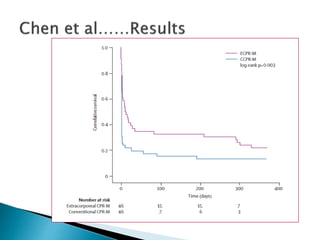
  • #12 Propensity matched Kaplan Meier curve of cumulative survival showed better cumulative rate of survival in ECPR-M at end of 30 days and 1yr
  • #13 Retrospective over 6 years, Korea. 85 ECPR in total Propensity matched 60 pairs (120 patients)
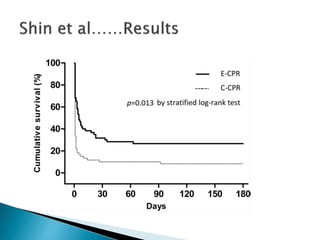
  • #14 KM curves of survival with minimal neurological impairment for the propensity score- matched patients Difference more pronounced in ‘presumed cardiac' subset (45 pairs) Note 30d outcome similar to 6 month
  • #15 Although clear benefit has been demonstrated in ECPR for IHCA (albeit non-randomised studies), little robust evidence for ECPR in OOHCA. In fact, data are scarce and conflicting Le Guen: terrible outcomes, but note extremely long time to ECMO
  • #18 KM survival analysis showing a benefit favouring door-to-ECMO time <30mins
  • #19 South Korea. Retrospective, single centre observational. 51% VF/VT. 10 survivors. 9 CPC 1or2, 1 CPC 4.
  • #20 10 out of 1583 studies included. Studies with crude data only not used (increased risk of bias in comparability). PPA studies used, ie. adjusted for confounders, attempt to reduce heterogenicity. Of note, in Australia survival to hosp DC is approx. 11% (9% in USA, 2% in Japan)
  • #22 Benefit more pronounced for OOHCA group (possibly related to younger patients, reversible disease factors etc)
  • #24 Pilot study, assessing feasibility. All were successfully cannulated (combined cut- down/ perc technique). Recent results: 10% survival, 10% OD
  • #25 Pilot study, assessing feasibility. All were successfully cannulated (combined cut- down/ perc technique). Recent results: 10% survival, 10% OD
  • #26 Currently in write-up stage. To be presented at ELSO San Diego. Pre-CHEER 2 patients.
  • #27 37 after excluding 3 due to incomplete datasets etc
  • #28 Log regression analysis looking at baseline data and association with mortality (p value)
  • #31 To give an idea of resources involved for these patients
  • #32 Complications on ECMO not infrequent, mainly bleeding. None associated with mortality