Welcome to
Redox Reactions
Classical Concept of Oxidation
Addition of Oxygen
Removal of Hydrogen
01
02
2Mg(s) + O2(g) 2MgO(s)
2H2S(g) + O2(g) 2S(s) + 2H2O(l)
Zn(s) Zn2+(aq) + 2e-
Loss of electron
03
Addition of an
electronegative element
04
Removal of an
electropositive element
05
Classical Concept of Reduction
C2H4(g) + H2(g) C2H6(g)
2HgO(s) 2Hg(l) + O2(g)
Cu2+(aq) + 2e− Cu(s)
△
Addition of Hydrogen
Removal of Oxygen
01
02
Gain of electron
03
Addition of an
electropositive element
04
Removal of an
electronegative element
05
Oxidation Number
It is an imaginary or apparent charge
developed over the atom of an element
when it goes from its elemental free
state to combined state in a molecule.
It is based on the assumption that
a complete transfer of an electron takes
place from a less electronegative atom
to a more electronegative atom.
Concept of Oxidation
Oxidation
Process in which there is an
increase in the oxidation number
of the element from reactant to
product in chemical reaction.
H2 + O2 2H2O
2Na + ½O2 Na2O
Increase in oxidation number
0 + 1
0 + 1
Concept of Reduction
Reduction
Process in which there is a
decrease in the oxidation number
of the element from reactant to
product in chemical reaction.
MgH2 (s) Mg (s) + H2 (g)
2Na (s) + O2 (g) Na2O (s)
Decrease in oxidation number
0
+ 2
0 - 2
1
2
For single monatomic ions,
the oxidation number is equal
to the charge on the ion.
O.N. of Naᐩ + 1
=
Rules for Finding Oxidation Number
Examples
Cl ̶
H+
Ca2+
More E.N. Negative O.N.
=
Less E.N. Positive O.N.
=
Rules for Finding Oxidation Number
In general, the oxidation number of
halogens (F, Cl, Br, I) is − 1
If any halogen atom is attached
to a more electronegative atom,
then it will have a positive
oxidation number.
Examples
HIO4 HCIO4
Cl2O ClF3
Fluorine is the most E.N. atom
(known). It always has an
oxidation number equal to -1
in all its compounds.
Rules for Finding Oxidation Number
Generally, the oxidation
number of hydrogen is +1
O.N. of H + 1
=
H2O
HCl H2S
In Metal - Hydrides
(As metals are electropositive)
O.N. of H - 1
=
CaH2
LiH NaH
Examples
Examples
In complex ions or polyatomic
ions, the sum of oxidation
numbers of all the atoms is equal
to the net charge on the ion.
For elements in their native
or free state, the oxidation
number is zero. Example:
H2, N2, Cl2, Cu, Zn etc.
Rules for Finding Oxidation Number
In neutral compounds, the
sum of oxidation numbers
of all the atoms of different
elements is equal to zero.
Rules for Finding Oxidation Number
The oxidation number of
oxygen is –2 in oxides in most
of its compounds (generally)
O.N. of O – 2
=
Examples
SO2
H2O CO2
The oxidation number of
oxygen is –1 in Peroxides (O2 )
Examples
BaO2
H2O2 Na2O2
2–
Examples CsO2
KO2 RbO2
Rules for Finding Oxidation Number
The oxidation number of oxygen is
– (½) in superoxides (O2 )
The oxidation number of oxygen
is +1 or +2 in oxy-fluorides depending
upon the bonding state.
In their compounds, the oxidation
number of alkali metal is +1 and the oxidation
number of alkaline earth metal is +2.
O.N. of Na+ + 1
=
O.N. of Mg2+ + 2
=
Rules for Finding Oxidation Number
Examples CaO
NaCl KF
Alkali Metals
(1st Group)
Alkaline Earth Metals
(2nd Group)
Lithium (Li) Beryllium (Be)
Sodium (Na) Magnesium (Mg)
Potassium (K) Calcium (Ca)
Rubidium (Rb) Strontium (Sr)
Caesium (Cs) Barium (Ba)
Rules for Finding Oxidation Number
Oxidation Number
Maximum O.N.
Electrons in
valence shell
Generally,
=
Minimum O.N.
Electrons in
valence shell - 8
=
Range of Oxidation Numbers
n: Group number of element
in modern periodic table
n - 10
Oxidation
number
n - 18 ≤ ≤
Generally, for p-block elements
Range of Oxidation Numbers
H2SO5 (Peroxymonosulphuric acid)
Calculated
O.S.
8
Maximum
O.S.
6
=
=
O.S. of Some Oxygen Containing Compounds
H2S2O8
Calculated
O.S.
7
Maximum
O.S.
6
=
=
O.S. of Some Oxygen Containing Compounds
Case 1 Case 2 Case 3
Maximum
O.N.
Calculated O.N. = 7
Maximum O.N. = 6
Calculated O.N. = 6
Maximum O.N. = 6
Calculated O.N.= 4/3
Actual O.N. = 2,0
Calculated
O.N.
Maximum
O.N.
<
Calculated
O.N.
Maximum
O.N.
>
Calculated
O.N.
Oxidation number of some
oxygen containing compounds
=
O.S. of Some Oxygen Containing Compounds
H2S2O8 SO3 C3O2
Paradox of Fractional Oxidation Number
In certain compounds, the oxidation number of a particular
element is a fraction and not a whole number
The actual oxidation numbers of these
elements are whole numbers, but the
average of those can be fractional.
Paradox of Fractional Oxidation Number
Average Oxidation
number of Carbon =
4
3
3x - 4 = 0 x =
4
3
⇒
Carbon suboxide
C3O2
Paradox of Fractional Oxidation Number
4
3
+
4
3
+
4
3
+
Average oxidation
number of C atoms
+ 2 + 2
+ 0
Actual oxidation
number of C atoms
The actual oxidation number of the
elements can be determined on the basis
of the bonds present in their molecules.
Paradox of Fractional Oxidation Number
Average Oxidation
number of Sulphur = 5
2
Tetrathionate ion
(S4O6)2−
4x - 12 = -2 x =
5
2
⇒
Paradox of Fractional Oxidation Number
+2.5
+2.5
+2.5
+2.5
Average oxidation
number of S atoms
+5
+5
0
0
Actual oxidation
number of S atoms
Substance which oxidises others
and itself gets reduced
Oxidising Agent/Oxidant
KMnO4, H2O2, K2Cr2O7
Examples
Oxidising and Reducing Agent
Substance which reduces others
and itself gets oxidised
Reducing Agent/Reductant
Na2S2O3, H2O2
Examples
Oxidation
Reduction
+7
+2 +3
+2
−
Fe2+ Fe3+
MnO4 Mn2+
Fe2+ (aq) + MnO4 (aq) Fe3+ (aq) + Mn2+(aq)
+2 +3
+7 +2
−
Oxidising and Reducing Agent
Combination
Decomposition
Displacement
Disproportionation
Comproportionation
Redox
Reactions
Combination Reactions
A + B C
C (s) + O2 (g) CO2 (g)
CH4 (g) + 2O2 (g) CO2 (g) + 2H2O (l)
C A + B
2 H2O (l) 2H2 (g) + O2 (g)
Decomposition Reactions
X + YZ XZ + Y
Displacement Reactions
Cu (s) + 2 AgNO3 (aq) 2 Ag (s) + Cu(NO3)2 (aq)
Na (s) + 2 H2O (l) 2 NaOH (aq) + H2 (g)
The redox reaction in which an element
from the same oxidation state changes
to two different oxidation states (one
lower and other higher)
Disproportionation Reactions
I2 (s) + NaOH (aq) NaI (aq) + NaIO3 (aq)
This reaction involves the change in
oxidation state of I from (0) to higher (+5)
and lower (−1) O.S
0 +5
−1
Oxidation
Reduction
Disproportionation Reactions
I− (aq) + IO3 (aq) I2 (aq)
−1 +5 0
Reduction
Oxidation
−
Comproportionation Redox Reaction
The redox reaction in which an element
from two different oxidation states (one
lower and other higher) changes to the
same oxidation state
It is reverse of disproportionation.
2KClO3 (s) 2KCl (s) + 3O2 (g)
−2 −1
+5 0
In this case, oxidation and reduction takes
place through a single molecule
Reduction
Oxidation
Intramolecular Redox Reaction
n - factor
It is defined as the
change in oxidation
state per molecule.
It is also known as
valence factor.
n-Factor
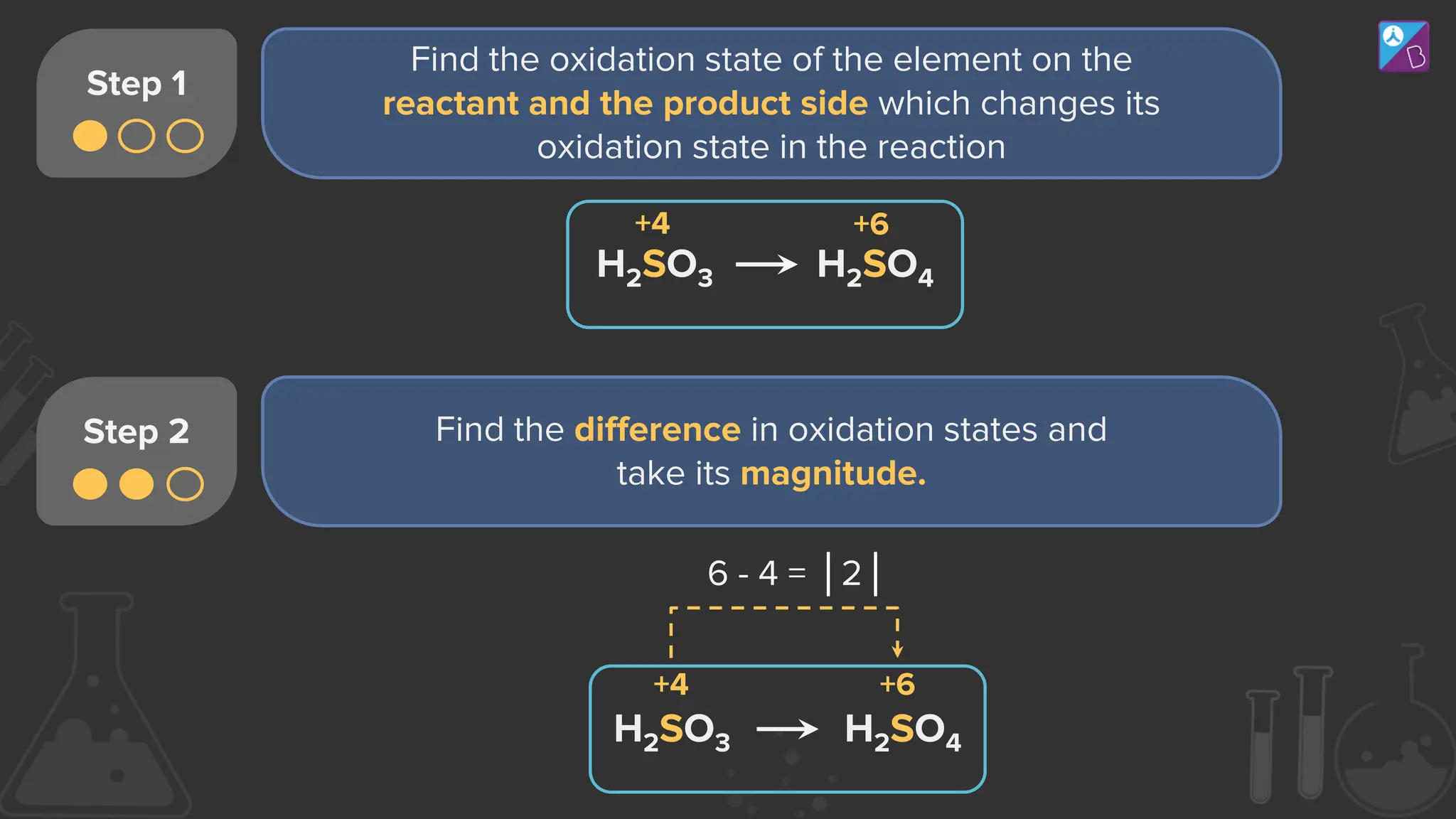
H2SO3 H2SO4
Step 1
H2SO3 H2SO4
+4 +6
Find the oxidation state of the element on the
reactant and the product side which changes its
oxidation state in the reaction
Step 2 Find the difference in oxidation states and
take its magnitude.
H2SO3 H2SO4
+4 +6
6 - 4 = │2│
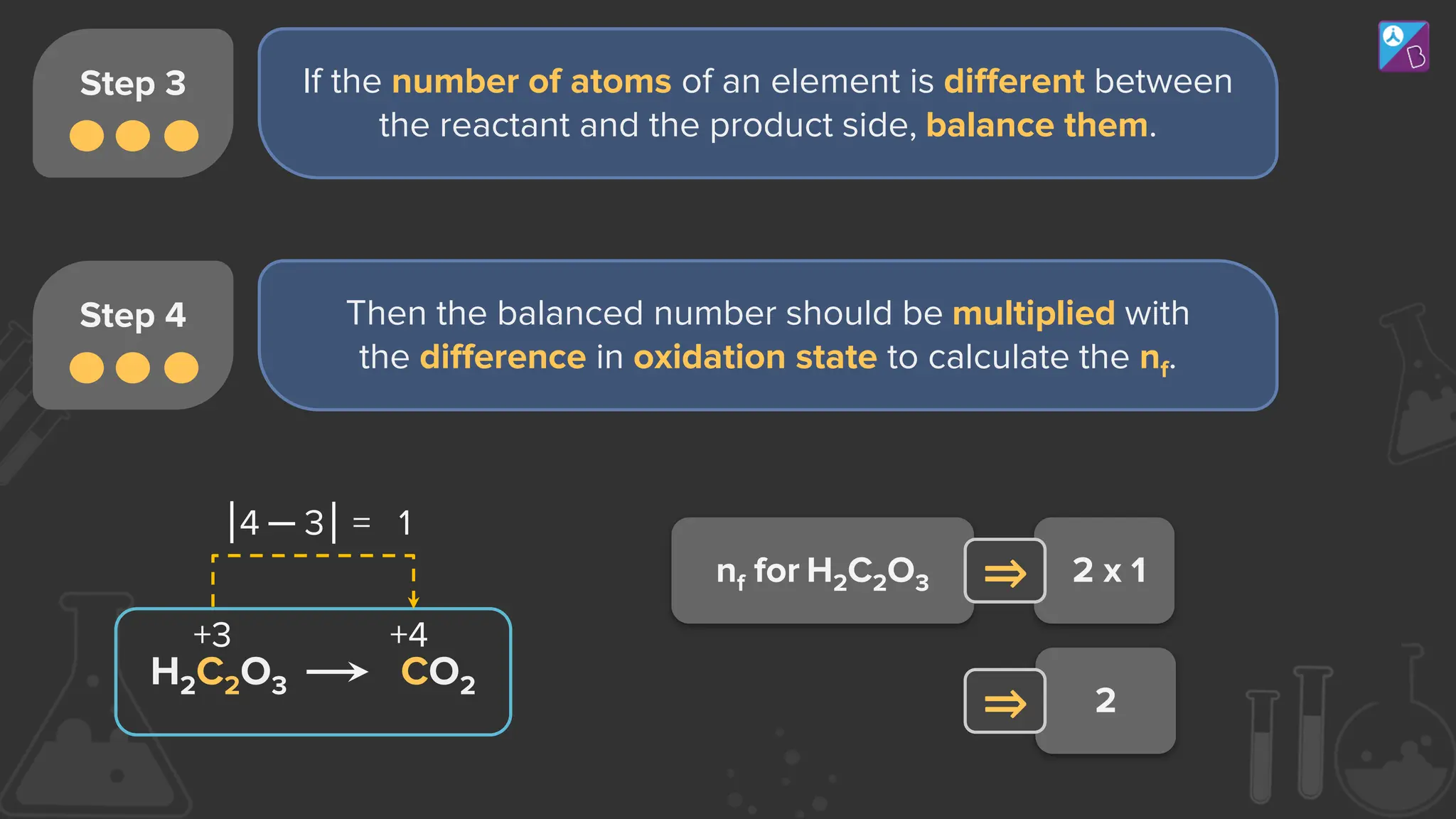
Step 3 If the number of atoms of an element is different between
the reactant and the product side, balance them.
H2C2O3 CO2
Step 4 Then the balanced number should be multiplied with
the difference in oxidation state to calculate the nf.
+4
+3
4 ─ 3 = 1
nf for H2C2O3 2 x 1
⇒
2
⇒
Calculation of nf for different Species
nf =│Charge│
Na+ nf = 1
⇒
SO4
2- nf = 2
⇒
For Ions
1
Al2(SO4)3
For Salts
2
nf = 1
nf = 6
Na+, Cl-
Al3+, SO4
2-
⇒
⇒
⇒
NaCl ⇒
Calculation of nf for different Species
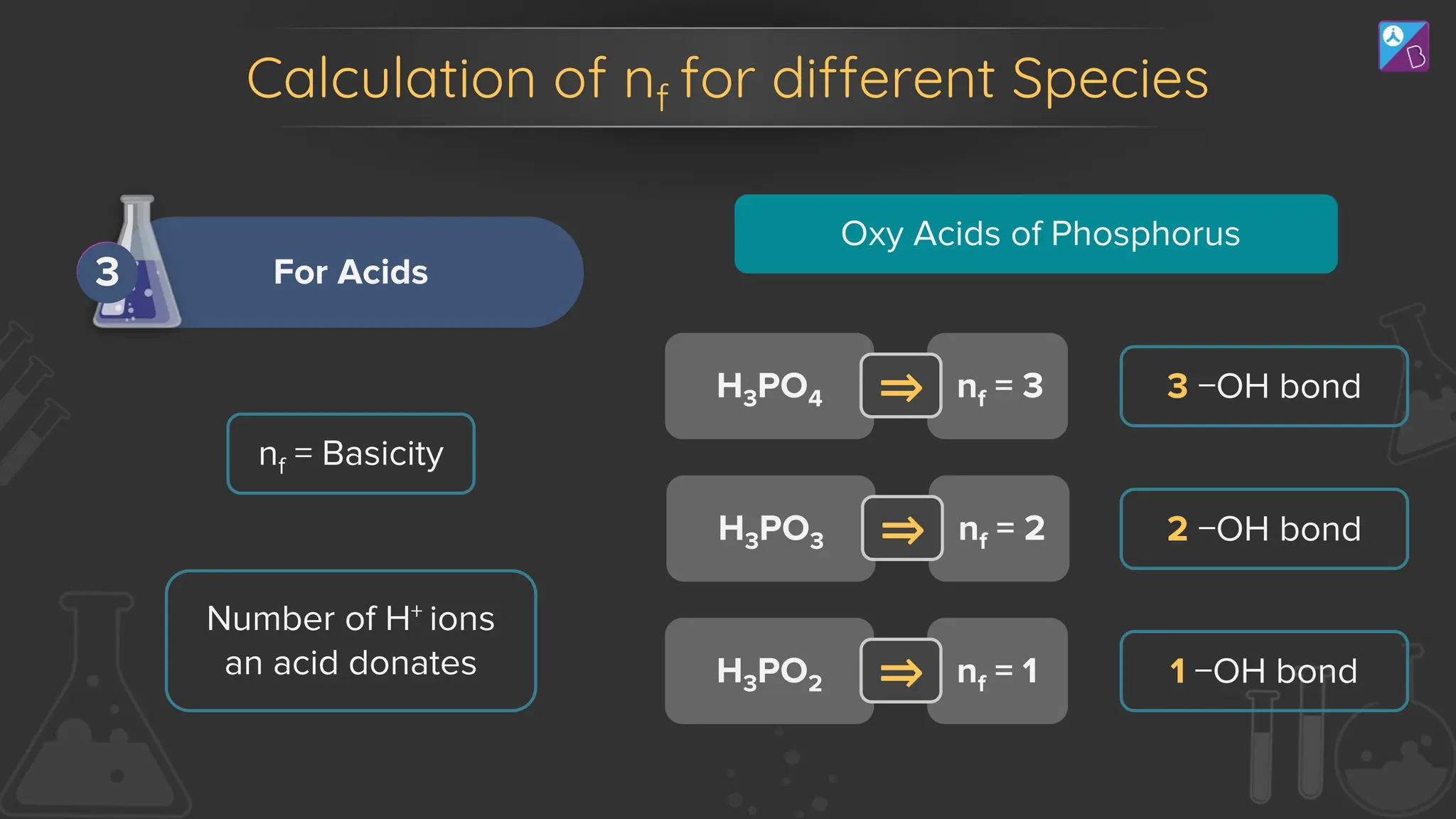
nf = Basicity
For Acids
Number of H+ ions
an acid donates
3
Oxy Acids of Phosphorus
H3PO4 nf = 3
⇒
H3PO3 nf = 2
⇒
H3PO2 nf = 1
⇒
3 −OH bond
2 −OH bond
1 −OH bond
Remember!!!
nf can be a fraction!
nf can’t be zero
or negative
Balancing of
Redox Reactions
Atom
Balance
1
2
Charge
Balance
Ion
Electron
Method
Oxidation
Number
Method
Methods
Balancing of Redox Reactions
Oxidation Number Method
Generally balancing is
carried out in 2 media
Acidic medium
(H+/H2O)
Basic medium
(OH−/H2O)
Balancing of Redox Reactions
Oxidation Number Method
MnO4 (aq) + Fe2+ (aq) Mn2+ (aq) + Fe3+ (aq)
Example −
Step 1 Identifying the
oxidizing/reducing agent
Oxidation
Oxidation Number
increases by 1 unit
Reduction
Oxidation Number
decreases by 5 units
MnO4 (aq) + Fe2+ (aq) Mn2+ (aq) + Fe3+ (aq)
+7 +2
+2 +3
−
MnO4 is the oxidising agent and
Fe2+ is the reducing agent
−
Oxidation Number Method
nf of Fe2+ = │(2 − 3) × 1│ = 1
nf of MnO4 = │(7 − 2) × 1│ = 5
MnO4 (aq) + Fe2+ (aq) Mn2+ (aq) + Fe3+ (aq)
+7 +2 +2 +3
−
−
Step 2
Finding the nf
Oxidation Number Method
Cross multiply the Oxidising and the
Reducing Agents by 1 (nf of R.A.) and 5 (nf of
O.A.) respectively on the reactant side.
Step 3 Equalising the decrease/increase
in oxidation number
1MnO4 (aq) + 5Fe2+ (aq) Mn2+ (aq) + Fe3+ (aq)
−
Oxidation Number Method
Balance all the atoms except O and H,
without changing the stoichiometric
coefficients on the reactant side
Step 4
Balancing the elements
MnO4 (aq) + 5Fe2+ (aq) Mn2+ (aq) + 5Fe3+ (aq)
−
Oxidation Number Method
Balance the O atoms by adding H2O
Step 5
Balancing the O atoms
MnO4 (aq) + 5Fe2+ (aq) Mn2+ (aq) + 5Fe3+ (aq) + 4H2O (l)
−
Oxidation Number Method
For an Acidic Medium
As soon as we add H2O, we add twice
the H+ ions on the opposite side.
xH2O 2xH+
MnO4
− (aq) + 5Fe2+ (aq) + 8H+ (aq) Mn2+ (aq)+ 5Fe3+ (aq) + 4H2O (l)
Charge on the reactant side
= [ 1 × (−1) + 5 × (+2) + 8 × (+1) ] = +17
Charge on the product side
= [1 × (+2) + 5 × (+3) + 4 × (0)] = +17
For an Acidic Medium
For a Basic Medium
ClO–(aq) + CrO2
– (aq) + OH–(aq) Cl–(aq) + CrO4
2– (aq) + H2O(l)
Example
3ClO− (aq) + 2CrO2
─ (aq) + H2O (l) 3Cl− (aq) + 2CrO4
2─ (aq) + 2H+ (aq)
Balance the whole reaction
as in an acidic medium
For a Basic Medium
3ClO− + 2CrO2
─ + H2O (l) + 2OH─ 3Cl− (aq) + 2CrO4
2 ─ + 2H+ + 2OH─
Add to both sides the same
number of OH─ as there are H+
3ClO−(aq) + 2CrO2
─ (aq) + H2O (l) + 2OH─(aq) 3Cl− (aq) + 2CrO4
2 ─ (aq)+ 2H2O(l)
Combine H+ and OH─
to form H2O
For a Basic Medium
3ClO−(aq) + 2CrO2
─ (aq)+ 2OH─(aq) 3Cl− (aq) + 2CrO4
2 ─ (aq)+ H2O (l)
Cancel any H2O that
you can
Since the charges on both the
sides are the same, this equation
is overall perfectly balanced.
Charge on reactant side = ─7 Charge on product side = ─7
Equivalent Mass
Equivalent mass
Or
Gram Eq. mass
=
Molar Mass
n - factor
Earlier it was expressed by taking
hydrogen, oxygen, chlorine and silver
as the reference elements.
Number of parts by
mass of an element which
reacts or displaces from a
compound 1.008 parts by
mass of hydrogen, 8 parts
by mass of oxygen and 35.5
parts by mass of chlorine,
is known as the equivalent
mass of that element.
Number of Gram Equivalents
No. of Gram Eq. =
Given Mass
Gram Equivalent Mass
=
Given Mass
Molar Mass/nf
=
Given Mass
Molar Mass
× nf
= Moles × nf
Normality
Number of gram
equivalent of
solute present
in 1 litre of the
solution
Normality
× nf
=
=
Number of gram
equivalents of solute
Volume of the solution (L)
Number of moles of solute
Volume of the solution (L)
Molarity × nf
=
Law of Equivalence
In a chemical reaction, equivalents or
milliequivalents of the reactants react in
equal amount to give the same number
of equivalents or milliequivalents of the
products separately.
n1 A + n2 B n3 C + n4 D
Eq. of A = Eq. of B = Eq. of C = Eq. of D
The law states that
one equivalent of
an element always
combines with one
equivalent of the
other.
Recall !!!
● Analyte: Solution with unknown concentration
● Titrant: Solution with known concentration
Equivalence point
is the point where:
No. of equivalent
of the analyte
No. of equivalent
of the titrant
=
In this titration, one oxidizing agent (O.A.)
reacts with one reducing agent (R.A.)
O.A. + R.A. Products
At the equivalence point
Redox Titration
Equivalence of O.A. Equivalence of R.A
=
N1V1 N2V2
=
N1 and V1= Normality and Volume of the Analyte Respectively
N2 and V2= Normality and Volume of the titrant Respectively
Strong Oxidizing Agent
Acts in both acidic as well as
basic medium
Self Indicator
For acidification, H2SO4
is generally used.
Use of HCl is avoided
as KMnO4 oxidises
HCl to Cl2 gas.
Titration using Potassium Permanganate
Beyond the equivalence point,
pink color re-appears
MnO4 (aq) + 5Fe2+ (aq) + 8H+ (aq) Mn2+ (aq) + 5Fe3+ (aq) + 4H2O (l)
Purple Pale pink
−
Titration using Potassium Permanganate
Oxidizing agent
only in acidic
medium
Example :
Diphenylamine,
Potassium
Ferricyanide
External redox
indicators are
used in titrations.
Titration Using Potassium Dichromate
For acidification, H2SO4
and HCl can be used as
K2Cr2O7 does not oxidize
HCl at room temperature.
K2Cr2O7 is less powerful
oxidizing agent than KMnO4.
Cr2O7 (aq) + 14H+ (aq) + 6e− 2Cr3+ (aq) + 7H2O (l)
K2Cr2O7 oxidises the diphenylamine
indicator just after the equivalence
point giving intense blue colour
indicating the end point.
Orange
2−
Titration Using Potassium Dichromate
Z + X (Excess) Product 1
X (Remaining) + Y Product 2
Reaction 1
Reaction 2
Back Titration
Back Titration
The substance or solution of
unknown concentration (1) is
made to react with known
volume and concentration of
intermediate reactant solution (2).
4 gm of contaminated
chalk, CaCO3
200 ml, 0.5N HCl
+
(1) (2)
Back Titration
The amount of intermediate
reactant is in excess of that
required for completing
reaction with analyte.
The reaction goes past the
equivalence point.
After completing the reaction
with analyte, the resulting
solution containing excess of
intermediate reactant is titrated
with known volume and
concentration of titrant
50 ml of 0.5N NaOH
Let us
assume
Back Titration
N1V1 N2V2
=
0.5 × V1 0.5 × 50
=
● N1 and V1 are normality and
volume of intermediate reactant
● N2 and V2 are normality and
volume of titrant
Volume of
excess HCl, V1
50 mL
=
m.eq. of
excess HCl
m.eq. of titrant
(NaOH)
=
0.5 × 50
= 25 m.eq.
=
Determination of excess volume or
excess m.eq. of intermediate
reactant allows us to determine the
volume or m.eq. of intermediate
reactant which reacted with analyte
m.eq. of
Chalk
Total m.eq.
of HCl
= m.eq. of
excess HCl
−
m.eq. of Chalk (0.5 × 200) − 25
=
Back Titration
m.eq. of Chalk
m.eq. of HCl
used for chalk
= 75
=
=
Mass of chalk
E
× 1000
Mass of chalk × 1000
50
Mass of chalk = 3.75 g
75
=
This means chalk contained
0.25 gm of impurities in it.
Back Titration
NaOH + HCl NaCl + H2O
Na2CO3 + HCl NaHCO3 + H2O
Reaction 1
Reaction 2
NaOH Na2CO3 NaHCO3
NaHCO3 + HCl H2CO3 + H2O
Reaction 3
Double Indicator Titration
Suitable indicator is employed to
identify completion of individual
reaction.
The indicator is selected based on
the range of pH change at
equivalence volume of the titrant.
Indicator
Color Transition
Range
Phenolphthalein (HPh) 8.3 − 10
Methyl Orange (MeOH) 3.2 − 4.4
Double Indicator Titration
The reaction is completed in two stages.
The first stage reaction is :
Na2CO3 (aq) + HCl (aq) NaCl (aq) + NaHCO3 (aq)
Titrant
Intermediate
Product
(Basic Salt)
It means that pH value
remains above 7.
Double Indicator Titration
The second stage reaction is :
NaHCO3 (aq) + HCl (aq) NaCl (aq) + CO2 (g) + H2O (l)
Acidic
pH of the solution
further goes down.
Remeber !!!
Double Indicator Titration
Indicator - Methyl Orange
m.eq. of HCl
m.eq. of NaOH + m.eq. of Na2CO3 +
meq. of NaHCO3
=
m.eq. of HCl m.eq. of NaOH + m.eq. of Na2CO3
=
Indicator - Phenolphthalein
Iodometric Titration
This titration is used to determine the strength
or the concentration of an oxidising agent.
Iodometric titration is carried out in two steps
Step 1
I (aq) + O.A I2 (g) + Product
nf = 2
unknown
Oxidising agent oxidises I to I2
Eq. of oxidising agent = Eq. of I2
0
−1
−
−
The iodine liberated is then titrated with
standard hypo solution (Na2S2O3)
Step 2
I2 (g) + S2O3 (aq) I (aq) + S4O6 (aq)
nf = 2
Eq. of I2 = Eq. of S2O3
Eq. of O.A. = Eq. of I2 = Eq. of S2O3
In both the cases, the n-factor of I2 is the same
0 −1
2− 2−
−
2−
2−
Iodimetric Titration
It is used to determine the strength or
the concentration of a reducing agent,
which is directly titrated with I2
Iodimetric titration is carried
out in a single step
unknown
Iodimetric Titration
Both iodometric and iodimetric
titrations are carried out in an acidic
medium only, as I2 will undergo
disproportion reaction in basic medium.
I (aq) + OH (aq) I2 (g) + IO3 (aq)
–
– –
I2 (g) + R.A I– (aq) + Product
H2O2
H2O2 O2 + 2H+ + 2e-
H2O2 + 2OH- O2 + 2H2O + 2e-
Acidic Medium
Basic Medium
H2O2 + 2H+ + 2e- 2H2O
H2O2 + 2e- 2OH-
Acidic Medium
Basic Medium
H2O2 as reducing agent. H2O2 as oxidising agent.
Volume Strength of H2O2
2H2O2 (aq) 2H2O (l) + O2 (g)
Decompostion of H2O2 :
The concentration of H2O2 is usually
represented in term of volume (vol).
If a sample of H2O2 is labelled as ‘x V’,
it means that 1 vol of H2O2 solution
gives x vol of O2 gas at STP on
complete decomposition
M × 11.2
N × 5.6
=
Volume Strength of H2O2
=
Redox Reactions in Electrochemistry
The area of chemistry
concerned with
the interconversion of
chemical energy
and electrical energy.
Electrochemistry
Let's define some basic
terms in Electrochemistry
like Electrode , Electrode
potential etc.
Electrodes
In order to pass the current through
an electrolytic solution two rods or plates
(metallic conductors) are always needed which
are connected with the terminals of a battery.
These rods are known as electrodes.
Types of Electrodes
Based on the
tendency to
get oxidised
or reduced
Anode
Cathode
The electrode through which the
electron leaves the electrolytic
solution (positive electrode).
The electrode through which the
electron enter the electrolytic
solution (negative electrode).
Electrolyte
The substances whose aqueous
solution allow the passage of electric
current and is chemically decomposed
into ions, are termed electrolytes.
Zn (s) Zn2+ (aq) + 2e-
Electrode Potential
The potential difference
developed between an electrode
and an electrolyte in a solution.
Unit: Volt
Standard Electrode Potential
Potential difference developed
between metal electrodes and
the solution of its ions at 1 M
concentration at 1 bar pressure
and at a particular temperature.
Standard electrode potential
of hydrogen electrode
0.00 volts
=
By convention,
Types of Electrode Potential
Oxidation
Potential (OP)
Reduction
Potential (RP)
Electrode Potential
Oxidation Potential
Electrode potential for
oxidation half reaction
M (s) Mn+ (aq) + ne−
Termed as negative electrode
Shorthand
notation M(s) / Mn+(aq)
E
Under standard conditions
M(s) / Mn+(aq)
E0
Standard Oxidation
Potential (SOP)
Indicates
standard
state
Example of Oxidation Potential
Oxidation half
Representation
H2O2 / O2
E
o
H2O2 O2 + 2H+ + 2e−
⇌
Oxidation half
Representation
Cu (s) Cu2+ (aq) + 2e−
⇌
Cu(s) / Cu2+(aq)
E o
= −0.34 V
Example of Oxidation Potential
Oxidation half
Representation
Zn (s) Zn2+ (aq) + 2e−
⇌
Zn(s) / Zn2+(aq)
E = +0.76 V
o
Reduction Potential
Electrode potential for
reduction half reaction
Mn+ (aq) + ne− M (s)
Termed as positive electrode
Shorthand
notation Mn+(aq) / M(s)
E
Under standard conditions
Mn+(aq) / M(s)
E
o
Standard Reduction
Potential (SRP)
Indicates
standard
state
Example of Reduction Potential
Reduction half
Representation
Cu2+ (aq) + 2e− Cu (s)
⇌
Reduction half
Representation
Zn2+ (aq) + 2e− Zn (s)
⇌
Zn2+(aq) / Zn(s)
E o
= −0.76 V
Cu2+(aq) / Cu(s)
E o
= 0.34 V
Reduction half
Representation
H2O2 / H2O
E
o
H2O2 + 2H+ + 2e− 2H2O
⇌
Example of Reduction Potential
Electrochemical Cell
It is a device for the interconversion
of chemical energy & electrical energy.
Galvanic cell Electrolytic cell
Electrochemical cells
Galvanic Cell
<
ΔrG 0 Example Daniel cell
Chemical energy is converted
into electrical energy.
A galvanic cell is an electrochemical cell
that produces electricity as a result of the
spontaneous reaction occurring inside it.
Electrolytic Cell
An electric current drives a
non-spontaneous reaction.
Electrical energy is being
used to carry out chemical
reactions (chemical energy).
Salt Bridge
U-shaped tube containing a solution of KCl or
NH4NO3 usually solidified by boiling with agar agar
and later cooled to form a jelly like substance.
Functions of Salt Bridge
Completes the circuit.
Maintains electrical neutrality in the
solution of both half cells.
01
02
Provides anions to the oxidation half cell and
cations to the reduction half cell.
03
Redox Couple
Redox couple is the combination of oxidized
and reduced forms of the same substance taking
part in oxidation or reduction half reaction.
Eg: Zn2+/Zn and Cu2+/Cu
Represented as Ma+/M
Electrochemical Series
A list of oxidizing agents
arranged in the decreasing
order of their standard
reduction potential
Reaction (Oxidized form + ne- Reduced form) Eo / V
Increasing
strength
of
oxidizing
agent
Increasing
strength
of
reducing
agent
F2 (g) + 2e- → 2F-
O2 (g) + 4H+ + 4e- → 2H2O
Cu2+ + 2e- → Cu (s)
2H+ + 2e- → H2 (g)
Fe2+ + 2e- → Fe (s)
Zn2+ + 2e- → Zn (s)
Li+ + e- → Li (s)
2.87
1.23
0.34
0.00
-0.44
-0.76
-3.05
Zn Rod in CuSO4 Solution
Zn(s) + Cu2+(aq) Zn2+(aq) + Cu(s)
This reaction is spontaneous as
Reduction potential of Cu2+
is more than Zn2+
Applications of Electrochemical Series
01
02
03
Predicting the feasibility
of the redox reaction.
Calculation of EMF
of the cells.
Comparison of strength
of oxidising and
reducing agent.

Redox Reactions, Stoichiometry & (Volumetric Analysis).pdf

  • 1.
  • 2.
    Classical Concept ofOxidation Addition of Oxygen Removal of Hydrogen 01 02 2Mg(s) + O2(g) 2MgO(s) 2H2S(g) + O2(g) 2S(s) + 2H2O(l) Zn(s) Zn2+(aq) + 2e- Loss of electron 03 Addition of an electronegative element 04 Removal of an electropositive element 05
  • 3.
    Classical Concept ofReduction C2H4(g) + H2(g) C2H6(g) 2HgO(s) 2Hg(l) + O2(g) Cu2+(aq) + 2e− Cu(s) △ Addition of Hydrogen Removal of Oxygen 01 02 Gain of electron 03 Addition of an electropositive element 04 Removal of an electronegative element 05
  • 4.
    Oxidation Number It isan imaginary or apparent charge developed over the atom of an element when it goes from its elemental free state to combined state in a molecule. It is based on the assumption that a complete transfer of an electron takes place from a less electronegative atom to a more electronegative atom.
  • 5.
    Concept of Oxidation Oxidation Processin which there is an increase in the oxidation number of the element from reactant to product in chemical reaction. H2 + O2 2H2O 2Na + ½O2 Na2O Increase in oxidation number Increase in oxidation number 0 + 1 0 + 1
  • 6.
    Concept of Reduction Reduction Processin which there is a decrease in the oxidation number of the element from reactant to product in chemical reaction. MgH2 (s) Mg (s) + H2 (g) 2Na (s) + O2 (g) Na2O (s) Decrease in oxidation number Decrease in oxidation number 0 + 2 0 - 2 1 2
  • 7.
    For single monatomicions, the oxidation number is equal to the charge on the ion. O.N. of Naᐩ + 1 = Rules for Finding Oxidation Number Examples Cl ̶ H+ Ca2+ More E.N. Negative O.N. = Less E.N. Positive O.N. =
  • 8.
    Rules for FindingOxidation Number In general, the oxidation number of halogens (F, Cl, Br, I) is − 1 If any halogen atom is attached to a more electronegative atom, then it will have a positive oxidation number. Examples HIO4 HCIO4 Cl2O ClF3 Fluorine is the most E.N. atom (known). It always has an oxidation number equal to -1 in all its compounds.
  • 9.
    Rules for FindingOxidation Number Generally, the oxidation number of hydrogen is +1 O.N. of H + 1 = H2O HCl H2S In Metal - Hydrides (As metals are electropositive) O.N. of H - 1 = CaH2 LiH NaH Examples Examples
  • 10.
    In complex ionsor polyatomic ions, the sum of oxidation numbers of all the atoms is equal to the net charge on the ion. For elements in their native or free state, the oxidation number is zero. Example: H2, N2, Cl2, Cu, Zn etc. Rules for Finding Oxidation Number In neutral compounds, the sum of oxidation numbers of all the atoms of different elements is equal to zero.
  • 11.
    Rules for FindingOxidation Number The oxidation number of oxygen is –2 in oxides in most of its compounds (generally) O.N. of O – 2 = Examples SO2 H2O CO2 The oxidation number of oxygen is –1 in Peroxides (O2 ) Examples BaO2 H2O2 Na2O2 2–
  • 12.
    Examples CsO2 KO2 RbO2 Rulesfor Finding Oxidation Number The oxidation number of oxygen is – (½) in superoxides (O2 ) The oxidation number of oxygen is +1 or +2 in oxy-fluorides depending upon the bonding state.
  • 13.
    In their compounds,the oxidation number of alkali metal is +1 and the oxidation number of alkaline earth metal is +2. O.N. of Na+ + 1 = O.N. of Mg2+ + 2 = Rules for Finding Oxidation Number Examples CaO NaCl KF
  • 14.
    Alkali Metals (1st Group) AlkalineEarth Metals (2nd Group) Lithium (Li) Beryllium (Be) Sodium (Na) Magnesium (Mg) Potassium (K) Calcium (Ca) Rubidium (Rb) Strontium (Sr) Caesium (Cs) Barium (Ba) Rules for Finding Oxidation Number
  • 15.
    Oxidation Number Maximum O.N. Electronsin valence shell Generally, = Minimum O.N. Electrons in valence shell - 8 = Range of Oxidation Numbers
  • 16.
    n: Group numberof element in modern periodic table n - 10 Oxidation number n - 18 ≤ ≤ Generally, for p-block elements Range of Oxidation Numbers
  • 17.
  • 18.
  • 19.
    Case 1 Case2 Case 3 Maximum O.N. Calculated O.N. = 7 Maximum O.N. = 6 Calculated O.N. = 6 Maximum O.N. = 6 Calculated O.N.= 4/3 Actual O.N. = 2,0 Calculated O.N. Maximum O.N. < Calculated O.N. Maximum O.N. > Calculated O.N. Oxidation number of some oxygen containing compounds = O.S. of Some Oxygen Containing Compounds H2S2O8 SO3 C3O2
  • 20.
    Paradox of FractionalOxidation Number In certain compounds, the oxidation number of a particular element is a fraction and not a whole number The actual oxidation numbers of these elements are whole numbers, but the average of those can be fractional.
  • 21.
    Paradox of FractionalOxidation Number Average Oxidation number of Carbon = 4 3 3x - 4 = 0 x = 4 3 ⇒ Carbon suboxide C3O2
  • 22.
    Paradox of FractionalOxidation Number 4 3 + 4 3 + 4 3 + Average oxidation number of C atoms + 2 + 2 + 0 Actual oxidation number of C atoms The actual oxidation number of the elements can be determined on the basis of the bonds present in their molecules.
  • 23.
    Paradox of FractionalOxidation Number Average Oxidation number of Sulphur = 5 2 Tetrathionate ion (S4O6)2− 4x - 12 = -2 x = 5 2 ⇒
  • 24.
    Paradox of FractionalOxidation Number +2.5 +2.5 +2.5 +2.5 Average oxidation number of S atoms +5 +5 0 0 Actual oxidation number of S atoms
  • 25.
    Substance which oxidisesothers and itself gets reduced Oxidising Agent/Oxidant KMnO4, H2O2, K2Cr2O7 Examples Oxidising and Reducing Agent Substance which reduces others and itself gets oxidised Reducing Agent/Reductant Na2S2O3, H2O2 Examples
  • 26.
    Oxidation Reduction +7 +2 +3 +2 − Fe2+ Fe3+ MnO4Mn2+ Fe2+ (aq) + MnO4 (aq) Fe3+ (aq) + Mn2+(aq) +2 +3 +7 +2 − Oxidising and Reducing Agent
  • 27.
  • 28.
    Combination Reactions A +B C C (s) + O2 (g) CO2 (g) CH4 (g) + 2O2 (g) CO2 (g) + 2H2O (l)
  • 29.
    C A +B 2 H2O (l) 2H2 (g) + O2 (g) Decomposition Reactions
  • 30.
    X + YZXZ + Y Displacement Reactions Cu (s) + 2 AgNO3 (aq) 2 Ag (s) + Cu(NO3)2 (aq) Na (s) + 2 H2O (l) 2 NaOH (aq) + H2 (g)
  • 31.
    The redox reactionin which an element from the same oxidation state changes to two different oxidation states (one lower and other higher) Disproportionation Reactions
  • 32.
    I2 (s) +NaOH (aq) NaI (aq) + NaIO3 (aq) This reaction involves the change in oxidation state of I from (0) to higher (+5) and lower (−1) O.S 0 +5 −1 Oxidation Reduction Disproportionation Reactions
  • 33.
    I− (aq) +IO3 (aq) I2 (aq) −1 +5 0 Reduction Oxidation − Comproportionation Redox Reaction The redox reaction in which an element from two different oxidation states (one lower and other higher) changes to the same oxidation state It is reverse of disproportionation.
  • 34.
    2KClO3 (s) 2KCl(s) + 3O2 (g) −2 −1 +5 0 In this case, oxidation and reduction takes place through a single molecule Reduction Oxidation Intramolecular Redox Reaction
  • 35.
  • 36.
    It is definedas the change in oxidation state per molecule. It is also known as valence factor. n-Factor H2SO3 H2SO4
  • 37.
    Step 1 H2SO3 H2SO4 +4+6 Find the oxidation state of the element on the reactant and the product side which changes its oxidation state in the reaction Step 2 Find the difference in oxidation states and take its magnitude. H2SO3 H2SO4 +4 +6 6 - 4 = │2│
  • 38.
    Step 3 Ifthe number of atoms of an element is different between the reactant and the product side, balance them. H2C2O3 CO2 Step 4 Then the balanced number should be multiplied with the difference in oxidation state to calculate the nf. +4 +3 4 ─ 3 = 1 nf for H2C2O3 2 x 1 ⇒ 2 ⇒
  • 39.
    Calculation of nffor different Species nf =│Charge│ Na+ nf = 1 ⇒ SO4 2- nf = 2 ⇒ For Ions 1 Al2(SO4)3 For Salts 2 nf = 1 nf = 6 Na+, Cl- Al3+, SO4 2- ⇒ ⇒ ⇒ NaCl ⇒
  • 40.
    Calculation of nffor different Species nf = Basicity For Acids Number of H+ ions an acid donates 3 Oxy Acids of Phosphorus H3PO4 nf = 3 ⇒ H3PO3 nf = 2 ⇒ H3PO2 nf = 1 ⇒ 3 −OH bond 2 −OH bond 1 −OH bond
  • 41.
    Remember!!! nf can bea fraction! nf can’t be zero or negative
  • 42.
  • 43.
  • 44.
  • 45.
    Generally balancing is carriedout in 2 media Acidic medium (H+/H2O) Basic medium (OH−/H2O) Balancing of Redox Reactions
  • 46.
    Oxidation Number Method MnO4(aq) + Fe2+ (aq) Mn2+ (aq) + Fe3+ (aq) Example − Step 1 Identifying the oxidizing/reducing agent
  • 47.
    Oxidation Oxidation Number increases by1 unit Reduction Oxidation Number decreases by 5 units MnO4 (aq) + Fe2+ (aq) Mn2+ (aq) + Fe3+ (aq) +7 +2 +2 +3 − MnO4 is the oxidising agent and Fe2+ is the reducing agent − Oxidation Number Method
  • 48.
    nf of Fe2+= │(2 − 3) × 1│ = 1 nf of MnO4 = │(7 − 2) × 1│ = 5 MnO4 (aq) + Fe2+ (aq) Mn2+ (aq) + Fe3+ (aq) +7 +2 +2 +3 − − Step 2 Finding the nf Oxidation Number Method
  • 49.
    Cross multiply theOxidising and the Reducing Agents by 1 (nf of R.A.) and 5 (nf of O.A.) respectively on the reactant side. Step 3 Equalising the decrease/increase in oxidation number 1MnO4 (aq) + 5Fe2+ (aq) Mn2+ (aq) + Fe3+ (aq) − Oxidation Number Method
  • 50.
    Balance all theatoms except O and H, without changing the stoichiometric coefficients on the reactant side Step 4 Balancing the elements MnO4 (aq) + 5Fe2+ (aq) Mn2+ (aq) + 5Fe3+ (aq) − Oxidation Number Method
  • 51.
    Balance the Oatoms by adding H2O Step 5 Balancing the O atoms MnO4 (aq) + 5Fe2+ (aq) Mn2+ (aq) + 5Fe3+ (aq) + 4H2O (l) − Oxidation Number Method
  • 52.
    For an AcidicMedium As soon as we add H2O, we add twice the H+ ions on the opposite side. xH2O 2xH+
  • 53.
    MnO4 − (aq) +5Fe2+ (aq) + 8H+ (aq) Mn2+ (aq)+ 5Fe3+ (aq) + 4H2O (l) Charge on the reactant side = [ 1 × (−1) + 5 × (+2) + 8 × (+1) ] = +17 Charge on the product side = [1 × (+2) + 5 × (+3) + 4 × (0)] = +17 For an Acidic Medium
  • 54.
    For a BasicMedium ClO–(aq) + CrO2 – (aq) + OH–(aq) Cl–(aq) + CrO4 2– (aq) + H2O(l) Example 3ClO− (aq) + 2CrO2 ─ (aq) + H2O (l) 3Cl− (aq) + 2CrO4 2─ (aq) + 2H+ (aq) Balance the whole reaction as in an acidic medium
  • 55.
    For a BasicMedium 3ClO− + 2CrO2 ─ + H2O (l) + 2OH─ 3Cl− (aq) + 2CrO4 2 ─ + 2H+ + 2OH─ Add to both sides the same number of OH─ as there are H+ 3ClO−(aq) + 2CrO2 ─ (aq) + H2O (l) + 2OH─(aq) 3Cl− (aq) + 2CrO4 2 ─ (aq)+ 2H2O(l) Combine H+ and OH─ to form H2O
  • 56.
    For a BasicMedium 3ClO−(aq) + 2CrO2 ─ (aq)+ 2OH─(aq) 3Cl− (aq) + 2CrO4 2 ─ (aq)+ H2O (l) Cancel any H2O that you can Since the charges on both the sides are the same, this equation is overall perfectly balanced. Charge on reactant side = ─7 Charge on product side = ─7
  • 57.
    Equivalent Mass Equivalent mass Or GramEq. mass = Molar Mass n - factor Earlier it was expressed by taking hydrogen, oxygen, chlorine and silver as the reference elements. Number of parts by mass of an element which reacts or displaces from a compound 1.008 parts by mass of hydrogen, 8 parts by mass of oxygen and 35.5 parts by mass of chlorine, is known as the equivalent mass of that element.
  • 58.
    Number of GramEquivalents No. of Gram Eq. = Given Mass Gram Equivalent Mass = Given Mass Molar Mass/nf = Given Mass Molar Mass × nf = Moles × nf
  • 59.
    Normality Number of gram equivalentof solute present in 1 litre of the solution Normality × nf = = Number of gram equivalents of solute Volume of the solution (L) Number of moles of solute Volume of the solution (L) Molarity × nf =
  • 60.
    Law of Equivalence Ina chemical reaction, equivalents or milliequivalents of the reactants react in equal amount to give the same number of equivalents or milliequivalents of the products separately. n1 A + n2 B n3 C + n4 D Eq. of A = Eq. of B = Eq. of C = Eq. of D The law states that one equivalent of an element always combines with one equivalent of the other.
  • 61.
    Recall !!! ● Analyte:Solution with unknown concentration ● Titrant: Solution with known concentration Equivalence point is the point where: No. of equivalent of the analyte No. of equivalent of the titrant = In this titration, one oxidizing agent (O.A.) reacts with one reducing agent (R.A.) O.A. + R.A. Products
  • 62.
    At the equivalencepoint Redox Titration Equivalence of O.A. Equivalence of R.A = N1V1 N2V2 = N1 and V1= Normality and Volume of the Analyte Respectively N2 and V2= Normality and Volume of the titrant Respectively
  • 63.
    Strong Oxidizing Agent Actsin both acidic as well as basic medium Self Indicator For acidification, H2SO4 is generally used. Use of HCl is avoided as KMnO4 oxidises HCl to Cl2 gas. Titration using Potassium Permanganate
  • 64.
    Beyond the equivalencepoint, pink color re-appears MnO4 (aq) + 5Fe2+ (aq) + 8H+ (aq) Mn2+ (aq) + 5Fe3+ (aq) + 4H2O (l) Purple Pale pink − Titration using Potassium Permanganate
  • 65.
    Oxidizing agent only inacidic medium Example : Diphenylamine, Potassium Ferricyanide External redox indicators are used in titrations. Titration Using Potassium Dichromate For acidification, H2SO4 and HCl can be used as K2Cr2O7 does not oxidize HCl at room temperature. K2Cr2O7 is less powerful oxidizing agent than KMnO4.
  • 66.
    Cr2O7 (aq) +14H+ (aq) + 6e− 2Cr3+ (aq) + 7H2O (l) K2Cr2O7 oxidises the diphenylamine indicator just after the equivalence point giving intense blue colour indicating the end point. Orange 2− Titration Using Potassium Dichromate
  • 67.
    Z + X(Excess) Product 1 X (Remaining) + Y Product 2 Reaction 1 Reaction 2 Back Titration
  • 68.
    Back Titration The substanceor solution of unknown concentration (1) is made to react with known volume and concentration of intermediate reactant solution (2). 4 gm of contaminated chalk, CaCO3 200 ml, 0.5N HCl + (1) (2)
  • 69.
    Back Titration The amountof intermediate reactant is in excess of that required for completing reaction with analyte. The reaction goes past the equivalence point. After completing the reaction with analyte, the resulting solution containing excess of intermediate reactant is titrated with known volume and concentration of titrant 50 ml of 0.5N NaOH Let us assume
  • 70.
    Back Titration N1V1 N2V2 = 0.5× V1 0.5 × 50 = ● N1 and V1 are normality and volume of intermediate reactant ● N2 and V2 are normality and volume of titrant Volume of excess HCl, V1 50 mL = m.eq. of excess HCl m.eq. of titrant (NaOH) = 0.5 × 50 = 25 m.eq. =
  • 71.
    Determination of excessvolume or excess m.eq. of intermediate reactant allows us to determine the volume or m.eq. of intermediate reactant which reacted with analyte m.eq. of Chalk Total m.eq. of HCl = m.eq. of excess HCl − m.eq. of Chalk (0.5 × 200) − 25 = Back Titration
  • 72.
    m.eq. of Chalk m.eq.of HCl used for chalk = 75 = = Mass of chalk E × 1000 Mass of chalk × 1000 50 Mass of chalk = 3.75 g 75 = This means chalk contained 0.25 gm of impurities in it. Back Titration
  • 73.
    NaOH + HClNaCl + H2O Na2CO3 + HCl NaHCO3 + H2O Reaction 1 Reaction 2 NaOH Na2CO3 NaHCO3 NaHCO3 + HCl H2CO3 + H2O Reaction 3 Double Indicator Titration
  • 74.
    Suitable indicator isemployed to identify completion of individual reaction. The indicator is selected based on the range of pH change at equivalence volume of the titrant. Indicator Color Transition Range Phenolphthalein (HPh) 8.3 − 10 Methyl Orange (MeOH) 3.2 − 4.4 Double Indicator Titration
  • 75.
    Double Indicator Titration Thereaction is completed in two stages. The first stage reaction is : Na2CO3 (aq) + HCl (aq) NaCl (aq) + NaHCO3 (aq) Titrant Intermediate Product (Basic Salt) It means that pH value remains above 7.
  • 76.
    Double Indicator Titration Thesecond stage reaction is : NaHCO3 (aq) + HCl (aq) NaCl (aq) + CO2 (g) + H2O (l) Acidic pH of the solution further goes down.
  • 77.
  • 78.
    Double Indicator Titration Indicator- Methyl Orange m.eq. of HCl m.eq. of NaOH + m.eq. of Na2CO3 + meq. of NaHCO3 = m.eq. of HCl m.eq. of NaOH + m.eq. of Na2CO3 = Indicator - Phenolphthalein
  • 79.
    Iodometric Titration This titrationis used to determine the strength or the concentration of an oxidising agent. Iodometric titration is carried out in two steps
  • 80.
    Step 1 I (aq)+ O.A I2 (g) + Product nf = 2 unknown Oxidising agent oxidises I to I2 Eq. of oxidising agent = Eq. of I2 0 −1 − − The iodine liberated is then titrated with standard hypo solution (Na2S2O3)
  • 81.
    Step 2 I2 (g)+ S2O3 (aq) I (aq) + S4O6 (aq) nf = 2 Eq. of I2 = Eq. of S2O3 Eq. of O.A. = Eq. of I2 = Eq. of S2O3 In both the cases, the n-factor of I2 is the same 0 −1 2− 2− − 2− 2−
  • 82.
    Iodimetric Titration It isused to determine the strength or the concentration of a reducing agent, which is directly titrated with I2 Iodimetric titration is carried out in a single step
  • 83.
    unknown Iodimetric Titration Both iodometricand iodimetric titrations are carried out in an acidic medium only, as I2 will undergo disproportion reaction in basic medium. I (aq) + OH (aq) I2 (g) + IO3 (aq) – – – I2 (g) + R.A I– (aq) + Product
  • 84.
    H2O2 H2O2 O2 +2H+ + 2e- H2O2 + 2OH- O2 + 2H2O + 2e- Acidic Medium Basic Medium H2O2 + 2H+ + 2e- 2H2O H2O2 + 2e- 2OH- Acidic Medium Basic Medium H2O2 as reducing agent. H2O2 as oxidising agent.
  • 85.
    Volume Strength ofH2O2 2H2O2 (aq) 2H2O (l) + O2 (g) Decompostion of H2O2 : The concentration of H2O2 is usually represented in term of volume (vol). If a sample of H2O2 is labelled as ‘x V’, it means that 1 vol of H2O2 solution gives x vol of O2 gas at STP on complete decomposition M × 11.2 N × 5.6 = Volume Strength of H2O2 =
  • 86.
    Redox Reactions inElectrochemistry The area of chemistry concerned with the interconversion of chemical energy and electrical energy. Electrochemistry Let's define some basic terms in Electrochemistry like Electrode , Electrode potential etc.
  • 87.
    Electrodes In order topass the current through an electrolytic solution two rods or plates (metallic conductors) are always needed which are connected with the terminals of a battery. These rods are known as electrodes.
  • 88.
    Types of Electrodes Basedon the tendency to get oxidised or reduced Anode Cathode The electrode through which the electron leaves the electrolytic solution (positive electrode). The electrode through which the electron enter the electrolytic solution (negative electrode).
  • 89.
    Electrolyte The substances whoseaqueous solution allow the passage of electric current and is chemically decomposed into ions, are termed electrolytes. Zn (s) Zn2+ (aq) + 2e-
  • 90.
    Electrode Potential The potentialdifference developed between an electrode and an electrolyte in a solution. Unit: Volt
  • 91.
    Standard Electrode Potential Potentialdifference developed between metal electrodes and the solution of its ions at 1 M concentration at 1 bar pressure and at a particular temperature. Standard electrode potential of hydrogen electrode 0.00 volts = By convention,
  • 92.
    Types of ElectrodePotential Oxidation Potential (OP) Reduction Potential (RP) Electrode Potential
  • 93.
    Oxidation Potential Electrode potentialfor oxidation half reaction M (s) Mn+ (aq) + ne− Termed as negative electrode Shorthand notation M(s) / Mn+(aq) E Under standard conditions M(s) / Mn+(aq) E0 Standard Oxidation Potential (SOP) Indicates standard state
  • 94.
    Example of OxidationPotential Oxidation half Representation H2O2 / O2 E o H2O2 O2 + 2H+ + 2e− ⇌ Oxidation half Representation Cu (s) Cu2+ (aq) + 2e− ⇌ Cu(s) / Cu2+(aq) E o = −0.34 V
  • 95.
    Example of OxidationPotential Oxidation half Representation Zn (s) Zn2+ (aq) + 2e− ⇌ Zn(s) / Zn2+(aq) E = +0.76 V o
  • 96.
    Reduction Potential Electrode potentialfor reduction half reaction Mn+ (aq) + ne− M (s) Termed as positive electrode Shorthand notation Mn+(aq) / M(s) E Under standard conditions Mn+(aq) / M(s) E o Standard Reduction Potential (SRP) Indicates standard state
  • 97.
    Example of ReductionPotential Reduction half Representation Cu2+ (aq) + 2e− Cu (s) ⇌ Reduction half Representation Zn2+ (aq) + 2e− Zn (s) ⇌ Zn2+(aq) / Zn(s) E o = −0.76 V Cu2+(aq) / Cu(s) E o = 0.34 V
  • 98.
    Reduction half Representation H2O2 /H2O E o H2O2 + 2H+ + 2e− 2H2O ⇌ Example of Reduction Potential
  • 99.
    Electrochemical Cell It isa device for the interconversion of chemical energy & electrical energy. Galvanic cell Electrolytic cell Electrochemical cells
  • 100.
    Galvanic Cell < ΔrG 0Example Daniel cell Chemical energy is converted into electrical energy. A galvanic cell is an electrochemical cell that produces electricity as a result of the spontaneous reaction occurring inside it.
  • 101.
    Electrolytic Cell An electriccurrent drives a non-spontaneous reaction. Electrical energy is being used to carry out chemical reactions (chemical energy).
  • 102.
    Salt Bridge U-shaped tubecontaining a solution of KCl or NH4NO3 usually solidified by boiling with agar agar and later cooled to form a jelly like substance.
  • 103.
    Functions of SaltBridge Completes the circuit. Maintains electrical neutrality in the solution of both half cells. 01 02 Provides anions to the oxidation half cell and cations to the reduction half cell. 03
  • 104.
    Redox Couple Redox coupleis the combination of oxidized and reduced forms of the same substance taking part in oxidation or reduction half reaction. Eg: Zn2+/Zn and Cu2+/Cu Represented as Ma+/M
  • 105.
    Electrochemical Series A listof oxidizing agents arranged in the decreasing order of their standard reduction potential
  • 106.
    Reaction (Oxidized form+ ne- Reduced form) Eo / V Increasing strength of oxidizing agent Increasing strength of reducing agent F2 (g) + 2e- → 2F- O2 (g) + 4H+ + 4e- → 2H2O Cu2+ + 2e- → Cu (s) 2H+ + 2e- → H2 (g) Fe2+ + 2e- → Fe (s) Zn2+ + 2e- → Zn (s) Li+ + e- → Li (s) 2.87 1.23 0.34 0.00 -0.44 -0.76 -3.05
  • 107.
    Zn Rod inCuSO4 Solution Zn(s) + Cu2+(aq) Zn2+(aq) + Cu(s) This reaction is spontaneous as Reduction potential of Cu2+ is more than Zn2+
  • 108.
    Applications of ElectrochemicalSeries 01 02 03 Predicting the feasibility of the redox reaction. Calculation of EMF of the cells. Comparison of strength of oxidising and reducing agent.