byby
CHEMISTRY DEPARTMENTCHEMISTRY DEPARTMENT
CHEM-111CHEM-111
General ChemistryGeneral Chemistry
Unit five (b)Unit five (b)
Chemical EquationsChemical Equations
Unit Five
• Oxidation and reduction Reactions
• Oxidizing agent
• Reducing agents
• Oxidation Numbers
• Biological Oxidation-Reduction
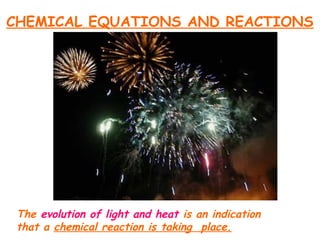
CHEMICAL EQUATIONS AND REACTIONS
The evolution of light and heat is an indication
that a chemical reaction is taking place.
CHEMICAL REACTION
A process in which nature & chemical composition
of a substance is changed.
Examples: food digestion, burning of coal, rust of
iron nails, burning of methane etc,
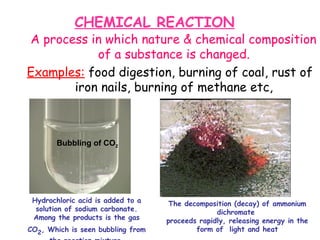
Hydrochloric acid is added to a
solution of sodium carbonate.
Among the products is the gas
CO2, Which is seen bubbling from
The decomposition (decay) of ammonium
dichromate
proceeds rapidly, releasing energy in the
form of light and heat
Bubbling of CO2
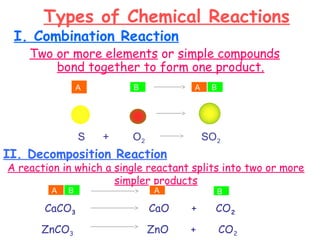
Types of Chemical Reactions
I. Combination Reaction
Two or more elements or simple compounds
bond together to form one product.
+A B BA
+
S + O2 SO2
II. Decomposition Reaction
A reaction in which a single reactant splits into two or more
simpler products
+ BBA A
CaCO3 CaO + CO2
ZnCO3 ZnO + CO2
Δ
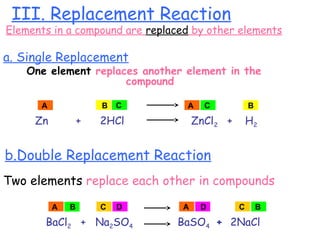
III. Replacement Reaction
Elements in a compound are replaced by other elements
a. Single Replacement
One element replaces another element in the
compound
BCACBA + +
Zn + 2HCl ZnCl2 + H2
b.Double Replacement Reaction
Two elements replace each other in compounds
BA DC A BD C
BaCl2 + Na2SO4 BaSO4 + 2NaCl
+ +
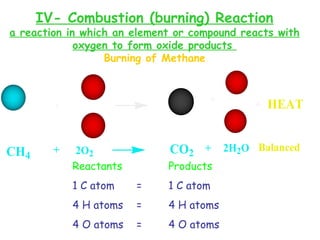
IV- Combustion (burning) Reaction
a reaction in which an element or compound reacts with
oxygen to form oxide products
Burning of Methane
+
+
CH4
+ 2O2 CO2 + 2H2O
HEAT+
Balanced
Reactants Products
1 C atom = 1 C atom
4 H atoms = 4 H atoms
4 O atoms = 4 O atoms
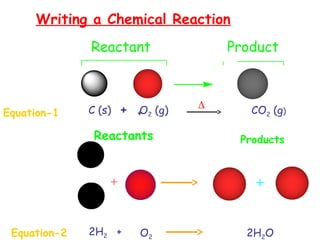
Reactant
s
Product
s
Equation-1 C (s) +O2 (g)
Δ
CO2 (g)
++
2H2 + O2 2H2O
Writing a Chemical Reaction
Equation-2
Reactants Products
+
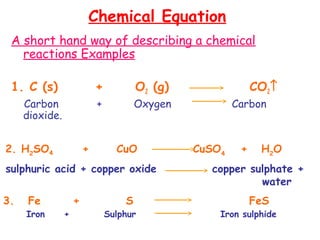
A short hand way of describing a chemical
reactions Examples
1. C (s) + O2 (g) CO2↑
Carbon + Oxygen Carbon
dioxide.
Chemical Equation
2. H2
SO4 + CuO CuSO4
+ H2
O
sulphuric acid + copper oxide copper sulphate +
water
3. Fe + S FeS
Iron + Sulphur Iron sulphide
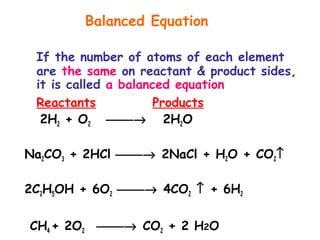
Balanced Equation
If the number of atoms of each element
are the same on reactant & product sides,
it is called a balanced equation
Reactants Products
2H2 + O2 → 2H2O
Na2CO3 + 2HCl → 2NaCl + H2O + CO2↑
2C2H5OH + 6O2 → 4CO2 ↑ + 6H2
CH4 + 2O2 → CO2 + 2 H2O
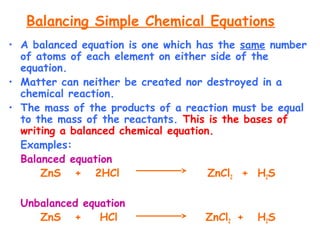
Balancing Simple Chemical Equations
• A balanced equation is one which has the same number
of atoms of each element on either side of the
equation.
• Matter can neither be created nor destroyed in a
chemical reaction.
• The mass of the products of a reaction must be equal
to the mass of the reactants. This is the bases of
writing a balanced chemical equation.
Examples:
Balanced equation
ZnS + 2HCl ZnCl2 + H2S
Unbalanced equation
ZnS + HCl ZnCl2 + H2S
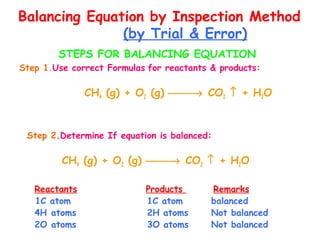
STEPS FOR BALANCING EQUATION
Step 1.Use correct Formulas for reactants & products:
CH4 (g) + O2 (g) → CO2 ↑ + H2O
Step 2.Determine If equation is balanced:
CH4 (g) + O2 (g) → CO2 ↑ + H2O
Reactants Products Remarks
1C atom 1C atom balanced
4H atoms 2H atoms Not balanced
2O atoms 3O atoms Not balanced
Balancing Equation by Inspection Method
(by Trial & Error)
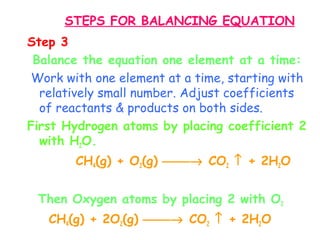
Step 3
Balance the equation one element at a time:
Work with one element at a time, starting with
relatively small number. Adjust coefficients
of reactants & products on both sides.
First Hydrogen atoms by placing coefficient 2
with H2O.
CH4(g) + O2(g) → CO2 ↑ + 2H2O
Then Oxygen atoms by placing 2 with O2
CH4(g) + 2O2(g) → CO2 ↑ + 2H2O
STEPS FOR BALANCING EQUATION
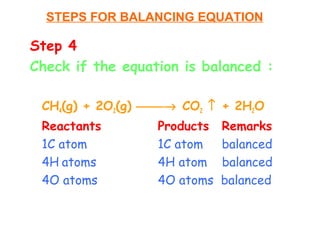
Step 4
Check if the equation is balanced :
CH4(g) + 2O2(g) → CO2 ↑ + 2H2O
Reactants Products Remarks
1C atom 1C atom balanced
4H atoms 4H atom balanced
4O atoms 4O atoms balanced
STEPS FOR BALANCING EQUATION
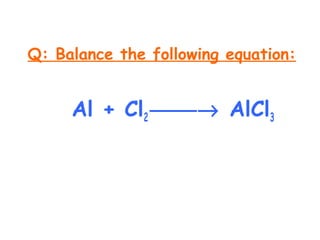
Q: Balance the following equation:
Al + Cl2 → AlCl3
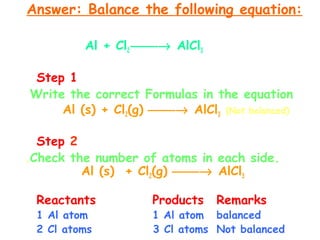
Answer: Balance the following equation:
Al + Cl2 → AlCl3
Step 1
Write the correct Formulas in the equation
Al (s) + Cl2(g) → AlCl3 (Not balanced)
Step 2
.Check the number of atoms in each side.
Al (s) + Cl2(g) → AlCl3
Reactants Products Remarks
1 Al atom 1 Al atom balanced
2 Cl atoms 3 Cl atoms Not balanced
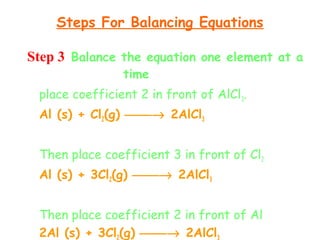
Steps For Balancing Equations
Step 3 Balance the equation one element at a
time
place coefficient 2 in front of AlCl3.
Al (s) + Cl2(g) → 2AlCl3
Then place coefficient 3 in front of Cl2
Al (s) + 3Cl2(g) → 2AlCl3
Then place coefficient 2 in front of Al
2Al (s) + 3Cl (g) → 2AlCl
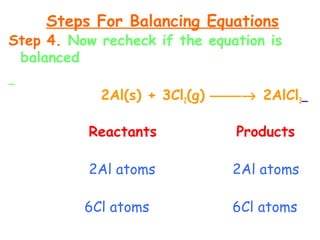
Steps For Balancing Equations
Step 4. Now recheck if the equation is
balanced
2Al(s) + 3Cl2(g) → 2AlCl3
Reactants Products
2Al atoms 2Al atoms
6Cl atoms 6Cl atoms
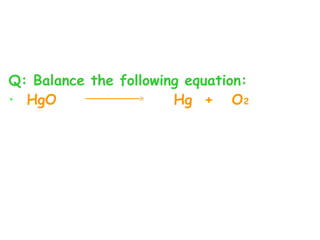
Q: Balance the following equation:
• HgO Hg + O2
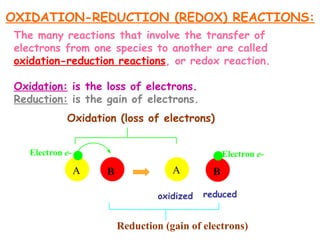
The many reactions that involve the transfer of
electrons from one species to another are called
oxidation-reduction reactions, or redox reaction.
Oxidation: is the loss of electrons.
Reduction: is the gain of electrons.
OXIDATION-REDUCTION (REDOX) REACTIONS:
Oxidation (loss of electrons)
A AB B
oxidized reduced
Reduction (gain of electrons)
Electron e-Electron e-
Oxidation
1. Addition of oxygen
S + O2 SO2 Addition of oxygen
2. Or loss of electrons by substance
Mg Mg2+
+ 2e-
loss of electrons
3.Or Removal of hydrogen or any electropositive
element from a compound.
CR
OH
H
R CR R
O
oxidation Removal of hydrogen
Reduction
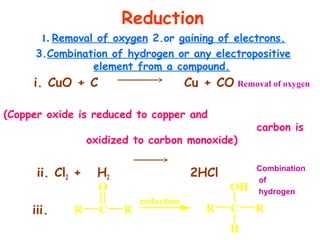
1. Removal of oxygen 2.or gaining of electrons.
3.Combination of hydrogen or any electropositive
element from a compound.
i. CuO + C Cu + CO Removal of oxygen
(Copper oxide is reduced to copper and
carbon is
oxidized to carbon monoxide)
ii. Cl2 + H2 2HCl
CR R
O
CR
OH
H
R
reduction
iii.
Combination
of
hydrogen
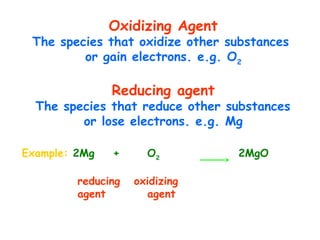
Oxidizing Agent
The species that oxidize other substances
or gain electrons. e.g. O2
Reducing agent
The species that reduce other substances
or lose electrons. e.g. Mg
Example: 2Mg + O2
2MgO
reducing oxidizing
agent agent
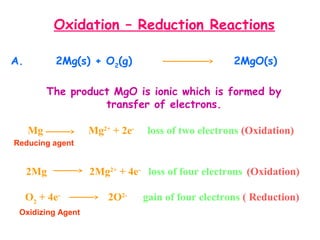
Mg Mg2+
+ 2e-
loss of two electrons (Oxidation)
2Mg 2Mg2+
+ 4e-
loss of four electrons (Oxidation)
O2
+ 4e-
2O2-
gain of four electrons ( Reduction)
The product MgO is ionic which is formed by
transfer of electrons.
A. 2Mg(s) + O2
(g) 2MgO(s)
Oxidation – Reduction Reactions
Reducing agent
Oxidizing Agent
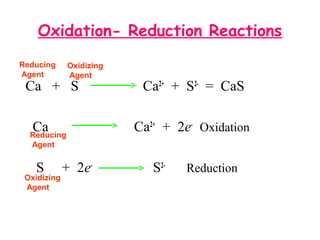
Oxidation- Reduction Reactions
Ca + S Ca2+
+ S2-
= CaS
Ca Ca2+
+ 2e-
Oxidation
S + 2e-
S2-
Reduction
Reducing
Agent
Oxidizing
Agent
Reducing
Agent
Oxidizing
Agent
Oxidation Number
Oxidation number of an element is a number
which indicates the degree of oxidation or
reduction suffered by an element.
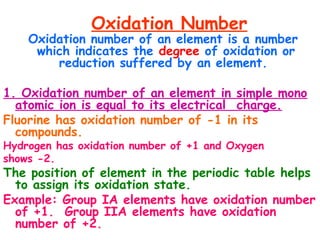
1. Oxidation number of an element in simple mono
atomic ion is equal to its electrical charge.
Fluorine has oxidation number of -1 in its
compounds.
Hydrogen has oxidation number of +1 and Oxygen
shows -2.
The position of element in the periodic table helps
to assign its oxidation state.
Example: Group IA elements have oxidation number
of +1. Group IIA elements have oxidation
number of +2.
Oxidation Number
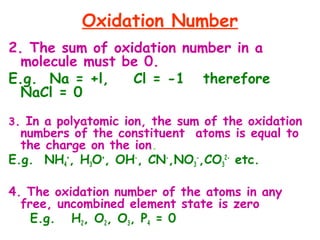
2. The sum of oxidation number in a
molecule must be 0.
E.g. Na = +l, Cl = -1 therefore
NaCl = 0
3. In a polyatomic ion, the sum of the oxidation
numbers of the constituent atoms is equal to
the charge on the ion.
E.g. NH4
+
, H3O+
, OH-
, CN-
,NO3
-
,CO3
2-
etc.
4. The oxidation number of the atoms in any
free, uncombined element state is zero
E.g. H2, O2, O3, P4 = 0
BIOLOGICAL OXIDATION-
REDUCTION REACTIONS
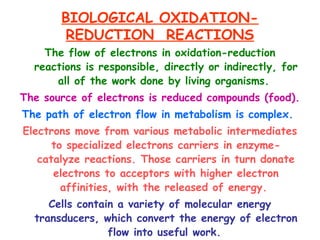
The flow of electrons in oxidation-reduction
reactions is responsible, directly or indirectly, for
all of the work done by living organisms.
The source of electrons is reduced compounds (food).
The path of electron flow in metabolism is complex.
Electrons move from various metabolic intermediates
to specialized electrons carriers in enzyme-
catalyze reactions. Those carriers in turn donate
electrons to acceptors with higher electron
affinities, with the released of energy.
Cells contain a variety of molecular energy
transducers, which convert the energy of electron
flow into useful work.
Balancing Equation
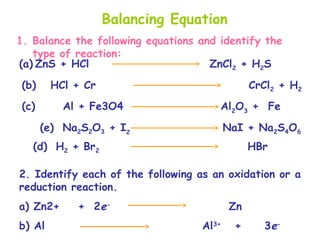
1. Balance the following equations and identify the
type of reaction:
(a) ZnS + HCl ZnCl2 + H2S
(b) HCl + Cr CrCl2 + H2
(c) Al + Fe3O4 Al2
O3
+ Fe
(d) H2 + Br2 HBr
(e) Na2S2O3 + I2
NaI + Na2S4O6
2. Identify each of the following as an oxidation or a
reduction reaction.
a) Zn2+ + 2e-
Zn
b) Al Al3+
+ 3e-

05b chemical equations

  • 1.
    byby CHEMISTRY DEPARTMENTCHEMISTRY DEPARTMENT CHEM-111CHEM-111 GeneralChemistryGeneral Chemistry Unit five (b)Unit five (b) Chemical EquationsChemical Equations
  • 2.
    Unit Five • Oxidationand reduction Reactions • Oxidizing agent • Reducing agents • Oxidation Numbers • Biological Oxidation-Reduction
  • 3.
    CHEMICAL EQUATIONS ANDREACTIONS The evolution of light and heat is an indication that a chemical reaction is taking place.
  • 4.
    CHEMICAL REACTION A processin which nature & chemical composition of a substance is changed. Examples: food digestion, burning of coal, rust of iron nails, burning of methane etc, Hydrochloric acid is added to a solution of sodium carbonate. Among the products is the gas CO2, Which is seen bubbling from The decomposition (decay) of ammonium dichromate proceeds rapidly, releasing energy in the form of light and heat Bubbling of CO2
  • 5.
    Types of ChemicalReactions I. Combination Reaction Two or more elements or simple compounds bond together to form one product. +A B BA + S + O2 SO2 II. Decomposition Reaction A reaction in which a single reactant splits into two or more simpler products + BBA A CaCO3 CaO + CO2 ZnCO3 ZnO + CO2 Δ
  • 6.
    III. Replacement Reaction Elementsin a compound are replaced by other elements a. Single Replacement One element replaces another element in the compound BCACBA + + Zn + 2HCl ZnCl2 + H2 b.Double Replacement Reaction Two elements replace each other in compounds BA DC A BD C BaCl2 + Na2SO4 BaSO4 + 2NaCl + +
  • 7.
    IV- Combustion (burning)Reaction a reaction in which an element or compound reacts with oxygen to form oxide products Burning of Methane + + CH4 + 2O2 CO2 + 2H2O HEAT+ Balanced Reactants Products 1 C atom = 1 C atom 4 H atoms = 4 H atoms 4 O atoms = 4 O atoms
  • 8.
    Reactant s Product s Equation-1 C (s)+O2 (g) Δ CO2 (g) ++ 2H2 + O2 2H2O Writing a Chemical Reaction Equation-2 Reactants Products +
  • 9.
    A short handway of describing a chemical reactions Examples 1. C (s) + O2 (g) CO2↑ Carbon + Oxygen Carbon dioxide. Chemical Equation 2. H2 SO4 + CuO CuSO4 + H2 O sulphuric acid + copper oxide copper sulphate + water 3. Fe + S FeS Iron + Sulphur Iron sulphide
  • 10.
    Balanced Equation If thenumber of atoms of each element are the same on reactant & product sides, it is called a balanced equation Reactants Products 2H2 + O2 → 2H2O Na2CO3 + 2HCl → 2NaCl + H2O + CO2↑ 2C2H5OH + 6O2 → 4CO2 ↑ + 6H2 CH4 + 2O2 → CO2 + 2 H2O
  • 11.
    Balancing Simple ChemicalEquations • A balanced equation is one which has the same number of atoms of each element on either side of the equation. • Matter can neither be created nor destroyed in a chemical reaction. • The mass of the products of a reaction must be equal to the mass of the reactants. This is the bases of writing a balanced chemical equation. Examples: Balanced equation ZnS + 2HCl ZnCl2 + H2S Unbalanced equation ZnS + HCl ZnCl2 + H2S
  • 12.
    STEPS FOR BALANCINGEQUATION Step 1.Use correct Formulas for reactants & products: CH4 (g) + O2 (g) → CO2 ↑ + H2O Step 2.Determine If equation is balanced: CH4 (g) + O2 (g) → CO2 ↑ + H2O Reactants Products Remarks 1C atom 1C atom balanced 4H atoms 2H atoms Not balanced 2O atoms 3O atoms Not balanced Balancing Equation by Inspection Method (by Trial & Error)
  • 13.
    Step 3 Balance theequation one element at a time: Work with one element at a time, starting with relatively small number. Adjust coefficients of reactants & products on both sides. First Hydrogen atoms by placing coefficient 2 with H2O. CH4(g) + O2(g) → CO2 ↑ + 2H2O Then Oxygen atoms by placing 2 with O2 CH4(g) + 2O2(g) → CO2 ↑ + 2H2O STEPS FOR BALANCING EQUATION
  • 14.
    Step 4 Check ifthe equation is balanced : CH4(g) + 2O2(g) → CO2 ↑ + 2H2O Reactants Products Remarks 1C atom 1C atom balanced 4H atoms 4H atom balanced 4O atoms 4O atoms balanced STEPS FOR BALANCING EQUATION
  • 15.
    Q: Balance thefollowing equation: Al + Cl2 → AlCl3
  • 16.
    Answer: Balance thefollowing equation: Al + Cl2 → AlCl3 Step 1 Write the correct Formulas in the equation Al (s) + Cl2(g) → AlCl3 (Not balanced) Step 2 .Check the number of atoms in each side. Al (s) + Cl2(g) → AlCl3 Reactants Products Remarks 1 Al atom 1 Al atom balanced 2 Cl atoms 3 Cl atoms Not balanced
  • 17.
    Steps For BalancingEquations Step 3 Balance the equation one element at a time place coefficient 2 in front of AlCl3. Al (s) + Cl2(g) → 2AlCl3 Then place coefficient 3 in front of Cl2 Al (s) + 3Cl2(g) → 2AlCl3 Then place coefficient 2 in front of Al 2Al (s) + 3Cl (g) → 2AlCl
  • 18.
    Steps For BalancingEquations Step 4. Now recheck if the equation is balanced 2Al(s) + 3Cl2(g) → 2AlCl3 Reactants Products 2Al atoms 2Al atoms 6Cl atoms 6Cl atoms
  • 19.
    Q: Balance thefollowing equation: • HgO Hg + O2
  • 20.
    The many reactionsthat involve the transfer of electrons from one species to another are called oxidation-reduction reactions, or redox reaction. Oxidation: is the loss of electrons. Reduction: is the gain of electrons. OXIDATION-REDUCTION (REDOX) REACTIONS: Oxidation (loss of electrons) A AB B oxidized reduced Reduction (gain of electrons) Electron e-Electron e-
  • 21.
    Oxidation 1. Addition ofoxygen S + O2 SO2 Addition of oxygen 2. Or loss of electrons by substance Mg Mg2+ + 2e- loss of electrons 3.Or Removal of hydrogen or any electropositive element from a compound. CR OH H R CR R O oxidation Removal of hydrogen
  • 22.
    Reduction 1. Removal ofoxygen 2.or gaining of electrons. 3.Combination of hydrogen or any electropositive element from a compound. i. CuO + C Cu + CO Removal of oxygen (Copper oxide is reduced to copper and carbon is oxidized to carbon monoxide) ii. Cl2 + H2 2HCl CR R O CR OH H R reduction iii. Combination of hydrogen
  • 23.
    Oxidizing Agent The speciesthat oxidize other substances or gain electrons. e.g. O2 Reducing agent The species that reduce other substances or lose electrons. e.g. Mg Example: 2Mg + O2 2MgO reducing oxidizing agent agent
  • 24.
    Mg Mg2+ + 2e- lossof two electrons (Oxidation) 2Mg 2Mg2+ + 4e- loss of four electrons (Oxidation) O2 + 4e- 2O2- gain of four electrons ( Reduction) The product MgO is ionic which is formed by transfer of electrons. A. 2Mg(s) + O2 (g) 2MgO(s) Oxidation – Reduction Reactions Reducing agent Oxidizing Agent
  • 25.
    Oxidation- Reduction Reactions Ca+ S Ca2+ + S2- = CaS Ca Ca2+ + 2e- Oxidation S + 2e- S2- Reduction Reducing Agent Oxidizing Agent Reducing Agent Oxidizing Agent
  • 26.
    Oxidation Number Oxidation numberof an element is a number which indicates the degree of oxidation or reduction suffered by an element. 1. Oxidation number of an element in simple mono atomic ion is equal to its electrical charge. Fluorine has oxidation number of -1 in its compounds. Hydrogen has oxidation number of +1 and Oxygen shows -2. The position of element in the periodic table helps to assign its oxidation state. Example: Group IA elements have oxidation number of +1. Group IIA elements have oxidation number of +2.
  • 27.
    Oxidation Number 2. Thesum of oxidation number in a molecule must be 0. E.g. Na = +l, Cl = -1 therefore NaCl = 0 3. In a polyatomic ion, the sum of the oxidation numbers of the constituent atoms is equal to the charge on the ion. E.g. NH4 + , H3O+ , OH- , CN- ,NO3 - ,CO3 2- etc. 4. The oxidation number of the atoms in any free, uncombined element state is zero E.g. H2, O2, O3, P4 = 0
  • 28.
    BIOLOGICAL OXIDATION- REDUCTION REACTIONS Theflow of electrons in oxidation-reduction reactions is responsible, directly or indirectly, for all of the work done by living organisms. The source of electrons is reduced compounds (food). The path of electron flow in metabolism is complex. Electrons move from various metabolic intermediates to specialized electrons carriers in enzyme- catalyze reactions. Those carriers in turn donate electrons to acceptors with higher electron affinities, with the released of energy. Cells contain a variety of molecular energy transducers, which convert the energy of electron flow into useful work.
  • 29.
    Balancing Equation 1. Balancethe following equations and identify the type of reaction: (a) ZnS + HCl ZnCl2 + H2S (b) HCl + Cr CrCl2 + H2 (c) Al + Fe3O4 Al2 O3 + Fe (d) H2 + Br2 HBr (e) Na2S2O3 + I2 NaI + Na2S4O6 2. Identify each of the following as an oxidation or a reduction reaction. a) Zn2+ + 2e- Zn b) Al Al3+ + 3e-