COPYRIGHT,
ACCESSIBILITY, AND
UNIVERSAL DESIGN
TAMU Faculty Orientation
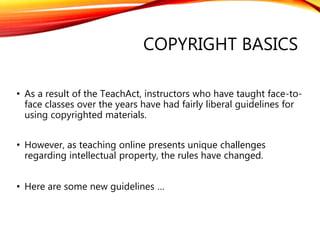
COPYRIGHT BASICS
• As a result of the TeachAct, instructors who have taught face-to-
face classes over the years have had fairly liberal guidelines for
using copyrighted materials.
• However, as teaching online presents unique challenges
regarding intellectual property, the rules have changed.
• Here are some new guidelines …
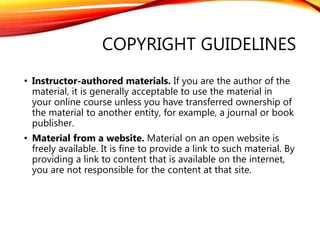
COPYRIGHT GUIDELINES
• Instructor-authored materials. If you are the author of the
material, it is generally acceptable to use the material in
your online course unless you have transferred ownership of
the material to another entity, for example, a journal or book
publisher.
• Material from a website. Material on an open website is
freely available. It is fine to provide a link to such material. By
providing a link to content that is available on the internet,
you are not responsible for the content at that site.
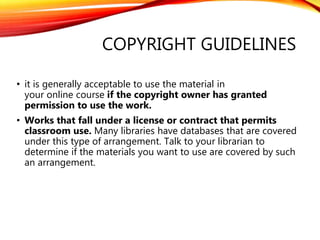
COPYRIGHT GUIDELINES
• it is generally acceptable to use the material in
your online course if the copyright owner has granted
permission to use the work.
• Works that fall under a license or contract that permits
classroom use. Many libraries have databases that are covered
under this type of arrangement. Talk to your librarian to
determine if the materials you want to use are covered by such
an arrangement.
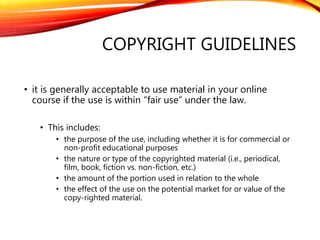
COPYRIGHT GUIDELINES
• it is generally acceptable to use material in your online
course if the use is within “fair use” under the law.
• This includes:
• the purpose of the use, including whether it is for commercial or
non-profit educational purposes
• the nature or type of the copyrighted material (i.e., periodical,
film, book, fiction vs. non-fiction, etc.)
• the amount of the portion used in relation to the whole
• the effect of the use on the potential market for or value of the
copy-righted material.
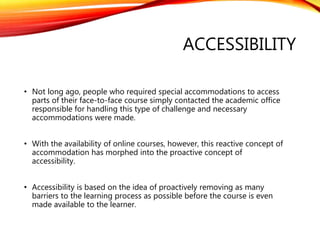
ACCESSIBILITY
• Not long ago, people who required special accommodations to access
parts of their face-to-face course simply contacted the academic office
responsible for handling this type of challenge and necessary
accommodations were made.
• With the availability of online courses, however, this reactive concept of
accommodation has morphed into the proactive concept of
accessibility.
• Accessibility is based on the idea of proactively removing as many
barriers to the learning process as possible before the course is even
made available to the learner.
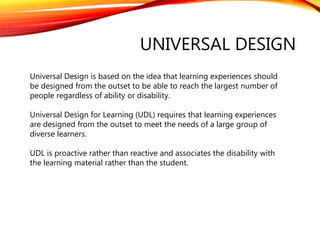
UNIVERSAL DESIGN
Universal Design is based on the idea that learning experiences should
be designed from the outset to be able to reach the largest number of
people regardless of ability or disability.
Universal Design for Learning (UDL) requires that learning experiences
are designed from the outset to meet the needs of a large group of
diverse learners.
UDL is proactive rather than reactive and associates the disability with
the learning material rather than the student.
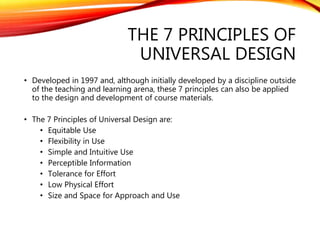
THE 7 PRINCIPLES OF
UNIVERSAL DESIGN
• Developed in 1997 and, although initially developed by a discipline outside
of the teaching and learning arena, these 7 principles can also be applied
to the design and development of course materials.
• The 7 Principles of Universal Design are:
• Equitable Use
• Flexibility in Use
• Simple and Intuitive Use
• Perceptible Information
• Tolerance for Effort
• Low Physical Effort
• Size and Space for Approach and Use

Tamu copyright accessibility

  • 1.
  • 2.
    COPYRIGHT BASICS • Asa result of the TeachAct, instructors who have taught face-to- face classes over the years have had fairly liberal guidelines for using copyrighted materials. • However, as teaching online presents unique challenges regarding intellectual property, the rules have changed. • Here are some new guidelines …
  • 3.
    COPYRIGHT GUIDELINES • Instructor-authoredmaterials. If you are the author of the material, it is generally acceptable to use the material in your online course unless you have transferred ownership of the material to another entity, for example, a journal or book publisher. • Material from a website. Material on an open website is freely available. It is fine to provide a link to such material. By providing a link to content that is available on the internet, you are not responsible for the content at that site.
  • 4.
    COPYRIGHT GUIDELINES • itis generally acceptable to use the material in your online course if the copyright owner has granted permission to use the work. • Works that fall under a license or contract that permits classroom use. Many libraries have databases that are covered under this type of arrangement. Talk to your librarian to determine if the materials you want to use are covered by such an arrangement.
  • 5.
    COPYRIGHT GUIDELINES • itis generally acceptable to use material in your online course if the use is within “fair use” under the law. • This includes: • the purpose of the use, including whether it is for commercial or non-profit educational purposes • the nature or type of the copyrighted material (i.e., periodical, film, book, fiction vs. non-fiction, etc.) • the amount of the portion used in relation to the whole • the effect of the use on the potential market for or value of the copy-righted material.
  • 6.
    ACCESSIBILITY • Not longago, people who required special accommodations to access parts of their face-to-face course simply contacted the academic office responsible for handling this type of challenge and necessary accommodations were made. • With the availability of online courses, however, this reactive concept of accommodation has morphed into the proactive concept of accessibility. • Accessibility is based on the idea of proactively removing as many barriers to the learning process as possible before the course is even made available to the learner.
  • 7.
    UNIVERSAL DESIGN Universal Designis based on the idea that learning experiences should be designed from the outset to be able to reach the largest number of people regardless of ability or disability. Universal Design for Learning (UDL) requires that learning experiences are designed from the outset to meet the needs of a large group of diverse learners. UDL is proactive rather than reactive and associates the disability with the learning material rather than the student.
  • 8.
    THE 7 PRINCIPLESOF UNIVERSAL DESIGN • Developed in 1997 and, although initially developed by a discipline outside of the teaching and learning arena, these 7 principles can also be applied to the design and development of course materials. • The 7 Principles of Universal Design are: • Equitable Use • Flexibility in Use • Simple and Intuitive Use • Perceptible Information • Tolerance for Effort • Low Physical Effort • Size and Space for Approach and Use