COURSE SELF-
ASSESSMENT AND
STUDENT
EVALUATIONS
Texas A & M School of Law
MODULE 4
• The following slides contain important information,
including:
• Crafting a Mid-Semester Survey
• Developing FAQs
• Creating an End of Semester Evaluation
• Steps to Successful Course Revision
CRAFTING A MID-
SEMESTER SURVEY
• This is an effective way to assess your
students' understanding of and satisfaction
with the course materials.
• Feedback mid-semester allows you to hear
your students’ concerns while there is still
time to make changes and provide an
optimal experience for students.
SAMPLE MID-SEMESTER
SURVEY QUESTIONS
• Do you find the subject matter of this course easy, average,
or difficult?
• Have you kept up with the reading assignments?
• How much time per week do you devote to this class
outside of scheduled class hours?
• Do you ask questions or make comments in this class?
• What would encourage you to participate more?
• Are the lectures to the point?
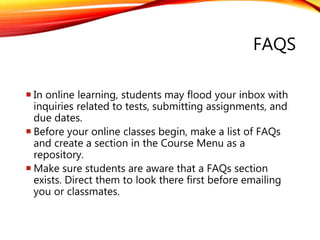
FAQS
 In online learning, students may flood your inbox with
inquiries related to tests, submitting assignments, and
due dates.
 Before your online classes begin, make a list of FAQs
and create a section in the Course Menu as a
repository.
 Make sure students are aware that a FAQs section
exists. Direct them to look there first before emailing
you or classmates.
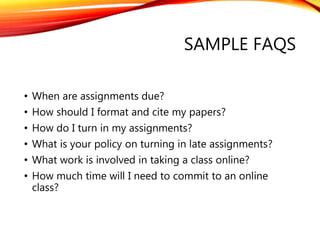
SAMPLE FAQS
• When are assignments due?
• How should I format and cite my papers?
• How do I turn in my assignments?
• What is your policy on turning in late assignments?
• What work is involved in taking a class online?
• How much time will I need to commit to an online
class?
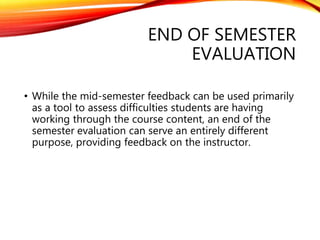
END OF SEMESTER
EVALUATION
• While the mid-semester feedback can be used primarily
as a tool to assess difficulties students are having
working through the course content, an end of the
semester evaluation can serve an entirely different
purpose, providing feedback on the instructor.
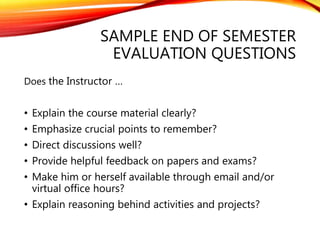
SAMPLE END OF SEMESTER
EVALUATION QUESTIONS
Does the Instructor …
• Explain the course material clearly?
• Emphasize crucial points to remember?
• Direct discussions well?
• Provide helpful feedback on papers and exams?
• Make him or herself available through email and/or
virtual office hours?
• Explain reasoning behind activities and projects?
SUCCESSFUL COURSE
REVISION
Once you've taught your online course and turned in grades
for the semester, you'll want to take a close look at what
worked well and what needs improvement.
Though all sections of your course can be updated, the
following 5 areas are crucial….
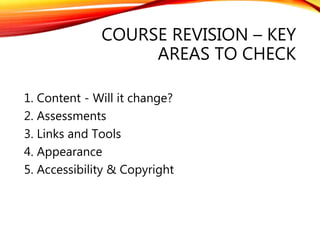
COURSE REVISION – KEY
AREAS TO CHECK
1. Content - Will it change?
2. Assessments
3. Links and Tools
4. Appearance
5. Accessibility & Copyright

Module 4

  • 1.
  • 2.
    MODULE 4 • Thefollowing slides contain important information, including: • Crafting a Mid-Semester Survey • Developing FAQs • Creating an End of Semester Evaluation • Steps to Successful Course Revision
  • 3.
    CRAFTING A MID- SEMESTERSURVEY • This is an effective way to assess your students' understanding of and satisfaction with the course materials. • Feedback mid-semester allows you to hear your students’ concerns while there is still time to make changes and provide an optimal experience for students.
  • 4.
    SAMPLE MID-SEMESTER SURVEY QUESTIONS •Do you find the subject matter of this course easy, average, or difficult? • Have you kept up with the reading assignments? • How much time per week do you devote to this class outside of scheduled class hours? • Do you ask questions or make comments in this class? • What would encourage you to participate more? • Are the lectures to the point?
  • 5.
    FAQS  In onlinelearning, students may flood your inbox with inquiries related to tests, submitting assignments, and due dates.  Before your online classes begin, make a list of FAQs and create a section in the Course Menu as a repository.  Make sure students are aware that a FAQs section exists. Direct them to look there first before emailing you or classmates.
  • 6.
    SAMPLE FAQS • Whenare assignments due? • How should I format and cite my papers? • How do I turn in my assignments? • What is your policy on turning in late assignments? • What work is involved in taking a class online? • How much time will I need to commit to an online class?
  • 7.
    END OF SEMESTER EVALUATION •While the mid-semester feedback can be used primarily as a tool to assess difficulties students are having working through the course content, an end of the semester evaluation can serve an entirely different purpose, providing feedback on the instructor.
  • 8.
    SAMPLE END OFSEMESTER EVALUATION QUESTIONS Does the Instructor … • Explain the course material clearly? • Emphasize crucial points to remember? • Direct discussions well? • Provide helpful feedback on papers and exams? • Make him or herself available through email and/or virtual office hours? • Explain reasoning behind activities and projects?
  • 9.
    SUCCESSFUL COURSE REVISION Once you'vetaught your online course and turned in grades for the semester, you'll want to take a close look at what worked well and what needs improvement. Though all sections of your course can be updated, the following 5 areas are crucial….
  • 10.
    COURSE REVISION –KEY AREAS TO CHECK 1. Content - Will it change? 2. Assessments 3. Links and Tools 4. Appearance 5. Accessibility & Copyright