Raymond Rose
ray@rose-smith.com
These slides are available at
https://www.slideshare.net/RaymondRose/dlac-2019-v2
Issues in Access and
Accessibility for All in
Digital Learning
Do you know:
• What UDL stands for/is?
• What ADA stands for/is?
• What Section 504 is?
• Who is designated as your:
• Title IX Coordinator?
• Section 504 Coordinator?
• ADA Coordinator?
• If your institution has an accessibility policy?
SmartBrief on Leadership
What We Know About Disabilities
• Nationally ~13% students in K-12 have some form of
disability
• Color Blindness effects ~4.5 % of population
• Little research on students with disabilities in K-12 online
education
Who Has a Disability?
• 13% of students ages 3-21 have some form of
disability (NCES)
• 11% of college undergraduates
• 21% undergraduate veterans
• 30% undergraduates age 30 and over
Why Accessibility?
•Instructional
•Moral
•Ethical
•Legal
FROM THIS TO ….
What is Universal Design for Learning?
Applies the general concept of Universal Design to learning
environments. Sometimes organizations with use Universal
Design for Instruction (UDI) rather than Universal Design
for Learning (UDL).
Definition of Universal Design for Learning
A framework of guidelines that integrates accessibility into
the creation of learning materials (for digital or face-to-face
environments), so that all students have equal opportunity
to achieve the learning objectives and goals, thereby being
able to demonstrate the desired learning outcomes.
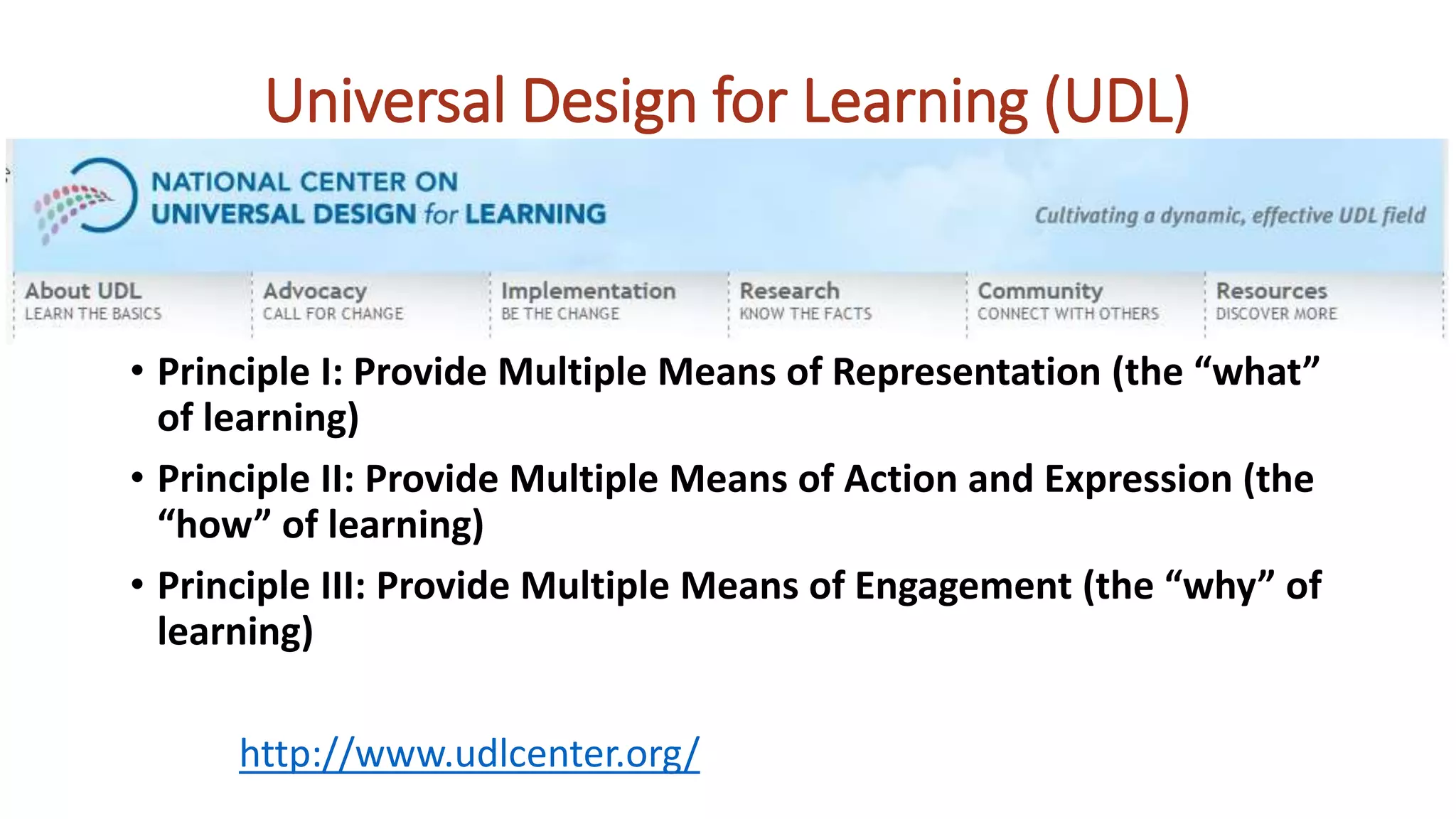
• Principle I: Provide Multiple Means of Representation (the “what”
of learning)
• Principle II: Provide Multiple Means of Action and Expression (the
“how” of learning)
• Principle III: Provide Multiple Means of Engagement (the “why” of
learning)
http://www.udlcenter.org/
Universal Design for Learning (UDL)
Why Universal Design for Learning?
For those who have particular challenges, or come a
little short of having an official diagnosis but still
encounter difficulties with certain formats when
learning material, implementing Universal Design for
Learning can mean the difference between a student
struggling through a course or being able to learn the
material with "lower" barriers or no barriers at all.
UDL principles provide flexibility in the teaching and learning
processes in order to reduce barriers to learning.
Flexibility in the ways that..
• information is presented
• students can respond or demonstrate knowledge and skills
• students are engaged
Reduces barriers...
• in instruction
• by providing appropriate accommodations, supports and challenges
• Maintains high achievement expectations for all students
What UDL is not...
UDL does not change curriculum or student outcomes.
UDL does not make it easier for students to cheat.
UDL does not give special privileges to only a few students
Implemented correctly, UDL creates a level playing field so
that barriers are reduced and all students will be able to
demonstrate the same outcomes at the same level.
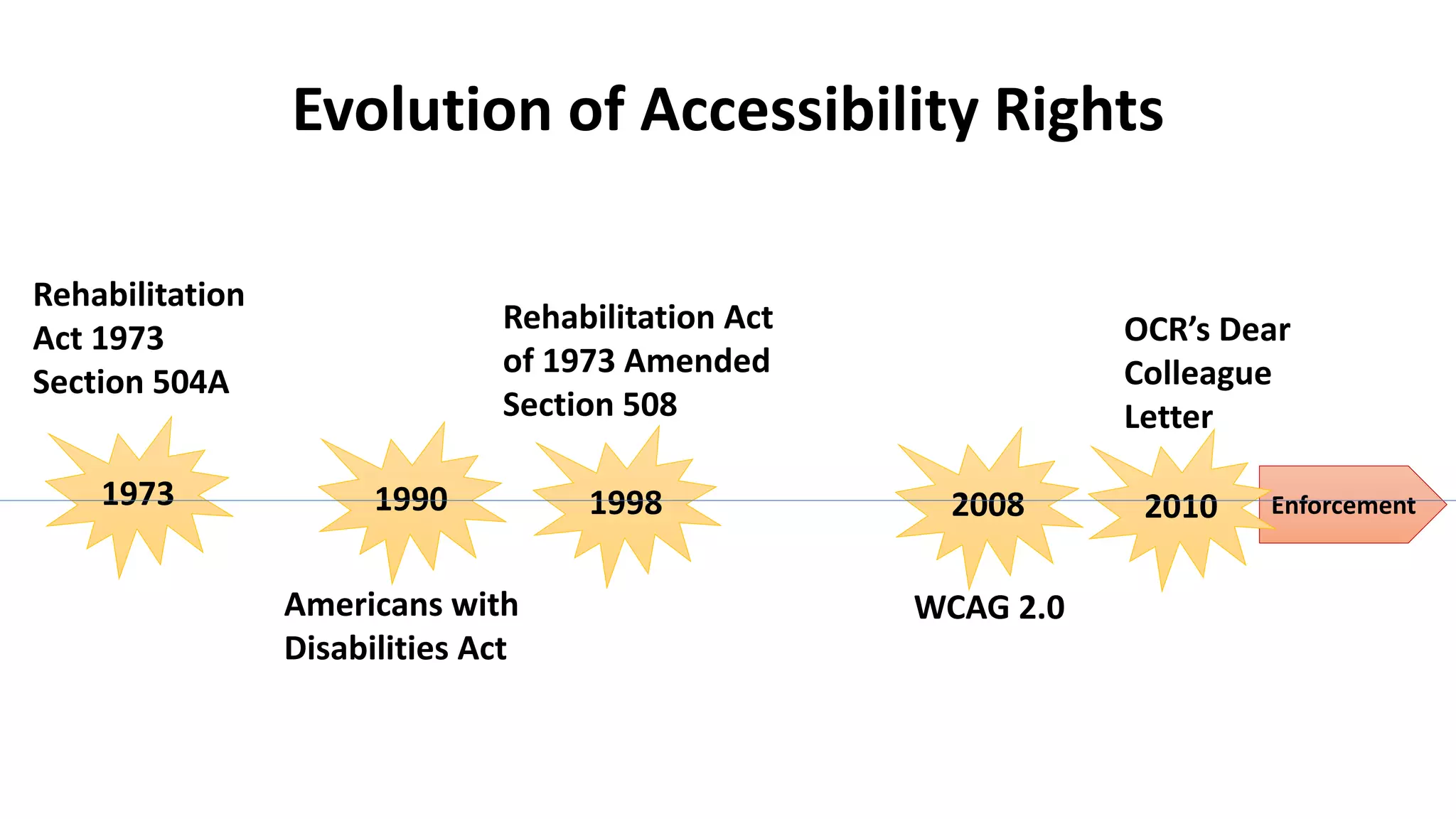
Enforcement
OCR’s Dear
Colleague
Letter
2010
WCAG 2.0
2008
Rehabilitation Act
of 1973 Amended
Section 508
1998
Americans with
Disabilities Act
1990
Rehabilitation
Act 1973
Section 504A
1973
Evolution of Accessibility Rights
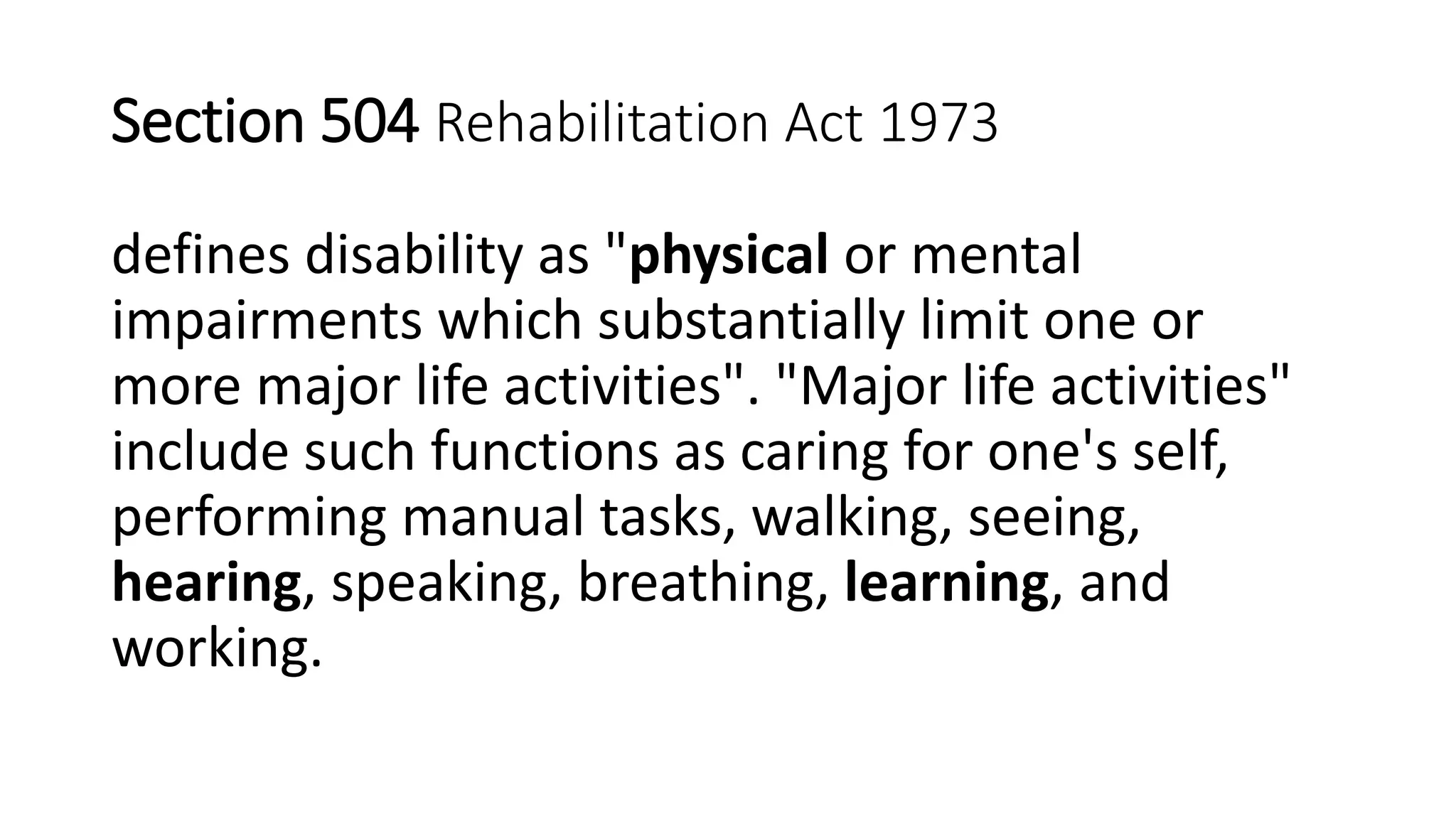
Section 504 Rehabilitation Act 1973
defines disability as "physical or mental
impairments which substantially limit one or
more major life activities". "Major life activities"
include such functions as caring for one's self,
performing manual tasks, walking, seeing,
hearing, speaking, breathing, learning, and
working.
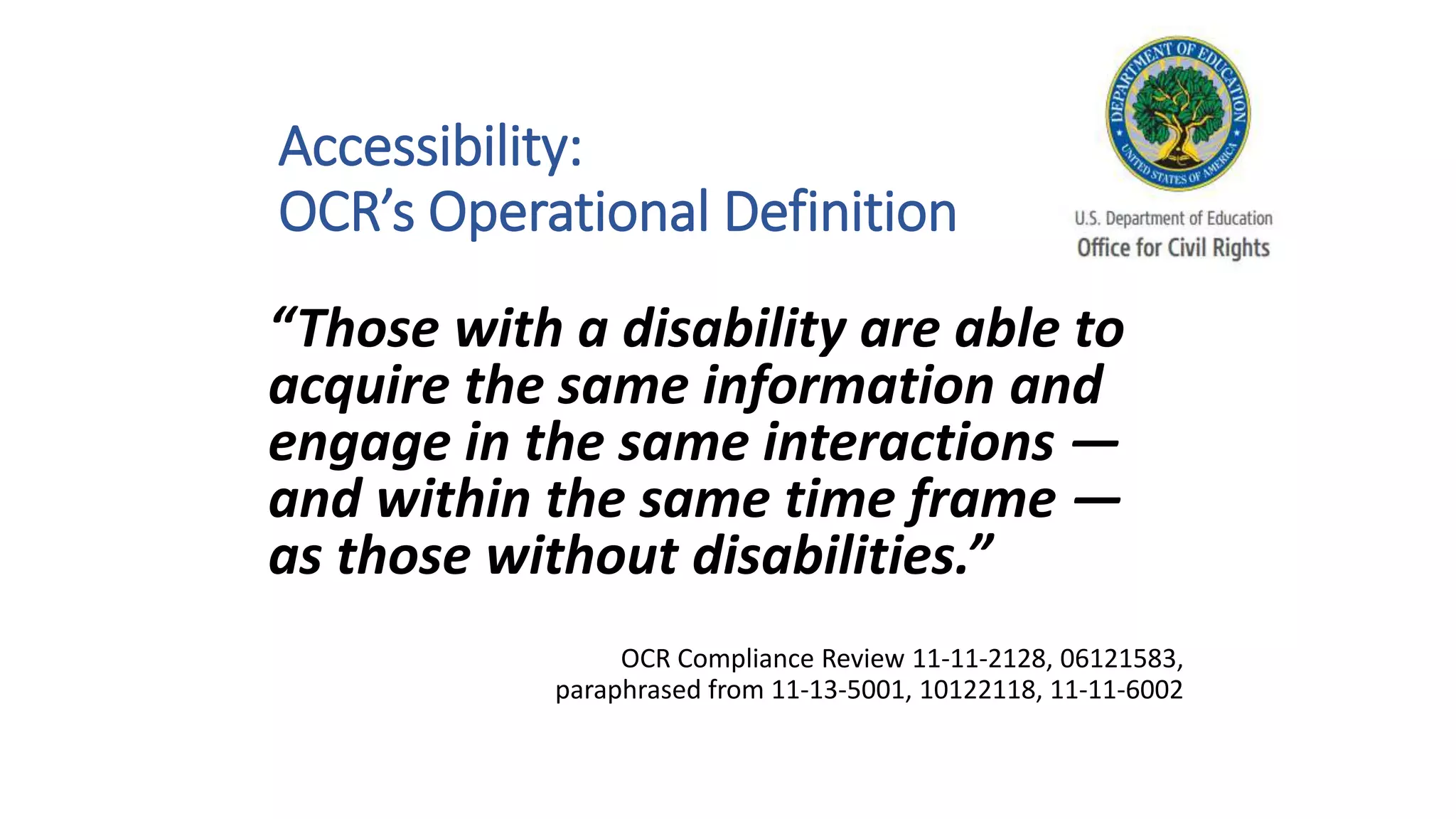
“Those with a disability are able to
acquire the same information and
engage in the same interactions —
and within the same time frame —
as those without disabilities.”
OCR Compliance Review 11-11-2128, 06121583,
paraphrased from 11-13-5001, 10122118, 11-11-6002
Accessibility:
OCR’s Operational Definition
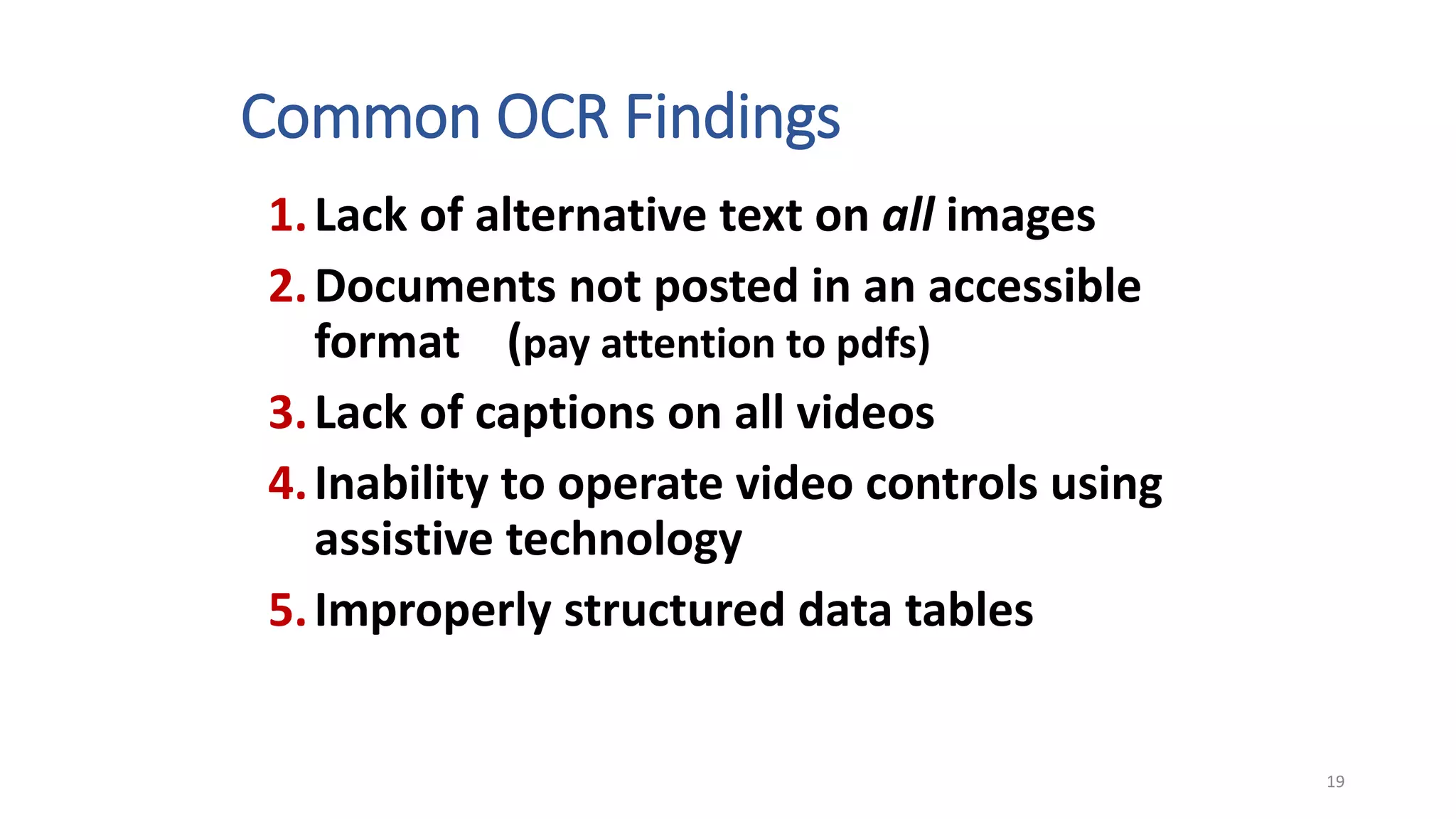
Common OCR Findings
1.Lack of alternative text on all images
2.Documents not posted in an accessible
format (pay attention to pdfs)
3.Lack of captions on all videos
4.Inability to operate video controls using
assistive technology
5.Improperly structured data tables
19
Common OCR Findings
5.Improperly formatted and labeled form
fields
6.Improper contrast between background
and foreground colors
7.Using color for navigation directions
8.Frames not titled with text that
facilitates frame identification and
navigation
20
Web Content Accessibility Guidelines
(WCAG) Overview
A stable, referenceable technical standard. 12 guidelines organized
under 4 principles:
• perceivable
• operable
• understandable
• robust
There are testable success criteria,
at three levels: A, AA, and AAA.
https://www.w3.org/WAI/intro/wcag
21
Website & Online Course Design Recommendations
(1of2)
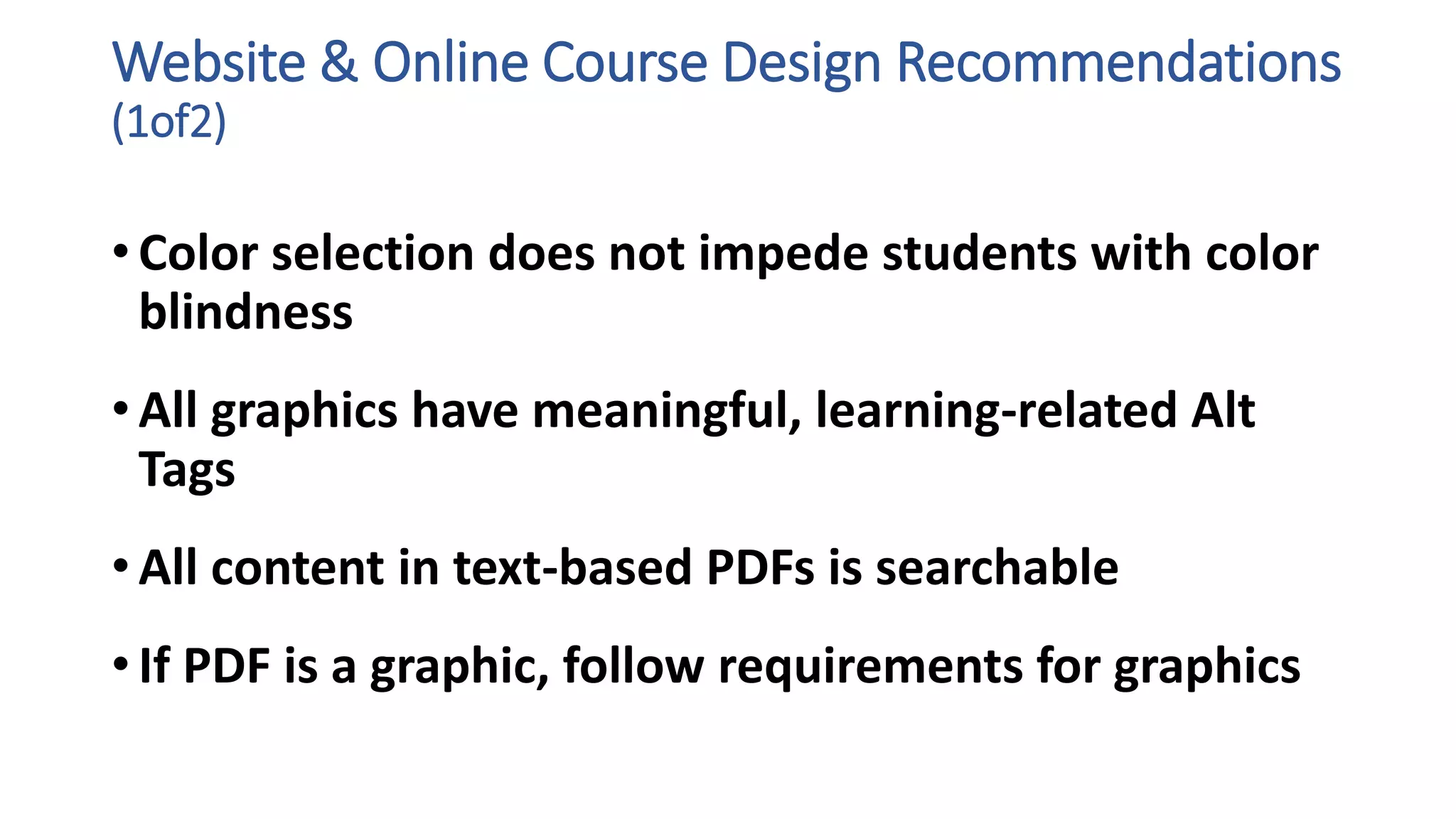
• Color selection does not impede students with color
blindness
• All graphics have meaningful, learning-related Alt
Tags
• All content in text-based PDFs is searchable
• If PDF is a graphic, follow requirements for graphics
Website & Online Course Design Recommendations (2of2)
All audio is accompanied by text transcripts
All video includes synchronized captioning
Course navigation is possible without the use of a
mouse
Courses are reviewed for access by a screen reader
Content at all external links meet the same accessibility
standards
National Standard for Quality Online Teaching
B2 The online teacher incorporates discipline-specific technologies, tools, and
resources to meet individualized learner needs.
Frameworks like the Universal Design for Learning emphasize the need for
learner agency and instructor responsiveness for optimal learning, as well
as the need to utilize discipline-specific technologies, tools, and resources
to meet the individual needs of diverse learners through consideration of
what will work for all.
The online teacher varies resources and strategies depending on individual
student needs.
The More Accessible
Webinar
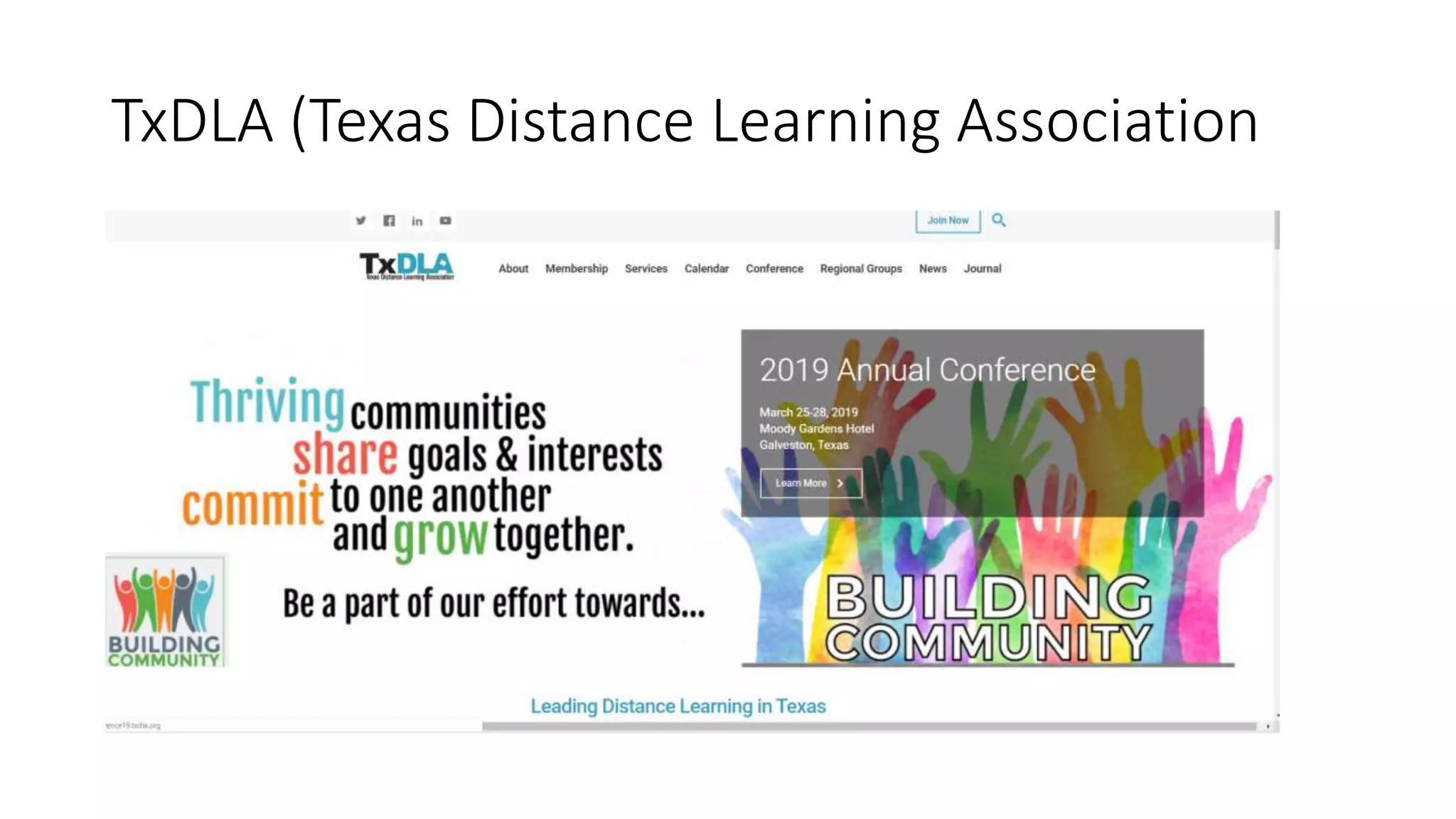
TxDLA (Texas Distance Learning Association
TxDLA Online
Certificate Program
Making Digital Content Accessible for Learners
Winter Program Dates: January 20 - February 24,
2019
Spring Program Dates: March 25 - May 6, 2019
**Prices**
$600.00 (online only program offered for Winter
and Spring dates)
$995.00 (in-person and online program bundled
with full 2019 TxDLA Conference registration
offered for Spring dates only)
Digital Accessibility Certification Program
Includes:
31 hours of online classwork.
Facilitated by a Certified Accessibility Specialist,
with contributions from several TxDLA specialists
in accessibility.
Capstone project with both peer and instructor
review.
Participants assigned to a small group for one
interactive assignment during the first 10 days.
Discussions must be revisited for replies and
interactions during the 5 week course. Remainder
of course is self-paced.
Select PRESENT
then Select Captions
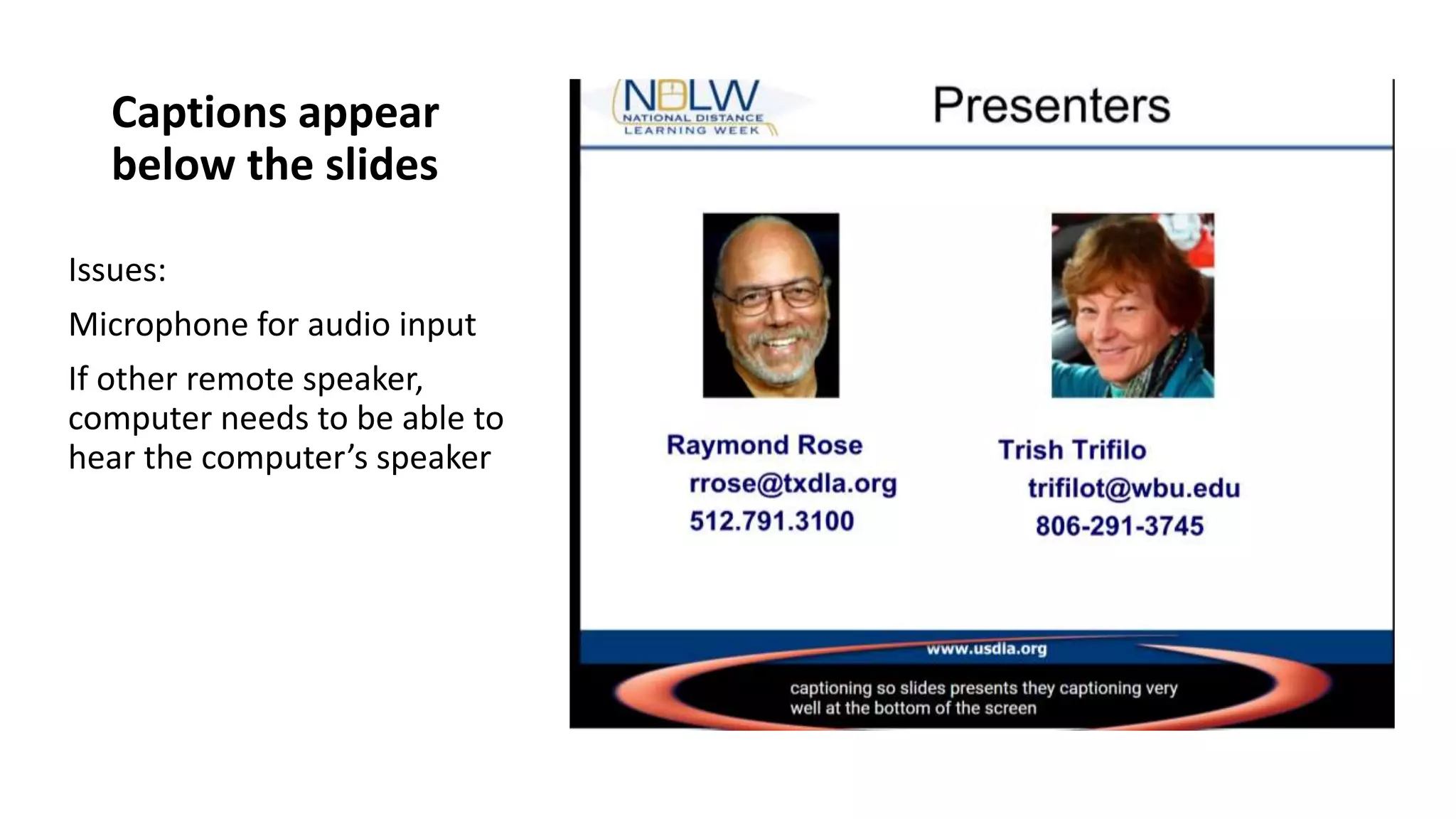
Captions appear
below the slides
Issues:
Microphone for audio input
If other remote speaker,
computer needs to be able to
hear the computer’s speaker
Resources
• WebAIM (Web Accessibility in Mind)
• http://WebAim.org
• http://WAVE.webaim.org (Web Accessibility Evaluation Tool)
• Online Learning and Web Accessibility (MVL Research Institute)
• https://mvlri.org/research/webinar-podcast/online-learning-and-the-
rehabilitation-act-of-1973/
• National Standards for Quality
• https://www.nsqol.org/
Readings
• OCR Reaches Web Accessibility Agreement with 11 Educational
Institutions
• https://www.3playmedia.com/2016/07/29/ocr-reaches-web-accessibility-
agreement-with-11-educational-institutions/
• Accessibility in mind? A nationwide study of K-12 Web sites in the
United States
• https://firstmonday.org/ojs/index.php/fm/article/view/9183/7722
• Consortium on School Networking
• https://www.cosn.org/digitalaccessibility
Consent Decree
• Dudley v Miami
• https://www.ada.gov/miami_university_cd.html
Resolution Letter
• Texas school district
• https://www2.ed.gov/about/offices/list/ocr/docs/investigations/more/06171
280-a.pdf
OCR Reading Room
https://www2.ed.gov/about/offices/list/ocr/frontpage/faq/readingroom.html
The place to find:
Case Resolutions
Pending Cases Currently Under Investigation
Correspondence
and more
Raymond Rose
ray@rose-smith.com
512.791.3100
http://Slideshare.net/raymondrose
http://rmrose.blogspot.com
Texas Distance Learning
Association
rrose@txdla.org
Digital Accessibility Certificate
https://www.txdla.org/accessibilitycertification

DLAC 2019 Workshop on Access and Accessibility

  • 1.
    Raymond Rose ray@rose-smith.com These slidesare available at https://www.slideshare.net/RaymondRose/dlac-2019-v2 Issues in Access and Accessibility for All in Digital Learning
  • 2.
    Do you know: •What UDL stands for/is? • What ADA stands for/is? • What Section 504 is? • Who is designated as your: • Title IX Coordinator? • Section 504 Coordinator? • ADA Coordinator? • If your institution has an accessibility policy?
  • 3.
  • 4.
    What We KnowAbout Disabilities • Nationally ~13% students in K-12 have some form of disability • Color Blindness effects ~4.5 % of population • Little research on students with disabilities in K-12 online education
  • 5.
    Who Has aDisability? • 13% of students ages 3-21 have some form of disability (NCES) • 11% of college undergraduates • 21% undergraduate veterans • 30% undergraduates age 30 and over
  • 6.
  • 8.
  • 10.
    What is UniversalDesign for Learning? Applies the general concept of Universal Design to learning environments. Sometimes organizations with use Universal Design for Instruction (UDI) rather than Universal Design for Learning (UDL). Definition of Universal Design for Learning A framework of guidelines that integrates accessibility into the creation of learning materials (for digital or face-to-face environments), so that all students have equal opportunity to achieve the learning objectives and goals, thereby being able to demonstrate the desired learning outcomes.
  • 11.
    • Principle I:Provide Multiple Means of Representation (the “what” of learning) • Principle II: Provide Multiple Means of Action and Expression (the “how” of learning) • Principle III: Provide Multiple Means of Engagement (the “why” of learning) http://www.udlcenter.org/ Universal Design for Learning (UDL)
  • 12.
    Why Universal Designfor Learning? For those who have particular challenges, or come a little short of having an official diagnosis but still encounter difficulties with certain formats when learning material, implementing Universal Design for Learning can mean the difference between a student struggling through a course or being able to learn the material with "lower" barriers or no barriers at all.
  • 13.
    UDL principles provideflexibility in the teaching and learning processes in order to reduce barriers to learning. Flexibility in the ways that.. • information is presented • students can respond or demonstrate knowledge and skills • students are engaged Reduces barriers... • in instruction • by providing appropriate accommodations, supports and challenges • Maintains high achievement expectations for all students
  • 14.
    What UDL isnot... UDL does not change curriculum or student outcomes. UDL does not make it easier for students to cheat. UDL does not give special privileges to only a few students Implemented correctly, UDL creates a level playing field so that barriers are reduced and all students will be able to demonstrate the same outcomes at the same level.
  • 16.
    Enforcement OCR’s Dear Colleague Letter 2010 WCAG 2.0 2008 RehabilitationAct of 1973 Amended Section 508 1998 Americans with Disabilities Act 1990 Rehabilitation Act 1973 Section 504A 1973 Evolution of Accessibility Rights
  • 17.
    Section 504 RehabilitationAct 1973 defines disability as "physical or mental impairments which substantially limit one or more major life activities". "Major life activities" include such functions as caring for one's self, performing manual tasks, walking, seeing, hearing, speaking, breathing, learning, and working.
  • 18.
    “Those with adisability are able to acquire the same information and engage in the same interactions — and within the same time frame — as those without disabilities.” OCR Compliance Review 11-11-2128, 06121583, paraphrased from 11-13-5001, 10122118, 11-11-6002 Accessibility: OCR’s Operational Definition
  • 19.
    Common OCR Findings 1.Lackof alternative text on all images 2.Documents not posted in an accessible format (pay attention to pdfs) 3.Lack of captions on all videos 4.Inability to operate video controls using assistive technology 5.Improperly structured data tables 19
  • 20.
    Common OCR Findings 5.Improperlyformatted and labeled form fields 6.Improper contrast between background and foreground colors 7.Using color for navigation directions 8.Frames not titled with text that facilitates frame identification and navigation 20
  • 21.
    Web Content AccessibilityGuidelines (WCAG) Overview A stable, referenceable technical standard. 12 guidelines organized under 4 principles: • perceivable • operable • understandable • robust There are testable success criteria, at three levels: A, AA, and AAA. https://www.w3.org/WAI/intro/wcag 21
  • 22.
    Website & OnlineCourse Design Recommendations (1of2) • Color selection does not impede students with color blindness • All graphics have meaningful, learning-related Alt Tags • All content in text-based PDFs is searchable • If PDF is a graphic, follow requirements for graphics
  • 23.
    Website & OnlineCourse Design Recommendations (2of2) All audio is accompanied by text transcripts All video includes synchronized captioning Course navigation is possible without the use of a mouse Courses are reviewed for access by a screen reader Content at all external links meet the same accessibility standards
  • 24.
    National Standard forQuality Online Teaching B2 The online teacher incorporates discipline-specific technologies, tools, and resources to meet individualized learner needs. Frameworks like the Universal Design for Learning emphasize the need for learner agency and instructor responsiveness for optimal learning, as well as the need to utilize discipline-specific technologies, tools, and resources to meet the individual needs of diverse learners through consideration of what will work for all. The online teacher varies resources and strategies depending on individual student needs.
  • 26.
  • 27.
    TxDLA (Texas DistanceLearning Association
  • 28.
    TxDLA Online Certificate Program MakingDigital Content Accessible for Learners Winter Program Dates: January 20 - February 24, 2019 Spring Program Dates: March 25 - May 6, 2019 **Prices** $600.00 (online only program offered for Winter and Spring dates) $995.00 (in-person and online program bundled with full 2019 TxDLA Conference registration offered for Spring dates only) Digital Accessibility Certification Program Includes: 31 hours of online classwork. Facilitated by a Certified Accessibility Specialist, with contributions from several TxDLA specialists in accessibility. Capstone project with both peer and instructor review. Participants assigned to a small group for one interactive assignment during the first 10 days. Discussions must be revisited for replies and interactions during the 5 week course. Remainder of course is self-paced.
  • 29.
  • 30.
    Captions appear below theslides Issues: Microphone for audio input If other remote speaker, computer needs to be able to hear the computer’s speaker
  • 32.
    Resources • WebAIM (WebAccessibility in Mind) • http://WebAim.org • http://WAVE.webaim.org (Web Accessibility Evaluation Tool) • Online Learning and Web Accessibility (MVL Research Institute) • https://mvlri.org/research/webinar-podcast/online-learning-and-the- rehabilitation-act-of-1973/ • National Standards for Quality • https://www.nsqol.org/
  • 33.
    Readings • OCR ReachesWeb Accessibility Agreement with 11 Educational Institutions • https://www.3playmedia.com/2016/07/29/ocr-reaches-web-accessibility- agreement-with-11-educational-institutions/ • Accessibility in mind? A nationwide study of K-12 Web sites in the United States • https://firstmonday.org/ojs/index.php/fm/article/view/9183/7722 • Consortium on School Networking • https://www.cosn.org/digitalaccessibility
  • 34.
    Consent Decree • Dudleyv Miami • https://www.ada.gov/miami_university_cd.html Resolution Letter • Texas school district • https://www2.ed.gov/about/offices/list/ocr/docs/investigations/more/06171 280-a.pdf
  • 35.
    OCR Reading Room https://www2.ed.gov/about/offices/list/ocr/frontpage/faq/readingroom.html Theplace to find: Case Resolutions Pending Cases Currently Under Investigation Correspondence and more
  • 36.
    Raymond Rose ray@rose-smith.com 512.791.3100 http://Slideshare.net/raymondrose http://rmrose.blogspot.com Texas DistanceLearning Association rrose@txdla.org Digital Accessibility Certificate https://www.txdla.org/accessibilitycertification