Planning: Part I
Evaluation of Necessity and Feasibility
PROJECT IDENTIFICATION AND INITIATION
• A project is identified when someone in the organization
identifies a business need to build a system.
• A need may surface when an organization identifies
unique and competitive ways of using IT.
• To leverage the capabilities of emerging technologies
such as cloud computing, mobile apps, Big Data
analytics
• Initiated by Business Process Management (BPM)
activities
Project sponsor
• Person (or group) who has an interest in the
system’s success
• Determines tangible and intangible business
value of the project for the organization
System Request
• Business reasons for building a system
• Business value that system is expected to
provide
• Business requirements of the project
• Other special issues
• Submitted to the approval committee for
consideration
FEASIBILITY ANALYSIS
• Is it a GO!
• If it is a GO, what are the risks that needs to be
managed?
• Components of the feasibility analysis:
• Technical feasibility
• Economic feasibility
• Organizational feasibility
• A feasibility study deliverable that is submitted to the
approval committee at the end of project initiation.
• Continuous review and revision of the initial feasibility
assessment
Technical Feasibility
• Evaluating if the IT group is capable of carrying
out the development and/or implementation
• Technical risk analysis: Can our IT build and/or
implement it?
• Considerations:
• Users’ and analysts’ familiarity with the application
• Familiarity with the technology
• Project size
• Compatibility of the new system with the technology
that already exists
Economic Feasibility
• Analysis of cost and benefit: “Should we build the
system?”
• Usually, benefits of IT projects are not immediate
• Techniques to estimate cost-benefit over-time
• Simple Cash Flow
• Discounted Cash Flow
• Measures to determine economic feasibility
• Return on Investment (ROI)
• Break-Even Point (BEP)
• Net Present Value (NPV)
• Steps of Economic Feasibility Analysis
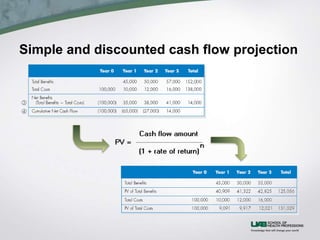
Simple and discounted cash flow projection
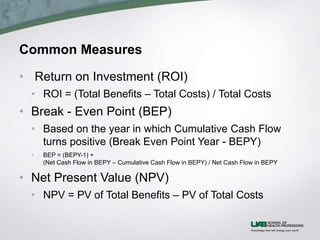
Common Measures
• Return on Investment (ROI)
• ROI = (Total Benefits – Total Costs) / Total Costs
• Break - Even Point (BEP)
• Based on the year in which Cumulative Cash Flow
turns positive (Break Even Point Year - BEPY)
• BEP = (BEPY-1) +
(Net Cash Flow in BEPY – Cumulative Cash Flow in BEPY) / Net Cash Flow in BEPY
• Net Present Value (NPV)
• NPV = PV of Total Benefits – PV of Total Costs
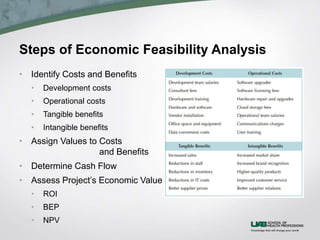
Steps of Economic Feasibility Analysis
• Identify Costs and Benefits
• Development costs
• Operational costs
• Tangible benefits
• Intangible benefits
• Assign Values to Costs
and Benefits
• Determine Cash Flow
• Assess Project’s Economic Value
• ROI
• BEP
• NPV
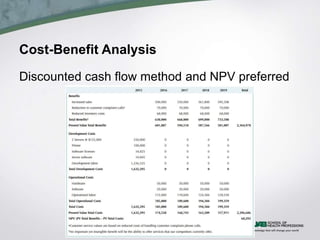
Cost-Benefit Analysis
Discounted cash flow method and NPV preferred
Organizational Feasibility
• If we build it, will the users use it?
• Compare project goals to business objectives of the
organization
• Stakeholder analysis
• Project champion(s)
• Organizational management
• System users
• Other stakeholders

Hi600 m1 u1_part2_instslides

  • 1.
    Planning: Part I Evaluationof Necessity and Feasibility
  • 2.
    PROJECT IDENTIFICATION ANDINITIATION • A project is identified when someone in the organization identifies a business need to build a system. • A need may surface when an organization identifies unique and competitive ways of using IT. • To leverage the capabilities of emerging technologies such as cloud computing, mobile apps, Big Data analytics • Initiated by Business Process Management (BPM) activities
  • 3.
    Project sponsor • Person(or group) who has an interest in the system’s success • Determines tangible and intangible business value of the project for the organization
  • 4.
    System Request • Businessreasons for building a system • Business value that system is expected to provide • Business requirements of the project • Other special issues • Submitted to the approval committee for consideration
  • 5.
    FEASIBILITY ANALYSIS • Isit a GO! • If it is a GO, what are the risks that needs to be managed? • Components of the feasibility analysis: • Technical feasibility • Economic feasibility • Organizational feasibility • A feasibility study deliverable that is submitted to the approval committee at the end of project initiation. • Continuous review and revision of the initial feasibility assessment
  • 6.
    Technical Feasibility • Evaluatingif the IT group is capable of carrying out the development and/or implementation • Technical risk analysis: Can our IT build and/or implement it? • Considerations: • Users’ and analysts’ familiarity with the application • Familiarity with the technology • Project size • Compatibility of the new system with the technology that already exists
  • 7.
    Economic Feasibility • Analysisof cost and benefit: “Should we build the system?” • Usually, benefits of IT projects are not immediate • Techniques to estimate cost-benefit over-time • Simple Cash Flow • Discounted Cash Flow • Measures to determine economic feasibility • Return on Investment (ROI) • Break-Even Point (BEP) • Net Present Value (NPV) • Steps of Economic Feasibility Analysis
  • 8.
    Simple and discountedcash flow projection
  • 9.
    Common Measures • Returnon Investment (ROI) • ROI = (Total Benefits – Total Costs) / Total Costs • Break - Even Point (BEP) • Based on the year in which Cumulative Cash Flow turns positive (Break Even Point Year - BEPY) • BEP = (BEPY-1) + (Net Cash Flow in BEPY – Cumulative Cash Flow in BEPY) / Net Cash Flow in BEPY • Net Present Value (NPV) • NPV = PV of Total Benefits – PV of Total Costs
  • 10.
    Steps of EconomicFeasibility Analysis • Identify Costs and Benefits • Development costs • Operational costs • Tangible benefits • Intangible benefits • Assign Values to Costs and Benefits • Determine Cash Flow • Assess Project’s Economic Value • ROI • BEP • NPV
  • 11.
    Cost-Benefit Analysis Discounted cashflow method and NPV preferred
  • 12.
    Organizational Feasibility • Ifwe build it, will the users use it? • Compare project goals to business objectives of the organization • Stakeholder analysis • Project champion(s) • Organizational management • System users • Other stakeholders

Editor's Notes

  • #2  The first part of the planning phase is the evaluation of necessity and feasibility of the new information system. Before everything else, we have to make sure that building or purchasing the requested information system makes business sense for the organization.
  • #3 So, the very first step of the planning phase is project identification. A process is usually identified when someone in the organization identifies a business need: mostly either something is not working or not working well enough or to leverage emerging technologies to improve workflows and processes. Nowadays, many new Information System projects grow out of Business Process Management (BPM), which is a methodology used by organizations to continuously improve end-to-end business processes. systematically creating, assessing, and altering business processes aims Business Process Automation (BPA) outcome: Business Process Improvement (BPI) or Business Process Reengineering (BPR)
  • #4 The project sponsor is a person (or group) who has an interest in the system’s success and may or may not be the person who identified the project. The project sponsor serves as the primary point of contact for the project team and will work throughout the SDLC to make sure that the project is moving in the right direction from the business perspective . The project sponsor has the insights needed to determine the business value that will be gained from the system. The business value can be tangible, that is, it can be quantified and measured easily like “reduction in operating costs or savings of FTEs”. It can also be an intangible value, which is the result of an intuitive belief that the system provides important, but hard-to-measure benefits to the organization, like quality improvement.
  • #5 As part of a formal system selection process within the organization, the project sponsor describes the business reasons for building a system and the value that system is expected to provide. The request also includes the business requirements of the project, which refers to the business capabilities that the system will need to have. The system request also includes special issues section as a catchall category for other information that should be considered in assessing the project. The completed system request is then submitted to the approval committee for consideration and the committee reviews the system request and makes an initial determination of whether to investigate the proposed project or not.
  • #6 If the approval committee initially determines that the proposed project is worth investigating, then the next step is to conduct a feasibility analysis. Feasibility analysis guides the organization in determining whether to proceed with a project. Feasibility analysis also identifies the important risks associated with the project that must be managed if the project is approved. Just like the system request, each organization has its own process and format for the feasibility analysis, but most of them include techniques to assess technical, economic, and organizational feasibility. The results of evaluating these three feasibility factors are combined into a feasibility study deliverable that is submitted to the approval committee. And with that, the project initiation gets completed. However, the initial feasibility assessment should be continuously reviewed and revised to measure how well identified risks are managed to evaluate new risks that have appeared
  • #7 With technical feasibility, we try to determine the extent to which the system can be successfully designed, developed, and installed by the IT group. In essence, it is a technical risk analysis that aims to answer whether we (that is the IT group of the organization) can build and/or implement the system. Unidentified risks can endanger the successful completion of a project. The aspects considered during technical feasibility analysis include users’ and analysts’ familiarity with the application and the technology that the project to be built on, b) the size of the project, and c) compatibility of the new system with the systems and technology that are already in place. Even simple issues such as the different Java versions being required for the new and an existing systems could cause a major headache. My experience and I am sure yours too is full of such examples.
  • #8 Economic feasibility analysis is also called as cost-benefit analysis, that identifies the costs and benefits associated with the system. With this analysis, we try to answer whether it makes a business sense to build the system. IT projects usually involve an initial investment that produces benefits over time, along with some on-going support costs. Therefore, we need techniques to calculate estimated costs and benefits overtime. So, in the coming few slides, we will define simple and discounted cash flow techniques and Return of Investment, Break-Even Point, and Net Present Value measures that determine economic feasibility. And finally, we will talk about the steps of the economic feasibility analysis
  • #9 Simple cash flow projection simply looks at dollar amounts of estimated annual costs and benefits starting from Year 0, usually for about 3 to 5 years. The net benefit is the difference between total annual benefits and costs individually; and the Cumulative Net Cash Flow shows the cash flow over time starting from the beginning of the project. * This kind of projection does not take into account the time value of the money. So, the Present Value (PV) formula gives a way calculate the present value of a future cash flow amount, considering the potential rate of return of that amount, if it was invested somewhere else. The number n in this formula represents the year in which the cash flow occurs. * So if we consider the time value of the money, the present values table of the total costs and benefits would change into the bottom table in this slide.
  • #10 So, let’s look at some of the most common measures of economic feasibility : Return of Investment measures the rate of return on the money invested in the project. It is basically the ratio of net benefits to total costs. There is no standard Return-on-investment threshold value above which is considered “high” return on investment. It should always be analyzed in terms of what it means for the particular project. Another measure is the Brake-Even Point: It is the number of years it takes for the organization to recover its original investment. It is calculated as the number of the year before the Break-Even-Point PLUS the fraction of the Break-Even-Point year, that is calculated by the ratio of the difference between the net cash flow and the cumulative cash flow; to the net cash flow in that year. It is an indication of the project’s liquidity, in other words, it shows the speed that the project generates cash returns. And the last measure we will look at is the Net Present Value, which is simply the difference between the total present value of the benefits and the total present value of the costs. In a very general sense, as long as the Net Present Value is positive, the projects is considered to be economically acceptable.
  • #11 So, we have learned the techniques and measures to be used for Economic Feasibility Analysis, but in order to use them, we first need to identify what the costs and benefits are and then assign dollar values to them. One of the most common pitfalls a systems analyst may fall into is to become biased in identifying and assigning values to costs and benefits. Therefore, it is important to consult with other relevant parties within the organization, while conducting economic feasibility analysis.
  • #12  The textbook has a nice example where Return-on-investment and Break-even-point with the simple cash flow projection and more rigorous discounted cash flow projection using present values (Net-present-value) displayed and whether the project is financially acceptable is debated. The two methods may produce different results, so the economic feasibility analysis should be carried out carefully.
  • #13 Last but not the least, let us look at organizational feasibility. Organizational feasibility looks at how well the system ultimately will be accepted by its users and incorporated into the ongoing operations of the organization. There are many organizational factors that can have an impact on the project, and experienced developers know that organizational feasibility can be the most difficult feasibility dimension to assess. It is a little easier if the system being considered is an already built system; that way you can have some representatives of the users to evaluate it on a test environment. However, if the system is to be built, it is much harder to asses how well the users will receive it. In essence, the goal of an organizational feasibility analysis is to answer the question of “If we build it, will the users use it?” One way to assess the organizational feasibility is to understand how well the goals of the project align with the business objectives and organizational strategies. Another way to assess the organizational feasibility is to conduct stakeholder analysis. By a stakeholder, we mean a person, group, or organization that can affect a new system. Stakeholders include one or preferably more than one project champion with political and financial influence. This person may or may not be the project sponsor who created the system request. Additionally, the proposed project would also benefit from the support of the organization’s management. They usually have influence over the systems users. And most importantly, the system users are the main stakeholders and they will be the ones ultimately using the system daily. And finally, other internal or external stakeholders should also be considered. For example IT maybe a stakeholder if they are expected to provide support for the new system. With that we conclude the first part of the planning phase and next week we will talk about project selection and management…. Amanda Dorsey