www.lumenlearnin
g.com
Lumen Learning
Kim Thanos
Co-founder & CEO
kim@lumenlearning.com
David Wiley
Co-founder & Chief Academic Officer
david@lumenlearning.com
Topics
WHAT quick review of terms and meaning
WHY issues and scope
HOW lessons learned in adoption
AND THEN the opportunities created
OER are teaching, learning, and research
resources that reside in the public domain or
have been released under an intellectual
property license that permits their
free use and re-purposing by
others.
Open educational resources include full
courses, course
materials, modules, textbooks, streaming
videos, tests, software, and any other
tools, materials, or techniques used to support access
to knowledge.
William and Flora Hewlett Foundation
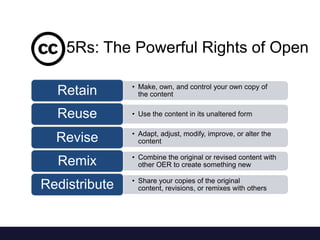
5Rs: The Powerful Rights of Open
• Make, own, and control your own copy of
the contentRetain
• Use the content in its unaltered formReuse
• Adapt, adjust, modify, improve, or alter the
contentRevise
• Combine the original or revised content with
other OER to create something newRemix
• Share your copies of the original
content, revisions, or remixes with othersRedistribute
www.lumenlearning.com
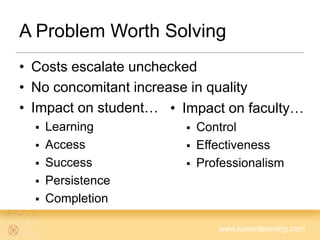
A Problem Worth Solving
• Costs escalate unchecked
• No concomitant increase in quality
• Impact on student…
 Learning
 Access
 Success
 Persistence
 Completion
• Impact on faculty…
 Control
 Effectiveness
 Professionalism
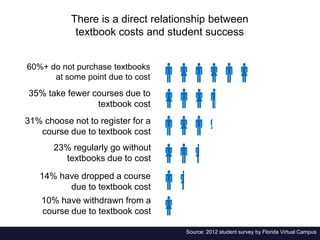
There is a direct relationship between
textbook costs and student success






60%+ do not purchase textbooks
at some point due to cost
35% take fewer courses due to
textbook cost
31% choose not to register for a
course due to textbook cost
23% regularly go without
textbooks due to cost
14% have dropped a course
due to textbook cost
10% have withdrawn from a
course due to textbook cost
Source: 2012 student survey by Florida Virtual Campus
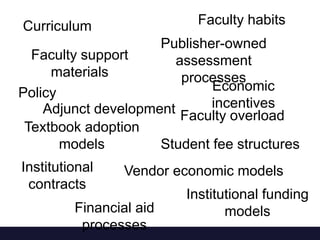
Curriculum
Textbook adoption
models
Economic
incentives
Policy
Institutional funding
models
Institutional
contracts
Faculty habits
Publisher-owned
assessment
processes
Student fee structures
Faculty support
materials
Financial aid
processes
Vendor economic models
Faculty overloadAdjunct development
Lesson 1
Systemic change is required
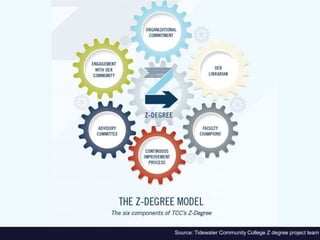
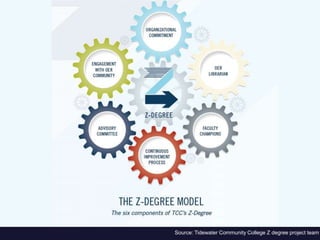
Source: Tidewater Community College Z degree project team
Lesson 2
An institutional champion is vital
www.lumenlearning.com
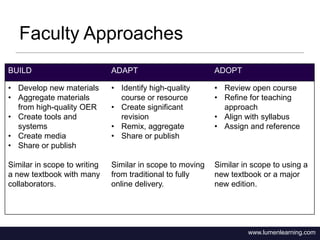
Faculty Approaches
BUILD ADAPT ADOPT
• Develop new materials
• Aggregate materials
from high-quality OER
• Create tools and
systems
• Create media
• Share or publish
Similar in scope to writing
a new textbook with many
collaborators.
• Identify high-quality
course or resource
• Create significant
revision
• Remix, aggregate
• Share or publish
Similar in scope to moving
from traditional to fully
online delivery.
• Review open course
• Refine for teaching
approach
• Align with syllabus
• Assign and reference
Similar in scope to using a
new textbook or a major
new edition.
Lesson 3
Faculty require diverse approaches and
supports
Source: Tidewater Community College Z degree project team
Lesson 4
The community must own the connection
So what?
What can be done only in the context of
open?
1. Continuous Quality Improvement
2. Open Pedagogy
Open
5Rs give you permission to make
changes, but...
don’t tell you what needs changing.
Analytics
Identify the weaker parts of your course, but...
don’t give you permission to fix them.
Open + Analytics
Open + Analytics
identifying the weaker parts of your course
+ permissions to fix them
continuous quality improvement
Open Pedagogy
What kind of activities can students engage in
with OER / open data / open access articles
that they cannot do otherwise?
“Disposable Assignments”
• Students hate doing them
• You hate grading them
• Huge waste of time and energy
• Students see value in doing them
• You see value in grading them
• Actually add value to the world
“Valuable Assignments”
From Process to Product
In theory, all assignments have students
engage in valuable processes.
There’s no reason they shouldn’t result in
valuable products.
http://bit.ly/wikisblogs
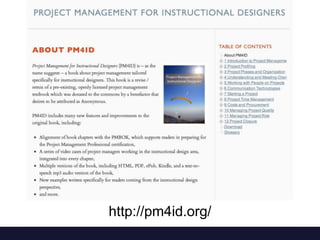
http://pm4id.org/
You’re already using
OER.
Are you taking
advantage of all 5Rs?
Are your classes better
– not just cheaper –
than before?
Be the example.
Discussion
@kthanos
@opencontent

Open Textbook Summit - Lumen Learning

  • 1.
    www.lumenlearnin g.com Lumen Learning Kim Thanos Co-founder& CEO kim@lumenlearning.com David Wiley Co-founder & Chief Academic Officer david@lumenlearning.com
  • 2.
    Topics WHAT quick reviewof terms and meaning WHY issues and scope HOW lessons learned in adoption AND THEN the opportunities created
  • 3.
    OER are teaching,learning, and research resources that reside in the public domain or have been released under an intellectual property license that permits their free use and re-purposing by others. Open educational resources include full courses, course materials, modules, textbooks, streaming videos, tests, software, and any other tools, materials, or techniques used to support access to knowledge. William and Flora Hewlett Foundation
  • 4.
    5Rs: The PowerfulRights of Open • Make, own, and control your own copy of the contentRetain • Use the content in its unaltered formReuse • Adapt, adjust, modify, improve, or alter the contentRevise • Combine the original or revised content with other OER to create something newRemix • Share your copies of the original content, revisions, or remixes with othersRedistribute
  • 5.
    www.lumenlearning.com A Problem WorthSolving • Costs escalate unchecked • No concomitant increase in quality • Impact on student…  Learning  Access  Success  Persistence  Completion • Impact on faculty…  Control  Effectiveness  Professionalism
  • 8.
    There is adirect relationship between textbook costs and student success       60%+ do not purchase textbooks at some point due to cost 35% take fewer courses due to textbook cost 31% choose not to register for a course due to textbook cost 23% regularly go without textbooks due to cost 14% have dropped a course due to textbook cost 10% have withdrawn from a course due to textbook cost Source: 2012 student survey by Florida Virtual Campus
  • 9.
    Curriculum Textbook adoption models Economic incentives Policy Institutional funding models Institutional contracts Facultyhabits Publisher-owned assessment processes Student fee structures Faculty support materials Financial aid processes Vendor economic models Faculty overloadAdjunct development
  • 11.
  • 12.
    Source: Tidewater CommunityCollege Z degree project team
  • 13.
    Lesson 2 An institutionalchampion is vital
  • 14.
    www.lumenlearning.com Faculty Approaches BUILD ADAPTADOPT • Develop new materials • Aggregate materials from high-quality OER • Create tools and systems • Create media • Share or publish Similar in scope to writing a new textbook with many collaborators. • Identify high-quality course or resource • Create significant revision • Remix, aggregate • Share or publish Similar in scope to moving from traditional to fully online delivery. • Review open course • Refine for teaching approach • Align with syllabus • Assign and reference Similar in scope to using a new textbook or a major new edition.
  • 15.
    Lesson 3 Faculty requirediverse approaches and supports
  • 16.
    Source: Tidewater CommunityCollege Z degree project team
  • 17.
    Lesson 4 The communitymust own the connection
  • 19.
    So what? What canbe done only in the context of open?
  • 20.
    1. Continuous QualityImprovement 2. Open Pedagogy
  • 21.
    Open 5Rs give youpermission to make changes, but... don’t tell you what needs changing.
  • 22.
    Analytics Identify the weakerparts of your course, but... don’t give you permission to fix them.
  • 23.
  • 24.
    Open + Analytics identifyingthe weaker parts of your course + permissions to fix them continuous quality improvement
  • 25.
    Open Pedagogy What kindof activities can students engage in with OER / open data / open access articles that they cannot do otherwise?
  • 26.
    “Disposable Assignments” • Studentshate doing them • You hate grading them • Huge waste of time and energy • Students see value in doing them • You see value in grading them • Actually add value to the world “Valuable Assignments”
  • 27.
    From Process toProduct In theory, all assignments have students engage in valuable processes. There’s no reason they shouldn’t result in valuable products.
  • 28.
  • 29.
  • 30.
    You’re already using OER. Areyou taking advantage of all 5Rs? Are your classes better – not just cheaper – than before? Be the example.
  • 31.

Editor's Notes

  • #9 Recent research (conducted by the Florida Virtual Campus) quantifies the ways high textbook costs affect student persistence and success. More than 60% of students report not having purchase textbooks at some point due to the costNearly a quarter (23%) of students regularly go without textbooks due to their costDue to the high cost of textbooks:35% of students report taking fewer courses31% report not registering for a course14% have dropped a course10% have withdrawn from a courseLink to research source: http://www.openaccesstextbooks.org/pdf/2012_Exec_Sum_Student_Txtbk_Survey.pdf