The Best of Both Worlds:Redesigning Your Course for Blended LearningGail Matthews-DeNatale, Ph.D.Professional Developmentand Instructional Design Specialist, TERCSpecial Thanks to The Alfred P. Sloan Foundation andThe Simmons College Blended Learning Initiative
Agenda15	Workshop Introductions, Wish List20	Blended Learning Overview 20	Recommended Process, Example--- 10 Minute Stretch Break ---20	Redesign Exercise: Goals, Evidence35	Redesign Exercise: Assignment30	Sharing Out, Tips, Final Questions
Introductions, Wish ListYour nameWhat you teachCourse that you’ll be working on todayYour “wish list” for what you’d like to get out of this workshop
Overview: What is blended learning?Combines online and face-to-face (25% or more of the course takes place online)Characteristics PlannedDistributedIntegratedSynergistic
Assumptions SurveyWhat do you like most, or expect to like most, about blended learning?
Advantages of BlendedFaculty-student-student interactionDurable record of participationPersistent presence (anytime learning)Independent/active learningDeepened understanding (reflection, critical thinking)
Assumptions SurveyWhat concerns or anxieties do you have about blended learning?
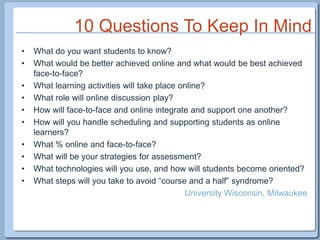
Disadvantages of BlendedNo set model – many decisions to be made anewSignificant time needed for planning, managing workload, staying organizedMany new things to learn (both teaching and technology)
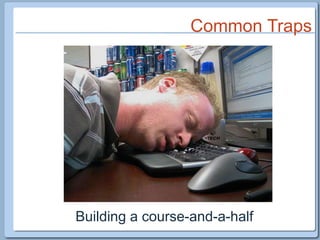
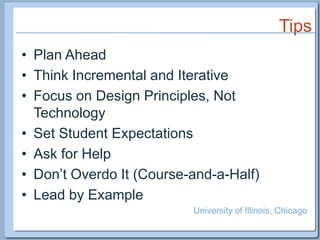
Common TrapsBuilding a course-and-a-half
Common TrapsLeading with Technology, Not Learning
Common Traps“Activities” to Nowhere
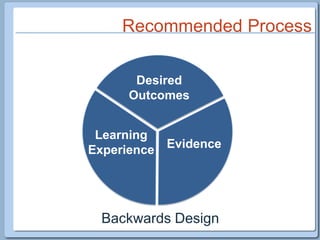
Recommended Process1DesiredOutcomes23LearningExperienceEvidenceBackwards Design
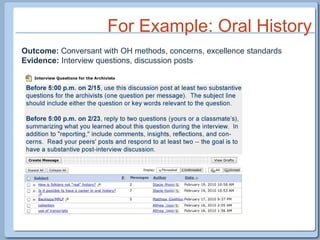
For Example: Oral HistoryOutcome: Conversant with OH methods, concerns, excellence standardsEvidence: Interview questions, discussion posts
BreakStretch your legs for 10 minutesWhen we reconvene, you’ll apply the backwards design process to your course.
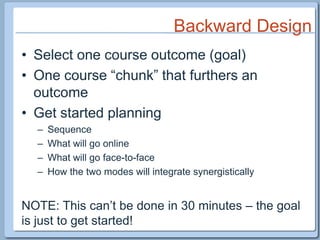
Backward DesignTake a look at your syllabusWhat you want your students to know and be able to do by the end of the courseWhat will provide you with evidence of this learning?
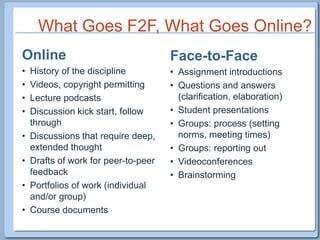
What Goes F2F, What Goes Online?OnlineHistory of the disciplineVideos, copyright permittingLecture podcastsDiscussion kick start, follow throughDiscussions that require deep, extended thoughtDrafts of work for peer-to-peer feedbackPortfolios of work (individual and/or group)Course documentsFace-to-FaceAssignment introductions
Questions and answers(clarification, elaboration)
Student presentations
Groups: process (setting norms, meeting times)
Groups: reporting out

Blended Learning Workshop

Editor's Notes

  • #5 NOTE: Reduction in face-to-face time does not mean reduction in learning or reduced contact with peers/faculty – usually provides more timeFlexibility – can be “in class” at a time that suits their needsAvailability – class is available from any location that has an Internet connectionPersistence – There is a durable record of student participation because all work needs to be posted to the course – good for increasing student reflection and critical thinking.
  • #6 Flexibility – can be “in class” at a time that suits their needsAvailability – class is available from any location that has an Internet connectionPersistence – There is a durable record of student participation because all work needs to be posted to the course – good for increasing student reflection and critical thinking.
  • #7 Flexibility – can be “in class” at a time that suits their needsAvailability – class is available from any location that has an Internet connectionPersistence – There is a durable record of student participation because all work needs to be posted to the course – good for increasing student reflection and critical thinking.
  • #9 A different model of teaching and learningDifference #1: Search for a canonWhat should a blended schedule look like?What goes online, what remains F2F?Three tests and a term paper no longer “works”Difference #2: Rethinking what we doClosing the loopThe course-and-a-half syndromeHearing voices: from soliloquy to dialogue
  • #10 A different model of teaching and learningDifference #1: Search for a canonWhat should a blended schedule look like?What goes online, what remains F2F?Three tests and a term paper no longer “works”Difference #2: Rethinking what we doClosing the loopThe course-and-a-half syndromeHearing voices: from soliloquy to dialogue
  • #11 The course-and-a-half syndromeHearing voices: from soliloquy to dialogue
  • #12 The course-and-a-half syndromeHearing voices: from soliloquy to dialogue
  • #17 Kick start / follow through example – 3 questions, 3 comments
  • #21 A different model of teaching and learningDifference #1: Search for a canonWhat should a blended schedule look like?What goes online, what remains F2F?Three tests and a term paper no longer “works”Difference #2: Rethinking what we doClosing the loopThe course-and-a-half syndromeHearing voices: from soliloquy to dialogue