Upper GI Hemorrhage: Emergency Management พญ .  ปิยะธิดา หาญสมบูรณ์ หัวหน้างานโรคทางเดินอาหาร กลุ่มงานอายุรศาสตร์ โรงพยาบาลราชวิถี
Admission Rate 100/100,000 Incidence 50-100/100,000 per year
Clinical Manifestations: Hematemesis Melena Hematochezia
Causes of acute upper gastrointestinal harmorrhage 5 Rare 5 Vascular malformations  1 Upper gastrointestinal malignancy 15 Mallory Weiss tear 5-10 Varices 5-15 Oesophagitis 8-15 Gastroduodenal erosions  35-50 Peptic ulcer Approx% Diagnosis
Acute Nonvariceal hemorrhage
Acute Variceal hemorrhage
Portal Hypertensive Gastropathy
Basic Principle in Management Rapid Assessment Initial Resuscitation
When? How many ?
When to transfuse blood?  Changes in vital signs Continuous bleeding Signs of poor tissue oxygenation Low hematocrit (Hct 20-25%)
Target Hemoglobin 10mg/dL  Elder Hemoglobin 7-8 mg/dL   normal adult Hemoglobin  9 mg/dL  patient with portal hypertension  Fresh Frozen Plasma 1 unit/ 4 units PRC Platelet concentration if < 50,000
Assessment
Important History history of oropharyngeal disease anemia weight loss change in bowel habit abdominal pain use of anticoagulation and/or antiplatelet therapy use of nonsteroidal anti-inflammatory drugs including aspirin underlying medical disorder (especially liver disease) previous gastrointestinal surgery previous gastrointestinal disease prior gastrointestinal bleeding age
Hemodynamic status and severity of GI bleeding minor <10 Normal Moderate 10-20 Postural (orthostatic hypotension and tachycardia) Massive 20-25 Shock (resting hypotension) Severity of bleed Blood loss (% of intravascular vol) Vital Signs
Characteristics of vomitus Bright red vomitus Coffee ground
Objectives of NG Lavage Appearance of gastric content Clear the stomach for the endoscopy Prevent pulmonary aspiration
Cappelli MS, et al.  High risk gastrointestinal bleeding.  Gastroenterol Clin N Am .  2000;29(2) Aljabreen AM, Fallone CA, Barkun AN. Nasogastric aspirate predicts high risk endoscopic lesions in patients with acute upper GI bleeding.  Gastrointest Endosc .  2004;59:172. 28.7 Red 19.4 Brown 12.3 Black Red Blood 19.1 Red 8.2 Brown or black Coffee ground 6 Brown or Red Clear Mortality % Stool color NG aspirate color
Risk Stratification
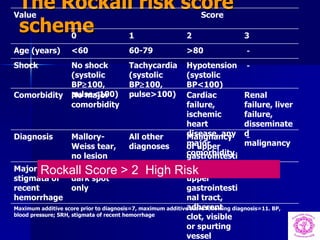
The Rockall risk score scheme Rockall Score > 2  High Risk Maximum additive score prior to diagnosis=7, maximum additive score following diagnosis=11. BP, blood pressure; SRH, stigmata of recent hemorrhage - Blood in upper gastrointestinal tract, adherent clot, visible or spurting vessel - None or dark spot only Major stigmata of recent hemorrhage - Malignancy of upper gastrointestinal tract All other diagnoses Mallory-Weiss tear, no lesion identified and no SRH Diagnosis Renal failure, liver failure, disseminated malignancy Cardiac failure, ischemic heart disease, any major comorbidity - No major comorbidity Comorbidity - Hypotension (systolic BP<100) Tachycardia (systolic BP  100, pulse>100) No shock (systolic BP  100, pulse<100) Shock - >80 60-79 <60 Age (years) 3 2 1 0 Score Value
Rockall score  < 2 could be safely managed in OPD setting  Rockall T, Logan R, Devlin H, et al. Selection of patients for early discharged or outpatient care after acute gastrointestinal hemorrhage.  Lancet . 1996;347:1138-40.
Cipoletta criteria Endoscopic absence of varices, other signs of portal hypertension, or high risk stigmata of recent hemorrhage Absence of hypovolemic shock or orthostasis Hb > 8mg/dL and no blood transfusion Normal coagulation studies Absence of serious medical illness Easy accessibility to hospital and adequate social/family support Capoletta L, BiancoM, Rotondana G, et al. Outpatient management for low risk nonvariceal upper GI bleeding; a randomized controlled trial.  Gastrointest Endosc .2002;55:1-5
Longstreth Guidelines for selecting Patient with acute UGIH for OPD care Absolute No high risk endoscopic features, varices,or portal hypertensive gastropathy Not absolute No debilitation No orthostatic vital sigh changes No severe liver disease No anticoagulation therapy or coagulopathy No fresh, voluminous hematemesis or multiple episodes of melena on the day of presentation No severe anemia (hemoglobin 8 g/dL) Adequate support at home Longstreth G, Feitelberg S. Successful outpatient management of acute upper gastrointestinal hemorrhage: use of practice guidelines in a large patient series.  Gastrointest Endosc . 1998;47:219-222.
University of California,San Francisco (UCSF) Triage Very Low Risk age < 60 Absence of major cormorbid No Hx of red hematemesis, hematochezia or bright red nasogastric   aspirate No Hemodynamic instability No significant coagulopathy and   profound anemia D/C from ER Outpatient workup Elmunzer BJ, Inadomi JM, Elta GH. Risk Stratification in Upper Gastrointestinal Bleeding.  J Clin Gastroenterol  2007;41:559-563.
LOW Risk Hemodynamic stable within 1 hour of resuscitation No recent red hematemesis, hematochezia, or bright red nasogastric aspirate No active cardiopulmonary or liver disease No significant coagulopathy or profound anemia Allow: Age> 60,coffee ground in NG aspirate, presence of compensated comorbidities,and initial hemodynamic compromise EGD Low risk D/C from ER Outpatient workup Elmunzer BJ, Inadomi JM, Elta GH. Risk Stratification in Upper Gastrointestinal Bleeding.  J Clin Gastroenterol  2007;41:559-563 .
Blantchford Score Blantchford score > 0  High Risk 6 < 10 1 10  -  12 g / dL Hemoglobin level for women  ( g / dL ) 6 < 10 3 10  -  11 g / dL 1 12  -  13 g / dL Hemoglobin level for men  ( g / dL ) 6 >   70 4 >   28   - 70 3 >  22.4 - 28 2 >   18.2 – 22.4 Blood urea nitrogen level  ( mg / dL ) Score Admission risk marker 2 Cardiac failure 2 Hepatic disease 2 Presentation with syncope 1 Presentation with melena 1 Pulse > 100 per min Other markers 3 <90 2 90  -  99 1 100   -109 Systolic blood pressures  ( mm Hg ) Score Admission risk marker
The Rockall risk score scheme Clinical Rockall Score Maximum additive score prior to diagnosis=7, maximum additive score following diagnosis=11. BP, blood pressure; SRH, stigmata of recent hemorrhage - Blood in upper gastrointestinal tract, adherent clot, visible or spurting vessel - None or dark spot only Major stigmata of recent hemorrhage - Malignancy of upper gastrointestinal tract All other diagnoses Mallory-Weiss tear, no lesion identified and no SRH Diagnosis Renal failure, liver failure, disseminated malignancy Cardiac failure, ischemic heart disease, any major comorbidity - No major comorbidity Comorbidity - Hypotension (systolic BP<100) Tachycardia (systolic BP  100, pulse>100) No shock (systolic BP  100, pulse<100) Shock - >80 60-79 <60 Age (years) 3 2 1 0 Score Value
Clinical Rockall score 0, no adverse outcomes 1-3,no adverse outcomes, 29% need transfusion >3   ,21% rebleeding, 5%surgery, 10% death OPD workup Tham   TCK, James C, Kelly M. Predicting outcome of acute non variceal upper gastrointestinal hemorrhage without endoscopy using clinical Rockall score.  Postgrad Med   J  2006;82:757-759. Clinical Rockall < 3
ธันวาคม  2547
High Risk factors Host factors: Age >   60 yrs Cormorbid conditions Hemostatic instability,orthostatic hypotension, PR> 100,BP < 100 Coagulopathy Bleeding character: Continuous red blood from NG Red blood per rectum Patient course: Need blood transfusion Hemodynamic instability
Acute Non Variceal Hemorrhage
Bleeding Peptic Ulcer - Epidemiology - More than 300,000 hospital admissions annually in the US 1 Incidence: 103 cases/100,000 adults/year 2 Mortality: 5~14% 3 , unchanged for the past two decades, exclusively among elderly patients with significant comorbidities 1 Yavorski RT et al. Am J Gastroenterol 1995; 90:568-73 2 Longstreth GF. Am J Gastroenterol 1995; 90:206-10 3 Rockall TA et al. BMJ 1995; 38:222-6
Bleeding Peptic Ulcer - Natural History - Approximately 80-85% bleeding stops spontaneously Remaining 15-20% recurrent or continuous bleeding Early risk- stratification facilitates appropriate level of care Multidisciplinary approach
Laine et al.  NEJM  1994; 331:717 Risk of rebleeding correlated with endoscopic bleeding stigma 11 43 11 7 3 2 Mortality 55 22 10 5 Rebleeding Active  Bleed NBVV Adherent Clot Flat spot Clean- Base
Role of PPI
Keep gastric pH>6 Platelet aggregation and clot formation Principle
Omeprazole before endoscopy in patients with gastrointestinal bleedings Lau   JY, Leung WK, Wu JC, et al. New Engl J Med . 2007 Apr 19;356(16): 1631-40. N 638 319 319 Omeprazole 80mgIV bolus, 8mg/hr placebo 19.1% 28.4% Endoscopic Rx
Reduced the need   for endoscopic therapy Infusion of high dose   Omeprazole before endoscopy acclerated   the resolution of signs of bleeding   in ulcers Lau   JY, Leung WK, Wu JC, et al. New Engl J Med . 2007 Apr 19;356(16): 1631-40 .
High dose PPI after endoscopic therapy Decreased Rebleeding Decreased Surgery Cochrane systematic review 2005 Lau JY, Sung JJ, Lee KK, et al.  Effect of intravenous omeprazole on recurrent bleeding after endoscopic treatment of bleeding peptic ulcers.  N Engl J  Med. 2000;343: 310-16 .
Endoscopic Management of Non variceal Hemorrhage Injection Therapy Thermal Devices Mechanical Devices
Acute Variceal Bleeding
Esophageal Varices 50% in cirrhosis 20% varices – large at presentation Developing rate 10-15% per year 1/3 varices bleed Mortality rate ~20-30% /bleeding episode 50% stop spontaneously
72 >16 50 >15-16 17 >14-15 9 >13-14 0 < 13 Incidence of bleeding % Variceal Pressure mm Hg
 
Predicting Variceal Hemorrhage 72 60 44 52 40 28 34 23 16 +++ 54 38 28 33 23 15 19 12 8 + 42 30 20 26 16 10 15 10 6 - F3 F2 F1 F3 F2 F1 F3 F2 F1 C B A Red Wale Child Class
Risk Factors for recurrent hemorrhage Platelet clot on varice Red signs Red signs Active Bleeding on scope Active alcoholism Ascites Hepatoma Renal failure Ascites Severity of initial bleed Severity of liver failure Age > 60 Late Rebleeding >6wk Early Rebleeding <6wk
Sherry red spot (red color sign) Red Spot Red Wale sign (varices on varix)
Esophageal Varices Platelet clot
Initial Management: Resuscitation and Blood Transfusion (Keep hemoglobin 8gm/dl)  Class I Level B Antibiotic prophylaxis for 7 days Norfloxacin 400 mg bid or IV Ciprofloxacin  Class I Level A Ceftriazone 1 gm/day  Class I Level B Pharmacologic Therapy 3-5 days  Class I Level A Somatostatin and analogs Terlipressin EGD within 12   hours + EVL or sclerotherapy  Class I Level A Balloon   tamponade used as temporary measure (max 24 hours)  Class I Level B ACG Practice Guideline 2007
N-2 butyl-cyanoacrylate for bleeding gastric varices: A United states pilot study and cost analysis Greenwald BD, Caldwell SH, Hespenheide EE, et al Am J Gastroenterol   2003 Sep;98(9):1982-8. Odd of Death > 7 fold non cyanoacrylate group 5/28 (18%) 1 year 1/30 (3%) 6 week 2/37 (5.5%) 72 hour Rebleeding 24/31 (29%) 1 year 30/34 (88%) 3 months survival
Role of Surgery Severe hemorrhage unresponsive to initial resuscitation Unavailable or failure of endoscopic therapy Coexisting 2 nd  indication to operations such as perforation, obstruction or suspicious of malignancy
Thank you for your Attention

TAEM10:Upper Gi Hemorrhage Ems

  • 1.
    Upper GI Hemorrhage:Emergency Management พญ . ปิยะธิดา หาญสมบูรณ์ หัวหน้างานโรคทางเดินอาหาร กลุ่มงานอายุรศาสตร์ โรงพยาบาลราชวิถี
  • 2.
    Admission Rate 100/100,000Incidence 50-100/100,000 per year
  • 3.
  • 4.
    Causes of acuteupper gastrointestinal harmorrhage 5 Rare 5 Vascular malformations 1 Upper gastrointestinal malignancy 15 Mallory Weiss tear 5-10 Varices 5-15 Oesophagitis 8-15 Gastroduodenal erosions 35-50 Peptic ulcer Approx% Diagnosis
  • 5.
  • 6.
  • 7.
  • 8.
    Basic Principle inManagement Rapid Assessment Initial Resuscitation
  • 9.
  • 10.
    When to transfuseblood? Changes in vital signs Continuous bleeding Signs of poor tissue oxygenation Low hematocrit (Hct 20-25%)
  • 11.
    Target Hemoglobin 10mg/dL Elder Hemoglobin 7-8 mg/dL normal adult Hemoglobin 9 mg/dL patient with portal hypertension Fresh Frozen Plasma 1 unit/ 4 units PRC Platelet concentration if < 50,000
  • 12.
  • 13.
    Important History historyof oropharyngeal disease anemia weight loss change in bowel habit abdominal pain use of anticoagulation and/or antiplatelet therapy use of nonsteroidal anti-inflammatory drugs including aspirin underlying medical disorder (especially liver disease) previous gastrointestinal surgery previous gastrointestinal disease prior gastrointestinal bleeding age
  • 14.
    Hemodynamic status andseverity of GI bleeding minor <10 Normal Moderate 10-20 Postural (orthostatic hypotension and tachycardia) Massive 20-25 Shock (resting hypotension) Severity of bleed Blood loss (% of intravascular vol) Vital Signs
  • 15.
    Characteristics of vomitusBright red vomitus Coffee ground
  • 16.
    Objectives of NGLavage Appearance of gastric content Clear the stomach for the endoscopy Prevent pulmonary aspiration
  • 17.
    Cappelli MS, etal. High risk gastrointestinal bleeding. Gastroenterol Clin N Am . 2000;29(2) Aljabreen AM, Fallone CA, Barkun AN. Nasogastric aspirate predicts high risk endoscopic lesions in patients with acute upper GI bleeding. Gastrointest Endosc . 2004;59:172. 28.7 Red 19.4 Brown 12.3 Black Red Blood 19.1 Red 8.2 Brown or black Coffee ground 6 Brown or Red Clear Mortality % Stool color NG aspirate color
  • 18.
  • 19.
    The Rockall riskscore scheme Rockall Score > 2 High Risk Maximum additive score prior to diagnosis=7, maximum additive score following diagnosis=11. BP, blood pressure; SRH, stigmata of recent hemorrhage - Blood in upper gastrointestinal tract, adherent clot, visible or spurting vessel - None or dark spot only Major stigmata of recent hemorrhage - Malignancy of upper gastrointestinal tract All other diagnoses Mallory-Weiss tear, no lesion identified and no SRH Diagnosis Renal failure, liver failure, disseminated malignancy Cardiac failure, ischemic heart disease, any major comorbidity - No major comorbidity Comorbidity - Hypotension (systolic BP<100) Tachycardia (systolic BP  100, pulse>100) No shock (systolic BP  100, pulse<100) Shock - >80 60-79 <60 Age (years) 3 2 1 0 Score Value
  • 20.
    Rockall score < 2 could be safely managed in OPD setting Rockall T, Logan R, Devlin H, et al. Selection of patients for early discharged or outpatient care after acute gastrointestinal hemorrhage. Lancet . 1996;347:1138-40.
  • 21.
    Cipoletta criteria Endoscopicabsence of varices, other signs of portal hypertension, or high risk stigmata of recent hemorrhage Absence of hypovolemic shock or orthostasis Hb > 8mg/dL and no blood transfusion Normal coagulation studies Absence of serious medical illness Easy accessibility to hospital and adequate social/family support Capoletta L, BiancoM, Rotondana G, et al. Outpatient management for low risk nonvariceal upper GI bleeding; a randomized controlled trial. Gastrointest Endosc .2002;55:1-5
  • 22.
    Longstreth Guidelines forselecting Patient with acute UGIH for OPD care Absolute No high risk endoscopic features, varices,or portal hypertensive gastropathy Not absolute No debilitation No orthostatic vital sigh changes No severe liver disease No anticoagulation therapy or coagulopathy No fresh, voluminous hematemesis or multiple episodes of melena on the day of presentation No severe anemia (hemoglobin 8 g/dL) Adequate support at home Longstreth G, Feitelberg S. Successful outpatient management of acute upper gastrointestinal hemorrhage: use of practice guidelines in a large patient series. Gastrointest Endosc . 1998;47:219-222.
  • 23.
    University of California,SanFrancisco (UCSF) Triage Very Low Risk age < 60 Absence of major cormorbid No Hx of red hematemesis, hematochezia or bright red nasogastric aspirate No Hemodynamic instability No significant coagulopathy and profound anemia D/C from ER Outpatient workup Elmunzer BJ, Inadomi JM, Elta GH. Risk Stratification in Upper Gastrointestinal Bleeding. J Clin Gastroenterol 2007;41:559-563.
  • 24.
    LOW Risk Hemodynamicstable within 1 hour of resuscitation No recent red hematemesis, hematochezia, or bright red nasogastric aspirate No active cardiopulmonary or liver disease No significant coagulopathy or profound anemia Allow: Age> 60,coffee ground in NG aspirate, presence of compensated comorbidities,and initial hemodynamic compromise EGD Low risk D/C from ER Outpatient workup Elmunzer BJ, Inadomi JM, Elta GH. Risk Stratification in Upper Gastrointestinal Bleeding. J Clin Gastroenterol 2007;41:559-563 .
  • 25.
    Blantchford Score Blantchfordscore > 0 High Risk 6 < 10 1 10 - 12 g / dL Hemoglobin level for women ( g / dL ) 6 < 10 3 10 - 11 g / dL 1 12 - 13 g / dL Hemoglobin level for men ( g / dL ) 6 > 70 4 > 28 - 70 3 > 22.4 - 28 2 > 18.2 – 22.4 Blood urea nitrogen level ( mg / dL ) Score Admission risk marker 2 Cardiac failure 2 Hepatic disease 2 Presentation with syncope 1 Presentation with melena 1 Pulse > 100 per min Other markers 3 <90 2 90 - 99 1 100 -109 Systolic blood pressures ( mm Hg ) Score Admission risk marker
  • 26.
    The Rockall riskscore scheme Clinical Rockall Score Maximum additive score prior to diagnosis=7, maximum additive score following diagnosis=11. BP, blood pressure; SRH, stigmata of recent hemorrhage - Blood in upper gastrointestinal tract, adherent clot, visible or spurting vessel - None or dark spot only Major stigmata of recent hemorrhage - Malignancy of upper gastrointestinal tract All other diagnoses Mallory-Weiss tear, no lesion identified and no SRH Diagnosis Renal failure, liver failure, disseminated malignancy Cardiac failure, ischemic heart disease, any major comorbidity - No major comorbidity Comorbidity - Hypotension (systolic BP<100) Tachycardia (systolic BP  100, pulse>100) No shock (systolic BP  100, pulse<100) Shock - >80 60-79 <60 Age (years) 3 2 1 0 Score Value
  • 27.
    Clinical Rockall score0, no adverse outcomes 1-3,no adverse outcomes, 29% need transfusion >3 ,21% rebleeding, 5%surgery, 10% death OPD workup Tham TCK, James C, Kelly M. Predicting outcome of acute non variceal upper gastrointestinal hemorrhage without endoscopy using clinical Rockall score. Postgrad Med J 2006;82:757-759. Clinical Rockall < 3
  • 28.
  • 29.
    High Risk factorsHost factors: Age > 60 yrs Cormorbid conditions Hemostatic instability,orthostatic hypotension, PR> 100,BP < 100 Coagulopathy Bleeding character: Continuous red blood from NG Red blood per rectum Patient course: Need blood transfusion Hemodynamic instability
  • 30.
  • 31.
    Bleeding Peptic Ulcer- Epidemiology - More than 300,000 hospital admissions annually in the US 1 Incidence: 103 cases/100,000 adults/year 2 Mortality: 5~14% 3 , unchanged for the past two decades, exclusively among elderly patients with significant comorbidities 1 Yavorski RT et al. Am J Gastroenterol 1995; 90:568-73 2 Longstreth GF. Am J Gastroenterol 1995; 90:206-10 3 Rockall TA et al. BMJ 1995; 38:222-6
  • 32.
    Bleeding Peptic Ulcer- Natural History - Approximately 80-85% bleeding stops spontaneously Remaining 15-20% recurrent or continuous bleeding Early risk- stratification facilitates appropriate level of care Multidisciplinary approach
  • 33.
    Laine et al. NEJM 1994; 331:717 Risk of rebleeding correlated with endoscopic bleeding stigma 11 43 11 7 3 2 Mortality 55 22 10 5 Rebleeding Active Bleed NBVV Adherent Clot Flat spot Clean- Base
  • 34.
  • 35.
    Keep gastric pH>6Platelet aggregation and clot formation Principle
  • 36.
    Omeprazole before endoscopyin patients with gastrointestinal bleedings Lau JY, Leung WK, Wu JC, et al. New Engl J Med . 2007 Apr 19;356(16): 1631-40. N 638 319 319 Omeprazole 80mgIV bolus, 8mg/hr placebo 19.1% 28.4% Endoscopic Rx
  • 37.
    Reduced the need for endoscopic therapy Infusion of high dose Omeprazole before endoscopy acclerated the resolution of signs of bleeding in ulcers Lau JY, Leung WK, Wu JC, et al. New Engl J Med . 2007 Apr 19;356(16): 1631-40 .
  • 38.
    High dose PPIafter endoscopic therapy Decreased Rebleeding Decreased Surgery Cochrane systematic review 2005 Lau JY, Sung JJ, Lee KK, et al. Effect of intravenous omeprazole on recurrent bleeding after endoscopic treatment of bleeding peptic ulcers. N Engl J Med. 2000;343: 310-16 .
  • 39.
    Endoscopic Management ofNon variceal Hemorrhage Injection Therapy Thermal Devices Mechanical Devices
  • 40.
  • 41.
    Esophageal Varices 50%in cirrhosis 20% varices – large at presentation Developing rate 10-15% per year 1/3 varices bleed Mortality rate ~20-30% /bleeding episode 50% stop spontaneously
  • 42.
    72 >16 50>15-16 17 >14-15 9 >13-14 0 < 13 Incidence of bleeding % Variceal Pressure mm Hg
  • 43.
  • 44.
    Predicting Variceal Hemorrhage72 60 44 52 40 28 34 23 16 +++ 54 38 28 33 23 15 19 12 8 + 42 30 20 26 16 10 15 10 6 - F3 F2 F1 F3 F2 F1 F3 F2 F1 C B A Red Wale Child Class
  • 45.
    Risk Factors forrecurrent hemorrhage Platelet clot on varice Red signs Red signs Active Bleeding on scope Active alcoholism Ascites Hepatoma Renal failure Ascites Severity of initial bleed Severity of liver failure Age > 60 Late Rebleeding >6wk Early Rebleeding <6wk
  • 46.
    Sherry red spot(red color sign) Red Spot Red Wale sign (varices on varix)
  • 47.
  • 48.
    Initial Management: Resuscitationand Blood Transfusion (Keep hemoglobin 8gm/dl) Class I Level B Antibiotic prophylaxis for 7 days Norfloxacin 400 mg bid or IV Ciprofloxacin Class I Level A Ceftriazone 1 gm/day Class I Level B Pharmacologic Therapy 3-5 days Class I Level A Somatostatin and analogs Terlipressin EGD within 12 hours + EVL or sclerotherapy Class I Level A Balloon tamponade used as temporary measure (max 24 hours) Class I Level B ACG Practice Guideline 2007
  • 49.
    N-2 butyl-cyanoacrylate forbleeding gastric varices: A United states pilot study and cost analysis Greenwald BD, Caldwell SH, Hespenheide EE, et al Am J Gastroenterol 2003 Sep;98(9):1982-8. Odd of Death > 7 fold non cyanoacrylate group 5/28 (18%) 1 year 1/30 (3%) 6 week 2/37 (5.5%) 72 hour Rebleeding 24/31 (29%) 1 year 30/34 (88%) 3 months survival
  • 50.
    Role of SurgerySevere hemorrhage unresponsive to initial resuscitation Unavailable or failure of endoscopic therapy Coexisting 2 nd indication to operations such as perforation, obstruction or suspicious of malignancy
  • 51.
    Thank you foryour Attention