Acute Upper Gastrointestinal
         Bleeding
      Entesar El Sharqawy
              MD
Hepatology, Gastroenterology
  and Infectious Diseases.
      Benha University
          26/09/12
Objectives
 Discuss  and provide background information of upper
  GIT bleeding.
 Identify goals of history, physical finding and care in
  UGIB.
 Discuss utility of NGT in the evaluation of UGIB.
 Identify key points to resussitation and work up of
  UGIB.
 Discuss therapy of upper GIB.
 Outline key informations to have when calling GI
  consultants.
Gastrointestinal Bleeding
 Introduction:
  GI   bleeding is a common disorder that
   troubles all medical/surgical specialties
  UGI bleeding>LGI bleeding
  Prevalence: 170 cases/100.000 adults/yr
  Cost estimate: $2.5B/yr (USA)
  Mortality 5-12%
    40% for recurrent bleeders
  Severity: acute/chronic/intermittent/occult
Epidemiology:
 Upper: Lower GI bleeding = 5:1
 30% pts are older than 65 years.
 Incidence:     1-2% of all hospital admissions
    Most common diagnosis of new ICU admits
 85% stop sponateously
    Those with massive bleeding need urgent
      intervention
    Only 5-10% need operative intervention after
      endoscopic interventions
Early therapeutic maneuvers decrease mortality rates
Gastrointestinal Bleeding

Presentation of bleeding:


  Hematemesis-UGI   source
  Melena-UGI source usually but 5% can be from
   LGI source
  Hematochezia (BRBPR)-LGI source usually but
   15% from UGI source
  Occult-UGIB
Chain of events

1.   Recognize severity
2.   Establish access for resusitation
3.   Resusitate
4.   Identify source
5.   Intervention
Gastrointestinal Bleeding
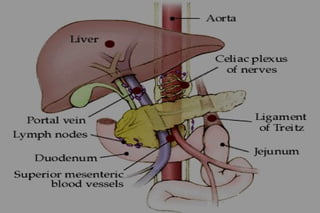
 UGI vs LGI location determined by the
 Ligament of Treitz:

  UGI – proximal to LT
    *Esophagus, *stomach, *duodenal bulb, 2nd/3rd
      portion of duodenum, Hepatic and Pancreatic

  LGI – distal to LT
    Small bowel, *colon
Etiology of Significant UGI
    Bleeding in Adults
     Varices  
     Peptic ulcer disease   
     Gastric erosions   
     Mallory-Weiss tear   
     Esophagitis  
     Duodenitis
Etiology of Significant UGI
   Bleeding in Children
Esophagitis   
Gastritis   
Ulcer   
Esophageal Vs
 Mallory-Weiss
Initial Assessment
 History  and PE
 Vitals, ABC’s, and IVFs
   HR,   BP, Orthostatics
 Signs   of gross blood loss?
   Hematemesis,    melena, hematochezia
   NG    Tube
 Labs
   CBC,  Kidney Profile, LFT, Electrolytes, Coags, Acid-Base
    balance, type and cross
   Hct unreliable
   ECG
   Imaging: chest & abd. radiography, US, CT
Gastrointestinal Bleeding
 Determine the urgency of the clinical situation:
  Is the patient in shock?
     40% loss of circulating blood volume
     Agitation, pallor, tachycardia, hypotension
  Is the patient orthostatic?
     20% loss of circulating blood volume
     Postural hypotension
  Never rely on initial H/H values to asses amount of blood
    loss (hemoconcentration)
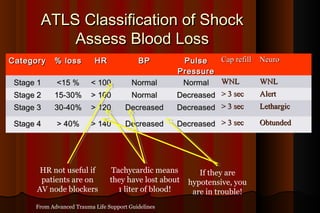
ATLS Classification of Shock
           Assess Blood Loss
Category    % loss         HR              BP         Pulse    Cap refill   Neuro
                                                     Pressure
 Stage 1     <15 %        < 100          Normal       Normal   WNL          WNL
 Stage 2    15-30%        > 100          Normal      Decreased > 3 sec      Alert
 Stage 3    30-40%        > 120       Decreased      Decreased > 3 sec      Lethargic

 Stage 4     > 40%        > 140       Decreased      Decreased > 3 sec      Obtunded


       HR not useful if           Tachycardic means        If they are
       patients are on           they have lost about   hypotensive, you
      AV node blockers              1 liter of blood!    are in trouble!
      From Advanced Trauma Life Support Guidelines
General Approach


Upper GI Bleed
      vs
Lower GI Bleed
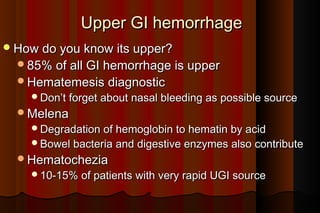
Upper GI hemorrhage
 How do you know its upper?
  85% of all GI hemorrhage is upper
  Hematemesis diagnostic
    Don’t forget about nasal bleeding as possible source
  Melena
    Degradation of hemoglobin to hematin by acid
    Bowel bacteria and digestive enzymes also contribute
  Hematochezia
    10-15% of patients with very rapid UGI source
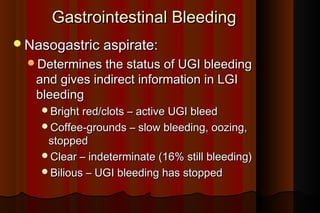
Gastrointestinal Bleeding
Nasogastric aspirate:
  Determines the status of UGI bleeding
   and gives indirect information in LGI
   bleeding
    Bright red/clots – active UGI bleed
    Coffee-grounds – slow bleeding, oozing,
     stopped
    Clear – indeterminate (16% still bleeding)
    Bilious – UGI bleeding has stopped
Diagnosis
 Questions    to ask in history
 Any hematemesis, coffee-ground emesis, melena, or
  hematochezia.
 Any vomiting and retching.
 Any history of viral infection.
 Any history of ASA, NSAID’s, steroids.
 Any ETOH abuse.
 Any history of iron or bismuth which can simulate melena and
  beets which can simulate hematochezia.
 Any weight loss or changes in bowel habits.
 Any history aortic graft.
Diagnosis
                   Physical exam
 Vital signs may show hypotension and
  tachycardia.
 Cool, clammy skin then in shock.
 Spider angiomata, palmer erythema, jaundice,
  and gynecomastia seen in liver disease.
 Petechiae and purpura seen in coagulopathy.
 Careful ENT exam to rule out causes that
  can mimic upper GI bleeds.
 Proper abdominal exam and rectal exam.
Upper GI hemorrhage

Upper endoscopy indications
    Hematemesis
    Melena or hematochezia with hypotension
    NGT with guiac positive fluid
    Should be completed in 24hrs for stable
     patients
Gastrointestinal Bleeding
 Role of endoscopy in triage of UGI
 bleeders:
     Accurate identification of the urgency of the clinical
      situation: hemodynamic compromise/signs of on-
      going bleeding/coagulopathy.
     Who should be hospitalized?
     Where to admit?
     Diagnosing the cause
     Risk stratification
Gastrointestinal Bleeding
 Risk stratification in UGI bleeding:
  Very low risk endoscopic findings:
     Clean-bsed ulcer
     Clean based Mallory-Weiss tear
     Gastritis/duodenitis/esophagitis
     Portal hypertensive gastropathy


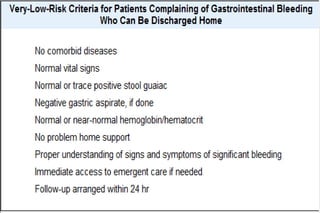
     Disposition:   Discharge if stable
Gastrointestinal Bleeding
 Risk stratification in UGI bleeding
  Medium risk endoscopic findings:
     AVM’s
     Ulcer with stigmata of recent hemorrhage
     Mallory-Weiss with stigmata of recent hemorrhage
     Varices with recent bleeding
     Cancer


     Hemostasis and medical ward/intermediate care unit
Gastrointestinal Bleeding
 Risk stratification in UGI bleeding:
  High risk endoscopic findings:
     Active variceal bleeding
     Active ulcer bleeding
     Active bleeding Dieulafoy’s lesion


     Hemostasis and ICU admission
Resuscitation
Place in ICU and Surgery consultation
Airway protection
Maintain intravascular volume, O2
Give NS until PRBC and FFP available
Follow vitals, orthostatics, and urine
 output
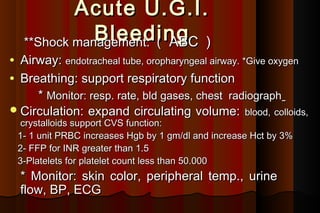
Acute U.G.I.
                Bleeding )
     **Shock management: (  ABC
• Airway: endotracheal tube, oropharyngeal airway. *Give oxygen
• Breathing: support respiratory function
     * Monitor: resp. rate, bld gases, chest radiograph
 Circulation: expand circulating volume: blood, colloids,
     crystalloids support CVS function:
    1- 1 unit PRBC increases Hgb by 1 gm/dl and increase Hct by 3%
    2- FFP for INR greater than 1.5
    3-Platelets for platelet count less than 50.000
    * Monitor: skin color, peripheral temp., urine
    flow, BP, ECG
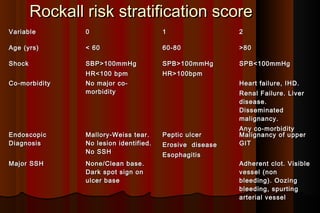
Rockall risk stratification score
Variable        0                       1                 2

Age (yrs)       < 60                    60-80             >80

Shock           SBP>100mmHg             SPB>100mmHg       SPB<100mmHg
                HR<100 bpm              HR>100bpm
Co-morbidity    No major co-                              Heart failure, IHD.
                morbidity                                 Renal Failure. Liver
                                                          disease.
                                                          Disseminated
                                                          malignancy.
                                                          Any co-morbidity
Endoscopic      Mallory-Weiss tear.     Peptic ulcer      Malignancy of upper
Diagnosis       No lesion identified.   Erosive disease   GIT
                No SSH                  Esophagitis
Major SSH       None/Clean base.                          Adherent clot. Visible
                Dark spot sign on                         vessel (non
                ulcer base                                bleeding). Oozing
                                                          bleeding, spurting
                                                          arterial vessel
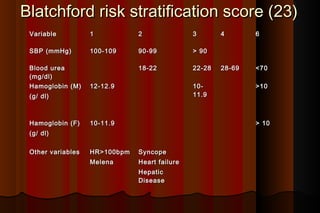
Blatchford risk stratification score (23)
 Variable          1           2               3       4       6

 SBP (mmHg)        100-109     90-99           > 90

 Blood urea                    18-22           22-28   28-69   < 70
 (mg / dl)
 Hamoglobin (M)    12-12.9                     10-             > 10
 (g / dl)                                      11.9


 Hamoglobin (F)    10-11.9                                     > 10
 (g / dl)

 Other variables   HR>100bpm   Syncope
                   Melena      Heart failure
                               Hepatic
                               Disease
INDICATIONS FOR
      ADMISSION & REFERRAL
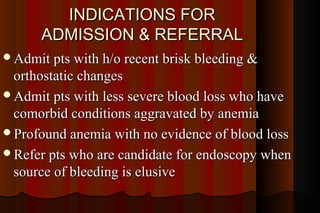
Admit pts with h/o recent brisk bleeding &
 orthostatic changes
Admit pts with less severe blood loss who have
 comorbid conditions aggravated by anemia
Profound anemia with no evidence of blood loss
Refer pts who are candidate for endoscopy when
 source of bleeding is elusive
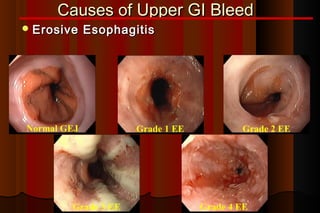
Causes of Upper GI Bleed
 Erosive    Esophagitis


Normal GEJ           Grade 1 EE           Grade 2 EE


        Grade 3 EE                Grade 4 EE
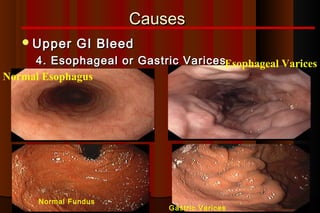
Causes
    Upper    GI Bleed
     4. Esophageal or Gastric VaricesEsophageal Varices
Normal Esophagus


      Normal Fundus
                             Gastric Varices
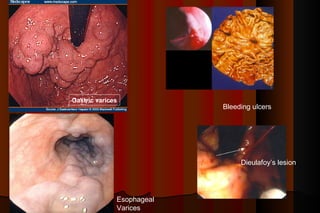
Gastric varices
                           Bleeding ulcers


                                Dieulafoy’s lesion


              Esophageal
              Varices
Causes of Upper GI Bleed
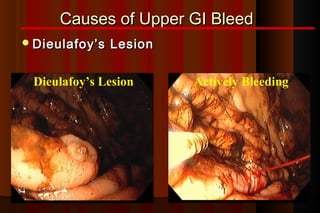
 Dieulafoy’s   Lesion

 Dieulafoy’s Lesion      Actively Bleeding
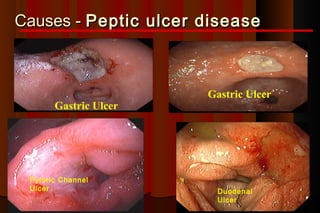
Causes - Peptic ulcer disease


                       Gastric Ulcer
       Gastric Ulcer


 Pyloric Channel
 Ulcer                  Duodenal
                        Ulcer
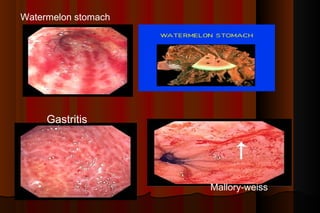
Watermelon stomach


     Gastritis


                     Mallory-weiss
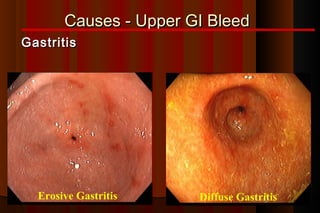
Causes - Upper GI Bleed
Gastritis


  Erosive Gastritis    Diffuse Gastritis
Causes of Upper GI Bleed
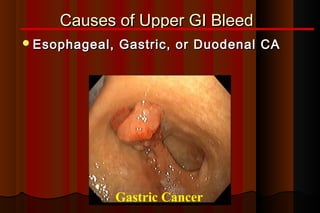
 Esophageal,   Gastric, or Duodenal CA


                Gastric Cancer
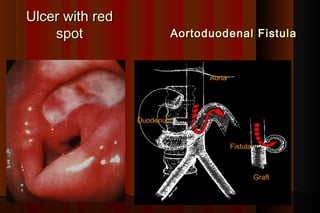
Ulcer with red
    spot                Aortoduodenal Fistula


                              Aorta


                 Duodenum


                                      Fistula


                                                Graft
Gastrointestinal Bleeding
 Prognostic factors in UGI bleeding:
     Severity of initial bleed.
     SHock/hemodynamic instability

     Age of patient   < 65
     Comorbid disease
     Anticoagulants/ coagulopathy
     Hb < 8g/dl
     APACHE II   < 11
     Presence of high-risk lesion, as varices/giant ulcer
     Endoscopic stigmata of significant hemorrhage (SSH)
     Need for emergency surgery
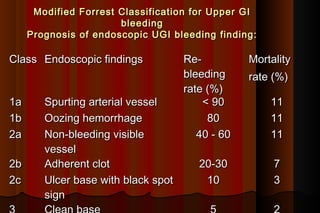
Modified Forrest Classification for Upper GI
                       bleeding
     Prognosis of endoscopic UGI bleeding finding:

Class Endoscopic findings            Re-          Mortality
                                     bleeding     rate (%)
                                     rate (%)
1a      Spurting arterial vessel         < 90         11
1b      Oozing hemorrhage                 80          11
2a      Non-bleeding visible            40 - 60       11
        vessel
2b      Adherent clot                   20-30          7
2c      Ulcer base with black spot       10            3
        sign
3       Clean base                        5            2
Gastrointestinal Bleeding
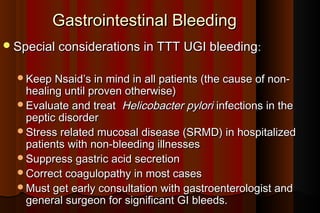
 Special considerations in TTT UGI bleeding :


  Keep Nsaid’s in mind in all patients (the cause of non-
   healing until proven otherwise)
  Evaluate and treat Helicobacter pylori infections in the
   peptic disorder
  Stress related mucosal disease (SRMD) in hospitalized
   patients with non-bleeding illnesses
  Suppress gastric acid secretion
  Correct coagulopathy in most cases
  Must get early consultation with gastroenterologist and
   general surgeon for significant GI bleeds.
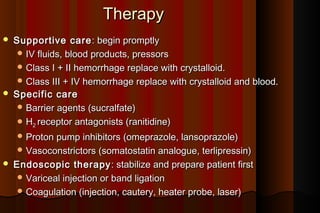
Therapy
   Supportive care : begin promptly
      IV fluids, blood products, pressors
      Class I + II hemorrhage replace with crystalloid.
      Class III + IV hemorrhage replace with crystalloid and blood.
   Specific care
      Barrier agents (sucralfate)
      H2 receptor antagonists (ranitidine)
     Proton pump inhibitors (omeprazole, lansoprazole)
     Vasoconstrictors (somatostatin analogue, terlipressin)
   Endoscopic therapy : stabilize and prepare patient first
      Variceal injection or band ligation
      Coagulation (injection, cautery, heater probe, laser)
Gastrointestinal Bleeding
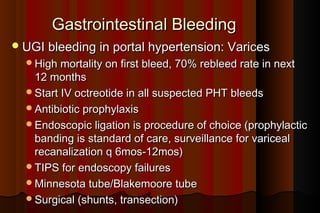
 UGI bleeding in portal hypertension: Varices
  High mortality on first bleed, 70% rebleed rate in next
   12 months
  Start IV octreotide in all suspected PHT bleeds
  Antibiotic prophylaxis
  Endoscopic ligation is procedure of choice (prophylactic
   banding is standard of care, surveillance for variceal
   recanalization q 6mos-12mos)
  TIPS for endoscopy failures
  Minnesota tube/Blakemoore tube
  Surgical (shunts, transection)
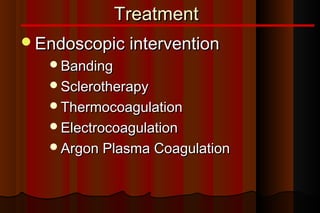
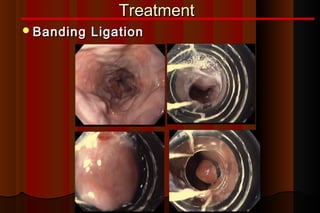
Treatment
Endoscopic intervention
   Banding
   Sclerotherapy
   Thermocoagulation
   Electrocoagulation
   Argon Plasma Coagulation
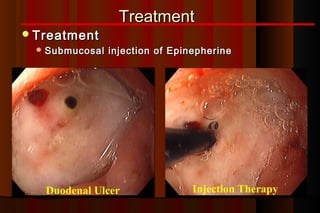
Treatment
 Treatment
   Submucosal   injection of Epinepherine


   Duodenal Ulcer                 Injection Therapy
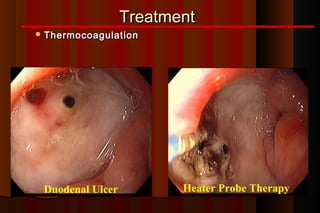
Treatment
 Thermocoagulation


 Duodenal Ulcer          Heater Probe Therapy
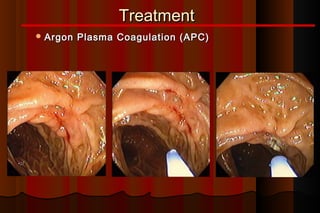
Treatment
 Argon   Plasma Coagulation (APC)
Treatment
 Banding   Ligation
Further treatment


 ICU care
 Treatment of complications

    - sepsis
    - DIC
    - MODS
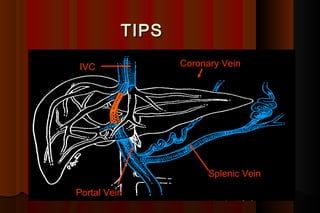
TIPS

IVC              Coronary Vein


                       Splenic Vein

Portal Vein
General Approach to GI
         Bleeding

Stablize

Locate

Treat
Acute gi b leed (revised) (p)   copy

Acute gi b leed (revised) (p) copy

  • 2.
    Acute Upper Gastrointestinal Bleeding Entesar El Sharqawy MD Hepatology, Gastroenterology and Infectious Diseases. Benha University 26/09/12
  • 3.
    Objectives  Discuss and provide background information of upper GIT bleeding.  Identify goals of history, physical finding and care in UGIB.  Discuss utility of NGT in the evaluation of UGIB.  Identify key points to resussitation and work up of UGIB.  Discuss therapy of upper GIB.  Outline key informations to have when calling GI consultants.
  • 4.
    Gastrointestinal Bleeding  Introduction: GI bleeding is a common disorder that troubles all medical/surgical specialties UGI bleeding>LGI bleeding Prevalence: 170 cases/100.000 adults/yr Cost estimate: $2.5B/yr (USA) Mortality 5-12% 40% for recurrent bleeders Severity: acute/chronic/intermittent/occult
  • 5.
    Epidemiology:  Upper: LowerGI bleeding = 5:1  30% pts are older than 65 years.  Incidence: 1-2% of all hospital admissions Most common diagnosis of new ICU admits  85% stop sponateously Those with massive bleeding need urgent intervention Only 5-10% need operative intervention after endoscopic interventions Early therapeutic maneuvers decrease mortality rates
  • 6.
    Gastrointestinal Bleeding Presentation ofbleeding: Hematemesis-UGI source Melena-UGI source usually but 5% can be from LGI source Hematochezia (BRBPR)-LGI source usually but 15% from UGI source Occult-UGIB
  • 7.
    Chain of events 1. Recognize severity 2. Establish access for resusitation 3. Resusitate 4. Identify source 5. Intervention
  • 8.
    Gastrointestinal Bleeding  UGIvs LGI location determined by the Ligament of Treitz: UGI – proximal to LT *Esophagus, *stomach, *duodenal bulb, 2nd/3rd portion of duodenum, Hepatic and Pancreatic LGI – distal to LT Small bowel, *colon
  • 10.
    Etiology of SignificantUGI Bleeding in Adults Varices   Peptic ulcer disease    Gastric erosions    Mallory-Weiss tear    Esophagitis   Duodenitis
  • 11.
    Etiology of SignificantUGI Bleeding in Children Esophagitis    Gastritis    Ulcer    Esophageal Vs  Mallory-Weiss
  • 12.
    Initial Assessment  History and PE  Vitals, ABC’s, and IVFs  HR, BP, Orthostatics  Signs of gross blood loss?  Hematemesis, melena, hematochezia  NG Tube  Labs  CBC, Kidney Profile, LFT, Electrolytes, Coags, Acid-Base balance, type and cross  Hct unreliable  ECG  Imaging: chest & abd. radiography, US, CT
  • 13.
    Gastrointestinal Bleeding  Determinethe urgency of the clinical situation: Is the patient in shock? 40% loss of circulating blood volume Agitation, pallor, tachycardia, hypotension Is the patient orthostatic? 20% loss of circulating blood volume Postural hypotension Never rely on initial H/H values to asses amount of blood loss (hemoconcentration)
  • 14.
    ATLS Classification ofShock Assess Blood Loss Category % loss HR BP Pulse Cap refill Neuro Pressure Stage 1 <15 % < 100 Normal Normal WNL WNL Stage 2 15-30% > 100 Normal Decreased > 3 sec Alert Stage 3 30-40% > 120 Decreased Decreased > 3 sec Lethargic Stage 4 > 40% > 140 Decreased Decreased > 3 sec Obtunded HR not useful if Tachycardic means If they are patients are on they have lost about hypotensive, you AV node blockers 1 liter of blood! are in trouble! From Advanced Trauma Life Support Guidelines
  • 15.
    General Approach Upper GIBleed vs Lower GI Bleed
  • 16.
    Upper GI hemorrhage How do you know its upper? 85% of all GI hemorrhage is upper Hematemesis diagnostic Don’t forget about nasal bleeding as possible source Melena Degradation of hemoglobin to hematin by acid Bowel bacteria and digestive enzymes also contribute Hematochezia 10-15% of patients with very rapid UGI source
  • 17.
    Gastrointestinal Bleeding Nasogastric aspirate: Determines the status of UGI bleeding and gives indirect information in LGI bleeding Bright red/clots – active UGI bleed Coffee-grounds – slow bleeding, oozing, stopped Clear – indeterminate (16% still bleeding) Bilious – UGI bleeding has stopped
  • 18.
    Diagnosis  Questions to ask in history  Any hematemesis, coffee-ground emesis, melena, or hematochezia.  Any vomiting and retching.  Any history of viral infection.  Any history of ASA, NSAID’s, steroids.  Any ETOH abuse.  Any history of iron or bismuth which can simulate melena and beets which can simulate hematochezia.  Any weight loss or changes in bowel habits.  Any history aortic graft.
  • 19.
    Diagnosis Physical exam  Vital signs may show hypotension and tachycardia.  Cool, clammy skin then in shock.  Spider angiomata, palmer erythema, jaundice, and gynecomastia seen in liver disease.  Petechiae and purpura seen in coagulopathy.  Careful ENT exam to rule out causes that can mimic upper GI bleeds.  Proper abdominal exam and rectal exam.
  • 20.
    Upper GI hemorrhage Upperendoscopy indications Hematemesis Melena or hematochezia with hypotension NGT with guiac positive fluid Should be completed in 24hrs for stable patients
  • 21.
    Gastrointestinal Bleeding  Roleof endoscopy in triage of UGI bleeders: Accurate identification of the urgency of the clinical situation: hemodynamic compromise/signs of on- going bleeding/coagulopathy. Who should be hospitalized? Where to admit? Diagnosing the cause Risk stratification
  • 22.
    Gastrointestinal Bleeding  Riskstratification in UGI bleeding: Very low risk endoscopic findings: Clean-bsed ulcer Clean based Mallory-Weiss tear Gastritis/duodenitis/esophagitis Portal hypertensive gastropathy Disposition: Discharge if stable
  • 23.
    Gastrointestinal Bleeding  Riskstratification in UGI bleeding Medium risk endoscopic findings: AVM’s Ulcer with stigmata of recent hemorrhage Mallory-Weiss with stigmata of recent hemorrhage Varices with recent bleeding Cancer Hemostasis and medical ward/intermediate care unit
  • 24.
    Gastrointestinal Bleeding  Riskstratification in UGI bleeding: High risk endoscopic findings: Active variceal bleeding Active ulcer bleeding Active bleeding Dieulafoy’s lesion Hemostasis and ICU admission
  • 25.
    Resuscitation Place in ICUand Surgery consultation Airway protection Maintain intravascular volume, O2 Give NS until PRBC and FFP available Follow vitals, orthostatics, and urine output
  • 26.
    Acute U.G.I. Bleeding )  **Shock management: (  ABC • Airway: endotracheal tube, oropharyngeal airway. *Give oxygen • Breathing: support respiratory function * Monitor: resp. rate, bld gases, chest radiograph  Circulation: expand circulating volume: blood, colloids, crystalloids support CVS function: 1- 1 unit PRBC increases Hgb by 1 gm/dl and increase Hct by 3% 2- FFP for INR greater than 1.5 3-Platelets for platelet count less than 50.000 * Monitor: skin color, peripheral temp., urine flow, BP, ECG
  • 27.
    Rockall risk stratificationscore Variable 0 1 2 Age (yrs) < 60 60-80 >80 Shock SBP>100mmHg SPB>100mmHg SPB<100mmHg HR<100 bpm HR>100bpm Co-morbidity No major co- Heart failure, IHD. morbidity Renal Failure. Liver disease. Disseminated malignancy. Any co-morbidity Endoscopic Mallory-Weiss tear. Peptic ulcer Malignancy of upper Diagnosis No lesion identified. Erosive disease GIT No SSH Esophagitis Major SSH None/Clean base. Adherent clot. Visible Dark spot sign on vessel (non ulcer base bleeding). Oozing bleeding, spurting arterial vessel
  • 28.
    Blatchford risk stratificationscore (23) Variable 1 2 3 4 6 SBP (mmHg) 100-109 90-99 > 90 Blood urea 18-22 22-28 28-69 < 70 (mg / dl) Hamoglobin (M) 12-12.9 10- > 10 (g / dl) 11.9 Hamoglobin (F) 10-11.9 > 10 (g / dl) Other variables HR>100bpm Syncope Melena Heart failure Hepatic Disease
  • 30.
    INDICATIONS FOR ADMISSION & REFERRAL Admit pts with h/o recent brisk bleeding & orthostatic changes Admit pts with less severe blood loss who have comorbid conditions aggravated by anemia Profound anemia with no evidence of blood loss Refer pts who are candidate for endoscopy when source of bleeding is elusive
  • 31.
    Causes of UpperGI Bleed  Erosive Esophagitis Normal GEJ Grade 1 EE Grade 2 EE Grade 3 EE Grade 4 EE
  • 32.
    Causes  Upper GI Bleed 4. Esophageal or Gastric VaricesEsophageal Varices Normal Esophagus Normal Fundus Gastric Varices
  • 33.
    Gastric varices Bleeding ulcers Dieulafoy’s lesion Esophageal Varices
  • 34.
    Causes of UpperGI Bleed  Dieulafoy’s Lesion Dieulafoy’s Lesion Actively Bleeding
  • 35.
    Causes - Pepticulcer disease Gastric Ulcer Gastric Ulcer Pyloric Channel Ulcer Duodenal Ulcer
  • 36.
    Watermelon stomach Gastritis Mallory-weiss
  • 37.
    Causes - UpperGI Bleed Gastritis Erosive Gastritis Diffuse Gastritis
  • 38.
    Causes of UpperGI Bleed  Esophageal, Gastric, or Duodenal CA Gastric Cancer
  • 39.
    Ulcer with red spot Aortoduodenal Fistula Aorta Duodenum Fistula Graft
  • 40.
    Gastrointestinal Bleeding  Prognosticfactors in UGI bleeding: Severity of initial bleed. SHock/hemodynamic instability Age of patient < 65 Comorbid disease Anticoagulants/ coagulopathy Hb < 8g/dl APACHE II < 11 Presence of high-risk lesion, as varices/giant ulcer Endoscopic stigmata of significant hemorrhage (SSH) Need for emergency surgery
  • 41.
    Modified Forrest Classificationfor Upper GI bleeding Prognosis of endoscopic UGI bleeding finding: Class Endoscopic findings Re- Mortality bleeding rate (%) rate (%) 1a Spurting arterial vessel < 90 11 1b Oozing hemorrhage 80 11 2a Non-bleeding visible 40 - 60 11 vessel 2b Adherent clot 20-30 7 2c Ulcer base with black spot 10 3 sign 3 Clean base 5 2
  • 42.
    Gastrointestinal Bleeding  Specialconsiderations in TTT UGI bleeding : Keep Nsaid’s in mind in all patients (the cause of non- healing until proven otherwise) Evaluate and treat Helicobacter pylori infections in the peptic disorder Stress related mucosal disease (SRMD) in hospitalized patients with non-bleeding illnesses Suppress gastric acid secretion Correct coagulopathy in most cases Must get early consultation with gastroenterologist and general surgeon for significant GI bleeds.
  • 43.
    Therapy  Supportive care : begin promptly  IV fluids, blood products, pressors  Class I + II hemorrhage replace with crystalloid.  Class III + IV hemorrhage replace with crystalloid and blood.  Specific care  Barrier agents (sucralfate)  H2 receptor antagonists (ranitidine)  Proton pump inhibitors (omeprazole, lansoprazole)  Vasoconstrictors (somatostatin analogue, terlipressin)  Endoscopic therapy : stabilize and prepare patient first  Variceal injection or band ligation  Coagulation (injection, cautery, heater probe, laser)
  • 44.
    Gastrointestinal Bleeding  UGIbleeding in portal hypertension: Varices High mortality on first bleed, 70% rebleed rate in next 12 months Start IV octreotide in all suspected PHT bleeds Antibiotic prophylaxis Endoscopic ligation is procedure of choice (prophylactic banding is standard of care, surveillance for variceal recanalization q 6mos-12mos) TIPS for endoscopy failures Minnesota tube/Blakemoore tube Surgical (shunts, transection)
  • 45.
    Treatment Endoscopic intervention Banding Sclerotherapy Thermocoagulation Electrocoagulation Argon Plasma Coagulation
  • 46.
    Treatment  Treatment  Submucosal injection of Epinepherine Duodenal Ulcer Injection Therapy
  • 47.
    Treatment  Thermocoagulation DuodenalUlcer Heater Probe Therapy
  • 48.
    Treatment  Argon Plasma Coagulation (APC)
  • 49.
  • 50.
    Further treatment  ICUcare  Treatment of complications - sepsis - DIC - MODS
  • 53.
    TIPS IVC Coronary Vein Splenic Vein Portal Vein
  • 54.
    General Approach toGI Bleeding Stablize Locate Treat