Acute Gastrointestinal Bleeding
Upper GI tract
Dr. Niladri Banerjee
MBBS, MS, MRCS Ed
MCh (Trauma Surgery & Critical Care)
Assistant Professor, Surgery
AIIMS, Jodhpur
Content
• Introduction
• Causes of UGI bleed
• Presentation, diagnosis & principles of
management
• Specific Management
INTRODUCTION
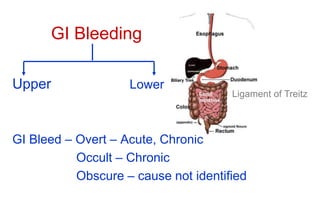
GI Bleeding
Upper Lower
GI Bleed – Overt – Acute, Chronic
Occult – Chronic
Obscure – cause not identified
Ligament of Treitz
Upper GI Bleeding
• Upper GI Bleed – Hematemesis, Melena
• Hematemesis- Coffee ground vomitus
• Melena - Black tarry stool, a foul odour
Colour and smell - Acid Hematin
• 60 ml of blood loss - melena
• Melena may persist for 3 days
AIIMS Delhi Data: 5 years
• Total admission - 5174
• GI Bleed - 1460
(28%)
• Mortality - 13%
CAUSES OF UGI BLEED
Major Causes of UGI Bleed
Ulcer
EMD(erosive mucosal
disease
Varices
s
Uncommon causes
Ca.
stomach Hemobilia
AV malformation
Causes of UGIB
Non-variceal bleeding
• Gastric and duodenal ulcers (30%-40%)
• Gastritis and duodenitis (20%)
• Esophagitis (5%-10%)
• Mallory-Weiss tears (5%-10%)
• Arteriovenous malformations (2%)
• Tumors (5%)
• Other causes (Dielafoy lesions,GAVE,
Aortoenteric fistula, Hemobilia,
Hemosuccus pancreaticus)
Portal hypertensive bleeding
• Gastroesophageal varices (>90%)
• Hypertensive portal gastropathy
(<5%)
• Isolated gastric varices (rare)
EMD
7%
Peptic
ulcer
60%
Variceal
25%
Others
8%
West
Peptic
ulcer
24%
Variceal
55%
EMD
18%
Others
3%
India
Etiology of UGI Bleed: West vs India
Prevalence of variceal bleeding in UGI bleeding- In
Indian scenario
Prevalence of variceal bleeding in UGI bleeding- In
Indian scenario
PRESENTATION, DIAGNOSIS &
PRINCIPLES OF MANAGEMENT
Presentation
• May present in subtle way (unexplained
microcytic anemia, positive occult blood in
stool) in the OPD
• Or may present as massive GI hemorrhage in
the emergency
Obscure bleeding (OPD)
• Clinical recognition:
– History of dyspepsia
– NSAIDs intake
– History of jaundice
– Splenomegaly
– Ascites
– Collaterals
Peptic ulcer
Variceal bleed
Acute exsanguinating bleed
• Patient in shock
• Severe bouts of hematemesis and melena
• Ryle’s tube shows bright red blood/coffee
ground
Principles of management
Initial assessment and resuscitation
History and examination
Localise bleeding
Initiate therapy
Initial Assessment
• ABC assessment
• To assess magnitude of bleeding
– Degree of shock
– Haematocrit
– Elderly vs young
• Lab evaluation (ABG, Base deficit, lactate)
• Resuscitation
– Ringer’s Lactate, Massive transfusion protocol
Resuscitation
• Initial 1-2 litres of crystalloids (RL)
• Early administration of blood
• Massive transfusion protocol (1:1:1 ratio of pRBC,
FFP and platelets)
• Restrictive target Hb strategy (Target around
7gm/dL) *
* Villanueva et al N Engl J Med. 2013
History and Physical Exam
• Symptoms assessment
• Medications
• Previous Surgery
• Head to toe examination
Risk stratification
It includes
– BUN
– Hb
– SBP
– Pulse
– Presence of melena, syncope, hepatic or cardiac dysfunction
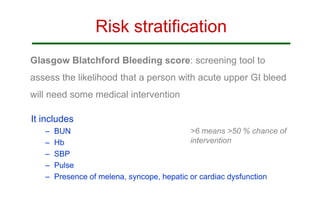
Glasgow Blatchford Bleeding score: screening tool to
assess the likelihood that a person with acute upper GI bleed
will need some medical intervention
>6 means >50 % chance of
intervention
Sabiston textbook of surgery 21st ed
Initiation of therapy
• Obtain immediate consultation with gastroenterologist,
surgery and interventional radiology
• Pharmacotherapy (Ulcer)
– Pantoprazole/Esomeprazole 80 mg iv stat and start infusion at 8
mg/hour
• Pharmacotherapy (Variceal bleed)
– somatostatin or an analogue (eg, octreotide 50 mcg IV bolus followed
by 50 mcg/hour continuous IV infusion)
– IV antibiotic (eg, ceftriaxone or fluoroquinolone)
SPECIFIC MANAGEMENT
Peptic Ulcer Bleeding
• Peptic Ulcer: DU, GU, Stomal ulcer
• 15-20% of all ulcer bleed
• 50% of bleeds associated with NSAID use
• Presentation – Hematemesis + melena
- Melena alone
Peptic ulcer bleeding: Natural History
• 70% - bleeding stops spontaneously
• Rebleeding - 25%
• Mortality - 10%
- unchanged over the years
• Prognostic factors
- age >60 years
- co-morbid illness
- shock at presentation
- Hematemesis/red blood in NG lavage
- Endoscopy - active bleed, visible vessel
• High risk vs. low risk
Peptic ulcer bleeding: Prognostication
Age
<60 yr
60–79 yr
>80 yr
Shock
Heart rate >100 beats/min
Systolic blood pressure <100
Coexisting illness
CAD, CHF
Renal or Liver failure, Cancer
Endoscopic diagnosis
No lesion observed, M-W tear
Any other diagnosis
Cancer of upper GI tract
Endoscopic stigmata of recent hemorrhage
2C, 3
1, 2A, 2B
0
1
2
1
2
2
3
0
1
2
0
2
Score <2 low risk
Rockall Score for Prognosis
Management: Fundamental principles
• Determine the source of bleeding
• Stop active bleeding
• Treat the underlying abnormality
• Prevent recurrent bleeding
• Most important: Immediate assessment and
stabilization of the hemodynamic status
Peptic ulcer bleeding: Management
• Resuscitation: 2 lines, iv fluids
• BT if HB <8 gm/dl
• Pharmacotherapy
• Endoscopic Rx
• Surgery
• Prevention of long term re-bleeding
Blood transfusion: Target
• In elderly - 10 gm/dl
• In younger, healthy patients – 8 gm/dl
• In Portal hypertension : 7-8 gm/dl
• Hematocrit better guide after volume resuscitation
• Packed red blood cells are preferred
• FFP should be given if blood requirement more
than 10 units or if coagulopathy
Ulcer Bleeding: Pharmacotherapy
• Acid Suppression: clot stabilization
- H2 blockers no benefit
- Proton pump inhibitors useful
• Tranexamic acid: ? Benefit
• Anti H. pylori treatment
Ulcer Bleeding: Role of PPIs
• Omeprazole alone, No endoscopic Rx
- reduce re-bleeding, need for surgery
(Khuroo et al, 1997)
• Omeprazole + endoscopic Rx
Re-bleed day 3 - 0 vs 8%
day 14 - 2 vs 12%
• Pantoprazole – IV infusion similar efficacy
(Lin et al,1999)
Ulcer Bleeding: Anti-H. pylori Rx
Anti-HP Omeprazole
(n=29) (n=22)
Ulcer recurrence 3/29 9/22
Re-bleeding 0/29 6/22
(Jaspersen et al, 1995)
Re-bleeding 0/16* 5/15*
(Rokkas et al,1995)
Ulcer Bleeding : Endoscopic Therapy
Timing of endoscopy
• Emergency diagnostic endoscopy – no role
• Endoscopy in emergency - if therapeutic intent
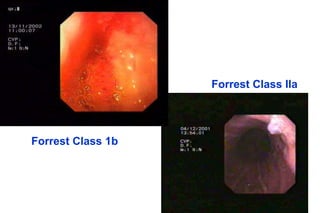
• Endoscopic signs - Stigmata of Recent
Hemorrhage (SRH)
Forrest Class 1b
Forrest Class IIa
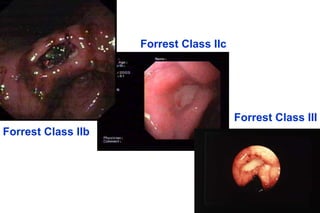
Forrest Class IIb
Forrest Class IIc
Forrest Class III
Ulcer Bleeding : Endoscopic Therapy
• Who requires EndoRx ?
Forrest class Re-bleeding EndoRx
Ia spurting bleeding 50-65% 
Ib active ooze 30-40% 
IIa visible vessel (NBVV) 40-50% 
IIb adherent clot 20% ?
IIc ulcer with hematin spot 10% x
III clean base ulcer 5% x
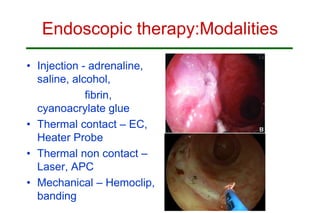
Endoscopic therapy:Modalities
• Injection - adrenaline,
saline, alcohol,
fibrin,
cyanoacrylate glue
• Thermal contact – EC,
Heater Probe
• Thermal non contact –
Laser, APC
• Mechanical – Hemoclip,
banding
Ulcer Bleeding : Endoscopic Therapy
• Injection:
– ? Tamponade, vasoconstriction
– 1:10,000 adrenaline around the ulcer
• Thermal:
– Heater probe, Electrocoagulation
– Principle – coaptive coagulation
– Seal the vessel up to 2 mm by pressure and heat
• Mechanical – clip the vessel
EndoRx: Meta-analysis
Further bleed Surgery Mortality
• Thermal 0.3 0.3 0.6
• Laser 0.5 0.6 0.5
• Injection 0.2 0.2 0.5
• All Rx 0.4 0.3 0.5
(0.4-0.7)
(Cook et al, 1992, Gastro, 30 trials, 2136 patients)
Ulcer Bleeding : Surgery
• Indications
- Continued Bleeding,
- Failure of Endo. Rx
- Re-bleeding in the hospital
- Blood Transfusion > 4 units
Re-bleeding: Long Term Prevention
• Anti H. pylori Rx
• Long term H2 blockers
• No/safer NSAIDs,
• Long term NSAID user: PPIs
Erosive Mucosal Disease
• Risk Factors - Acute stress, NSAIDs
• Bleeding usually mild, may be massive
• Re-bleeding uncommon
• Prevention:
-Acute stress - Ranitidine vs Sucralfate
• Treatment - supportive,
- pantoprazole/ ranitidine infusion
Portal Hypertension & UGI Bleeding
• 30-60% of cirrhotics have
varices
• One third of varices bleed
• High Mortality – 30% die
• 70% rebleed within next 6
weeks
• Important factors : Child Pugh
score and variceal grade
Variceal Bleeding: Aims of treatment
• Prevent First Bleeding
• Control Acute Bleeding
• Prevent Re-bleeding
Varices: Prevent First Bleeding
• Primary Prophylaxis –
- β-blockers – Propranolol, nadolol
clinical guide – heart rate <60/min.
Problems – contraindications to β-blockers
- 1/3rd patients do not respond
- Variceal Band ligation - promising
Varices: Control Acute Bleeding
• Pharmacotherapy –
– Somatostatin, Terlipressin, Octreotide
– Somatostatin
• 250 ugm stat, 250 ugm hourly infusion
• Duration 3-5 days
• As sole therapy - 80-85% efficacy
• Adjunct to Endo. Rx – early re-bleeding
• Cost is high
Varices: Control Acute Bleeding
• Mechanical :
– Balloon tamponade (SB tube), 80% effective
– Use if no Endoscopy available or fails
Varices: Control Acute Bleeding
• Endoscopic Rx - Variceal Sclerotherapy,
- Variceal Band ligation
- Efficacy – 90%, best modality
- Problems – early re-bleed, complications
• Fundal varices – glue injection
Endo clipping
Band ligation
Sclerotherapy
Varices: Prevent Re-bleeding
• Endoscopic therapy :
- Sclerotherapy, EVL – for variceal eradication
- EVL – faster variceal eradication, less
complications, but early recurrence
- Surveillance endoscopy after eradication
• Pharmacotherapy – may be useful
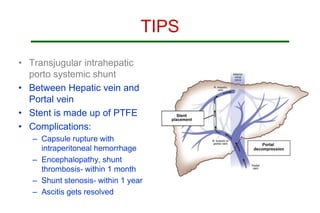
TIPS
• Transjugular intrahepatic
porto systemic shunt
• Between Hepatic vein and
Portal vein
• Stent is made up of PTFE
• Complications:
– Capsule rupture with
intraperitoneal hemorrhage
– Encephalopathy, shunt
thrombosis- within 1 month
– Shunt stenosis- within 1 year
– Ascitis gets resolved
Non-selective shunts
• End to side poto caval
• Side to side porto caval
• Interposition graft
• TIPS
• Linton shunt
Selective shunts
• Warrens shunt
• Inokuchi shunt
Surgical shunts
Variceal Bleeding : Surgery
Devascularisation operations
Variceal Bleeding : Surgery
Sugiura operation
• Ligation of veins near
esophagus
• Vagotomy
• Pyloroplasty
• Esophageal transection
and anastomosis
• Splenectomy
Last resort: Liver Transplantation
Variceal Bleeding : Surgery
Upper GI Bleeding: uncommon causes
• Vascular Lesions
– Dieulafoy’s lesion (ectatic abnormal vessel)
– A-V malformation
– GAVE (Watermelon stomach)
• Uncommon, bleeding usually massive
• Treatment: - Endoscopic
- Surgery
Dieulafoy lesion
• Vascular malformation within
6 cm of GEJ
• 1-3 mm vessels- at sub-
mucosa
• T/t: endoscopic t/t if fails
angiographic coil
embolisation
• Last resort: partial
gastrectomy
GAVE
• Watermelon stomach d/t
multiple dilated venules
• Antrum
• Continued occult bleed
• TOC: APC
• Last resort: antrectomy
Mallory-Weiss tears
• Binge drinking
• Mucosal and sub-mucosal
tears
• UGIE
• Most: self limiting within 72
hours
• Local endoscopic t/t,
angiographic embolisation,
gelatin sponge
Esophagitis
• GERD
• Usually superficial
mucosal ulceration
• Occult bleeding
• R/o medications, radiation,
Crohn’s
• T/t: acid suppressive
therapy
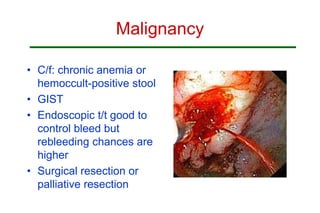
Malignancy
• C/f: chronic anemia or
hemoccult-positive stool
• GIST
• Endoscopic t/t good to
control bleed but
rebleeding chances are
higher
• Surgical resection or
palliative resection
Aortoenteric fistula
• Post graft-enteric erosion: 1% of aortic graft
• Median interval is 3 years
• Pseudoaneurysm with fistulisation
• Sentinel bleed massive and fatal
bleed
• D3 or D4
• Therapy: ligation of graft proximal to the
graft, removal of infected prosthesis, and
extra-anatomic bypass
• Duodenum-primarily repaired
Hemobilia
• Post trauma, iatrogenic, hepatic neoplasm
• Triad: hemorrhage, right upper quadrant pain
and jaundice
• UGIE: blood at the ampulla
• CT angio and embolization
Hemosuccus pancreaticus
• Bleeding from the pancreatic duct
• Splenic artery erosion: pancreatic pseudocyst
• Abdominal pain, hematochezia
• Treatment of choice: Distal pancreatectomy
Iatrogenic bleeding
• Endoscopic sphincterotomy
• Percutaneous trans-hepatic procedures
• Percutaneous endoscopic gastrostomy
UGI Bleeding: Summary
Upper GI Bleeding
Resuscitation
Clinical evaluation
Endoscopy – Emergency – if therapeutic
Otherwise Elective
Pharmacotherapy Endo. Rx Surgery
Prevent Re-bleeding
UGI Bleed: Summary
• UGI bleed: major cause of morbidity & mortality
• Varices and ulcers common causes
• Resuscitation, do not over transfuse
• UGI Bleed: Pharmacotherapy effective
– Ulcer bleed: intravenous PPI infusion
– Variceal bleed: somatostatin infusion
• Ulcer and variceal bleed: Endotherapy
• Surgery: minority of patients
Thank You

Acute Upper GI bleed.pptx

  • 1.
    Acute Gastrointestinal Bleeding UpperGI tract Dr. Niladri Banerjee MBBS, MS, MRCS Ed MCh (Trauma Surgery & Critical Care) Assistant Professor, Surgery AIIMS, Jodhpur
  • 2.
    Content • Introduction • Causesof UGI bleed • Presentation, diagnosis & principles of management • Specific Management
  • 3.
  • 4.
    GI Bleeding Upper Lower GIBleed – Overt – Acute, Chronic Occult – Chronic Obscure – cause not identified Ligament of Treitz
  • 5.
    Upper GI Bleeding •Upper GI Bleed – Hematemesis, Melena • Hematemesis- Coffee ground vomitus • Melena - Black tarry stool, a foul odour Colour and smell - Acid Hematin • 60 ml of blood loss - melena • Melena may persist for 3 days
  • 6.
    AIIMS Delhi Data:5 years • Total admission - 5174 • GI Bleed - 1460 (28%) • Mortality - 13%
  • 7.
  • 8.
    Major Causes ofUGI Bleed Ulcer EMD(erosive mucosal disease Varices s
  • 9.
  • 10.
    Causes of UGIB Non-varicealbleeding • Gastric and duodenal ulcers (30%-40%) • Gastritis and duodenitis (20%) • Esophagitis (5%-10%) • Mallory-Weiss tears (5%-10%) • Arteriovenous malformations (2%) • Tumors (5%) • Other causes (Dielafoy lesions,GAVE, Aortoenteric fistula, Hemobilia, Hemosuccus pancreaticus) Portal hypertensive bleeding • Gastroesophageal varices (>90%) • Hypertensive portal gastropathy (<5%) • Isolated gastric varices (rare)
  • 11.
  • 12.
    Prevalence of varicealbleeding in UGI bleeding- In Indian scenario
  • 13.
    Prevalence of varicealbleeding in UGI bleeding- In Indian scenario
  • 14.
  • 15.
    Presentation • May presentin subtle way (unexplained microcytic anemia, positive occult blood in stool) in the OPD • Or may present as massive GI hemorrhage in the emergency
  • 16.
    Obscure bleeding (OPD) •Clinical recognition: – History of dyspepsia – NSAIDs intake – History of jaundice – Splenomegaly – Ascites – Collaterals Peptic ulcer Variceal bleed
  • 17.
    Acute exsanguinating bleed •Patient in shock • Severe bouts of hematemesis and melena • Ryle’s tube shows bright red blood/coffee ground
  • 18.
    Principles of management Initialassessment and resuscitation History and examination Localise bleeding Initiate therapy
  • 19.
    Initial Assessment • ABCassessment • To assess magnitude of bleeding – Degree of shock – Haematocrit – Elderly vs young • Lab evaluation (ABG, Base deficit, lactate) • Resuscitation – Ringer’s Lactate, Massive transfusion protocol
  • 20.
    Resuscitation • Initial 1-2litres of crystalloids (RL) • Early administration of blood • Massive transfusion protocol (1:1:1 ratio of pRBC, FFP and platelets) • Restrictive target Hb strategy (Target around 7gm/dL) * * Villanueva et al N Engl J Med. 2013
  • 21.
    History and PhysicalExam • Symptoms assessment • Medications • Previous Surgery • Head to toe examination
  • 22.
    Risk stratification It includes –BUN – Hb – SBP – Pulse – Presence of melena, syncope, hepatic or cardiac dysfunction Glasgow Blatchford Bleeding score: screening tool to assess the likelihood that a person with acute upper GI bleed will need some medical intervention >6 means >50 % chance of intervention
  • 23.
    Sabiston textbook ofsurgery 21st ed
  • 24.
    Initiation of therapy •Obtain immediate consultation with gastroenterologist, surgery and interventional radiology • Pharmacotherapy (Ulcer) – Pantoprazole/Esomeprazole 80 mg iv stat and start infusion at 8 mg/hour • Pharmacotherapy (Variceal bleed) – somatostatin or an analogue (eg, octreotide 50 mcg IV bolus followed by 50 mcg/hour continuous IV infusion) – IV antibiotic (eg, ceftriaxone or fluoroquinolone)
  • 26.
  • 27.
    Peptic Ulcer Bleeding •Peptic Ulcer: DU, GU, Stomal ulcer • 15-20% of all ulcer bleed • 50% of bleeds associated with NSAID use • Presentation – Hematemesis + melena - Melena alone
  • 28.
    Peptic ulcer bleeding:Natural History • 70% - bleeding stops spontaneously • Rebleeding - 25% • Mortality - 10% - unchanged over the years
  • 29.
    • Prognostic factors -age >60 years - co-morbid illness - shock at presentation - Hematemesis/red blood in NG lavage - Endoscopy - active bleed, visible vessel • High risk vs. low risk Peptic ulcer bleeding: Prognostication
  • 30.
    Age <60 yr 60–79 yr >80yr Shock Heart rate >100 beats/min Systolic blood pressure <100 Coexisting illness CAD, CHF Renal or Liver failure, Cancer Endoscopic diagnosis No lesion observed, M-W tear Any other diagnosis Cancer of upper GI tract Endoscopic stigmata of recent hemorrhage 2C, 3 1, 2A, 2B 0 1 2 1 2 2 3 0 1 2 0 2 Score <2 low risk Rockall Score for Prognosis
  • 31.
    Management: Fundamental principles •Determine the source of bleeding • Stop active bleeding • Treat the underlying abnormality • Prevent recurrent bleeding • Most important: Immediate assessment and stabilization of the hemodynamic status
  • 32.
    Peptic ulcer bleeding:Management • Resuscitation: 2 lines, iv fluids • BT if HB <8 gm/dl • Pharmacotherapy • Endoscopic Rx • Surgery • Prevention of long term re-bleeding
  • 33.
    Blood transfusion: Target •In elderly - 10 gm/dl • In younger, healthy patients – 8 gm/dl • In Portal hypertension : 7-8 gm/dl • Hematocrit better guide after volume resuscitation • Packed red blood cells are preferred • FFP should be given if blood requirement more than 10 units or if coagulopathy
  • 34.
    Ulcer Bleeding: Pharmacotherapy •Acid Suppression: clot stabilization - H2 blockers no benefit - Proton pump inhibitors useful • Tranexamic acid: ? Benefit • Anti H. pylori treatment
  • 35.
    Ulcer Bleeding: Roleof PPIs • Omeprazole alone, No endoscopic Rx - reduce re-bleeding, need for surgery (Khuroo et al, 1997) • Omeprazole + endoscopic Rx Re-bleed day 3 - 0 vs 8% day 14 - 2 vs 12% • Pantoprazole – IV infusion similar efficacy (Lin et al,1999)
  • 36.
    Ulcer Bleeding: Anti-H.pylori Rx Anti-HP Omeprazole (n=29) (n=22) Ulcer recurrence 3/29 9/22 Re-bleeding 0/29 6/22 (Jaspersen et al, 1995) Re-bleeding 0/16* 5/15* (Rokkas et al,1995)
  • 37.
    Ulcer Bleeding :Endoscopic Therapy Timing of endoscopy • Emergency diagnostic endoscopy – no role • Endoscopy in emergency - if therapeutic intent • Endoscopic signs - Stigmata of Recent Hemorrhage (SRH)
  • 38.
  • 39.
    Forrest Class IIb ForrestClass IIc Forrest Class III
  • 40.
    Ulcer Bleeding :Endoscopic Therapy • Who requires EndoRx ? Forrest class Re-bleeding EndoRx Ia spurting bleeding 50-65%  Ib active ooze 30-40%  IIa visible vessel (NBVV) 40-50%  IIb adherent clot 20% ? IIc ulcer with hematin spot 10% x III clean base ulcer 5% x
  • 41.
    Endoscopic therapy:Modalities • Injection- adrenaline, saline, alcohol, fibrin, cyanoacrylate glue • Thermal contact – EC, Heater Probe • Thermal non contact – Laser, APC • Mechanical – Hemoclip, banding
  • 42.
    Ulcer Bleeding :Endoscopic Therapy • Injection: – ? Tamponade, vasoconstriction – 1:10,000 adrenaline around the ulcer • Thermal: – Heater probe, Electrocoagulation – Principle – coaptive coagulation – Seal the vessel up to 2 mm by pressure and heat • Mechanical – clip the vessel
  • 43.
    EndoRx: Meta-analysis Further bleedSurgery Mortality • Thermal 0.3 0.3 0.6 • Laser 0.5 0.6 0.5 • Injection 0.2 0.2 0.5 • All Rx 0.4 0.3 0.5 (0.4-0.7) (Cook et al, 1992, Gastro, 30 trials, 2136 patients)
  • 44.
    Ulcer Bleeding :Surgery • Indications - Continued Bleeding, - Failure of Endo. Rx - Re-bleeding in the hospital - Blood Transfusion > 4 units
  • 45.
    Re-bleeding: Long TermPrevention • Anti H. pylori Rx • Long term H2 blockers • No/safer NSAIDs, • Long term NSAID user: PPIs
  • 46.
    Erosive Mucosal Disease •Risk Factors - Acute stress, NSAIDs • Bleeding usually mild, may be massive • Re-bleeding uncommon • Prevention: -Acute stress - Ranitidine vs Sucralfate • Treatment - supportive, - pantoprazole/ ranitidine infusion
  • 47.
    Portal Hypertension &UGI Bleeding • 30-60% of cirrhotics have varices • One third of varices bleed • High Mortality – 30% die • 70% rebleed within next 6 weeks • Important factors : Child Pugh score and variceal grade
  • 48.
    Variceal Bleeding: Aimsof treatment • Prevent First Bleeding • Control Acute Bleeding • Prevent Re-bleeding
  • 49.
    Varices: Prevent FirstBleeding • Primary Prophylaxis – - β-blockers – Propranolol, nadolol clinical guide – heart rate <60/min. Problems – contraindications to β-blockers - 1/3rd patients do not respond - Variceal Band ligation - promising
  • 50.
    Varices: Control AcuteBleeding • Pharmacotherapy – – Somatostatin, Terlipressin, Octreotide – Somatostatin • 250 ugm stat, 250 ugm hourly infusion • Duration 3-5 days • As sole therapy - 80-85% efficacy • Adjunct to Endo. Rx – early re-bleeding • Cost is high
  • 51.
    Varices: Control AcuteBleeding • Mechanical : – Balloon tamponade (SB tube), 80% effective – Use if no Endoscopy available or fails
  • 52.
    Varices: Control AcuteBleeding • Endoscopic Rx - Variceal Sclerotherapy, - Variceal Band ligation - Efficacy – 90%, best modality - Problems – early re-bleed, complications • Fundal varices – glue injection
  • 53.
  • 54.
    Varices: Prevent Re-bleeding •Endoscopic therapy : - Sclerotherapy, EVL – for variceal eradication - EVL – faster variceal eradication, less complications, but early recurrence - Surveillance endoscopy after eradication • Pharmacotherapy – may be useful
  • 55.
    TIPS • Transjugular intrahepatic portosystemic shunt • Between Hepatic vein and Portal vein • Stent is made up of PTFE • Complications: – Capsule rupture with intraperitoneal hemorrhage – Encephalopathy, shunt thrombosis- within 1 month – Shunt stenosis- within 1 year – Ascitis gets resolved
  • 56.
    Non-selective shunts • Endto side poto caval • Side to side porto caval • Interposition graft • TIPS • Linton shunt Selective shunts • Warrens shunt • Inokuchi shunt Surgical shunts Variceal Bleeding : Surgery
  • 57.
    Devascularisation operations Variceal Bleeding: Surgery Sugiura operation • Ligation of veins near esophagus • Vagotomy • Pyloroplasty • Esophageal transection and anastomosis • Splenectomy
  • 58.
    Last resort: LiverTransplantation Variceal Bleeding : Surgery
  • 59.
    Upper GI Bleeding:uncommon causes • Vascular Lesions – Dieulafoy’s lesion (ectatic abnormal vessel) – A-V malformation – GAVE (Watermelon stomach) • Uncommon, bleeding usually massive • Treatment: - Endoscopic - Surgery
  • 60.
    Dieulafoy lesion • Vascularmalformation within 6 cm of GEJ • 1-3 mm vessels- at sub- mucosa • T/t: endoscopic t/t if fails angiographic coil embolisation • Last resort: partial gastrectomy
  • 61.
    GAVE • Watermelon stomachd/t multiple dilated venules • Antrum • Continued occult bleed • TOC: APC • Last resort: antrectomy
  • 62.
    Mallory-Weiss tears • Bingedrinking • Mucosal and sub-mucosal tears • UGIE • Most: self limiting within 72 hours • Local endoscopic t/t, angiographic embolisation, gelatin sponge
  • 63.
    Esophagitis • GERD • Usuallysuperficial mucosal ulceration • Occult bleeding • R/o medications, radiation, Crohn’s • T/t: acid suppressive therapy
  • 64.
    Malignancy • C/f: chronicanemia or hemoccult-positive stool • GIST • Endoscopic t/t good to control bleed but rebleeding chances are higher • Surgical resection or palliative resection
  • 65.
    Aortoenteric fistula • Postgraft-enteric erosion: 1% of aortic graft • Median interval is 3 years • Pseudoaneurysm with fistulisation • Sentinel bleed massive and fatal bleed • D3 or D4 • Therapy: ligation of graft proximal to the graft, removal of infected prosthesis, and extra-anatomic bypass • Duodenum-primarily repaired
  • 66.
    Hemobilia • Post trauma,iatrogenic, hepatic neoplasm • Triad: hemorrhage, right upper quadrant pain and jaundice • UGIE: blood at the ampulla • CT angio and embolization
  • 67.
    Hemosuccus pancreaticus • Bleedingfrom the pancreatic duct • Splenic artery erosion: pancreatic pseudocyst • Abdominal pain, hematochezia • Treatment of choice: Distal pancreatectomy
  • 68.
    Iatrogenic bleeding • Endoscopicsphincterotomy • Percutaneous trans-hepatic procedures • Percutaneous endoscopic gastrostomy
  • 69.
    UGI Bleeding: Summary UpperGI Bleeding Resuscitation Clinical evaluation Endoscopy – Emergency – if therapeutic Otherwise Elective Pharmacotherapy Endo. Rx Surgery Prevent Re-bleeding
  • 70.
    UGI Bleed: Summary •UGI bleed: major cause of morbidity & mortality • Varices and ulcers common causes • Resuscitation, do not over transfuse • UGI Bleed: Pharmacotherapy effective – Ulcer bleed: intravenous PPI infusion – Variceal bleed: somatostatin infusion • Ulcer and variceal bleed: Endotherapy • Surgery: minority of patients
  • 71.