TACHYCARDIA INDUCED
CARDIOMYOPATHY
Dr.Rohit Manoj Kumar
 Dilated cardiomyopathy (DCM): Characterized
by dilation and impaired contraction of one or
both ventricles
 DCM - caused by a variety of specific diseases
 ≥ 50% of patients with DCM:
- an etiologic basis will not be identified
- Idiopathic DCM
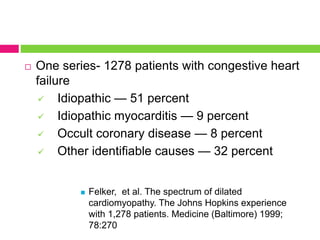
 One series- 1278 patients with congestive heart
failure
 Idiopathic — 51 percent
 Idiopathic myocarditis — 9 percent
 Occult coronary disease — 8 percent
 Other identifiable causes — 32 percent
 Felker, et al. The spectrum of dilated
cardiomyopathy. The Johns Hopkins experience
with 1,278 patients. Medicine (Baltimore) 1999;
78:270
Clinical presentation
 Most patients present between age : 20-60
years
- Can occur in children and elderly
 Symptoms of CHF
 Incidental detection of asymptomatic
cardiomegaly
 Symptoms related to coexisting arrhythmia,
conduction disturbance
 Thromboembolic complications
 Sudden death
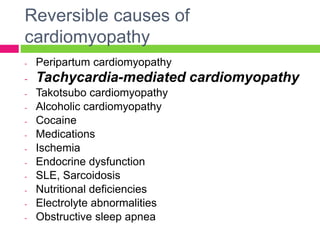
Reversible causes of
cardiomyopathy
- Peripartum cardiomyopathy
- Tachycardia-mediated cardiomyopathy
- Takotsubo cardiomyopathy
- Alcoholic cardiomyopathy
- Cocaine
- Medications
- Ischemia
- Endocrine dysfunction
- SLE, Sarcoidosis
- Nutritional deficiencies
- Electrolyte abnormalities
- Obstructive sleep apnea
Tachycardia induced
cardiomyopathy
Introduction
 Defn: Impairment in left ventricular function
secondary to chronic tachycardia, which is
partially or completely reversible once the
tachyarrhythmia is controlled
 Shown to occur both in experimental models
and in patients with incessant tachyarrhythmia.
Fenelon et al proposed the following criteria:
Dilatation of the heart or heart failure
Chronic or very frequent cardiac arrhythmias,
including incessant SVTs, AF or AFL and
incessant VT
 If chronic tachycardia continued more than 10-
15% of the day, with an atrial rate of more than
150% of that predicted for age, cardiomyopathy
occurs
Types
 Pure type:
 chronic tachycardia causes LV dysfunction in a
normal heart and completely recovers after
termination
 Impure Type:
 occurs in patients with structural heart diseases,
and cardiac dysfunction may only recover
incompletely after termination of the tachycardia
 Fenelon et al
 Data from several studies and from case
reports have shown that rate control by means
of cardioversion, negative chronotropic agents,
and surgical or catheter-based atrio-ventricular
node ablation, resulted in significant
improvement of systolic function
 Diagnosis is usually made following
observation of marked improvement in systolic
function after normalization of heart rate
 Clinicians should be aware that patients with
unexplained systolic dysfunction may have
tachycardia-induced cardiomyo-pathy, and that
controlling the arrhythmia may result in
improvement of systolic function
 Exact incidence unclear, an association between
tachycardia and cardiomyopathy has been
recognized for some time*
*Kasper EK, J Am Coll Cardiol. 1994;23(3):586
Associations
 SVT: EAT, AF, Afl, AVNRT, AVRT, PJRT
 VT: RVOT VT, Fascicular VT
 Frequent ectopics: Ventricular, atrial
Pathophysiology
 Whipple et al. first described experimental
tachycardia-induced cardiomyopathy in 1962
 They provided the first experimental model for
the condition, demonstrating that rapid and
protracted, atrial pacing led to low output heart
failure
Proposed mechanisms
 Myocardial energy depletion
 Impaired energy utilization
 Ischemia
 Abnormal calcium handling
Clinical features
 AGE:
 can occur at any age
 reported in infants, children, adolescents, and adults
 Follows any type of chronic or frequently recurring
paroxysmal tachyarrhythmias
 Atrial fibrillation, atrial flutter, ectopic atrial
tachycardia, atrioventricular tachycardia, and
ventricular tachycardia have all been reported to
cause
 Unclear why some patients with chronic
tachyarrhythmia develop ventricular
dysfunction whereas others tolerate high rates
and maintain normal systolic function
 Presumed risk factors include:
 Type, rate and duration of tachyarrhythmia
 Patient’s age
 Underlying heart disease
 Drugs
 Coexisting medical conditions
 Presentation:
 Variable
 Palpitations due to tachycardia per se
 Symptoms of heart failure like fatigue, exercise
intolerance, dyspnea, pedal edema etc
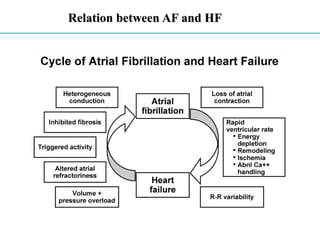
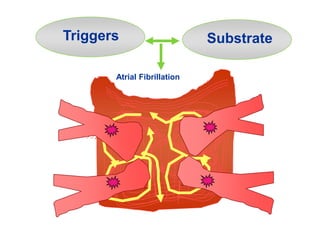
Relation between AF and HF
Triggers
Atrial Fibrillation
Substrate
Diagnosis
 No specific tests or markers available
 A high index of suspicion derived from history
and clinical features remains the only available
tool
 Diagnosis should be considered in any patient
with left ventricular systolic dysfunction and
chronic or frequently recurring cardiac
arrhythmia
 Evidence of previously normal systolic
function, is particularly suggestive of this
disorder
 Ventricular rate that causes tachycardia-
induced cardiomyopathy has not been
determined, although any prolonged heart rate
greater than 100 beats per minute may be
important.
 Important to recognize that resting heart rates
are poor indicators of overall heart rates in
patients with AF
 As heart rate response to exercise may vary
 Patients with well-controlled resting heart rates
may have a rapid ventricular response with
minimal activity and develop tachycardia-
induced cardiomyopathy
 Assessment of exercise heart rates and 24-
hour Holter monitoring useful in diagnosing
tachycardiomyopathy in patients with AF and
ventricular systolic dysfunction
 Imaging : ECHO, C MRI
 Right ventricular biopsy studies revealed
nonspecific findings of varying degrees of
cellular hypertrophy and interstitial fibrosis
consistent with a nonspecific cardiomyopathy
Treatment
 Initial treatment in lines of heart failure: ACEI,
B blockers, Diuretics
 Heart rate normalization, either by rate or
rhythm control, is the cornerstone of therapy
 Results in increase in ejection fraction,
reduction in end-systolic and end-diastolic
volumes and improvement of both symptoms
and exercise tolerance
 The best means to achieve heart rate control
vary
depending on the type of arrhythmia
 Include antiarrhythmic drug therapy, external
DC
cardioversion, radiofrequency catheter ablation,
pacemaker therapy or insertion of an
implantable
cardioverter defibrillator
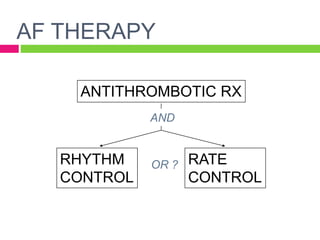
AF THERAPY
ANTITHROMBOTIC RX
RHYTHM
CONTROL
RATE
CONTROL
OR ?
AND
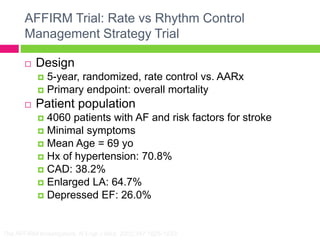
The AFFIRM Investigators. N Engl J Med. 2002;347:1825-1833.
AFFIRM Trial: Rate vs Rhythm Control
Management Strategy Trial
 Design
 5-year, randomized, rate control vs. AARx
 Primary endpoint: overall mortality
 Patient population
 4060 patients with AF and risk factors for stroke
 Minimal symptoms
 Mean Age = 69 yo
 Hx of hypertension: 70.8%
 CAD: 38.2%
 Enlarged LA: 64.7%
 Depressed EF: 26.0%
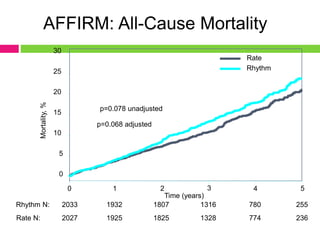
AFFIRM: All-Cause Mortality
Rate N:
Rhythm N:
2027
2033
1925
1932
1825
1807
1328
1316
774
780
236
255
0
5
10
15
20
25
30
0 1 2 3 4 5
Mortality,%
Rate
Rhythm
p=0.078 unadjusted
Time (years)
p=0.068 adjusted
The AFFIRM Investigators. N Engl J Med. 2002;347:1825-1833.
100 –
80 –
60 –
40 –
20 –
0 –
Time (years)
Percent
With AF
Recurrence
Rate Control
Raitt, et al. Am H J 2006
0 1 2 3 4 5 6
N, Events (%)
Rate control:
Rhythm control:
563, 3 (0)
729, 2 (0)
167, 383 (69)
344, 356 (50)
98, 440 (80)
250, 422 (60)
42, 472 (87)
143, 470 (69)
10, 481 (92)
73, 494 (75)
2, 484 (95)
18, 503 (79)
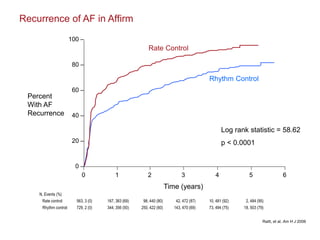
Recurrence of AF in Affirm
Rhythm Control
Log rank statistic = 58.62
p < 0.0001
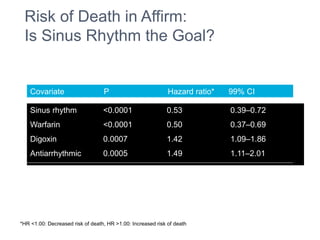
Risk of Death in Affirm:
Is Sinus Rhythm the Goal?
*HR <1.00: Decreased risk of death, HR >1.00: Increased risk of death
AFFIRM Investigators. Circulation. 2004;109:1509-13.
AFFIRM: Selected time-dependent covariates associated with survival
Sinus rhythm <0.0001 0.53 0.39–0.72
Warfarin <0.0001 0.50 0.37–0.69
Digoxin 0.0007 1.42 1.09–1.86
Antiarrhythmic 0.0005 1.49 1.11–2.01
Covariate P Hazard ratio* 99% CI
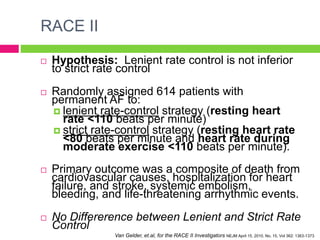
RACE II
 Hypothesis: Lenient rate control is not inferior
to strict rate control
 Randomly assigned 614 patients with
permanent AF to:
 lenient rate-control strategy (resting heart
rate <110 beats per minute)
 strict rate-control strategy (resting heart rate
<80 beats per minute and heart rate during
moderate exercise <110 beats per minute).
 Primary outcome was a composite of death from
cardiovascular causes, hospitalization for heart
failure, and stroke, systemic embolism,
bleeding, and life-threatening arrhythmic events.
 No Differerence between Lenient and Strict Rate
Control
Van Gelder, et.al, for the RACE II Investigators NEJM April 15, 2010, No. 15, Vol 362: 1363-1373
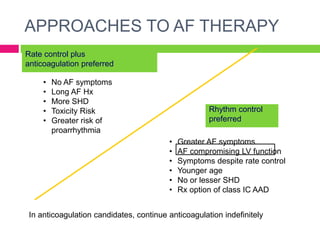
Rate control plus
anticoagulation preferred
Rhythm control
preferred
• No AF symptoms
• Long AF Hx
• More SHD
• Toxicity Risk
• Greater risk of
proarrhythmia
• Greater AF symptoms
• AF compromising LV function
• Symptoms despite rate control
• Younger age
• No or lesser SHD
• Rx option of class IC AAD
In anticoagulation candidates, continue anticoagulation indefinitely
APPROACHES TO AF THERAPY
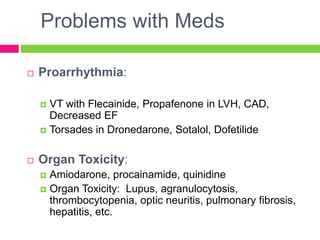
Problems with Meds
 Proarrhythmia:
 VT with Flecainide, Propafenone in LVH, CAD,
Decreased EF
 Torsades in Dronedarone, Sotalol, Dofetilide
 Organ Toxicity:
 Amiodarone, procainamide, quinidine
 Organ Toxicity: Lupus, agranulocytosis,
thrombocytopenia, optic neuritis, pulmonary fibrosis,
hepatitis, etc.
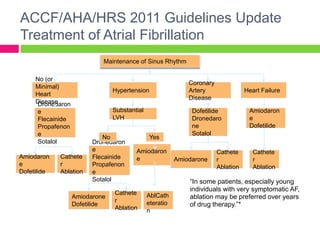
ACCF/AHA/HRS 2011 Guidelines Update
Treatment of Atrial Fibrillation
*Knight BP. HRS Practical Rate and Rhythm Management of Atrial Fibrillation. Updated January 2010. Available at:
http://www.hrsonline.org/ClinicalGuidance/upload/2010_rate-rhythm_guide1.pdf
“In some patients, especially young
individuals with very symptomatic AF,
ablation may be preferred over years
of drug therapy.”*
Maintenance of Sinus Rhythm
Dronedaron
e
Flecainide
Propafenon
e
Sotalol Dronedaron
e
Flecainide
Propafenon
e
Sotalol
Cathete
r
Ablation
Cathete
r
Ablation
Amiodarone
Amiodaron
e
Cathete
r
Ablation
Amiodarone
Dofetilide
AblCath
eteratio
n
Cathete
r
Ablation
Amiodaron
e
Dofetilide
Substantial
LVH
No Yes
Dofetilide
Dronedaro
ne
Sotalol
Amiodaron
e
Dofetilide
No (or
Minimal)
Heart
Disease
Hypertension
Coronary
Artery
Disease
Heart Failure
Prognosis
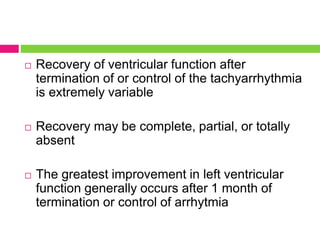
 Recovery of ventricular function after
termination of or control of the tachyarrhythmia
is extremely variable
 Recovery may be complete, partial, or totally
absent
 The greatest improvement in left ventricular
function generally occurs after 1 month of
termination or control of arrhytmia
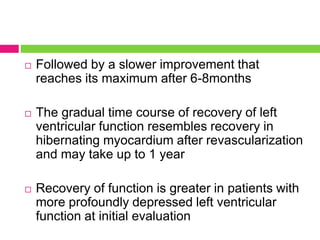
 Followed by a slower improvement that
reaches its maximum after 6-8months
 The gradual time course of recovery of left
ventricular function resembles recovery in
hibernating myocardium after revascularization
and may take up to 1 year
 Recovery of function is greater in patients with
more profoundly depressed left ventricular
function at initial evaluation
 Recurrent tachycardia can lead to an abrupt
decline in LVEF
 Close ongoing monitoring with clinic visits,
ambulatory (Holter) monitoring, and
echocardiography is essential
 Moniter every three to six months for up to one
to two years following the initial clinical
improvement
 In some patients whose LVEF has normalized,
the LV chamber may remain somewhat
enlarged
 If tachycardia-mediated cardiomyopathy
recurs, these patients are at substantial risk for
sudden death and ICD implantation should be
contemplated
Conclusion
 Tachycardiomyopathy is a rare but potentially
curable form of dilated cardiomyopathy
 It should be considered in all patients whose
systolic dysfunction is diagnosed subsequent
to or concomitant with atrial fibrillation or
chronic tachyarrhythmia.
Tachyarrhtymia induced cardiomyopathy

Tachyarrhtymia induced cardiomyopathy

  • 1.
  • 2.
     Dilated cardiomyopathy(DCM): Characterized by dilation and impaired contraction of one or both ventricles  DCM - caused by a variety of specific diseases  ≥ 50% of patients with DCM: - an etiologic basis will not be identified - Idiopathic DCM
  • 3.
     One series-1278 patients with congestive heart failure  Idiopathic — 51 percent  Idiopathic myocarditis — 9 percent  Occult coronary disease — 8 percent  Other identifiable causes — 32 percent  Felker, et al. The spectrum of dilated cardiomyopathy. The Johns Hopkins experience with 1,278 patients. Medicine (Baltimore) 1999; 78:270
  • 4.
    Clinical presentation  Mostpatients present between age : 20-60 years - Can occur in children and elderly  Symptoms of CHF  Incidental detection of asymptomatic cardiomegaly  Symptoms related to coexisting arrhythmia, conduction disturbance  Thromboembolic complications  Sudden death
  • 5.
    Reversible causes of cardiomyopathy -Peripartum cardiomyopathy - Tachycardia-mediated cardiomyopathy - Takotsubo cardiomyopathy - Alcoholic cardiomyopathy - Cocaine - Medications - Ischemia - Endocrine dysfunction - SLE, Sarcoidosis - Nutritional deficiencies - Electrolyte abnormalities - Obstructive sleep apnea
  • 6.
  • 7.
    Introduction  Defn: Impairmentin left ventricular function secondary to chronic tachycardia, which is partially or completely reversible once the tachyarrhythmia is controlled  Shown to occur both in experimental models and in patients with incessant tachyarrhythmia.
  • 8.
    Fenelon et alproposed the following criteria: Dilatation of the heart or heart failure Chronic or very frequent cardiac arrhythmias, including incessant SVTs, AF or AFL and incessant VT
  • 9.
     If chronictachycardia continued more than 10- 15% of the day, with an atrial rate of more than 150% of that predicted for age, cardiomyopathy occurs
  • 10.
    Types  Pure type: chronic tachycardia causes LV dysfunction in a normal heart and completely recovers after termination  Impure Type:  occurs in patients with structural heart diseases, and cardiac dysfunction may only recover incompletely after termination of the tachycardia  Fenelon et al
  • 11.
     Data fromseveral studies and from case reports have shown that rate control by means of cardioversion, negative chronotropic agents, and surgical or catheter-based atrio-ventricular node ablation, resulted in significant improvement of systolic function  Diagnosis is usually made following observation of marked improvement in systolic function after normalization of heart rate
  • 12.
     Clinicians shouldbe aware that patients with unexplained systolic dysfunction may have tachycardia-induced cardiomyo-pathy, and that controlling the arrhythmia may result in improvement of systolic function  Exact incidence unclear, an association between tachycardia and cardiomyopathy has been recognized for some time* *Kasper EK, J Am Coll Cardiol. 1994;23(3):586
  • 13.
    Associations  SVT: EAT,AF, Afl, AVNRT, AVRT, PJRT  VT: RVOT VT, Fascicular VT  Frequent ectopics: Ventricular, atrial
  • 14.
    Pathophysiology  Whipple etal. first described experimental tachycardia-induced cardiomyopathy in 1962  They provided the first experimental model for the condition, demonstrating that rapid and protracted, atrial pacing led to low output heart failure
  • 15.
    Proposed mechanisms  Myocardialenergy depletion  Impaired energy utilization  Ischemia  Abnormal calcium handling
  • 16.
    Clinical features  AGE: can occur at any age  reported in infants, children, adolescents, and adults  Follows any type of chronic or frequently recurring paroxysmal tachyarrhythmias  Atrial fibrillation, atrial flutter, ectopic atrial tachycardia, atrioventricular tachycardia, and ventricular tachycardia have all been reported to cause
  • 17.
     Unclear whysome patients with chronic tachyarrhythmia develop ventricular dysfunction whereas others tolerate high rates and maintain normal systolic function
  • 18.
     Presumed riskfactors include:  Type, rate and duration of tachyarrhythmia  Patient’s age  Underlying heart disease  Drugs  Coexisting medical conditions
  • 19.
     Presentation:  Variable Palpitations due to tachycardia per se  Symptoms of heart failure like fatigue, exercise intolerance, dyspnea, pedal edema etc
  • 20.
  • 21.
  • 23.
  • 24.
     No specifictests or markers available  A high index of suspicion derived from history and clinical features remains the only available tool  Diagnosis should be considered in any patient with left ventricular systolic dysfunction and chronic or frequently recurring cardiac arrhythmia
  • 25.
     Evidence ofpreviously normal systolic function, is particularly suggestive of this disorder  Ventricular rate that causes tachycardia- induced cardiomyopathy has not been determined, although any prolonged heart rate greater than 100 beats per minute may be important.
  • 26.
     Important torecognize that resting heart rates are poor indicators of overall heart rates in patients with AF  As heart rate response to exercise may vary  Patients with well-controlled resting heart rates may have a rapid ventricular response with minimal activity and develop tachycardia- induced cardiomyopathy
  • 27.
     Assessment ofexercise heart rates and 24- hour Holter monitoring useful in diagnosing tachycardiomyopathy in patients with AF and ventricular systolic dysfunction  Imaging : ECHO, C MRI
  • 28.
     Right ventricularbiopsy studies revealed nonspecific findings of varying degrees of cellular hypertrophy and interstitial fibrosis consistent with a nonspecific cardiomyopathy
  • 29.
  • 30.
     Initial treatmentin lines of heart failure: ACEI, B blockers, Diuretics  Heart rate normalization, either by rate or rhythm control, is the cornerstone of therapy  Results in increase in ejection fraction, reduction in end-systolic and end-diastolic volumes and improvement of both symptoms and exercise tolerance
  • 31.
     The bestmeans to achieve heart rate control vary depending on the type of arrhythmia  Include antiarrhythmic drug therapy, external DC cardioversion, radiofrequency catheter ablation, pacemaker therapy or insertion of an implantable cardioverter defibrillator
  • 32.
  • 33.
    The AFFIRM Investigators.N Engl J Med. 2002;347:1825-1833. AFFIRM Trial: Rate vs Rhythm Control Management Strategy Trial  Design  5-year, randomized, rate control vs. AARx  Primary endpoint: overall mortality  Patient population  4060 patients with AF and risk factors for stroke  Minimal symptoms  Mean Age = 69 yo  Hx of hypertension: 70.8%  CAD: 38.2%  Enlarged LA: 64.7%  Depressed EF: 26.0%
  • 34.
    AFFIRM: All-Cause Mortality RateN: Rhythm N: 2027 2033 1925 1932 1825 1807 1328 1316 774 780 236 255 0 5 10 15 20 25 30 0 1 2 3 4 5 Mortality,% Rate Rhythm p=0.078 unadjusted Time (years) p=0.068 adjusted The AFFIRM Investigators. N Engl J Med. 2002;347:1825-1833.
  • 35.
    100 – 80 – 60– 40 – 20 – 0 – Time (years) Percent With AF Recurrence Rate Control Raitt, et al. Am H J 2006 0 1 2 3 4 5 6 N, Events (%) Rate control: Rhythm control: 563, 3 (0) 729, 2 (0) 167, 383 (69) 344, 356 (50) 98, 440 (80) 250, 422 (60) 42, 472 (87) 143, 470 (69) 10, 481 (92) 73, 494 (75) 2, 484 (95) 18, 503 (79) Recurrence of AF in Affirm Rhythm Control Log rank statistic = 58.62 p < 0.0001
  • 36.
    Risk of Deathin Affirm: Is Sinus Rhythm the Goal? *HR <1.00: Decreased risk of death, HR >1.00: Increased risk of death AFFIRM Investigators. Circulation. 2004;109:1509-13. AFFIRM: Selected time-dependent covariates associated with survival Sinus rhythm <0.0001 0.53 0.39–0.72 Warfarin <0.0001 0.50 0.37–0.69 Digoxin 0.0007 1.42 1.09–1.86 Antiarrhythmic 0.0005 1.49 1.11–2.01 Covariate P Hazard ratio* 99% CI
  • 37.
    RACE II  Hypothesis:Lenient rate control is not inferior to strict rate control  Randomly assigned 614 patients with permanent AF to:  lenient rate-control strategy (resting heart rate <110 beats per minute)  strict rate-control strategy (resting heart rate <80 beats per minute and heart rate during moderate exercise <110 beats per minute).  Primary outcome was a composite of death from cardiovascular causes, hospitalization for heart failure, and stroke, systemic embolism, bleeding, and life-threatening arrhythmic events.  No Differerence between Lenient and Strict Rate Control Van Gelder, et.al, for the RACE II Investigators NEJM April 15, 2010, No. 15, Vol 362: 1363-1373
  • 39.
    Rate control plus anticoagulationpreferred Rhythm control preferred • No AF symptoms • Long AF Hx • More SHD • Toxicity Risk • Greater risk of proarrhythmia • Greater AF symptoms • AF compromising LV function • Symptoms despite rate control • Younger age • No or lesser SHD • Rx option of class IC AAD In anticoagulation candidates, continue anticoagulation indefinitely APPROACHES TO AF THERAPY
  • 40.
    Problems with Meds Proarrhythmia:  VT with Flecainide, Propafenone in LVH, CAD, Decreased EF  Torsades in Dronedarone, Sotalol, Dofetilide  Organ Toxicity:  Amiodarone, procainamide, quinidine  Organ Toxicity: Lupus, agranulocytosis, thrombocytopenia, optic neuritis, pulmonary fibrosis, hepatitis, etc.
  • 41.
    ACCF/AHA/HRS 2011 GuidelinesUpdate Treatment of Atrial Fibrillation *Knight BP. HRS Practical Rate and Rhythm Management of Atrial Fibrillation. Updated January 2010. Available at: http://www.hrsonline.org/ClinicalGuidance/upload/2010_rate-rhythm_guide1.pdf “In some patients, especially young individuals with very symptomatic AF, ablation may be preferred over years of drug therapy.”* Maintenance of Sinus Rhythm Dronedaron e Flecainide Propafenon e Sotalol Dronedaron e Flecainide Propafenon e Sotalol Cathete r Ablation Cathete r Ablation Amiodarone Amiodaron e Cathete r Ablation Amiodarone Dofetilide AblCath eteratio n Cathete r Ablation Amiodaron e Dofetilide Substantial LVH No Yes Dofetilide Dronedaro ne Sotalol Amiodaron e Dofetilide No (or Minimal) Heart Disease Hypertension Coronary Artery Disease Heart Failure
  • 42.
  • 43.
     Recovery ofventricular function after termination of or control of the tachyarrhythmia is extremely variable  Recovery may be complete, partial, or totally absent  The greatest improvement in left ventricular function generally occurs after 1 month of termination or control of arrhytmia
  • 44.
     Followed bya slower improvement that reaches its maximum after 6-8months  The gradual time course of recovery of left ventricular function resembles recovery in hibernating myocardium after revascularization and may take up to 1 year  Recovery of function is greater in patients with more profoundly depressed left ventricular function at initial evaluation
  • 45.
     Recurrent tachycardiacan lead to an abrupt decline in LVEF  Close ongoing monitoring with clinic visits, ambulatory (Holter) monitoring, and echocardiography is essential  Moniter every three to six months for up to one to two years following the initial clinical improvement
  • 46.
     In somepatients whose LVEF has normalized, the LV chamber may remain somewhat enlarged  If tachycardia-mediated cardiomyopathy recurs, these patients are at substantial risk for sudden death and ICD implantation should be contemplated
  • 47.
  • 48.
     Tachycardiomyopathy isa rare but potentially curable form of dilated cardiomyopathy  It should be considered in all patients whose systolic dysfunction is diagnosed subsequent to or concomitant with atrial fibrillation or chronic tachyarrhythmia.