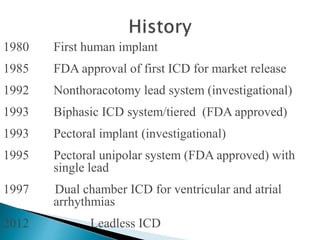


1980 First human implant
1985 FDA approval of first ICD for market release
1992 Nonthoracotomy lead system (investigational)
1993 Biphasic ICD system/tiered (FDA approved)
1993 Pectoral implant (investigational)
1995 Pectoral unipolar system (FDA approved) with
single lead
1997 Dual chamber ICD for ventricular and atrial
arrhythmias
2012 Leadless ICD
The idea behind ICD’s recognizes that Vfib or
Vtach degenerating into Vfib is responsible
for a large percentage of sudden cardiac
death
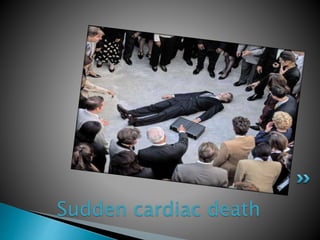
Sudden cardiac death
SCD is natural death from cardiac causes,
heralded by abrupt loss of consciousness
within 1 hour of the onset of an acute change
in cardiovascular status
 50 % of all CVS deaths
 >80 % due to arrhytmias esp VT/VF
 Unpredictable, risk factors, forewarning
symptoms not adequately defined
 Commonly unexpected first event,
oftenstriking victims in the productive age
group
 Most incidence out-of-hospital
 Timely defibrillation is the only effective
therapy to prevent death
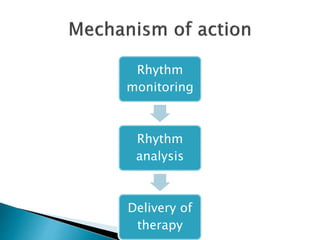
Rhythm
monitoring
Rhythm
analysis
Delivery of
therapy
 Continuously moniters the electrical activity of
heart
 Using various sophisticated algorithms detects
abnormal electrical activity and furthur classifies
them into supraventricular or ventricular
arrhytmia
 Rate discrimination: Compares ventricular and
atrial rates. If atrial>ventricular rhythm is atrial, if
not its ventricular
 Rhythm discrimination: Moniters how regular the
ventricular tachycardia is. Usually VT is regular, AF
with conduction is irregular
 Morphology discrimination: checks the morphology
of every ventricular beat and compares it to what
the ICD believes is a normally conducted
ventricular impulse for the patient. This normal
ventricular impulse is often an average of a
multiple of beats of the patient taken in the recent
past
 Once a shockable rhythm is detected(VT/VF)
the ICD responds in a sequential manner
which is referred to as TIERD therapy
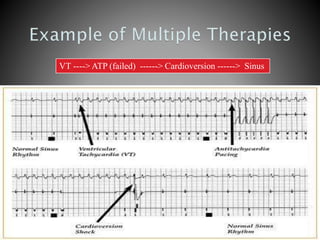
 Antitachycardia pacing(ATP): Initial response
to VT. Burst of current to override the
abnormal rhythm and revert to sinus rhythm.
Usually terminates most of the VT’s. Not
useful in VF. Is not painful
 Cardiovertion and Defibrillation shocks: For VT
wherein antitachycardia pacing fails, initial therapy
for VF
 Shocks are painful unlike antitachycardia pacing
 Shock voltage depends on the preset value. Ranges
from <5 J in low voltage shocks and upto 40 J in high
voltage shocks
 Biphasic shocks used currently
 Maximum 4-5 shocks are delivered
 Time to shock: Usually 5-10 seconds needed
to charge the capacitors and then the shock
is delivered
 Rhythm reanalysis before final shock delivery
to prevent unwanted shocks if arrhytmia is
spontaneously terminated
 Rhythm redetection: After shock delivery to
look for revertion to sinus rhythym
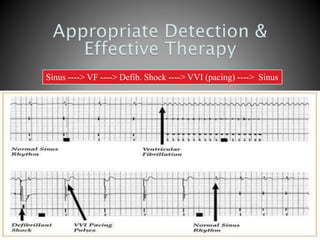
Sinus ----> VF ----> Defib. Shock ----> VVI (pacing) ----> Sinus
VT ----> ATP (failed) ------> Cardioversion ------> Sinus
EVERYONE !
Do not think so…….
The ICD
trials
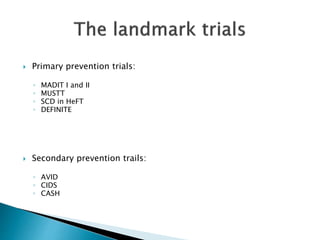
 Primary prevention trials:
◦ MADIT I and II
◦ MUSTT
◦ SCD in HeFT
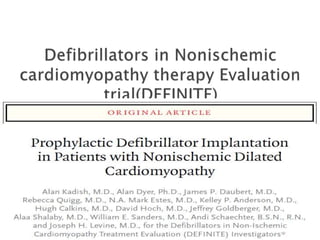
◦ DEFINITE
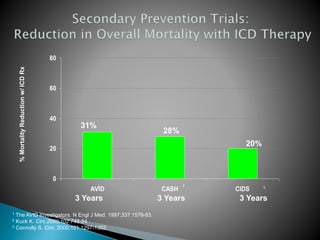
 Secondary prevention trails:
◦ AVID
◦ CIDS
◦ CASH
1 The AVID Investigators. N Engl J Med. 1997;337:1576-83.
2 Kuck K. Circ.2000;102:748-54.
3 Connolly S. Circ. 2000;101:1297-1302.
0
20
40
60
80
AVID CASH CIDS
1 2 3
31%
28%
20%
%MortalityReductionw/ICDRx
3 Years 3 Years 3 Years
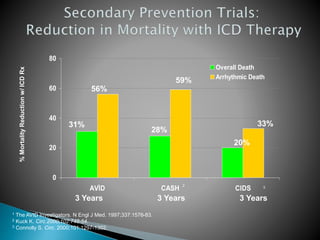
1 The AVID Investigators. N Engl J Med. 1997;337:1576-83.
2 Kuck K. Circ.2000;102:748-54.
3 Connolly S. Circ. 2000;101:1297-1302.
0
20
40
60
80
AVID CASH CIDS
Overall Death
Arrhythmic Death
1 2 3
31%
56%
28%
59%
20%
33%
%MortalityReductionw/ICDRx
3 Years 3 Years 3 Years
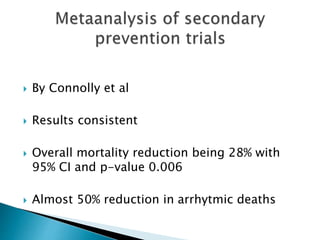
 By Connolly et al
 Results consistent
 Overall mortality reduction being 28% with
95% CI and p-value 0.006
 Almost 50% reduction in arrhytmic deaths
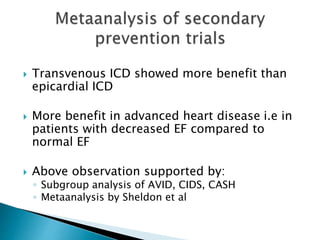
 Transvenous ICD showed more benefit than
epicardial ICD
 More benefit in advanced heart disease i.e in
patients with decreased EF compared to
normal EF
 Above observation supported by:
◦ Subgroup analysis of AVID, CIDS, CASH
◦ Metaanalysis by Sheldon et al
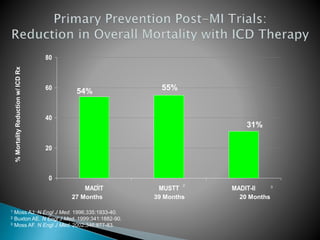
1 Moss AJ. N Engl J Med. 1996;335:1933-40.
2 Buxton AE. N Engl J Med. 1999;341:1882-90.
3 Moss AF. N Engl J Med. 2002;346:877-83.
0
20
40
60
80
MADIT MUSTT MADIT-II
1 2 3
54% 55%
31%
27 Months 39 Months 20 Months
%MortalityReductionw/ICDRx
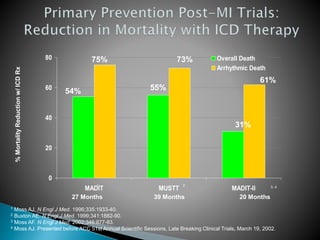
1 Moss AJ. N Engl J Med. 1996;335:1933-40.
2 Buxton AE. N Engl J Med. 1999;341:1882-90.
3 Moss AF. N Engl J Med. 2002;346:877-83.
4 Moss AJ. Presented before ACC 51st Annual Scientific Sessions, Late Breaking Clinical Trials, March 19, 2002.
0
20
40
60
80
MADIT MUSTT MADIT-II
Overall Death
Arrhythmic Death
1 2 3, 4
54%
75%
55%
73%
31%
61%
27 Months 39 Months 20 Months
%MortalityReductionw/ICDRx
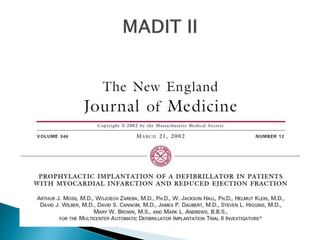
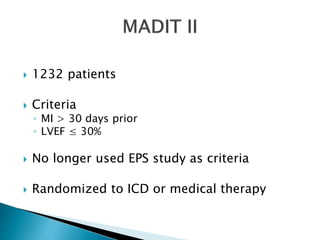
 1232 patients
 Criteria
◦ MI > 30 days prior
◦ LVEF ≤ 30%
 No longer used EPS study as criteria
 Randomized to ICD or medical therapy
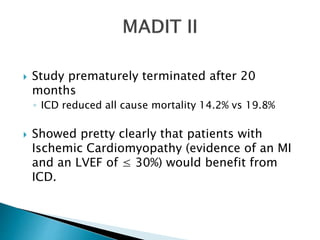
 Study prematurely terminated after 20
months
◦ ICD reduced all cause mortality 14.2% vs 19.8%
 Showed pretty clearly that patients with
Ischemic Cardiomyopathy (evidence of an MI
and an LVEF of ≤ 30%) would benefit from
ICD.
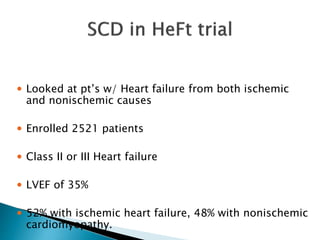
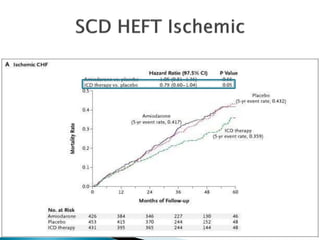
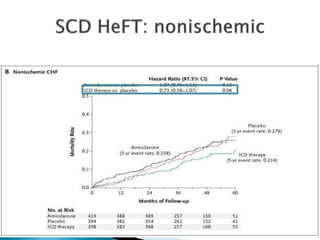
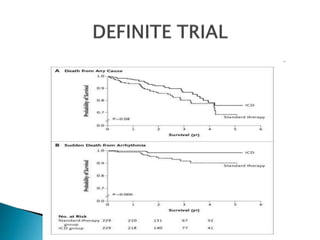
 Looked at pt’s w/ Heart failure from both ischemic
and nonischemic causes
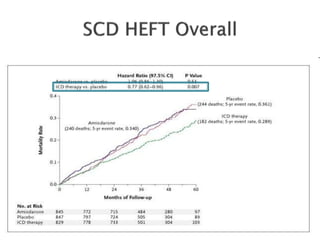
 Enrolled 2521 patients
 Class II or III Heart failure
 LVEF of 35%
 52% with ischemic heart failure, 48% with nonischemic
cardiomyopathy.
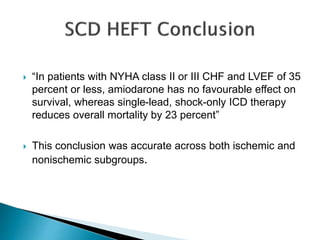
 “In patients with NYHA class II or III CHF and LVEF of 35
percent or less, amiodarone has no favourable effect on
survival, whereas single-lead, shock-only ICD therapy
reduces overall mortality by 23 percent”
 This conclusion was accurate across both ischemic and
nonischemic subgroups.
ICD’S can save lives in patients,in heart failure
arising from BOTH ischemic AND nonischemic
causes.
 ICD’S can save lives in patients,in heart failure
arising from BOTH ischemic AND nonischemic
causes.
0
20
40
60
80
MADIT MUSTT MADIT-II
0
20
40
60
80
AVID CASH CIDS
1 Moss AJ. N Engl J Med. 1996;335:1933-40.
2 Buxton AE. N Engl J Med. 1999;341:1882-90.
3 Moss AJ. N Engl J Med. 2002;346:877-83
4 The AVID Investigators. N Engl J Med. 1997;337:1576-83.
5 Kuck K. Circ. 2000;102:748-54.
6 Connolly S. Circ. 2000:101:1297-1302.
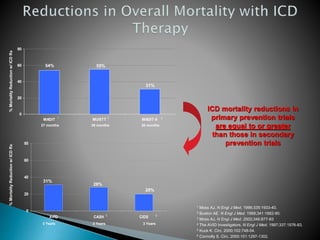
ICD mortality reductions in
primary prevention trials
are equal to or greater
than those in secondary
prevention trials
1 2
4 65
54% 55%
31%
27 months 39 months 20 months
31%
28%
20%
%MortalityReductionw/ICDRx%MortalityReductionw/ICDRx
3 Years 3 Years 3 Years
3
0
20
40
60
80
MADIT MUSTT MADIT-II
Overall Death
Arrhythmic Death
0
20
40
60
80
AVID CASH CIDS
Overall Death
Arrhythmic Death
1 Moss AJ. N Engl J Med. 1996;335:1933-40.
2 Buxton AE. N Engl J Med. 1999;341:1882-90.
3 Moss AJ. N Engl J Med. 2002;346:877-83
4 Moss AJ. Presented before ACC 51st Annual Scientific Sessions,
Late Breaking Clinical Trials, March 19, 2002.
5 The AVID Investigators. N Engl J Med. 1997;337:1576-83.
6 Kuck K. Circ. 2000;102:748-54.
7 Connolly S. Circ. 2000:101:1297-1302.
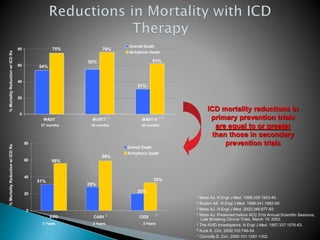
ICD mortality reductions in
primary prevention trials
are equal to or greater
than those in secondary
prevention trials
1 3, 42
5 76
54%
75%
55%
76%
31%
61%
27 months 39 months 20 months
31%
56%
28%
59%
20%
33%
%MortalityReductionw/ICDRx%MortalityReductionw/ICDRx
3 Years 3 Years 3 Years
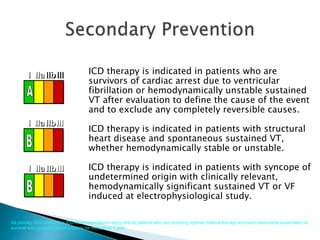
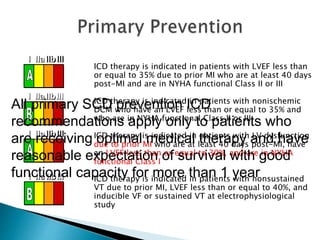
ICD therapy is indicated in patients who are
survivors of cardiac arrest due to ventricular
fibrillation or hemodynamically unstable sustained
VT after evaluation to define the cause of the event
and to exclude any completely reversible causes.
ICD therapy is indicated in patients with structural
heart disease and spontaneous sustained VT,
whether hemodynamically stable or unstable.
ICD therapy is indicated in patients with syncope of
undetermined origin with clinically relevant,
hemodynamically significant sustained VT or VF
induced at electrophysiological study.
III IIaIIaIIa IIbIIbIIbIIIIIIIIIIII IIaIIaIIa IIbIIbIIbIIIIIIIIIIII IIaIIaIIa IIbIIbIIbIIIIIIIIIIIaIIaIIa IIbIIbIIbIIIIIIIII
III IIaIIaIIa IIbIIbIIb IIIIIIIIIIII IIaIIaIIa IIbIIbIIb IIIIIIIIIIII IIaIIaIIa IIbIIbIIb IIIIIIIIIIIaIIaIIa IIbIIbIIb IIIIIIIII
All primary SCD prevention ICD recommendations apply only to patients who are receiving optimal medical therapy and have reasonable expectation of
survival with good functional capacity for more than 1 year.
ICD therapy is indicated in patients with LVEF less than
or equal to 35% due to prior MI who are at least 40 days
post-MI and are in NYHA functional Class II or III
ICD therapy is indicated in patients with nonischemic
DCM who have an LVEF less than or equal to 35% and
who are in NYHA functional Class II or III
ICD therapy is indicated in patients with LV dysfunction
due to prior MI who are at least 40 days post-MI, have
an LVEF less than or equal to 30%, and are in NYHA
functional Class I
ICD therapy is indicated in patients with nonsustained
VT due to prior MI, LVEF less than or equal to 40%, and
inducible VF or sustained VT at electrophysiological
study
III IIaIIaIIa IIbIIbIIbIIIIIIIIIIII IIaIIaIIa IIbIIbIIbIIIIIIIIIIII IIaIIaIIa IIbIIbIIbIIIIIIIIIIIaIIaIIa IIbIIbIIbIIIIIIIII
III IIaIIaIIa IIbIIbIIb IIIIIIIIIIII IIaIIaIIa IIbIIbIIb IIIIIIIIIIII IIaIIaIIa IIbIIbIIb IIIIIIIIIIIaIIaIIa IIbIIbIIb IIIIIIIII
All primary SCD prevention ICD
recommendations apply only to patients who
are receiving optimal medical therapy and have
reasonable expectation of survival with good
functional capacity for more than 1 year
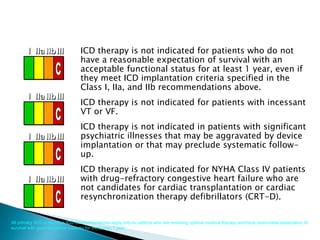
ICD therapy is not indicated for patients who do not
have a reasonable expectation of survival with an
acceptable functional status for at least 1 year, even if
they meet ICD implantation criteria specified in the
Class I, IIa, and IIb recommendations above.
ICD therapy is not indicated for patients with incessant
VT or VF.
ICD therapy is not indicated in patients with significant
psychiatric illnesses that may be aggravated by device
implantation or that may preclude systematic follow-
up.
ICD therapy is not indicated for NYHA Class IV patients
with drug-refractory congestive heart failure who are
not candidates for cardiac transplantation or cardiac
resynchronization therapy defibrillators (CRT-D).
III IIaIIaIIa IIbIIbIIb IIIIIIIIIIII IIaIIaIIa IIbIIbIIb IIIIIIIIIIII IIaIIaIIa IIbIIbIIb IIIIIIIIIIIaIIaIIa IIbIIbIIb IIIIIIIII
All primary SCD prevention ICD recommendations apply only to patients who are receiving optimal medical therapy and have reasonable expectation of
survival with good functional capacity for more than 1 year.
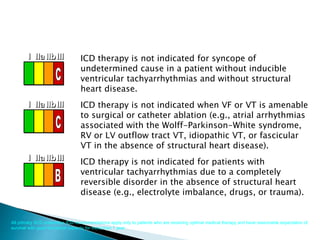
ICD therapy is not indicated for syncope of
undetermined cause in a patient without inducible
ventricular tachyarrhythmias and without structural
heart disease.
ICD therapy is not indicated when VF or VT is amenable
to surgical or catheter ablation (e.g., atrial arrhythmias
associated with the Wolff-Parkinson-White syndrome,
RV or LV outflow tract VT, idiopathic VT, or fascicular
VT in the absence of structural heart disease).
ICD therapy is not indicated for patients with
ventricular tachyarrhythmias due to a completely
reversible disorder in the absence of structural heart
disease (e.g., electrolyte imbalance, drugs, or trauma).
III IIaIIaIIa IIbIIbIIb IIIIIIIIIIII IIaIIaIIa IIbIIbIIb IIIIIIIIIIII IIaIIaIIa IIbIIbIIb IIIIIIIIIIIaIIaIIa IIbIIbIIb IIIIIIIII
All primary SCD prevention ICD recommendations apply only to patients who are receiving optimal medical therapy and have reasonable expectation of
survival with good functional capacity for more than 1 year.
 Asian data limited
 Disease pattern different from Western world
 Most landmark trials seldom recruited Asian
subjects
 Incidence in USA, Europe 1 per 1000
population
 Similar incidence in Japan
 China : 0.42 per 1000
 Hong Kong: 0.0018 per 1000
 In an epidemiological study in USA, it was
found that Asians had a lower incidence of
SCD- 212.6 per 1,00,000 compared to 407.1
in Caucasians and 502.7 in Blacks
 Underlying difference for this lower incidence
in Asians is not clear
 Most SCD occurs in structural heart diseases
( Ischemic or non ischemic)
 CAD accounts for 80% of SCD in West
 CAD remains most common cause of SCD in
Asia as well but incidence is quite lower
compared to west
 South korean autopsy registrty : CAD was
underlying cause of SCD in only 49.7% of
cases
 Japan registry of post MI patients: Incidence
of SC was only 1.2% in 4 year follow up
 Applicability of MADIT II, a primary
prevention trial was tested in 2 Asian
observational studies
 Tanno et al:
◦ Japan cohort had lower incidence of SCD compared
to MADIT II cohort ( 2 versus 12.1% )
 Siu et al:
◦ Hongkong cohort had similar incidence of SCD
compared to MADIT II ( 10 vs 12.1% )
 LVEF is most important predictor of SCD in
western patients with structural heart diasease
 Asian studies also showed LVEF predicts SCD
 Japanese post MI registry (HIJAM II):
◦ LVEF strongest predictor
◦ But for similar EF SCD less common than in Western
population ( In patients with EF < 30% SCD incidence was
5.1% at 5 years compared to 12.1% at 2 years in MADIT
II)
 TRACE study: Incidence of SCD in patients
with EF<30% was 15.5% at 3 years
 VALLIANT study: Incidence of SCD in patients
with EF<30% was 10% at 2 years
 HIJAM II and other post MI Asian registries
shows high rate of revascularization
compared to Western studies, highliting
importance of revascularization in preventing
SCD
 Less common than in structural
 Mainly in young, active, previously healthy
individuals
 More prevalent in Asia than in West
 Single centre Korean review: Of 186 SCD
44.1%had no structural heart disease
 Taiwan ICD registry: In ICD implantation for
secondary prevention a higher proportion of
patients (23%) had structurally normal heart,
as compared to Western secondary
prevention trials like AVID(3%), CIDS(9%) and
CASH(4%)
 Common causes:
◦ Brugada syndrome (Most common, far more
coomon in Asia compared to West)
◦ CPVT
◦ Congenital long QT syndrome
◦ Short QT syndrome
◦ Idiopathic VF syndrome
◦ WPW syndrome
 LVEF is the currently the strongest predictor
for SCD
 Single most important selection criteria for
AICD
 But, most ICD recepients for primary
prevention, do not experience any VT/VF
(MADIT II)
 When absolute number of SCD events were
measured, majority occurred in general
population group than in high risk subgroup
 Current primary prevention ICD guidelines
protect only a minority of SCD victims
 Other available risk stratification methods like
ambulatory ECG, heart rate variability, signal
averaged ECG, QT dispersion and T wave
alterans have poor predictive value
 Although ICD is an effective treatment for
prevention of SCD, its costly, benefits only a
small proportion of those at risk
 Cardiac disease pattern in Asia different than
in west
 Asiana have lower incidence of SCD, less SCD
related to CSD and more SCD related to non
structural heart disease
 In concordance with Western studies, LVEF
remains sigle most important risk factor for
SCD even in Asia,
 But, for a given LVEF, the risk of SCD is
considerably lower in Asia than in west
 LVEF, as a sole predictor for risk stratification
may not be sufficient especially in Asia
 More studies needed to develop methods to
risk stratify individuals at risk for SCD
Aicd in asian settings ppt

Aicd in asian settings ppt

  • 3.
    1980 First humanimplant 1985 FDA approval of first ICD for market release 1992 Nonthoracotomy lead system (investigational) 1993 Biphasic ICD system/tiered (FDA approved) 1993 Pectoral implant (investigational) 1995 Pectoral unipolar system (FDA approved) with single lead 1997 Dual chamber ICD for ventricular and atrial arrhythmias 2012 Leadless ICD
  • 4.
    The idea behindICD’s recognizes that Vfib or Vtach degenerating into Vfib is responsible for a large percentage of sudden cardiac death
  • 5.
  • 6.
    SCD is naturaldeath from cardiac causes, heralded by abrupt loss of consciousness within 1 hour of the onset of an acute change in cardiovascular status
  • 7.
     50 %of all CVS deaths  >80 % due to arrhytmias esp VT/VF  Unpredictable, risk factors, forewarning symptoms not adequately defined  Commonly unexpected first event, oftenstriking victims in the productive age group
  • 8.
     Most incidenceout-of-hospital  Timely defibrillation is the only effective therapy to prevent death
  • 9.
  • 10.
     Continuously monitersthe electrical activity of heart  Using various sophisticated algorithms detects abnormal electrical activity and furthur classifies them into supraventricular or ventricular arrhytmia  Rate discrimination: Compares ventricular and atrial rates. If atrial>ventricular rhythm is atrial, if not its ventricular
  • 11.
     Rhythm discrimination:Moniters how regular the ventricular tachycardia is. Usually VT is regular, AF with conduction is irregular  Morphology discrimination: checks the morphology of every ventricular beat and compares it to what the ICD believes is a normally conducted ventricular impulse for the patient. This normal ventricular impulse is often an average of a multiple of beats of the patient taken in the recent past
  • 12.
     Once ashockable rhythm is detected(VT/VF) the ICD responds in a sequential manner which is referred to as TIERD therapy  Antitachycardia pacing(ATP): Initial response to VT. Burst of current to override the abnormal rhythm and revert to sinus rhythm. Usually terminates most of the VT’s. Not useful in VF. Is not painful
  • 13.
     Cardiovertion andDefibrillation shocks: For VT wherein antitachycardia pacing fails, initial therapy for VF  Shocks are painful unlike antitachycardia pacing  Shock voltage depends on the preset value. Ranges from <5 J in low voltage shocks and upto 40 J in high voltage shocks  Biphasic shocks used currently  Maximum 4-5 shocks are delivered
  • 14.
     Time toshock: Usually 5-10 seconds needed to charge the capacitors and then the shock is delivered  Rhythm reanalysis before final shock delivery to prevent unwanted shocks if arrhytmia is spontaneously terminated  Rhythm redetection: After shock delivery to look for revertion to sinus rhythym
  • 15.
    Sinus ----> VF----> Defib. Shock ----> VVI (pacing) ----> Sinus
  • 16.
    VT ----> ATP(failed) ------> Cardioversion ------> Sinus
  • 18.
  • 19.
    Do not thinkso…….
  • 20.
  • 21.
     Primary preventiontrials: ◦ MADIT I and II ◦ MUSTT ◦ SCD in HeFT ◦ DEFINITE  Secondary prevention trails: ◦ AVID ◦ CIDS ◦ CASH
  • 22.
    1 The AVIDInvestigators. N Engl J Med. 1997;337:1576-83. 2 Kuck K. Circ.2000;102:748-54. 3 Connolly S. Circ. 2000;101:1297-1302. 0 20 40 60 80 AVID CASH CIDS 1 2 3 31% 28% 20% %MortalityReductionw/ICDRx 3 Years 3 Years 3 Years
  • 23.
    1 The AVIDInvestigators. N Engl J Med. 1997;337:1576-83. 2 Kuck K. Circ.2000;102:748-54. 3 Connolly S. Circ. 2000;101:1297-1302. 0 20 40 60 80 AVID CASH CIDS Overall Death Arrhythmic Death 1 2 3 31% 56% 28% 59% 20% 33% %MortalityReductionw/ICDRx 3 Years 3 Years 3 Years
  • 24.
     By Connollyet al  Results consistent  Overall mortality reduction being 28% with 95% CI and p-value 0.006  Almost 50% reduction in arrhytmic deaths
  • 25.
     Transvenous ICDshowed more benefit than epicardial ICD  More benefit in advanced heart disease i.e in patients with decreased EF compared to normal EF  Above observation supported by: ◦ Subgroup analysis of AVID, CIDS, CASH ◦ Metaanalysis by Sheldon et al
  • 27.
    1 Moss AJ.N Engl J Med. 1996;335:1933-40. 2 Buxton AE. N Engl J Med. 1999;341:1882-90. 3 Moss AF. N Engl J Med. 2002;346:877-83. 0 20 40 60 80 MADIT MUSTT MADIT-II 1 2 3 54% 55% 31% 27 Months 39 Months 20 Months %MortalityReductionw/ICDRx
  • 28.
    1 Moss AJ.N Engl J Med. 1996;335:1933-40. 2 Buxton AE. N Engl J Med. 1999;341:1882-90. 3 Moss AF. N Engl J Med. 2002;346:877-83. 4 Moss AJ. Presented before ACC 51st Annual Scientific Sessions, Late Breaking Clinical Trials, March 19, 2002. 0 20 40 60 80 MADIT MUSTT MADIT-II Overall Death Arrhythmic Death 1 2 3, 4 54% 75% 55% 73% 31% 61% 27 Months 39 Months 20 Months %MortalityReductionw/ICDRx
  • 30.
     1232 patients Criteria ◦ MI > 30 days prior ◦ LVEF ≤ 30%  No longer used EPS study as criteria  Randomized to ICD or medical therapy
  • 31.
     Study prematurelyterminated after 20 months ◦ ICD reduced all cause mortality 14.2% vs 19.8%  Showed pretty clearly that patients with Ischemic Cardiomyopathy (evidence of an MI and an LVEF of ≤ 30%) would benefit from ICD.
  • 33.
     Looked atpt’s w/ Heart failure from both ischemic and nonischemic causes  Enrolled 2521 patients  Class II or III Heart failure  LVEF of 35%  52% with ischemic heart failure, 48% with nonischemic cardiomyopathy.
  • 37.
     “In patientswith NYHA class II or III CHF and LVEF of 35 percent or less, amiodarone has no favourable effect on survival, whereas single-lead, shock-only ICD therapy reduces overall mortality by 23 percent”  This conclusion was accurate across both ischemic and nonischemic subgroups.
  • 38.
    ICD’S can savelives in patients,in heart failure arising from BOTH ischemic AND nonischemic causes.
  • 41.
     ICD’S cansave lives in patients,in heart failure arising from BOTH ischemic AND nonischemic causes.
  • 42.
    0 20 40 60 80 MADIT MUSTT MADIT-II 0 20 40 60 80 AVIDCASH CIDS 1 Moss AJ. N Engl J Med. 1996;335:1933-40. 2 Buxton AE. N Engl J Med. 1999;341:1882-90. 3 Moss AJ. N Engl J Med. 2002;346:877-83 4 The AVID Investigators. N Engl J Med. 1997;337:1576-83. 5 Kuck K. Circ. 2000;102:748-54. 6 Connolly S. Circ. 2000:101:1297-1302. ICD mortality reductions in primary prevention trials are equal to or greater than those in secondary prevention trials 1 2 4 65 54% 55% 31% 27 months 39 months 20 months 31% 28% 20% %MortalityReductionw/ICDRx%MortalityReductionw/ICDRx 3 Years 3 Years 3 Years 3
  • 43.
    0 20 40 60 80 MADIT MUSTT MADIT-II OverallDeath Arrhythmic Death 0 20 40 60 80 AVID CASH CIDS Overall Death Arrhythmic Death 1 Moss AJ. N Engl J Med. 1996;335:1933-40. 2 Buxton AE. N Engl J Med. 1999;341:1882-90. 3 Moss AJ. N Engl J Med. 2002;346:877-83 4 Moss AJ. Presented before ACC 51st Annual Scientific Sessions, Late Breaking Clinical Trials, March 19, 2002. 5 The AVID Investigators. N Engl J Med. 1997;337:1576-83. 6 Kuck K. Circ. 2000;102:748-54. 7 Connolly S. Circ. 2000:101:1297-1302. ICD mortality reductions in primary prevention trials are equal to or greater than those in secondary prevention trials 1 3, 42 5 76 54% 75% 55% 76% 31% 61% 27 months 39 months 20 months 31% 56% 28% 59% 20% 33% %MortalityReductionw/ICDRx%MortalityReductionw/ICDRx 3 Years 3 Years 3 Years
  • 45.
    ICD therapy isindicated in patients who are survivors of cardiac arrest due to ventricular fibrillation or hemodynamically unstable sustained VT after evaluation to define the cause of the event and to exclude any completely reversible causes. ICD therapy is indicated in patients with structural heart disease and spontaneous sustained VT, whether hemodynamically stable or unstable. ICD therapy is indicated in patients with syncope of undetermined origin with clinically relevant, hemodynamically significant sustained VT or VF induced at electrophysiological study. III IIaIIaIIa IIbIIbIIbIIIIIIIIIIII IIaIIaIIa IIbIIbIIbIIIIIIIIIIII IIaIIaIIa IIbIIbIIbIIIIIIIIIIIaIIaIIa IIbIIbIIbIIIIIIIII III IIaIIaIIa IIbIIbIIbIIIIIIIIIIII IIaIIaIIa IIbIIbIIbIIIIIIIIIIII IIaIIaIIa IIbIIbIIbIIIIIIIIIIIaIIaIIa IIbIIbIIbIIIIIIIII III IIaIIaIIa IIbIIbIIb IIIIIIIIIIII IIaIIaIIa IIbIIbIIb IIIIIIIIIIII IIaIIaIIa IIbIIbIIb IIIIIIIIIIIaIIaIIa IIbIIbIIb IIIIIIIII All primary SCD prevention ICD recommendations apply only to patients who are receiving optimal medical therapy and have reasonable expectation of survival with good functional capacity for more than 1 year.
  • 46.
    ICD therapy isindicated in patients with LVEF less than or equal to 35% due to prior MI who are at least 40 days post-MI and are in NYHA functional Class II or III ICD therapy is indicated in patients with nonischemic DCM who have an LVEF less than or equal to 35% and who are in NYHA functional Class II or III ICD therapy is indicated in patients with LV dysfunction due to prior MI who are at least 40 days post-MI, have an LVEF less than or equal to 30%, and are in NYHA functional Class I ICD therapy is indicated in patients with nonsustained VT due to prior MI, LVEF less than or equal to 40%, and inducible VF or sustained VT at electrophysiological study III IIaIIaIIa IIbIIbIIbIIIIIIIIIIII IIaIIaIIa IIbIIbIIbIIIIIIIIIIII IIaIIaIIa IIbIIbIIbIIIIIIIIIIIaIIaIIa IIbIIbIIbIIIIIIIII III IIaIIaIIa IIbIIbIIbIIIIIIIIIIII IIaIIaIIa IIbIIbIIbIIIIIIIIIIII IIaIIaIIa IIbIIbIIbIIIIIIIIIIIaIIaIIa IIbIIbIIbIIIIIIIII III IIaIIaIIa IIbIIbIIb IIIIIIIIIIII IIaIIaIIa IIbIIbIIb IIIIIIIIIIII IIaIIaIIa IIbIIbIIb IIIIIIIIIIIaIIaIIa IIbIIbIIb IIIIIIIII III IIaIIaIIa IIbIIbIIb IIIIIIIIIIII IIaIIaIIa IIbIIbIIb IIIIIIIIIIII IIaIIaIIa IIbIIbIIb IIIIIIIIIIIaIIaIIa IIbIIbIIb IIIIIIIII All primary SCD prevention ICD recommendations apply only to patients who are receiving optimal medical therapy and have reasonable expectation of survival with good functional capacity for more than 1 year
  • 48.
    ICD therapy isnot indicated for patients who do not have a reasonable expectation of survival with an acceptable functional status for at least 1 year, even if they meet ICD implantation criteria specified in the Class I, IIa, and IIb recommendations above. ICD therapy is not indicated for patients with incessant VT or VF. ICD therapy is not indicated in patients with significant psychiatric illnesses that may be aggravated by device implantation or that may preclude systematic follow- up. ICD therapy is not indicated for NYHA Class IV patients with drug-refractory congestive heart failure who are not candidates for cardiac transplantation or cardiac resynchronization therapy defibrillators (CRT-D). III IIaIIaIIa IIbIIbIIb IIIIIIIIIIII IIaIIaIIa IIbIIbIIb IIIIIIIIIIII IIaIIaIIa IIbIIbIIb IIIIIIIIIIIaIIaIIa IIbIIbIIb IIIIIIIII III IIaIIaIIa IIbIIbIIb IIIIIIIIIIII IIaIIaIIa IIbIIbIIb IIIIIIIIIIII IIaIIaIIa IIbIIbIIb IIIIIIIIIIIaIIaIIa IIbIIbIIb IIIIIIIII III IIaIIaIIa IIbIIbIIb IIIIIIIIIIII IIaIIaIIa IIbIIbIIb IIIIIIIIIIII IIaIIaIIa IIbIIbIIb IIIIIIIIIIIaIIaIIa IIbIIbIIb IIIIIIIII III IIaIIaIIa IIbIIbIIb IIIIIIIIIIII IIaIIaIIa IIbIIbIIb IIIIIIIIIIII IIaIIaIIa IIbIIbIIb IIIIIIIIIIIaIIaIIa IIbIIbIIb IIIIIIIII All primary SCD prevention ICD recommendations apply only to patients who are receiving optimal medical therapy and have reasonable expectation of survival with good functional capacity for more than 1 year.
  • 49.
    ICD therapy isnot indicated for syncope of undetermined cause in a patient without inducible ventricular tachyarrhythmias and without structural heart disease. ICD therapy is not indicated when VF or VT is amenable to surgical or catheter ablation (e.g., atrial arrhythmias associated with the Wolff-Parkinson-White syndrome, RV or LV outflow tract VT, idiopathic VT, or fascicular VT in the absence of structural heart disease). ICD therapy is not indicated for patients with ventricular tachyarrhythmias due to a completely reversible disorder in the absence of structural heart disease (e.g., electrolyte imbalance, drugs, or trauma). III IIaIIaIIa IIbIIbIIb IIIIIIIIIIII IIaIIaIIa IIbIIbIIb IIIIIIIIIIII IIaIIaIIa IIbIIbIIb IIIIIIIIIIIaIIaIIa IIbIIbIIb IIIIIIIII III IIaIIaIIa IIbIIbIIb IIIIIIIIIIII IIaIIaIIa IIbIIbIIb IIIIIIIIIIII IIaIIaIIa IIbIIbIIb IIIIIIIIIIIaIIaIIa IIbIIbIIb IIIIIIIII III IIaIIaIIa IIbIIbIIb IIIIIIIIIIII IIaIIaIIa IIbIIbIIb IIIIIIIIIIII IIaIIaIIa IIbIIbIIb IIIIIIIIIIIaIIaIIa IIbIIbIIb IIIIIIIII All primary SCD prevention ICD recommendations apply only to patients who are receiving optimal medical therapy and have reasonable expectation of survival with good functional capacity for more than 1 year.
  • 51.
     Asian datalimited  Disease pattern different from Western world
  • 52.
     Most landmarktrials seldom recruited Asian subjects
  • 53.
     Incidence inUSA, Europe 1 per 1000 population  Similar incidence in Japan  China : 0.42 per 1000  Hong Kong: 0.0018 per 1000
  • 54.
     In anepidemiological study in USA, it was found that Asians had a lower incidence of SCD- 212.6 per 1,00,000 compared to 407.1 in Caucasians and 502.7 in Blacks  Underlying difference for this lower incidence in Asians is not clear
  • 55.
     Most SCDoccurs in structural heart diseases ( Ischemic or non ischemic)  CAD accounts for 80% of SCD in West  CAD remains most common cause of SCD in Asia as well but incidence is quite lower compared to west
  • 56.
     South koreanautopsy registrty : CAD was underlying cause of SCD in only 49.7% of cases  Japan registry of post MI patients: Incidence of SC was only 1.2% in 4 year follow up
  • 57.
     Applicability ofMADIT II, a primary prevention trial was tested in 2 Asian observational studies  Tanno et al: ◦ Japan cohort had lower incidence of SCD compared to MADIT II cohort ( 2 versus 12.1% )  Siu et al: ◦ Hongkong cohort had similar incidence of SCD compared to MADIT II ( 10 vs 12.1% )
  • 58.
     LVEF ismost important predictor of SCD in western patients with structural heart diasease  Asian studies also showed LVEF predicts SCD  Japanese post MI registry (HIJAM II): ◦ LVEF strongest predictor ◦ But for similar EF SCD less common than in Western population ( In patients with EF < 30% SCD incidence was 5.1% at 5 years compared to 12.1% at 2 years in MADIT II)
  • 59.
     TRACE study:Incidence of SCD in patients with EF<30% was 15.5% at 3 years  VALLIANT study: Incidence of SCD in patients with EF<30% was 10% at 2 years  HIJAM II and other post MI Asian registries shows high rate of revascularization compared to Western studies, highliting importance of revascularization in preventing SCD
  • 60.
     Less commonthan in structural  Mainly in young, active, previously healthy individuals  More prevalent in Asia than in West  Single centre Korean review: Of 186 SCD 44.1%had no structural heart disease
  • 61.
     Taiwan ICDregistry: In ICD implantation for secondary prevention a higher proportion of patients (23%) had structurally normal heart, as compared to Western secondary prevention trials like AVID(3%), CIDS(9%) and CASH(4%)
  • 62.
     Common causes: ◦Brugada syndrome (Most common, far more coomon in Asia compared to West) ◦ CPVT ◦ Congenital long QT syndrome ◦ Short QT syndrome ◦ Idiopathic VF syndrome ◦ WPW syndrome
  • 63.
     LVEF isthe currently the strongest predictor for SCD  Single most important selection criteria for AICD  But, most ICD recepients for primary prevention, do not experience any VT/VF (MADIT II)
  • 64.
     When absolutenumber of SCD events were measured, majority occurred in general population group than in high risk subgroup  Current primary prevention ICD guidelines protect only a minority of SCD victims  Other available risk stratification methods like ambulatory ECG, heart rate variability, signal averaged ECG, QT dispersion and T wave alterans have poor predictive value
  • 65.
     Although ICDis an effective treatment for prevention of SCD, its costly, benefits only a small proportion of those at risk  Cardiac disease pattern in Asia different than in west  Asiana have lower incidence of SCD, less SCD related to CSD and more SCD related to non structural heart disease
  • 66.
     In concordancewith Western studies, LVEF remains sigle most important risk factor for SCD even in Asia,  But, for a given LVEF, the risk of SCD is considerably lower in Asia than in west  LVEF, as a sole predictor for risk stratification may not be sufficient especially in Asia
  • 67.
     More studiesneeded to develop methods to risk stratify individuals at risk for SCD