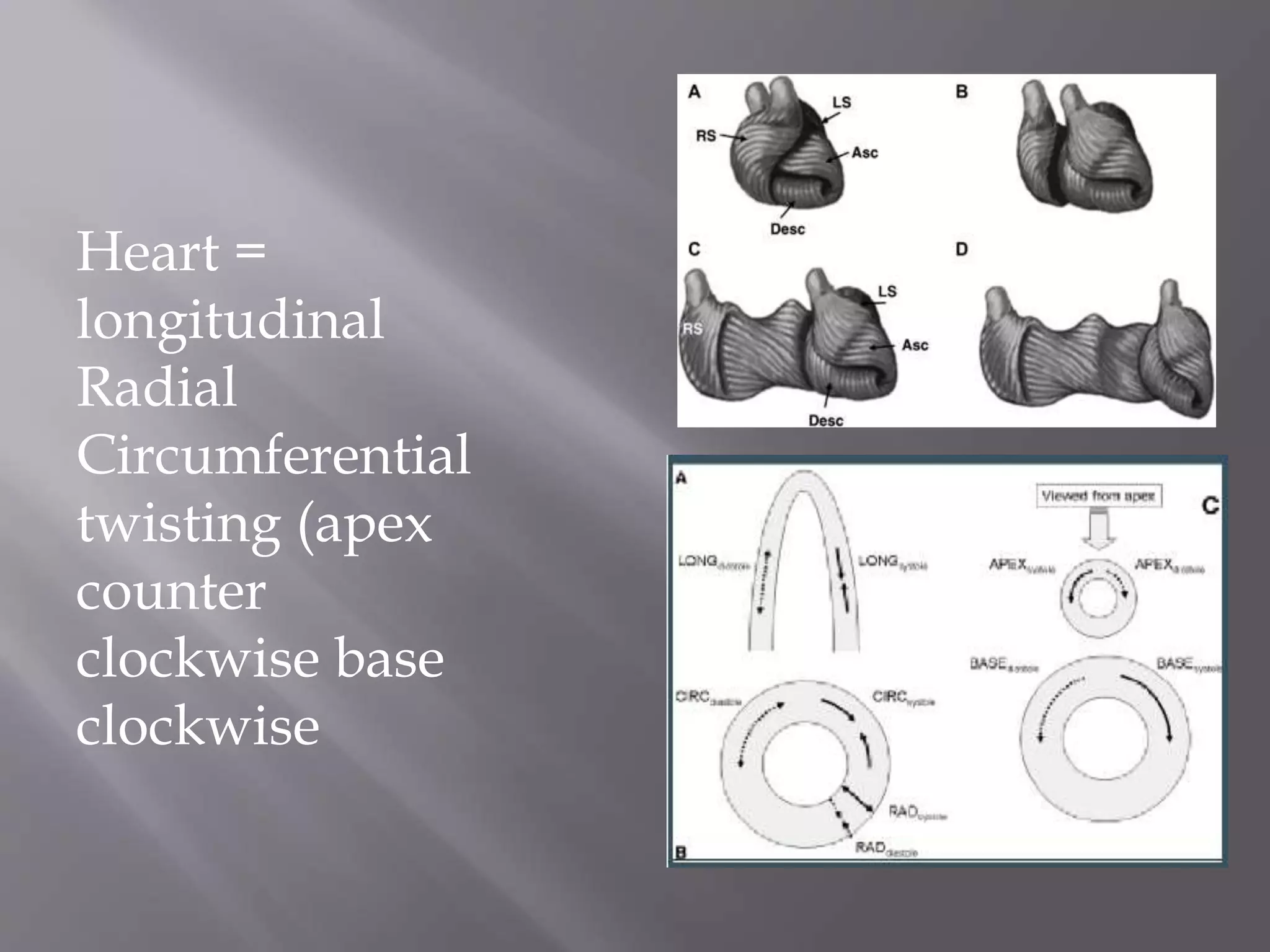
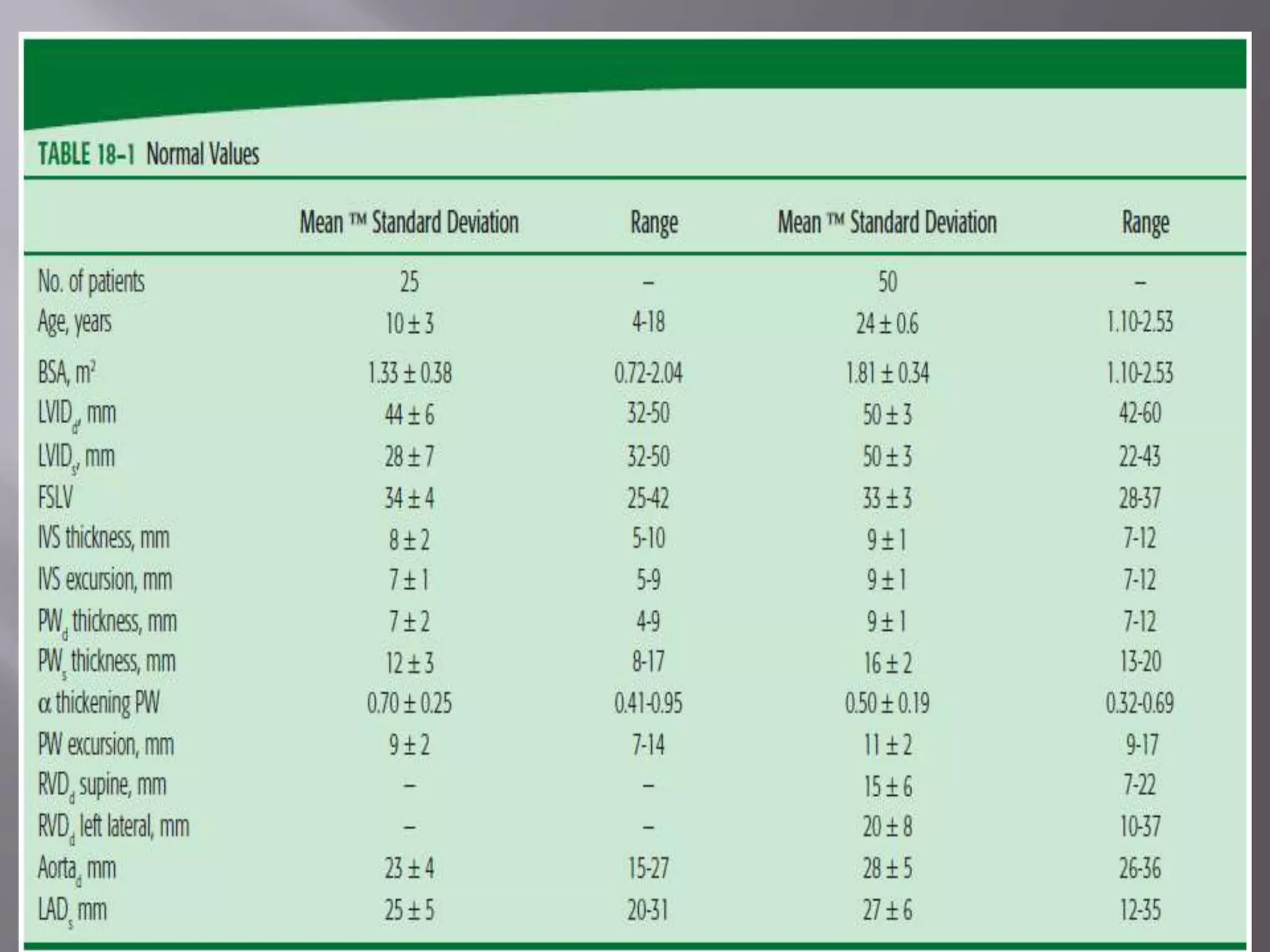
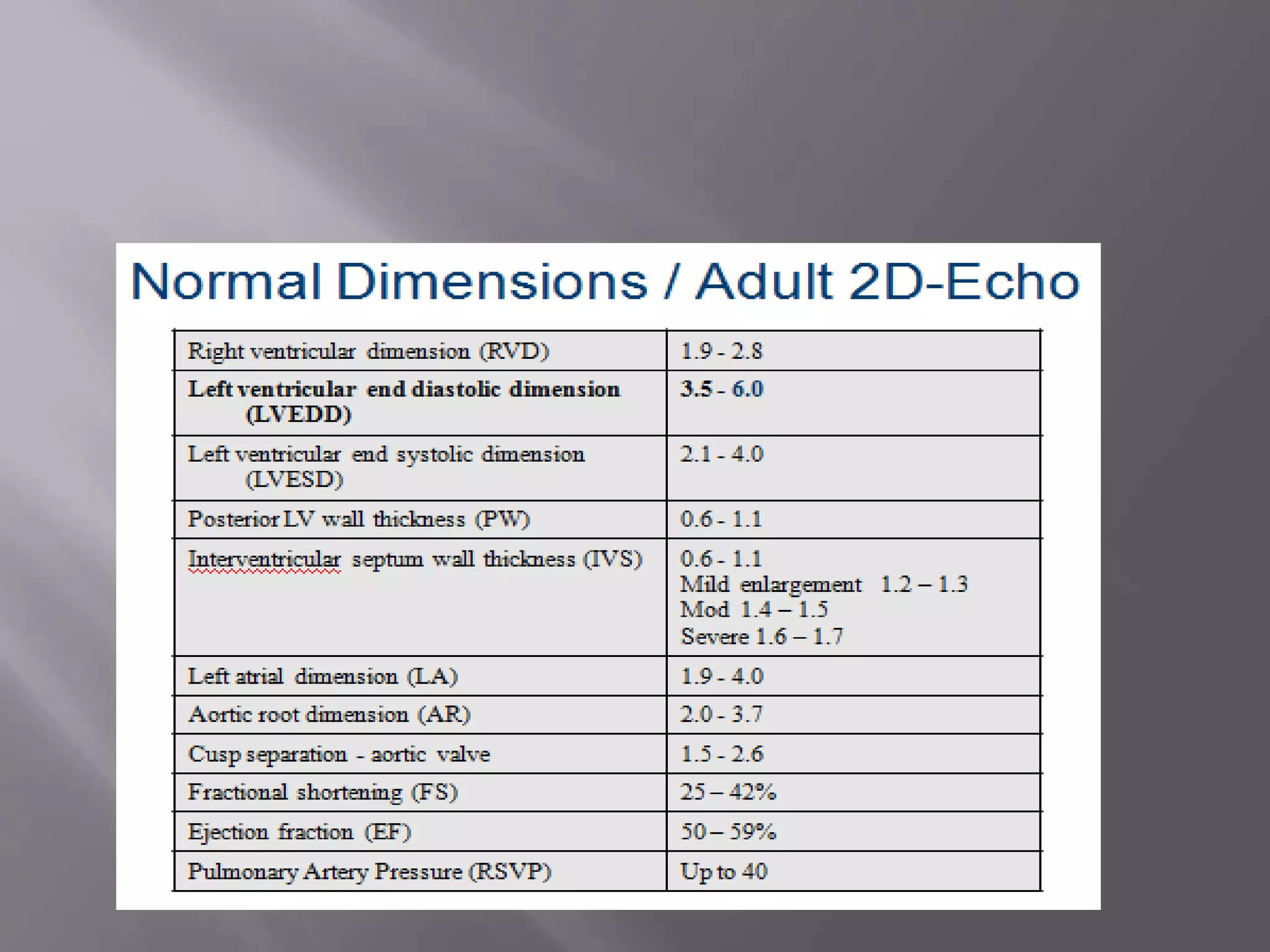
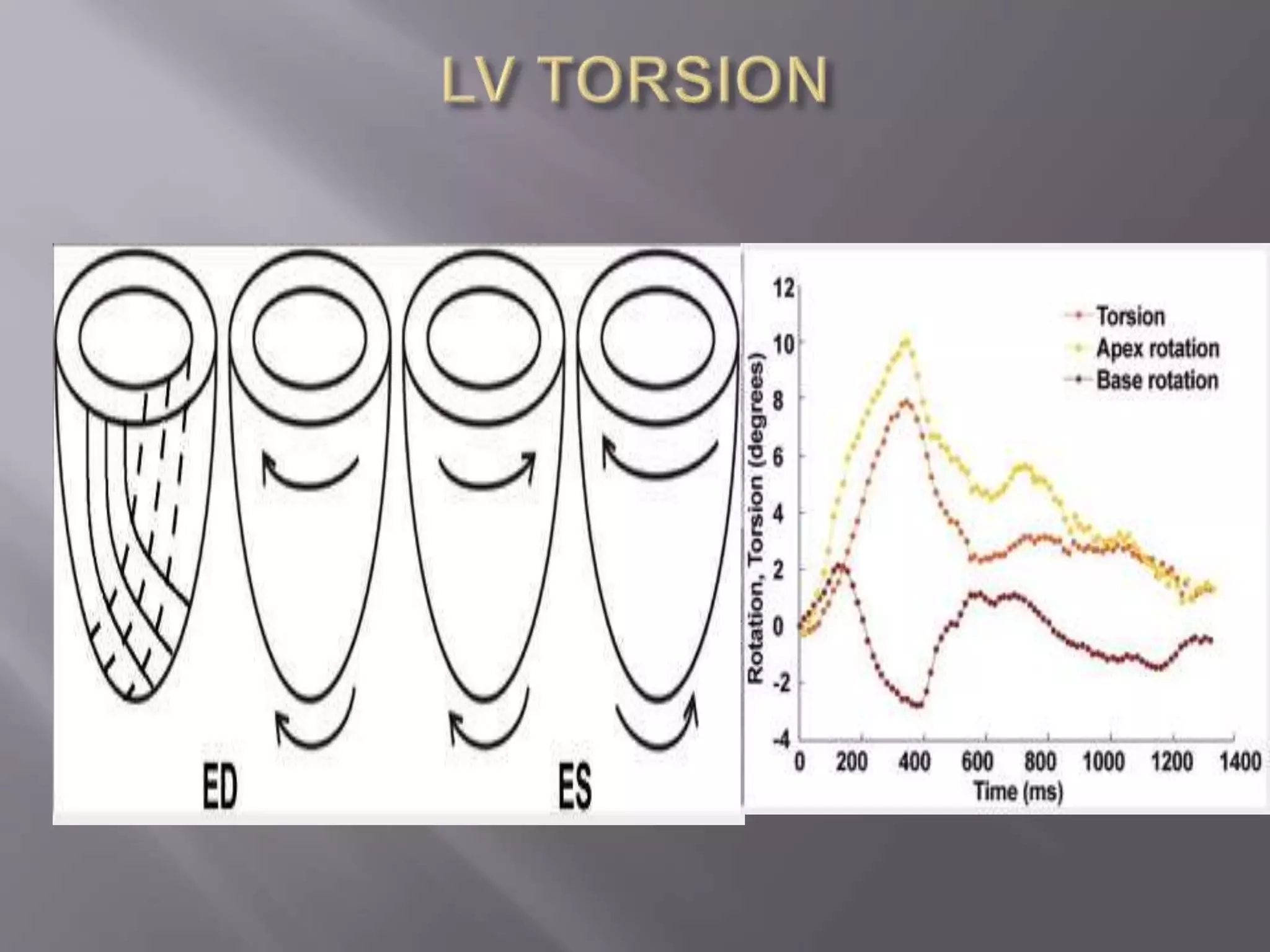
Heart =
longitudinal
Radial
Circumferential
twisting (apex
counter
clockwise base
clockwise
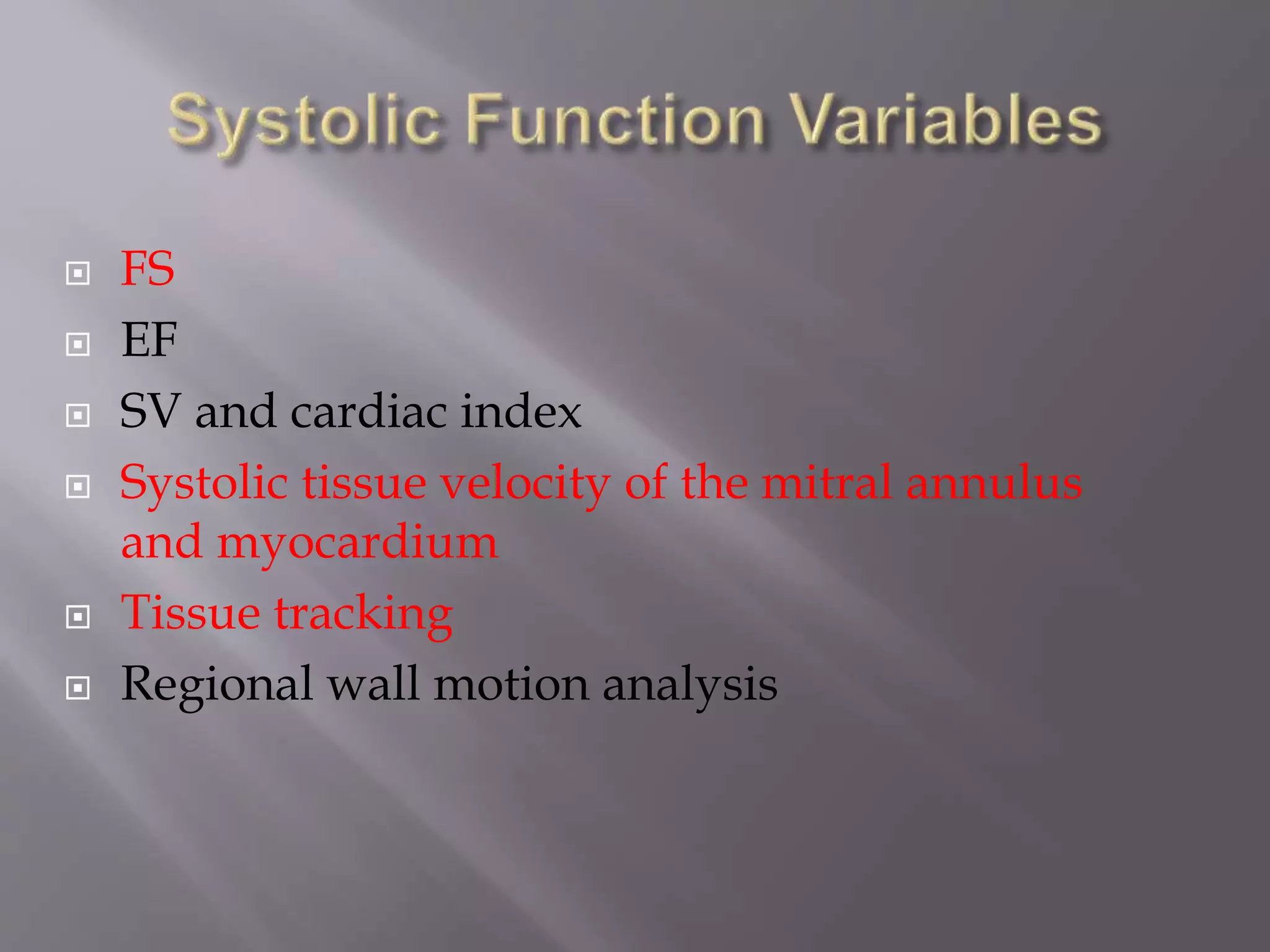
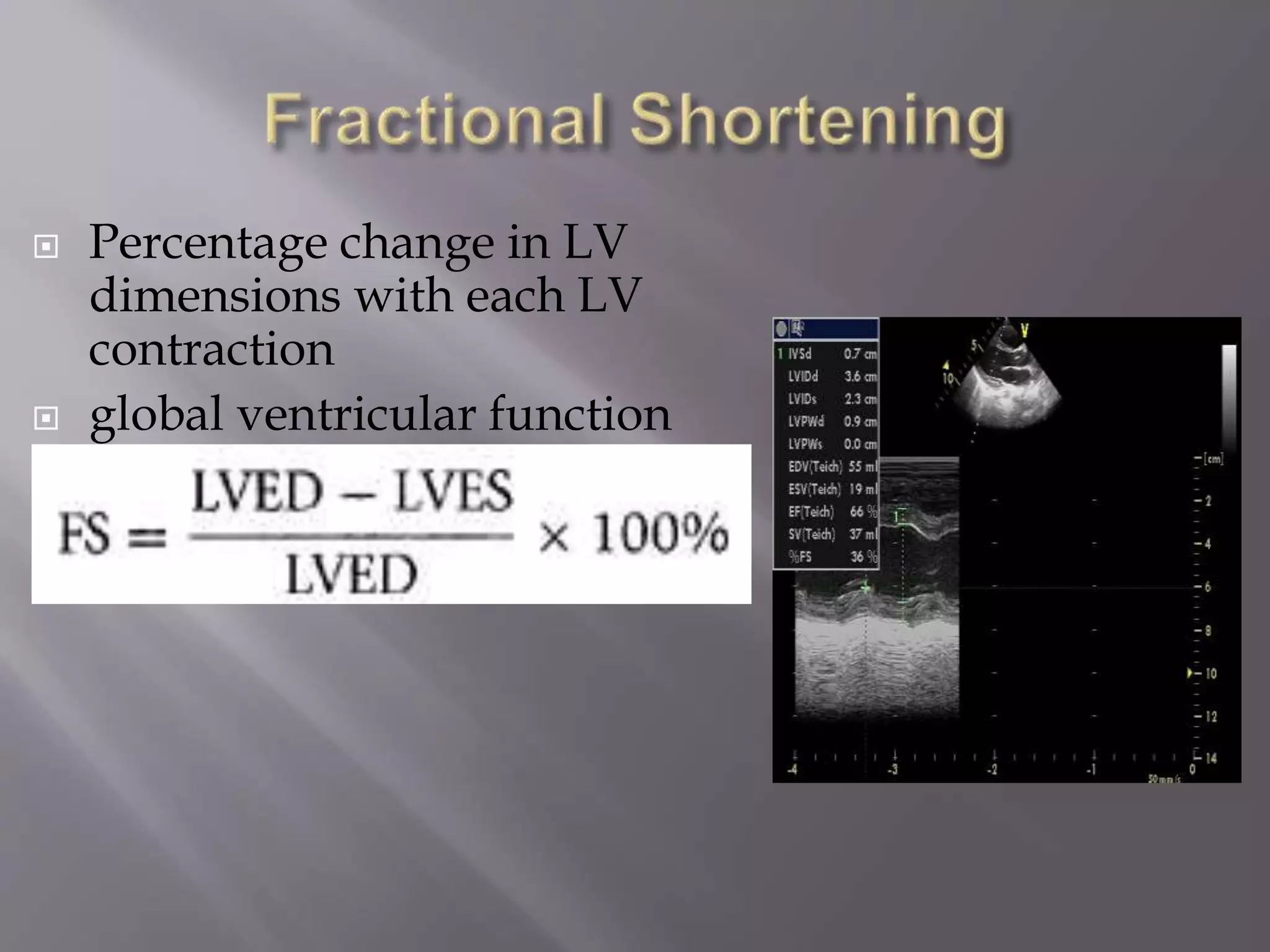
 FS
 EF
 SV and cardiac index
 Systolic tissue velocity of the mitral annulus
and myocardium
 Tissue tracking
 Regional wall motion analysis
 Percentage change in LV
dimensions with each LV
contraction
 global ventricular function
 only at the level being interrogated
 If regional dysfunction is present, which is not in the
interrogation plane-misleading estimate
 global LV function
 eyeballing e
 inter-observer variation
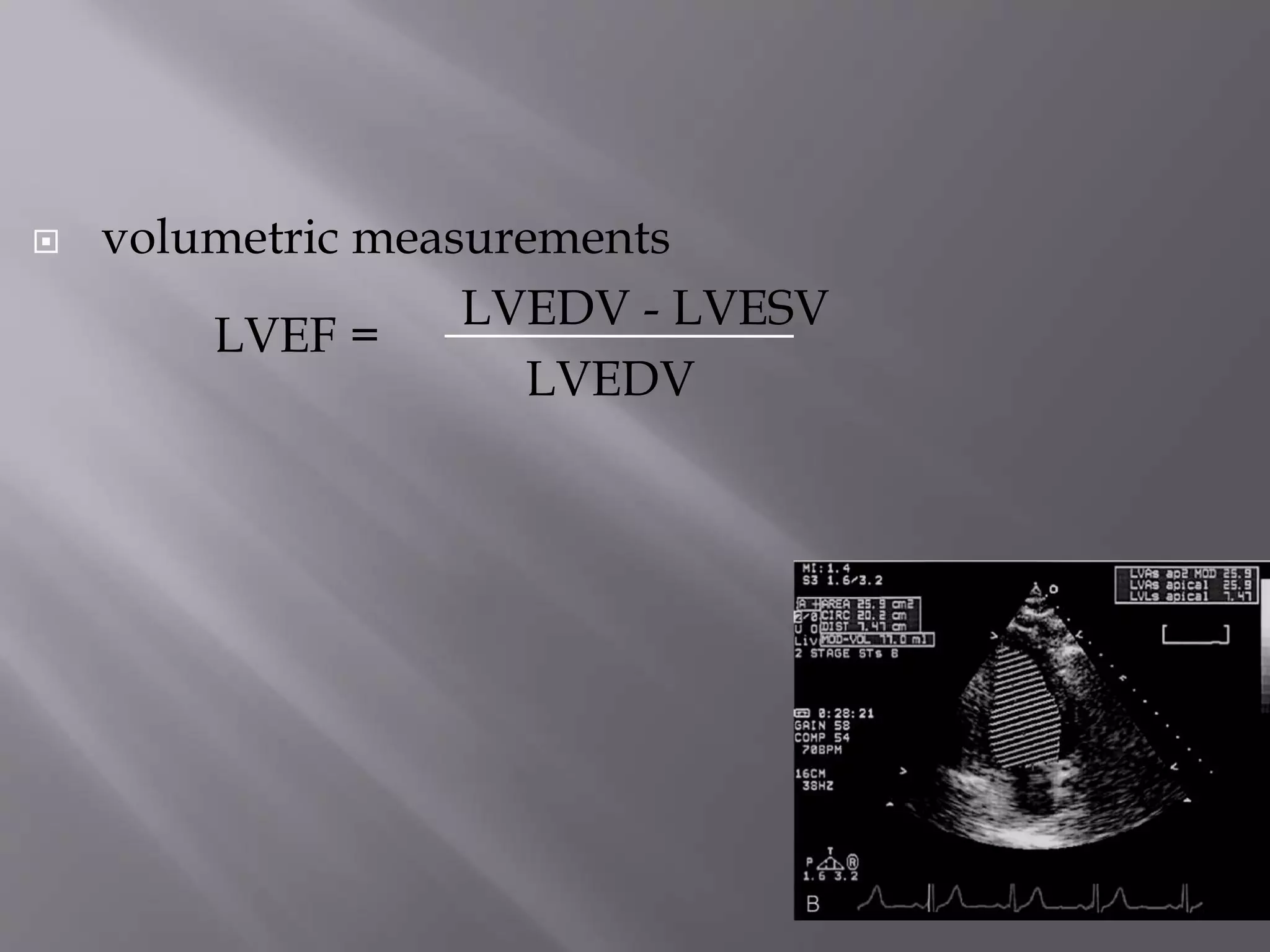
 volumetric measurements
LVEDV - LVESV
LVEDV
LVEF =

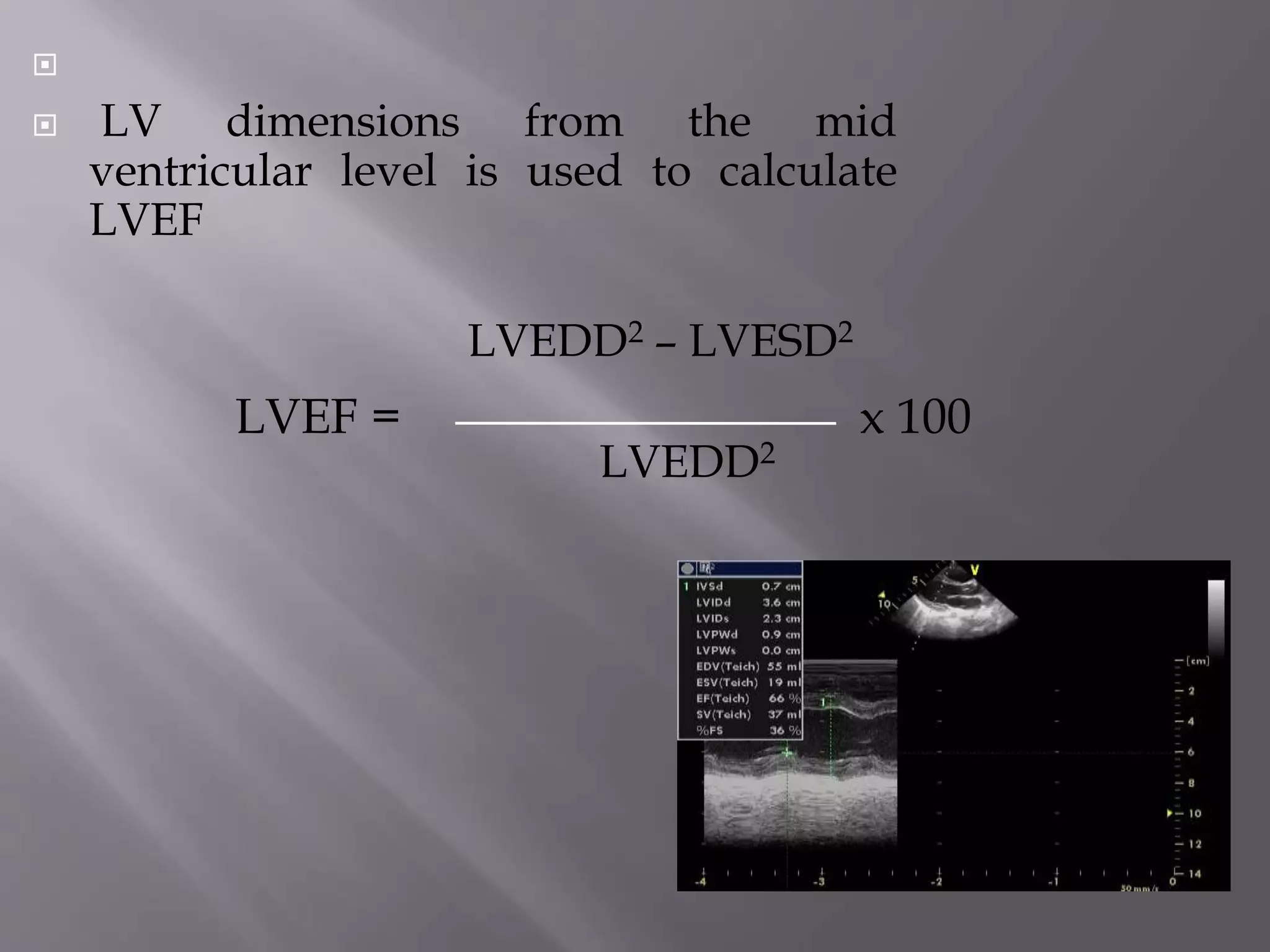
 LV dimensions from the mid
ventricular level is used to calculate
LVEF
LVEDD2 – LVESD2
LVEDD2
LVEF = x 100
 Not a true indicator of systolic function
 Determined by multiple factors
 amount of blood volume ejected with each
cardiac cycle
 difference between the LV end-diastolic
volume and LV end-systolic volume obtained
by the Simpson method
 difference should be equal to SV across the
LVOT if there is no valvular regurgitation
 If there is MR, regurgitant volume needs to be
subtracted to obtain stroke volume across the
LVOT
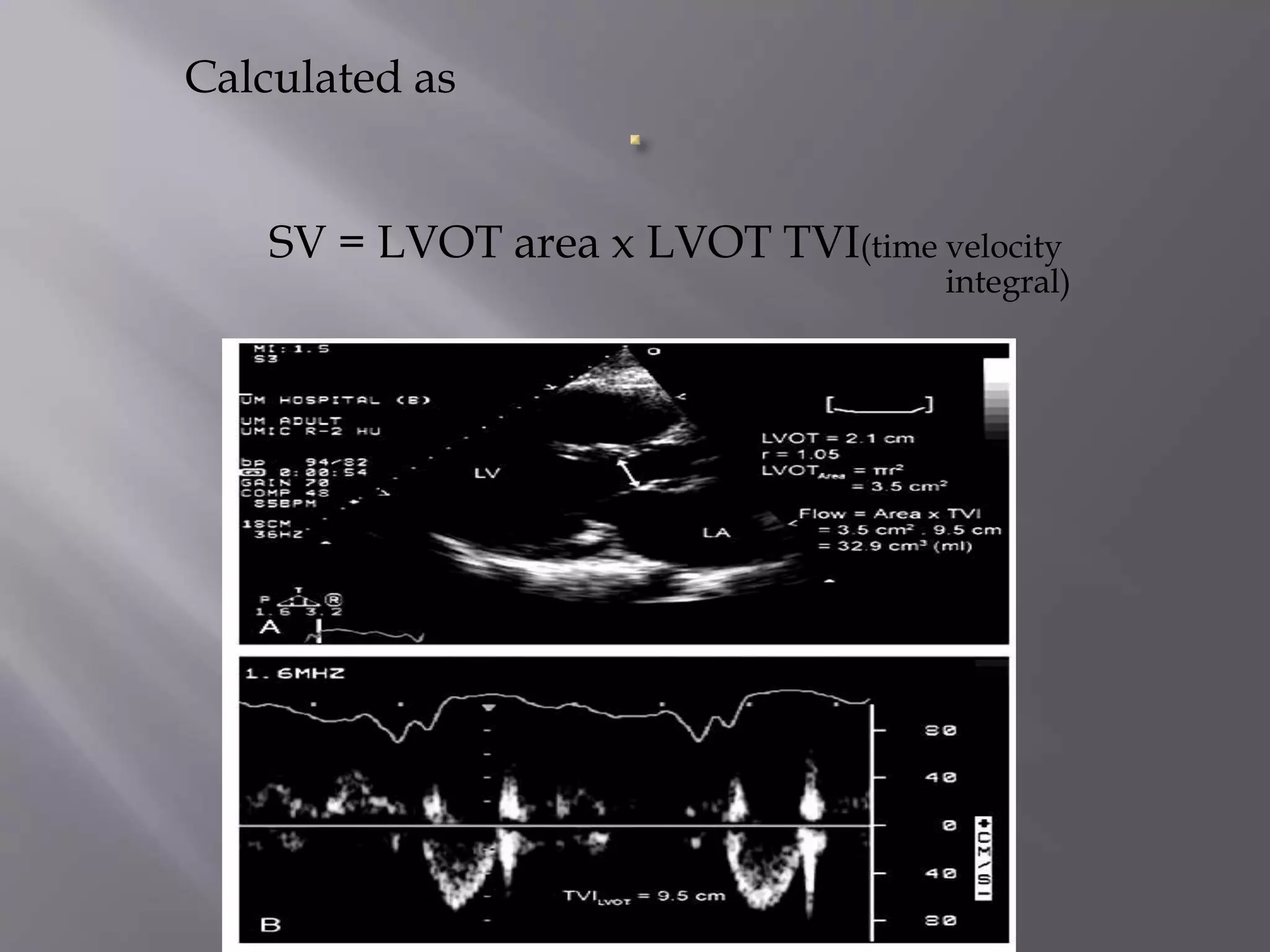
Calculated as
SV = LVOT area x LVOT TVI(time velocity
integral)

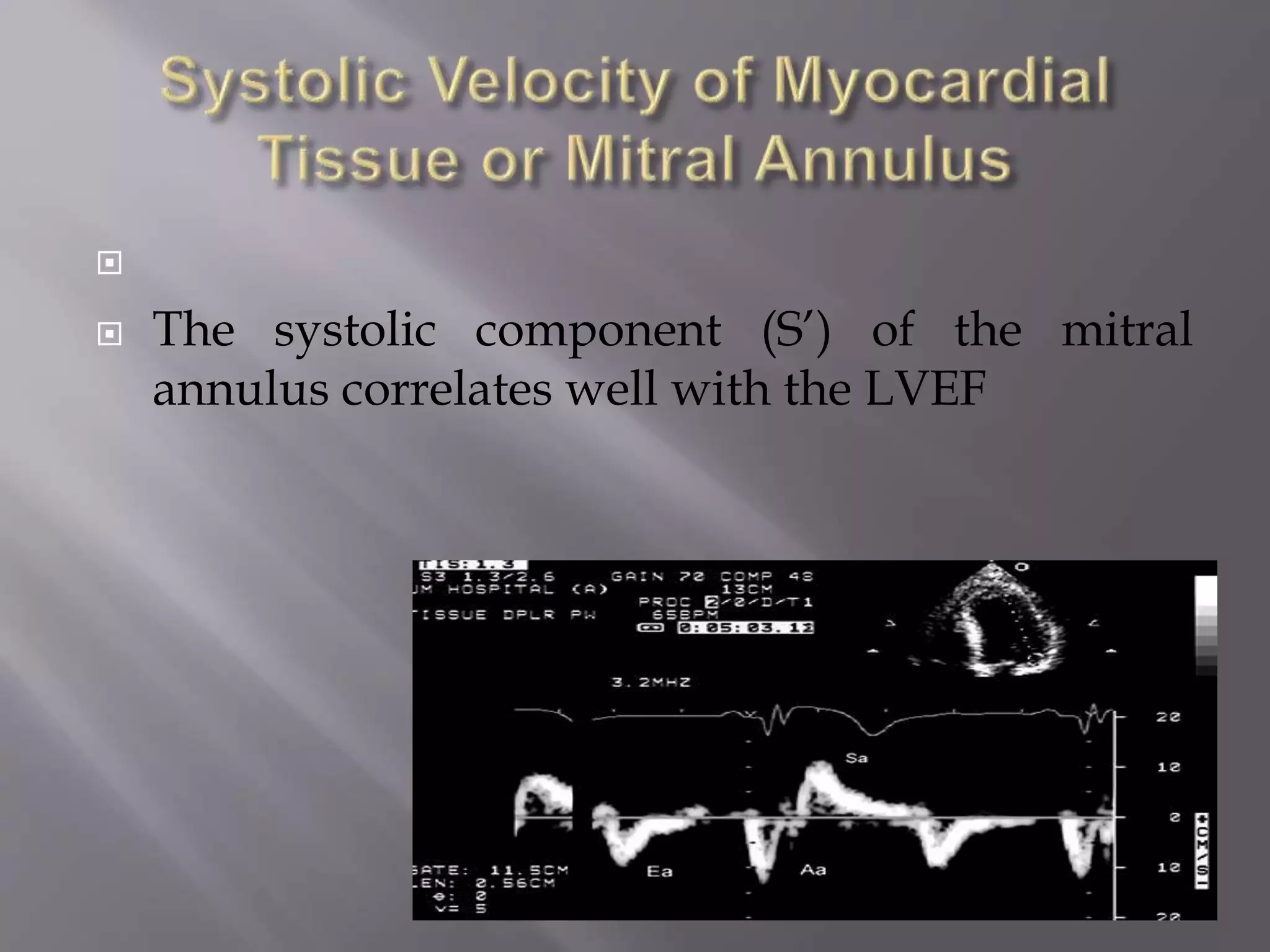
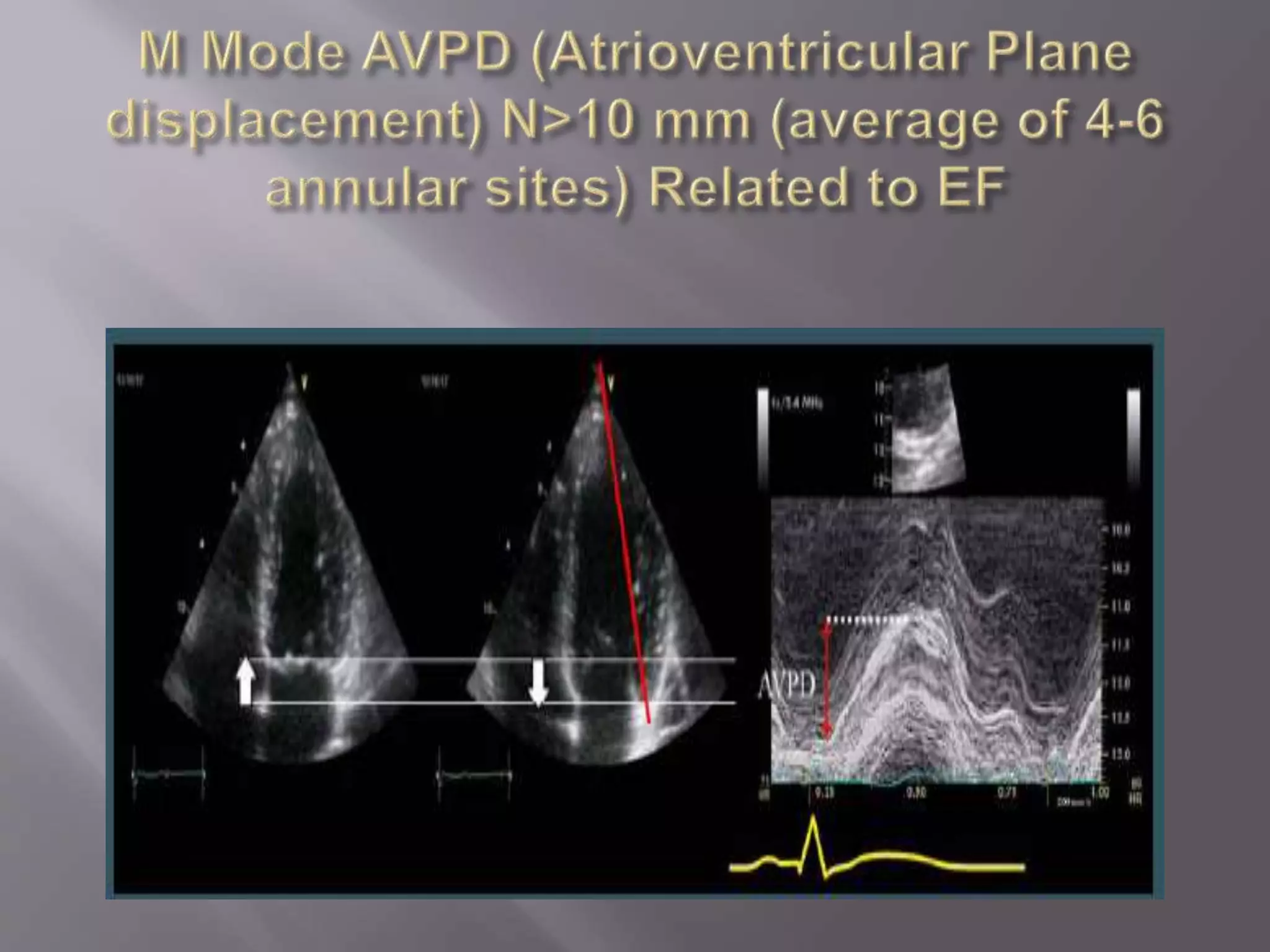
 The systolic component (S’) of the mitral
annulus correlates well with the LVEF
 Mitral anulus displacement -tissue tracking
 Normal mitral annular systolic motion is
>8mm (average 12 + 2 on apical 4 or apical 2
views)
 systolic mitral anulus displacement of < 5 cm
= LVEF (<30%)
 8cm/s --cutoff point

Estimation of global left ventricular function from the velocity of longitudinal shortening.
Echocardiography 2002;19(3):177-185
 Systolic contraction of the ventricles is
performed optimally when regional
contractions are coordinated
 All walls should contract within 20 to 30
milliseconds of each other
 Disrupted by conduction delay, atrial
fibrillation, or a pacemaker
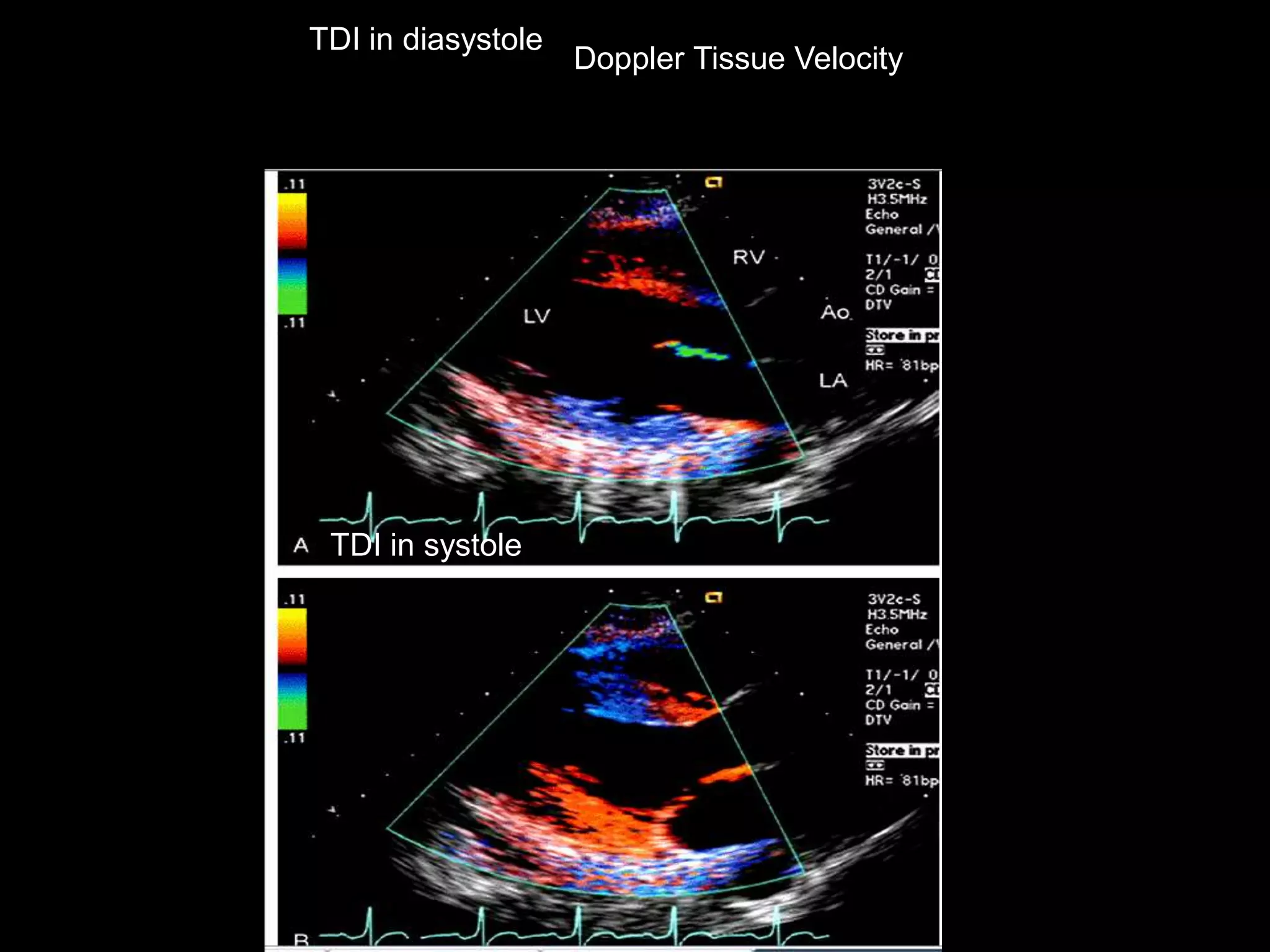
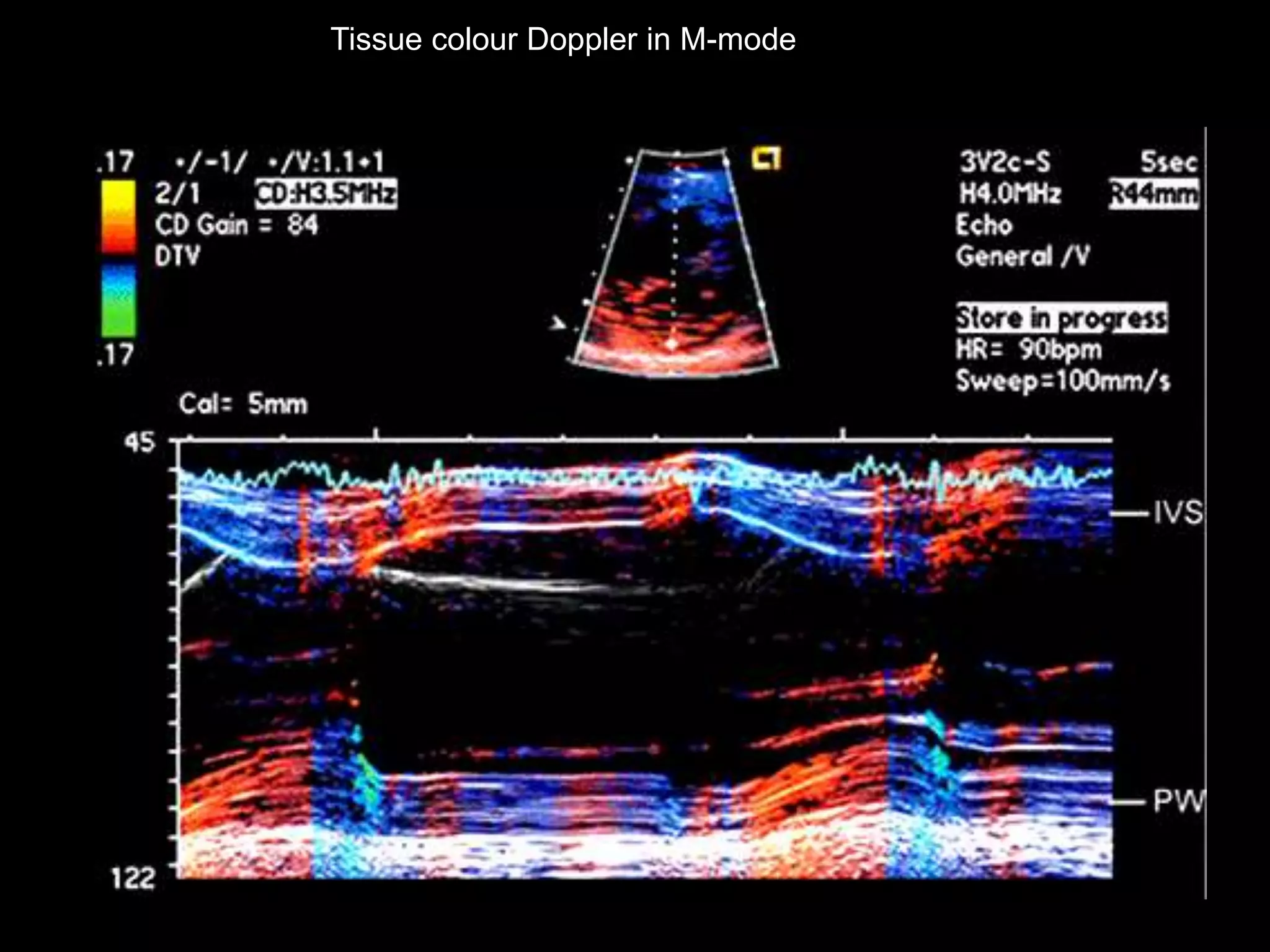
 tissue Doppler imaging-- timings of cardiac
events or myocardial movement
TDI in systole
TDI in diasystole
Doppler Tissue Velocity
Tissue colour Doppler in M-mode
 byproduct of tissue Doppler imaging
 Basoapical views of each ventricular segment
are displayed as seven color bands, with each
color representing a particular distance the
tissue moves during systole
 Tissue tracking provides a rapid assessment of
systolic motion
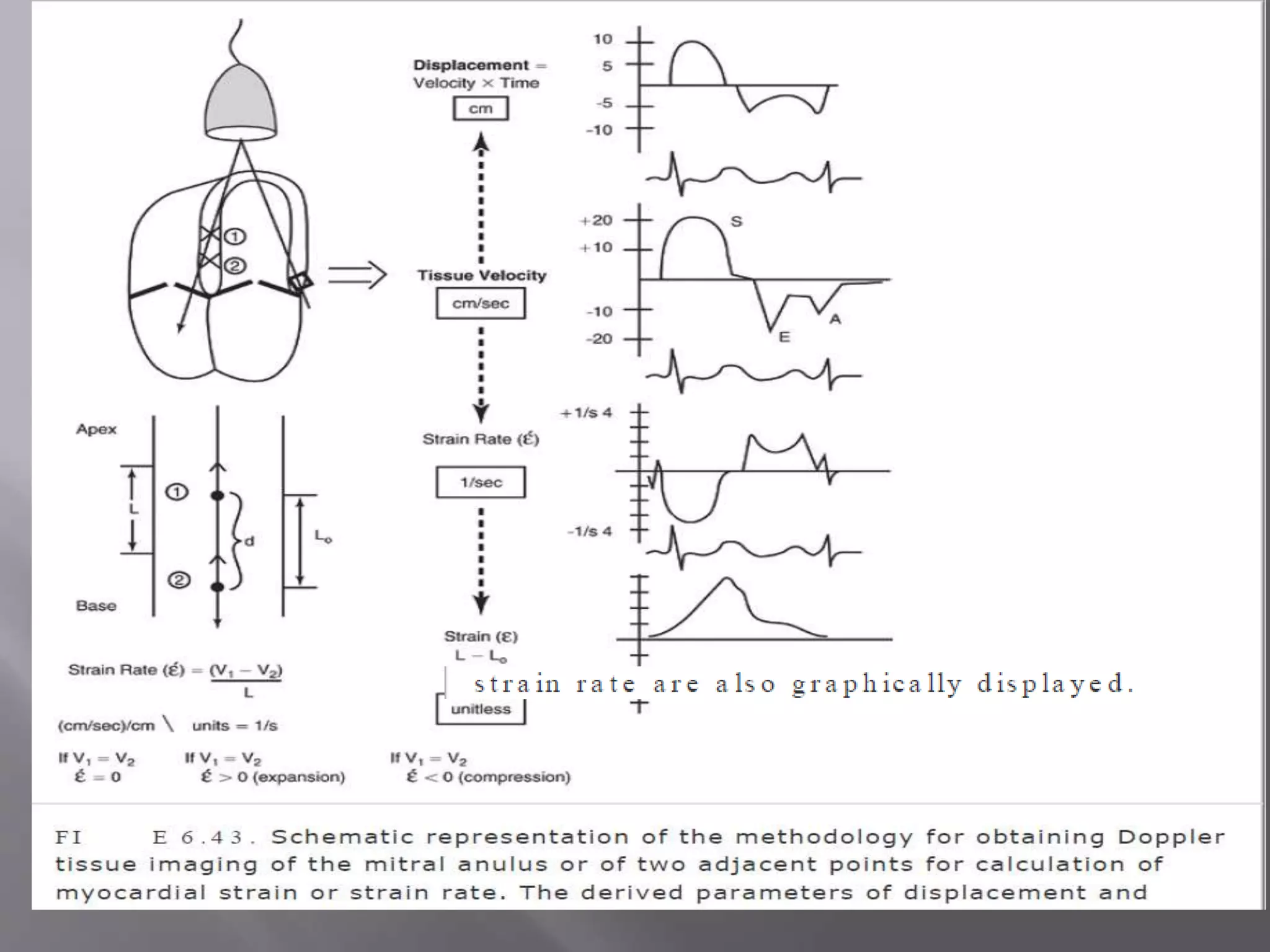
 The simplest to understand is displacement, defined as
excursion (in millimeters). (product of systolic velocity
and duration of contraction. )
 Strain rate imaging is a newly developed variation of
DTI that provides a high-resolution evaluation of
regional myocardial function.
 Strain rate is defined as the instantaneous rate of
change in the two velocities divided by the
instantaneous distance between the two points.
 Positive strain rate represents active contraction and
negative values, relaxation or lengthening between the
two points.
 strain rate has been demonstrated to be a more
sensitive and earlier indicator of regional dysfunction
than many routine techniques.
 Strain rate imaging has tremendous temporal
resolution as well and can be used to demonstrate
subtle phenomena such as postsystolic contraction.
 Normal ventricular contraction consists of
simultaneous myocardial thickening and
endocardial excursion toward the center of the
ventricle
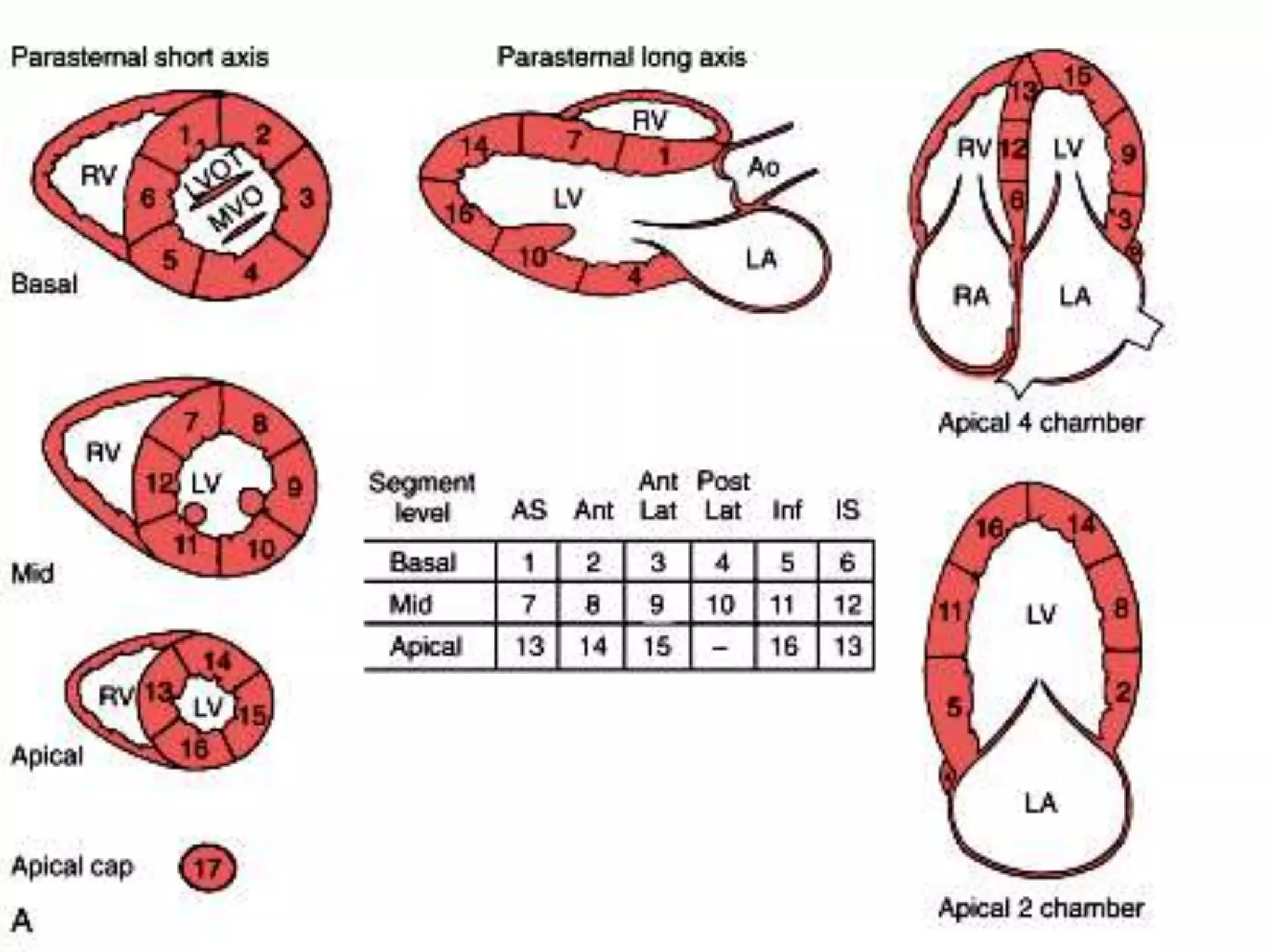
 Regional contractility or wall motion of the LV is
graded by dividing the LV into segments
 In 2002, a 17-segment model was recommended by
the American Society of Echocardiography
 LV is divided into three levels - basal, mid or
papillary and apical
Circulation, 2002;105: 539-542
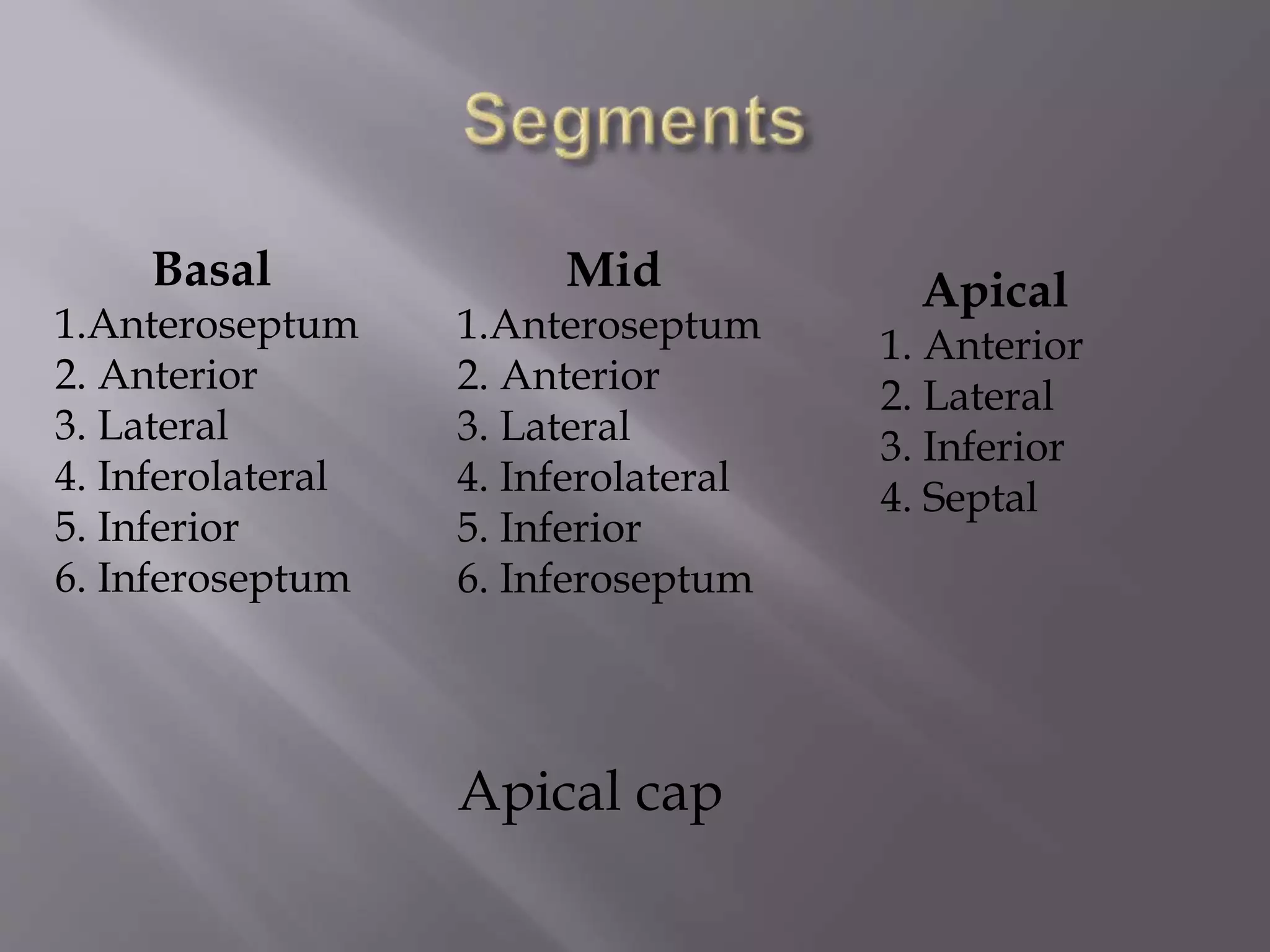
Basal
1.Anteroseptum
2. Anterior
3. Lateral
4. Inferolateral
5. Inferior
6. Inferoseptum
Mid
1.Anteroseptum
2. Anterior
3. Lateral
4. Inferolateral
5. Inferior
6. Inferoseptum
Apical
1. Anterior
2. Lateral
3. Inferior
4. Septal
Apical cap
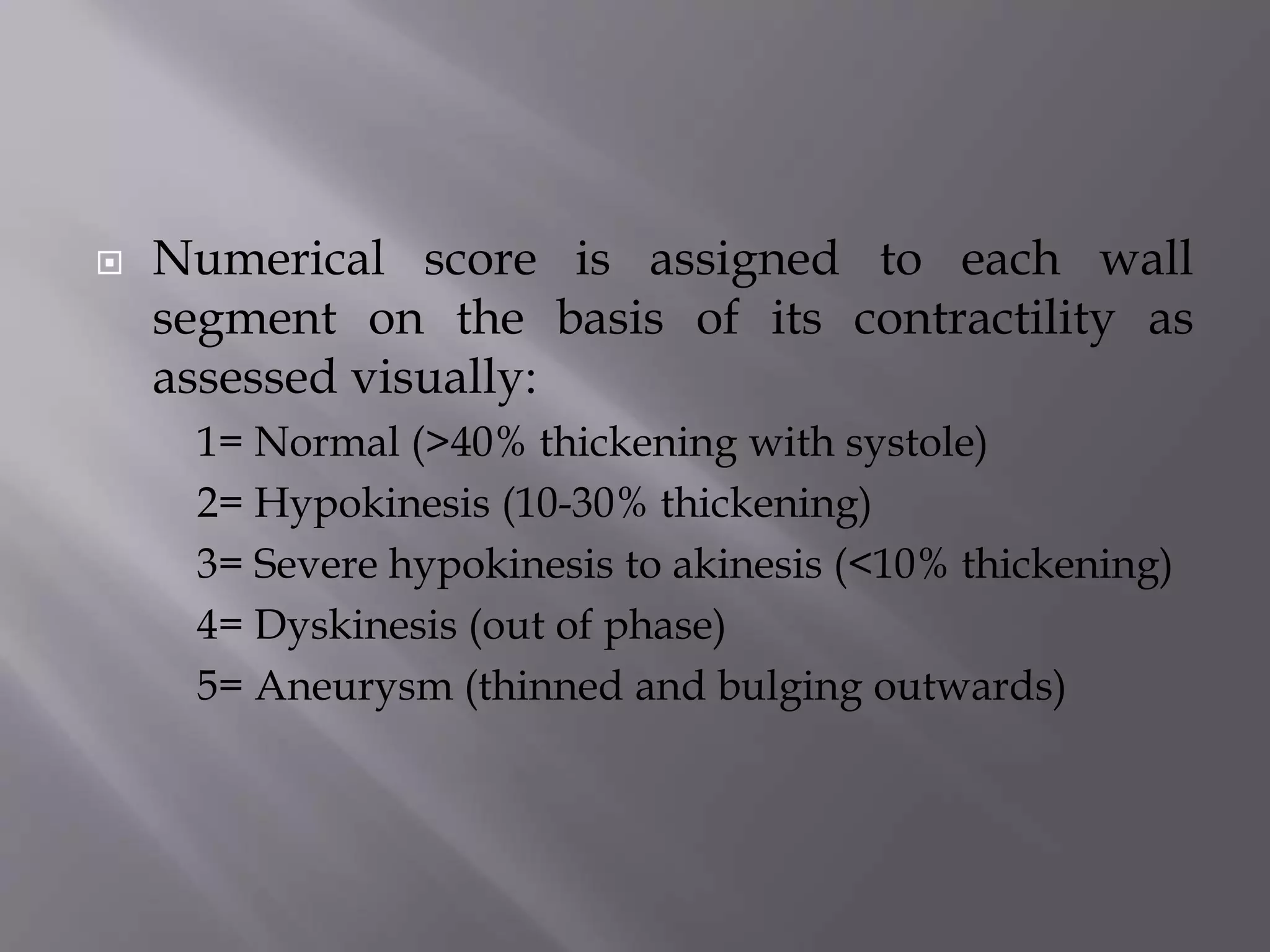
 Numerical score is assigned to each wall
segment on the basis of its contractility as
assessed visually:
1= Normal (>40% thickening with systole)
2= Hypokinesis (10-30% thickening)
3= Severe hypokinesis to akinesis (<10% thickening)
4= Dyskinesis (out of phase)
5= Aneurysm (thinned and bulging outwards)
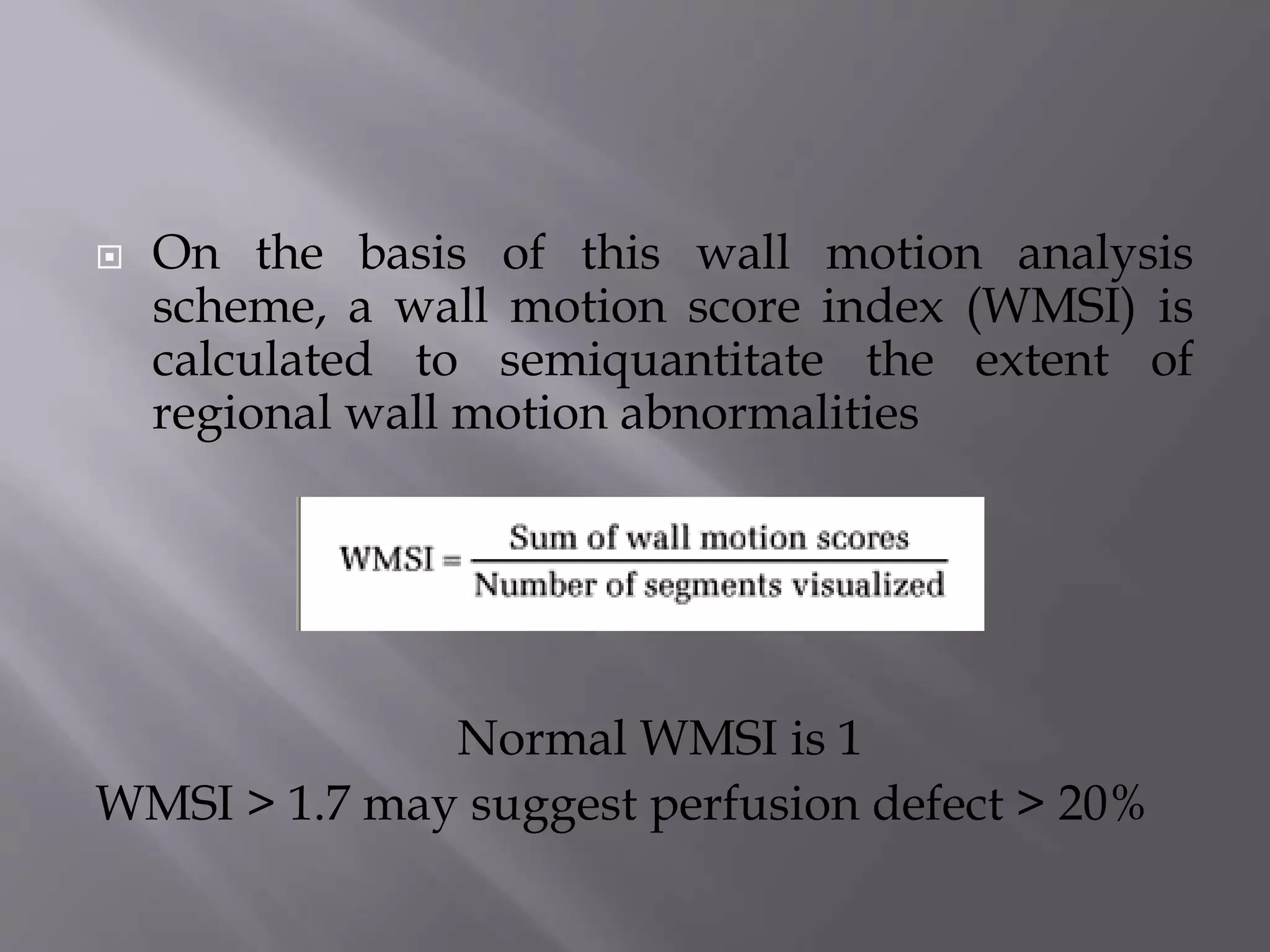
 On the basis of this wall motion analysis
scheme, a wall motion score index (WMSI) is
calculated to semiquantitate the extent of
regional wall motion abnormalities
Normal WMSI is 1
WMSI > 1.7 may suggest perfusion defect > 20%
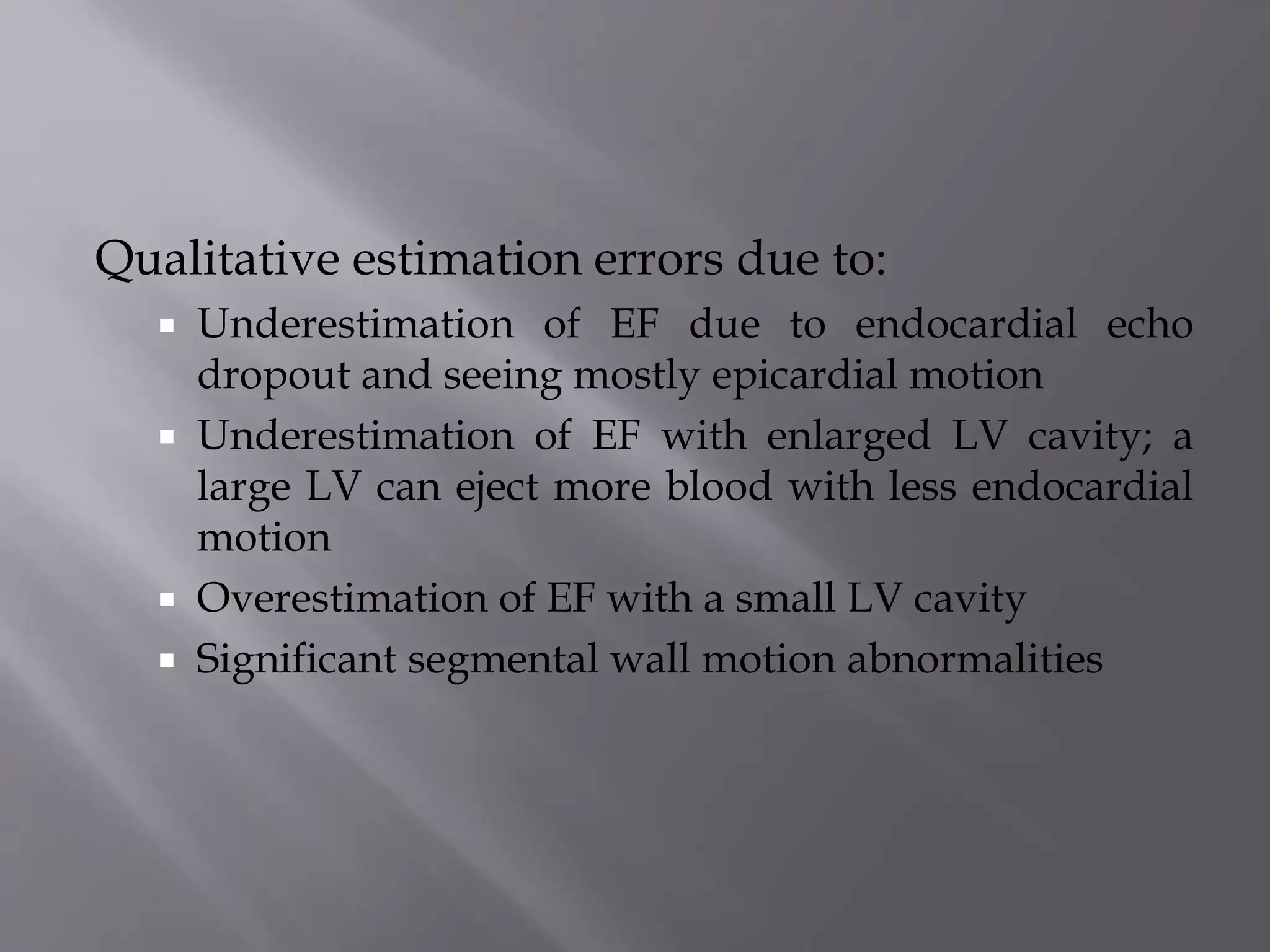
Qualitative estimation errors due to:
 Underestimation of EF due to endocardial echo
dropout and seeing mostly epicardial motion
 Underestimation of EF with enlarged LV cavity; a
large LV can eject more blood with less endocardial
motion
 Overestimation of EF with a small LV cavity
 Significant segmental wall motion abnormalities
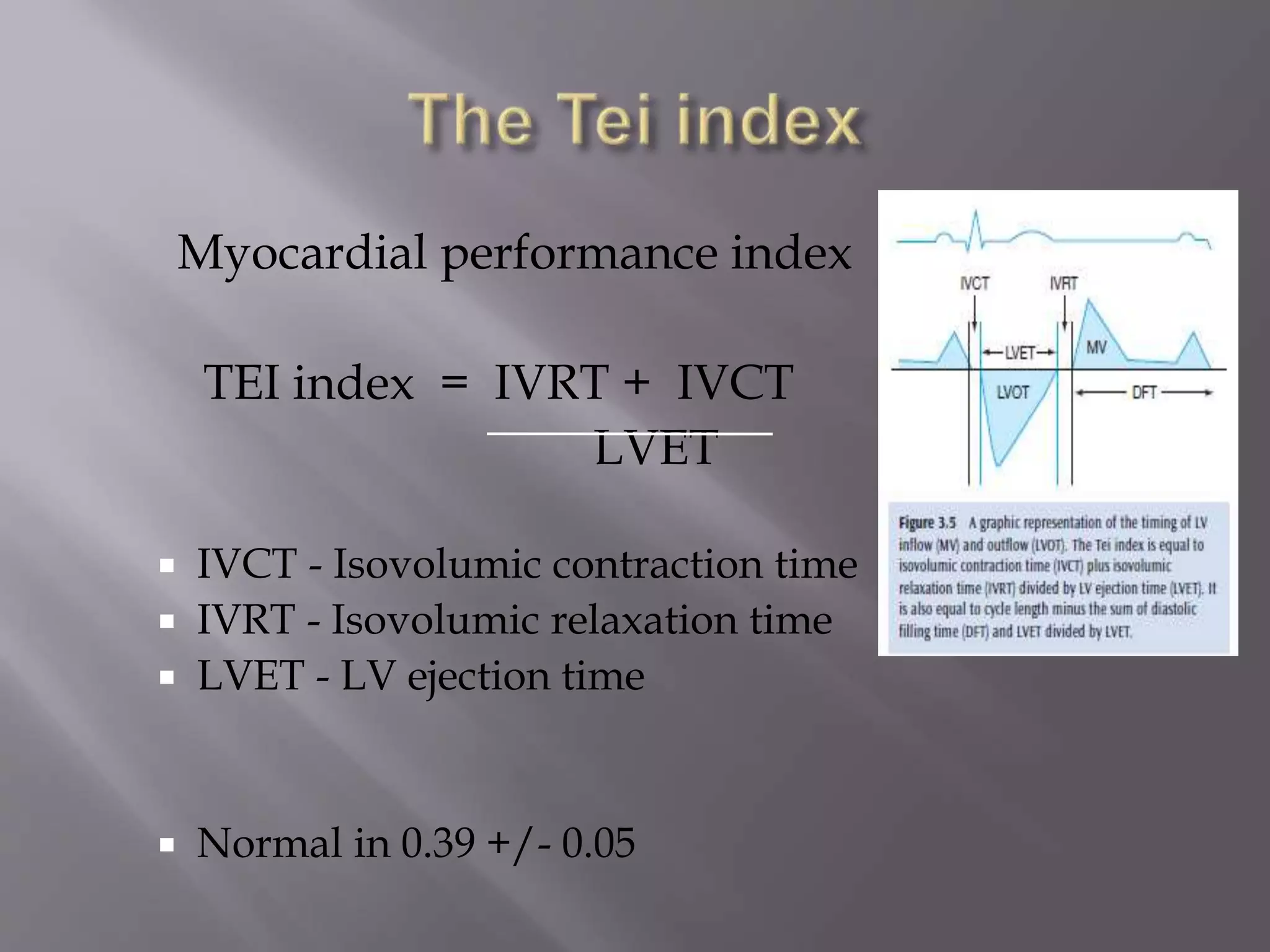
Myocardial performance index
TEI index = IVRT + IVCT
LVET
 IVCT - Isovolumic contraction time
 IVRT - Isovolumic relaxation time
 LVET - LV ejection time
 Normal in 0.39 +/- 0.05
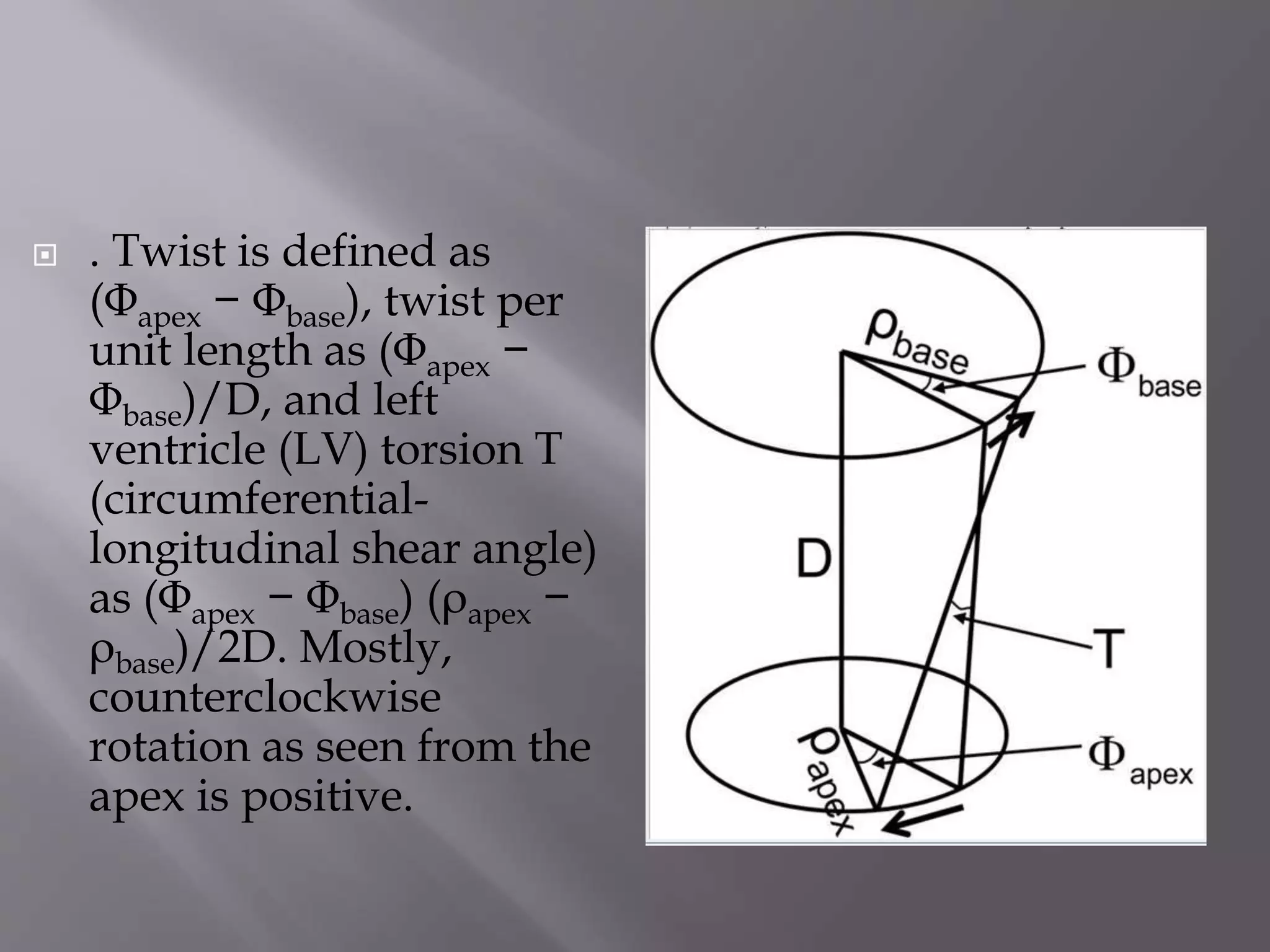
 . Twist is defined as
(Φapex − Φbase), twist per
unit length as (Φapex −
Φbase)/D, and left
ventricle (LV) torsion T
(circumferential-
longitudinal shear angle)
as (Φapex − Φbase) (ρapex −
ρbase)/2D. Mostly,
counterclockwise
rotation as seen from the
apex is positive.
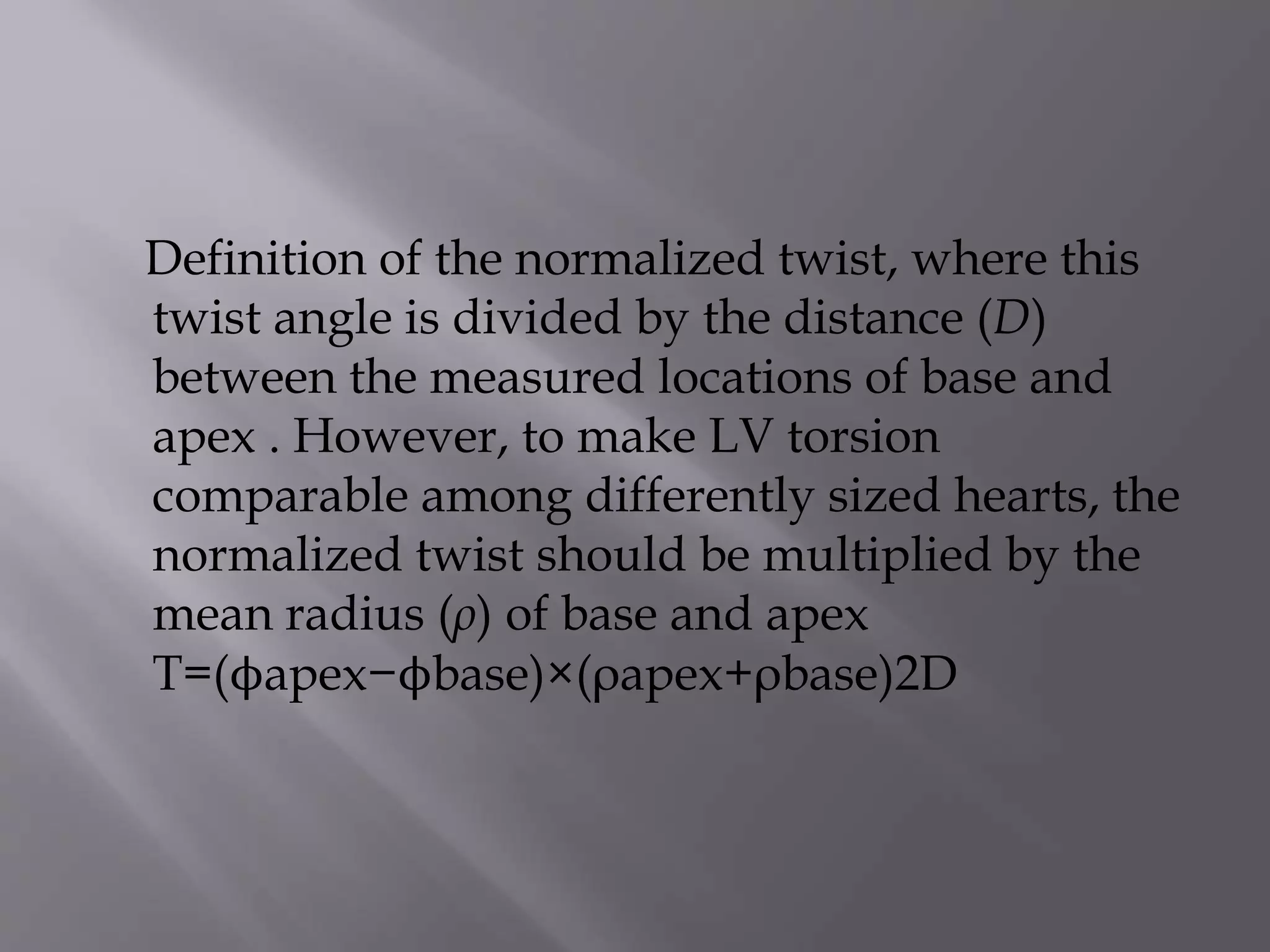
Definition of the normalized twist, where this
twist angle is divided by the distance (D)
between the measured locations of base and
apex . However, to make LV torsion
comparable among differently sized hearts, the
normalized twist should be multiplied by the
mean radius (ρ) of base and apex
T=(ϕapex−ϕbase)×(ρapex+ρbase)2D
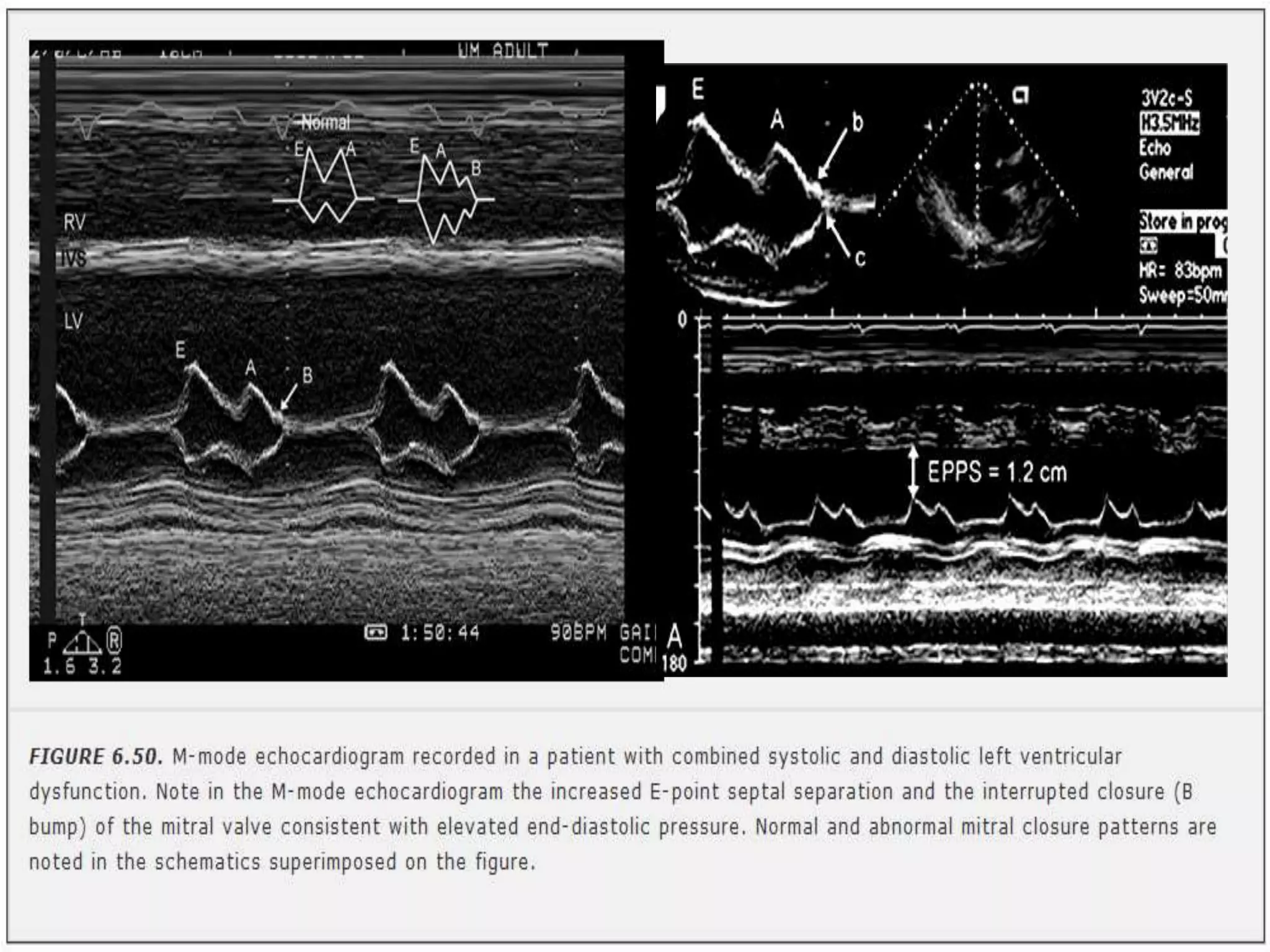
1. E-point septal separation
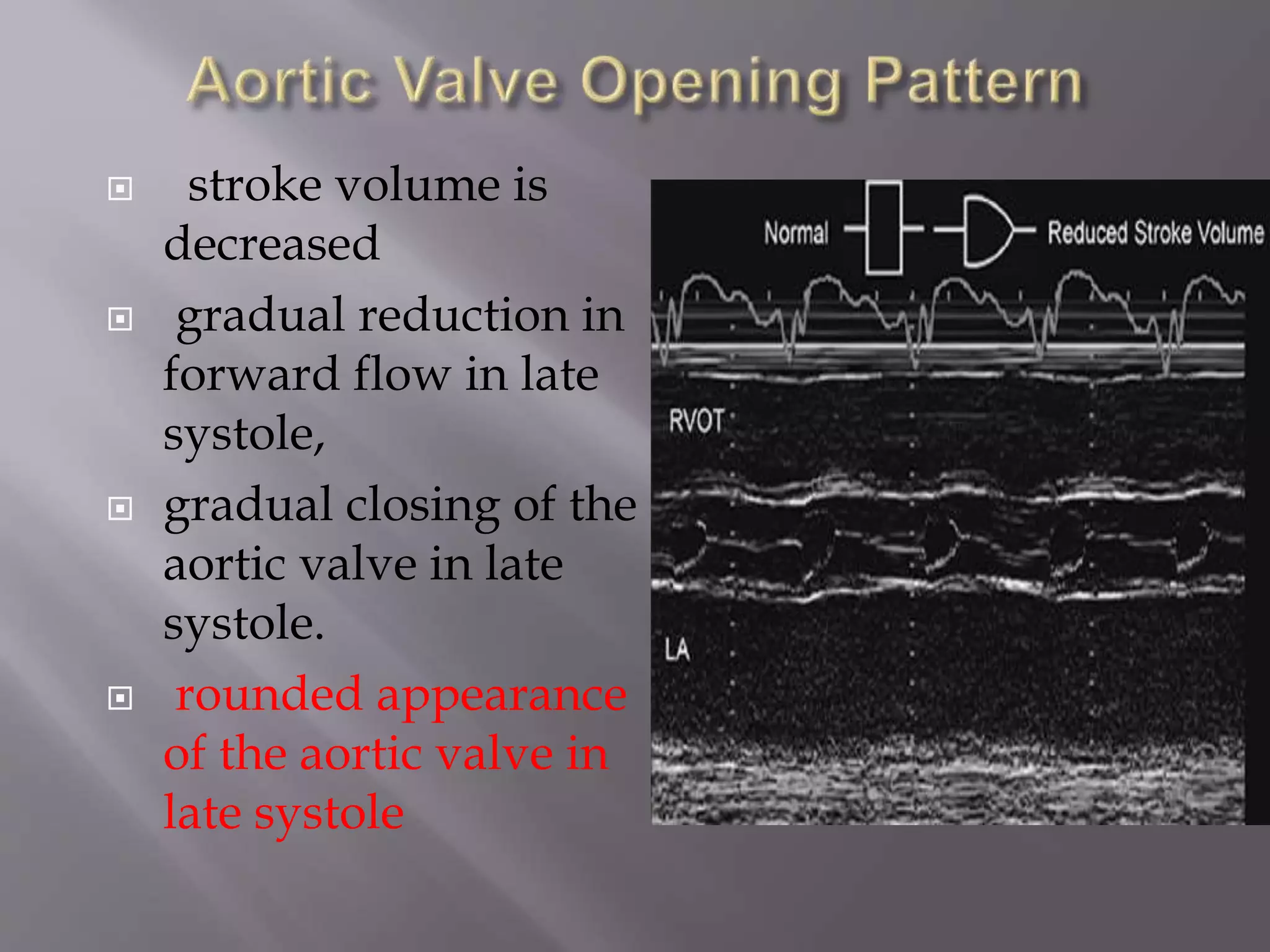
2. Aortic valve opening pattern
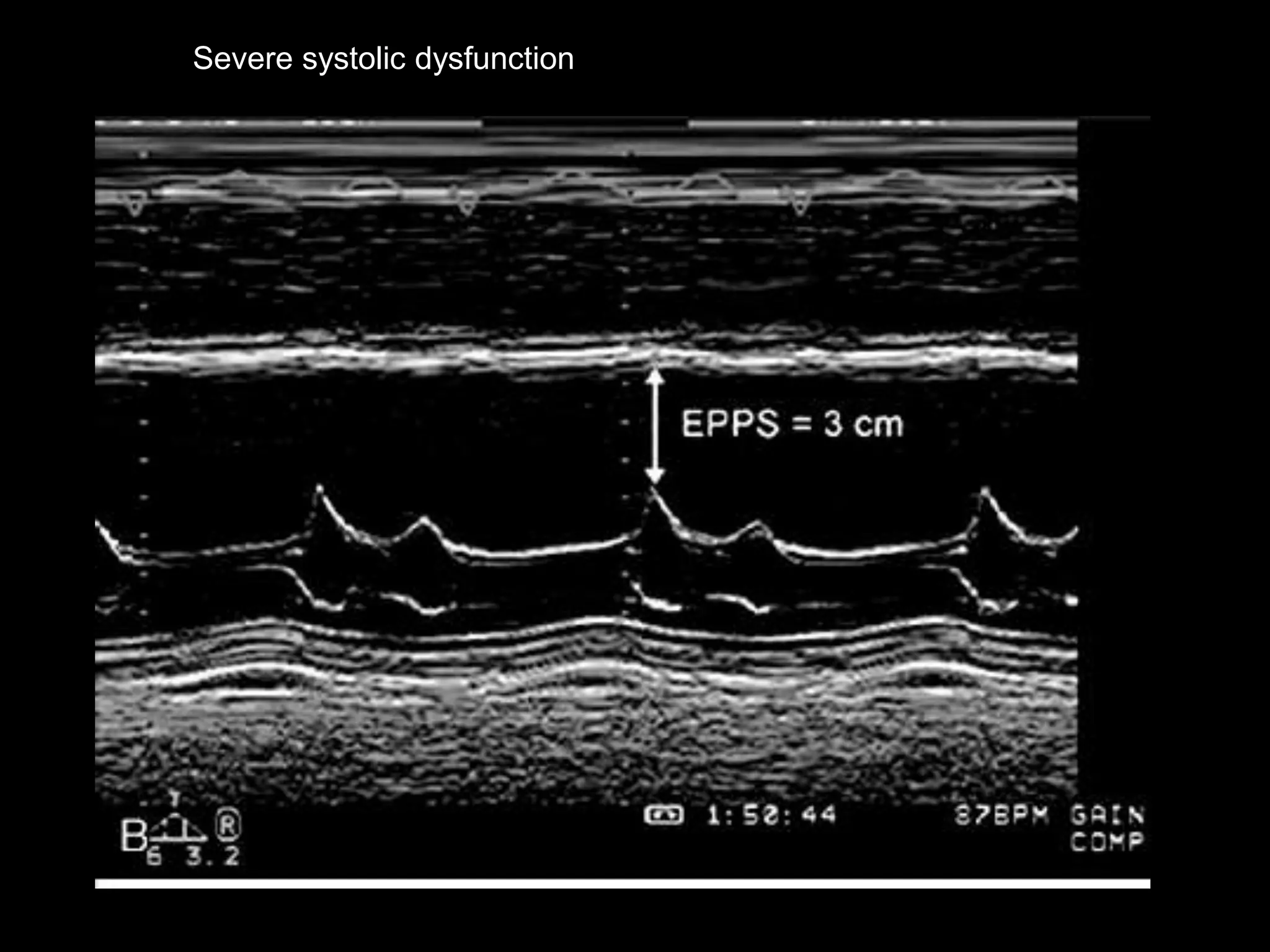
 magnitude of opening of the mitral valve=E-
wave height, correlates with transmitral flow
and, in the absence of significant MR, with LV
SV
 Mitral valve E point (maximal early opening) -
within 6 mm of the left side of the ventricular
septum
 decreased ejection fraction-distance is
increased
Severe systolic dysfunction
 stroke volume is
decreased
 gradual reduction in
forward flow in late
systole,
 gradual closing of the
aortic valve in late
systole.
 rounded appearance
of the aortic valve in
late systole
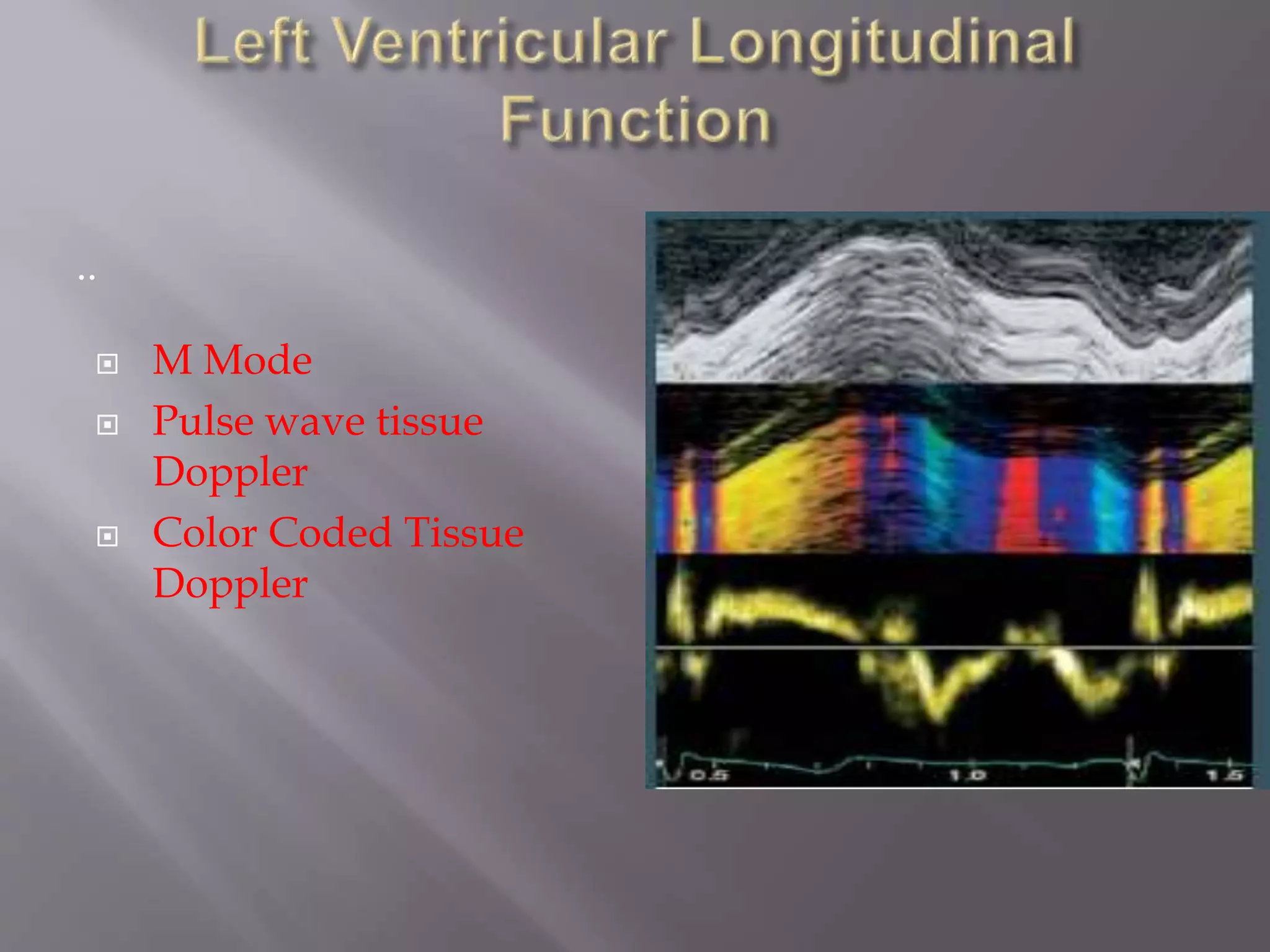
.. .
 M Mode
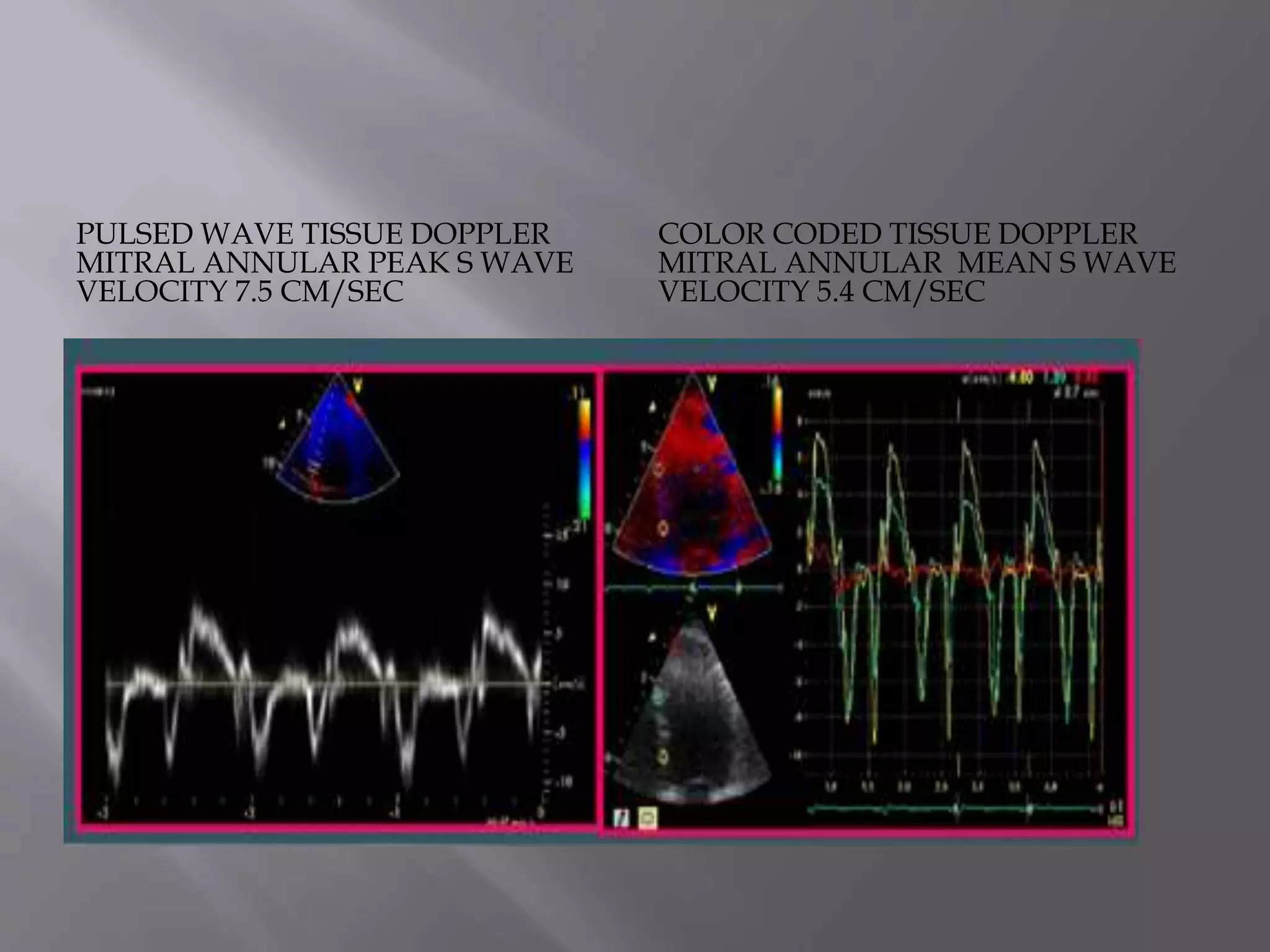
 Pulse wave tissue
Doppler
 Color Coded Tissue
Doppler
PULSED WAVE TISSUE DOPPLER
MITRAL ANNULAR PEAK S WAVE
VELOCITY 7.5 CM/SEC
COLOR CODED TISSUE DOPPLER
MITRAL ANNULAR MEAN S WAVE
VELOCITY 5.4 CM/SEC
Diastolic Function
rate and time course of blood flow from LA to
LV is determined by
1.Pressure difference along the path
2.Ventricular relaxation
3.Relative compliances of the two chambers
Basic Principle
Basic Principle
1.Ventricular relaxation
2.Myocardial compliance and Chamber
Compliance
3. LV-EDP
4.Ventricular Diastolic filling
5.Atrial Pressures and Filling
Parameters of Diastolic Function
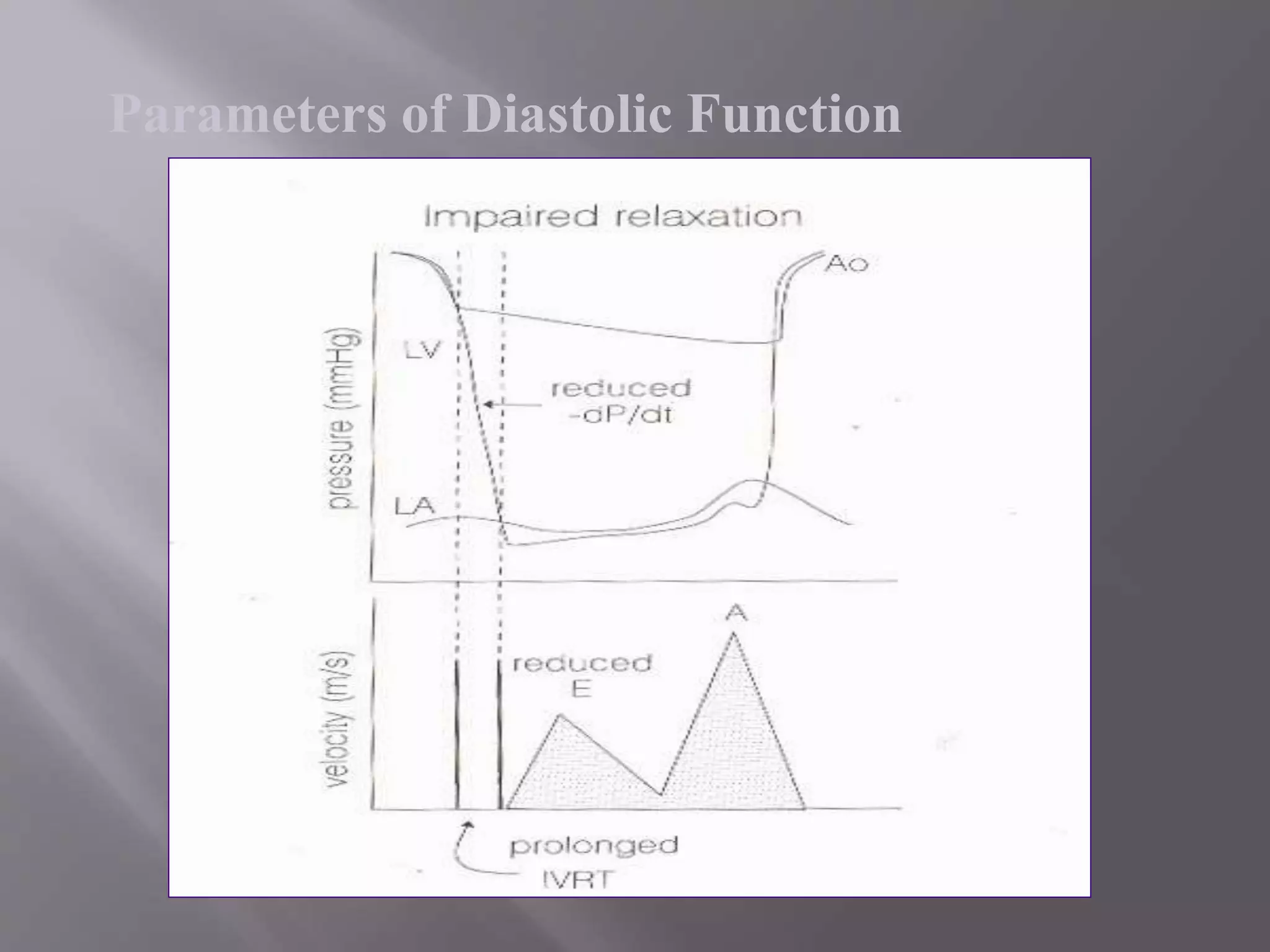
Ventricular Relaxation
-occurs during IVR and early diastolic filling
-active process involving utilization of energy of the
myocardium.
The measure of Ventricular Relaxation include the
following:
1.Isovolumic relaxation time (IVRT)
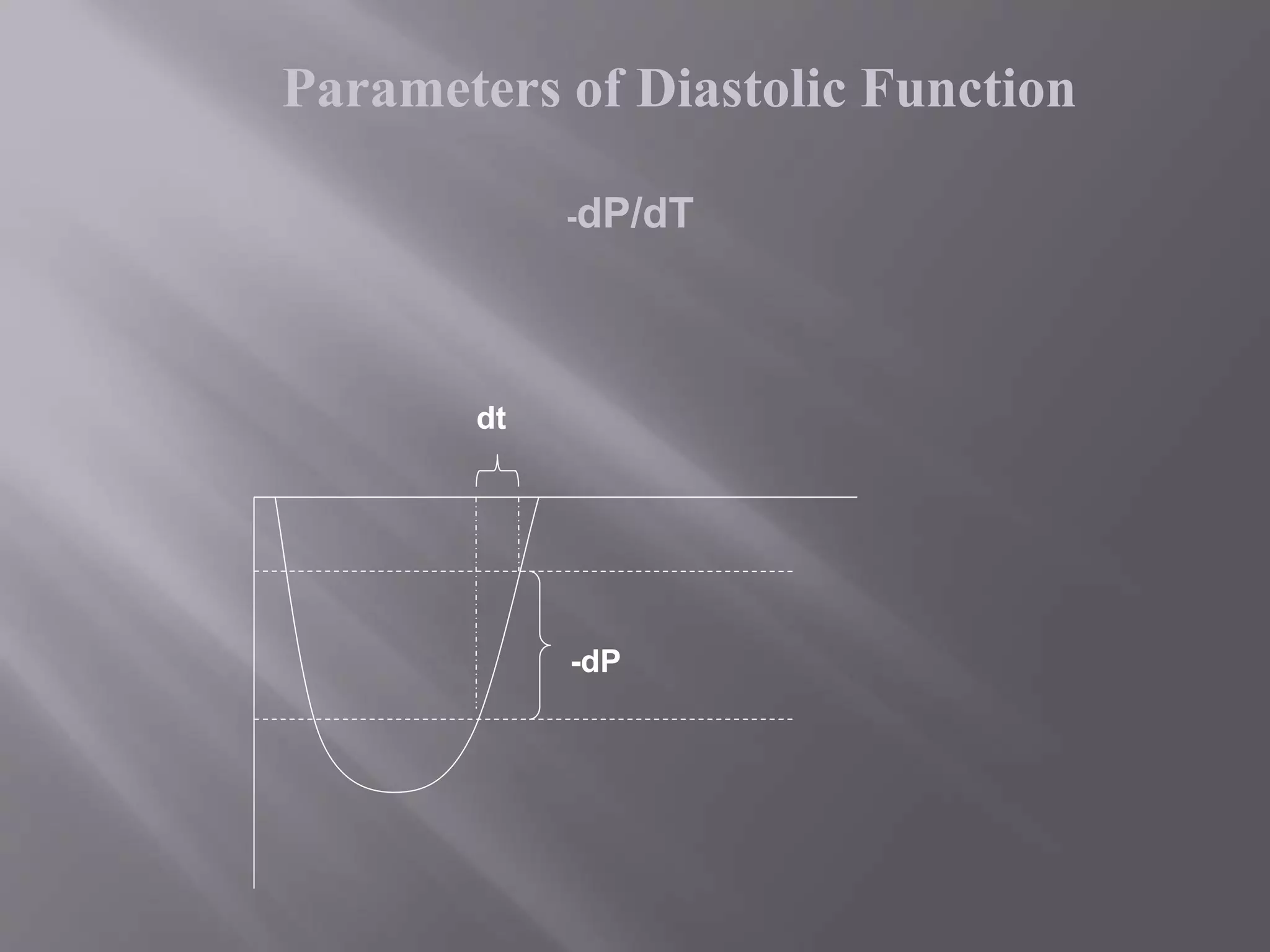
2.The maximum rate of pressure decline (- dP/dt)
Parameters of Diastolic Function
-dP
dt
-dP/dT
Parameters of Diastolic Function
Ventricular Compliance
ratio of change in volume to change in
pressure (dV/dP).
Stiffness -inverse of compliance: the ratio
of change in pressure to change in volume
(dP/dV)
Parameters of Diastolic Function
Compliance :
1.Myocardial compliance – isolated myocardium
2.Chamber Compliance – entire chamber
Parameters of Diastolic Function
Chamber compliance :
1.Ventricular size and shape
2.Characteristics of the myocardium
3.Extrinsic factors:
a.pericardium
b.RV volume
c.pleural pressure
Parameters of Diastolic Function
Factors that affect Diastolic filling
Early filling
•Ventricular Diastolic Function
•Changes in the pressure difference between the
ventricle and atrium due to changes in preload.
•Changes in Transmitral volume flow rate (increased
in MR).
•Change in LA pressure.
Parameters of Diastolic Function
Late filling
•Ventricular Diastolic function
•Cardiac rhythm
•Atrial contractile function
•Ventricular end-diastolic pressure
•HR
•Time of atrial Contraction
Parameters of Diastolic Function
Left Ventricular Filling
Factors that Affect Doppler Left
Ventricular Filling
1.Technical
2.Normal Variations
3.Physiologic
Technical
1.Sample volume location
2.Doppler modality
3.Intercept angle
Left Ventricular Filling
Normal Variation
Respiration – Increase filling during inspiration
on the right, increase filling at end of
expiration on the left.
Left Ventricular Filling
Normal Variation
Heart rate – Increase
heart rate shortens
diastasis so that the A
velocity more closely
follow the E velocity.
Left Ventricular Filling
PR interval
Longer PR interval results in an A
velocity early in diastole.
Left Ventricular Filling
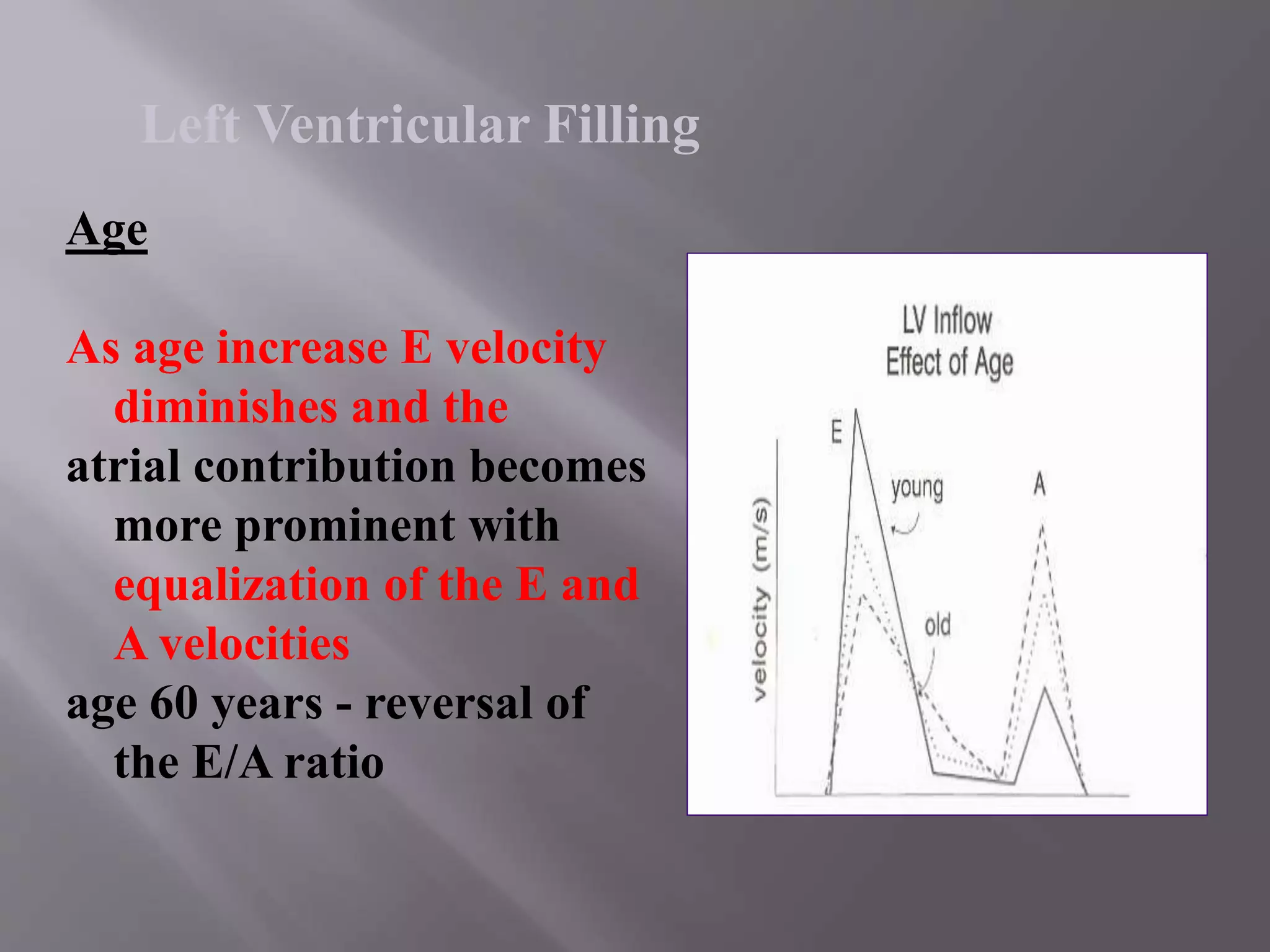
Age
As age increase E velocity
diminishes and the
atrial contribution becomes
more prominent with
equalization of the E and
A velocities
age 60 years - reversal of
the E/A ratio
Left Ventricular Filling
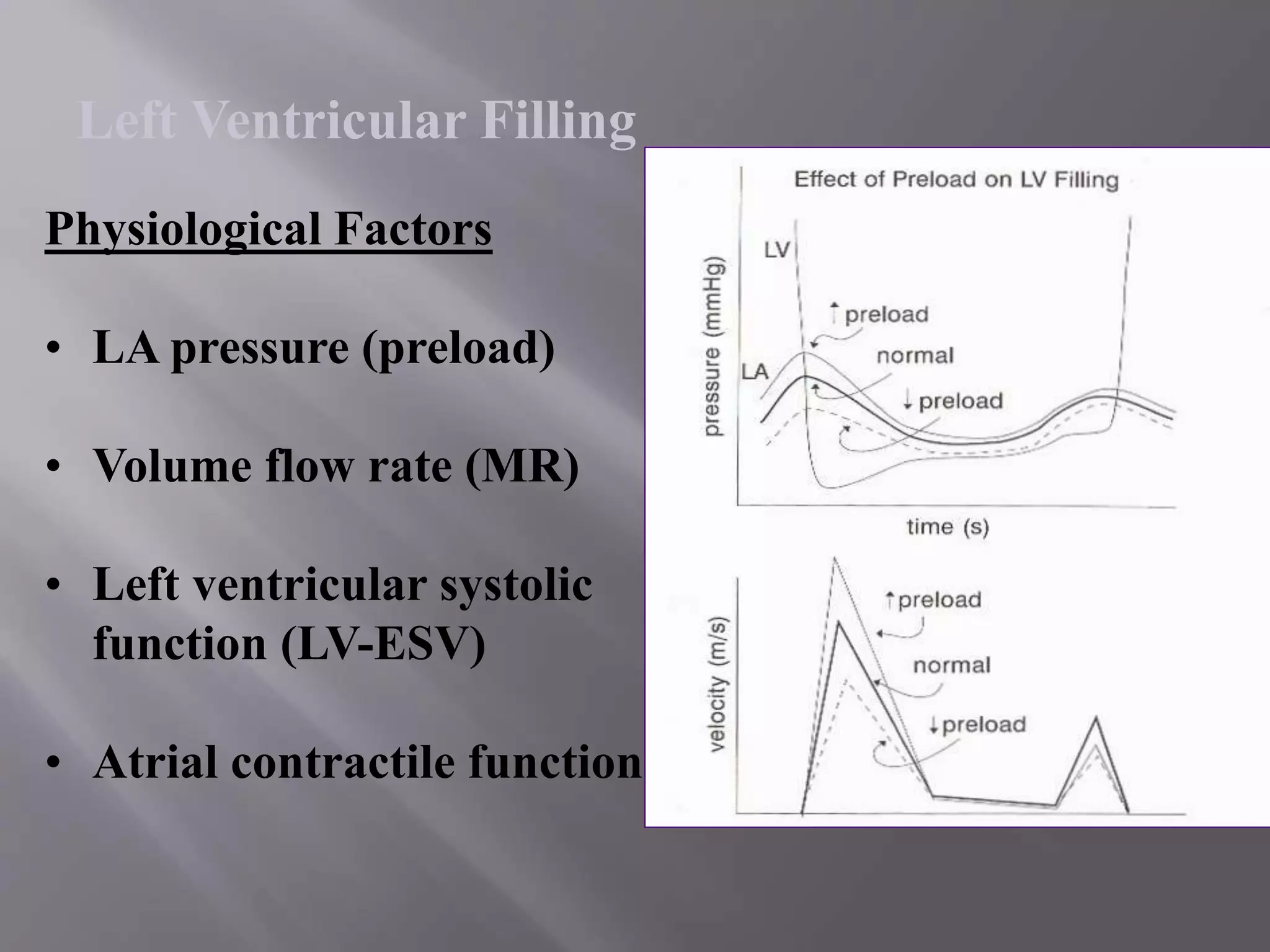
Physiological Factors
• LA pressure (preload)
• Volume flow rate (MR)
• Left ventricular systolic
function (LV-ESV)
• Atrial contractile function
Left Ventricular Filling
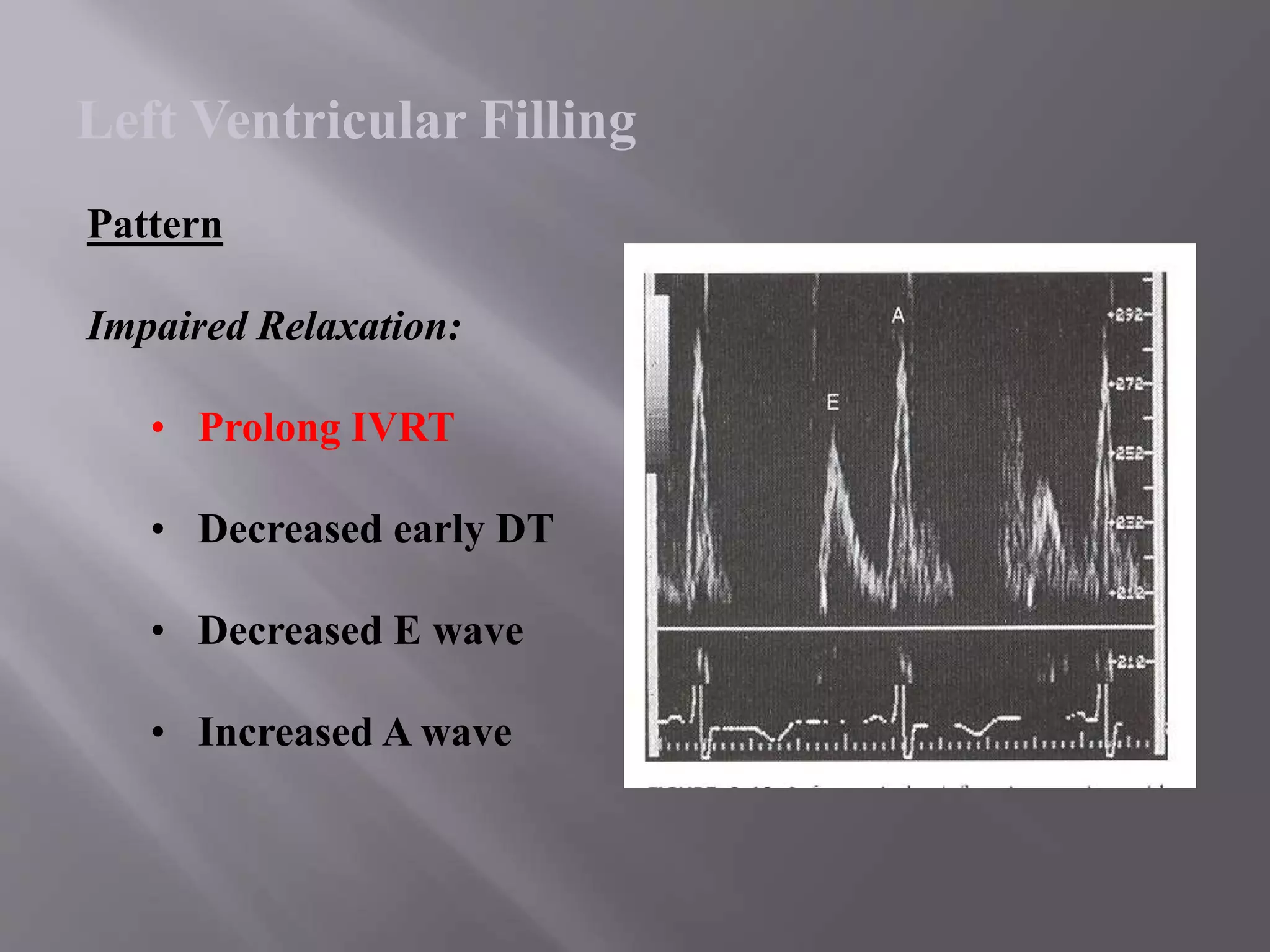
Pattern
Impaired Relaxation:
• Prolong IVRT
• Decreased early DT
• Decreased E wave
• Increased A wave
Left Ventricular Filling
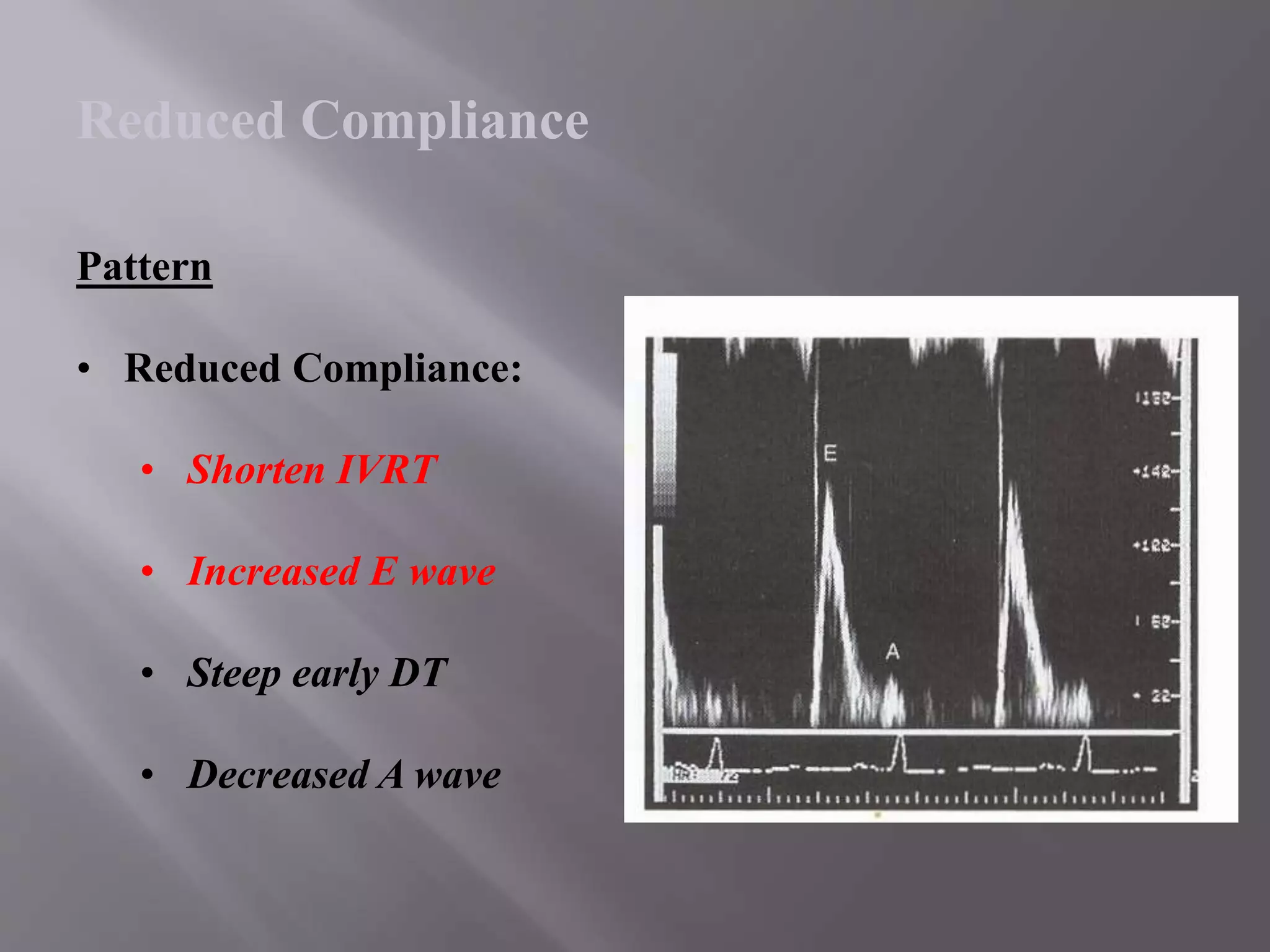
Pattern
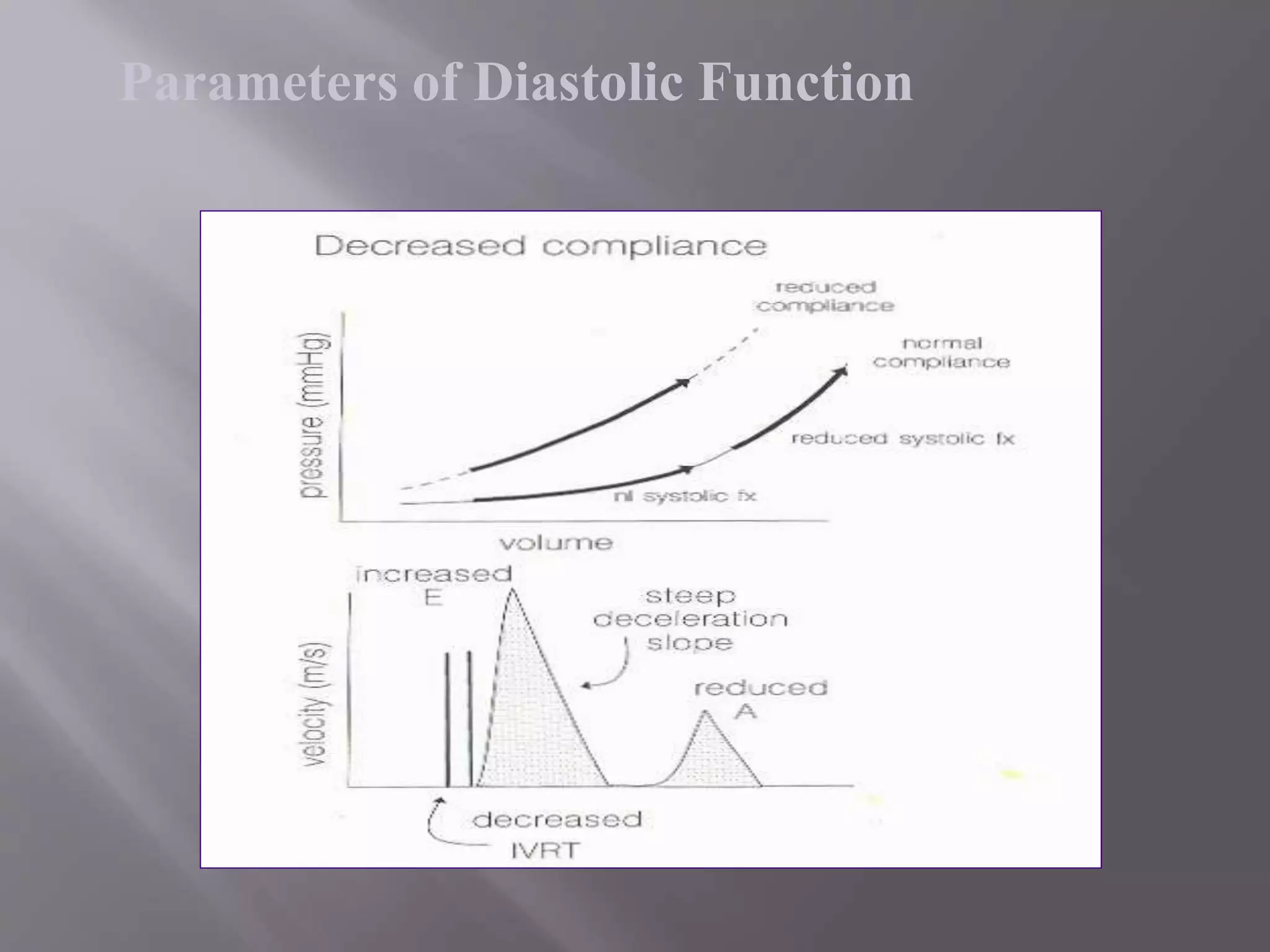
• Reduced Compliance:
• Shorten IVRT
• Increased E wave
• Steep early DT
• Decreased A wave
Reduced Compliance
Left Atrial Filling
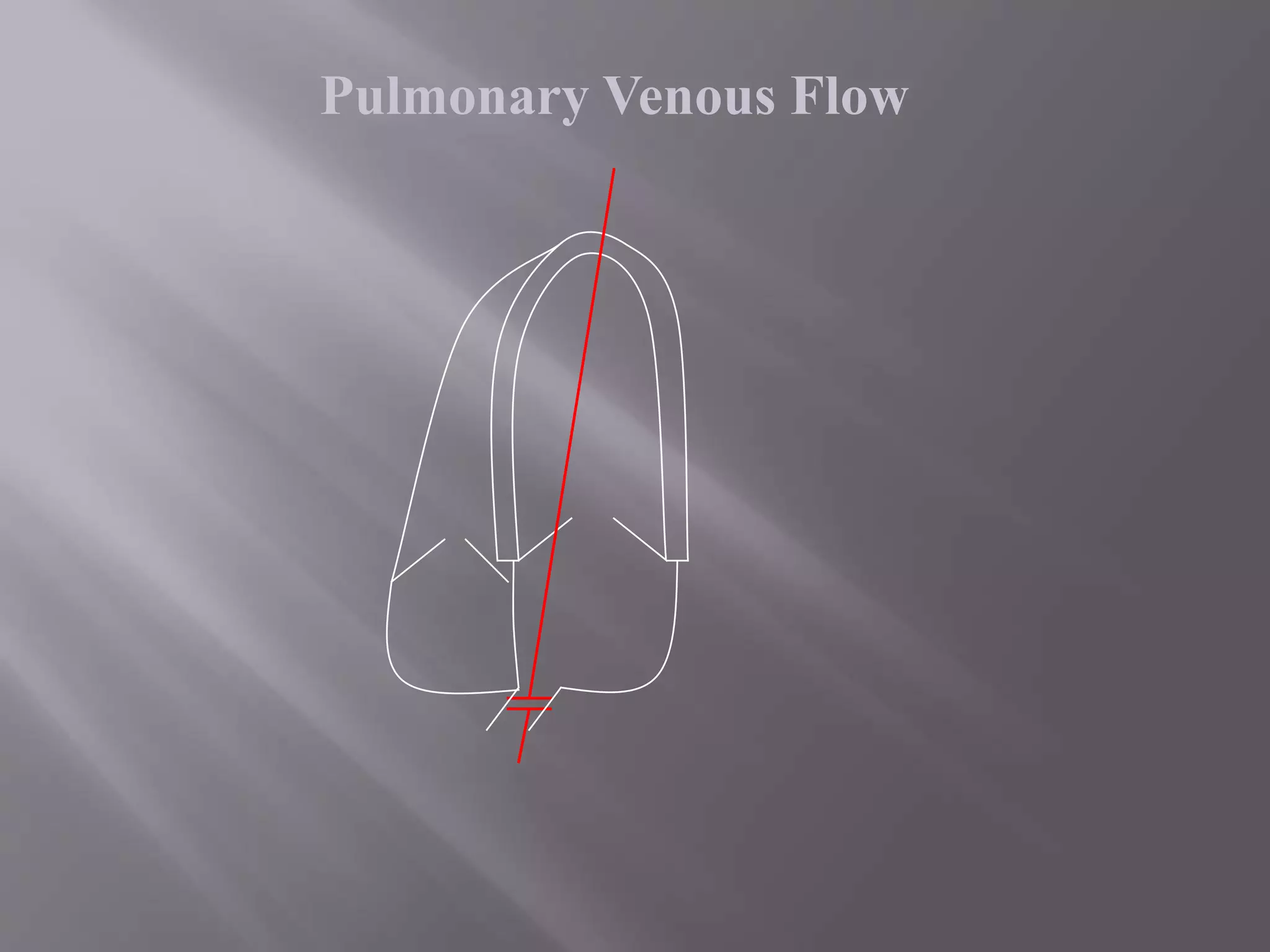
• Window and Plane – A4C
• Vein interrogated – Right superior
pulmonary vein.
Left Atrial Filling
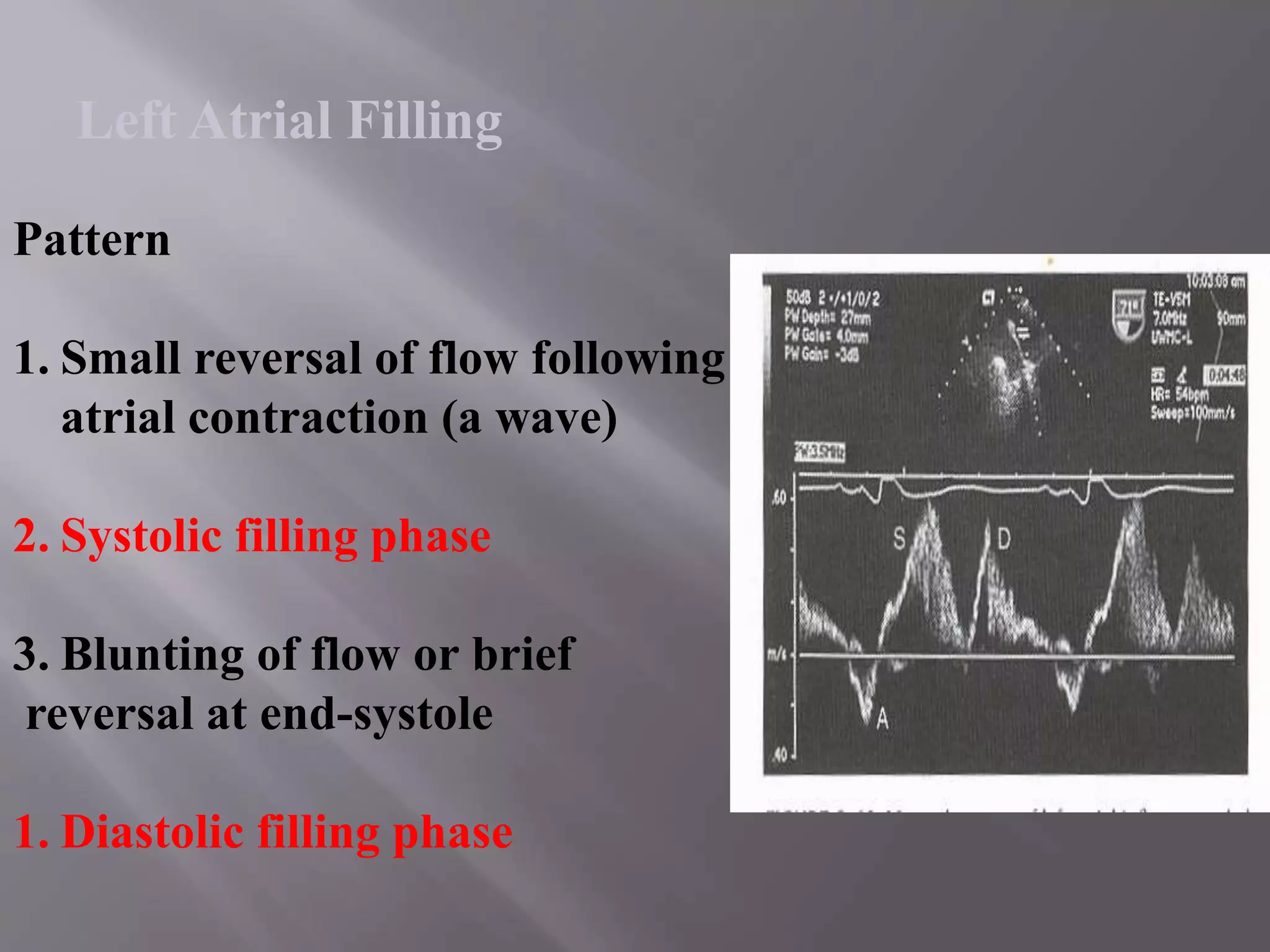
Pattern
1. Small reversal of flow following
atrial contraction (a wave)
2. Systolic filling phase
3. Blunting of flow or brief
reversal at end-systole
1. Diastolic filling phase
Left Atrial Filling
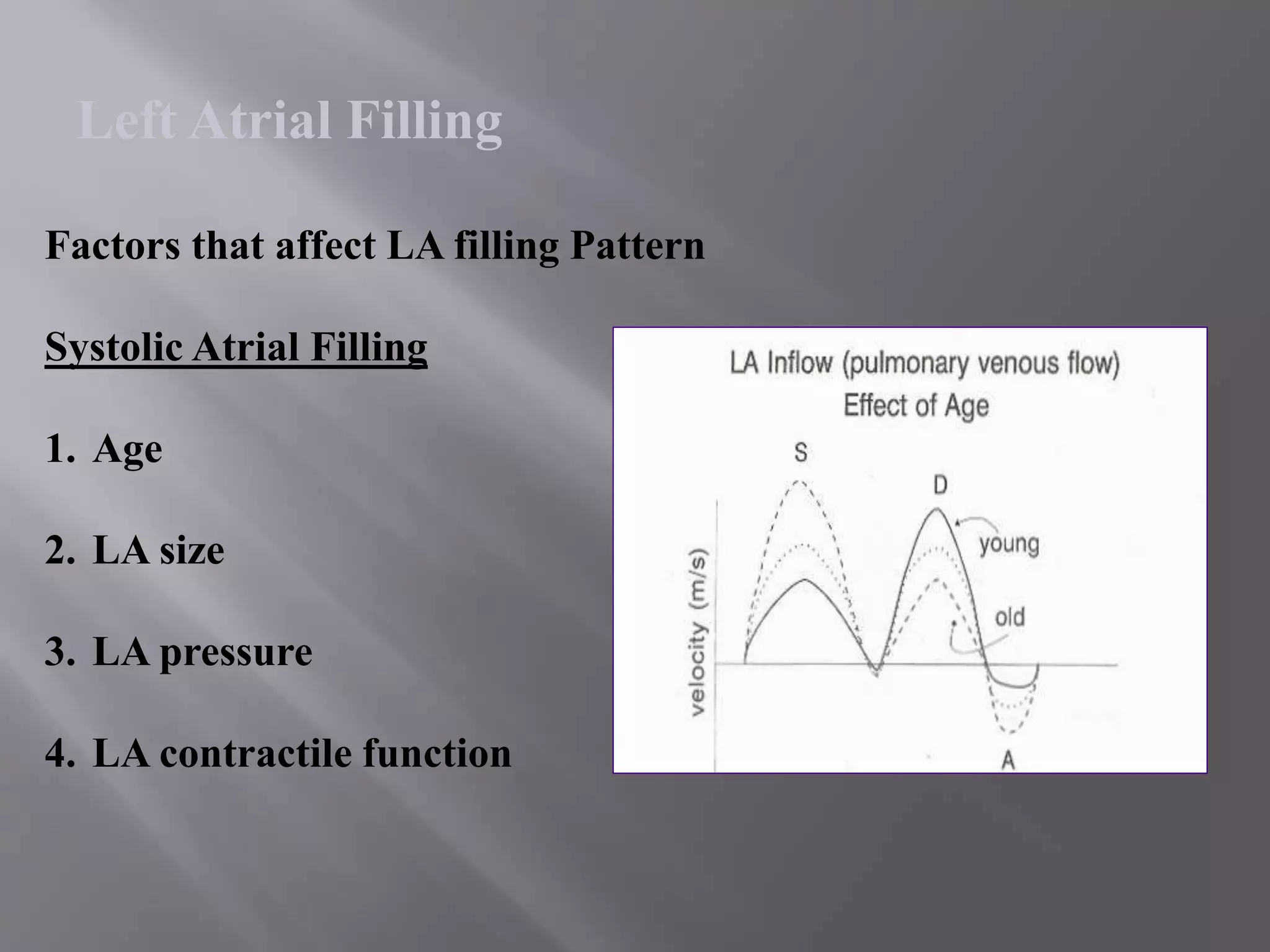
Factors that affect LA filling Pattern
Systolic Atrial Filling
1. Age
2. LA size
3. LA pressure
4. LA contractile function
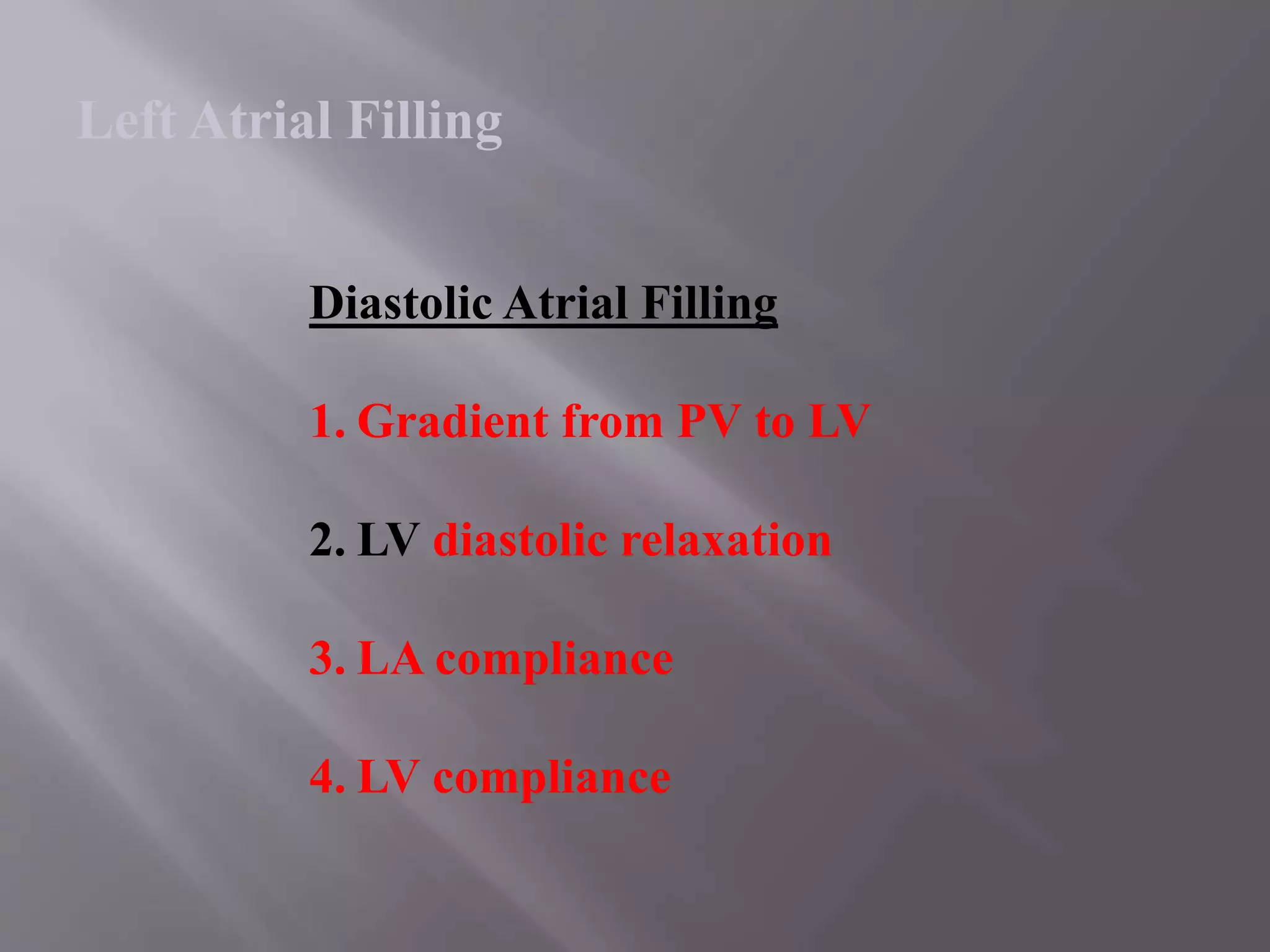
Left Atrial Filling
Diastolic Atrial Filling
1. Gradient from PV to LV
2. LV diastolic relaxation
3. LA compliance
4. LV compliance
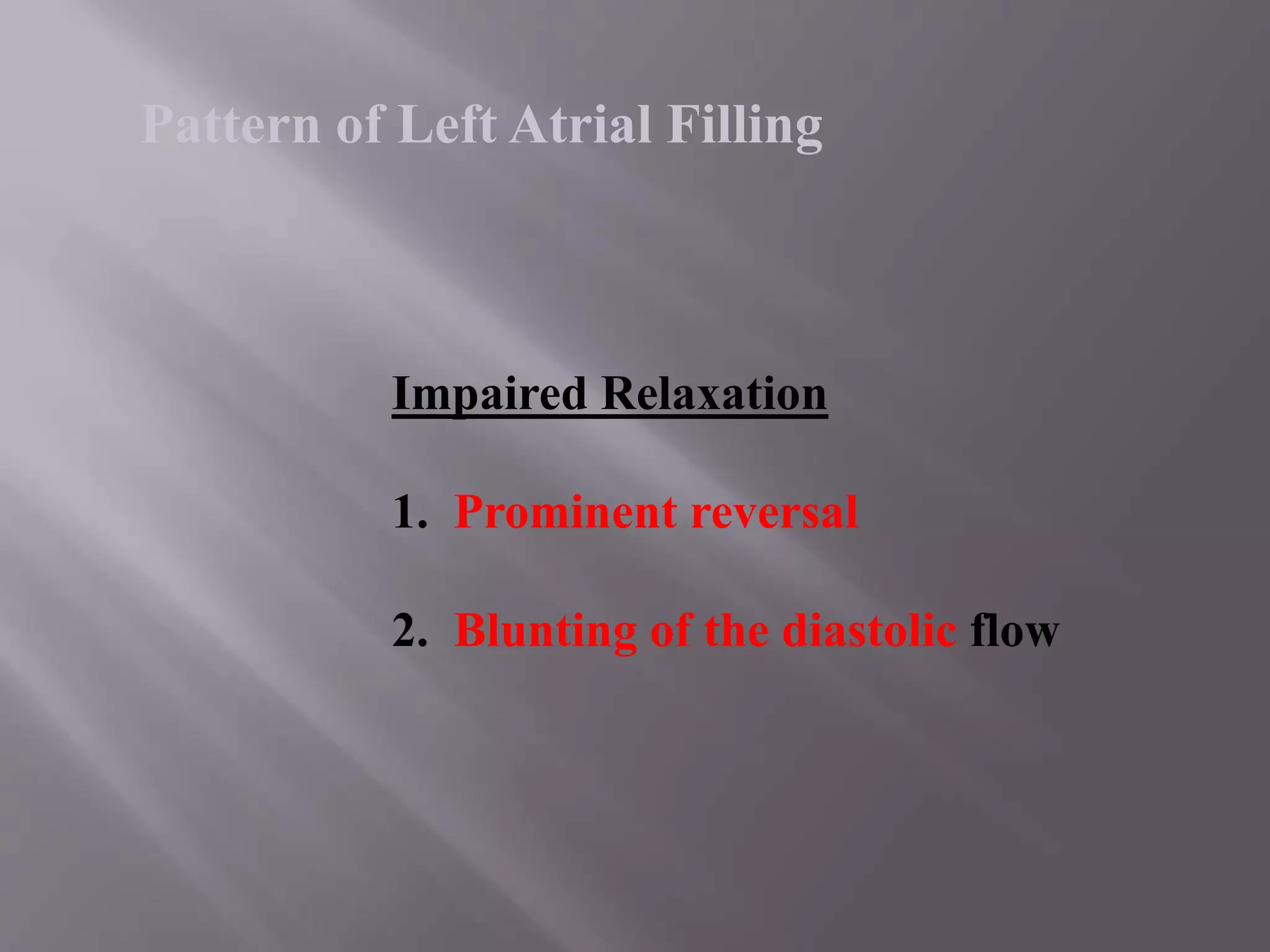
Left Atrial Filling
Impaired Relaxation
1. Prominent reversal
2. Blunting of the diastolic flow
Pattern of Left Atrial Filling
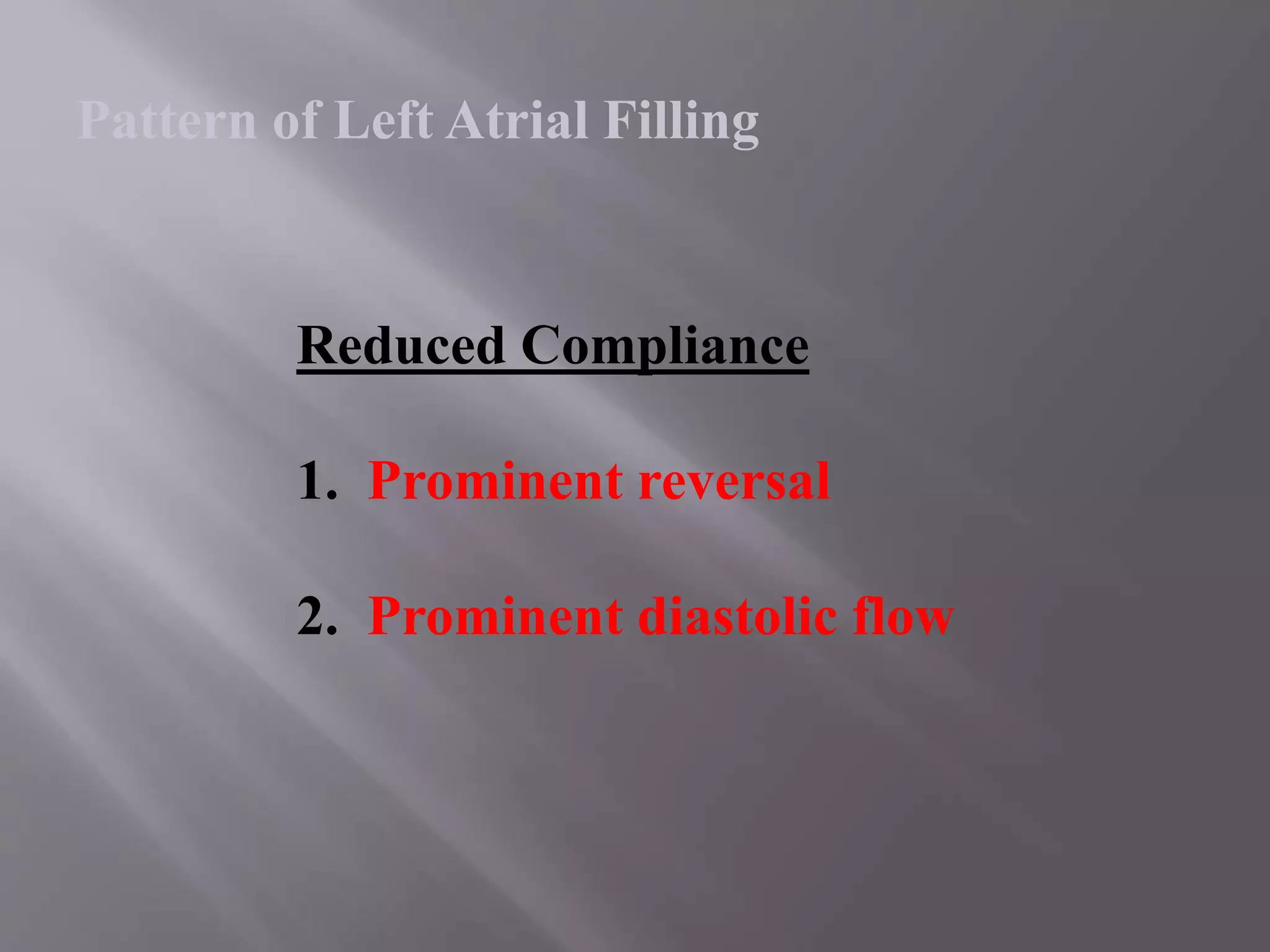
Reduced Compliance
1. Prominent reversal
2. Prominent diastolic flow
Pattern of Left Atrial Filling
 Mitral Inflow +/- Valsalva
 Pulmonary Venous Flow
 Tissue Doppler
 Color M-mode
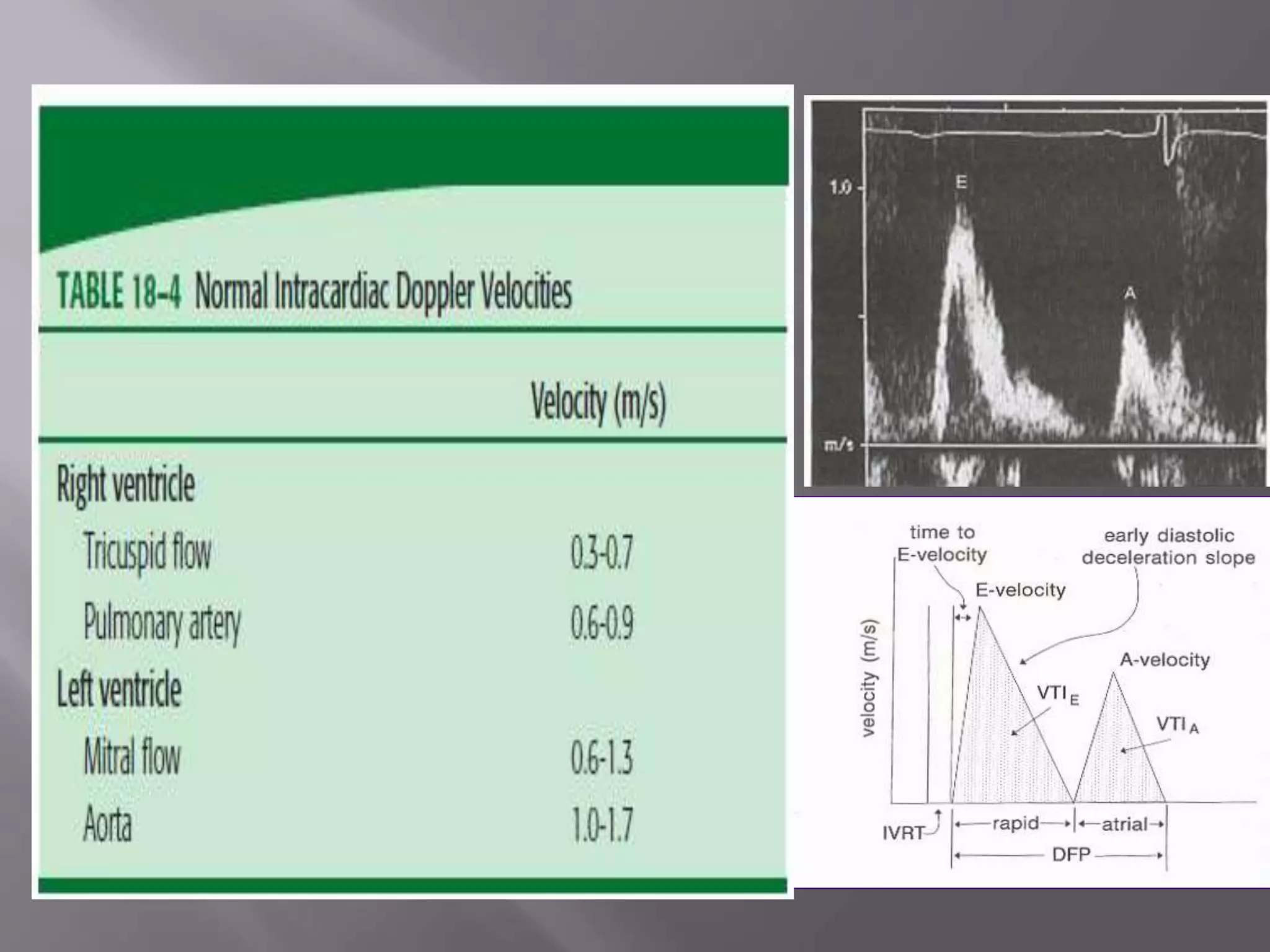
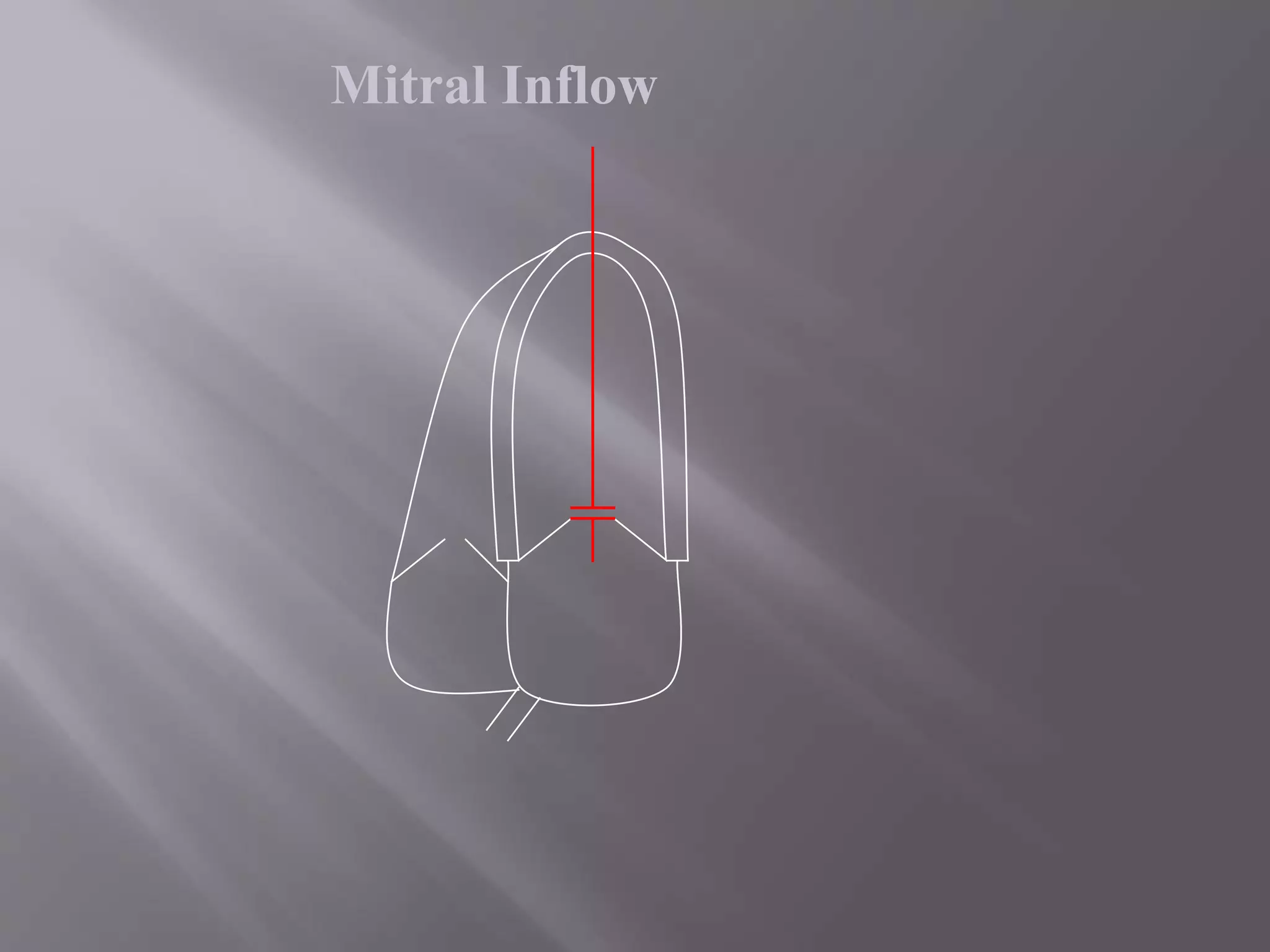
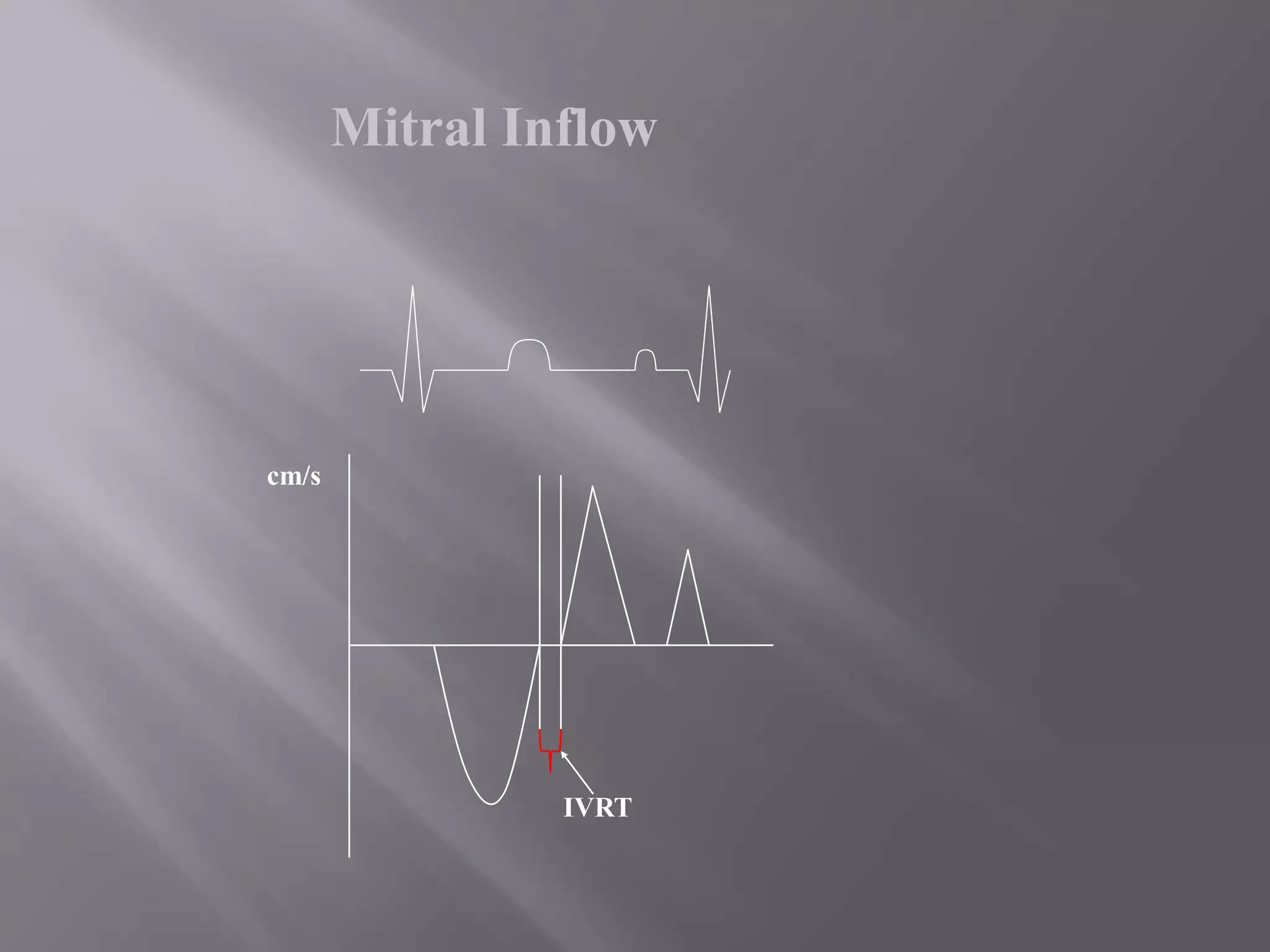
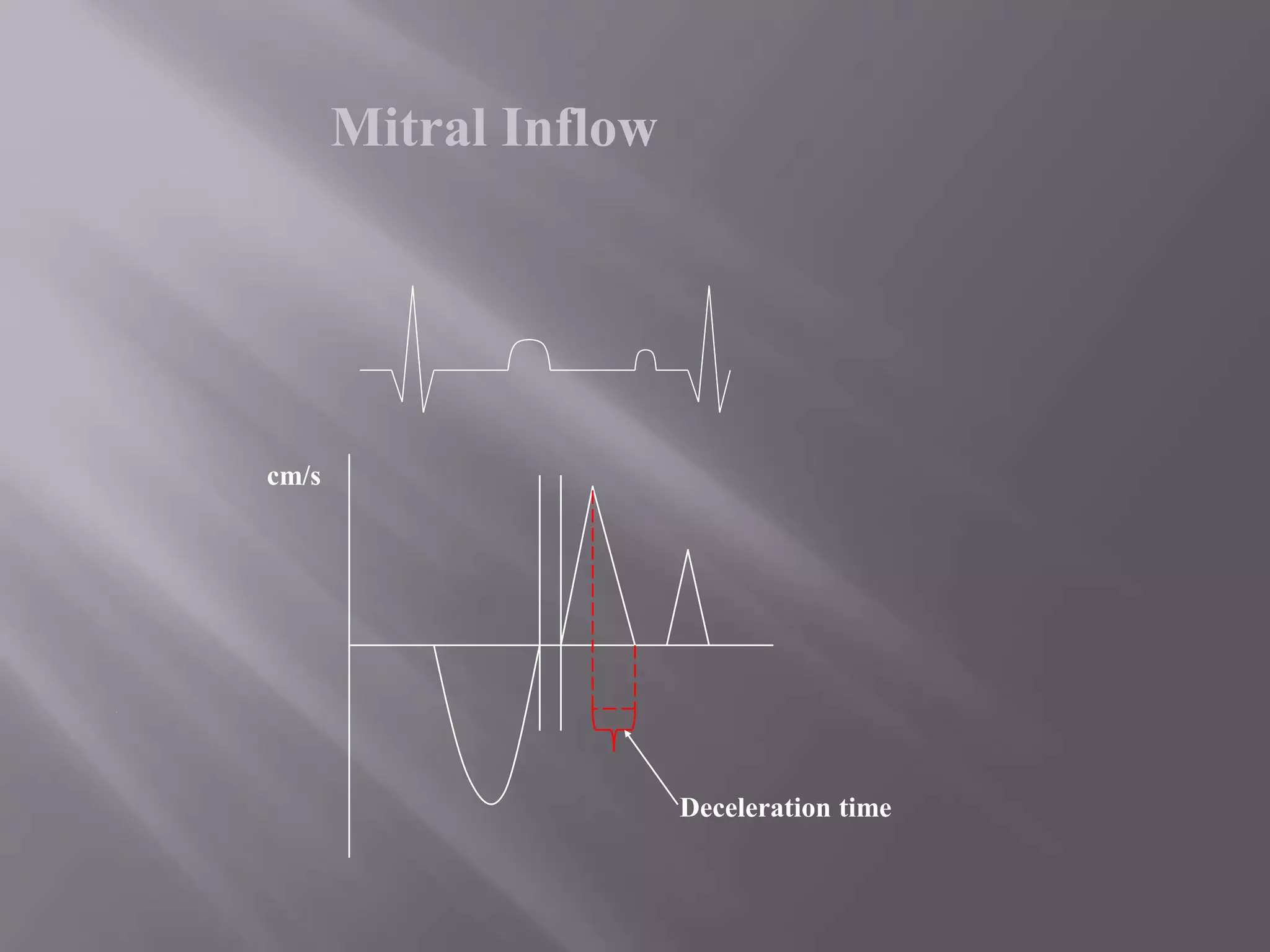
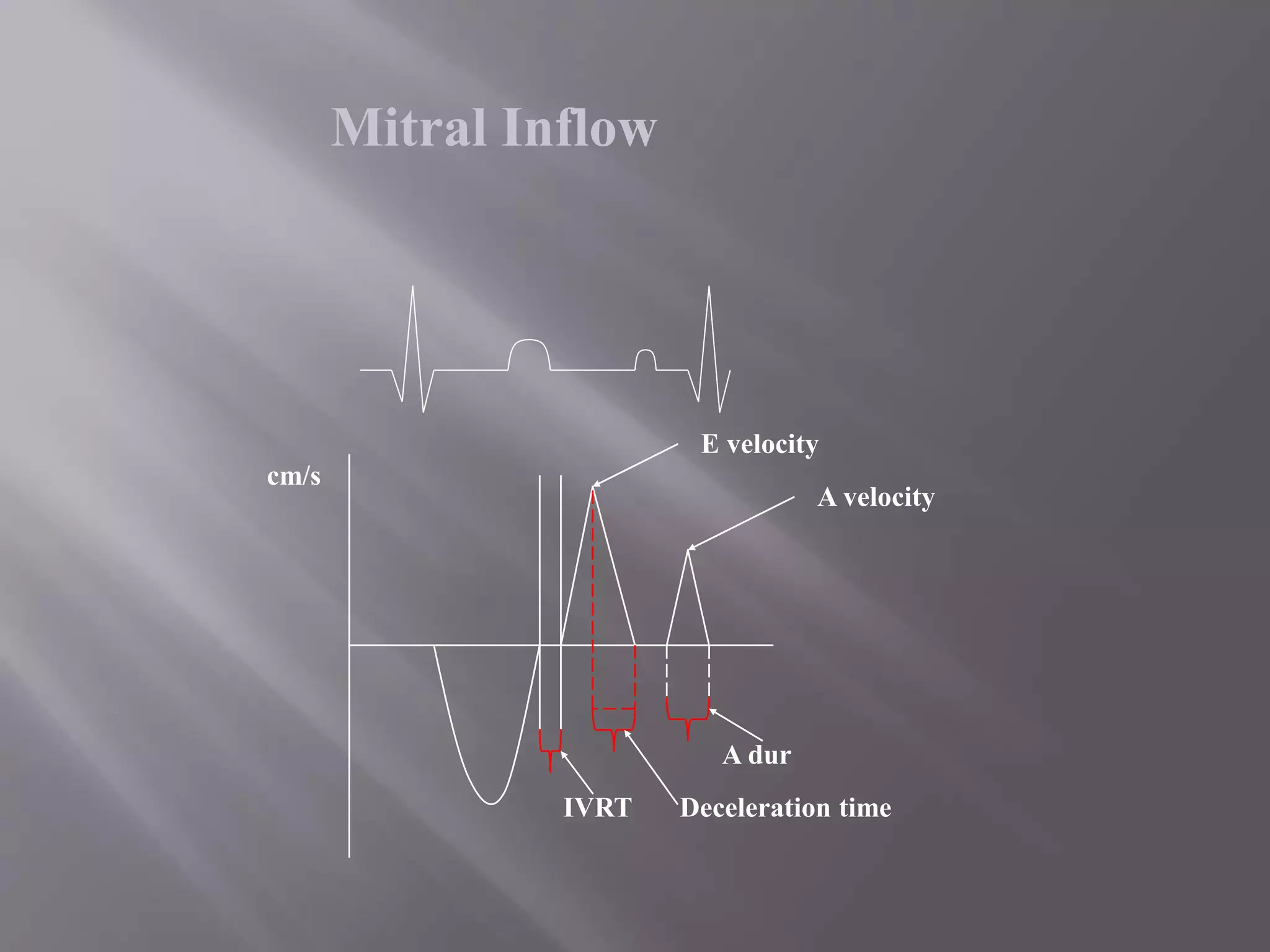
Mitral Inflow
Mitral Inflow
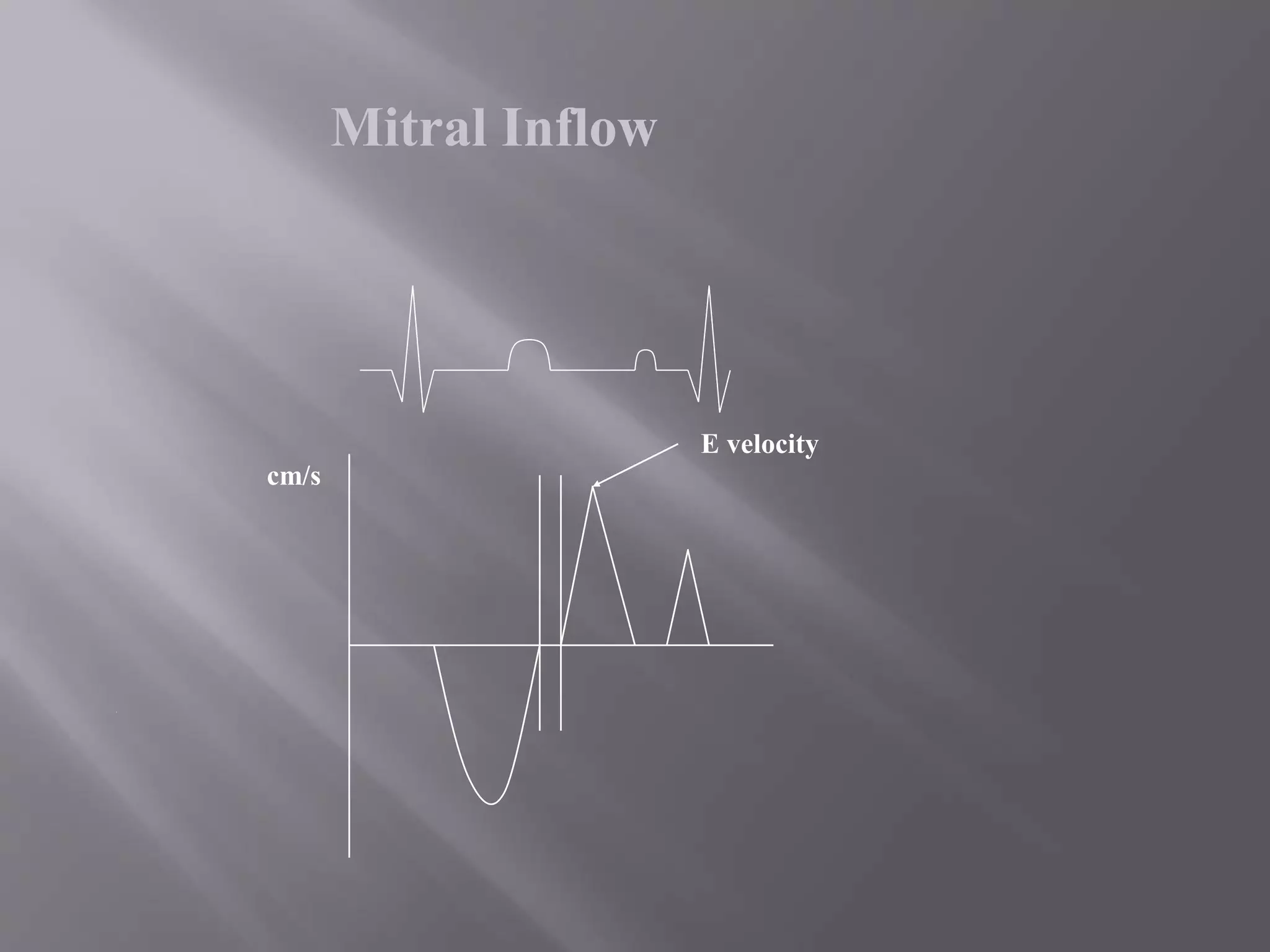
cm/s
E velocity
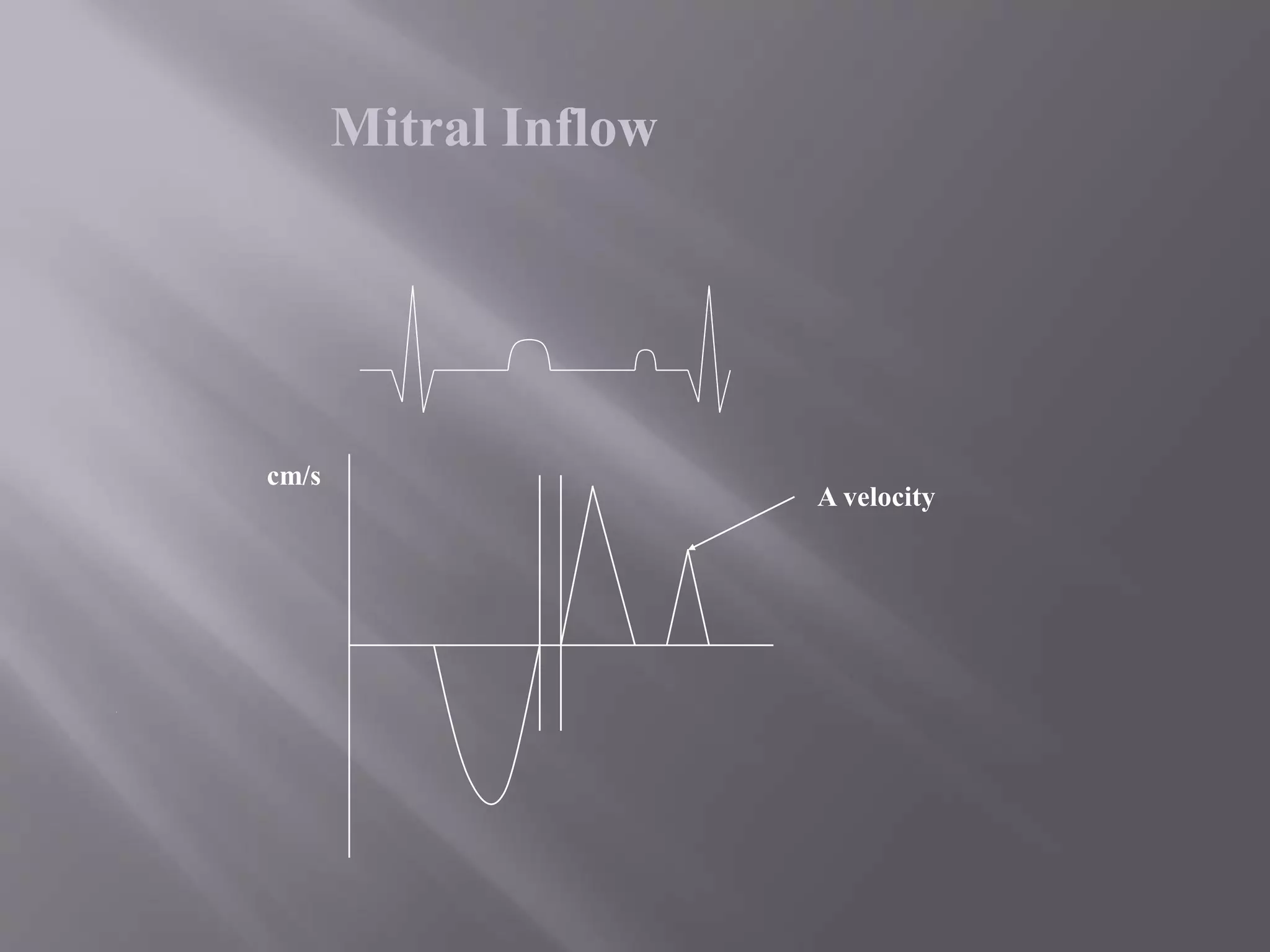
Mitral Inflow
cm/s
A velocity
Mitral Inflow
cm/s
IVRT
Mitral Inflow
cm/s
A dur
Mitral Inflow
cm/s
Deceleration time
Mitral Inflow
cm/s
E velocity
A velocity
IVRT
A dur
Deceleration time
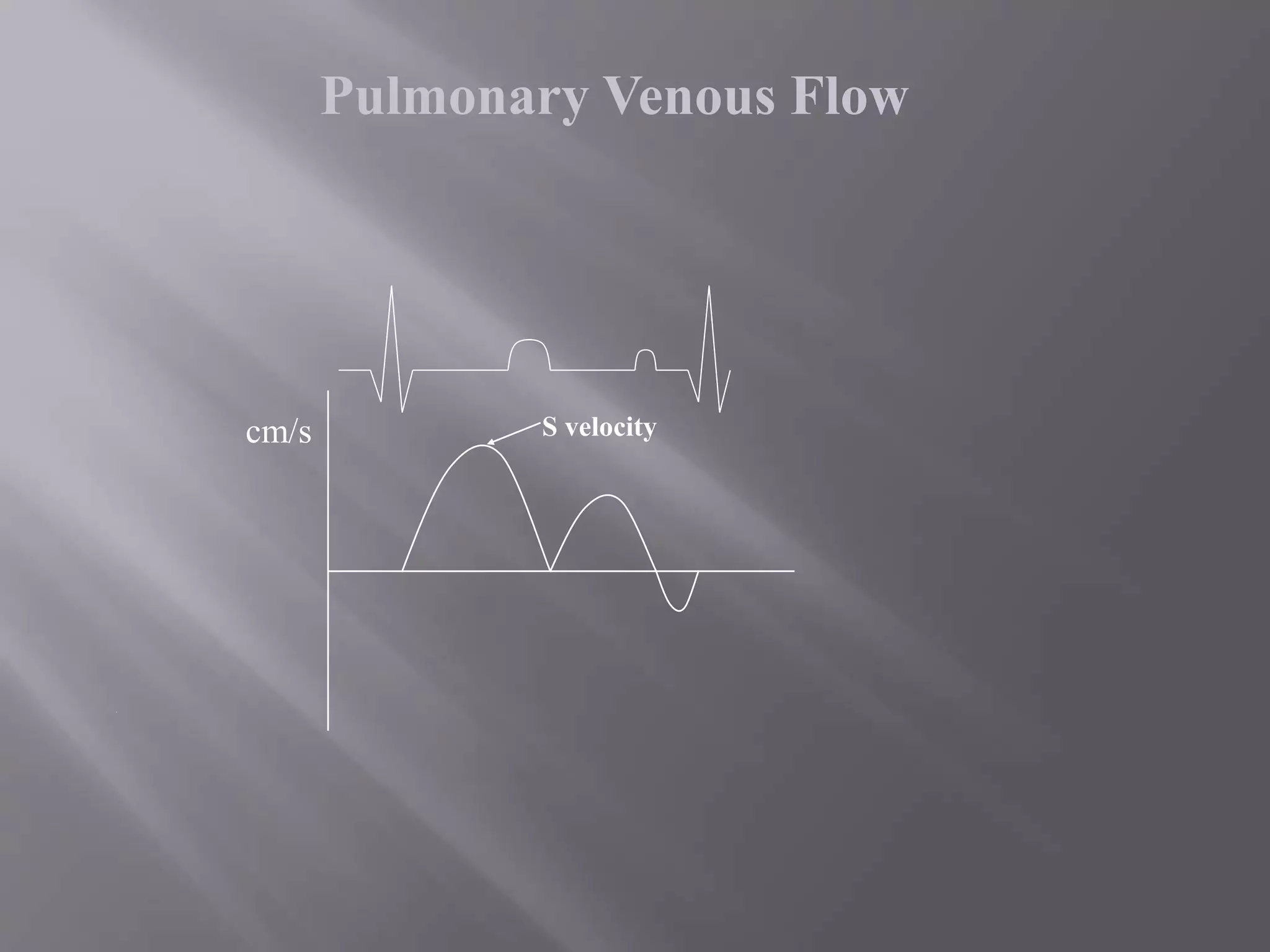
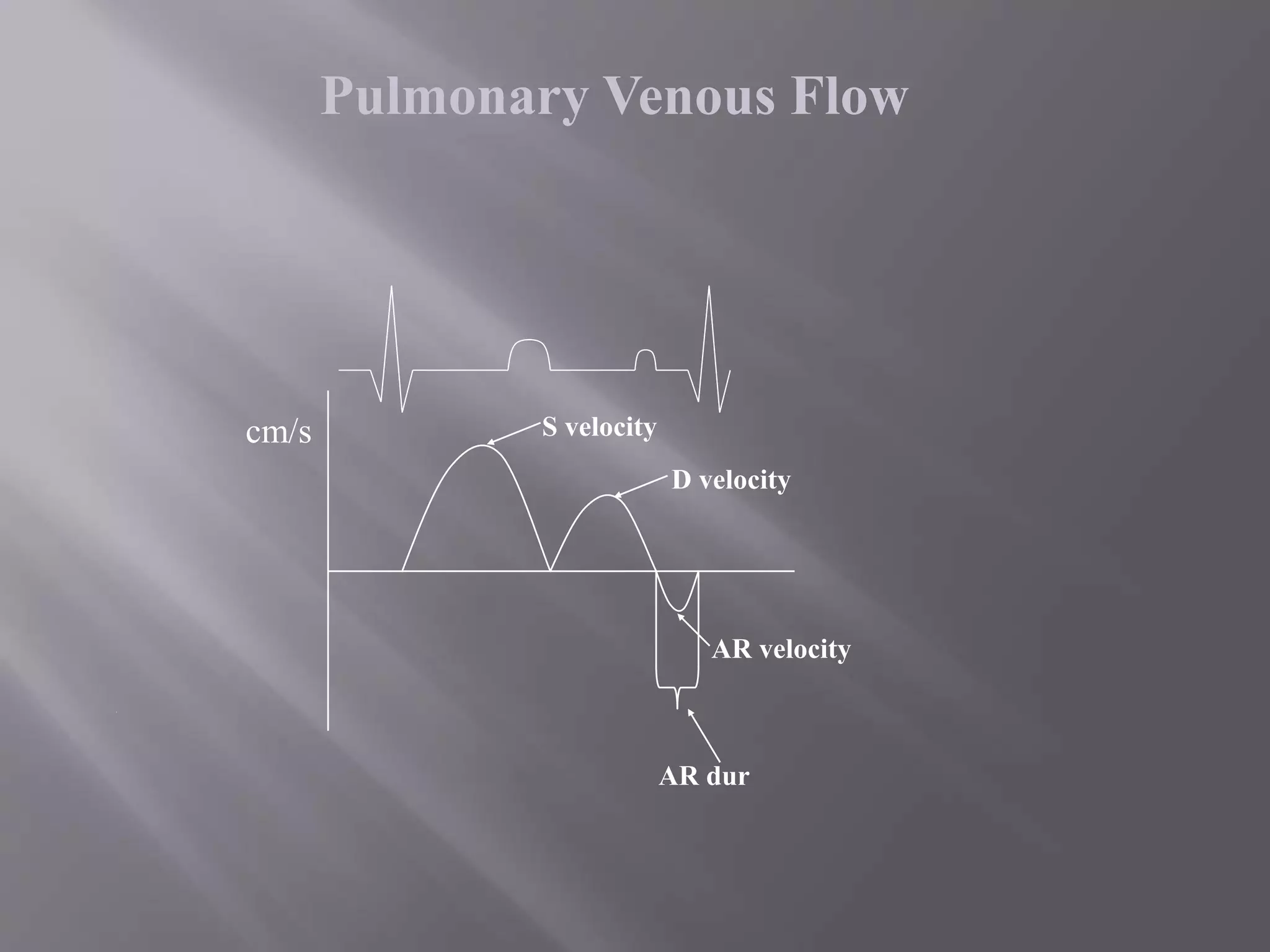
Pulmonary Venous Flow
cm/s S velocity
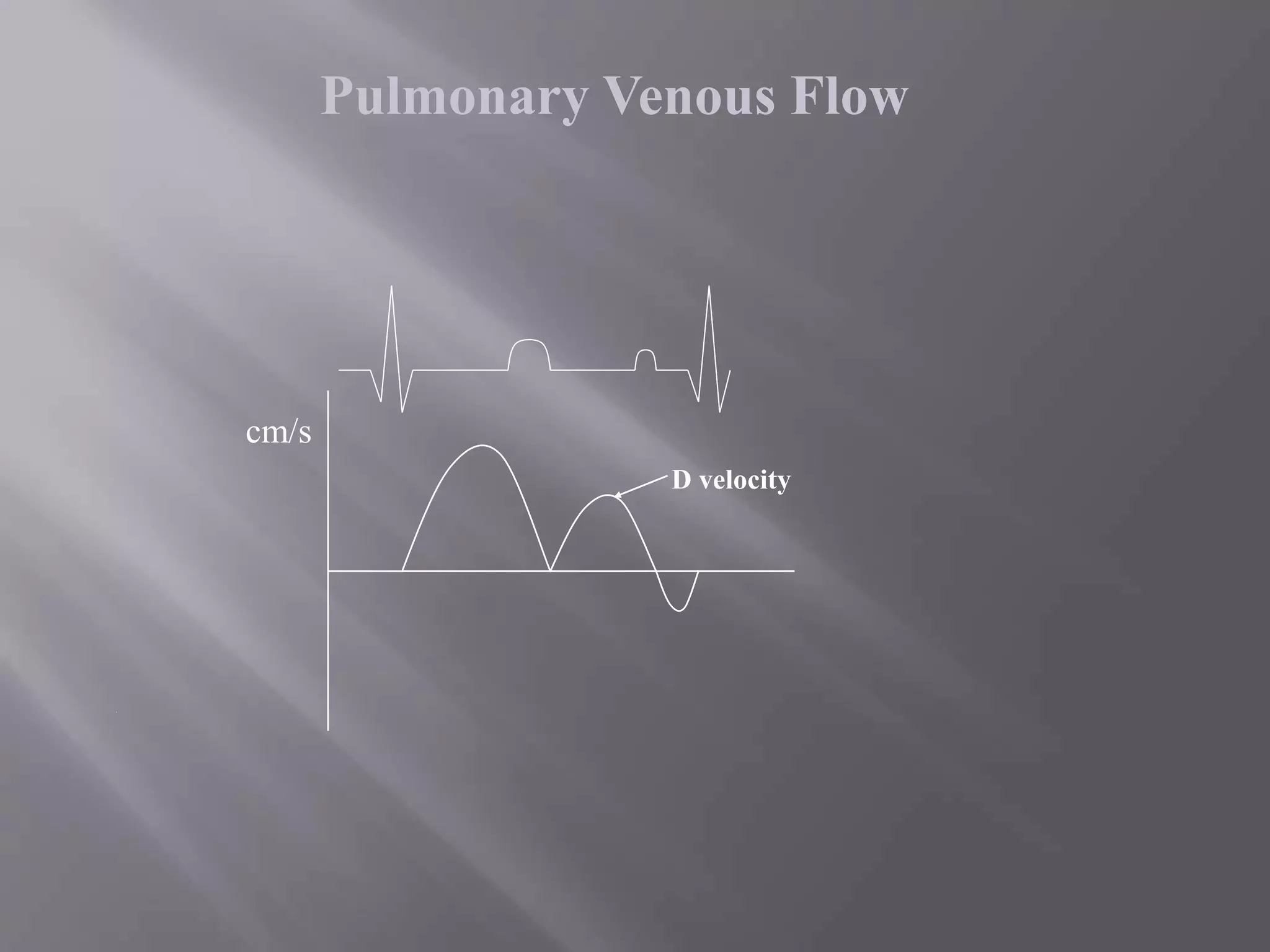
Pulmonary Venous Flow
cm/s
D velocity
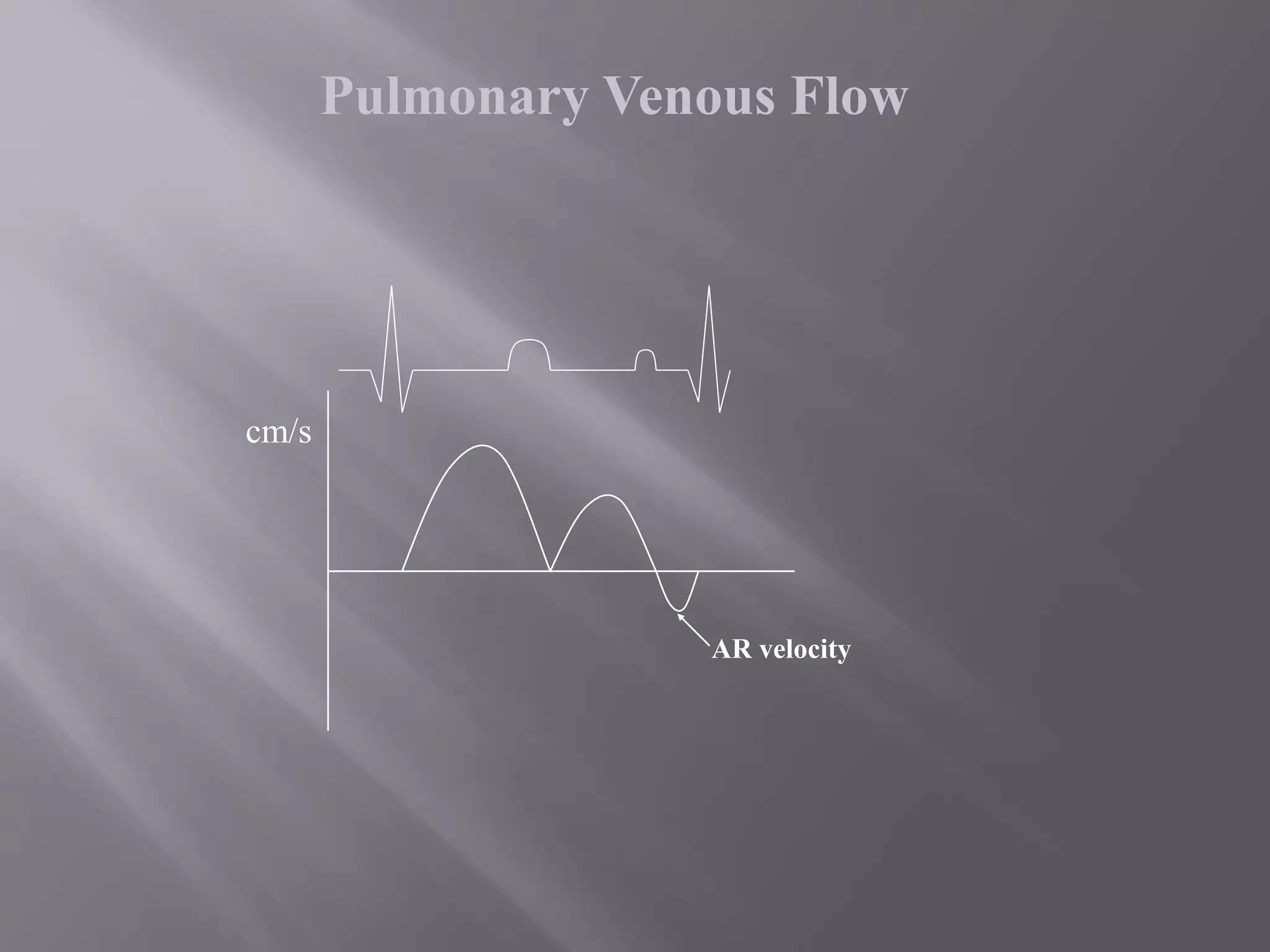
Pulmonary Venous Flow
cm/s
AR velocity
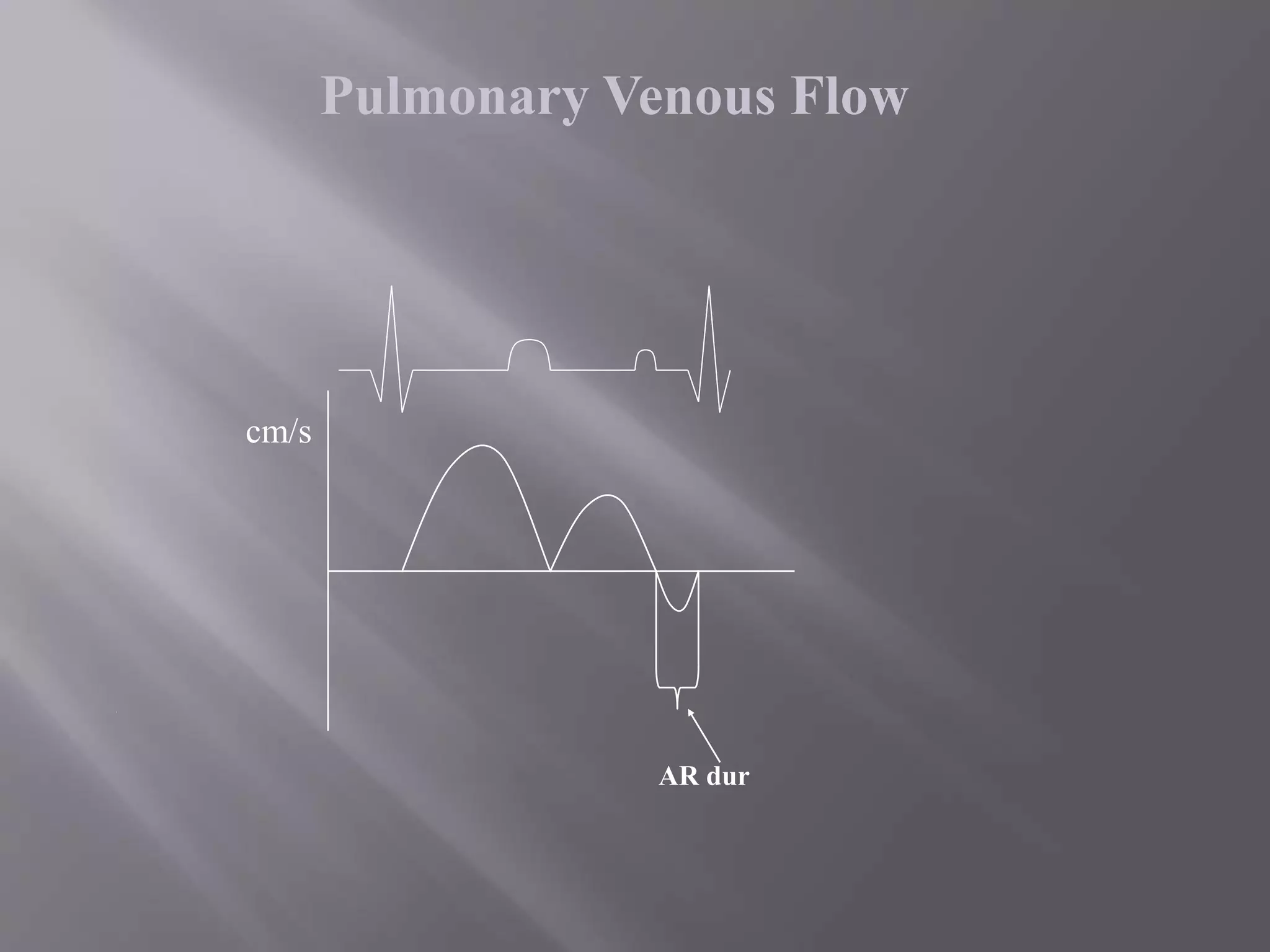
Pulmonary Venous Flow
cm/s
AR dur
Pulmonary Venous Flow
cm/s
D velocity
S velocity
AR velocity
AR dur
Pulmonary Venous Flow
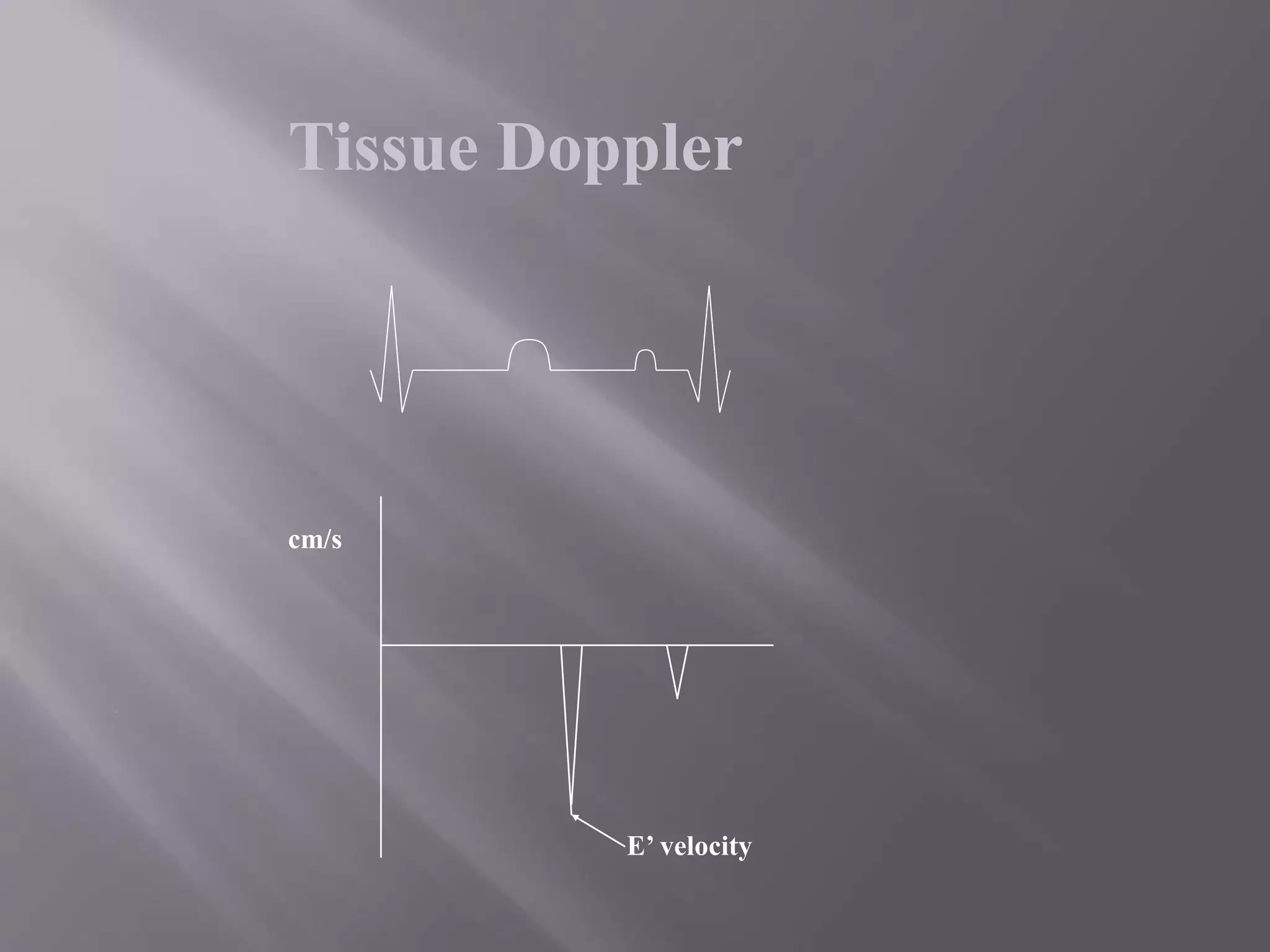
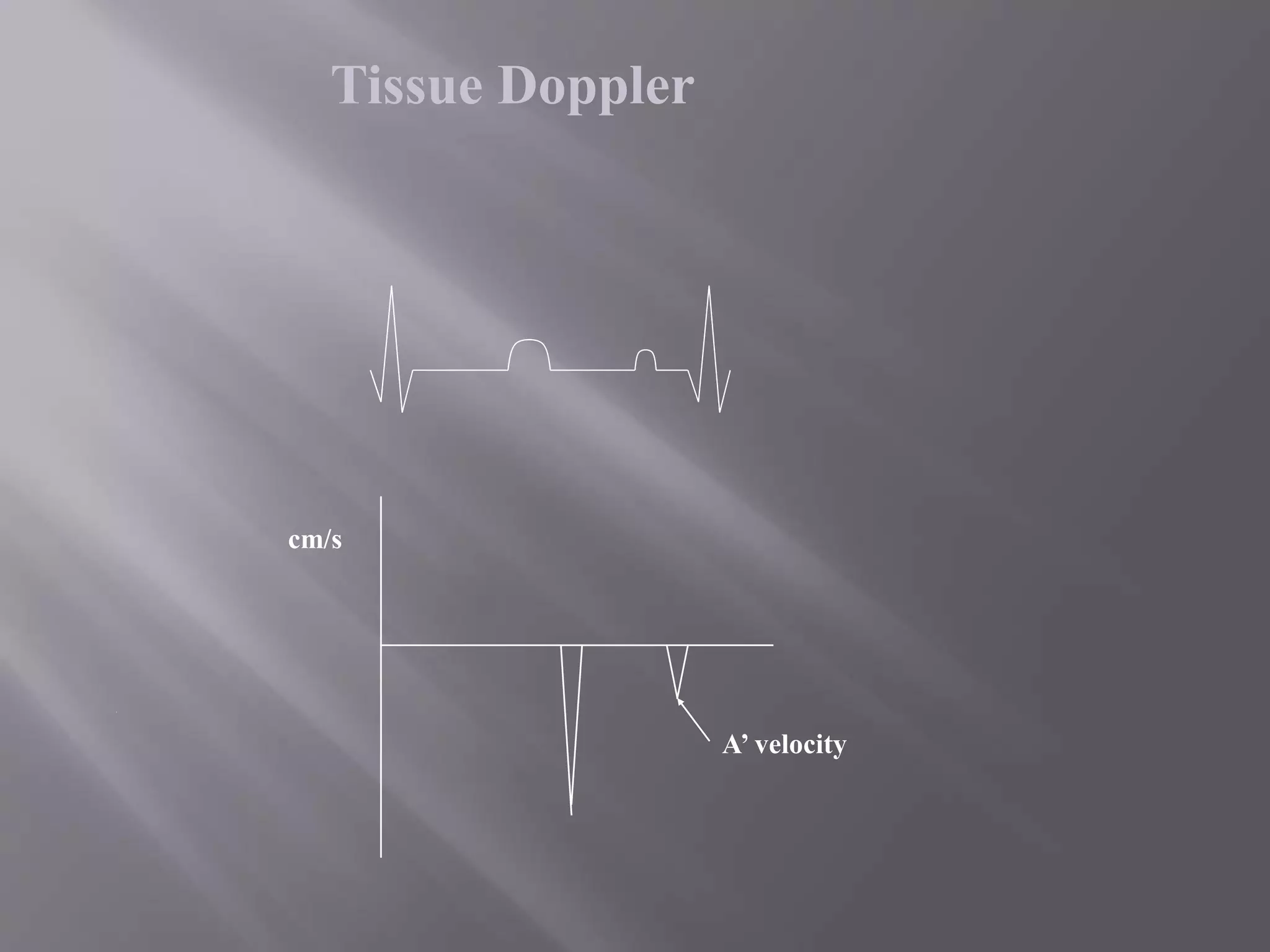
Tissue Doppler
Tissue Doppler
cm/s
E’ velocity
cm/s
A’ velocity
Tissue Doppler
cm/s
E’ velocity
A’ velocity
Tissue Doppler
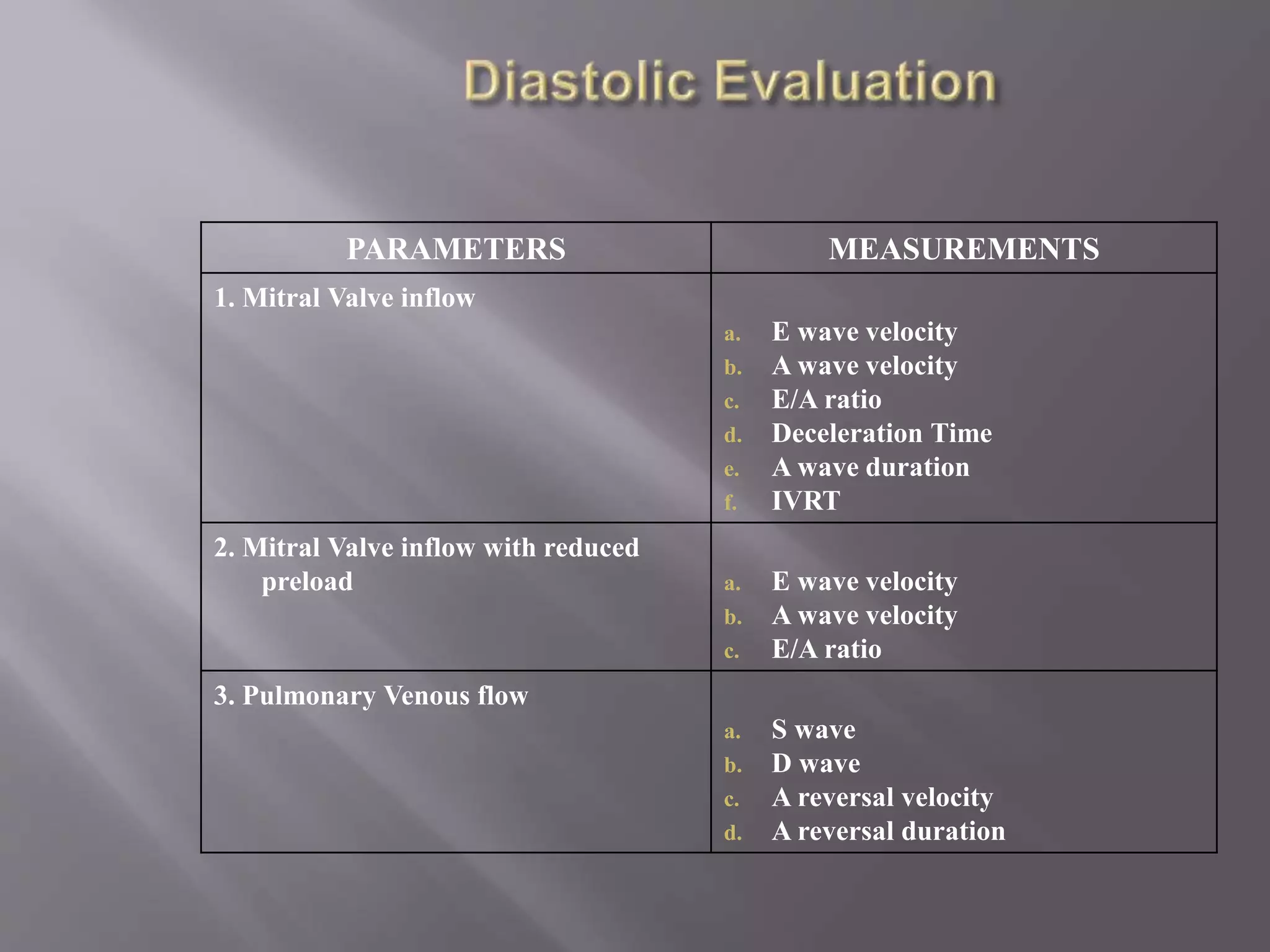
PARAMETERS MEASUREMENTS
1. Mitral Valve inflow
a. E wave velocity
b. A wave velocity
c. E/A ratio
d. Deceleration Time
e. A wave duration
f. IVRT
2. Mitral Valve inflow with reduced
preload a. E wave velocity
b. A wave velocity
c. E/A ratio
3. Pulmonary Venous flow
a. S wave
b. D wave
c. A reversal velocity
d. A reversal duration
PARAMETERS MEASUREMENTS
4. Tissue Doppler
a. E’
b. A’
c. E/E’
5. Color M-mode
a. Vp
b. E/Vp
Diastolic Evaluation
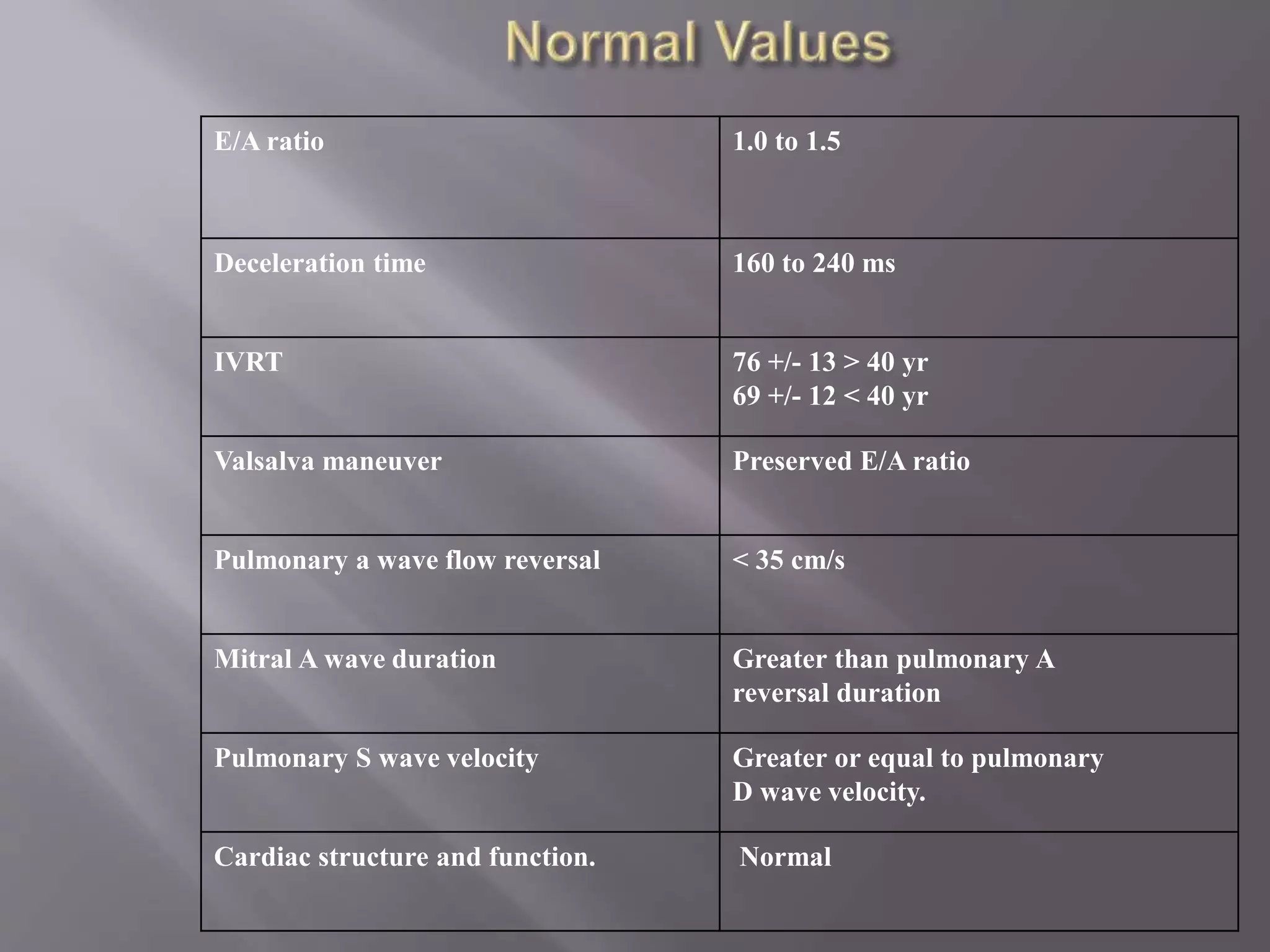
E/A ratio 1.0 to 1.5
Deceleration time 160 to 240 ms
IVRT 76 +/- 13 > 40 yr
69 +/- 12 < 40 yr
Valsalva maneuver Preserved E/A ratio
Pulmonary a wave flow reversal < 35 cm/s
Mitral A wave duration Greater than pulmonary A
reversal duration
Pulmonary S wave velocity Greater or equal to pulmonary
D wave velocity.
Cardiac structure and function. Normal
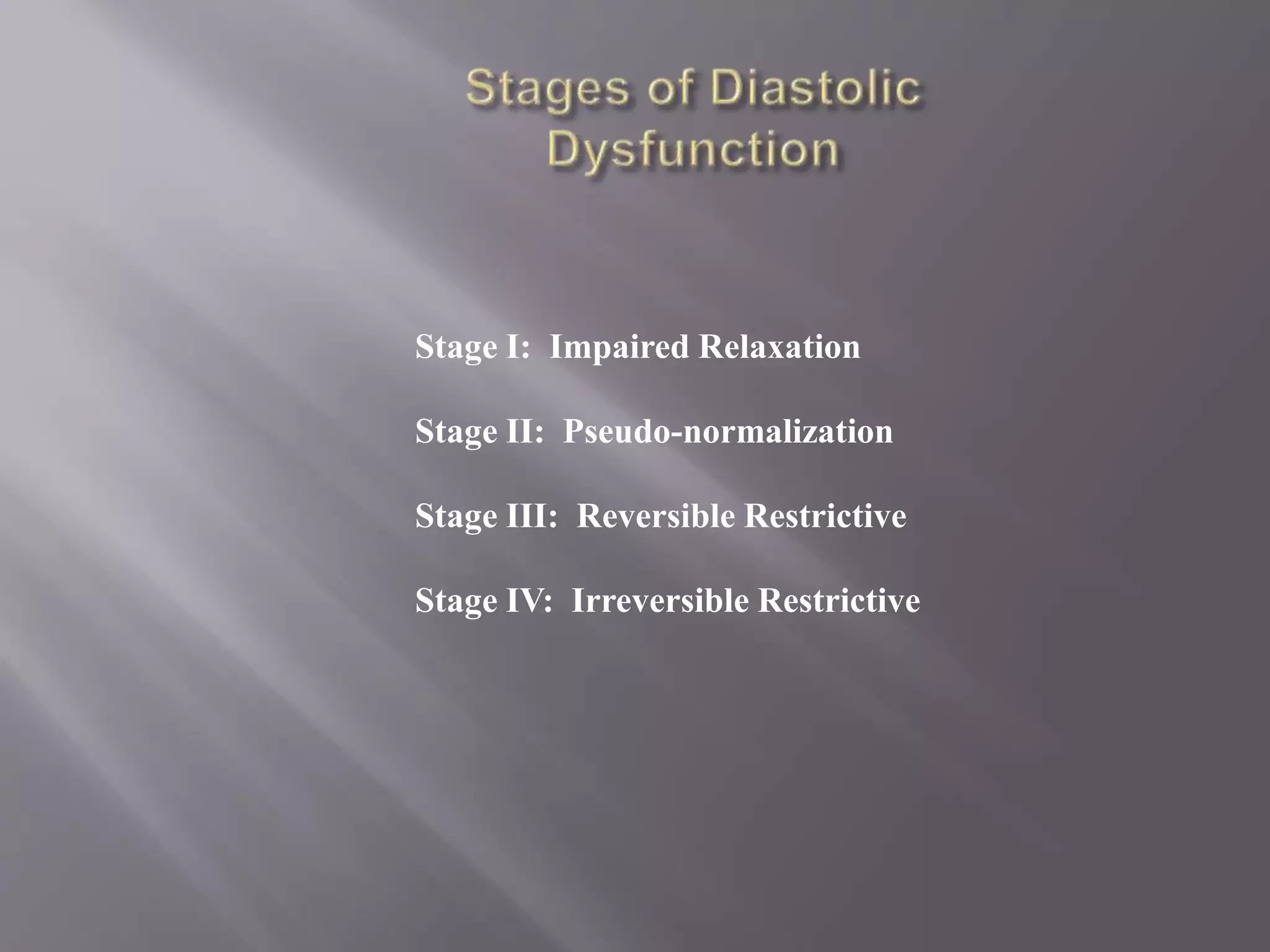
Stage I: Impaired Relaxation
Stage II: Pseudo-normalization
Stage III: Reversible Restrictive
Stage IV: Irreversible Restrictive
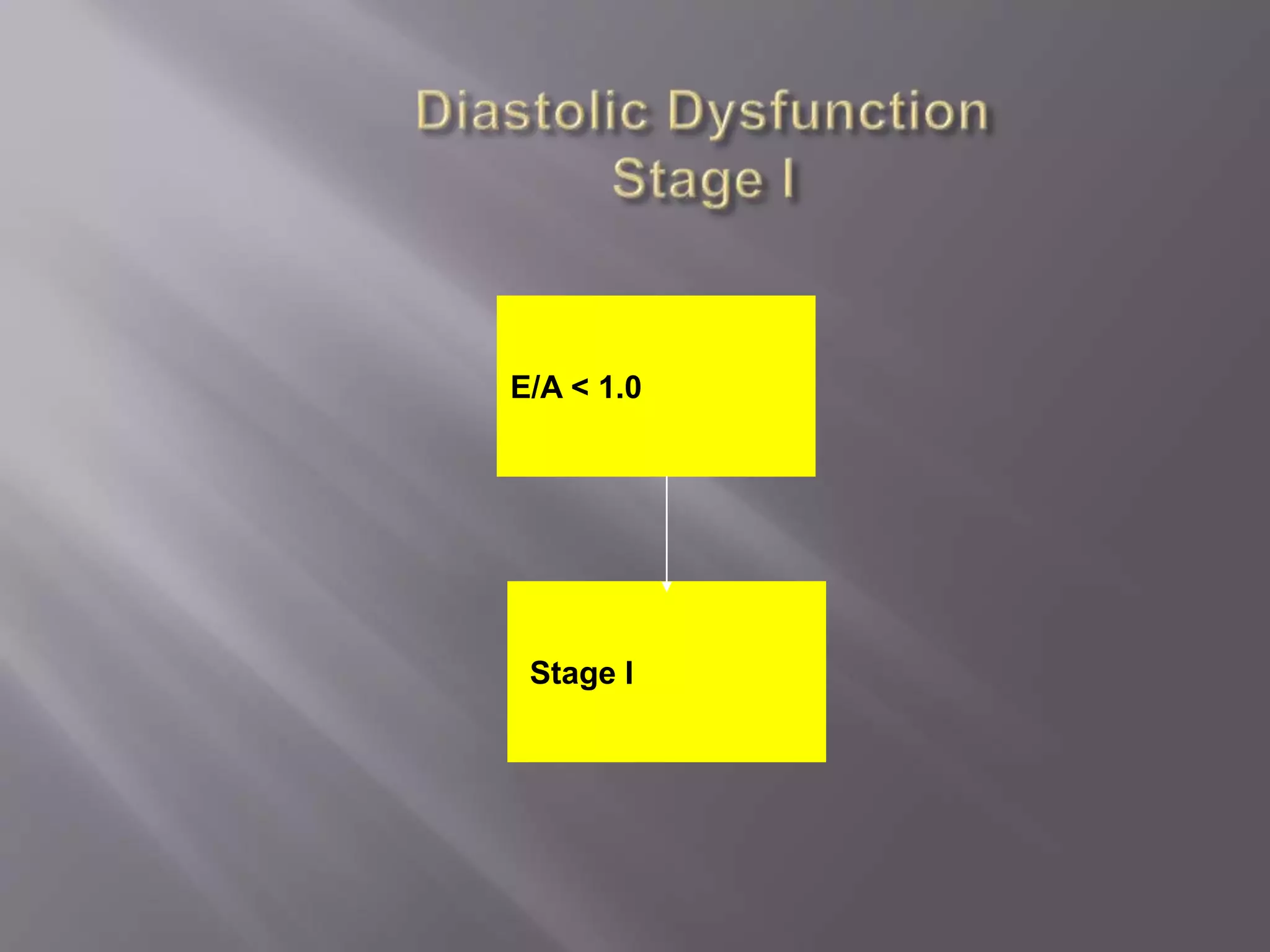
E/A < 1.0
Stage I
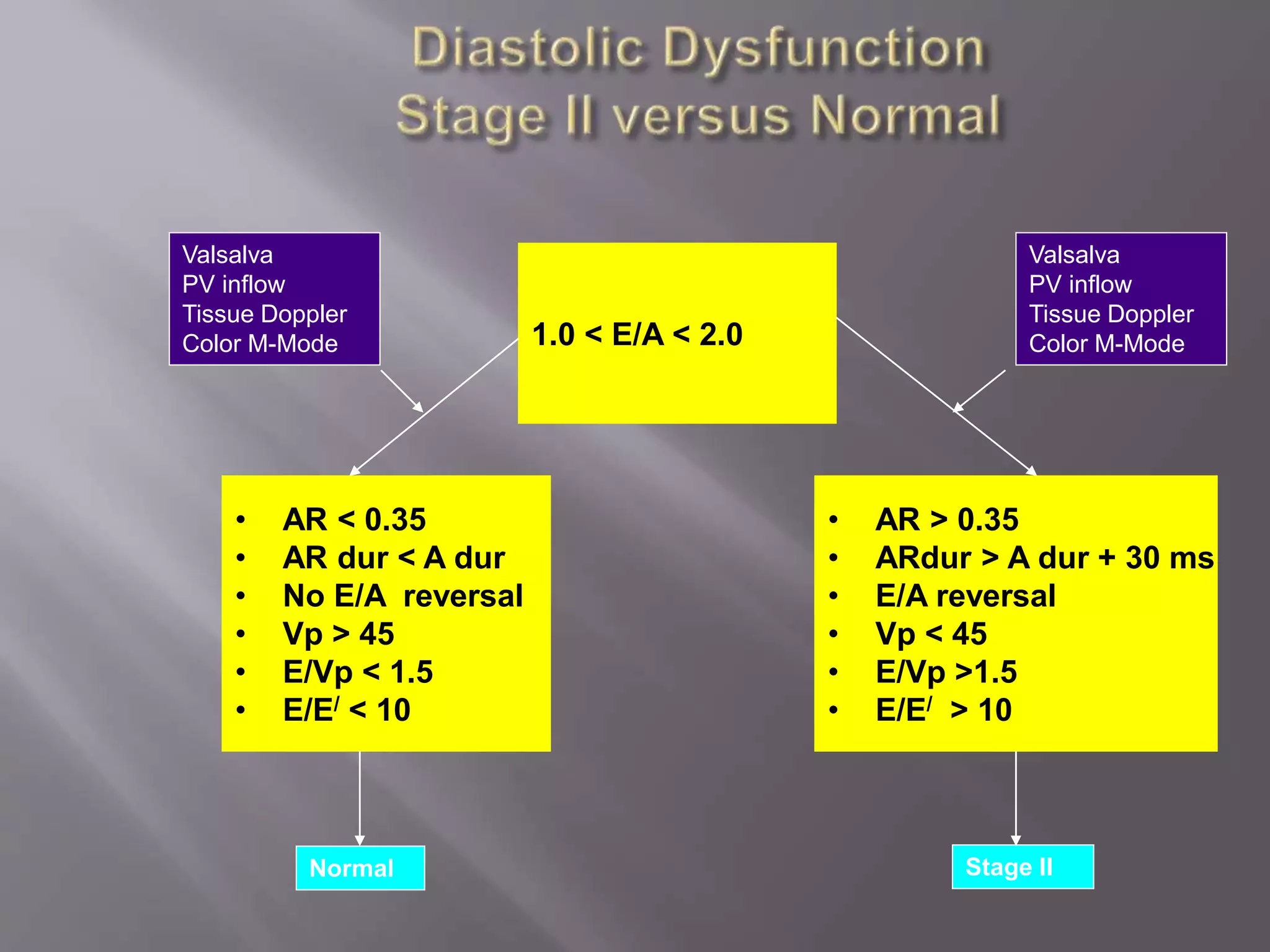
1.0 < E/A < 2.0
• AR < 0.35
• AR dur < A dur
• No E/A reversal
• Vp > 45
• E/Vp < 1.5
• E/E/ < 10
• AR > 0.35
• ARdur > A dur + 30 ms
• E/A reversal
• Vp < 45
• E/Vp >1.5
• E/E/ > 10
Valsalva
PV inflow
Tissue Doppler
Color M-Mode
Valsalva
PV inflow
Tissue Doppler
Color M-Mode
Normal Stage II
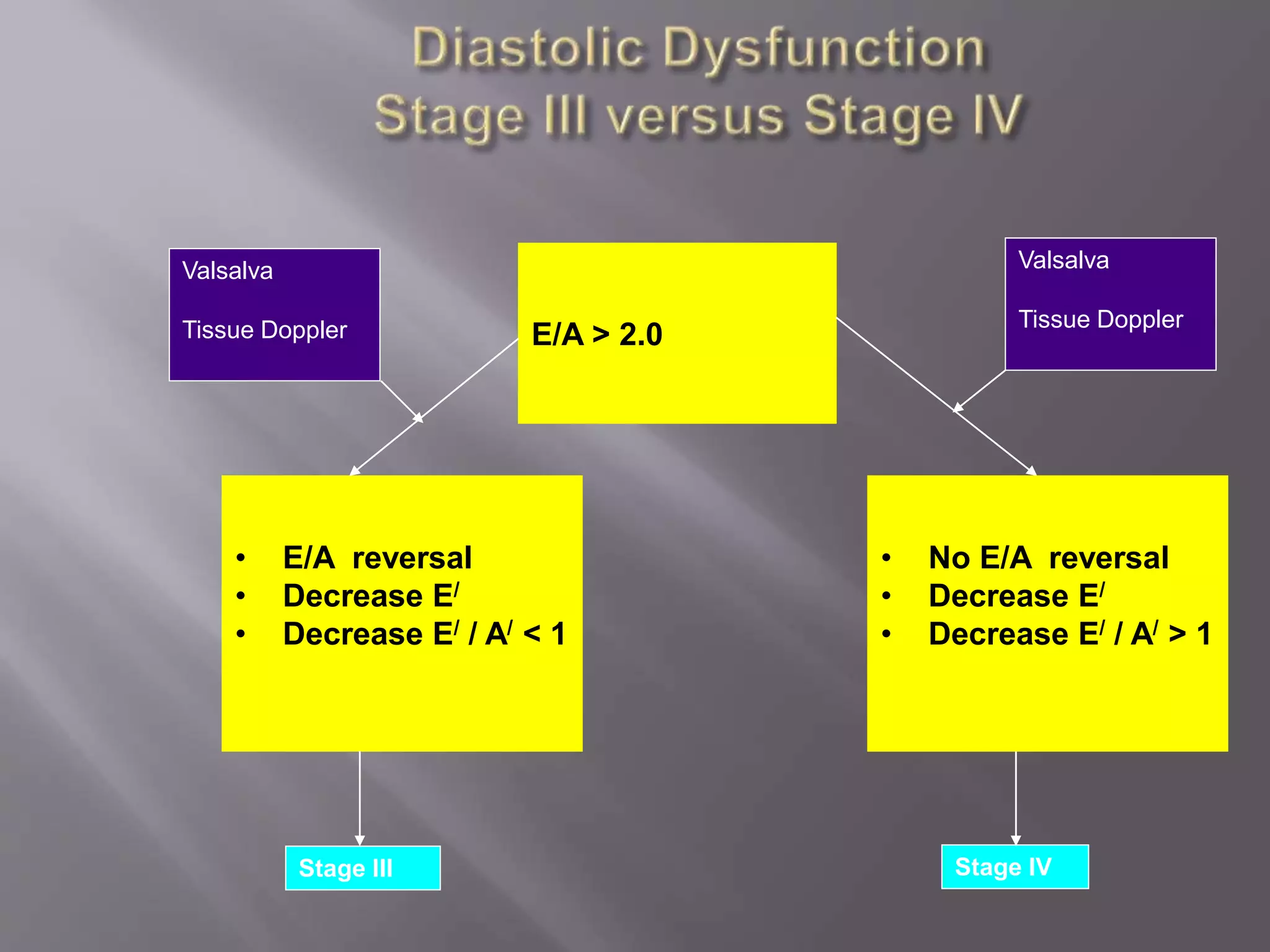
E/A > 2.0
• E/A reversal
• Decrease E/
• Decrease E/ / A/ < 1
Valsalva
Tissue Doppler
Valsalva
Tissue Doppler
Stage III Stage IV
• No E/A reversal
• Decrease E/
• Decrease E/ / A/ > 1

Echocardiographic assesment of systolic and diastolic dysfunction

  • 2.
  • 5.
     FS  EF SV and cardiac index  Systolic tissue velocity of the mitral annulus and myocardium  Tissue tracking  Regional wall motion analysis
  • 6.
     Percentage changein LV dimensions with each LV contraction  global ventricular function
  • 7.
     only atthe level being interrogated  If regional dysfunction is present, which is not in the interrogation plane-misleading estimate
  • 8.
     global LVfunction  eyeballing e  inter-observer variation
  • 9.
  • 10.
      LV dimensionsfrom the mid ventricular level is used to calculate LVEF LVEDD2 – LVESD2 LVEDD2 LVEF = x 100
  • 11.
     Not atrue indicator of systolic function  Determined by multiple factors  amount of blood volume ejected with each cardiac cycle  difference between the LV end-diastolic volume and LV end-systolic volume obtained by the Simpson method
  • 12.
     difference shouldbe equal to SV across the LVOT if there is no valvular regurgitation  If there is MR, regurgitant volume needs to be subtracted to obtain stroke volume across the LVOT
  • 13.
    Calculated as SV =LVOT area x LVOT TVI(time velocity integral)
  • 14.
      The systoliccomponent (S’) of the mitral annulus correlates well with the LVEF
  • 15.
     Mitral anulusdisplacement -tissue tracking  Normal mitral annular systolic motion is >8mm (average 12 + 2 on apical 4 or apical 2 views)  systolic mitral anulus displacement of < 5 cm = LVEF (<30%)
  • 16.
     8cm/s --cutoffpoint  Estimation of global left ventricular function from the velocity of longitudinal shortening. Echocardiography 2002;19(3):177-185
  • 17.
     Systolic contractionof the ventricles is performed optimally when regional contractions are coordinated  All walls should contract within 20 to 30 milliseconds of each other  Disrupted by conduction delay, atrial fibrillation, or a pacemaker  tissue Doppler imaging-- timings of cardiac events or myocardial movement
  • 18.
    TDI in systole TDIin diasystole Doppler Tissue Velocity
  • 19.
  • 20.
     byproduct oftissue Doppler imaging  Basoapical views of each ventricular segment are displayed as seven color bands, with each color representing a particular distance the tissue moves during systole  Tissue tracking provides a rapid assessment of systolic motion
  • 21.
     The simplestto understand is displacement, defined as excursion (in millimeters). (product of systolic velocity and duration of contraction. )  Strain rate imaging is a newly developed variation of DTI that provides a high-resolution evaluation of regional myocardial function.
  • 22.
     Strain rateis defined as the instantaneous rate of change in the two velocities divided by the instantaneous distance between the two points.  Positive strain rate represents active contraction and negative values, relaxation or lengthening between the two points.  strain rate has been demonstrated to be a more sensitive and earlier indicator of regional dysfunction than many routine techniques.  Strain rate imaging has tremendous temporal resolution as well and can be used to demonstrate subtle phenomena such as postsystolic contraction.
  • 24.
     Normal ventricularcontraction consists of simultaneous myocardial thickening and endocardial excursion toward the center of the ventricle  Regional contractility or wall motion of the LV is graded by dividing the LV into segments  In 2002, a 17-segment model was recommended by the American Society of Echocardiography  LV is divided into three levels - basal, mid or papillary and apical Circulation, 2002;105: 539-542
  • 25.
    Basal 1.Anteroseptum 2. Anterior 3. Lateral 4.Inferolateral 5. Inferior 6. Inferoseptum Mid 1.Anteroseptum 2. Anterior 3. Lateral 4. Inferolateral 5. Inferior 6. Inferoseptum Apical 1. Anterior 2. Lateral 3. Inferior 4. Septal Apical cap
  • 27.
     Numerical scoreis assigned to each wall segment on the basis of its contractility as assessed visually: 1= Normal (>40% thickening with systole) 2= Hypokinesis (10-30% thickening) 3= Severe hypokinesis to akinesis (<10% thickening) 4= Dyskinesis (out of phase) 5= Aneurysm (thinned and bulging outwards)
  • 28.
     On thebasis of this wall motion analysis scheme, a wall motion score index (WMSI) is calculated to semiquantitate the extent of regional wall motion abnormalities Normal WMSI is 1 WMSI > 1.7 may suggest perfusion defect > 20%
  • 29.
    Qualitative estimation errorsdue to:  Underestimation of EF due to endocardial echo dropout and seeing mostly epicardial motion  Underestimation of EF with enlarged LV cavity; a large LV can eject more blood with less endocardial motion  Overestimation of EF with a small LV cavity  Significant segmental wall motion abnormalities
  • 30.
    Myocardial performance index TEIindex = IVRT + IVCT LVET  IVCT - Isovolumic contraction time  IVRT - Isovolumic relaxation time  LVET - LV ejection time  Normal in 0.39 +/- 0.05
  • 32.
     . Twistis defined as (Φapex − Φbase), twist per unit length as (Φapex − Φbase)/D, and left ventricle (LV) torsion T (circumferential- longitudinal shear angle) as (Φapex − Φbase) (ρapex − ρbase)/2D. Mostly, counterclockwise rotation as seen from the apex is positive.
  • 33.
    Definition of thenormalized twist, where this twist angle is divided by the distance (D) between the measured locations of base and apex . However, to make LV torsion comparable among differently sized hearts, the normalized twist should be multiplied by the mean radius (ρ) of base and apex T=(ϕapex−ϕbase)×(ρapex+ρbase)2D
  • 34.
    1. E-point septalseparation 2. Aortic valve opening pattern
  • 35.
     magnitude ofopening of the mitral valve=E- wave height, correlates with transmitral flow and, in the absence of significant MR, with LV SV  Mitral valve E point (maximal early opening) - within 6 mm of the left side of the ventricular septum  decreased ejection fraction-distance is increased
  • 36.
  • 38.
     stroke volumeis decreased  gradual reduction in forward flow in late systole,  gradual closing of the aortic valve in late systole.  rounded appearance of the aortic valve in late systole
  • 39.
    .. .  MMode  Pulse wave tissue Doppler  Color Coded Tissue Doppler
  • 41.
    PULSED WAVE TISSUEDOPPLER MITRAL ANNULAR PEAK S WAVE VELOCITY 7.5 CM/SEC COLOR CODED TISSUE DOPPLER MITRAL ANNULAR MEAN S WAVE VELOCITY 5.4 CM/SEC
  • 42.
  • 43.
    rate and timecourse of blood flow from LA to LV is determined by 1.Pressure difference along the path 2.Ventricular relaxation 3.Relative compliances of the two chambers Basic Principle
  • 44.
  • 45.
    1.Ventricular relaxation 2.Myocardial complianceand Chamber Compliance 3. LV-EDP 4.Ventricular Diastolic filling 5.Atrial Pressures and Filling Parameters of Diastolic Function
  • 46.
    Ventricular Relaxation -occurs duringIVR and early diastolic filling -active process involving utilization of energy of the myocardium. The measure of Ventricular Relaxation include the following: 1.Isovolumic relaxation time (IVRT) 2.The maximum rate of pressure decline (- dP/dt) Parameters of Diastolic Function
  • 47.
  • 48.
  • 49.
    Ventricular Compliance ratio ofchange in volume to change in pressure (dV/dP). Stiffness -inverse of compliance: the ratio of change in pressure to change in volume (dP/dV) Parameters of Diastolic Function
  • 50.
    Compliance : 1.Myocardial compliance– isolated myocardium 2.Chamber Compliance – entire chamber Parameters of Diastolic Function
  • 51.
  • 52.
    Chamber compliance : 1.Ventricularsize and shape 2.Characteristics of the myocardium 3.Extrinsic factors: a.pericardium b.RV volume c.pleural pressure Parameters of Diastolic Function
  • 53.
    Factors that affectDiastolic filling Early filling •Ventricular Diastolic Function •Changes in the pressure difference between the ventricle and atrium due to changes in preload. •Changes in Transmitral volume flow rate (increased in MR). •Change in LA pressure. Parameters of Diastolic Function
  • 54.
    Late filling •Ventricular Diastolicfunction •Cardiac rhythm •Atrial contractile function •Ventricular end-diastolic pressure •HR •Time of atrial Contraction Parameters of Diastolic Function
  • 55.
  • 56.
    Factors that AffectDoppler Left Ventricular Filling 1.Technical 2.Normal Variations 3.Physiologic Technical 1.Sample volume location 2.Doppler modality 3.Intercept angle Left Ventricular Filling
  • 57.
    Normal Variation Respiration –Increase filling during inspiration on the right, increase filling at end of expiration on the left. Left Ventricular Filling
  • 58.
    Normal Variation Heart rate– Increase heart rate shortens diastasis so that the A velocity more closely follow the E velocity. Left Ventricular Filling
  • 59.
    PR interval Longer PRinterval results in an A velocity early in diastole. Left Ventricular Filling
  • 60.
    Age As age increaseE velocity diminishes and the atrial contribution becomes more prominent with equalization of the E and A velocities age 60 years - reversal of the E/A ratio Left Ventricular Filling
  • 61.
    Physiological Factors • LApressure (preload) • Volume flow rate (MR) • Left ventricular systolic function (LV-ESV) • Atrial contractile function Left Ventricular Filling
  • 62.
    Pattern Impaired Relaxation: • ProlongIVRT • Decreased early DT • Decreased E wave • Increased A wave Left Ventricular Filling
  • 63.
    Pattern • Reduced Compliance: •Shorten IVRT • Increased E wave • Steep early DT • Decreased A wave Reduced Compliance
  • 64.
    Left Atrial Filling •Window and Plane – A4C • Vein interrogated – Right superior pulmonary vein. Left Atrial Filling
  • 65.
    Pattern 1. Small reversalof flow following atrial contraction (a wave) 2. Systolic filling phase 3. Blunting of flow or brief reversal at end-systole 1. Diastolic filling phase Left Atrial Filling
  • 66.
    Factors that affectLA filling Pattern Systolic Atrial Filling 1. Age 2. LA size 3. LA pressure 4. LA contractile function Left Atrial Filling
  • 67.
    Diastolic Atrial Filling 1.Gradient from PV to LV 2. LV diastolic relaxation 3. LA compliance 4. LV compliance Left Atrial Filling
  • 68.
    Impaired Relaxation 1. Prominentreversal 2. Blunting of the diastolic flow Pattern of Left Atrial Filling
  • 69.
    Reduced Compliance 1. Prominentreversal 2. Prominent diastolic flow Pattern of Left Atrial Filling
  • 70.
     Mitral Inflow+/- Valsalva  Pulmonary Venous Flow  Tissue Doppler  Color M-mode
  • 71.
  • 72.
  • 73.
  • 74.
  • 75.
  • 76.
  • 77.
    Mitral Inflow cm/s E velocity Avelocity IVRT A dur Deceleration time
  • 78.
  • 79.
  • 80.
  • 81.
  • 82.
  • 83.
    cm/s D velocity S velocity ARvelocity AR dur Pulmonary Venous Flow
  • 84.
  • 85.
  • 86.
  • 87.
  • 88.
    PARAMETERS MEASUREMENTS 1. MitralValve inflow a. E wave velocity b. A wave velocity c. E/A ratio d. Deceleration Time e. A wave duration f. IVRT 2. Mitral Valve inflow with reduced preload a. E wave velocity b. A wave velocity c. E/A ratio 3. Pulmonary Venous flow a. S wave b. D wave c. A reversal velocity d. A reversal duration
  • 89.
    PARAMETERS MEASUREMENTS 4. TissueDoppler a. E’ b. A’ c. E/E’ 5. Color M-mode a. Vp b. E/Vp Diastolic Evaluation
  • 90.
    E/A ratio 1.0to 1.5 Deceleration time 160 to 240 ms IVRT 76 +/- 13 > 40 yr 69 +/- 12 < 40 yr Valsalva maneuver Preserved E/A ratio Pulmonary a wave flow reversal < 35 cm/s Mitral A wave duration Greater than pulmonary A reversal duration Pulmonary S wave velocity Greater or equal to pulmonary D wave velocity. Cardiac structure and function. Normal
  • 91.
    Stage I: ImpairedRelaxation Stage II: Pseudo-normalization Stage III: Reversible Restrictive Stage IV: Irreversible Restrictive
  • 92.
  • 93.
    1.0 < E/A< 2.0 • AR < 0.35 • AR dur < A dur • No E/A reversal • Vp > 45 • E/Vp < 1.5 • E/E/ < 10 • AR > 0.35 • ARdur > A dur + 30 ms • E/A reversal • Vp < 45 • E/Vp >1.5 • E/E/ > 10 Valsalva PV inflow Tissue Doppler Color M-Mode Valsalva PV inflow Tissue Doppler Color M-Mode Normal Stage II
  • 94.
    E/A > 2.0 •E/A reversal • Decrease E/ • Decrease E/ / A/ < 1 Valsalva Tissue Doppler Valsalva Tissue Doppler Stage III Stage IV • No E/A reversal • Decrease E/ • Decrease E/ / A/ > 1

Editor's Notes

  • #19 This technique relies on altering receiver gains and frequency filters so that the Doppler signal arising from relatively dense, slow-moving targets such as the myocardium and cardiac anulus are interrogated for their velocity. A pulsed Doppler sample volume is placed within an area of the myocardium or the anulus and the velocities at that point are then displayed for quantitation .