02/10/16 RAGHAVENDRA KUMAR GUNDA1
02/10/16 RAGHAVENDRA KUMAR GUNDA2
COMPRESSION AND COMPACTION
ENERGY INVOLVED IN COMPACTION
TABLET STRENGTH
CRUSHING STRENGTH
FRIABILITY
LAMINATION
Presented by:
RAGHAVENDRA KUMAR GUNDA
GUIDED BY
Prof.A.M.S.SUDHAKAR BABU SIR M.PHARM., M.B.A.,Ph.D
PRINCIPAL & HOD
DEPARTMENT OF PHARMACEUTICS
A.M.REDDY MEMORIAL COLLEGE OF PHARMACY
02/10/16 RAGHAVENDRA KUMAR GUNDA3
02/10/16 RAGHAVENDRA KUMAR GUNDA4
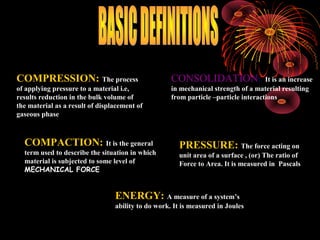
COMPRESSION: The process
of applying pressure to a material i.e,
results reduction in the bulk volume of
the material as a result of displacement of
gaseous phase
CONSOLIDATION: It is an increase
in mechanical strength of a material resulting
from particle –particle interactions
COMPACTION: It is the general
term used to describe the situation in which
material is subjected to some level of
MECHANICAL FORCE
PRESSURE: The force acting on
unit area of a surface , (or) The ratio of
Force to Area. It is measured in Pascals
ENERGY: A measure of a system’s
ability to do work. It is measured in Joules
02/10/16 RAGHAVENDRA KUMAR GUNDA5
Tablet Machines, Roll Compacters, Extruders are required a high
Input of MECHANICAL WORK
As the upper punch enters the Die, begins to apply force to
granulation; A small qty of energy needed to Rearrange the particles to
pack with less Void
As the process of compaction continues ( i.e both Compression
&Consolidation) energy is expended to over come DIEWALL
FRICTION& To increase the specific surface area as
Fragmentation  Deformation occurs.
The ways in which work done is converted into other forms of energy
. The work requirement is a key factor in machine design& any
proportion of applied energy stored in a product retains as
DESTRUCTIVE CAPABILITY.
02/10/16 RAGHAVENDRA KUMAR GUNDA6
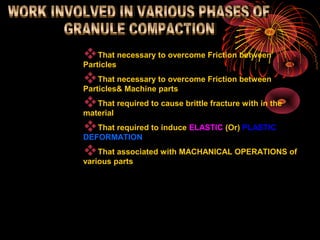
That necessary to overcome Friction between
Particles
That necessary to overcome Friction between
Particles& Machine parts
That required to cause brittle fracture with in the
material
That required to induce ELASTIC (Or) PLASTIC
DEFORMATION
That associated with MACHANICAL OPERATIONS of
various parts
02/10/16 RAGHAVENDRA KUMAR GUNDA7
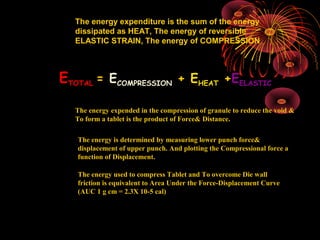
The energy expenditure is the sum of the energy
dissipated as HEAT, The energy of reversible
ELASTIC STRAIN, The energy of COMPRESSION
ETOTAL = ECOMPRESSION + EHEAT +EELASTIC
The energy expended in the compression of granule to reduce the void &
To form a tablet is the product of Force& Distance.
The energy is determined by measuring lower punch force&
displacement of upper punch. And plotting the Compressional force a
function of Displacement.
The energy used to compress Tablet and To overcome Die wall
friction is equivalent to Area Under the Force-Displacement Curve
(AUC 1 g cm = 2.3X 10⁻⁵ cal)
02/10/16 RAGHAVENDRA KUMAR GUNDA8
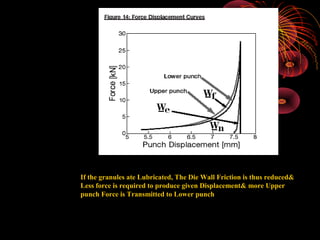
If the granules ate Lubricated, The Die Wall Friction is thus reduced&
Less force is required to produce given Displacement& more Upper
punch Force is Transmitted to Lower punch
02/10/16 RAGHAVENDRA KUMAR GUNDA9
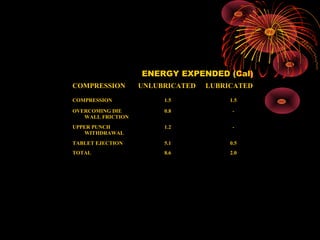
According to Experimental reports of NELSON &ASSOCIATES, the energy
expenditure in LUBRICATED& UN LUBRICATED SULPHATHIAZOLE
GRANULATION
Lubrication reduces the energy to 75% . Proved experimentally by
taking .4 gm lubricated the results are compared with un lubricated
sulphathiazole granules compressed at 1700 kg/cm2. The difference in
AUC is equal to .8 cal
The total work was calculated using formula
DMAX
WT = ∫ F.dD
DF=0
02/10/16 RAGHAVENDRA KUMAR GUNDA10
COMPRESSION UNLUBRICATED LUBRICATED
COMPRESSION 1.5 1.5
OVERCOMING DIE
WALL FRICTION
0.8 -
UPPER PUNCH
WITHDRAWAL
1.2 -
TABLET EJECTION 5.1 0.5
TOTAL 8.6 2.0
ENERGY EXPENDED (Cal)
02/10/16 RAGHAVENDRA KUMAR GUNDA11
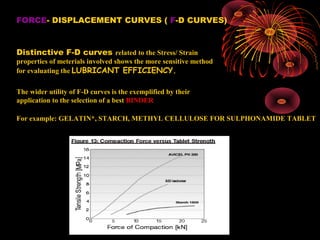
FORCE- DISPLACEMENT CURVES ( F-D CURVES)
Distinctive F-D curves related to the Stress/ Strain
properties of meterials involved shows the more sensitive method
for evaluating the LUBRICANT EFFICIENCY.
The wider utility of F-D curves is the exemplified by their
application to the selection of a best BINDER
For example: GELATIN*, STARCH, METHYL CELLULOSE FOR SULPHONAMIDE TABLET
02/10/16 RAGHAVENDRA KUMAR GUNDA12
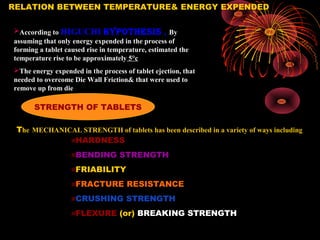
RELATION BETWEEN TEMPERATURE& ENERGY EXPENDED
According to HIGUCHI HYPOTHESIS , By
assuming that only energy expended in the process of
forming a tablet caused rise in temperature, estimated the
temperature rise to be approximately 5°c
The energy expended in the process of tablet ejection, that
needed to overcome Die Wall Friction& that were used to
remove up from die
STRENGTH OF TABLETS
The MECHANICAL STRENGTH of tablets has been described in a variety of ways including
HARDNESS
BENDING STRENGTH
FRIABILITY
FRACTURE RESISTANCE
CRUSHING STRENGTH
FLEXURE (or) BREAKING STRENGTH
02/10/16 RAGHAVENDRA KUMAR GUNDA13
The Mechanical Strength of tablets is an imp property of this form of
Drug Presentation& plays substantial role in both
PRODUCT DEVELOPMENT & CONTROL
The mechanical strength is primarily due to two events that occur
during COMPRESSION: The formation of Interparticulate bonds
& A reduction in porosity sed Density
The most popular estimate of tablet strength has been
CRUSHING STRENGTH SC In industry mechanical
strength is most often referred as TABLET HARDNESS/
more precisely CRUSHING STENGTH
BROOK & MARSHALL have described as the compressional force
(fc) that when applied diametrically to a tablet just fractures it. It was
measured in Kg. A SC OF 4Kg is considerable as minimum satisfactory.
02/10/16 RAGHAVENDRA KUMAR GUNDA14
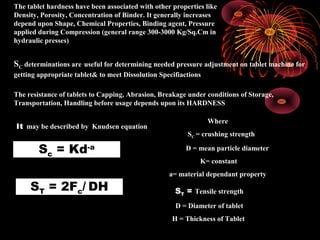
The tablet hardness have been associated with other properties like
Density, Porosity, Concentration of Binder. It generally increases
depend upon Shape, Chemical Properties, Binding agent, Pressure
applied during Compression (general range 300-3000 Kg/Sq.Cm in
hydraulic presses)
SC determinations are useful for determining needed pressure adjustment on tablet machine for
getting appropriate tablet& to meet Dissolution Specifiactions
The resistance of tablets to Capping, Abrasion, Breakage under conditions of Storage,
Transportation, Handling before usage depends upon its HARDNESS
It may be described by Knudsen equation
Sc = Kd-a
Where
SC = crushing strength
D = mean particle diameter
K= constant
a= material dependant property
ST = 2Fc/ DH ST = Tensile strength
D = Diameter of tablet
H = Thickness of Tablet
wf = 2(∫FdZ)/ DH
F = Force applied to Tablet
Z = deformation resulting from it
Many Crushing Strength Testers are described in the Literature, several are available
Commercially. Comparison between the have been described. The widely used are
HORIZONTAL
CRUSHING
STRENGTH
MONSANTO HARDNESS TESTER( STOKES MECHANISM
STRONG COBB TESTER (PNEUMATIC MECHANISM)
PFIZER TESTER(PLIERS MECHANISM)
ERWEKA TESTER(COUNTER WEIGHT PRINCIPLE)
SCHLEUNIGER TESTER(COUNTER WEIGHT PRINCIPLE)
02/10/16 RAGHAVENDRA KUMAR GUNDA16
SURFACE
CRUSHING
STRENGTH
VICKER’S TEST
Pfizer Tablet Hardness
Tester Monsanto Tablet Hardness Teste
Stokes Digital Tablet Hardness Tester
02/10/16 17
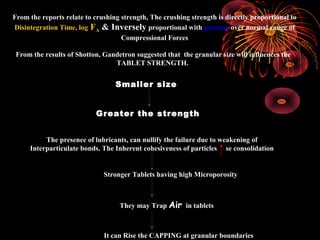
From the reports relate to crushing strength, The crushing strength is directly proportional to
Disintegration Time, log FA & Inversely proportional with porosity over normal range of
Compressional Forces
From the results of Shotton, Gandetron suggested that the granular size will influences the
TABLET STRENGTH.
Smaller size
Greater the strength
The presence of lubricants, can nullify the failure due to weakening of
Interparticulate bonds. The Inherent cohesiveness of particles se consolidation
Stronger Tablets having high Microporosity
They may Trap Air in tablets
It can Rise the CAPPING at granular boundaries
02/10/16 RAGHAVENDRA KUMAR GUNDA18
Presence of Thin Film of Binder at the surface
Lead to Failure across the Granules
Tablet with se TABLET STRENGTH
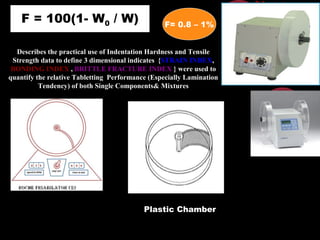
FRIABILITY test is performed to evaluate the ability of tablet to withstand wear& tear in
Packing & Transportation. The most popular version (commercially available) is the
ROCHE FRIABILATOR
THE APPARATUS consists of a Plastic Chamber, which is divided into two
parts& revolves at a speed of 25 rpm
02/10/16 RAGHAVENDRA KUMAR GUNDA19
F = 100(1- W0 / W)
Describes the practical use of Indentation Hardness and Tensile
Strength data to define 3 dimensional indicates {STRAIN INDEX,
BONDING INDEX , BRITTLE FRACTURE INDEX } were used to
quantify the relative Tabletting Performance (Especially Lamination
Tendency) of both Single Components& Mixtures
F= 0.8 – 1%
Plastic Chamber
02/10/16 20
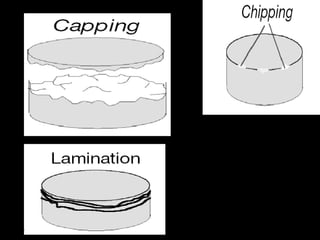
One of the more common problems encountered in Compaction is
that the tablet structure fails on Ejection from Die
The partial r complete separation of Top r Bottom surface of the
tablet from the body is called CAPPING
In other cases the tablet splits into a number of layers
(LAMINATES). The phenomenon of separation of various layers
known as LAMINATION. This is due to Inadequate removal of
Air from the Granules in the Die Cavity before& during Compression
Excessive fines in the Granules
entrap the Air with in the Tablet
Which Tend pack poorly
MASSIVE ELASTIC RECOVERY give force inherent
variation in Compressional Stress
02/10/16 21
02/10/16 RAGHAVENDRA KUMAR GUNDA22
REASONS
Entrapment of Air& Elastic Compression ruptures the bonds
Defective Punches & Dies
High Speed of Compression
Incorrect setup of press
OVERDRYING of Granules
PREVENTIVE MEASURES
Operating at high speed under partial vacuum
Use of Slow Compressional rates& Multi Stage Compression Press
The Technique which se the association of weakly bonded contributing factor
Instances
Choice of Addition of Excipients which provide a Matrix of PLASTICALLY
DEFORMING material for stress relief
Loading& Unloading of mass by utilization of Large Compressional rolls,
Precompression, Slow press speeds also reduce the Lamination
Lubricants, compression mechanism, Moisture levels, Tooling Geometry all
contribute for overcoming Lamination all take into consideration
02/10/16 RAGHAVENDRA KUMAR GUNDA23
Setting Dies & Punches properly
Reduce the percentage of fines
Punches should be either BUFFED/POLISHED before use
Defective Punches are replaced
Regulate the speed of machine to desired level
Regulate the pressure on punches so as to maintain a proper degree of compression
02/10/16 RAGHAVENDRA KUMAR GUNDA24
BIBLIOGRAPHY
1. THEORY AND PRACTICE OF INDUSTRIAL PHARMACY BY LEON LACHMAN
2. A TEXT BOOK OF TUITORIAL PHARMACY BY COOPER& GUNNS
3. BENTLY’S TEXT BOOK OF PHARMACY
4. ANSEL’S PHARMACEUTICAL DOSAGE FORMS AND DRUG DELIVERY SYSTEMS
5. AULTON’S PHARMACEUTICS
6. PHARMACEUTICAL DOSAGEFORMS TABLET VOLUMES-II
7. REMINGTON’S PHARMACEUTICAL SCIENCES
8. MODERN PHARMACEUTICS BY CHRISTOPPHER.T.RHODES (M-D SERIES)
9. FMC MATERIAL
10. WWW.PHARMAINFO.NET
11. WWW.WIKIPEDIA.COM
02/10/16 RAGHAVENDRA KUMAR GUNDA25

Compression and compaction

  • 1.
  • 2.
    02/10/16 RAGHAVENDRA KUMARGUNDA2 COMPRESSION AND COMPACTION ENERGY INVOLVED IN COMPACTION TABLET STRENGTH CRUSHING STRENGTH FRIABILITY LAMINATION Presented by: RAGHAVENDRA KUMAR GUNDA GUIDED BY Prof.A.M.S.SUDHAKAR BABU SIR M.PHARM., M.B.A.,Ph.D PRINCIPAL & HOD DEPARTMENT OF PHARMACEUTICS A.M.REDDY MEMORIAL COLLEGE OF PHARMACY
  • 3.
  • 4.
    02/10/16 RAGHAVENDRA KUMARGUNDA4 COMPRESSION: The process of applying pressure to a material i.e, results reduction in the bulk volume of the material as a result of displacement of gaseous phase CONSOLIDATION: It is an increase in mechanical strength of a material resulting from particle –particle interactions COMPACTION: It is the general term used to describe the situation in which material is subjected to some level of MECHANICAL FORCE PRESSURE: The force acting on unit area of a surface , (or) The ratio of Force to Area. It is measured in Pascals ENERGY: A measure of a system’s ability to do work. It is measured in Joules
  • 5.
    02/10/16 RAGHAVENDRA KUMARGUNDA5 Tablet Machines, Roll Compacters, Extruders are required a high Input of MECHANICAL WORK As the upper punch enters the Die, begins to apply force to granulation; A small qty of energy needed to Rearrange the particles to pack with less Void As the process of compaction continues ( i.e both Compression &Consolidation) energy is expended to over come DIEWALL FRICTION& To increase the specific surface area as Fragmentation Deformation occurs. The ways in which work done is converted into other forms of energy . The work requirement is a key factor in machine design& any proportion of applied energy stored in a product retains as DESTRUCTIVE CAPABILITY.
  • 6.
    02/10/16 RAGHAVENDRA KUMARGUNDA6 That necessary to overcome Friction between Particles That necessary to overcome Friction between Particles& Machine parts That required to cause brittle fracture with in the material That required to induce ELASTIC (Or) PLASTIC DEFORMATION That associated with MACHANICAL OPERATIONS of various parts
  • 7.
    02/10/16 RAGHAVENDRA KUMARGUNDA7 The energy expenditure is the sum of the energy dissipated as HEAT, The energy of reversible ELASTIC STRAIN, The energy of COMPRESSION ETOTAL = ECOMPRESSION + EHEAT +EELASTIC The energy expended in the compression of granule to reduce the void & To form a tablet is the product of Force& Distance. The energy is determined by measuring lower punch force& displacement of upper punch. And plotting the Compressional force a function of Displacement. The energy used to compress Tablet and To overcome Die wall friction is equivalent to Area Under the Force-Displacement Curve (AUC 1 g cm = 2.3X 10⁻⁵ cal)
  • 8.
    02/10/16 RAGHAVENDRA KUMARGUNDA8 If the granules ate Lubricated, The Die Wall Friction is thus reduced& Less force is required to produce given Displacement& more Upper punch Force is Transmitted to Lower punch
  • 9.
    02/10/16 RAGHAVENDRA KUMARGUNDA9 According to Experimental reports of NELSON &ASSOCIATES, the energy expenditure in LUBRICATED& UN LUBRICATED SULPHATHIAZOLE GRANULATION Lubrication reduces the energy to 75% . Proved experimentally by taking .4 gm lubricated the results are compared with un lubricated sulphathiazole granules compressed at 1700 kg/cm2. The difference in AUC is equal to .8 cal The total work was calculated using formula DMAX WT = ∫ F.dD DF=0
  • 10.
    02/10/16 RAGHAVENDRA KUMARGUNDA10 COMPRESSION UNLUBRICATED LUBRICATED COMPRESSION 1.5 1.5 OVERCOMING DIE WALL FRICTION 0.8 - UPPER PUNCH WITHDRAWAL 1.2 - TABLET EJECTION 5.1 0.5 TOTAL 8.6 2.0 ENERGY EXPENDED (Cal)
  • 11.
    02/10/16 RAGHAVENDRA KUMARGUNDA11 FORCE- DISPLACEMENT CURVES ( F-D CURVES) Distinctive F-D curves related to the Stress/ Strain properties of meterials involved shows the more sensitive method for evaluating the LUBRICANT EFFICIENCY. The wider utility of F-D curves is the exemplified by their application to the selection of a best BINDER For example: GELATIN*, STARCH, METHYL CELLULOSE FOR SULPHONAMIDE TABLET
  • 12.
    02/10/16 RAGHAVENDRA KUMARGUNDA12 RELATION BETWEEN TEMPERATURE& ENERGY EXPENDED According to HIGUCHI HYPOTHESIS , By assuming that only energy expended in the process of forming a tablet caused rise in temperature, estimated the temperature rise to be approximately 5°c The energy expended in the process of tablet ejection, that needed to overcome Die Wall Friction& that were used to remove up from die STRENGTH OF TABLETS The MECHANICAL STRENGTH of tablets has been described in a variety of ways including HARDNESS BENDING STRENGTH FRIABILITY FRACTURE RESISTANCE CRUSHING STRENGTH FLEXURE (or) BREAKING STRENGTH
  • 13.
    02/10/16 RAGHAVENDRA KUMARGUNDA13 The Mechanical Strength of tablets is an imp property of this form of Drug Presentation& plays substantial role in both PRODUCT DEVELOPMENT & CONTROL The mechanical strength is primarily due to two events that occur during COMPRESSION: The formation of Interparticulate bonds & A reduction in porosity sed Density The most popular estimate of tablet strength has been CRUSHING STRENGTH SC In industry mechanical strength is most often referred as TABLET HARDNESS/ more precisely CRUSHING STENGTH BROOK & MARSHALL have described as the compressional force (fc) that when applied diametrically to a tablet just fractures it. It was measured in Kg. A SC OF 4Kg is considerable as minimum satisfactory.
  • 14.
    02/10/16 RAGHAVENDRA KUMARGUNDA14 The tablet hardness have been associated with other properties like Density, Porosity, Concentration of Binder. It generally increases depend upon Shape, Chemical Properties, Binding agent, Pressure applied during Compression (general range 300-3000 Kg/Sq.Cm in hydraulic presses) SC determinations are useful for determining needed pressure adjustment on tablet machine for getting appropriate tablet& to meet Dissolution Specifiactions The resistance of tablets to Capping, Abrasion, Breakage under conditions of Storage, Transportation, Handling before usage depends upon its HARDNESS It may be described by Knudsen equation Sc = Kd-a Where SC = crushing strength D = mean particle diameter K= constant a= material dependant property ST = 2Fc/ DH ST = Tensile strength D = Diameter of tablet H = Thickness of Tablet
  • 15.
    wf = 2(∫FdZ)/DH F = Force applied to Tablet Z = deformation resulting from it Many Crushing Strength Testers are described in the Literature, several are available Commercially. Comparison between the have been described. The widely used are HORIZONTAL CRUSHING STRENGTH MONSANTO HARDNESS TESTER( STOKES MECHANISM STRONG COBB TESTER (PNEUMATIC MECHANISM) PFIZER TESTER(PLIERS MECHANISM) ERWEKA TESTER(COUNTER WEIGHT PRINCIPLE) SCHLEUNIGER TESTER(COUNTER WEIGHT PRINCIPLE)
  • 16.
    02/10/16 RAGHAVENDRA KUMARGUNDA16 SURFACE CRUSHING STRENGTH VICKER’S TEST Pfizer Tablet Hardness Tester Monsanto Tablet Hardness Teste Stokes Digital Tablet Hardness Tester
  • 17.
    02/10/16 17 From thereports relate to crushing strength, The crushing strength is directly proportional to Disintegration Time, log FA & Inversely proportional with porosity over normal range of Compressional Forces From the results of Shotton, Gandetron suggested that the granular size will influences the TABLET STRENGTH. Smaller size Greater the strength The presence of lubricants, can nullify the failure due to weakening of Interparticulate bonds. The Inherent cohesiveness of particles se consolidation Stronger Tablets having high Microporosity They may Trap Air in tablets It can Rise the CAPPING at granular boundaries
  • 18.
    02/10/16 RAGHAVENDRA KUMARGUNDA18 Presence of Thin Film of Binder at the surface Lead to Failure across the Granules Tablet with se TABLET STRENGTH FRIABILITY test is performed to evaluate the ability of tablet to withstand wear& tear in Packing & Transportation. The most popular version (commercially available) is the ROCHE FRIABILATOR THE APPARATUS consists of a Plastic Chamber, which is divided into two parts& revolves at a speed of 25 rpm
  • 19.
    02/10/16 RAGHAVENDRA KUMARGUNDA19 F = 100(1- W0 / W) Describes the practical use of Indentation Hardness and Tensile Strength data to define 3 dimensional indicates {STRAIN INDEX, BONDING INDEX , BRITTLE FRACTURE INDEX } were used to quantify the relative Tabletting Performance (Especially Lamination Tendency) of both Single Components& Mixtures F= 0.8 – 1% Plastic Chamber
  • 20.
    02/10/16 20 One ofthe more common problems encountered in Compaction is that the tablet structure fails on Ejection from Die The partial r complete separation of Top r Bottom surface of the tablet from the body is called CAPPING In other cases the tablet splits into a number of layers (LAMINATES). The phenomenon of separation of various layers known as LAMINATION. This is due to Inadequate removal of Air from the Granules in the Die Cavity before& during Compression Excessive fines in the Granules entrap the Air with in the Tablet Which Tend pack poorly MASSIVE ELASTIC RECOVERY give force inherent variation in Compressional Stress
  • 21.
  • 22.
    02/10/16 RAGHAVENDRA KUMARGUNDA22 REASONS Entrapment of Air& Elastic Compression ruptures the bonds Defective Punches & Dies High Speed of Compression Incorrect setup of press OVERDRYING of Granules PREVENTIVE MEASURES Operating at high speed under partial vacuum Use of Slow Compressional rates& Multi Stage Compression Press The Technique which se the association of weakly bonded contributing factor Instances Choice of Addition of Excipients which provide a Matrix of PLASTICALLY DEFORMING material for stress relief Loading& Unloading of mass by utilization of Large Compressional rolls, Precompression, Slow press speeds also reduce the Lamination Lubricants, compression mechanism, Moisture levels, Tooling Geometry all contribute for overcoming Lamination all take into consideration
  • 23.
    02/10/16 RAGHAVENDRA KUMARGUNDA23 Setting Dies & Punches properly Reduce the percentage of fines Punches should be either BUFFED/POLISHED before use Defective Punches are replaced Regulate the speed of machine to desired level Regulate the pressure on punches so as to maintain a proper degree of compression
  • 24.
    02/10/16 RAGHAVENDRA KUMARGUNDA24 BIBLIOGRAPHY 1. THEORY AND PRACTICE OF INDUSTRIAL PHARMACY BY LEON LACHMAN 2. A TEXT BOOK OF TUITORIAL PHARMACY BY COOPER& GUNNS 3. BENTLY’S TEXT BOOK OF PHARMACY 4. ANSEL’S PHARMACEUTICAL DOSAGE FORMS AND DRUG DELIVERY SYSTEMS 5. AULTON’S PHARMACEUTICS 6. PHARMACEUTICAL DOSAGEFORMS TABLET VOLUMES-II 7. REMINGTON’S PHARMACEUTICAL SCIENCES 8. MODERN PHARMACEUTICS BY CHRISTOPPHER.T.RHODES (M-D SERIES) 9. FMC MATERIAL 10. WWW.PHARMAINFO.NET 11. WWW.WIKIPEDIA.COM
  • 25.