Tablet production process
granulation and palletization
equipment
PRESENTED BY :
MADHU K S
1ST M PHARM
DEPT. OF IND PHARMACY
SRINIVAS COLLEGE OF PHARMACY MANGALORE
Content
• Definition
• Tablet manufacturing equipment
• Procedure for Manufacturing Tablets
• Methods used in tablet formulation
Granulation
pelletization
• Compression
• Reference
• Tablets are solid dosage forms consisting of active ingredient(s) and
suitable pharmaceutical excipients.
• They may vary in size, shape, weight, hardness, thickness,
disintegration and dissolution characteristics, and in other aspects.
• They may be classified, according to the method of manufacture, as
compressed tablets or molded tablets
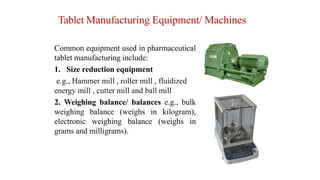
Tablet Manufacturing Equipment/ Machines
Common equipment used in pharmaceutical
tablet manufacturing include:
1. Size reduction equipment
e.g., Hammer mill , roller mill , fluidized
energy mill , cutter mill and ball mill
2. Weighing balance/ balances e.g., bulk
weighing balance (weighs in kilogram),
electronic weighing balance (weighs in
grams and milligrams).
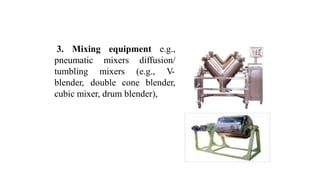
3. Mixing equipment e.g.,
pneumatic
tumbling
mixers diffusion/
mixers (e.g., V-
blender, double cone blender,
cubic mixer, drum blender),
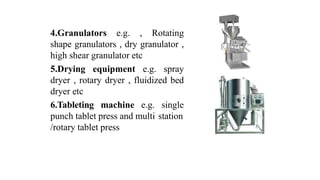
4.Granulators e.g. , Rotating
shape granulators , dry granulator ,
high shear granulator etc
5.Drying equipment e.g. spray
dryer , rotary dryer , fluidized bed
dryer etc
6.Tableting machine e.g. single
punch tablet press and multi station
/rotary tablet press
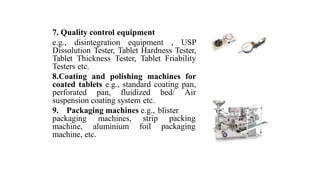
7. Quality control equipment
e.g., disintegration equipment , USP
Dissolution Tester, Tablet Hardness Tester,
Tablet Thickness Tester, Tablet Friability
Testers etc.
8.Coating and polishing machines for
coated tablets e.g., standard coating pan,
perforated pan, fluidized bed/ Air
suspension coating system etc.
9. Packaging machines e.g., blister
packaging machines, strip
machine, aluminium foil
packing
packaging
machine, etc.
Procedure for Manufacturing Tablets
• Dispensing: Each ingredient in the tablet formula is
weighed and accurately dispensed as per dose. This is
one of the critical steps in any type of formulation
process and should be done under technical
supervision.
• Sizing: Formulation ingredients must be in finely
divided form, otherwise, size reduction should be
carried out for better flow property and easy mixing.
• Powder
suitable
blending: Powders
blender to obtain
are mixed using a
a uniform and
homogeneous powder mix. The drug substance and
excipients are mixed in geometric dilution.
• Granulation: Here small powder particles are
gathered together into layers, and permanent
aggregates to render them into free-flowing states.
• Drying and dry screening: Screened wet granules
need to be dried for a particular time period in tray
dryer or fluid bed dryer at controlled temperature not
exceeding 550 degree C . Dried granules are screened
through the appropriate mesh screen
• Tablet compression: This step involves the
compression of granules into a flat or convex, round,
oblong, or unique shaped, scored or unscored tablets;
engraved with an identifying symbol and/ or code
number using tablet press.
• Coating: Tablets and granules are coated if there is
need to mask the unpleasant taste/odour of some drug
substance or to increase the aesthetic appeal of
uncoated tablets as well as to modify the release or
control the release of drug substance from tablets.
This is achieved by enclosing or covering the core
tablet or granules with coating solutions.
Methods used in tablet Formulation
Tablets are commonly manufactured by
• Direct compression
• Dry granulation or
• Wet granulation
DIRECTCOMPRESSION
• Direct compression involves direct
compression of powdered materials into tablets
without modifying the physical nature of the
materials itself.
• Direct compression
problems associated
avoids
with
many of the
wet and dry
granulations.
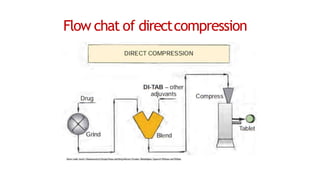
Flow chat of directcompression
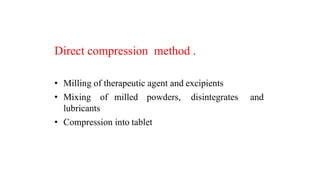
Direct compression method .
• Milling of therapeutic agent and excipients
• Mixing of milled powders, disintegrates and
lubricants
• Compression into tablet
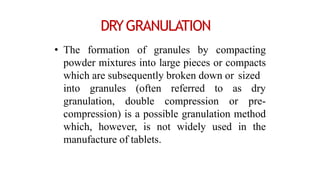
DRYGRANULATION
• The formation of granules by compacting
powder mixtures into large pieces or compacts
which are subsequently broken down or sized
into granules (often referred to
granulation, double compression
as dry
or pre-
compression) is a possible granulation method
which, however, is not widely used in the
manufacture of tablets.
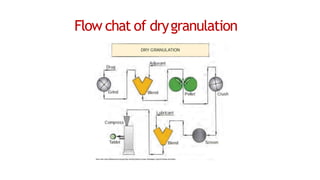
Flow chat of drygranulation
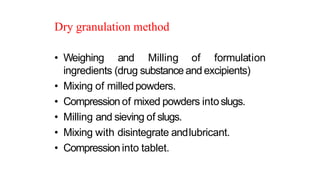
Dry granulation method
• Weighing and Milling of formulation
ingredients (drug substance and excipients)
• Mixing of milledpowders.
• Compression of mixed powders intoslugs.
• Milling and sieving of slugs.
• Mixing with disintegrate andlubricant.
• Compression into tablet.
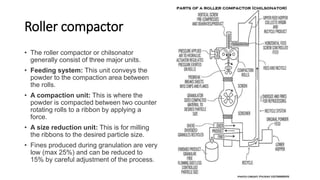
Roller compactor
• The roller compactor or chilsonator
generally consist of three major units.
• Feeding system: This unit conveys the
powder to the compaction area between
the rolls.
• A compaction unit: This is where the
powder is compacted between two counter
rotating rolls to a ribbon by applying a
force.
• A size reduction unit: This is for milling
the ribbons to the desired particle size.
• Fines produced during granulation are very
low (max 25%) and can be reduced to
15% by careful adjustment of the process.
• Pharmaceutical uses of Dry granulators
• Dry granulators are used when the drug do not compress well after wet
granulation.
• Dry granulator is the best choice for moisture sensitive drugs like
Aspirin, vitamins.
• It is used in granulating thermolabile drugs.
WETGRANULATION
• Wet granulation is a widely used method for
the production of compressed tablet. It is
essentially a process of size enlargement
involving several steps and the use of an
adhesive substance known as binder.
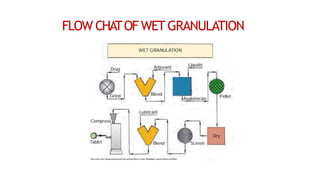
FLOW CHATOF WETGRANULATION
Steps involved in wet granulation method:
• Milling of the drug and excipients
• Weighing
• Mixing including commonly used blenders
• Wet massing
1. Low shear mixers/granulators,
2. High shear mixers/granulators,
3. Fluid-bed granulators/dryers,
4. Extruder and spheronizers.
• Drying of moist granules
• Sizing the granulation by dry screening
• Lubrication of granules
• Compression of granules into tablets
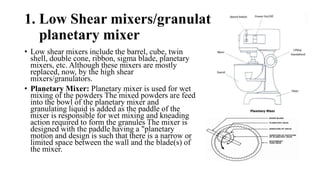
• Low shear mixers include the barrel, cube, twin
shell, double cone, ribbon, sigma blade, planetary
mixers, etc. Although these mixers are mostly
replaced, now, by the high shear
mixers/granulators.
• Planetary Mixer: Planetary mixer is used for wet
mixing of the powders The mixed powders are feed
into the bowl of the planetary mixer and
granulating liquid is added as the paddle of the
mixer is responsible for wet mixing and kneading
action required to form the granules The mixer is
designed with the paddle having a "planetary
motion and design is such that there is a narrow or
limited space between the wall and the blade(s) of
the mixer.
1. Low Shear mixers/granulators:
planetary mixer
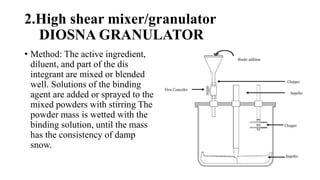
2.High shear mixer/granulator
DIOSNA GRANULATOR
• Method: The active ingredient,
diluent, and part of the dis
integrant are mixed or blended
well. Solutions of the binding
agent are added or sprayed to the
mixed powders with stirring The
powder mass is wetted with the
binding solution, until the mass
has the consistency of damp
snow.
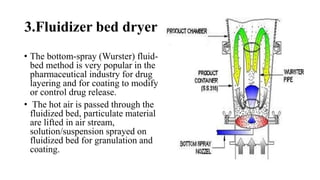
3.Fluidizer bed dryer
• The bottom-spray (Wurster) fluid-
bed method is very popular in the
pharmaceutical industry for drug
layering and for coating to modify
or control drug release.
• The hot air is passed through the
fluidized bed, particulate material
are lifted in air stream,
solution/suspension sprayed on
fluidized bed for granulation and
coating.
Advantages of F B D
• Fluidized Bed Dryers gives Homogeneous Drying.
• Fluid Bed Dryer is Suitable for Heat Sensitive Products.
• Fluidized Bed Ensures Efficiency in Material Drying.
• Handling Fluidized Bed Dryer is Easy and Less Labor Intensive.
• Fluid Bed Dryer Designs Come in a Wide Range of Capacities and Sizes.
• Fluid Bed Dryer has Low Maintenance Cost.
• No Hot Spots on the Final Products.
• Fluid Bed Dryer Is Suitable for both Continuous & Batch Material Processing.
4.Extruder and Spheronizer:
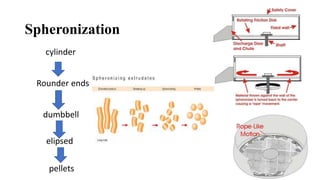
• Spheronization or marumerization, is a rapid and flexible process where
pharmaceutical products are made into small spheres, or pellets of diameter ranging
from about 0.5mm to 1mm where as in marumerizar in 0.6mm t0 1.2mm.
Dry mixing of ingredients-to achieve homogeneous powder dispersion
Wet massing – to produce a sufficiently plastic wet mass.
Extrusion – to form rod shaped particles of uniform diameter.
Spheronization – to round off these rods into spherical particles.
Drying - to achieve the desired final moisture content.
Screening -to achieve the desired narrow sizedistribution.
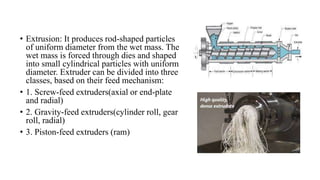
• Extrusion: It produces rod-shaped particles
of uniform diameter from the wet mass. The
wet mass is forced through dies and shaped
into small cylindrical particles with uniform
diameter. Extruder can be divided into three
classes, based on their feed mechanism:
• 1. Screw-feed extruders(axial or end-plate
and radial)
• 2. Gravity-feed extruders(cylinder roll, gear
roll, radial)
• 3. Piston-feed extruders (ram)
Spheronization
cylinder
Rounder ends
dumbbell
elipsed
pellets
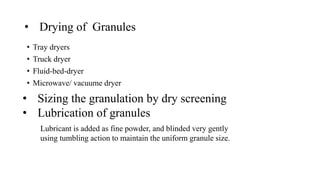
• Drying of Granules
• Tray dryers
• Truck dryer
• Fluid-bed-dryer
• Microwave/ vacuume dryer
• Sizing the granulation by dry screening
• Lubrication of granules
Lubricant is added as fine powder, and blinded very gently
using tumbling action to maintain the uniform granule size.
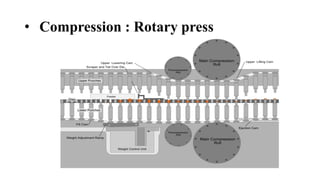
• Compression : Rotary press
Reference
• Sandler N, Lammens RF. Pneumatic dry granulation: potential to
improve roller compaction technology in drug manufacture. Expert
Opin Drug Deliv 2011; 8: 225-36.
• Politi G, Heilakka E. Method and apparatus for dry granulation.
Google Patents; 2009.
• Anonymous. Handbook of Pharmaceutical Granulation Technology.
3rd ed. Parikh DM, editor. Marcel Dekker, INC.; 2009

Presentation tablet production madhu k s

  • 1.
    Tablet production process granulationand palletization equipment PRESENTED BY : MADHU K S 1ST M PHARM DEPT. OF IND PHARMACY SRINIVAS COLLEGE OF PHARMACY MANGALORE
  • 2.
    Content • Definition • Tabletmanufacturing equipment • Procedure for Manufacturing Tablets • Methods used in tablet formulation Granulation pelletization • Compression • Reference
  • 3.
    • Tablets aresolid dosage forms consisting of active ingredient(s) and suitable pharmaceutical excipients. • They may vary in size, shape, weight, hardness, thickness, disintegration and dissolution characteristics, and in other aspects. • They may be classified, according to the method of manufacture, as compressed tablets or molded tablets
  • 4.
    Tablet Manufacturing Equipment/Machines Common equipment used in pharmaceutical tablet manufacturing include: 1. Size reduction equipment e.g., Hammer mill , roller mill , fluidized energy mill , cutter mill and ball mill 2. Weighing balance/ balances e.g., bulk weighing balance (weighs in kilogram), electronic weighing balance (weighs in grams and milligrams).
  • 5.
    3. Mixing equipmente.g., pneumatic tumbling mixers diffusion/ mixers (e.g., V- blender, double cone blender, cubic mixer, drum blender),
  • 6.
    4.Granulators e.g. ,Rotating shape granulators , dry granulator , high shear granulator etc 5.Drying equipment e.g. spray dryer , rotary dryer , fluidized bed dryer etc 6.Tableting machine e.g. single punch tablet press and multi station /rotary tablet press
  • 7.
    7. Quality controlequipment e.g., disintegration equipment , USP Dissolution Tester, Tablet Hardness Tester, Tablet Thickness Tester, Tablet Friability Testers etc. 8.Coating and polishing machines for coated tablets e.g., standard coating pan, perforated pan, fluidized bed/ Air suspension coating system etc. 9. Packaging machines e.g., blister packaging machines, strip machine, aluminium foil packing packaging machine, etc.
  • 8.
    Procedure for ManufacturingTablets • Dispensing: Each ingredient in the tablet formula is weighed and accurately dispensed as per dose. This is one of the critical steps in any type of formulation process and should be done under technical supervision. • Sizing: Formulation ingredients must be in finely divided form, otherwise, size reduction should be carried out for better flow property and easy mixing.
  • 9.
    • Powder suitable blending: Powders blenderto obtain are mixed using a a uniform and homogeneous powder mix. The drug substance and excipients are mixed in geometric dilution. • Granulation: Here small powder particles are gathered together into layers, and permanent aggregates to render them into free-flowing states. • Drying and dry screening: Screened wet granules need to be dried for a particular time period in tray dryer or fluid bed dryer at controlled temperature not exceeding 550 degree C . Dried granules are screened through the appropriate mesh screen
  • 10.
    • Tablet compression:This step involves the compression of granules into a flat or convex, round, oblong, or unique shaped, scored or unscored tablets; engraved with an identifying symbol and/ or code number using tablet press. • Coating: Tablets and granules are coated if there is need to mask the unpleasant taste/odour of some drug substance or to increase the aesthetic appeal of uncoated tablets as well as to modify the release or control the release of drug substance from tablets. This is achieved by enclosing or covering the core tablet or granules with coating solutions.
  • 11.
    Methods used intablet Formulation Tablets are commonly manufactured by • Direct compression • Dry granulation or • Wet granulation
  • 12.
    DIRECTCOMPRESSION • Direct compressioninvolves direct compression of powdered materials into tablets without modifying the physical nature of the materials itself. • Direct compression problems associated avoids with many of the wet and dry granulations.
  • 13.
    Flow chat ofdirectcompression
  • 14.
    Direct compression method. • Milling of therapeutic agent and excipients • Mixing of milled powders, disintegrates and lubricants • Compression into tablet
  • 15.
    DRYGRANULATION • The formationof granules by compacting powder mixtures into large pieces or compacts which are subsequently broken down or sized into granules (often referred to granulation, double compression as dry or pre- compression) is a possible granulation method which, however, is not widely used in the manufacture of tablets.
  • 16.
    Flow chat ofdrygranulation
  • 17.
    Dry granulation method •Weighing and Milling of formulation ingredients (drug substance and excipients) • Mixing of milledpowders. • Compression of mixed powders intoslugs. • Milling and sieving of slugs. • Mixing with disintegrate andlubricant. • Compression into tablet.
  • 18.
    Roller compactor • Theroller compactor or chilsonator generally consist of three major units. • Feeding system: This unit conveys the powder to the compaction area between the rolls. • A compaction unit: This is where the powder is compacted between two counter rotating rolls to a ribbon by applying a force. • A size reduction unit: This is for milling the ribbons to the desired particle size. • Fines produced during granulation are very low (max 25%) and can be reduced to 15% by careful adjustment of the process.
  • 19.
    • Pharmaceutical usesof Dry granulators • Dry granulators are used when the drug do not compress well after wet granulation. • Dry granulator is the best choice for moisture sensitive drugs like Aspirin, vitamins. • It is used in granulating thermolabile drugs.
  • 20.
    WETGRANULATION • Wet granulationis a widely used method for the production of compressed tablet. It is essentially a process of size enlargement involving several steps and the use of an adhesive substance known as binder.
  • 21.
  • 22.
    Steps involved inwet granulation method: • Milling of the drug and excipients • Weighing • Mixing including commonly used blenders • Wet massing 1. Low shear mixers/granulators, 2. High shear mixers/granulators, 3. Fluid-bed granulators/dryers, 4. Extruder and spheronizers. • Drying of moist granules • Sizing the granulation by dry screening • Lubrication of granules • Compression of granules into tablets
  • 23.
    • Low shearmixers include the barrel, cube, twin shell, double cone, ribbon, sigma blade, planetary mixers, etc. Although these mixers are mostly replaced, now, by the high shear mixers/granulators. • Planetary Mixer: Planetary mixer is used for wet mixing of the powders The mixed powders are feed into the bowl of the planetary mixer and granulating liquid is added as the paddle of the mixer is responsible for wet mixing and kneading action required to form the granules The mixer is designed with the paddle having a "planetary motion and design is such that there is a narrow or limited space between the wall and the blade(s) of the mixer. 1. Low Shear mixers/granulators: planetary mixer
  • 24.
    2.High shear mixer/granulator DIOSNAGRANULATOR • Method: The active ingredient, diluent, and part of the dis integrant are mixed or blended well. Solutions of the binding agent are added or sprayed to the mixed powders with stirring The powder mass is wetted with the binding solution, until the mass has the consistency of damp snow.
  • 25.
    3.Fluidizer bed dryer •The bottom-spray (Wurster) fluid- bed method is very popular in the pharmaceutical industry for drug layering and for coating to modify or control drug release. • The hot air is passed through the fluidized bed, particulate material are lifted in air stream, solution/suspension sprayed on fluidized bed for granulation and coating.
  • 26.
    Advantages of FB D • Fluidized Bed Dryers gives Homogeneous Drying. • Fluid Bed Dryer is Suitable for Heat Sensitive Products. • Fluidized Bed Ensures Efficiency in Material Drying. • Handling Fluidized Bed Dryer is Easy and Less Labor Intensive. • Fluid Bed Dryer Designs Come in a Wide Range of Capacities and Sizes. • Fluid Bed Dryer has Low Maintenance Cost. • No Hot Spots on the Final Products. • Fluid Bed Dryer Is Suitable for both Continuous & Batch Material Processing.
  • 27.
    4.Extruder and Spheronizer: •Spheronization or marumerization, is a rapid and flexible process where pharmaceutical products are made into small spheres, or pellets of diameter ranging from about 0.5mm to 1mm where as in marumerizar in 0.6mm t0 1.2mm. Dry mixing of ingredients-to achieve homogeneous powder dispersion Wet massing – to produce a sufficiently plastic wet mass. Extrusion – to form rod shaped particles of uniform diameter. Spheronization – to round off these rods into spherical particles. Drying - to achieve the desired final moisture content. Screening -to achieve the desired narrow sizedistribution.
  • 28.
    • Extrusion: Itproduces rod-shaped particles of uniform diameter from the wet mass. The wet mass is forced through dies and shaped into small cylindrical particles with uniform diameter. Extruder can be divided into three classes, based on their feed mechanism: • 1. Screw-feed extruders(axial or end-plate and radial) • 2. Gravity-feed extruders(cylinder roll, gear roll, radial) • 3. Piston-feed extruders (ram)
  • 29.
  • 30.
    • Drying ofGranules • Tray dryers • Truck dryer • Fluid-bed-dryer • Microwave/ vacuume dryer • Sizing the granulation by dry screening • Lubrication of granules Lubricant is added as fine powder, and blinded very gently using tumbling action to maintain the uniform granule size.
  • 31.
    • Compression :Rotary press
  • 32.
    Reference • Sandler N,Lammens RF. Pneumatic dry granulation: potential to improve roller compaction technology in drug manufacture. Expert Opin Drug Deliv 2011; 8: 225-36. • Politi G, Heilakka E. Method and apparatus for dry granulation. Google Patents; 2009. • Anonymous. Handbook of Pharmaceutical Granulation Technology. 3rd ed. Parikh DM, editor. Marcel Dekker, INC.; 2009