Tablets Manufacturing
 Shmmon Ahmad,
 Asst. Professor, (Faculty of Pharmaceutics)
 Glocal University, Saharanpur
 Former Q.A Officer Ind-Swift Ltd. (WHO, GMP, MHRA-UK, EME-Europe)
INTRODUCTION
2
• Tablets may be defined as the solid unit dosage form of
medicament or medicaments with suitable excipients and
prepared either by molding or by compression. It
comprises a mixture of active substances and excipients,
• Tablets formation process consist of a series of steps
(unit processes)– weighing, milling, mixing,
granulation, drying, compaction, (frequently) coating
and packaging. Regardless of the method used the unit
processes – weighing, milling and mixing, are the
same; subsequent steps differ.
Primary goals of tablet manufacturing process
3
• To formulate tablets that are strong and hard to withstand
mechanical shock encountered during manufacturing, packing,
shipping, dispensing and use.
• To formulate tablets that are uniform in weight and in drug content.
• To formulate tablets that are bioavailable according to indication
requirements.
• To formulate tablets that are chemically and physically stable over a
long period of time.
• To formulate tablets that have elegant product identity which is free
from any tablet defects.
Categories of tablets for oral use
1. — uncoated tablets;
2— coated tablets;
3— gastro-resistant tablets;
4. — modified-release tablets;
5. — effervescent tablets;
6. — soluble tablets;
7. — dispersible tablets;
8. — orodispersible tablets;
9. — chewable tablets;
10.— oral lyophilisates.
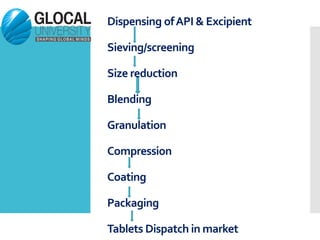
Dispensing ofAPI & Excipient
Sieving/screening
Size reduction
Blending
Granulation
Compression
Coating
Packaging
Tablets Dispatch in market
6
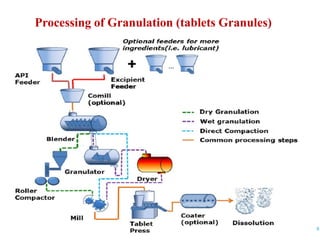
Processing of Granulation (tablets Granules)
Procedure for Manufacturing of
Tablets
7
• Dispensing: Each ingredient in the tablet formula is
weighed and accurately dispensed as per dose. This is
one of the critical steps in any type of formulation
process and should be done under technical supervision.
• Sizing: Formulation ingredients must be in finely
divided form, otherwise, size reduction should be carried
out for better flow property and easy mixing.
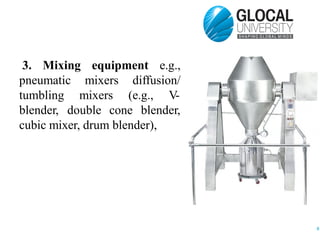
3. Mixing equipment e.g.,
pneumatic
tumbling
mixers diffusion/
mixers (e.g., V-
blender, double cone blender,
cubic mixer, drum blender),
8
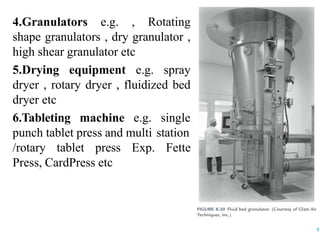
4.Granulators e.g. , Rotating
shape granulators , dry granulator ,
high shear granulator etc
5.Drying equipment e.g. spray
dryer , rotary dryer , fluidized bed
dryer etc
6.Tableting machine e.g. single
punch tablet press and multi station
/rotary tablet press Exp. Fette
Press, CardPress etc
9
7. Evaluation /Quality control (QC) equipment
e.g., disintegration equipment , USP Dissolution Tester,
Tablet Hardness Tester, Tablet Thickness Tester, Tablet
Friability Testers etc.
8.Coating and polishing machines for coated tablets
e.g., standard coating pan, perforated pan, fluidized bed/
Air suspension coating system etc.
8. Packaging machines e.g., blister packing machine,
aluminium foil packaging machine, etc. Machine
name Dph-220/260 High Speed Blister Packing
Machine
10
Tablet Manufacturing Equipment/ Machines
11
Common equipment used in pharmaceutical
tablet manufacturing include:
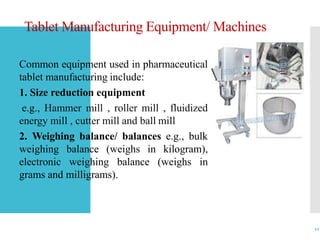
1. Size reduction equipment
e.g., Hammer mill , roller mill , fluidized
energy mill , cutter mill and ball mill
2. Weighing balance/ balances e.g., bulk
weighing balance (weighs in kilogram),
electronic weighing balance (weighs in
grams and milligrams).
• Powder
suitable
JSS College of Pharmacy, Mysuru 12
blending: Powders
blender to obtain
are mixed using a
a uniform and
homogeneous powder mix. The drug substance and
excipients are mixed in geometric dilution.
• Granulation: Here small powder particles are
gathered together into layers, and permanent
aggregates to render them into free-flowing states.
• Drying and dry screening: Screened wet granules
need to be dried for a particular time period in tray
dryer or fluid bed dryer at controlled temperature not
exceeding 550 degree C . Dried granules are screened
through the appropriate mesh screen
• Tablet compression: This step involves the
compression of granules into a flat or convex, round,
oblong, or unique shaped, scored or unscored tablets;
engraved with an identifying symbol and/ or code
number using tablet press.
• Coating: Tablets and granules are coated if there is
need to mask the unpleasant taste/odour of some drug
substance or to increase the aesthetic appeal of
uncoated tablets as well as to modify the release or
control the release of drug substance from tablets.
This is achieved by enclosing or covering the core
tablet or granules with coating solutions.
13
Methods used in tablet Formulation
14
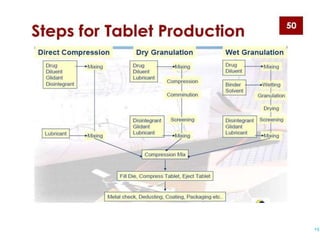
Tablets are commonly manufactured by
• Wet granulation
• Dry granulation or
• Direct compression
15
WET GRANULATION
16
• Wet granulation is a widely used method for
the production of compressed tablet. It is
essentially a process of size enlargement
involving several steps and the use of an
adhesive substance known as binder.
• The granules produced using this method of
meeting all
granulation has a greater probability of
the physical requirements for
tablet formation.
Methods:
17
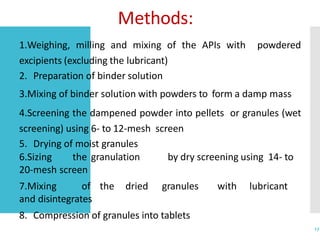
1.Weighing, milling and mixing of the APIs with powdered
excipients (excluding the lubricant)
2. Preparation of binder solution
3.Mixing of binder solution with powders to form a damp mass
4.Screening the dampened powder into pellets or granules (wet
screening) using 6- to 12-mesh screen
5. Drying of moist granules
6.Sizing the granulation by dry screening using 14- to
20-mesh screen
7.Mixing of the dried granules with lubricant
and disintegrates
8. Compression of granules into tablets
DRY GRANULATION
18
• The formation of granules by compacting
powder mixtures into large pieces or compacts
which are subsequently broken down or sized
into granules (often referred to as dry
granulation, double compression or pre-
compression) is a possible granulation method
which, however, is not widely used in the
manufacture of tablets.
Dry granulation method
JSS College of Pharmacy, Mysuru 19
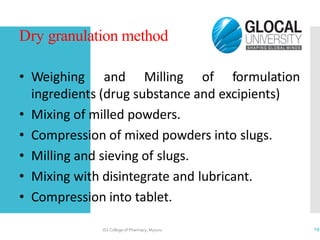
• Weighing and Milling of formulation
ingredients (drug substance and excipients)
• Mixing of milled powders.
• Compression of mixed powders into slugs.
• Milling and sieving of slugs.
• Mixing with disintegrate and lubricant.
• Compression into tablet.
DIRECT COMPRESSION
20
• direct compression involves direct
compression of powdered materials into tablets
without modifying the physical nature of the
materials itself.
• Direct compression
problems associated
avoids
with
many of the
wet and dry
granulations.
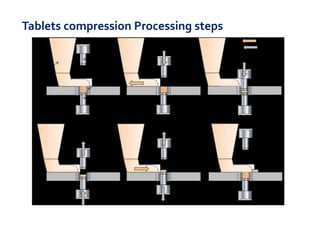
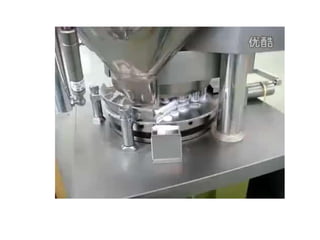
Compression
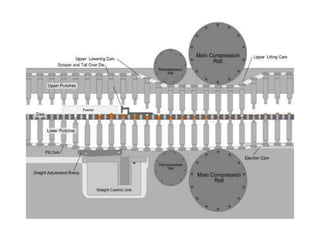
Tablets are being formed by compressing the
granules by using the compression machine.
Tablet formed in compression machine by
pressing the granules in die with lower and
upper punch. Tablet formation takes place by
the combined pressing action of two punches
(lower and upper) and a die.
Now it is possible to produce more than
500,000 tablets per hour due to different’s
innovations to tablet compression machines.
Tablets compression Processing steps
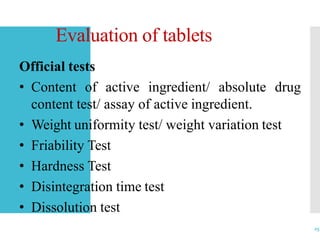
Evaluation of tablets
25
Official tests
• Content of active ingredient/ absolute drug
content test/ assay of active ingredient.
• Weight uniformity test/ weight variation test
• Friability Test
• Hardness Test
• Disintegration time test
• Dissolution test
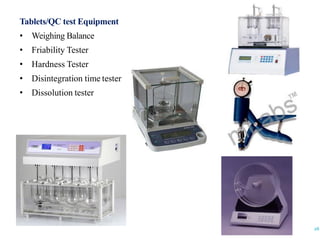
26
Tablets/QC test Equipment
• Weighing Balance
• Friability Tester
• Hardness Tester
• Disintegration time tester
• Dissolution tester
Percentage weight variation Limit forTablets
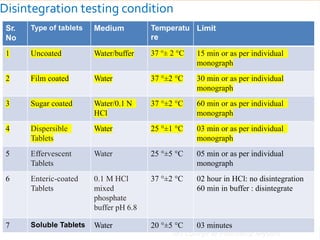
Disintegration testing condition
JSS College of Pharmacy, Mysuru
Disintegratio
n testing
condition and
interpretatio
n (IP)
Sr.
No
Type of tablets Medium Temperatu
re
Limit
1 Uncoated Water/buffer 37 °± 2 °C 15 min or as per individual
monograph
2 Film coated Water 37 °±2 °C 30 min or as per individual
monograph
3 Sugar coated Water/0.1 N
HCl
37 °±2 °C 60 min or as per individual
monograph
4 Dispersible
Tablets
Water 25 °±1 °C 03 min or as per individual
monograph
5 Effervescent
Tablets
Water 25 °±5 °C 05 min or as per individual
monograph
6 Enteric-coated
Tablets
0.1 M HCl
mixed
phosphate
buffer pH 6.8
37 °±2 °C 02 hour in HCl: no disintegration
60 min in buffer : disintegrate
7 Soluble Tablets Water 20 °±5 °C 03 minutes
JSS College of Pharmacy, Mysuru
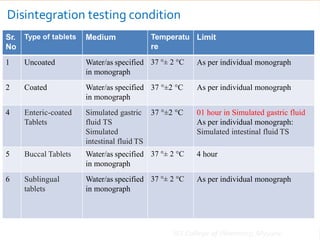
Disintegration testing condition
(USP
)
Sr.
No
Type of tablets Medium Temperatu
re
Limit
1 Uncoated Water/as specified
in monograph
37 °± 2 °C As per individual monograph
2 Coated Water/as specified
in monograph
37 °±2 °C As per individual monograph
4 Enteric-coated
Tablets
Simulated gastric
fluid TS
Simulated
intestinal fluid TS
37 °±2 °C 01 hour in Simulated gastric fluid
As per individual monograph:
Simulated intestinal fluid TS
5 Buccal Tablets Water/as specified
in monograph
37 °± 2 °C 4 hour
6 Sublingual
tablets
Water/as specified
in monograph
37 °± 2 °C As per individual monograph
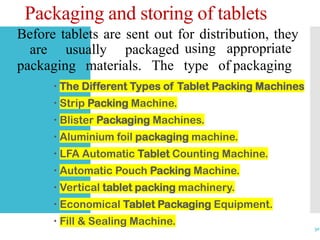
Packaging and storing of tablets
 The Different Types of Tablet Packing Machines
 Strip Packing Machine.
 Blister Packaging Machines.
 Aluminium foil packaging machine.
 LFA Automatic Tablet Counting Machine.
 Automatic Pouch Packing Machine.
 Vertical tablet packing machinery.
 Economical Tablet Packaging Equipment.
 Fill & Sealing Machine.
30
Before tablets are sent out for distribution, they
are usually packaged using
packaging materials. The type of
appropriate
packaging
31
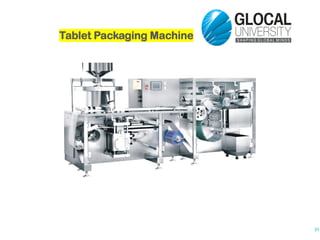
Tablet Packaging Machine
32

Pharmacetics 1 tablet Manufacturing PPT.pdf

  • 1.
    Tablets Manufacturing  ShmmonAhmad,  Asst. Professor, (Faculty of Pharmaceutics)  Glocal University, Saharanpur  Former Q.A Officer Ind-Swift Ltd. (WHO, GMP, MHRA-UK, EME-Europe)
  • 2.
    INTRODUCTION 2 • Tablets maybe defined as the solid unit dosage form of medicament or medicaments with suitable excipients and prepared either by molding or by compression. It comprises a mixture of active substances and excipients, • Tablets formation process consist of a series of steps (unit processes)– weighing, milling, mixing, granulation, drying, compaction, (frequently) coating and packaging. Regardless of the method used the unit processes – weighing, milling and mixing, are the same; subsequent steps differ.
  • 3.
    Primary goals oftablet manufacturing process 3 • To formulate tablets that are strong and hard to withstand mechanical shock encountered during manufacturing, packing, shipping, dispensing and use. • To formulate tablets that are uniform in weight and in drug content. • To formulate tablets that are bioavailable according to indication requirements. • To formulate tablets that are chemically and physically stable over a long period of time. • To formulate tablets that have elegant product identity which is free from any tablet defects.
  • 4.
    Categories of tabletsfor oral use 1. — uncoated tablets; 2— coated tablets; 3— gastro-resistant tablets; 4. — modified-release tablets; 5. — effervescent tablets; 6. — soluble tablets; 7. — dispersible tablets; 8. — orodispersible tablets; 9. — chewable tablets; 10.— oral lyophilisates.
  • 5.
    Dispensing ofAPI &Excipient Sieving/screening Size reduction Blending Granulation Compression Coating Packaging Tablets Dispatch in market
  • 6.
    6 Processing of Granulation(tablets Granules)
  • 7.
    Procedure for Manufacturingof Tablets 7 • Dispensing: Each ingredient in the tablet formula is weighed and accurately dispensed as per dose. This is one of the critical steps in any type of formulation process and should be done under technical supervision. • Sizing: Formulation ingredients must be in finely divided form, otherwise, size reduction should be carried out for better flow property and easy mixing.
  • 8.
    3. Mixing equipmente.g., pneumatic tumbling mixers diffusion/ mixers (e.g., V- blender, double cone blender, cubic mixer, drum blender), 8
  • 9.
    4.Granulators e.g. ,Rotating shape granulators , dry granulator , high shear granulator etc 5.Drying equipment e.g. spray dryer , rotary dryer , fluidized bed dryer etc 6.Tableting machine e.g. single punch tablet press and multi station /rotary tablet press Exp. Fette Press, CardPress etc 9
  • 10.
    7. Evaluation /Qualitycontrol (QC) equipment e.g., disintegration equipment , USP Dissolution Tester, Tablet Hardness Tester, Tablet Thickness Tester, Tablet Friability Testers etc. 8.Coating and polishing machines for coated tablets e.g., standard coating pan, perforated pan, fluidized bed/ Air suspension coating system etc. 8. Packaging machines e.g., blister packing machine, aluminium foil packaging machine, etc. Machine name Dph-220/260 High Speed Blister Packing Machine 10
  • 11.
    Tablet Manufacturing Equipment/Machines 11 Common equipment used in pharmaceutical tablet manufacturing include: 1. Size reduction equipment e.g., Hammer mill , roller mill , fluidized energy mill , cutter mill and ball mill 2. Weighing balance/ balances e.g., bulk weighing balance (weighs in kilogram), electronic weighing balance (weighs in grams and milligrams).
  • 12.
    • Powder suitable JSS Collegeof Pharmacy, Mysuru 12 blending: Powders blender to obtain are mixed using a a uniform and homogeneous powder mix. The drug substance and excipients are mixed in geometric dilution. • Granulation: Here small powder particles are gathered together into layers, and permanent aggregates to render them into free-flowing states. • Drying and dry screening: Screened wet granules need to be dried for a particular time period in tray dryer or fluid bed dryer at controlled temperature not exceeding 550 degree C . Dried granules are screened through the appropriate mesh screen
  • 13.
    • Tablet compression:This step involves the compression of granules into a flat or convex, round, oblong, or unique shaped, scored or unscored tablets; engraved with an identifying symbol and/ or code number using tablet press. • Coating: Tablets and granules are coated if there is need to mask the unpleasant taste/odour of some drug substance or to increase the aesthetic appeal of uncoated tablets as well as to modify the release or control the release of drug substance from tablets. This is achieved by enclosing or covering the core tablet or granules with coating solutions. 13
  • 14.
    Methods used intablet Formulation 14 Tablets are commonly manufactured by • Wet granulation • Dry granulation or • Direct compression
  • 15.
  • 16.
    WET GRANULATION 16 • Wetgranulation is a widely used method for the production of compressed tablet. It is essentially a process of size enlargement involving several steps and the use of an adhesive substance known as binder. • The granules produced using this method of meeting all granulation has a greater probability of the physical requirements for tablet formation.
  • 17.
    Methods: 17 1.Weighing, milling andmixing of the APIs with powdered excipients (excluding the lubricant) 2. Preparation of binder solution 3.Mixing of binder solution with powders to form a damp mass 4.Screening the dampened powder into pellets or granules (wet screening) using 6- to 12-mesh screen 5. Drying of moist granules 6.Sizing the granulation by dry screening using 14- to 20-mesh screen 7.Mixing of the dried granules with lubricant and disintegrates 8. Compression of granules into tablets
  • 18.
    DRY GRANULATION 18 • Theformation of granules by compacting powder mixtures into large pieces or compacts which are subsequently broken down or sized into granules (often referred to as dry granulation, double compression or pre- compression) is a possible granulation method which, however, is not widely used in the manufacture of tablets.
  • 19.
    Dry granulation method JSSCollege of Pharmacy, Mysuru 19 • Weighing and Milling of formulation ingredients (drug substance and excipients) • Mixing of milled powders. • Compression of mixed powders into slugs. • Milling and sieving of slugs. • Mixing with disintegrate and lubricant. • Compression into tablet.
  • 20.
    DIRECT COMPRESSION 20 • directcompression involves direct compression of powdered materials into tablets without modifying the physical nature of the materials itself. • Direct compression problems associated avoids with many of the wet and dry granulations.
  • 21.
    Compression Tablets are beingformed by compressing the granules by using the compression machine. Tablet formed in compression machine by pressing the granules in die with lower and upper punch. Tablet formation takes place by the combined pressing action of two punches (lower and upper) and a die. Now it is possible to produce more than 500,000 tablets per hour due to different’s innovations to tablet compression machines.
  • 23.
  • 25.
    Evaluation of tablets 25 Officialtests • Content of active ingredient/ absolute drug content test/ assay of active ingredient. • Weight uniformity test/ weight variation test • Friability Test • Hardness Test • Disintegration time test • Dissolution test
  • 26.
    26 Tablets/QC test Equipment •Weighing Balance • Friability Tester • Hardness Tester • Disintegration time tester • Dissolution tester
  • 27.
  • 28.
    Disintegration testing condition JSSCollege of Pharmacy, Mysuru Disintegratio n testing condition and interpretatio n (IP) Sr. No Type of tablets Medium Temperatu re Limit 1 Uncoated Water/buffer 37 °± 2 °C 15 min or as per individual monograph 2 Film coated Water 37 °±2 °C 30 min or as per individual monograph 3 Sugar coated Water/0.1 N HCl 37 °±2 °C 60 min or as per individual monograph 4 Dispersible Tablets Water 25 °±1 °C 03 min or as per individual monograph 5 Effervescent Tablets Water 25 °±5 °C 05 min or as per individual monograph 6 Enteric-coated Tablets 0.1 M HCl mixed phosphate buffer pH 6.8 37 °±2 °C 02 hour in HCl: no disintegration 60 min in buffer : disintegrate 7 Soluble Tablets Water 20 °±5 °C 03 minutes
  • 29.
    JSS College ofPharmacy, Mysuru Disintegration testing condition (USP ) Sr. No Type of tablets Medium Temperatu re Limit 1 Uncoated Water/as specified in monograph 37 °± 2 °C As per individual monograph 2 Coated Water/as specified in monograph 37 °±2 °C As per individual monograph 4 Enteric-coated Tablets Simulated gastric fluid TS Simulated intestinal fluid TS 37 °±2 °C 01 hour in Simulated gastric fluid As per individual monograph: Simulated intestinal fluid TS 5 Buccal Tablets Water/as specified in monograph 37 °± 2 °C 4 hour 6 Sublingual tablets Water/as specified in monograph 37 °± 2 °C As per individual monograph
  • 30.
    Packaging and storingof tablets  The Different Types of Tablet Packing Machines  Strip Packing Machine.  Blister Packaging Machines.  Aluminium foil packaging machine.  LFA Automatic Tablet Counting Machine.  Automatic Pouch Packing Machine.  Vertical tablet packing machinery.  Economical Tablet Packaging Equipment.  Fill & Sealing Machine. 30 Before tablets are sent out for distribution, they are usually packaged using packaging materials. The type of appropriate packaging
  • 31.
  • 32.