Presented by:
Meenakshee Shrivas
M.S. (Pharmaceutics)
NIPER Ahmedabad1
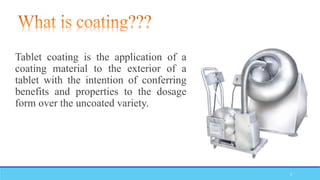
Tablet coating is the application of a
coating material to the exterior of a
tablet with the intention of conferring
benefits and properties to the dosage
form over the uncoated variety.
2
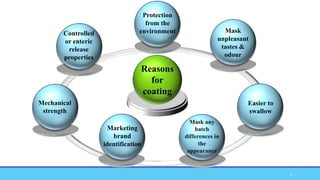
Reasons
for
coating
Mask any
batch
differences in
the
appearance
Marketing
brand
identification
Mechanical
strength
Controlled
or enteric
release
properties
Protection
from the
environment Mask
unpleasant
tastes &
odour
Easier to
swallow
3
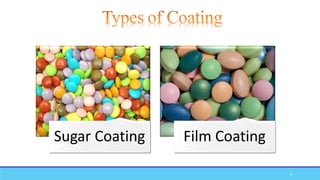
Sugar Coating Film Coating
4
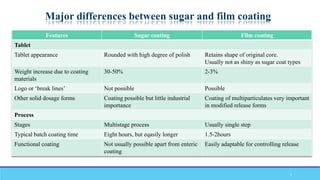
Features Sugar coating Film coating
Tablet
Tablet appearance Rounded with high degree of polish Retains shape of original core.
Usually not as shiny as sugar coat types
Weight increase due to coating
materials
30-50% 2-3%
Logo or ‘break lines’ Not possible Possible
Other solid dosage forms Coating possible but little industrial
importance
Coating of multiparticulates very important
in modified release forms
Process
Stages Multistage process Usually single step
Typical batch coating time Eight hours, but eqasily longer 1.5-2hours
Functional coating Not usually possible apart from enteric
coating
Easily adaptable for controlling release
Major differences between sugar and film coating
5
6
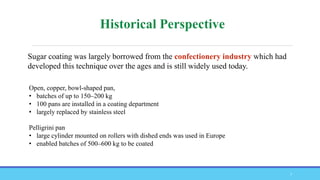
Open, copper, bowl-shaped pan,
• batches of up to 150–200 kg
• 100 pans are installed in a coating department
• largely replaced by stainless steel
Pelligrini pan
• large cylinder mounted on rollers with dished ends was used in Europe
• enabled batches of 500–600 kg to be coated
Sugar coating was largely borrowed from the confectionery industry which had
developed this technique over the ages and is still widely used today.
7
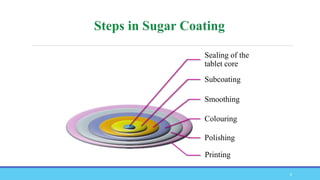
Sealing of the
tablet core
Subcoating
Smoothing
Colouring
Polishing
Printing
8
Sealing:
 Application of water impermeable polymer around the tablet core.
 This is unfortunately an organic solvent-dependent step in an otherwise
aqueous process.
Purpose:
 To protect the tablet core from the aqueous nature of sucrose applications.
 Prevents certain types of materials from migrating to the tablet surface
and spoiling the appearance, e.g. oils, acids, etc.
9
 Shellac
 Cellulose Acetate Phthalate (CAP)
 Polyvinyl Alcohol Phthalate (PVAP)
 Zein
Polymers used in sealing
10
[1] Shellac
 This is a purified resinous secretion of the insect Laccifer lacca, indigenous to
India.
 Solubility: Shellac is insoluble in water but shows solubility in aqueous alkalis; it
is moderately soluble in warm ethanol.
Problems:
 material of natural origin and consequently suffers from occasional supply problems
 quality variation
 stability problems associated with increased disintegration and dissolution times on
storage.
Polymer Trade name Function
Shellac EmCoat 120 N
MarCoat 125
Enteric coat
11
[2] Zein
 It is a protein contained in the endosperm tissue of Zea mais occurs as by product
of corn processing.
 Solubility: soluble in alcohol.
Polymer Trade name Function
Zein G200 Enteric coat
12
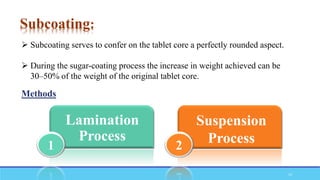
 Subcoating serves to confer on the tablet core a perfectly rounded aspect.
 During the sugar-coating process the increase in weight achieved can be
30–50% of the weight of the original tablet core.
Methods
Subcoating:
Lamination
Process
1
Suspension
Process
2
13
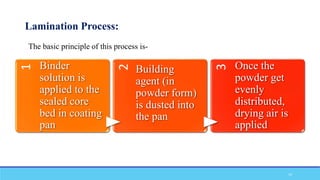
Lamination Process:
The basic principle of this process is-
1
Binder
solution is
applied to the
sealed core
bed in coating
pan 2
Building
agent (in
powder form)
is dusted into
the pan
3
Once the
powder get
evenly
distributed,
drying air is
applied
14
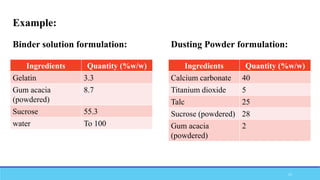
Ingredients Quantity (%w/w)
Gelatin 3.3
Gum acacia
(powdered)
8.7
Sucrose 55.3
water To 100
Ingredients Quantity (%w/w)
Calcium carbonate 40
Titanium dioxide 5
Talc 25
Sucrose (powdered) 28
Gum acacia
(powdered)
2
Binder solution formulation: Dusting Powder formulation:
Example:
15
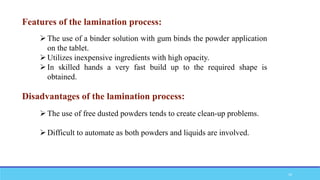
Features of the lamination process:
The use of a binder solution with gum binds the powder application
on the tablet.
Utilizes inexpensive ingredients with high opacity.
In skilled hands a very fast build up to the required shape is
obtained.
Disadvantages of the lamination process:
The use of free dusted powders tends to create clean-up problems.
Difficult to automate as both powders and liquids are involved.
16
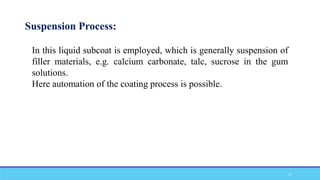
Suspension Process:
In this liquid subcoat is employed, which is generally suspension of
filler materials, e.g. calcium carbonate, talc, sucrose in the gum
solutions.
Here automation of the coating process is possible.
17
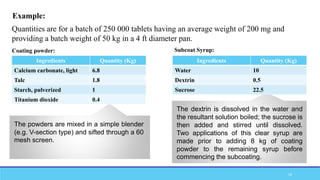
Example:
Quantities are for a batch of 250 000 tablets having an average weight of 200 mg and
providing a batch weight of 50 kg in a 4 ft diameter pan.
Ingredients Quantity (Kg)
Calcium carbonate, light 6.8
Talc 1.8
Starch, pulverized 1
Titanium dioxide 0.4
The powders are mixed in a simple blender
(e.g. V-section type) and sifted through a 60
mesh screen.
Coating powder: Subcoat Syrup:
Ingredients Quantity (Kg)
Water 10
Dextrin 0.5
Sucrose 22.5
The dextrin is dissolved in the water and
the resultant solution boiled; the sucrose is
then added and stirred until dissolved.
Two applications of this clear syrup are
made prior to adding 8 kg of coating
powder to the remaining syrup before
commencing the subcoating.
18
 Product obtained after subcoating is usually too rough.
 To smoothen the surface sucrose syrup is applied to it.
 Smoothing is usually achieved by applications of plain
70% w/w syrup.
 However large degrees of unevenness will require some
subcoating solids in the initial smoothing coats followed
by application of sucrose syrup.
Smoothing:
19
 Water-soluble dyes were used previously as colouring agents for sugar-
coated tablets.
 Now these has been superseded by the water insoluble pigments and
lakes, e.g. aluminium lakes of water soluble colours, iron oxides,
titanium dioxide, etc.
 These lake pigments are essentially insoluble in aqueous systems
between pH 3.5 and 9.0.
Colouring
20
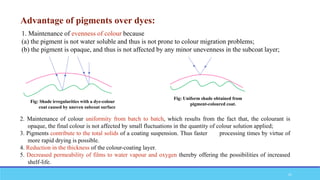
Fig: Shade irregularities with a dye-colour
coat caused by uneven subcoat surface
Fig: Uniform shade obtained from
pigment-coloured coat.
1. Maintenance of evenness of colour because
(a) the pigment is not water soluble and thus is not prone to colour migration problems;
(b) the pigment is opaque, and thus is not affected by any minor unevenness in the subcoat layer;
Advantage of pigments over dyes:
21
2. Maintenance of colour uniformity from batch to batch, which results from the fact that, the colourant is
opaque, the final colour is not affected by small fluctuations in the quantity of colour solution applied;
3. Pigments contribute to the total solids of a coating suspension. Thus faster processing times by virtue of
more rapid drying is possible.
4. Reduction in the thickness of the colour-coating layer.
5. Decreased permeability of films to water vapour and oxygen thereby offering the possibilities of increased
shelf-life.
After the colour-coating process the tablets have a somewhat dull, matt
appearance which requires a separate polishing step to give them the
high degree of gloss traditionally associated with sugar-coated tablets.
Some examples of polishing methods which are currently in use include:
Application of solution/suspension of waxes, e.g. carnauba and
beeswax. Use of wax-lined pan.
Use of canvas-lined pan with wax solution/suspension.
Finely powdered wax application.
Mineral oil application.
Polishing:
22
 Unfortunately, unlike film-coated tablets, sugar-coated tablets
cannot be monogrammed by engraving the punch tooling. Instead a
printing process is used.
 A typical edible pharmaceutical ink formulation is: shellac,
alcohol, pigment, lecithin, antifoam and other organic solvents.
Techniques of printing:
Offset gravure process - sensitive to minor changes in procedure..
Ink-jet printing - more robust technique.
Printing:
23
24
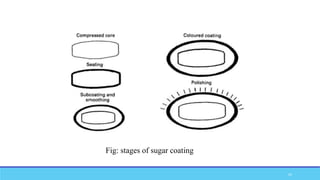
Fig: stages of sugar coating
25
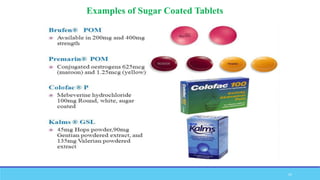
Examples of Sugar Coated Tablets
 Inexpensive and readily available raw materials.
 Constituent raw materials are widely accepted—no regulatory problems.
 Modern, simplified techniques have greatly reduced coating times over
traditional sugar-coating methods.
 No complex equipment or services are required.
 The process is capable of being controlled and documented to meet modern
GMP standards.
 Simplicity of equipment and ready availability of raw materials make sugar
coating an ideal coating method for developing countries.
 The process is generally not as critical as film coating; recovering and
reworking procedures are usually possible.
 For high humidity climates, it generally offers a stability advantage over film-
coated tablets.
 Results are aesthetically pleasing and have wide consumer acceptability.
26
Although the sugar-coating process produced a very elegant product, its main disadvantage is
 the processing time, which could last up to five days.
 the high degree of operator skill required
 identification of the product is difficult
 printing of individual tablets with the house logo and product name and identification is another
messy, slow and expensive process
27
28
A film coating is a thin polymer-based coat applied to a solid dosage form such as a
tablet, granule or other particle. The thickness of such a coating is usually between 20
and 100 μm.
The first reference to tablet film coating appeared in 1930 but it was not until 1954
that Abbott Laboratories produced the first commercially available film-coated tablet.
This was made possible by the development of a wide variety of materials—for
example, the cellulose derivatives. One of the most important of these is
hydroxypropyl methylcellulose.
29
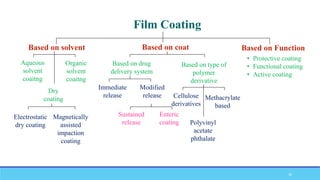
Film Coating
Based on solvent Based on coat
Aqueous
solvent
coaitng
Organic
solvent
coaitng
Dry
coating
Electrostatic
dry coating
Magnetically
assisted
impaction
coating
Based on drug
delivery system
Based on type of
polymer
derivative
Immediate
release
Modified
release
Sustained
release
Enteric
coating
Cellulose
derivatives
Polyvinyl
acetate
phthalate
Methacrylate
based
Based on Function
• Protective coating
• Functional coating
• Active coating
30
31
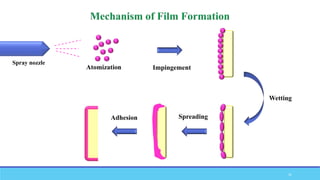
Atomization Impingement
Wetting
Spreading
Adhesion
Spray nozzle
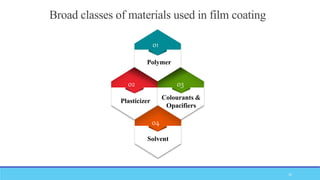
Broad classes of materials used in film coating
Plasticizer
Solvent
Colourants &
Opacifiers
Polymer
01
02 03
04
32
Non-functional film coating polymers
They can also termed as conventional film coating polymer.
The term conventional film coating has been used here to describe film coatings
applied for reasons of improved product appearance, improved handling, and
prevention of dusting and environmental protection.
33
[1] Acrylic Polymer/ methacrylate aminoester copolymer
 Insoluble in water
 Soluble in Acidic medium having pH <4
 Solubility in neutral and alkaline medium is achieved by swelling and
increased permeability to aqueous medium.
 Complete disintegration and dissolution of film can be assured by
incorporation of soluble polymers such as cellulose ethers, starch.
Polymer Trade name Company Function
Copolymers of acrylate and
methacrylates with quarternary
ammonium group in
combination with sodium
Carboxymethylcellulose
Eudragit RD 100 Evonik Rapidly disintegrating
34
[2] Cellulose derivatives
 Majority of these polymers used in film coating are ethers of cellulose.
 Polymer chain length together with size and extent of branching will
determine the viscosity of polymer solution.
Polymer Substituent Solubility Other properties
HPMC (Hydroxy Propyl
Methyl Cellulose)
-CH3-CH2-CH(OH)-CH3 Soluble in both aqueous and
organic solvents
• Non-tackiness
• Flexible strong film
Hydroxy ethyl cellulose -CH(OH)-CH3 Soluble in water,
Insoluble in organic solvents
Hydroxy propyl
cellulose
—CH2 —CH(OH)—CH3 Soluble in aqueous and
alcoholic media.
• Tackiness
• Weak film
Methyl cellulose -CH3 It has LCST 40-50˚C.
Readily soluble in water below
it’s LCST.
Rarely used in film coating due to
lack of commercial availability of
low viscosity material meeting
appropriate compebdial
requirements
35
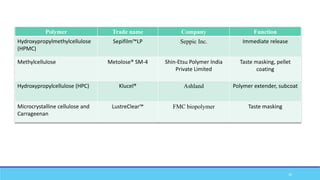
Polymer Trade name Company Function
Hydroxypropylmethylcellulose
(HPMC)
Sepifilm™LP Seppic Inc. Immediate release
Methylcellulose Metolose® SM-4 Shin-Etsu Polymer India
Private Limited
Taste masking, pellet
coating
Hydroxypropylcellulose (HPC) Klucel® Ashland Polymer extender, subcoat
Microcrystalline cellulose and
Carrageenan
LustreClear™ FMC biopolymer Taste masking
36
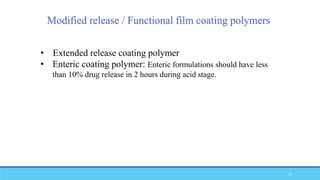
Modified release / Functional film coating polymers
• Extended release coating polymer
• Enteric coating polymer: Enteric formulations should have less
than 10% drug release in 2 hours during acid stage.
37
[1] Methacrylate ether copolymer
 Completely esterified with no free carboxylic acid group.
 Neutral in nature and insoluble over entire physiological pH.
 Become swell and permeable to water and dissolve substances thus used in
modified release formulation, e.g. Eudragit
Extended release coating polymer
Polymer Trade name Company Function
Copolymers of
acrylate and
methacrylates with
quarternary
ammonium group.
Insoluble, High permeability:
Eudragit® RL PO, Eudragit® RL,
Eudragit® RL 30D
Insoluble,Low Permeability:
Eudragit® RSPO, Eudragit® RS
30D
Evonik Sustained release
38
[2] Ethyl Cellulose
 High substitution of cellulose make it insoluble in water.
 The polymer is not usually used on its own but normally in combination with
secondary polymers such as HPMC etc.
Ideal polymer for modified release coating due to following properties:
 Odourless
 Tasteless
 High degree of stability (both under physiological conditions and normal
storage condition)
 Good solubility in common solvents used in coating.
Polymer Trade name Company Function
Ethyl cellulose Aquacoat® ECD FMC Sustained release
Surelease® Colorcon
39
Enteric coating polymer
[1] Methacrylic acid copolymer
 These polymer possess free carboxylic acid group.
 They form salt with alkalis and having solubility at pH in excess of 5.5
 Depending on the degree of substitution with carboxylic group they have
different pH-dissolution profile.
Specific name Monomers Trade name Marketed form
Poly(methylacrylate,
ethylacrylate)
copolymer of MA and EA in a
molar ratio of 1:1
Eudragit L30D 30% aqueous dispersion
Eudragit L100-55 Powder
Poly(methacrylic acid,
methylmethacrylate)
copolymer of MA and MMA
in a molar ratio of 1:1
Eudragit L12.5 12.5% solution in isopropanol
Eudragit L100 Powder
Poly(methacrylic acid,
methylmethacrylate)
copolymer of MA and MMA
in a molar ratio of 1:2
Eudragit S12.5 12.5% solution in isopropanol
Eudragit S100 Powder
40
[2] Cellulose esters
Polymer Substituent Solubility Other properties Trade name
Cellulose acetate
phthalate (CAP)
-CO-CH3, CO-C6H4-COOH Insoluble in water &
alcohol
• Oldest and widely
used enteric coat.
• Prone to hydrolysis
Aquacoat CPD®,
C–A–P NF
Eastman
Cellulose acetate
trimellitate (CAT)
-CO-CH3,-CO-C6H3-
(COOH)2
Start to dissolve at low
pH 5.5 thus efficient
dissolution in upper
small intestine
Chemically resembles
CAP but have
additional -COOH
group
Hydroxy propyl
methyl cellulose
phthalate (HPMCP)
-CH3,-CH2CH(OH)CH3,-
CO-C6H4-COOH
Insoluble in water but
soluble in aqueous
alkalis & acetone/water
95:5 mixture
More flexible polymer InstacoatTM EN-
HPMCP
41
42
Polymers characteristics
Solubility
Viscosity
Permeability
Mechanical property
Tackiness
Polymers characteristics
 For conventional film coating the polymer should have good solubility in
aqueous fluids to facilitate the dissolution of the active ingredient from the
finished dosage form. However, where a modified-release action is required
then a polymer system of low water solubility or permeability will be chosen.
 HPMC, HPC, MC, PVP, PEG have good solubility in water also in
gastrointestinal fluid and commonly used organic solvents.
 Wherever an aqueous solvent for film coating is proposed, it is necessary to
minimize the contact between tablet core and water, which can be achieved by
using maximum possible polymer concentration. However this can be limited by
coating suspension viscosity.
Solubility:
43
Polymers should have a low viscosity for a given concentration. This will permit the easy,
trouble-free spraying of their solutions in industrial film coating equipment.
Viscosity:
The lower viscosity grade polymer permits a higher solids concentration to be used, with
consequent reduction in solvent content of the solution, thus the shorter will be the processing
time as less solvent has to be removed
Polymers are available in different viscosity grades or viscosity designation.
Elevated temperature coating media can be used in order to additionally increase solids
loadings via a decrease in viscosity.
Very low viscosity polymers will suffer from poor film strength due to low molecular weight
composition.
Polymers characteristics
44
 Coating provides protection from the atmospheric elements such as moisture,
gases (particularly oxygen). Thus film coating can be used to optimize the
shelf-life of the tablet preparations.
 Sugar-coating techniques providing a better moisture barrier than that offered
by simple non-functional cellulosics or acrylics.
 Usually the moisture permeability of a simple film may be decreased by the
incorporation of water-insoluble polymers, however disintegration and
dissolution characteristics of the dosage form must be carefully checked.
Permeability:
Polymers characteristics
45
Some of the film mechanical properties of concern are:
 Tensile strength: The most important parameter here is the ultimate tensile strength, which is the
maximum stress applied at the point at which the film breaks.
 Tensile strain at break: A measure of how far the sample elongates prior to break.
 Modulus (elastic modulus): This is applied stress divided by the corresponding strain in the region
of linear elastic deformation. It can be regarded as an index of stiffness and rigidity of a film.
 Work of failure: This is numerically equivalent to the area under the curve and equates to the work
done in breaking the film. It is an index of the toughness of a film and is a better measure of the
film’s ability to withstand a mechanical challenge than is a simple consideration of tensile
strength.
Mechanical properties:
Polymers characteristics
A film coat must be mechanically adequate so that, in use it does not crack, split or generally fail.
46
Tackiness:
Polymers characteristics
In a film-coating sense, tack is a property of a polymer solution related to the
forces necessary to separate two parallel surfaces joined by a thin film of the
solution.
It is a property responsible for processing difficulties and is a limitation on the use
of some polymers, e.g. hydroxypropyl cellulose and certain polymers intended for
enteric use, e.g. Eudragit L30D and PVAP.
47
Plasticizer
Plasticizers are Low molecular weight materials that have capacity to alter the
physical properties of polymer Such as;
Reduced brittleness
Increased flexibility of film
Impart adhesive and mechanical properties to film
Decrease in Tg of polymer
 Drug release are dependent on the concentration of plasticizers to a great
extent.
 Plasticizers are non volatile components and therefore are responsible for the
weight gain of dosage forms during coating.
Some other effects of plasticizer:
48
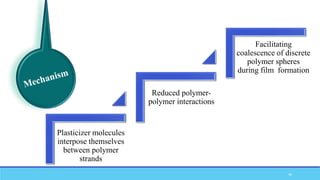
Plasticizer molecules
interpose themselves
between polymer
strands
Reduced polymer-
polymer interactions
Facilitating
coalescence of discrete
polymer spheres
during film formation
49
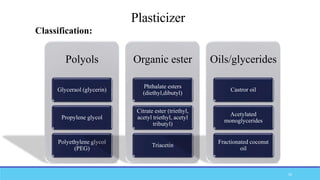
Plasticizer
Polyols
Glyceraol (glycerin)
Propylene glycol
Polyethylene glycol
(PEG)
Organic ester
Phthalate esters
(diethyl,dibutyl)
Citrate ester (triethyl,
acetyl triethyl, acetyl
tributyl)
Triacetin
Oils/glycerides
Castror oil
Acetylated
monoglycerides
Fractionated coconut
oil
Classification:
50
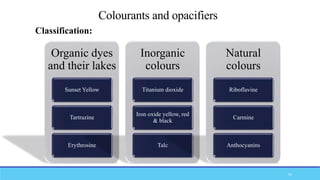
Colourants and opacifiers
Organic dyes
and their lakes
Sunset Yellow
Tartrazine
Erythrosine
Inorganic
colours
Titanium dioxide
Iron oxide yellow, red
& black
Talc
Natural
colours
Riboflavine
Carmine
Anthocyanins
Classification:
51
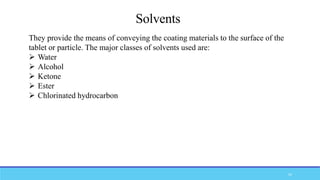
Solvents
They provide the means of conveying the coating materials to the surface of the
tablet or particle. The major classes of solvents used are:
 Water
 Alcohol
 Ketone
 Ester
 Chlorinated hydrocarbon
52
Solid dosage form may be incorporated with several special materials such as:
[1] Flavours and sweeteners are added to mask unpleasant odours or to develop the taste. e.g., fruit
spirits (organic solvent), aspartame, water soluble pineapple flavour.
[2] Surfactants are ancillary to stabilize immiscible or insoluble ingredients in the coating. They
facilitate substrate wettability and promote coalescence of polymeric material over the substrate’s
surface e.g., Spans, Tweens etc.
[3] Antioxidants are incorporated to stabilize a dye system to oxidation and colour change e.g.,
oximes, phenols etc.
[4] Antimicrobials are added to inhibit microbial growth in the coating composition. Various
cellulosic materials are mainly prone to microbial growth and they can not be stored in solution
form e.g., Carbamates, alkylisothiazloinone, benzothiazoles etc.
MiscellaneousCoating Solution Components
53
54

Coating of Pharmaceutical Tablet

  • 1.
    Presented by: Meenakshee Shrivas M.S.(Pharmaceutics) NIPER Ahmedabad1
  • 2.
    Tablet coating isthe application of a coating material to the exterior of a tablet with the intention of conferring benefits and properties to the dosage form over the uncoated variety. 2
  • 3.
    Reasons for coating Mask any batch differences in the appearance Marketing brand identification Mechanical strength Controlled orenteric release properties Protection from the environment Mask unpleasant tastes & odour Easier to swallow 3
  • 4.
  • 5.
    Features Sugar coatingFilm coating Tablet Tablet appearance Rounded with high degree of polish Retains shape of original core. Usually not as shiny as sugar coat types Weight increase due to coating materials 30-50% 2-3% Logo or ‘break lines’ Not possible Possible Other solid dosage forms Coating possible but little industrial importance Coating of multiparticulates very important in modified release forms Process Stages Multistage process Usually single step Typical batch coating time Eight hours, but eqasily longer 1.5-2hours Functional coating Not usually possible apart from enteric coating Easily adaptable for controlling release Major differences between sugar and film coating 5
  • 6.
  • 7.
    Open, copper, bowl-shapedpan, • batches of up to 150–200 kg • 100 pans are installed in a coating department • largely replaced by stainless steel Pelligrini pan • large cylinder mounted on rollers with dished ends was used in Europe • enabled batches of 500–600 kg to be coated Sugar coating was largely borrowed from the confectionery industry which had developed this technique over the ages and is still widely used today. 7
  • 8.
    Sealing of the tabletcore Subcoating Smoothing Colouring Polishing Printing 8
  • 9.
    Sealing:  Application ofwater impermeable polymer around the tablet core.  This is unfortunately an organic solvent-dependent step in an otherwise aqueous process. Purpose:  To protect the tablet core from the aqueous nature of sucrose applications.  Prevents certain types of materials from migrating to the tablet surface and spoiling the appearance, e.g. oils, acids, etc. 9
  • 10.
     Shellac  CelluloseAcetate Phthalate (CAP)  Polyvinyl Alcohol Phthalate (PVAP)  Zein Polymers used in sealing 10
  • 11.
    [1] Shellac  Thisis a purified resinous secretion of the insect Laccifer lacca, indigenous to India.  Solubility: Shellac is insoluble in water but shows solubility in aqueous alkalis; it is moderately soluble in warm ethanol. Problems:  material of natural origin and consequently suffers from occasional supply problems  quality variation  stability problems associated with increased disintegration and dissolution times on storage. Polymer Trade name Function Shellac EmCoat 120 N MarCoat 125 Enteric coat 11
  • 12.
    [2] Zein  Itis a protein contained in the endosperm tissue of Zea mais occurs as by product of corn processing.  Solubility: soluble in alcohol. Polymer Trade name Function Zein G200 Enteric coat 12
  • 13.
     Subcoating servesto confer on the tablet core a perfectly rounded aspect.  During the sugar-coating process the increase in weight achieved can be 30–50% of the weight of the original tablet core. Methods Subcoating: Lamination Process 1 Suspension Process 2 13
  • 14.
    Lamination Process: The basicprinciple of this process is- 1 Binder solution is applied to the sealed core bed in coating pan 2 Building agent (in powder form) is dusted into the pan 3 Once the powder get evenly distributed, drying air is applied 14
  • 15.
    Ingredients Quantity (%w/w) Gelatin3.3 Gum acacia (powdered) 8.7 Sucrose 55.3 water To 100 Ingredients Quantity (%w/w) Calcium carbonate 40 Titanium dioxide 5 Talc 25 Sucrose (powdered) 28 Gum acacia (powdered) 2 Binder solution formulation: Dusting Powder formulation: Example: 15
  • 16.
    Features of thelamination process: The use of a binder solution with gum binds the powder application on the tablet. Utilizes inexpensive ingredients with high opacity. In skilled hands a very fast build up to the required shape is obtained. Disadvantages of the lamination process: The use of free dusted powders tends to create clean-up problems. Difficult to automate as both powders and liquids are involved. 16
  • 17.
    Suspension Process: In thisliquid subcoat is employed, which is generally suspension of filler materials, e.g. calcium carbonate, talc, sucrose in the gum solutions. Here automation of the coating process is possible. 17
  • 18.
    Example: Quantities are fora batch of 250 000 tablets having an average weight of 200 mg and providing a batch weight of 50 kg in a 4 ft diameter pan. Ingredients Quantity (Kg) Calcium carbonate, light 6.8 Talc 1.8 Starch, pulverized 1 Titanium dioxide 0.4 The powders are mixed in a simple blender (e.g. V-section type) and sifted through a 60 mesh screen. Coating powder: Subcoat Syrup: Ingredients Quantity (Kg) Water 10 Dextrin 0.5 Sucrose 22.5 The dextrin is dissolved in the water and the resultant solution boiled; the sucrose is then added and stirred until dissolved. Two applications of this clear syrup are made prior to adding 8 kg of coating powder to the remaining syrup before commencing the subcoating. 18
  • 19.
     Product obtainedafter subcoating is usually too rough.  To smoothen the surface sucrose syrup is applied to it.  Smoothing is usually achieved by applications of plain 70% w/w syrup.  However large degrees of unevenness will require some subcoating solids in the initial smoothing coats followed by application of sucrose syrup. Smoothing: 19
  • 20.
     Water-soluble dyeswere used previously as colouring agents for sugar- coated tablets.  Now these has been superseded by the water insoluble pigments and lakes, e.g. aluminium lakes of water soluble colours, iron oxides, titanium dioxide, etc.  These lake pigments are essentially insoluble in aqueous systems between pH 3.5 and 9.0. Colouring 20
  • 21.
    Fig: Shade irregularitieswith a dye-colour coat caused by uneven subcoat surface Fig: Uniform shade obtained from pigment-coloured coat. 1. Maintenance of evenness of colour because (a) the pigment is not water soluble and thus is not prone to colour migration problems; (b) the pigment is opaque, and thus is not affected by any minor unevenness in the subcoat layer; Advantage of pigments over dyes: 21 2. Maintenance of colour uniformity from batch to batch, which results from the fact that, the colourant is opaque, the final colour is not affected by small fluctuations in the quantity of colour solution applied; 3. Pigments contribute to the total solids of a coating suspension. Thus faster processing times by virtue of more rapid drying is possible. 4. Reduction in the thickness of the colour-coating layer. 5. Decreased permeability of films to water vapour and oxygen thereby offering the possibilities of increased shelf-life.
  • 22.
    After the colour-coatingprocess the tablets have a somewhat dull, matt appearance which requires a separate polishing step to give them the high degree of gloss traditionally associated with sugar-coated tablets. Some examples of polishing methods which are currently in use include: Application of solution/suspension of waxes, e.g. carnauba and beeswax. Use of wax-lined pan. Use of canvas-lined pan with wax solution/suspension. Finely powdered wax application. Mineral oil application. Polishing: 22
  • 23.
     Unfortunately, unlikefilm-coated tablets, sugar-coated tablets cannot be monogrammed by engraving the punch tooling. Instead a printing process is used.  A typical edible pharmaceutical ink formulation is: shellac, alcohol, pigment, lecithin, antifoam and other organic solvents. Techniques of printing: Offset gravure process - sensitive to minor changes in procedure.. Ink-jet printing - more robust technique. Printing: 23
  • 24.
    24 Fig: stages ofsugar coating
  • 25.
    25 Examples of SugarCoated Tablets
  • 26.
     Inexpensive andreadily available raw materials.  Constituent raw materials are widely accepted—no regulatory problems.  Modern, simplified techniques have greatly reduced coating times over traditional sugar-coating methods.  No complex equipment or services are required.  The process is capable of being controlled and documented to meet modern GMP standards.  Simplicity of equipment and ready availability of raw materials make sugar coating an ideal coating method for developing countries.  The process is generally not as critical as film coating; recovering and reworking procedures are usually possible.  For high humidity climates, it generally offers a stability advantage over film- coated tablets.  Results are aesthetically pleasing and have wide consumer acceptability. 26
  • 27.
    Although the sugar-coatingprocess produced a very elegant product, its main disadvantage is  the processing time, which could last up to five days.  the high degree of operator skill required  identification of the product is difficult  printing of individual tablets with the house logo and product name and identification is another messy, slow and expensive process 27
  • 28.
  • 29.
    A film coatingis a thin polymer-based coat applied to a solid dosage form such as a tablet, granule or other particle. The thickness of such a coating is usually between 20 and 100 μm. The first reference to tablet film coating appeared in 1930 but it was not until 1954 that Abbott Laboratories produced the first commercially available film-coated tablet. This was made possible by the development of a wide variety of materials—for example, the cellulose derivatives. One of the most important of these is hydroxypropyl methylcellulose. 29
  • 30.
    Film Coating Based onsolvent Based on coat Aqueous solvent coaitng Organic solvent coaitng Dry coating Electrostatic dry coating Magnetically assisted impaction coating Based on drug delivery system Based on type of polymer derivative Immediate release Modified release Sustained release Enteric coating Cellulose derivatives Polyvinyl acetate phthalate Methacrylate based Based on Function • Protective coating • Functional coating • Active coating 30
  • 31.
  • 32.
    Broad classes ofmaterials used in film coating Plasticizer Solvent Colourants & Opacifiers Polymer 01 02 03 04 32
  • 33.
    Non-functional film coatingpolymers They can also termed as conventional film coating polymer. The term conventional film coating has been used here to describe film coatings applied for reasons of improved product appearance, improved handling, and prevention of dusting and environmental protection. 33
  • 34.
    [1] Acrylic Polymer/methacrylate aminoester copolymer  Insoluble in water  Soluble in Acidic medium having pH <4  Solubility in neutral and alkaline medium is achieved by swelling and increased permeability to aqueous medium.  Complete disintegration and dissolution of film can be assured by incorporation of soluble polymers such as cellulose ethers, starch. Polymer Trade name Company Function Copolymers of acrylate and methacrylates with quarternary ammonium group in combination with sodium Carboxymethylcellulose Eudragit RD 100 Evonik Rapidly disintegrating 34
  • 35.
    [2] Cellulose derivatives Majority of these polymers used in film coating are ethers of cellulose.  Polymer chain length together with size and extent of branching will determine the viscosity of polymer solution. Polymer Substituent Solubility Other properties HPMC (Hydroxy Propyl Methyl Cellulose) -CH3-CH2-CH(OH)-CH3 Soluble in both aqueous and organic solvents • Non-tackiness • Flexible strong film Hydroxy ethyl cellulose -CH(OH)-CH3 Soluble in water, Insoluble in organic solvents Hydroxy propyl cellulose —CH2 —CH(OH)—CH3 Soluble in aqueous and alcoholic media. • Tackiness • Weak film Methyl cellulose -CH3 It has LCST 40-50˚C. Readily soluble in water below it’s LCST. Rarely used in film coating due to lack of commercial availability of low viscosity material meeting appropriate compebdial requirements 35
  • 36.
    Polymer Trade nameCompany Function Hydroxypropylmethylcellulose (HPMC) Sepifilm™LP Seppic Inc. Immediate release Methylcellulose Metolose® SM-4 Shin-Etsu Polymer India Private Limited Taste masking, pellet coating Hydroxypropylcellulose (HPC) Klucel® Ashland Polymer extender, subcoat Microcrystalline cellulose and Carrageenan LustreClear™ FMC biopolymer Taste masking 36
  • 37.
    Modified release /Functional film coating polymers • Extended release coating polymer • Enteric coating polymer: Enteric formulations should have less than 10% drug release in 2 hours during acid stage. 37
  • 38.
    [1] Methacrylate ethercopolymer  Completely esterified with no free carboxylic acid group.  Neutral in nature and insoluble over entire physiological pH.  Become swell and permeable to water and dissolve substances thus used in modified release formulation, e.g. Eudragit Extended release coating polymer Polymer Trade name Company Function Copolymers of acrylate and methacrylates with quarternary ammonium group. Insoluble, High permeability: Eudragit® RL PO, Eudragit® RL, Eudragit® RL 30D Insoluble,Low Permeability: Eudragit® RSPO, Eudragit® RS 30D Evonik Sustained release 38
  • 39.
    [2] Ethyl Cellulose High substitution of cellulose make it insoluble in water.  The polymer is not usually used on its own but normally in combination with secondary polymers such as HPMC etc. Ideal polymer for modified release coating due to following properties:  Odourless  Tasteless  High degree of stability (both under physiological conditions and normal storage condition)  Good solubility in common solvents used in coating. Polymer Trade name Company Function Ethyl cellulose Aquacoat® ECD FMC Sustained release Surelease® Colorcon 39
  • 40.
    Enteric coating polymer [1]Methacrylic acid copolymer  These polymer possess free carboxylic acid group.  They form salt with alkalis and having solubility at pH in excess of 5.5  Depending on the degree of substitution with carboxylic group they have different pH-dissolution profile. Specific name Monomers Trade name Marketed form Poly(methylacrylate, ethylacrylate) copolymer of MA and EA in a molar ratio of 1:1 Eudragit L30D 30% aqueous dispersion Eudragit L100-55 Powder Poly(methacrylic acid, methylmethacrylate) copolymer of MA and MMA in a molar ratio of 1:1 Eudragit L12.5 12.5% solution in isopropanol Eudragit L100 Powder Poly(methacrylic acid, methylmethacrylate) copolymer of MA and MMA in a molar ratio of 1:2 Eudragit S12.5 12.5% solution in isopropanol Eudragit S100 Powder 40
  • 41.
    [2] Cellulose esters PolymerSubstituent Solubility Other properties Trade name Cellulose acetate phthalate (CAP) -CO-CH3, CO-C6H4-COOH Insoluble in water & alcohol • Oldest and widely used enteric coat. • Prone to hydrolysis Aquacoat CPD®, C–A–P NF Eastman Cellulose acetate trimellitate (CAT) -CO-CH3,-CO-C6H3- (COOH)2 Start to dissolve at low pH 5.5 thus efficient dissolution in upper small intestine Chemically resembles CAP but have additional -COOH group Hydroxy propyl methyl cellulose phthalate (HPMCP) -CH3,-CH2CH(OH)CH3,- CO-C6H4-COOH Insoluble in water but soluble in aqueous alkalis & acetone/water 95:5 mixture More flexible polymer InstacoatTM EN- HPMCP 41
  • 42.
  • 43.
    Polymers characteristics  Forconventional film coating the polymer should have good solubility in aqueous fluids to facilitate the dissolution of the active ingredient from the finished dosage form. However, where a modified-release action is required then a polymer system of low water solubility or permeability will be chosen.  HPMC, HPC, MC, PVP, PEG have good solubility in water also in gastrointestinal fluid and commonly used organic solvents.  Wherever an aqueous solvent for film coating is proposed, it is necessary to minimize the contact between tablet core and water, which can be achieved by using maximum possible polymer concentration. However this can be limited by coating suspension viscosity. Solubility: 43
  • 44.
    Polymers should havea low viscosity for a given concentration. This will permit the easy, trouble-free spraying of their solutions in industrial film coating equipment. Viscosity: The lower viscosity grade polymer permits a higher solids concentration to be used, with consequent reduction in solvent content of the solution, thus the shorter will be the processing time as less solvent has to be removed Polymers are available in different viscosity grades or viscosity designation. Elevated temperature coating media can be used in order to additionally increase solids loadings via a decrease in viscosity. Very low viscosity polymers will suffer from poor film strength due to low molecular weight composition. Polymers characteristics 44
  • 45.
     Coating providesprotection from the atmospheric elements such as moisture, gases (particularly oxygen). Thus film coating can be used to optimize the shelf-life of the tablet preparations.  Sugar-coating techniques providing a better moisture barrier than that offered by simple non-functional cellulosics or acrylics.  Usually the moisture permeability of a simple film may be decreased by the incorporation of water-insoluble polymers, however disintegration and dissolution characteristics of the dosage form must be carefully checked. Permeability: Polymers characteristics 45
  • 46.
    Some of thefilm mechanical properties of concern are:  Tensile strength: The most important parameter here is the ultimate tensile strength, which is the maximum stress applied at the point at which the film breaks.  Tensile strain at break: A measure of how far the sample elongates prior to break.  Modulus (elastic modulus): This is applied stress divided by the corresponding strain in the region of linear elastic deformation. It can be regarded as an index of stiffness and rigidity of a film.  Work of failure: This is numerically equivalent to the area under the curve and equates to the work done in breaking the film. It is an index of the toughness of a film and is a better measure of the film’s ability to withstand a mechanical challenge than is a simple consideration of tensile strength. Mechanical properties: Polymers characteristics A film coat must be mechanically adequate so that, in use it does not crack, split or generally fail. 46
  • 47.
    Tackiness: Polymers characteristics In afilm-coating sense, tack is a property of a polymer solution related to the forces necessary to separate two parallel surfaces joined by a thin film of the solution. It is a property responsible for processing difficulties and is a limitation on the use of some polymers, e.g. hydroxypropyl cellulose and certain polymers intended for enteric use, e.g. Eudragit L30D and PVAP. 47
  • 48.
    Plasticizer Plasticizers are Lowmolecular weight materials that have capacity to alter the physical properties of polymer Such as; Reduced brittleness Increased flexibility of film Impart adhesive and mechanical properties to film Decrease in Tg of polymer  Drug release are dependent on the concentration of plasticizers to a great extent.  Plasticizers are non volatile components and therefore are responsible for the weight gain of dosage forms during coating. Some other effects of plasticizer: 48
  • 49.
    Plasticizer molecules interpose themselves betweenpolymer strands Reduced polymer- polymer interactions Facilitating coalescence of discrete polymer spheres during film formation 49
  • 50.
    Plasticizer Polyols Glyceraol (glycerin) Propylene glycol Polyethyleneglycol (PEG) Organic ester Phthalate esters (diethyl,dibutyl) Citrate ester (triethyl, acetyl triethyl, acetyl tributyl) Triacetin Oils/glycerides Castror oil Acetylated monoglycerides Fractionated coconut oil Classification: 50
  • 51.
    Colourants and opacifiers Organicdyes and their lakes Sunset Yellow Tartrazine Erythrosine Inorganic colours Titanium dioxide Iron oxide yellow, red & black Talc Natural colours Riboflavine Carmine Anthocyanins Classification: 51
  • 52.
    Solvents They provide themeans of conveying the coating materials to the surface of the tablet or particle. The major classes of solvents used are:  Water  Alcohol  Ketone  Ester  Chlorinated hydrocarbon 52
  • 53.
    Solid dosage formmay be incorporated with several special materials such as: [1] Flavours and sweeteners are added to mask unpleasant odours or to develop the taste. e.g., fruit spirits (organic solvent), aspartame, water soluble pineapple flavour. [2] Surfactants are ancillary to stabilize immiscible or insoluble ingredients in the coating. They facilitate substrate wettability and promote coalescence of polymeric material over the substrate’s surface e.g., Spans, Tweens etc. [3] Antioxidants are incorporated to stabilize a dye system to oxidation and colour change e.g., oximes, phenols etc. [4] Antimicrobials are added to inhibit microbial growth in the coating composition. Various cellulosic materials are mainly prone to microbial growth and they can not be stored in solution form e.g., Carbamates, alkylisothiazloinone, benzothiazoles etc. MiscellaneousCoating Solution Components 53
  • 54.

Editor's Notes

  • #4 Mechanical strength:--facilitates their handling on high- speed automatic filling and packaging equipment.
  • #8 The last major sugar-coated tablet to be developed was Brufen (Boots).
  • #14 The drying air process needs to be carefully controlled to prevent too rapid evaporation of the water. The objective should be to create as smooth a coat as possible in order to reduce the time for smoothing the coat in the final stages of process. Excessively rapid drying results in a very uneven surface. Too low an evaporation rate gives rise to a lengthy process and the danger of cores adhering together.
  • #21 Here, the water-soluble dye is adsorbed onto a hydrated alumina surface, filtered, washed and dried. By careful processing, the optimum particle size profile is achieved. The smaller and more even the particle size, the greater the colouring power and hence the smaller the quantity that need be used to achieve the same result. Dyes are not UV stable, Pigments are UV stable. Major difference is – particle size Dyes –mostly available in granular form, get dissolved in water and absorbed on the material to which it impart colour. Lake Pigments- extremely fine powder, suspended in liquid and form film paint.1-2 micron particle Lightfastness-light destroyed coloured object by breaking open electronic bonding Pigments are stable
  • #24 Some regulatory authorities demand that tablets, be they coated or uncoated, should possess some detailed identifying mark. Those authorities who do not actually require this actively encourage it as part of the overall GMP and product acceptability requirements.
  • #41 Degree of substitution= S100<L100 Thus S100 is soluble at higher pH
  • #45 HPMC coating polymers, for example, are available in a number of viscosity designations defined as the nominal viscosity of a 2%w/w aqueous solution at 20°C. Thus a 5mPa s grade will have a nominal viscosity of 5 mPa s in 2% aqueous solution in water at 20°C and similarly with 6 mPa s, 15 mPa s and 50 mPa s grades. Commercial nomenclature for these grades may still describe them as ‘5 cP’ etc.
  • #46 HPMC coating polymers, for example, are available in a number of viscosity designations defined as the nominal viscosity of a 2%w/w aqueous solution at 20°C. Thus a 5mPa s grade will have a nominal viscosity of 5 mPa s in 2% aqueous solution in water at 20°C and similarly with 6 mPa s, 15 mPa s and 50 mPa s grades. Commercial nomenclature for these grades may still describe them as ‘5 cP’ etc.
  • #47 HPMC coating polymers, for example, are available in a number of viscosity designations defined as the nominal viscosity of a 2%w/w aqueous solution at 20°C. Thus a 5mPa s grade will have a nominal viscosity of 5 mPa s in 2% aqueous solution in water at 20°C and similarly with 6 mPa s, 15 mPa s and 50 mPa s grades. Commercial nomenclature for these grades may still describe them as ‘5 cP’ etc.