Ports
蘇文鈺
成大資訊
本投影片取材自:
SYSTEMC: FROM THE GROUND UP
By
David C. Black and Jack Donovan
Ports
• SystemC lets modules use channels inserted
between the communicating modules.
• Such communication method uses a concept
related to a mechanism called port.
• Actually, a port is a pointer to a channel
outside the module.
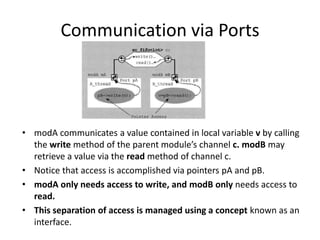
Communication via Ports

• modA communicates a value contained in local variable v by calling
the write method of the parent module’s channel c. modB may
retrieve a value via the read method of channel c.
• Notice that access is accomplished via pointers pA and pB.
• modA only needs access to write, and modB only needs access to
read.
• This separation of access is managed using a concept known as an
interface.
Interfaces

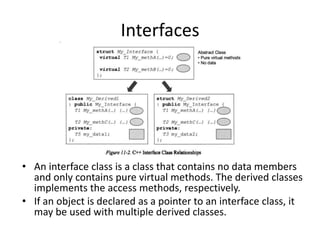
• An interface class is a class that contains no data members
and only contains pure virtual methods. The derived classes
implements the access methods, respectively.
• If an object is declared as a pointer to an interface class, it
may be used with multiple derived classes.
Relation between interface and
channel
• A SystemC interface is an abstract class that inherits
from sc_interface and provides only pure virtual
declarations of methods referenced by SystemC
channels and ports. No implementations or data are
provided in SystemC interface.
• A SystemC channel is a class that implements one or
more SystemC interface classes and inherits from
either sc_channel or sc_prim_channel. A channel
implements all the methods of the inherited
interface classes.
Two Examples of Using Ports
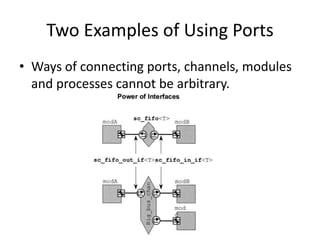
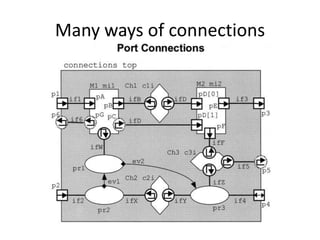
• Ways of connecting ports, channels, modules
and processes cannot be arbitrary.
Convenience of sc_interfaces using
Ports
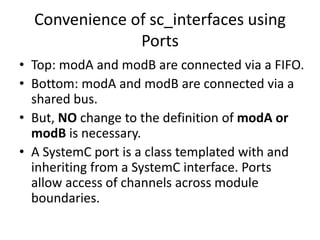
• Top: modA and modB are connected via a FIFO.
• Bottom: modA and modB are connected via a
shared bus.
• But, NO change to the definition of modA or
modB is necessary.
• A SystemC port is a class templated with and
inheriting from a SystemC interface. Ports
allow access of channels across module
boundaries.
Syntax
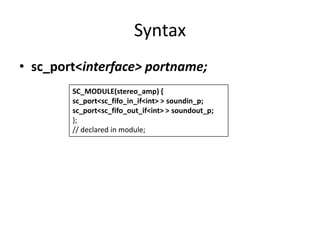
• sc_port<interface> portname;
SC_MODULE(stereo_amp) {
sc_port<sc_fifo_in_if<int> > soundin_p;
sc_port<sc_fifo_out_if<int> > soundout_p;
};
// declared in module;
Many ways of connections
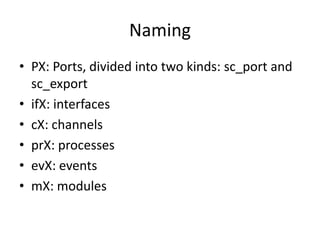
Naming
• PX: Ports, divided into two kinds: sc_port and
sc_export
• ifX: interfaces
• cX: channels
• prX: processes
• evX: events
• mX: modules
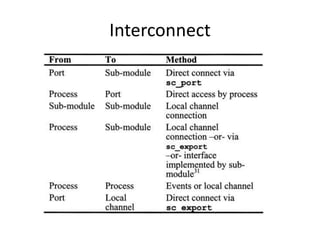
Interconnect
Rules
• Port connected to channel through interface
• Between processes, events are used for
signaling, possibly for synchronization.
• Processes can communicate with processes via
interfaces to channels connected to the submodule ports or by way of interfaces through a
modules itself using sc_export.
• Modules communicate with processes via
channels. Ports and corresponding interfaces are
needed, mostly.
Mechanism
1.
2.
3.
4.
5.

Instantiate modules and channels
Make required interfaces
Connecting ports
Modules connected to channels
Syntaxes of connecting ports:
1. mod_inst.portname(channel_instance); // By
Name
2. mod_instance(channel_instance,...); // By
Position
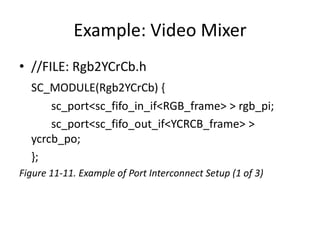
Example: Video Mixer
• //FILE: Rgb2YCrCb.h
SC_MODULE(Rgb2YCrCb) {
sc_port<sc_fifo_in_if<RGB_frame> > rgb_pi;
sc_port<sc_fifo_out_if<YCRCB_frame> >
ycrcb_po;
};
Figure 11-11. Example of Port Interconnect Setup (1 of 3)
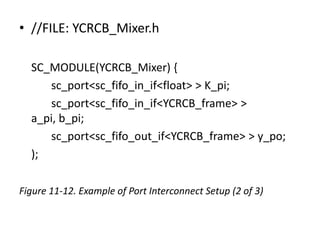
• //FILE: YCRCB_Mixer.h
SC_MODULE(YCRCB_Mixer) {
sc_port<sc_fifo_in_if<float> > K_pi;
sc_port<sc_fifo_in_if<YCRCB_frame> >
a_pi, b_pi;
sc_port<sc_fifo_out_if<YCRCB_frame> > y_po;
);
Figure 11-12. Example of Port Interconnect Setup (2 of 3)
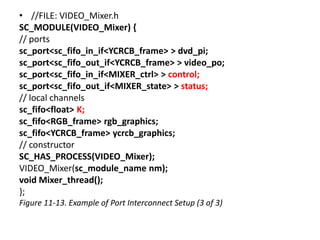
• //FILE: VIDEO_Mixer.h
SC_MODULE(VIDEO_Mixer) {
// ports
sc_port<sc_fifo_in_if<YCRCB_frame> > dvd_pi;
sc_port<sc_fifo_out_if<YCRCB_frame> > video_po;
sc_port<sc_fifo_in_if<MIXER_ctrl> > control;
sc_port<sc_fifo_out_if<MIXER_state> > status;
// local channels
sc_fifo<float> K;
sc_fifo<RGB_frame> rgb_graphics;
sc_fifo<YCRCB_frame> ycrcb_graphics;
// constructor
SC_HAS_PROCESS(VIDEO_Mixer);
VIDEO_Mixer(sc_module_name nm);
void Mixer_thread();
};
Figure 11-13. Example of Port Interconnect Setup (3 of 3)
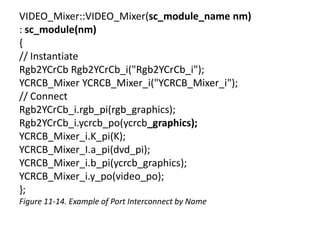
VIDEO_Mixer::VIDEO_Mixer(sc_module_name nm)
: sc_module(nm)
{
// Instantiate
Rgb2YCrCb Rgb2YCrCb_i("Rgb2YCrCb_i");
YCRCB_Mixer YCRCB_Mixer_i("YCRCB_Mixer_i");
// Connect
Rgb2YCrCb_i.rgb_pi(rgb_graphics);
Rgb2YCrCb_i.ycrcb_po(ycrcb_graphics);
YCRCB_Mixer_i.K_pi(K);
YCRCB_Mixer_I.a_pi(dvd_pi);
YCRCB_Mixer_i.b_pi(ycrcb_graphics);
YCRCB_Mixer_i.y_po(video_po);
};
Figure 11-14. Example of Port Interconnect by Name
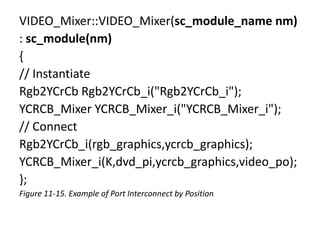
VIDEO_Mixer::VIDEO_Mixer(sc_module_name nm)
: sc_module(nm)
{
// Instantiate
Rgb2YCrCb Rgb2YCrCb_i("Rgb2YCrCb_i");
YCRCB_Mixer YCRCB_Mixer_i("YCRCB_Mixer_i");
// Connect
Rgb2YCrCb_i(rgb_graphics,ycrcb_graphics);
YCRCB_Mixer_i(K,dvd_pi,ycrcb_graphics,video_po);
};
Figure 11-15. Example of Port Interconnect by Position
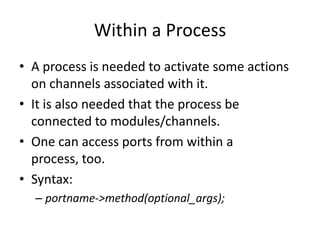
Within a Process
• A process is needed to activate some actions
on channels associated with it.
• It is also needed that the process be
connected to modules/channels.
• One can access ports from within a
process, too.
• Syntax:
– portname->method(optional_args);
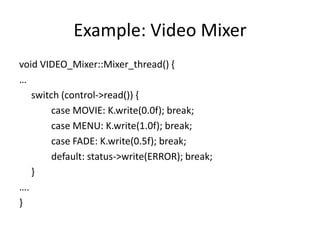
Example: Video Mixer
void VIDEO_Mixer::Mixer_thread() {
…
switch (control->read()) {
case MOVIE: K.write(0.0f); break;
case MENU: K.write(1.0f); break;
case FADE: K.write(0.5f); break;
default: status->write(ERROR); break;
}
….
}
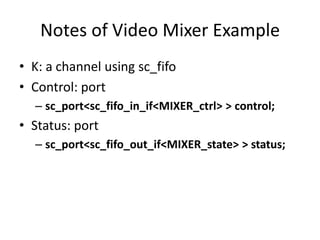
Notes of Video Mixer Example
• K: a channel using sc_fifo
• Control: port
– sc_port<sc_fifo_in_if<MIXER_ctrl> > control;

• Status: port
– sc_port<sc_fifo_out_if<MIXER_state> > status;
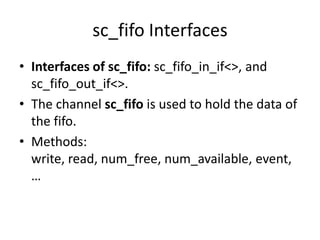
sc_fifo Interfaces
• Interfaces of sc_fifo: sc_fifo_in_if<>, and
sc_fifo_out_if<>.
• The channel sc_fifo is used to hold the data of
the fifo.
• Methods:
write, read, num_free, num_available, event,
…
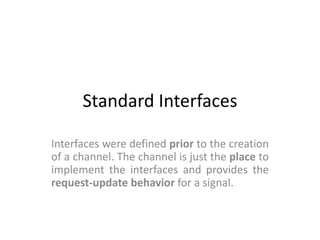
Standard Interfaces
Interfaces were defined prior to the creation
of a channel. The channel is just the place to
implement the interfaces and provides the
request-update behavior for a signal.
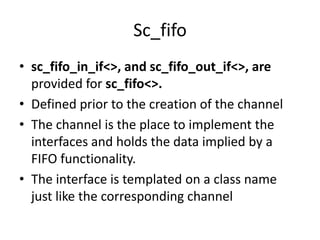
Sc_fifo
• sc_fifo_in_if<>, and sc_fifo_out_if<>, are
provided for sc_fifo<>.
• Defined prior to the creation of the channel
• The channel is the place to implement the
interfaces and holds the data implied by a
FIFO functionality.
• The interface is templated on a class name
just like the corresponding channel
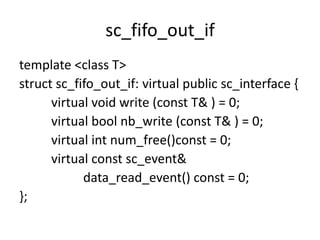
sc_fifo_out_if
template <class T>
struct sc_fifo_out_if: virtual public sc_interface {
virtual void write (const T& ) = 0;
virtual bool nb_write (const T& ) = 0;
virtual int num_free()const = 0;
virtual const sc_event&
data_read_event() const = 0;
};
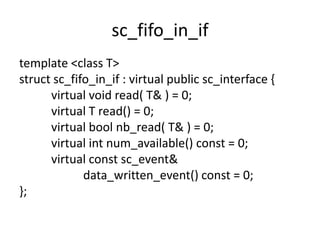
sc_fifo_in_if
template <class T>
struct sc_fifo_in_if : virtual public sc_interface {
virtual void read( T& ) = 0;
virtual T read() = 0;
virtual bool nb_read( T& ) = 0;
virtual int num_available() const = 0;
virtual const sc_event&
data_written_event() const = 0;
};
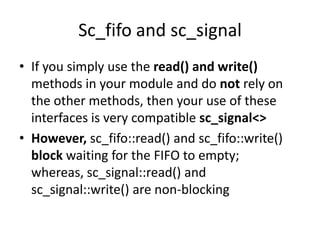
Sc_fifo and sc_signal
• If you simply use the read() and write()
methods in your module and do not rely on
the other methods, then your use of these
interfaces is very compatible sc_signal<>
• However, sc_fifo::read() and sc_fifo::write()
block waiting for the FIFO to empty;
whereas, sc_signal::read() and
sc_signal::write() are non-blocking
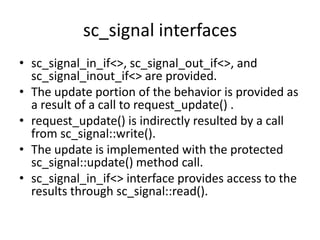
sc_signal interfaces
• sc_signal_in_if<>, sc_signal_out_if<>, and
sc_signal_inout_if<> are provided.
• The update portion of the behavior is provided as
a result of a call to request_update() .
• request_update() is indirectly resulted by a call
from sc_signal::write().
• The update is implemented with the protected
sc_signal::update() method call.
• sc_signal_in_if<> interface provides access to the
results through sc_signal::read().
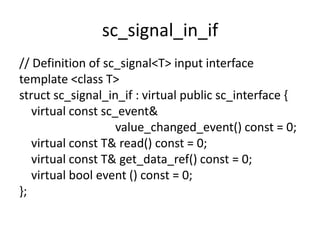
sc_signal_in_if
// Definition of sc_signal<T> input interface
template <class T>
struct sc_signal_in_if : virtual public sc_interface {
virtual const sc_event&
value_changed_event() const = 0;
virtual const T& read() const = 0;
virtual const T& get_data_ref() const = 0;
virtual bool event () const = 0;
};
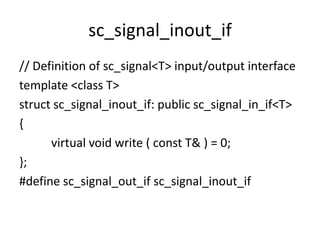
sc_signal_inout_if
// Definition of sc_signal<T> input/output interface
template <class T>
struct sc_signal_inout_if: public sc_signal_in_if<T>
{
virtual void write ( const T& ) = 0;
};
#define sc_signal_out_if sc_signal_inout_if
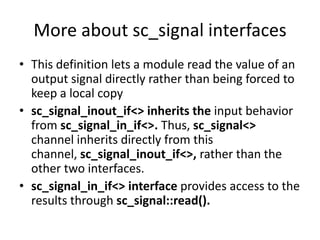
More about sc_signal interfaces
• This definition lets a module read the value of an
output signal directly rather than being forced to
keep a local copy
• sc_signal_inout_if<> inherits the input behavior
from sc_signal_in_if<>. Thus, sc_signal<>
channel inherits directly from this
channel, sc_signal_inout_if<>, rather than the
other two interfaces.
• sc_signal_in_if<> interface provides access to the
results through sc_signal::read().
sc_mutex_if
// Definition of sc_mutex_if interface
struct sc_mutex_if: virtual public sc_interface {
virtual int lock() = 0;
virtual int trylock() = 0;
virtual int unlock() = 0;
};
// No event methods are provided for sensitivity. If
event sensitivity is required, one must implement
own channels and interfaces.
sc_semaphore_if
// Definition of sc_semaphore_if interface
struct sc_semaphore_if : virtual public sc_interface
{
virtual int wait() = 0;
virtual int trywait() = 0;
virtual int post() = 0;
virtual int get_value() const = 0;
};
//Same to sc_mutex_if, no event methods are provided
for sensitivity. You have to do your own if necessary.
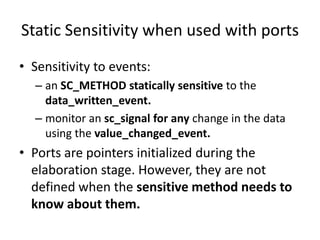
Static Sensitivity when used with ports
• Sensitivity to events:
– an SC_METHOD statically sensitive to the
data_written_event.
– monitor an sc_signal for any change in the data
using the value_changed_event.

• Ports are pointers initialized during the
elaboration stage. However, they are not
defined when the sensitive method needs to
know about them.
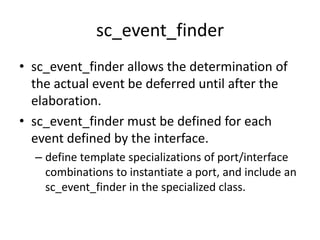
sc_event_finder
• sc_event_finder allows the determination of
the actual event be deferred until after the
elaboration.
• sc_event_finder must be defined for each
event defined by the interface.
– define template specializations of port/interface
combinations to instantiate a port, and include an
sc_event_finder in the specialized class.
Example: A port with sensitivity to the
positive edge event of sc_signal
• sc_event_finder takes two arguments:
– a reference to the port being found (*this)
– a reference to the member function, (posedge_event()) that returns a
reference to the event of interest and can be used as sensitivity.
struct ea_port_sc_signal_in_if_bool
: public sc_port<sc_signal_in_if<bool>,1>
{
typedef sc_signal_in_if<bool> if_type;
sc_event_finder& ef_posedge_event() const {
return *new sc_event_finder_t<if_type>(
*this,
&if_type::posedge_event
);
}
};
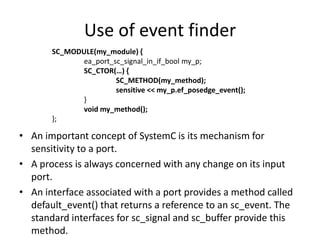
Use of event finder
SC_MODULE(my_module) {
ea_port_sc_signal_in_if_bool my_p;
SC_CTOR(…) {
SC_METHOD(my_method);
sensitive << my_p.ef_posedge_event();
}
void my_method();
};

• An important concept of SystemC is its mechanism for
sensitivity to a port.
• A process is always concerned with any change on its input
port.
• An interface associated with a port provides a method called
default_event() that returns a reference to an sc_event. The
standard interfaces for sc_signal and sc_buffer provide this
method.
sc_port array
• Provide multi-port or port array of liked
defined.
• Syntax:
– sc_port <interface[ ,N]> portname;
– // N=0..MAX Default N=1
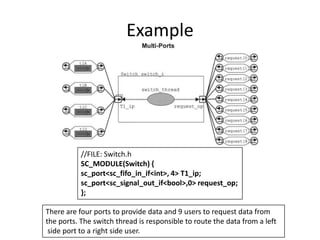
Example

//FILE: Switch.h
SC_MODULE(Switch) {
sc_port<sc_fifo_in_if<int>, 4> T1_ip;
sc_port<sc_signal_out_if<bool>,0> request_op;
};
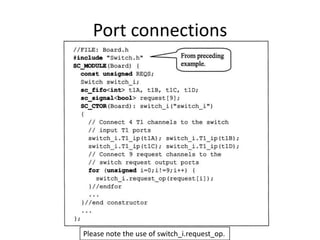
There are four ports to provide data and 9 users to request data from
the ports. The switch thread is responsible to route the data from a left
side port to a right side user.
Port connections

Please note the use of switch_i.request_op.
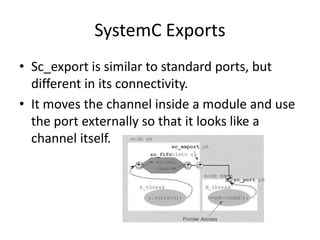
SystemC Exports
• Sc_export is similar to standard ports, but
different in its connectivity.
• It moves the channel inside a module and use
the port externally so that it looks like a
channel itself.
Sc_export
• It can be replaced by using normal channelinterface-port configuration, but
• It is sometimes desirable that it exports some
channels but keep others private. This is a
feature preferred by most IP provider;
• It can provides multiple interfaces at the top
level, though one can still use hierarchical
channels.
Other advantages
• Each sc_export contains an interface, so
connection is not required and hidden interface
can be made.
• A specific interface is hidden from IP provider, not
disclosed to the users.
• A model for profiling or exploration can be made
with such exports which can be dropped in the
later stage of development.
• Syntax:
– sc_export<interface> portname;
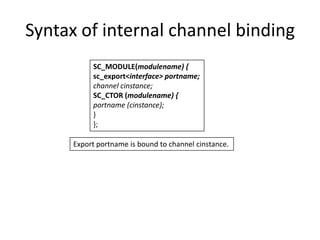
Syntax of internal channel binding
SC_MODULE(modulename) {
sc_export<interface> portname;
channel cinstance;
SC_CTOR (modulename) {
portname (cinstance);
}
};
Export portname is bound to channel cinstance.
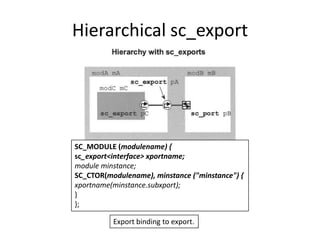
Hierarchical sc_export

SC_MODULE (modulename) {
sc_export<interface> xportname;
module minstance;
SC_CTOR(modulename), minstance ("minstance") {
xportname(minstance.subxport);
}
};
Export binding to export.
Three points to be noted
• No array export is supported.
• Unlike a sc_port, It lacks the requirement of a
connection.
• Static sensitivity cannot be used here, though
one can use wait(exportname->event()) on
defined interfaces in an SC_THREAD.
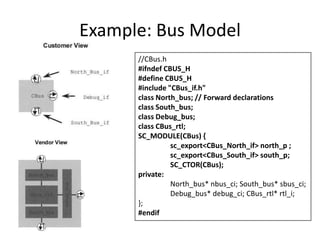
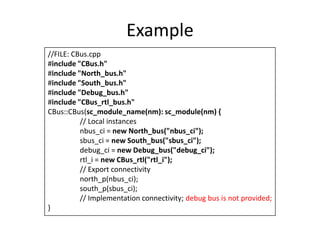
Example: Bus Model
//CBus.h
#ifndef CBUS_H
#define CBUS_H
#include "CBus_if.h"
class North_bus; // Forward declarations
class South_bus;
class Debug_bus;
class CBus_rtl;
SC_MODULE(CBus) {
sc_export<CBus_North_if> north_p ;
sc_export<CBus_South_if> south_p;
SC_CTOR(CBus);
private:
North_bus* nbus_ci; South_bus* sbus_ci;
Debug_bus* debug_ci; CBus_rtl* rtl_i;
};
#endif
Example
//FILE: CBus.cpp
#include "CBus.h"
#include "North_bus.h"
#include "South_bus.h"
#include "Debug_bus.h"
#include "CBus_rtl_bus.h"
CBus::CBus(sc_module_name(nm): sc_module(nm) {
// Local instances
nbus_ci = new North_bus("nbus_ci");
sbus_ci = new South_bus("sbus_ci");
debug_ci = new Debug_bus("debug_ci");
rtl_i = new CBus_rtl("rtl_i");
// Export connectivity
north_p(nbus_ci);
south_p(sbus_ci);
// Implementation connectivity; debug bus is not provided;
}
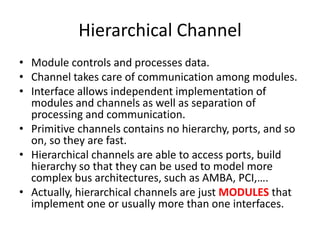
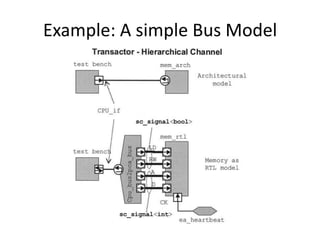
Hierarchical Channel
• Module controls and processes data.
• Channel takes care of communication among modules.
• Interface allows independent implementation of
modules and channels as well as separation of
processing and communication.
• Primitive channels contains no hierarchy, ports, and so
on, so they are fast.
• Hierarchical channels are able to access ports, build
hierarchy so that they can be used to model more
complex bus architectures, such as AMBA, PCI,….
• Actually, hierarchical channels are just MODULES that
implement one or usually more than one interfaces.
Example: A simple Bus Model
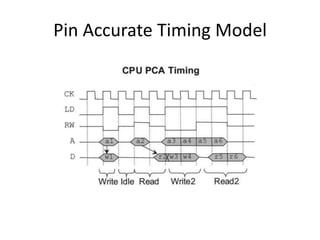
Pin Accurate Timing Model
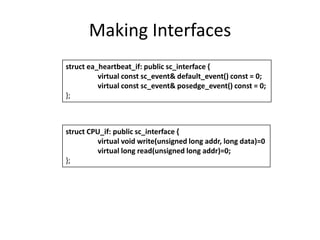
Making Interfaces
struct ea_heartbeat_if: public sc_interface {
virtual const sc_event& default_event() const = 0;
virtual const sc_event& posedge_event() const = 0;
};

struct CPU_if: public sc_interface {
virtual void write(unsigned long addr, long data)=0
virtual long read(unsigned long addr)=0;
};
Memory Model
//FILE: mem_arch.h
#include "CPU_if.h"
struct mem: public sc_channel, CPU_if {
// Constructors & destructor
explicit mem(sc_module_name nm,
unsigned long ba, unsigned sz)
: sc_channel(nm), m_base(ba), m_size(sz)
{ m_mem = new long[m_size]; }
~mem() { delete [] m_mem; }
// Interface implementations
virtual void write(unsigned long addr, long data) {
if (m_start <= addr && addr < m_base+m_size) {
m_mem[addr–m_base] = data;
}
}

virtual long read(unsigned long addr) {
if (m_start <= addr && addr < m_base+m_size) {
return m_mem[addr–m_base];
} else {
cout <<
"ERROR:"<<name()<<"@"<<sc_time_stamp
()
<< ": Illegal address: " << addr << endl;
sc_stop(); return 0;
}
}
private:
unsigned long m_base;
unsigned m_size;
long m_mem[];
mem(const mem&); // Disable
};
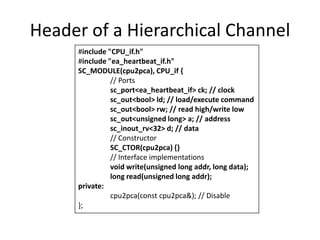
Header of a Hierarchical Channel
#include "CPU_if.h"
#include "ea_heartbeat_if.h"
SC_MODULE(cpu2pca), CPU_if {
// Ports
sc_port<ea_heartbeat_if> ck; // clock
sc_out<bool> ld; // load/execute command
sc_out<bool> rw; // read high/write low
sc_out<unsigned long> a; // address
sc_inout_rv<32> d; // data
// Constructor
SC_CTOR(cpu2pca) {}
// Interface implementations
void write(unsigned long addr, long data);
long read(unsigned long addr);
private:
cpu2pca(const cpu2pca&); // Disable
};
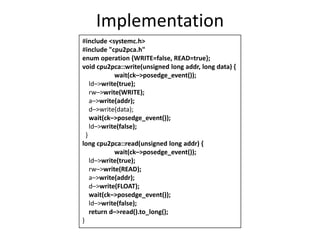
Implementation
#include <systemc.h>
#include "cpu2pca.h"
enum operation {WRITE=false, READ=true};
void cpu2pca::write(unsigned long addr, long data) {
wait(ck–>posedge_event());
ld–>write(true);
rw–>write(WRITE);
a–>write(addr);
d–>write(data);
wait(ck–>posedge_event());
ld–>write(false);
}
long cpu2pca::read(unsigned long addr) {
wait(ck–>posedge_event());
ld–>write(true);
rw–>write(READ);
a–>write(addr);
d–>write(FLOAT);
wait(ck–>posedge_event());
ld–>write(false);
return d–>read().to_long();
}

SystemC Ports

  • 1.
  • 2.
    Ports • SystemC letsmodules use channels inserted between the communicating modules. • Such communication method uses a concept related to a mechanism called port. • Actually, a port is a pointer to a channel outside the module.
  • 3.
    Communication via Ports •modA communicates a value contained in local variable v by calling the write method of the parent module’s channel c. modB may retrieve a value via the read method of channel c. • Notice that access is accomplished via pointers pA and pB. • modA only needs access to write, and modB only needs access to read. • This separation of access is managed using a concept known as an interface.
  • 4.
    Interfaces • An interfaceclass is a class that contains no data members and only contains pure virtual methods. The derived classes implements the access methods, respectively. • If an object is declared as a pointer to an interface class, it may be used with multiple derived classes.
  • 5.
    Relation between interfaceand channel • A SystemC interface is an abstract class that inherits from sc_interface and provides only pure virtual declarations of methods referenced by SystemC channels and ports. No implementations or data are provided in SystemC interface. • A SystemC channel is a class that implements one or more SystemC interface classes and inherits from either sc_channel or sc_prim_channel. A channel implements all the methods of the inherited interface classes.
  • 6.
    Two Examples ofUsing Ports • Ways of connecting ports, channels, modules and processes cannot be arbitrary.
  • 7.
    Convenience of sc_interfacesusing Ports • Top: modA and modB are connected via a FIFO. • Bottom: modA and modB are connected via a shared bus. • But, NO change to the definition of modA or modB is necessary. • A SystemC port is a class templated with and inheriting from a SystemC interface. Ports allow access of channels across module boundaries.
  • 8.
    Syntax • sc_port<interface> portname; SC_MODULE(stereo_amp){ sc_port<sc_fifo_in_if<int> > soundin_p; sc_port<sc_fifo_out_if<int> > soundout_p; }; // declared in module;
  • 9.
    Many ways ofconnections
  • 10.
    Naming • PX: Ports,divided into two kinds: sc_port and sc_export • ifX: interfaces • cX: channels • prX: processes • evX: events • mX: modules
  • 11.
  • 12.
    Rules • Port connectedto channel through interface • Between processes, events are used for signaling, possibly for synchronization. • Processes can communicate with processes via interfaces to channels connected to the submodule ports or by way of interfaces through a modules itself using sc_export. • Modules communicate with processes via channels. Ports and corresponding interfaces are needed, mostly.
  • 13.
    Mechanism 1. 2. 3. 4. 5. Instantiate modules andchannels Make required interfaces Connecting ports Modules connected to channels Syntaxes of connecting ports: 1. mod_inst.portname(channel_instance); // By Name 2. mod_instance(channel_instance,...); // By Position
  • 14.
    Example: Video Mixer •//FILE: Rgb2YCrCb.h SC_MODULE(Rgb2YCrCb) { sc_port<sc_fifo_in_if<RGB_frame> > rgb_pi; sc_port<sc_fifo_out_if<YCRCB_frame> > ycrcb_po; }; Figure 11-11. Example of Port Interconnect Setup (1 of 3)
  • 15.
    • //FILE: YCRCB_Mixer.h SC_MODULE(YCRCB_Mixer){ sc_port<sc_fifo_in_if<float> > K_pi; sc_port<sc_fifo_in_if<YCRCB_frame> > a_pi, b_pi; sc_port<sc_fifo_out_if<YCRCB_frame> > y_po; ); Figure 11-12. Example of Port Interconnect Setup (2 of 3)
  • 16.
    • //FILE: VIDEO_Mixer.h SC_MODULE(VIDEO_Mixer){ // ports sc_port<sc_fifo_in_if<YCRCB_frame> > dvd_pi; sc_port<sc_fifo_out_if<YCRCB_frame> > video_po; sc_port<sc_fifo_in_if<MIXER_ctrl> > control; sc_port<sc_fifo_out_if<MIXER_state> > status; // local channels sc_fifo<float> K; sc_fifo<RGB_frame> rgb_graphics; sc_fifo<YCRCB_frame> ycrcb_graphics; // constructor SC_HAS_PROCESS(VIDEO_Mixer); VIDEO_Mixer(sc_module_name nm); void Mixer_thread(); }; Figure 11-13. Example of Port Interconnect Setup (3 of 3)
  • 17.
    VIDEO_Mixer::VIDEO_Mixer(sc_module_name nm) : sc_module(nm) { //Instantiate Rgb2YCrCb Rgb2YCrCb_i("Rgb2YCrCb_i"); YCRCB_Mixer YCRCB_Mixer_i("YCRCB_Mixer_i"); // Connect Rgb2YCrCb_i.rgb_pi(rgb_graphics); Rgb2YCrCb_i.ycrcb_po(ycrcb_graphics); YCRCB_Mixer_i.K_pi(K); YCRCB_Mixer_I.a_pi(dvd_pi); YCRCB_Mixer_i.b_pi(ycrcb_graphics); YCRCB_Mixer_i.y_po(video_po); }; Figure 11-14. Example of Port Interconnect by Name
  • 18.
    VIDEO_Mixer::VIDEO_Mixer(sc_module_name nm) : sc_module(nm) { //Instantiate Rgb2YCrCb Rgb2YCrCb_i("Rgb2YCrCb_i"); YCRCB_Mixer YCRCB_Mixer_i("YCRCB_Mixer_i"); // Connect Rgb2YCrCb_i(rgb_graphics,ycrcb_graphics); YCRCB_Mixer_i(K,dvd_pi,ycrcb_graphics,video_po); }; Figure 11-15. Example of Port Interconnect by Position
  • 19.
    Within a Process •A process is needed to activate some actions on channels associated with it. • It is also needed that the process be connected to modules/channels. • One can access ports from within a process, too. • Syntax: – portname->method(optional_args);
  • 20.
    Example: Video Mixer voidVIDEO_Mixer::Mixer_thread() { … switch (control->read()) { case MOVIE: K.write(0.0f); break; case MENU: K.write(1.0f); break; case FADE: K.write(0.5f); break; default: status->write(ERROR); break; } …. }
  • 21.
    Notes of VideoMixer Example • K: a channel using sc_fifo • Control: port – sc_port<sc_fifo_in_if<MIXER_ctrl> > control; • Status: port – sc_port<sc_fifo_out_if<MIXER_state> > status;
  • 22.
    sc_fifo Interfaces • Interfacesof sc_fifo: sc_fifo_in_if<>, and sc_fifo_out_if<>. • The channel sc_fifo is used to hold the data of the fifo. • Methods: write, read, num_free, num_available, event, …
  • 23.
    Standard Interfaces Interfaces weredefined prior to the creation of a channel. The channel is just the place to implement the interfaces and provides the request-update behavior for a signal.
  • 24.
    Sc_fifo • sc_fifo_in_if<>, andsc_fifo_out_if<>, are provided for sc_fifo<>. • Defined prior to the creation of the channel • The channel is the place to implement the interfaces and holds the data implied by a FIFO functionality. • The interface is templated on a class name just like the corresponding channel
  • 25.
    sc_fifo_out_if template <class T> structsc_fifo_out_if: virtual public sc_interface { virtual void write (const T& ) = 0; virtual bool nb_write (const T& ) = 0; virtual int num_free()const = 0; virtual const sc_event& data_read_event() const = 0; };
  • 26.
    sc_fifo_in_if template <class T> structsc_fifo_in_if : virtual public sc_interface { virtual void read( T& ) = 0; virtual T read() = 0; virtual bool nb_read( T& ) = 0; virtual int num_available() const = 0; virtual const sc_event& data_written_event() const = 0; };
  • 27.
    Sc_fifo and sc_signal •If you simply use the read() and write() methods in your module and do not rely on the other methods, then your use of these interfaces is very compatible sc_signal<> • However, sc_fifo::read() and sc_fifo::write() block waiting for the FIFO to empty; whereas, sc_signal::read() and sc_signal::write() are non-blocking
  • 28.
    sc_signal interfaces • sc_signal_in_if<>,sc_signal_out_if<>, and sc_signal_inout_if<> are provided. • The update portion of the behavior is provided as a result of a call to request_update() . • request_update() is indirectly resulted by a call from sc_signal::write(). • The update is implemented with the protected sc_signal::update() method call. • sc_signal_in_if<> interface provides access to the results through sc_signal::read().
  • 29.
    sc_signal_in_if // Definition ofsc_signal<T> input interface template <class T> struct sc_signal_in_if : virtual public sc_interface { virtual const sc_event& value_changed_event() const = 0; virtual const T& read() const = 0; virtual const T& get_data_ref() const = 0; virtual bool event () const = 0; };
  • 30.
    sc_signal_inout_if // Definition ofsc_signal<T> input/output interface template <class T> struct sc_signal_inout_if: public sc_signal_in_if<T> { virtual void write ( const T& ) = 0; }; #define sc_signal_out_if sc_signal_inout_if
  • 31.
    More about sc_signalinterfaces • This definition lets a module read the value of an output signal directly rather than being forced to keep a local copy • sc_signal_inout_if<> inherits the input behavior from sc_signal_in_if<>. Thus, sc_signal<> channel inherits directly from this channel, sc_signal_inout_if<>, rather than the other two interfaces. • sc_signal_in_if<> interface provides access to the results through sc_signal::read().
  • 32.
    sc_mutex_if // Definition ofsc_mutex_if interface struct sc_mutex_if: virtual public sc_interface { virtual int lock() = 0; virtual int trylock() = 0; virtual int unlock() = 0; }; // No event methods are provided for sensitivity. If event sensitivity is required, one must implement own channels and interfaces.
  • 33.
    sc_semaphore_if // Definition ofsc_semaphore_if interface struct sc_semaphore_if : virtual public sc_interface { virtual int wait() = 0; virtual int trywait() = 0; virtual int post() = 0; virtual int get_value() const = 0; }; //Same to sc_mutex_if, no event methods are provided for sensitivity. You have to do your own if necessary.
  • 34.
    Static Sensitivity whenused with ports • Sensitivity to events: – an SC_METHOD statically sensitive to the data_written_event. – monitor an sc_signal for any change in the data using the value_changed_event. • Ports are pointers initialized during the elaboration stage. However, they are not defined when the sensitive method needs to know about them.
  • 35.
    sc_event_finder • sc_event_finder allowsthe determination of the actual event be deferred until after the elaboration. • sc_event_finder must be defined for each event defined by the interface. – define template specializations of port/interface combinations to instantiate a port, and include an sc_event_finder in the specialized class.
  • 36.
    Example: A portwith sensitivity to the positive edge event of sc_signal • sc_event_finder takes two arguments: – a reference to the port being found (*this) – a reference to the member function, (posedge_event()) that returns a reference to the event of interest and can be used as sensitivity. struct ea_port_sc_signal_in_if_bool : public sc_port<sc_signal_in_if<bool>,1> { typedef sc_signal_in_if<bool> if_type; sc_event_finder& ef_posedge_event() const { return *new sc_event_finder_t<if_type>( *this, &if_type::posedge_event ); } };
  • 37.
    Use of eventfinder SC_MODULE(my_module) { ea_port_sc_signal_in_if_bool my_p; SC_CTOR(…) { SC_METHOD(my_method); sensitive << my_p.ef_posedge_event(); } void my_method(); }; • An important concept of SystemC is its mechanism for sensitivity to a port. • A process is always concerned with any change on its input port. • An interface associated with a port provides a method called default_event() that returns a reference to an sc_event. The standard interfaces for sc_signal and sc_buffer provide this method.
  • 38.
    sc_port array • Providemulti-port or port array of liked defined. • Syntax: – sc_port <interface[ ,N]> portname; – // N=0..MAX Default N=1
  • 39.
    Example //FILE: Switch.h SC_MODULE(Switch) { sc_port<sc_fifo_in_if<int>,4> T1_ip; sc_port<sc_signal_out_if<bool>,0> request_op; }; There are four ports to provide data and 9 users to request data from the ports. The switch thread is responsible to route the data from a left side port to a right side user.
  • 40.
    Port connections Please notethe use of switch_i.request_op.
  • 41.
    SystemC Exports • Sc_exportis similar to standard ports, but different in its connectivity. • It moves the channel inside a module and use the port externally so that it looks like a channel itself.
  • 42.
    Sc_export • It canbe replaced by using normal channelinterface-port configuration, but • It is sometimes desirable that it exports some channels but keep others private. This is a feature preferred by most IP provider; • It can provides multiple interfaces at the top level, though one can still use hierarchical channels.
  • 43.
    Other advantages • Eachsc_export contains an interface, so connection is not required and hidden interface can be made. • A specific interface is hidden from IP provider, not disclosed to the users. • A model for profiling or exploration can be made with such exports which can be dropped in the later stage of development. • Syntax: – sc_export<interface> portname;
  • 44.
    Syntax of internalchannel binding SC_MODULE(modulename) { sc_export<interface> portname; channel cinstance; SC_CTOR (modulename) { portname (cinstance); } }; Export portname is bound to channel cinstance.
  • 45.
    Hierarchical sc_export SC_MODULE (modulename){ sc_export<interface> xportname; module minstance; SC_CTOR(modulename), minstance ("minstance") { xportname(minstance.subxport); } }; Export binding to export.
  • 46.
    Three points tobe noted • No array export is supported. • Unlike a sc_port, It lacks the requirement of a connection. • Static sensitivity cannot be used here, though one can use wait(exportname->event()) on defined interfaces in an SC_THREAD.
  • 47.
    Example: Bus Model //CBus.h #ifndefCBUS_H #define CBUS_H #include "CBus_if.h" class North_bus; // Forward declarations class South_bus; class Debug_bus; class CBus_rtl; SC_MODULE(CBus) { sc_export<CBus_North_if> north_p ; sc_export<CBus_South_if> south_p; SC_CTOR(CBus); private: North_bus* nbus_ci; South_bus* sbus_ci; Debug_bus* debug_ci; CBus_rtl* rtl_i; }; #endif
  • 48.
    Example //FILE: CBus.cpp #include "CBus.h" #include"North_bus.h" #include "South_bus.h" #include "Debug_bus.h" #include "CBus_rtl_bus.h" CBus::CBus(sc_module_name(nm): sc_module(nm) { // Local instances nbus_ci = new North_bus("nbus_ci"); sbus_ci = new South_bus("sbus_ci"); debug_ci = new Debug_bus("debug_ci"); rtl_i = new CBus_rtl("rtl_i"); // Export connectivity north_p(nbus_ci); south_p(sbus_ci); // Implementation connectivity; debug bus is not provided; }
  • 49.
    Hierarchical Channel • Modulecontrols and processes data. • Channel takes care of communication among modules. • Interface allows independent implementation of modules and channels as well as separation of processing and communication. • Primitive channels contains no hierarchy, ports, and so on, so they are fast. • Hierarchical channels are able to access ports, build hierarchy so that they can be used to model more complex bus architectures, such as AMBA, PCI,…. • Actually, hierarchical channels are just MODULES that implement one or usually more than one interfaces.
  • 50.
  • 51.
  • 52.
    Making Interfaces struct ea_heartbeat_if:public sc_interface { virtual const sc_event& default_event() const = 0; virtual const sc_event& posedge_event() const = 0; }; struct CPU_if: public sc_interface { virtual void write(unsigned long addr, long data)=0 virtual long read(unsigned long addr)=0; };
  • 53.
    Memory Model //FILE: mem_arch.h #include"CPU_if.h" struct mem: public sc_channel, CPU_if { // Constructors & destructor explicit mem(sc_module_name nm, unsigned long ba, unsigned sz) : sc_channel(nm), m_base(ba), m_size(sz) { m_mem = new long[m_size]; } ~mem() { delete [] m_mem; } // Interface implementations virtual void write(unsigned long addr, long data) { if (m_start <= addr && addr < m_base+m_size) { m_mem[addr–m_base] = data; } } virtual long read(unsigned long addr) { if (m_start <= addr && addr < m_base+m_size) { return m_mem[addr–m_base]; } else { cout << "ERROR:"<<name()<<"@"<<sc_time_stamp () << ": Illegal address: " << addr << endl; sc_stop(); return 0; } } private: unsigned long m_base; unsigned m_size; long m_mem[]; mem(const mem&); // Disable };
  • 54.
    Header of aHierarchical Channel #include "CPU_if.h" #include "ea_heartbeat_if.h" SC_MODULE(cpu2pca), CPU_if { // Ports sc_port<ea_heartbeat_if> ck; // clock sc_out<bool> ld; // load/execute command sc_out<bool> rw; // read high/write low sc_out<unsigned long> a; // address sc_inout_rv<32> d; // data // Constructor SC_CTOR(cpu2pca) {} // Interface implementations void write(unsigned long addr, long data); long read(unsigned long addr); private: cpu2pca(const cpu2pca&); // Disable };
  • 55.
    Implementation #include <systemc.h> #include "cpu2pca.h" enumoperation {WRITE=false, READ=true}; void cpu2pca::write(unsigned long addr, long data) { wait(ck–>posedge_event()); ld–>write(true); rw–>write(WRITE); a–>write(addr); d–>write(data); wait(ck–>posedge_event()); ld–>write(false); } long cpu2pca::read(unsigned long addr) { wait(ck–>posedge_event()); ld–>write(true); rw–>write(READ); a–>write(addr); d–>write(FLOAT); wait(ck–>posedge_event()); ld–>write(false); return d–>read().to_long(); }