Experiences with SystemC


Design Verification Using
       SystemC
         Greg Tierney

         Presented to
        DV Club, Boston
         March 5, 2007


           DV Club, Boston
Experiences with SystemC


                     About Avid
Invented digital video editing
Headquartered in Tewksbury
 – http://www.avid.com/company/
Products
 – Film/Video Editing and
   Finishing
 – Audio
 – Broadcast
 – Animation
 – Storage & Workgroups
 – Digital Asset and Production
   Management
Services
 – Support
 – Training
 – Consulting


                              DV Club, Boston
Experiences with SystemC


            Agenda
What is SystemC?
Why did Avid choose to use SystemC?
DV problems solved by SystemC.
Summary


              DV Club, Boston
Experiences with SystemC


         What is SystemC?
Provides hardware constructs and a simulation kernel
for C++
It is a class library
– And it is a language standard (IEEE 1666TM 2005)
It has utilities and constructs
– Data types, ports, channels, processes
Adopted by different disciplines
– Architectural Modeling (SoC, performance)
– DV (RTL simulation, HW/SW co-verification)
– Synthesis
It is open source (OSCI)
– http://www.systemc.org

                       DV Club, Boston
Experiences with SystemC


  Why Avid Chose SystemC
Enhanced existing C++ DV code
– Replaced an unreliable in-house framework
    • Signal encapsulation
    • Thread management
    • Random seed management
– Smooth transition from C++ to SystemC
Tool availability
– Single kernel multi-language simulator
Industry acceptance
Low cost
Came with built-in verification capabilities

                        DV Club, Boston
Experiences with SystemC


            Agenda
What is SystemC?
Why did Avid choose to use SystemC?
DV problems solved by SystemC.
Summary


              DV Club, Boston
Experiences with SystemC


Crossing Language Boundaries

Connect an entire HDL module to the
testbench.
– Wrap the module with a SystemC class
  (sc_foreign_module).
– Provide a string mapping for each port.
Connect a foreign signal anywhere in the
hierarchy.
– Bind a sc_signal (observe_foreign_signal).
– Provide a string of hierarchical path to wire or reg.

                     DV Club, Boston
Experiences with SystemC


                        Code Examples
class MyDUT : public sc_foreign_module {            SC_MODULE(MyVTB)
public:                                             {
  sc_in<sc_logic> reset;
                                                    public:
  sc_in<sc_logic> clock;
  sc_out<sc_lv<16> > AD;                              SC_CTOR(MyVTB) :
                                                         MyDUTInst(“MyDUTInst”, “MyDUT”),
  MyDUT(sc_module_nam nm, const char* hdl_name)          MyMonitorInst(“MyMonitorInst”,
   : sc_foreign_module(nm, hdl_name),                                  “MyVTB.MyDUTInst.FooInst”)
     reset(“reset”),
                                                      {
     clock(“clock”),
     AD(“AD”){}                                          MyDUTInst.reset(tb_reset);
};                                                       MyDUTInst.clock(tb_clock);
                                                         MyDUTInst.AD(tb_AD);
class MyMonitor : public sc_module {                  }
public:                                             private:
  MyMonitor(sc_module_name,                           MyDUT MyDUTInst;
            const string& path2DUT){                  MyMonitor MyMonitorInst;
    string path2sig = path2DUT + “.snoop”;
    snoopSig_.observe_foreign_signal(path2sig);       sc_signal<sc_logic>   tb_reset;
    SC_THREAD(threadT);                               sc_signal<sc_logic>   tb_clock;
    sensitive <<                                      sc_signal<sc_lv<16> > tb_AD;
       snoopSig_.value_changed_event();             };
  }
private:
  sc_signal<sc_logic> snoopSig_;
  void threadT();
};

                                           DV Club, Boston
Experiences with SystemC


      Issues with Binding
No clear standard for language boundary
resolution.
– Each vendor has its own implementation.
– Implementation we use doesn’t map arrays or
  records (yet).
Supporting foreign interface requires two
pass compilation.
– First pass creates object files.
– Second pass builds a symbol library used in
  design elaboration.

                    DV Club, Boston
Experiences with SystemC


SystemC Connections
   p
              start()                           p     start()


Call a public method                    Connect sc_port to a
via pointer to object                       sc_export


           outp      write()   read()     inp


                  Connect sc_port to a
                       channel


                        DV Club, Boston
Experiences with SystemC


                        Code Examples
struct start_stop_if : public sc_interface        SC_MODULE(MyTest){
{                                                 public:
  virtual void start()=0;                           sc_port<start_stop_if> bfm_port;
  virtual void stop()=0;                          };
};                                                SC_MODULE(vtb){
                                                  public:
class MyBFM :                                       SC_CTOR(vtb);
  public sc_module,                               private:
  public virtual start_stop_if                      sc_signal<sc_logic>   Clock;
{                                                   sc_signal<sc_logic>   Request;
public:                                             sc_signal<sc_lv<16> > AD;
  sc_in<sc_logic>   Clock;                          tlm::tlm_fifo<MyX>    MyXReceiveChan;
  sc_out<sc_logic> Request;                         MyTest                MyTestInst;
  sc_in<sc_lv<16> > AD;                             MyBFM                 MyBFMInst;
  tlm::tlm_put_port<MyX> MyXReceivePort;          };
  sc_export<start_stop_if> StartStopExport;
                                                  vtb:vtb(sc_module_name) :
  void start();                                     MyBFMInst(“MyBFMInst”), MyTestInst(“MyTestInst”)
  void stop();                                    {
                                                    MyBFMInst.Clock(Clock);
  SC_CTOR(MyBFM){                                   MyBFMInst.Request(Request);
     StartStopExport(*this);                        MyBFMInst.AD(AD);
  }                                                 MyBFMInst.MyXReceivePort(MyXReceiveChan);
};                                                  MyTestInst.bfm_port(MyBFMInst.StartStopExport);
                                                  }

                                         DV Club, Boston
Experiences with SystemC


   Issues with Connections
Construction and binding are separate steps.
– Ports must be public.
– Ports bound after modules and channels are constructed.
Binding uses “strict type checking”.
– Compilation will fail if type mismatch in the connection.
– Splitting a vector across multiple ports is complicated.
Binding errors detected at elaboration.
– Simulation should abort at runtime if a port is not bound.
– Need to assign attributes to port (e.g. # of connections).


                         DV Club, Boston
Experiences with SystemC


         Randomization
Separate library dedicated to verification
constructs (SCV).
Robust, rich feature set for
randomization.
– Simple constraints (ranges and lists).
– Complex constraint solver.
– Thread-safe seeding.
– Extendible to custom object types.

                  DV Club, Boston
Experiences with SystemC


    Randomization at Avid
SCV more than we needed.
– So, we use a subset of the features.
Provide a Tcl interface to apply constraints.
– Wrap scv_smart_ptr.
– Define string representations for simple
  constraints.
– Recompilation not required to change constraints.
– Reapply constraints over course of simulation.


                    DV Club, Boston
Experiences with SystemC


           Processes
Hardware is inherently parallel.
DV must be multi-threaded.
SystemC solves this with processes.
– Macros: SC_THREAD and SC_METHOD.
– Events, mutexes, semaphores.
– Dynamic processes (sc_spawn).


               DV Club, Boston
Experiences with SystemC


              Hierarchy

SystemC defines an object hierarchy.
– Relates objects (parent/child).
– Familiar to HDL design.
Avid DV defines a layer hierarchy.
– Relates connections.
– Familiar to communication stacks.
Issue: SystemC is not a methodology.

                  DV Club, Boston
Experiences with SystemC


Example Hierarchy
                                           VTOP

                                           VTEST

            Test


                              Translator              Reference Model       Scoreboard


                                           VTB
       TLM Agent
                              STIMGEN                  Analysis Agent      Analysis Agent


 Commander_BFM               TX_BFM               Snooper_BFM              RX_BFM


   Driver          Monitor     Driver               Monitor      Monitor      Monitor


                                           DUT


                                  DV Club, Boston
Experiences with SystemC


            Agenda
What is SystemC?
Why did Avid choose to use SystemC?
DV problems solved by SystemC.
Summary


              DV Club, Boston
Experiences with SystemC


           Additional Issues
Compile and link performance is disappointing.
– Overuse of C++ templates in library.
– Partially attributed to vendor implementation.
Libraries are huge.
Being a language standard has tool implications.
C++ learning curve.
– C++ code debug very different than HDL.
    • Segmentation faults, stack traces, code stepping
Think like a HW engineer, code like a SW engineer.


                          DV Club, Boston
Experiences with SystemC


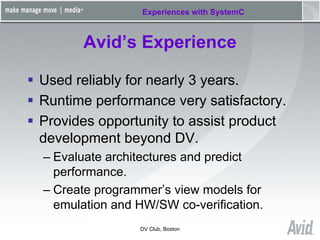
      Avid’s Experience

Used reliably for nearly 3 years.
Runtime performance very satisfactory.
Provides opportunity to assist product
development beyond DV.
– Evaluate architectures and predict
  performance.
– Create programmer’s view models for
  emulation and HW/SW co-verification.
                DV Club, Boston

Tierney bq207

  • 1.
    Experiences with SystemC DesignVerification Using SystemC Greg Tierney Presented to DV Club, Boston March 5, 2007 DV Club, Boston
  • 2.
    Experiences with SystemC About Avid Invented digital video editing Headquartered in Tewksbury – http://www.avid.com/company/ Products – Film/Video Editing and Finishing – Audio – Broadcast – Animation – Storage & Workgroups – Digital Asset and Production Management Services – Support – Training – Consulting DV Club, Boston
  • 3.
    Experiences with SystemC Agenda What is SystemC? Why did Avid choose to use SystemC? DV problems solved by SystemC. Summary DV Club, Boston
  • 4.
    Experiences with SystemC What is SystemC? Provides hardware constructs and a simulation kernel for C++ It is a class library – And it is a language standard (IEEE 1666TM 2005) It has utilities and constructs – Data types, ports, channels, processes Adopted by different disciplines – Architectural Modeling (SoC, performance) – DV (RTL simulation, HW/SW co-verification) – Synthesis It is open source (OSCI) – http://www.systemc.org DV Club, Boston
  • 5.
    Experiences with SystemC Why Avid Chose SystemC Enhanced existing C++ DV code – Replaced an unreliable in-house framework • Signal encapsulation • Thread management • Random seed management – Smooth transition from C++ to SystemC Tool availability – Single kernel multi-language simulator Industry acceptance Low cost Came with built-in verification capabilities DV Club, Boston
  • 6.
    Experiences with SystemC Agenda What is SystemC? Why did Avid choose to use SystemC? DV problems solved by SystemC. Summary DV Club, Boston
  • 7.
    Experiences with SystemC CrossingLanguage Boundaries Connect an entire HDL module to the testbench. – Wrap the module with a SystemC class (sc_foreign_module). – Provide a string mapping for each port. Connect a foreign signal anywhere in the hierarchy. – Bind a sc_signal (observe_foreign_signal). – Provide a string of hierarchical path to wire or reg. DV Club, Boston
  • 8.
    Experiences with SystemC Code Examples class MyDUT : public sc_foreign_module { SC_MODULE(MyVTB) public: { sc_in<sc_logic> reset; public: sc_in<sc_logic> clock; sc_out<sc_lv<16> > AD; SC_CTOR(MyVTB) : MyDUTInst(“MyDUTInst”, “MyDUT”), MyDUT(sc_module_nam nm, const char* hdl_name) MyMonitorInst(“MyMonitorInst”, : sc_foreign_module(nm, hdl_name), “MyVTB.MyDUTInst.FooInst”) reset(“reset”), { clock(“clock”), AD(“AD”){} MyDUTInst.reset(tb_reset); }; MyDUTInst.clock(tb_clock); MyDUTInst.AD(tb_AD); class MyMonitor : public sc_module { } public: private: MyMonitor(sc_module_name, MyDUT MyDUTInst; const string& path2DUT){ MyMonitor MyMonitorInst; string path2sig = path2DUT + “.snoop”; snoopSig_.observe_foreign_signal(path2sig); sc_signal<sc_logic> tb_reset; SC_THREAD(threadT); sc_signal<sc_logic> tb_clock; sensitive << sc_signal<sc_lv<16> > tb_AD; snoopSig_.value_changed_event(); }; } private: sc_signal<sc_logic> snoopSig_; void threadT(); }; DV Club, Boston
  • 9.
    Experiences with SystemC Issues with Binding No clear standard for language boundary resolution. – Each vendor has its own implementation. – Implementation we use doesn’t map arrays or records (yet). Supporting foreign interface requires two pass compilation. – First pass creates object files. – Second pass builds a symbol library used in design elaboration. DV Club, Boston
  • 10.
    Experiences with SystemC SystemCConnections p start() p start() Call a public method Connect sc_port to a via pointer to object sc_export outp write() read() inp Connect sc_port to a channel DV Club, Boston
  • 11.
    Experiences with SystemC Code Examples struct start_stop_if : public sc_interface SC_MODULE(MyTest){ { public: virtual void start()=0; sc_port<start_stop_if> bfm_port; virtual void stop()=0; }; }; SC_MODULE(vtb){ public: class MyBFM : SC_CTOR(vtb); public sc_module, private: public virtual start_stop_if sc_signal<sc_logic> Clock; { sc_signal<sc_logic> Request; public: sc_signal<sc_lv<16> > AD; sc_in<sc_logic> Clock; tlm::tlm_fifo<MyX> MyXReceiveChan; sc_out<sc_logic> Request; MyTest MyTestInst; sc_in<sc_lv<16> > AD; MyBFM MyBFMInst; tlm::tlm_put_port<MyX> MyXReceivePort; }; sc_export<start_stop_if> StartStopExport; vtb:vtb(sc_module_name) : void start(); MyBFMInst(“MyBFMInst”), MyTestInst(“MyTestInst”) void stop(); { MyBFMInst.Clock(Clock); SC_CTOR(MyBFM){ MyBFMInst.Request(Request); StartStopExport(*this); MyBFMInst.AD(AD); } MyBFMInst.MyXReceivePort(MyXReceiveChan); }; MyTestInst.bfm_port(MyBFMInst.StartStopExport); } DV Club, Boston
  • 12.
    Experiences with SystemC Issues with Connections Construction and binding are separate steps. – Ports must be public. – Ports bound after modules and channels are constructed. Binding uses “strict type checking”. – Compilation will fail if type mismatch in the connection. – Splitting a vector across multiple ports is complicated. Binding errors detected at elaboration. – Simulation should abort at runtime if a port is not bound. – Need to assign attributes to port (e.g. # of connections). DV Club, Boston
  • 13.
    Experiences with SystemC Randomization Separate library dedicated to verification constructs (SCV). Robust, rich feature set for randomization. – Simple constraints (ranges and lists). – Complex constraint solver. – Thread-safe seeding. – Extendible to custom object types. DV Club, Boston
  • 14.
    Experiences with SystemC Randomization at Avid SCV more than we needed. – So, we use a subset of the features. Provide a Tcl interface to apply constraints. – Wrap scv_smart_ptr. – Define string representations for simple constraints. – Recompilation not required to change constraints. – Reapply constraints over course of simulation. DV Club, Boston
  • 15.
    Experiences with SystemC Processes Hardware is inherently parallel. DV must be multi-threaded. SystemC solves this with processes. – Macros: SC_THREAD and SC_METHOD. – Events, mutexes, semaphores. – Dynamic processes (sc_spawn). DV Club, Boston
  • 16.
    Experiences with SystemC Hierarchy SystemC defines an object hierarchy. – Relates objects (parent/child). – Familiar to HDL design. Avid DV defines a layer hierarchy. – Relates connections. – Familiar to communication stacks. Issue: SystemC is not a methodology. DV Club, Boston
  • 17.
    Experiences with SystemC ExampleHierarchy VTOP VTEST Test Translator Reference Model Scoreboard VTB TLM Agent STIMGEN Analysis Agent Analysis Agent Commander_BFM TX_BFM Snooper_BFM RX_BFM Driver Monitor Driver Monitor Monitor Monitor DUT DV Club, Boston
  • 18.
    Experiences with SystemC Agenda What is SystemC? Why did Avid choose to use SystemC? DV problems solved by SystemC. Summary DV Club, Boston
  • 19.
    Experiences with SystemC Additional Issues Compile and link performance is disappointing. – Overuse of C++ templates in library. – Partially attributed to vendor implementation. Libraries are huge. Being a language standard has tool implications. C++ learning curve. – C++ code debug very different than HDL. • Segmentation faults, stack traces, code stepping Think like a HW engineer, code like a SW engineer. DV Club, Boston
  • 20.
    Experiences with SystemC Avid’s Experience Used reliably for nearly 3 years. Runtime performance very satisfactory. Provides opportunity to assist product development beyond DV. – Evaluate architectures and predict performance. – Create programmer’s view models for emulation and HW/SW co-verification. DV Club, Boston