Chapter 5 
Queue
Queue 
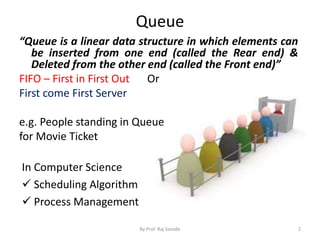
“Queue is a linear data structure in which elements can 
be inserted from one end (called the Rear end) & 
Deleted from the other end (called the Front end)” 
FIFO – First in First Out Or 
First come First Server 
e.g. People standing in Queue 
for Movie Ticket 
By Prof. Raj Sarode 2 
In Computer Science 
 Scheduling Algorithm 
 Process Management
Implementation or Representation of Queue 
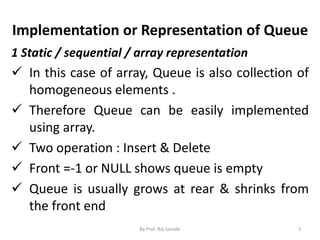
1 Static / sequential / array representation 
 In this case of array, Queue is also collection of 
homogeneous elements . 
 Therefore Queue can be easily implemented 
using array. 
 Two operation : Insert & Delete 
 Front =-1 or NULL shows queue is empty 
 Queue is usually grows at rear & shrinks from 
the front end 
By Prof. Raj Sarode 3
Front=1 
Front=2 
Front=3 
By Prof. Raj Sarode 4 
Front=-1 
0 1 2 3 4 
Rear=-1 
Front=0 
A 
0 1 2 3 4 
Rear=0 
1 
2 
Insert A 
Front=0 
A B 
0 1 2 3 4 
Rear=1 
3 
Insert B 
Front=0 
A B C 
0 1 2 3 4 
Rear=2 
4 
Insert C 
B C 
0 1 2 3 4 
Rear=2 
5 
Delete 
C 
0 1 2 3 4 
Rear=2 
6 
Delete 
0 1 2 3 4 
Rear=2 
7 
Delete 
Queue is empty 
Queue is empty 
Entry point is called Rear & 
Exit point is called Front
2 Dynamic / pointer/ linked Representation 
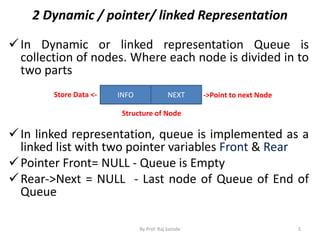
 In Dynamic or linked representation Queue is 
collection of nodes. Where each node is divided in to 
two parts 
INFO NEXT 
 In linked representation, queue is implemented as a 
linked list with two pointer variables Front & Rear 
Pointer Front= NULL - Queue is Empty 
Rear->Next = NULL - Last node of Queue of End of 
Queue 
By Prof. Raj Sarode 5 
Store Data <- 
Structure of Node 
->Point to next Node
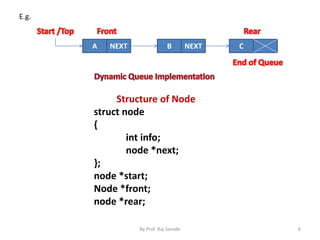
A NEXT B NEXT C 
E.g. 
Structure of Node 
struct node 
{ 
int info; 
node *next; 
}; 
node *start; 
Node *front; 
node *rear; 
By Prof. Raj Sarode 6
Queue Operation 
1. Insert in the Queue ( Enqueue ) 
Enqueue ; inserts an element at the rear of 
the queue 
2. Delete from Queue ( Dequeue ) 
Dequeue ; deletes an element at the front of 
the queue. 
By Prof. Raj Sarode 7
Algorithm 1 
Q insert (Queue, MAX, FRONT, REAR, Element) 
1. Check for Overflow 
a. If REAR=MAX-1 
or 
FRONT = REAR+1 then 
b. Print “overflow” & return 
2. If FRONT =-1 then 
Set FRONT=REAR=0 
else if REAR=MAX then 
Set REAR=FRONT=0 
else Set REAR=REAR+1 //Increment Rear by 1 
End if 
End if 
3. QUEUE [REAR] = Element //Insert the Element at New Location 
4. Return. 
By Prof. Raj Sarode 8
Algorithm 2 
Q delete (Queue, MAX, FRONT, REAR, Element) 
1. Check for Underflow 
a. If FRONT=-1 then 
b. Print “underflow” & return 
Else 
2. Element= Queue[FRONT] //delete element from queue 
3. If FRONT=REAR then 
Set FRONT=REAR=-1 
Else 
FRONT=FRONT+1 //Increment the Front by one 
End if 
4. Return 
By Prof. Raj Sarode 9
Types Of Queue 
1. Circular Queue 
2. Deque (Double Ended Queue) 
3. Priority Queue 
By Prof. Raj Sarode 10
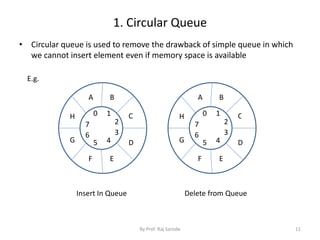
1. Circular Queue 
• Circular queue is used to remove the drawback of simple queue in which 
we cannot insert element even if memory space is available 
I J 
7 7 
3 
By Prof. Raj Sarode 11 
3 
H 
B 
C 
D 
F E 
G 
A 
E.g. 
0 1 
2 
3 
5 4 
6 
H 
B 
C 
D 
F E 
G 
A 
0 1 
2 
3 
5 4 
6 
K 
Insert In Queue Delete from Queue
2. Deque (Double Ended Queue) 
• Deque is double ended queue in which insertion and deletion 
can be performed from both ends, Rear and Front 
• It follows same strategy as simple queue . 
A B C D E 
0 1 2 3 4 5 6 7 8 
EA FB C D E 
0 1 2 3 4 5 6 7 8 
By Prof. Raj Sarode 12
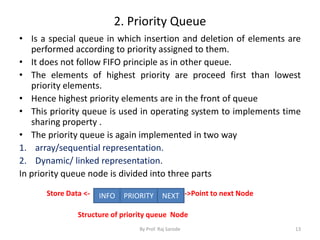
2. Priority Queue 
• Is a special queue in which insertion and deletion of elements are 
performed according to priority assigned to them. 
• It does not follow FIFO principle as in other queue. 
• The elements of highest priority are proceed first than lowest 
priority elements. 
• Hence highest priority elements are in the front of queue 
• This priority queue is used in operating system to implements time 
sharing property . 
• The priority queue is again implemented in two way 
1. array/sequential representation. 
2. Dynamic/ linked representation. 
In priority queue node is divided into three parts 
Store Data <- INFO PRIORITY 
NEXT ->Point to next Node 
Structure of priority queue Node 
By Prof. Raj Sarode 13
Thank You 
By Prof. Raj Sarode 14

Queue

  • 1.
  • 2.
    Queue “Queue isa linear data structure in which elements can be inserted from one end (called the Rear end) & Deleted from the other end (called the Front end)” FIFO – First in First Out Or First come First Server e.g. People standing in Queue for Movie Ticket By Prof. Raj Sarode 2 In Computer Science  Scheduling Algorithm  Process Management
  • 3.
    Implementation or Representationof Queue 1 Static / sequential / array representation  In this case of array, Queue is also collection of homogeneous elements .  Therefore Queue can be easily implemented using array.  Two operation : Insert & Delete  Front =-1 or NULL shows queue is empty  Queue is usually grows at rear & shrinks from the front end By Prof. Raj Sarode 3
  • 4.
    Front=1 Front=2 Front=3 By Prof. Raj Sarode 4 Front=-1 0 1 2 3 4 Rear=-1 Front=0 A 0 1 2 3 4 Rear=0 1 2 Insert A Front=0 A B 0 1 2 3 4 Rear=1 3 Insert B Front=0 A B C 0 1 2 3 4 Rear=2 4 Insert C B C 0 1 2 3 4 Rear=2 5 Delete C 0 1 2 3 4 Rear=2 6 Delete 0 1 2 3 4 Rear=2 7 Delete Queue is empty Queue is empty Entry point is called Rear & Exit point is called Front
  • 5.
    2 Dynamic /pointer/ linked Representation  In Dynamic or linked representation Queue is collection of nodes. Where each node is divided in to two parts INFO NEXT  In linked representation, queue is implemented as a linked list with two pointer variables Front & Rear Pointer Front= NULL - Queue is Empty Rear->Next = NULL - Last node of Queue of End of Queue By Prof. Raj Sarode 5 Store Data <- Structure of Node ->Point to next Node
  • 6.
    A NEXT BNEXT C E.g. Structure of Node struct node { int info; node *next; }; node *start; Node *front; node *rear; By Prof. Raj Sarode 6
  • 7.
    Queue Operation 1.Insert in the Queue ( Enqueue ) Enqueue ; inserts an element at the rear of the queue 2. Delete from Queue ( Dequeue ) Dequeue ; deletes an element at the front of the queue. By Prof. Raj Sarode 7
  • 8.
    Algorithm 1 Qinsert (Queue, MAX, FRONT, REAR, Element) 1. Check for Overflow a. If REAR=MAX-1 or FRONT = REAR+1 then b. Print “overflow” & return 2. If FRONT =-1 then Set FRONT=REAR=0 else if REAR=MAX then Set REAR=FRONT=0 else Set REAR=REAR+1 //Increment Rear by 1 End if End if 3. QUEUE [REAR] = Element //Insert the Element at New Location 4. Return. By Prof. Raj Sarode 8
  • 9.
    Algorithm 2 Qdelete (Queue, MAX, FRONT, REAR, Element) 1. Check for Underflow a. If FRONT=-1 then b. Print “underflow” & return Else 2. Element= Queue[FRONT] //delete element from queue 3. If FRONT=REAR then Set FRONT=REAR=-1 Else FRONT=FRONT+1 //Increment the Front by one End if 4. Return By Prof. Raj Sarode 9
  • 10.
    Types Of Queue 1. Circular Queue 2. Deque (Double Ended Queue) 3. Priority Queue By Prof. Raj Sarode 10
  • 11.
    1. Circular Queue • Circular queue is used to remove the drawback of simple queue in which we cannot insert element even if memory space is available I J 7 7 3 By Prof. Raj Sarode 11 3 H B C D F E G A E.g. 0 1 2 3 5 4 6 H B C D F E G A 0 1 2 3 5 4 6 K Insert In Queue Delete from Queue
  • 12.
    2. Deque (DoubleEnded Queue) • Deque is double ended queue in which insertion and deletion can be performed from both ends, Rear and Front • It follows same strategy as simple queue . A B C D E 0 1 2 3 4 5 6 7 8 EA FB C D E 0 1 2 3 4 5 6 7 8 By Prof. Raj Sarode 12
  • 13.
    2. Priority Queue • Is a special queue in which insertion and deletion of elements are performed according to priority assigned to them. • It does not follow FIFO principle as in other queue. • The elements of highest priority are proceed first than lowest priority elements. • Hence highest priority elements are in the front of queue • This priority queue is used in operating system to implements time sharing property . • The priority queue is again implemented in two way 1. array/sequential representation. 2. Dynamic/ linked representation. In priority queue node is divided into three parts Store Data <- INFO PRIORITY NEXT ->Point to next Node Structure of priority queue Node By Prof. Raj Sarode 13
  • 14.
    Thank You ByProf. Raj Sarode 14