by:
Hussain Al-ghawi
syntax
*what is syntax
Definition : syntax is the arrangement of words in sentences, clauses,
and phrases, and the study of the formation of sentences and the
relationship of their component parts, So let’s investigate what
sentences are made up of in order to understand the structure
Phrases – Modifiers - Noun Phrase
Constituents - Verb Phrases
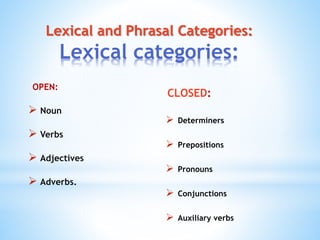
Lexical and Phrasal Categories:
Lexical categories:
OPEN:
 Noun
 Verbs
 Adjectives
 Adverbs.
CLOSED:
 Determiners
 Prepositions
 Pronouns
 Conjunctions
 Auxiliary verbs
Lexical Open Categories:
Noun is a part of speech that refers to person, place, thing,
animal and idea.
 can be categorized:
 Countable and uncountable nouns:
UN soup C sandwich
 Proper and common nouns:
Proper: America, Cape Girardeau.
Common: computer, desk.
 Abstract and concrete nouns:
Abstract: freedom, peace, brain, and job
Concrete: pen, chair, menu.
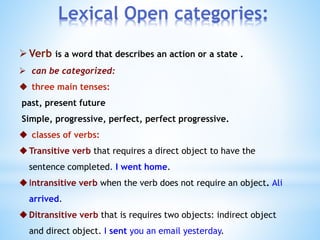
Lexical Open categories:
Verb is a word that describes an action or a state .
 can be categorized:
 three main tenses:
past, present future
Simple, progressive, perfect, perfect progressive.
 classes of verbs:
Transitive verb that requires a direct object to have the
sentence completed. I went home.
Intransitive verb when the verb does not require an object. Ali
arrived.
Ditransitive verb that is requires two objects: indirect object
and direct object. I sent you an email yesterday.
Lexical Open Categories:
Intensive verb: relates back to the subject for describing its
state.
He is my subject. The verb be is describing the subject H.
Complex transitive verb is related to the object not the
subject.
I thought you a teacher.
prepositional verb is when a verb requires a propositional
phrase to be completed.
I talked about my subject in my first presentation.
Verb talk is followed by prepositions such as to and
Lexical Open categories:
 Adjectives are something called describing words and
commonly occur with nouns.
 Adjectives can describe places, people and things.
 We can divide adjectives in to five types based on their
forms.
 regular adjectives and there are two kind of these
adjectives, short syllable such as short, big, and fast. And
long syllable such as expensive and beautiful.
 Adjectives compound two words together. part-time
 Adjectives end with ing and describe the subject. confusing.
 Adjectives end with (ed/ied) and they describe objects. Confused
. Also we can categorize adjectives based on our sence.
 touch such as rough and soft.
 sound such as melodious and thundering.
 taste such as fresh and spicy.
 size such as huge and massive.
 shape such as deep and flat.
 quantity such as abundant and empty.
 time such as ancient and modern
Lexical Open Categories:
Lexical categories:
Adverb is to describe verbs and to add information in relation to
circumstances of manner, time, place, and quantity..
We have several types of adverbs.
Adverb of time, (I called my mother yesterday).
Adverb of place, (I want to sit here).
Adverb of manner, (he explained clearly).
Adverb of degree or quantity,
the mall is too far from the campus. Adverbs can appear in several
positions.
• In the beginning of the sentence. unfortunately, he missed the party.
• In the middle of the sentence, which comes after the noun and before the
main verb. For example, I barely understood what the African American
said.
• At the end of the sentence, the company wants to be known widely.
Lexical closed categories:
Determiners are the closed lexical phrase categories used to identify
some words..
There are different types of determiners:
 Definite (a/an)
 Indefinite articles (the).
 Demonstratives are such as, this, that, these, and those.
 Quantifiers such as some, any, each, every, etc.
 Possessives such as, my, his, her, and your.
 Wh-determiners, such as whose, what, and which.
Lexical closed categories:
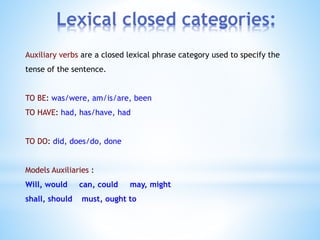
Auxiliary verbs are a closed lexical phrase category used to specify the
tense of the sentence.
TO BE: was/were, am/is/are, been
TO HAVE: had, has/have, had
TO DO: did, does/do, done
Models Auxiliaries :
Will, would can, could may, might
shall, should must, ought to
Lexical closed categories:
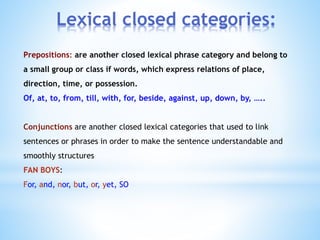
Prepositions: are another closed lexical phrase category and belong to
a small group or class if words, which express relations of place,
direction, time, or possession.
Of, at, to, from, till, with, for, beside, against, up, down, by, …..
Conjunctions are another closed lexical categories that used to link
sentences or phrases in order to make the sentence understandable and
smoothly structures
FAN BOYS:
For, and, nor, but, or, yet, SO
Lexical closed categories:
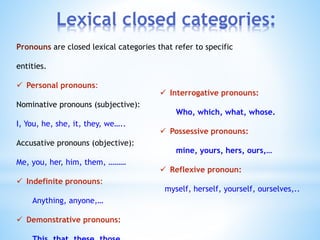
Pronouns are closed lexical categories that refer to specific
entities.
 Personal pronouns:
Nominative pronouns (subjective):
I, You, he, she, it, they, we…..
Accusative pronouns (objective):
Me, you, her, him, them, ………
 Indefinite pronouns:
Anything, anyone,…
 Demonstrative pronouns:
 Interrogative pronouns:
Who, which, what, whose.
 Possessive pronouns:
mine, yours, hers, ours,…
 Reflexive pronoun:
myself, herself, yourself, ourselves,..
Phrasal Categories:
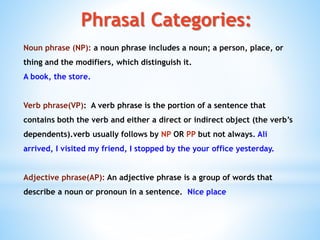
Noun phrase (NP): a noun phrase includes a noun; a person, place, or
thing and the modifiers, which distinguish it.
A book, the store.
Verb phrase(VP): A verb phrase is the portion of a sentence that
contains both the verb and either a direct or indirect object (the verb’s
dependents).verb usually follows by NP OR PP but not always. Ali
arrived, I visited my friend, I stopped by the your office yesterday.
Adjective phrase(AP): An adjective phrase is a group of words that
describe a noun or pronoun in a sentence. Nice place
Phrasal Categories:
Adverbial phrase(ADV P): An adverb phrase is simply two or more words
that act as an adverb. It can modify a verb, adverb, or adjective and can
tell “how”, “where”, “why”, or “when.”
Prepositional phrase(PP): A prepositional phrase will begin with a
preposition and end with a noun, pronoun, gerund, or clause, the "object"
of the preposition
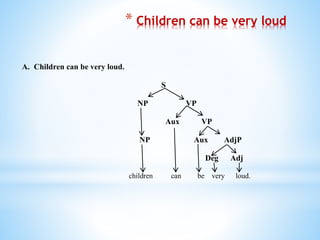
* Children can be very loud
A. Children can be very loud.
S
NP VP
Aux VP
NP Aux AdjP
Deg Adj
children can be very loud.
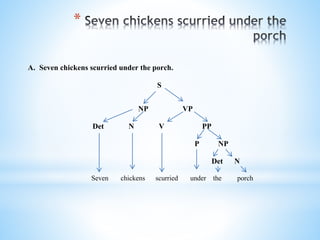
*
A. Seven chickens scurried under the porch.
S
NP VP
Det N V PP
P NP
Det N
Seven chickens scurried under the porch
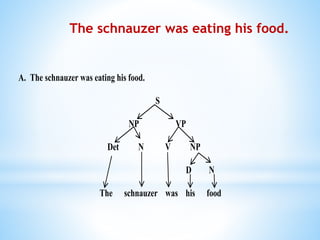
A. The schnauzer was eating his food.
S
NP VP
Det N V NP
D N
The schnauzer was his food
The schnauzer was eating his food.

Syntax

  • 1.
  • 2.
    *what is syntax Definition: syntax is the arrangement of words in sentences, clauses, and phrases, and the study of the formation of sentences and the relationship of their component parts, So let’s investigate what sentences are made up of in order to understand the structure Phrases – Modifiers - Noun Phrase Constituents - Verb Phrases
  • 3.
    Lexical and PhrasalCategories: Lexical categories: OPEN:  Noun  Verbs  Adjectives  Adverbs. CLOSED:  Determiners  Prepositions  Pronouns  Conjunctions  Auxiliary verbs
  • 4.
    Lexical Open Categories: Nounis a part of speech that refers to person, place, thing, animal and idea.  can be categorized:  Countable and uncountable nouns: UN soup C sandwich  Proper and common nouns: Proper: America, Cape Girardeau. Common: computer, desk.  Abstract and concrete nouns: Abstract: freedom, peace, brain, and job Concrete: pen, chair, menu.
  • 5.
    Lexical Open categories: Verbis a word that describes an action or a state .  can be categorized:  three main tenses: past, present future Simple, progressive, perfect, perfect progressive.  classes of verbs: Transitive verb that requires a direct object to have the sentence completed. I went home. Intransitive verb when the verb does not require an object. Ali arrived. Ditransitive verb that is requires two objects: indirect object and direct object. I sent you an email yesterday.
  • 6.
    Lexical Open Categories: Intensiveverb: relates back to the subject for describing its state. He is my subject. The verb be is describing the subject H. Complex transitive verb is related to the object not the subject. I thought you a teacher. prepositional verb is when a verb requires a propositional phrase to be completed. I talked about my subject in my first presentation. Verb talk is followed by prepositions such as to and
  • 7.
    Lexical Open categories: Adjectives are something called describing words and commonly occur with nouns.  Adjectives can describe places, people and things.  We can divide adjectives in to five types based on their forms.  regular adjectives and there are two kind of these adjectives, short syllable such as short, big, and fast. And long syllable such as expensive and beautiful.
  • 8.
     Adjectives compoundtwo words together. part-time  Adjectives end with ing and describe the subject. confusing.  Adjectives end with (ed/ied) and they describe objects. Confused . Also we can categorize adjectives based on our sence.  touch such as rough and soft.  sound such as melodious and thundering.  taste such as fresh and spicy.  size such as huge and massive.  shape such as deep and flat.  quantity such as abundant and empty.  time such as ancient and modern Lexical Open Categories:
  • 9.
    Lexical categories: Adverb isto describe verbs and to add information in relation to circumstances of manner, time, place, and quantity.. We have several types of adverbs. Adverb of time, (I called my mother yesterday). Adverb of place, (I want to sit here). Adverb of manner, (he explained clearly). Adverb of degree or quantity, the mall is too far from the campus. Adverbs can appear in several positions. • In the beginning of the sentence. unfortunately, he missed the party. • In the middle of the sentence, which comes after the noun and before the main verb. For example, I barely understood what the African American said. • At the end of the sentence, the company wants to be known widely.
  • 10.
    Lexical closed categories: Determinersare the closed lexical phrase categories used to identify some words.. There are different types of determiners:  Definite (a/an)  Indefinite articles (the).  Demonstratives are such as, this, that, these, and those.  Quantifiers such as some, any, each, every, etc.  Possessives such as, my, his, her, and your.  Wh-determiners, such as whose, what, and which.
  • 11.
    Lexical closed categories: Auxiliaryverbs are a closed lexical phrase category used to specify the tense of the sentence. TO BE: was/were, am/is/are, been TO HAVE: had, has/have, had TO DO: did, does/do, done Models Auxiliaries : Will, would can, could may, might shall, should must, ought to
  • 12.
    Lexical closed categories: Prepositions:are another closed lexical phrase category and belong to a small group or class if words, which express relations of place, direction, time, or possession. Of, at, to, from, till, with, for, beside, against, up, down, by, ….. Conjunctions are another closed lexical categories that used to link sentences or phrases in order to make the sentence understandable and smoothly structures FAN BOYS: For, and, nor, but, or, yet, SO
  • 13.
    Lexical closed categories: Pronounsare closed lexical categories that refer to specific entities.  Personal pronouns: Nominative pronouns (subjective): I, You, he, she, it, they, we….. Accusative pronouns (objective): Me, you, her, him, them, ………  Indefinite pronouns: Anything, anyone,…  Demonstrative pronouns:  Interrogative pronouns: Who, which, what, whose.  Possessive pronouns: mine, yours, hers, ours,…  Reflexive pronoun: myself, herself, yourself, ourselves,..
  • 14.
    Phrasal Categories: Noun phrase(NP): a noun phrase includes a noun; a person, place, or thing and the modifiers, which distinguish it. A book, the store. Verb phrase(VP): A verb phrase is the portion of a sentence that contains both the verb and either a direct or indirect object (the verb’s dependents).verb usually follows by NP OR PP but not always. Ali arrived, I visited my friend, I stopped by the your office yesterday. Adjective phrase(AP): An adjective phrase is a group of words that describe a noun or pronoun in a sentence. Nice place
  • 15.
    Phrasal Categories: Adverbial phrase(ADVP): An adverb phrase is simply two or more words that act as an adverb. It can modify a verb, adverb, or adjective and can tell “how”, “where”, “why”, or “when.” Prepositional phrase(PP): A prepositional phrase will begin with a preposition and end with a noun, pronoun, gerund, or clause, the "object" of the preposition
  • 16.
    * Children canbe very loud A. Children can be very loud. S NP VP Aux VP NP Aux AdjP Deg Adj children can be very loud.
  • 17.
    * A. Seven chickensscurried under the porch. S NP VP Det N V PP P NP Det N Seven chickens scurried under the porch
  • 18.
    A. The schnauzerwas eating his food. S NP VP Det N V NP D N The schnauzer was his food The schnauzer was eating his food.