GROUP 3
RIFYAL MUKARRAM
CHAERUL FARDA
ISMAIL MARSUKI
JUVRIANTO CJ
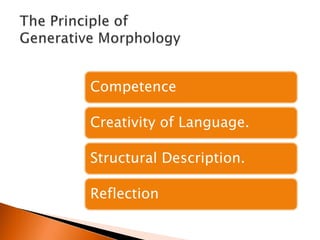
Competence
Creativity of Language.
Structural Description.
Reflection
 Competence and Performance
Competence is the idealized conception of language,
considered as opposite of performance that is special
utterances of spoken language
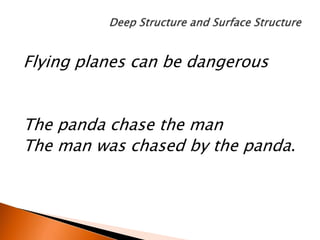
 Deep Structure and Surface Structure
Deep structure is an abstract syntactical representation of a
sentence. On the other hand, the surface structure of a
sentence is the final stage in the syntactical representation of
a sentence
Flying planes can be dangerous
The panda chase the man
The man was chased by the panda.
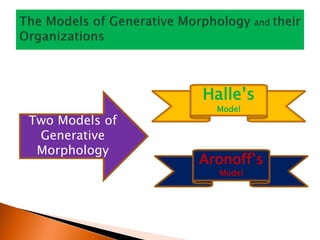
Two Models of
Generative
Morphology
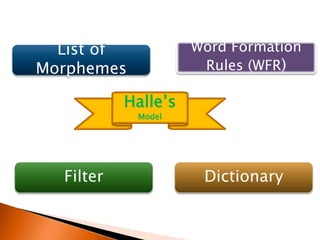
Halle’s
Model
Aronoff’s
Model
Halle’s
Model
Word Formation
Rules (WFR)
List of
Morphemes
DictionaryFilter
Word Formation Rules
(WFR)
Apply to Stems
and Form the
Linear Sequences
( STEM + one or
more morpheme)
Examples :
[STEM + some] Adj
hand + some
[STEM+ther] N
Fa+ther
[be+STEM]
Be+lieve
Word Formation
Rules Which
Apply to Words
Examples :
[VERB + er] N
Teach + er
[NOUN+ish] adj
Child + ish
[ADJECTIVE+en]v
Dark + en
WFR Specify Sequences in which morphemes
must be arranged to form words of a language
{ Allow Grammatical Sequences Un+drink+able}
{Exclude the Ungrammatical sequence
drink+un+able}
WFR Specify
a. The Syntactic category of the base { Noun , Verb}
b. The Syntactic Category of the output { Noun, Verb}
c. The internal boundary in the output “+”
d. Reguler semantic information
Examples [un + VERB + able]adj
Un+drink+able
WFR Specify the semantic and syntactic features of
the derived words that are not in accord with the
features of the base.WFR operate in the same ways as
derivational morphology and inflectional
morphology.
WFR are more powerful than
phonological rules.
Scalise (1984:34) states that the
researches carried out later shows a
number of problems concerning
generative morphology of Halle’s
model. The problems are related to
every subcomponent of this model,
namely the List of Morphemes, Word
Formation Rules, Filter, and Dictionary.
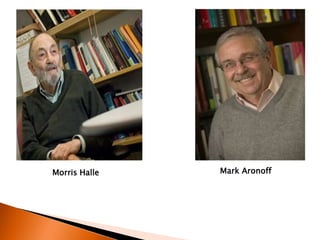
Morris Halle Mark Aronoff
The List of Morphemes
In relation to this subcomponent, there are
two kinds of problem namely, the general
problem and specific problem. The general
problem that the basic units of the system
are morphemes, a choice oriented to
“English”, because in English, words and
morphemes are nearly always the same.
Word Formation Rules
A general observation
that can be made in respect to
the Word Formation Rules of
Halle’s model is they are
unrestricted. As stated before,
the Word Formation Rules of
Halle’s model have access to the
information contained in the
final steps in a derivation. As a
matter of fact, the dictionary
functions as a kind of global
condition to the input and
output of the Word Formation
Rules.
(i) constitutionlism (ii) *dogmatismal
capitalism *fatalismal
The main objection to the filter is that it is not a
restricted mechanism. A set of words that are
possible but non-existent are not restricted in the
sense that there are no principles that restrict the
complexity level of derived words and compound
words. As an example, a very complex compound
word in English is given below :
Junior high school teachers association
curriculum planning committee.
The dictionary and the List of
Morphemes introduce redundancy
into the system. Word-based
morphology does not require two
different levels of representation.
1. Dictionary
2. Word Formation Rules
3. Readjustment Rules
Each of these components elaborated into
hypothesis:
1). Word-Based Hypothesis
All word formation processes are based
on words. A new word is formed by
applying a regular rule to an existing
word. Both the new word and the
existing word are the members of the
major lexical categories (Aronoff 1976:22)
 A. The bases of the Words Formation Rules
are words;
 B. These words are the existing words. Thus,
possible but non-existent words cannot
be the bases of the Word Formation Rules;
 C. The Word Formation Rules can take single
words as bases, not more (e.g. Phrases)
and not less (e.g. Bound forms);
 D. The input and output of the Word
Formation Rules must be the members of the
members of the major lexical categories
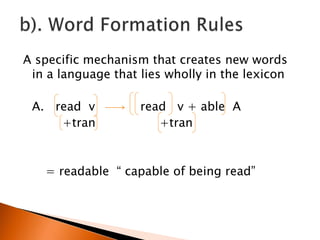
A specific mechanism that creates new words
in a language that lies wholly in the lexicon
A. read v read v + able A
+tran +tran
= readable “ capable of being read”
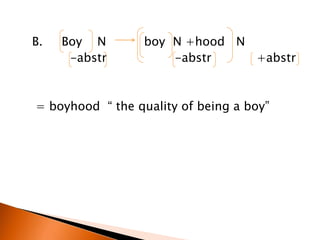
B. Boy N boy N +hood N
-abstr -abstr +abstr
= boyhood “ the quality of being a boy”
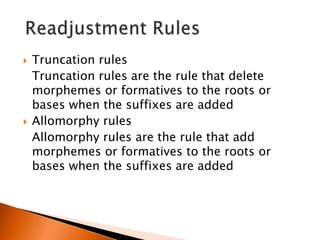
 Truncation rules
Truncation rules are the rule that delete
morphemes or formatives to the roots or
bases when the suffixes are added
 Allomorphy rules
Allomorphy rules are the rule that add
morphemes or formatives to the roots or
bases when the suffixes are added

MORPHOSYNTAX: GENERATIVE MORPHOLOGY

  • 1.
    GROUP 3 RIFYAL MUKARRAM CHAERULFARDA ISMAIL MARSUKI JUVRIANTO CJ
  • 2.
  • 3.
     Competence andPerformance Competence is the idealized conception of language, considered as opposite of performance that is special utterances of spoken language  Deep Structure and Surface Structure Deep structure is an abstract syntactical representation of a sentence. On the other hand, the surface structure of a sentence is the final stage in the syntactical representation of a sentence
  • 4.
    Flying planes canbe dangerous The panda chase the man The man was chased by the panda.
  • 5.
  • 6.
  • 7.
    Word Formation Rules (WFR) Applyto Stems and Form the Linear Sequences ( STEM + one or more morpheme) Examples : [STEM + some] Adj hand + some [STEM+ther] N Fa+ther [be+STEM] Be+lieve Word Formation Rules Which Apply to Words Examples : [VERB + er] N Teach + er [NOUN+ish] adj Child + ish [ADJECTIVE+en]v Dark + en
  • 8.
    WFR Specify Sequencesin which morphemes must be arranged to form words of a language { Allow Grammatical Sequences Un+drink+able} {Exclude the Ungrammatical sequence drink+un+able} WFR Specify a. The Syntactic category of the base { Noun , Verb} b. The Syntactic Category of the output { Noun, Verb} c. The internal boundary in the output “+” d. Reguler semantic information Examples [un + VERB + able]adj Un+drink+able WFR Specify the semantic and syntactic features of the derived words that are not in accord with the features of the base.WFR operate in the same ways as derivational morphology and inflectional morphology. WFR are more powerful than phonological rules.
  • 10.
    Scalise (1984:34) statesthat the researches carried out later shows a number of problems concerning generative morphology of Halle’s model. The problems are related to every subcomponent of this model, namely the List of Morphemes, Word Formation Rules, Filter, and Dictionary.
  • 11.
  • 12.
    The List ofMorphemes In relation to this subcomponent, there are two kinds of problem namely, the general problem and specific problem. The general problem that the basic units of the system are morphemes, a choice oriented to “English”, because in English, words and morphemes are nearly always the same.
  • 13.
    Word Formation Rules Ageneral observation that can be made in respect to the Word Formation Rules of Halle’s model is they are unrestricted. As stated before, the Word Formation Rules of Halle’s model have access to the information contained in the final steps in a derivation. As a matter of fact, the dictionary functions as a kind of global condition to the input and output of the Word Formation Rules. (i) constitutionlism (ii) *dogmatismal capitalism *fatalismal
  • 14.
    The main objectionto the filter is that it is not a restricted mechanism. A set of words that are possible but non-existent are not restricted in the sense that there are no principles that restrict the complexity level of derived words and compound words. As an example, a very complex compound word in English is given below : Junior high school teachers association curriculum planning committee.
  • 15.
    The dictionary andthe List of Morphemes introduce redundancy into the system. Word-based morphology does not require two different levels of representation.
  • 16.
    1. Dictionary 2. WordFormation Rules 3. Readjustment Rules
  • 17.
    Each of thesecomponents elaborated into hypothesis: 1). Word-Based Hypothesis All word formation processes are based on words. A new word is formed by applying a regular rule to an existing word. Both the new word and the existing word are the members of the major lexical categories (Aronoff 1976:22)
  • 18.
     A. Thebases of the Words Formation Rules are words;  B. These words are the existing words. Thus, possible but non-existent words cannot be the bases of the Word Formation Rules;  C. The Word Formation Rules can take single words as bases, not more (e.g. Phrases) and not less (e.g. Bound forms);  D. The input and output of the Word Formation Rules must be the members of the members of the major lexical categories
  • 19.
    A specific mechanismthat creates new words in a language that lies wholly in the lexicon A. read v read v + able A +tran +tran = readable “ capable of being read”
  • 20.
    B. Boy Nboy N +hood N -abstr -abstr +abstr = boyhood “ the quality of being a boy”
  • 21.
     Truncation rules Truncationrules are the rule that delete morphemes or formatives to the roots or bases when the suffixes are added  Allomorphy rules Allomorphy rules are the rule that add morphemes or formatives to the roots or bases when the suffixes are added