Native-speaker Intuitions about Words

                                                               • We have intuitions about the existence of:
                                                                 – words
          Lexical Categories                                     – syntactic categories: words are not all of the
         (or Parts of Speech)                                      same kind (or category)


                                                           1                                                                   2


  Words and word-level categories
                                                                            Acoustic wave forms
        (lexical categories)

My brother will meet a friend from college
                                                                     Kay saw two pieces.
at the station.

Det N      Aux V     Det N     P
My brother will meet a friend from

N       P Det           N        Adv
                                                                     K..ay....s.......aw...t......wo...p.....ie....c.......e
college at the          station soon.

                                                           3                                                                   4


             Acoustic wave forms                                                    A paradox?

    You wore a lily.
                                                                There is no acoustic evidence for the existence
                                                                 of words as independent units, yet we have
                                                                          intuitions that words exist.


    Y......ou...w..o....re...a.....l..i......l...y......


                                                           5                                                                   6


                                                                                                                                   1
Word-level categories:                                 Word-level categories:
        phonological evidence                                  phonological evidence

(1) a. We need to increase productivity.           (5) a. We want to record this movie.
                                                       b. Do you have my record?
    b. We need an increase in productivity.

                                                   (6) a. We want to reCORD this movie.
(2) a. We need to inCREASE productivity.
                                                       b. Do you have my REcord?
    b. We need an INcrease in productivity.


                                              7                                            8


        Word-level categories:                             Word-level categories:
        morphological evidence                             morphological evidence
Verbs: -ed, -s, -ing                               Adjectives: -er, -est
Base     (Past)      Present   Gerund
walk     walked walks          walking             tall-er, tall-est; short er short est
                                                   tall er tall est; short-er, short-est
talk     talked      talks     talking
show     showed shows          showing             *child-er child-est

child     *childed *childs     *childing
                                              9                                            10


        Word-level categories:                             Word-level categories:
        morphological evidence                             morphological evidence
Adverbs: -ly                                       Nouns: -s (number)

sad-ly, desperate-ly, aggressive-ly
     y     p       y gg           y                • idiot-s
                                                     idiot s

*child-ly, *walk-ly                                *idiotic-s, *small-s, *big-s

                                                   Prepositions: no inflection
                                              11                                           12


                                                                                                2
Categories                           Adverb: property or manner of action
                                                              quickly, intelligently, happily, surely
  - Semantic Definition:
                                                        Preposition: locations, instruments, action
 Noun: person, place, thing, concept
                                                                     modifiers
       Bill, man, Boston, pencil, tranquility
                                                              in (the garden), near (
                                                                  (   g      ),       (Fred), with (a knife)
                                                                                           ),      (       )
 Verb: action, state
        hit, jump, love, appreciate, know

 Adjective: property, attribute
         happy, pretty, big, misdirected
                                                   13                                                          14


        What are these categories?                                 Functional categories

                                                        These categories are usually associated with a
under                   locate                          particular kind of a phrase.

Chicago                 be                              Determiner: (the, a, this, that) requires a noun to
knowledge               exquisite                       form a phrase: the man, a girl

preview                 slowly                          Degree Adverbs: (so, very, more) forms a phrase
                                                        with an adjective or an adverb: very pretty, very
                                                        quickly, so tall, so happily.


                                                   15                                                          16


Conjunction: (and, but, or) form a sentence or a                         Jabberwocky
              phrase from 2 sentences or phrases                                Through the Looking Glass
              of the same type.                                                 by Lewis Carroll

          I studied chemistry and Bill studied                 ‘Twas brillig and the slithy toves
          linguistics.                                         did gyre and gimble in the wabe:
          Mary studied but Bill played hockey.                 All mimsy were the borogroves,
                                                                        y                 g     ,
          You can serve or receive the ball.                   And the mome raths outgrabe.
                                                              “Beware the Jabberwock, my son!
                                                              The jaws that bite, the claws that catch!
                                                              Beware the Jubjub bird, and shun
                                                              The frumious Bandersnatch!”

                                                   17                                                          18


                                                                                                                    3
‘Twas brillig and the slithy toves
                                                                                                         Adj     N
                                                                    did gyre and gimble in the wabe:
                                                                              V              V
                                                                   All mimsy were the borogroves,
“Somehow it seems to fill my head with ideas –                                                           N
 only I don’t exactly know what they are!”
    y               y              y                                And the mome raths outgrabe.
                                                                                          g
                                                                                  Adj or N       N           V
                                      - Alice                       Beware the Jabberwock, my son!
                                                                    The jaws that bite, the claws that catch!
                                                                    Beware the Jubjub bird, and shun
                                                                    The frumious Bandersnatch!
                                                        19                    Adj                    N                       20


          Word-level Categories                                         Word-level Categories
  Syntactic Evidence: Distribution Tests                       Syntactic Evidence: Distribution Tests

 Syntactic Frame                                              Syntactic Frame
    Noun frame:             Det _____                        Verb frame:                 AUX _____________
                 e.g., th problem, a cat, some students
                       the   bl        t        t d t                                    e.g., will want, should go, can fl
                                                                                                ill    t h ld            fly

   The/a/some __ can be a pain in the neck.                    They could __ .

    Some chores can be a pain in the neck.                     They could leave.
    *Some destroy can be a pain in the neck.                   *They could problem. / *They could small.

                                                        21                                                                   22


          Word-level Categories                                         Word-level Categories
  Syntactic Evidence: Distribution Tests                       Syntactic Evidence: Distribution Tests

 Syntactic Frame                                              Syntactic Frame
  Adjective frame 1: Det ___                                  Adverb frame:                  Degree Adv ___
                   e.g., th strange f t a nice d
                         the t      fact,  i day                                      e.g., very quickly, quite generously
                                                                                                   i kl     it          l

 Adjective frame 2: Degree Adv ___                            Adverbial frame: He [VP treats her] ___
                   e.g., very strange, extremely nice
                                                                                      e.g., treats her nicely
    This is very __.
    This is very interesting.                                 Adverbials: adverbs, PPs, etc. e.g., treats her
                                                              with respect.
   *This is very interest.
                                                        23                                                                   24


                                                                                                                                  4
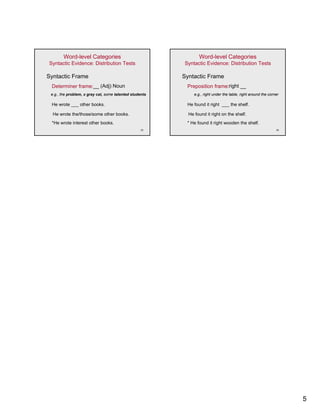
Word-level Categories                                    Word-level Categories
Syntactic Evidence: Distribution Tests                   Syntactic Evidence: Distribution Tests

Syntactic Frame                                          Syntactic Frame
 Determiner frame:__ (Adj) Noun                           Preposition frame:right __
 e.g., the problem, a gray cat, some talented students        e.g., right under the table, right around the corner

 He wrote ___ other books.                                He found it right ___ the shelf.

  He wrote the/those/some other books.                     He found it right on the shelf.
 *He wrote interest other books.                          * He found it right wooden the shelf.
                                                   25                                                           26


                                                                                                                     5

Lexical categories

  • 1.
    Native-speaker Intuitions aboutWords • We have intuitions about the existence of: – words Lexical Categories – syntactic categories: words are not all of the (or Parts of Speech) same kind (or category) 1 2 Words and word-level categories Acoustic wave forms (lexical categories) My brother will meet a friend from college Kay saw two pieces. at the station. Det N Aux V Det N P My brother will meet a friend from N P Det N Adv K..ay....s.......aw...t......wo...p.....ie....c.......e college at the station soon. 3 4 Acoustic wave forms A paradox? You wore a lily. There is no acoustic evidence for the existence of words as independent units, yet we have intuitions that words exist. Y......ou...w..o....re...a.....l..i......l...y...... 5 6 1
  • 2.
    Word-level categories: Word-level categories: phonological evidence phonological evidence (1) a. We need to increase productivity. (5) a. We want to record this movie. b. Do you have my record? b. We need an increase in productivity. (6) a. We want to reCORD this movie. (2) a. We need to inCREASE productivity. b. Do you have my REcord? b. We need an INcrease in productivity. 7 8 Word-level categories: Word-level categories: morphological evidence morphological evidence Verbs: -ed, -s, -ing Adjectives: -er, -est Base (Past) Present Gerund walk walked walks walking tall-er, tall-est; short er short est tall er tall est; short-er, short-est talk talked talks talking show showed shows showing *child-er child-est child *childed *childs *childing 9 10 Word-level categories: Word-level categories: morphological evidence morphological evidence Adverbs: -ly Nouns: -s (number) sad-ly, desperate-ly, aggressive-ly y p y gg y • idiot-s idiot s *child-ly, *walk-ly *idiotic-s, *small-s, *big-s Prepositions: no inflection 11 12 2
  • 3.
    Categories Adverb: property or manner of action quickly, intelligently, happily, surely - Semantic Definition: Preposition: locations, instruments, action Noun: person, place, thing, concept modifiers Bill, man, Boston, pencil, tranquility in (the garden), near ( ( g ), (Fred), with (a knife) ), ( ) Verb: action, state hit, jump, love, appreciate, know Adjective: property, attribute happy, pretty, big, misdirected 13 14 What are these categories? Functional categories These categories are usually associated with a under locate particular kind of a phrase. Chicago be Determiner: (the, a, this, that) requires a noun to knowledge exquisite form a phrase: the man, a girl preview slowly Degree Adverbs: (so, very, more) forms a phrase with an adjective or an adverb: very pretty, very quickly, so tall, so happily. 15 16 Conjunction: (and, but, or) form a sentence or a Jabberwocky phrase from 2 sentences or phrases Through the Looking Glass of the same type. by Lewis Carroll I studied chemistry and Bill studied ‘Twas brillig and the slithy toves linguistics. did gyre and gimble in the wabe: Mary studied but Bill played hockey. All mimsy were the borogroves, y g , You can serve or receive the ball. And the mome raths outgrabe. “Beware the Jabberwock, my son! The jaws that bite, the claws that catch! Beware the Jubjub bird, and shun The frumious Bandersnatch!” 17 18 3
  • 4.
    ‘Twas brillig andthe slithy toves Adj N did gyre and gimble in the wabe: V V All mimsy were the borogroves, “Somehow it seems to fill my head with ideas – N only I don’t exactly know what they are!” y y y And the mome raths outgrabe. g Adj or N N V - Alice Beware the Jabberwock, my son! The jaws that bite, the claws that catch! Beware the Jubjub bird, and shun The frumious Bandersnatch! 19 Adj N 20 Word-level Categories Word-level Categories Syntactic Evidence: Distribution Tests Syntactic Evidence: Distribution Tests Syntactic Frame Syntactic Frame Noun frame: Det _____ Verb frame: AUX _____________ e.g., th problem, a cat, some students the bl t t d t e.g., will want, should go, can fl ill t h ld fly The/a/some __ can be a pain in the neck. They could __ . Some chores can be a pain in the neck. They could leave. *Some destroy can be a pain in the neck. *They could problem. / *They could small. 21 22 Word-level Categories Word-level Categories Syntactic Evidence: Distribution Tests Syntactic Evidence: Distribution Tests Syntactic Frame Syntactic Frame Adjective frame 1: Det ___ Adverb frame: Degree Adv ___ e.g., th strange f t a nice d the t fact, i day e.g., very quickly, quite generously i kl it l Adjective frame 2: Degree Adv ___ Adverbial frame: He [VP treats her] ___ e.g., very strange, extremely nice e.g., treats her nicely This is very __. This is very interesting. Adverbials: adverbs, PPs, etc. e.g., treats her with respect. *This is very interest. 23 24 4
  • 5.
    Word-level Categories Word-level Categories Syntactic Evidence: Distribution Tests Syntactic Evidence: Distribution Tests Syntactic Frame Syntactic Frame Determiner frame:__ (Adj) Noun Preposition frame:right __ e.g., the problem, a gray cat, some talented students e.g., right under the table, right around the corner He wrote ___ other books. He found it right ___ the shelf. He wrote the/those/some other books. He found it right on the shelf. *He wrote interest other books. * He found it right wooden the shelf. 25 26 5