Vocabulary
by: Retno Dumilah 14320099
Ferry Sandriya 14320020
Ahmad Zakki Maulana 14320079
Collocation
Definition
Why?
Types
Collocation
Differential
Exercise
Short
Text
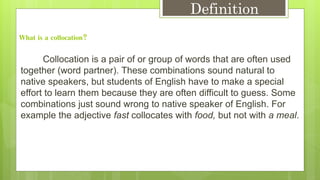
What is a collocation?
Collocation is a pair of or group of words that are often used
together (word partner). These combinations sound natural to
native speakers, but students of English have to make a special
effort to learn them because they are often difficult to guess. Some
combinations just sound wrong to native speaker of English. For
example the adjective fast collocates with food, but not with a meal.
Definition
Sometimes, a pair of words may not be obviously wrong, and
people will understand what is meant, but it may not be the natural,
normal collocation. If someone says I did a few mistakes they will
be understood, but fluent English would probably say I made a few
mistakes.
If you want to use a word naturally, you need to learn the other
words often go with in it. It can be different from language to
language. For example, in English we say:
I missed the bus. (NOT I lost the bus)
She committed suicide. (NOT she undertook or did suicide)
Definition
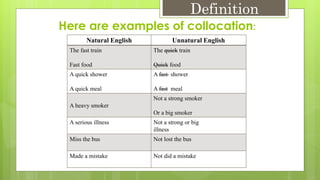
Here are examples of collocation:
Natural English Unnatural English
The fast train
Fast food
The quick train
Quick food
A quick shower
A quick meal
A fast shower
A fast meal
A heavy smoker
Not a strong smoker
Or a big smoker
A serious illness Not a strong or big
illness
Miss the bus Not lost the bus
Made a mistake Not did a mistake
Definition
Your language will be more natural and more easily understood. Smoking is
strictly forbidden is more natural than smoking is strongly forbidden.
It is easier for our brains to remember and use language in chunks or
blocks rather than as single words.
You will have alternative and richer ways of expressing yourself. Instead
of saying it was very cold and very dark; we can say it was bitterly cold
and pitch dark.
Improve your style in writing. We may not need or want to use these in
informal conversations, but in writing they can give our text more variety and
make it read better.
Why should we learn it?
Lexical and Grammatical Collocations
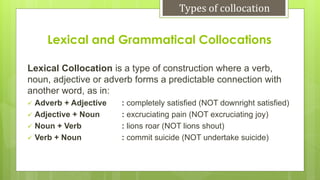
Lexical Collocation is a type of construction where a verb,
noun, adjective or adverb forms a predictable connection with
another word, as in:
 Adverb + Adjective : completely satisfied (NOT downright satisfied)
 Adjective + Noun : excruciating pain (NOT excruciating joy)
 Noun + Verb : lions roar (NOT lions shout)
 Verb + Noun : commit suicide (NOT undertake suicide)
Types of collocation
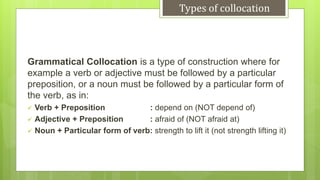
Grammatical Collocation is a type of construction where for
example a verb or adjective must be followed by a particular
preposition, or a noun must be followed by a particular form of
the verb, as in:
 Verb + Preposition : depend on (NOT depend of)
 Adjective + Preposition : afraid of (NOT afraid at)
 Noun + Particular form of verb: strength to lift it (not strength lifting it)
Types of collocation
e.g. : fully aware, happily married, etc.Adverb + Adjective
• I am fully aware that it is impossible to finish the task in a week.
That sweet couple are happily married.
e.g. : major problem, brief chat, etc.Adjective + Noun
• Unemployment is a major problem for the government at the moment.
The lecturers had a brief chat about the students‘ field work at the administration
office.
e.g. :a sense of pride, a pang of nostalgia, etc.Noun + Noun
• If people have a sense of pride in their town, they are more likely to behave well
there.
Older people feel a pang of nostalgia as they think back on their schooldays.
Types of collocation
e.g. : launch the product, pose a problem, etc.
Verb + Noun
• The increase in oil prices certainly poses a problem for us.
We are going to launch a new automatic motor in June 2012.
e.g. : smiled happily, whispered softly, etc.
Verb + Adverb
• Nadia smiled happily as she watched the children playing in the garden.
My mother whispered softly in my ear that she would always love me.
e.g. : lions roar, economy booms, etc.
Noun + Verb
• The lion roars in the zoo.
The economy boomed in 1990s.
e.g. : burst into tears, swelling with pride, etc.
Verb + Expression
With Preposition
• When he saw his exam results, Rooney burst into tears.
Swelling with pride, Stanley watched his daughter pick up her violin and play.
Types of collocation
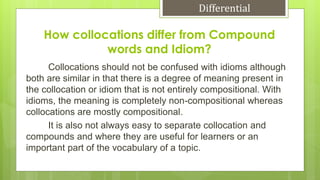
How collocations differ from Compound
words and Idiom?
Collocations should not be confused with idioms although
both are similar in that there is a degree of meaning present in
the collocation or idiom that is not entirely compositional. With
idioms, the meaning is completely non-compositional whereas
collocations are mostly compositional.
It is also not always easy to separate collocation and
compounds and where they are useful for learners or an
important part of the vocabulary of a topic.
Differential
How collocations differ from Compound
words and Idiom?
Compounds are units of meaning formed with two or
more words. Sometimes the words are written
separately, sometimes they have a hyphen and
sometimes they are written as one word. Usually the
meaning of the compound can be guessed by knowing
the meaning of the individual words. Some examples of
compounds are bookstore, post office, narrow-minded,
etc.
Compound
Differential
Idioms are group of words in a fixed order that have a
meaning that cannot be guessed by knowing meaning of
the individual words. For example, pass the buck is an
idiom meaning to pass responsibility for a problem to
another person to avoid dealing with it oneself.
Idiom
Differential
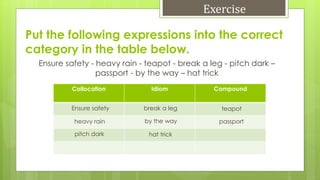
Put the following expressions into the correct
category in the table below.
Ensure safety - heavy rain - teapot - break a leg - pitch dark –
passport - by the way – hat trick
Exercise
Collocation Idiom Compound
Ensure safety
heavy rain
teapotbreak a leg
pitch dark
passportby the way
hat trick
Sort Text
You can train yourselves to notice them whenever you read or
listen to anything in English. Loot at the collocations that are
worth learning from this short text in English.

Collocation in use

  • 1.
    Vocabulary by: Retno Dumilah14320099 Ferry Sandriya 14320020 Ahmad Zakki Maulana 14320079 Collocation
  • 2.
  • 3.
    What is acollocation? Collocation is a pair of or group of words that are often used together (word partner). These combinations sound natural to native speakers, but students of English have to make a special effort to learn them because they are often difficult to guess. Some combinations just sound wrong to native speaker of English. For example the adjective fast collocates with food, but not with a meal. Definition
  • 4.
    Sometimes, a pairof words may not be obviously wrong, and people will understand what is meant, but it may not be the natural, normal collocation. If someone says I did a few mistakes they will be understood, but fluent English would probably say I made a few mistakes. If you want to use a word naturally, you need to learn the other words often go with in it. It can be different from language to language. For example, in English we say: I missed the bus. (NOT I lost the bus) She committed suicide. (NOT she undertook or did suicide) Definition
  • 5.
    Here are examplesof collocation: Natural English Unnatural English The fast train Fast food The quick train Quick food A quick shower A quick meal A fast shower A fast meal A heavy smoker Not a strong smoker Or a big smoker A serious illness Not a strong or big illness Miss the bus Not lost the bus Made a mistake Not did a mistake Definition
  • 6.
    Your language willbe more natural and more easily understood. Smoking is strictly forbidden is more natural than smoking is strongly forbidden. It is easier for our brains to remember and use language in chunks or blocks rather than as single words. You will have alternative and richer ways of expressing yourself. Instead of saying it was very cold and very dark; we can say it was bitterly cold and pitch dark. Improve your style in writing. We may not need or want to use these in informal conversations, but in writing they can give our text more variety and make it read better. Why should we learn it?
  • 7.
    Lexical and GrammaticalCollocations Lexical Collocation is a type of construction where a verb, noun, adjective or adverb forms a predictable connection with another word, as in:  Adverb + Adjective : completely satisfied (NOT downright satisfied)  Adjective + Noun : excruciating pain (NOT excruciating joy)  Noun + Verb : lions roar (NOT lions shout)  Verb + Noun : commit suicide (NOT undertake suicide) Types of collocation
  • 8.
    Grammatical Collocation isa type of construction where for example a verb or adjective must be followed by a particular preposition, or a noun must be followed by a particular form of the verb, as in:  Verb + Preposition : depend on (NOT depend of)  Adjective + Preposition : afraid of (NOT afraid at)  Noun + Particular form of verb: strength to lift it (not strength lifting it) Types of collocation
  • 9.
    e.g. : fullyaware, happily married, etc.Adverb + Adjective • I am fully aware that it is impossible to finish the task in a week. That sweet couple are happily married. e.g. : major problem, brief chat, etc.Adjective + Noun • Unemployment is a major problem for the government at the moment. The lecturers had a brief chat about the students‘ field work at the administration office. e.g. :a sense of pride, a pang of nostalgia, etc.Noun + Noun • If people have a sense of pride in their town, they are more likely to behave well there. Older people feel a pang of nostalgia as they think back on their schooldays. Types of collocation
  • 10.
    Types of collocation e.g.: launch the product, pose a problem, etc. Verb + Noun • The increase in oil prices certainly poses a problem for us. We are going to launch a new automatic motor in June 2012. e.g. : smiled happily, whispered softly, etc. Verb + Adverb • Nadia smiled happily as she watched the children playing in the garden. My mother whispered softly in my ear that she would always love me.
  • 11.
    e.g. : lionsroar, economy booms, etc. Noun + Verb • The lion roars in the zoo. The economy boomed in 1990s. e.g. : burst into tears, swelling with pride, etc. Verb + Expression With Preposition • When he saw his exam results, Rooney burst into tears. Swelling with pride, Stanley watched his daughter pick up her violin and play. Types of collocation
  • 12.
    How collocations differfrom Compound words and Idiom? Collocations should not be confused with idioms although both are similar in that there is a degree of meaning present in the collocation or idiom that is not entirely compositional. With idioms, the meaning is completely non-compositional whereas collocations are mostly compositional. It is also not always easy to separate collocation and compounds and where they are useful for learners or an important part of the vocabulary of a topic. Differential
  • 13.
    How collocations differfrom Compound words and Idiom? Compounds are units of meaning formed with two or more words. Sometimes the words are written separately, sometimes they have a hyphen and sometimes they are written as one word. Usually the meaning of the compound can be guessed by knowing the meaning of the individual words. Some examples of compounds are bookstore, post office, narrow-minded, etc. Compound Differential
  • 14.
    Idioms are groupof words in a fixed order that have a meaning that cannot be guessed by knowing meaning of the individual words. For example, pass the buck is an idiom meaning to pass responsibility for a problem to another person to avoid dealing with it oneself. Idiom Differential
  • 15.
    Put the followingexpressions into the correct category in the table below. Ensure safety - heavy rain - teapot - break a leg - pitch dark – passport - by the way – hat trick Exercise Collocation Idiom Compound Ensure safety heavy rain teapotbreak a leg pitch dark passportby the way hat trick
  • 16.
    Sort Text You cantrain yourselves to notice them whenever you read or listen to anything in English. Loot at the collocations that are worth learning from this short text in English.