Toy Compiler
Front End:
It performs lexical syntax and semantic involved functions
• Determine validity of source statement from view point of
analysis.
• Determine ‘content’ of source statement.
• Construct a suitable representation of source statement for
the use of
• subsequent analysis function or synthesis phase of a language
processor.
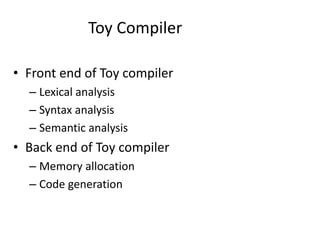
• Front end of Toy compiler
– Lexical analysis
– Syntax analysis
– Semantic analysis
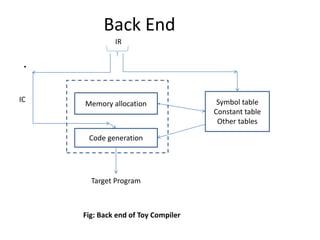
• Back end of Toy compiler
– Memory allocation
– Code generation
Toy Compiler
Output of Front End
• Table of Information:
Contains information obtained during different analysis of source program.
IC: Description of source statement
• Has sequence of IC units
• Each IC unit represent the meaning of each individual
• actions performed based on source program . IC unit may contain
reference to information in various tables.
• Actions:
Convert (id,#1) to real, giving (id,#4)
Add (id,#4) to (id,#3), giving (id,#5)
Store (id,#5) in (id,#2)
Lexical Analysis of Front End
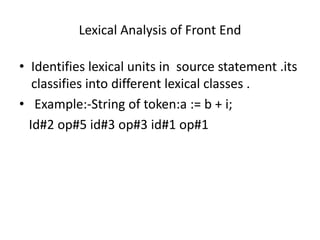
• Identifies lexical units in source statement .its
classifies into different lexical classes .
• Example:-String of token:a := b + i;
Id#2 op#5 id#3 op#3 id#1 op#1
Syntax Analysis of Front End
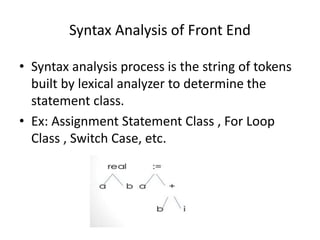
• Syntax analysis process is the string of tokens
built by lexical analyzer to determine the
statement class.
• Ex: Assignment Statement Class , For Loop
Class , Switch Case, etc.
Semantic Analysis of Front End
When semantic analysis determine the meaning of sub-tree in
IC, it adds
-Declaration (added to symbol table)
-Imperative Statement Analysis (determines the action
sequence.
Back End
.
Memory allocation
Code generation
Symbol table
Constant table
Other tables
Target Program
IR
IC
Fig: Back end of Toy Compiler
• Memory allocation :
– The memory requirement of identifier is
computed from its type, length and
dimensionality
– Address of memory area is entered in the symbol
table
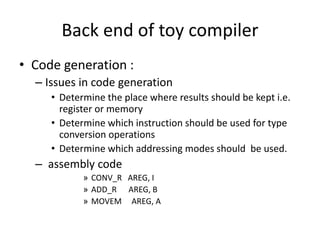
Back end of toy compiler
• Code generation :
– Issues in code generation
• Determine the place where results should be kept i.e.
register or memory
• Determine which instruction should be used for type
conversion operations
• Determine which addressing modes should be used.
– assembly code
» CONV_R AREG, I
» ADD_R AREG, B
» MOVEM AREG, A
• 1. Memory Allocation:
• –
• A memory allocation requirement of an identifier is computed from its
• •
• Size,
• •
• Length,
• •
• Type,
• •
• Dimension
• –
• And then memory is allocated to it.
• –
• The address of memory area is then entered in symbol table. See next figure.
• –
• i
• * & temp are not shown because memory allocation is not required now for
• this id.
• –
• i
• * and temp should be allocated memory but this decision are taken in
• preparatory steps of code generation.
• Sr. No.
• Symbol
• Type
• Length
• Address
• 1
• i
• Integer
• -
• 2000
• 2
• a
• Real
• -
• 2016
• 3
• b
• Real
• -
• 2020

Toy complier

  • 2.
    Toy Compiler Front End: Itperforms lexical syntax and semantic involved functions • Determine validity of source statement from view point of analysis. • Determine ‘content’ of source statement. • Construct a suitable representation of source statement for the use of • subsequent analysis function or synthesis phase of a language processor.
  • 3.
    • Front endof Toy compiler – Lexical analysis – Syntax analysis – Semantic analysis • Back end of Toy compiler – Memory allocation – Code generation Toy Compiler
  • 5.
    Output of FrontEnd • Table of Information: Contains information obtained during different analysis of source program. IC: Description of source statement • Has sequence of IC units • Each IC unit represent the meaning of each individual • actions performed based on source program . IC unit may contain reference to information in various tables. • Actions: Convert (id,#1) to real, giving (id,#4) Add (id,#4) to (id,#3), giving (id,#5) Store (id,#5) in (id,#2)
  • 7.
    Lexical Analysis ofFront End • Identifies lexical units in source statement .its classifies into different lexical classes . • Example:-String of token:a := b + i; Id#2 op#5 id#3 op#3 id#1 op#1
  • 8.
    Syntax Analysis ofFront End • Syntax analysis process is the string of tokens built by lexical analyzer to determine the statement class. • Ex: Assignment Statement Class , For Loop Class , Switch Case, etc.
  • 9.
    Semantic Analysis ofFront End When semantic analysis determine the meaning of sub-tree in IC, it adds -Declaration (added to symbol table) -Imperative Statement Analysis (determines the action sequence.
  • 11.
    Back End . Memory allocation Codegeneration Symbol table Constant table Other tables Target Program IR IC Fig: Back end of Toy Compiler
  • 12.
    • Memory allocation: – The memory requirement of identifier is computed from its type, length and dimensionality – Address of memory area is entered in the symbol table
  • 13.
    Back end oftoy compiler • Code generation : – Issues in code generation • Determine the place where results should be kept i.e. register or memory • Determine which instruction should be used for type conversion operations • Determine which addressing modes should be used. – assembly code » CONV_R AREG, I » ADD_R AREG, B » MOVEM AREG, A
  • 14.
    • 1. MemoryAllocation: • – • A memory allocation requirement of an identifier is computed from its • • • Size, • • • Length, • • • Type, • • • Dimension • – • And then memory is allocated to it. • – • The address of memory area is then entered in symbol table. See next figure. • – • i • * & temp are not shown because memory allocation is not required now for • this id. • – • i • * and temp should be allocated memory but this decision are taken in • preparatory steps of code generation. • Sr. No. • Symbol • Type • Length • Address • 1 • i • Integer • - • 2000 • 2 • a • Real • - • 2016 • 3 • b • Real • - • 2020