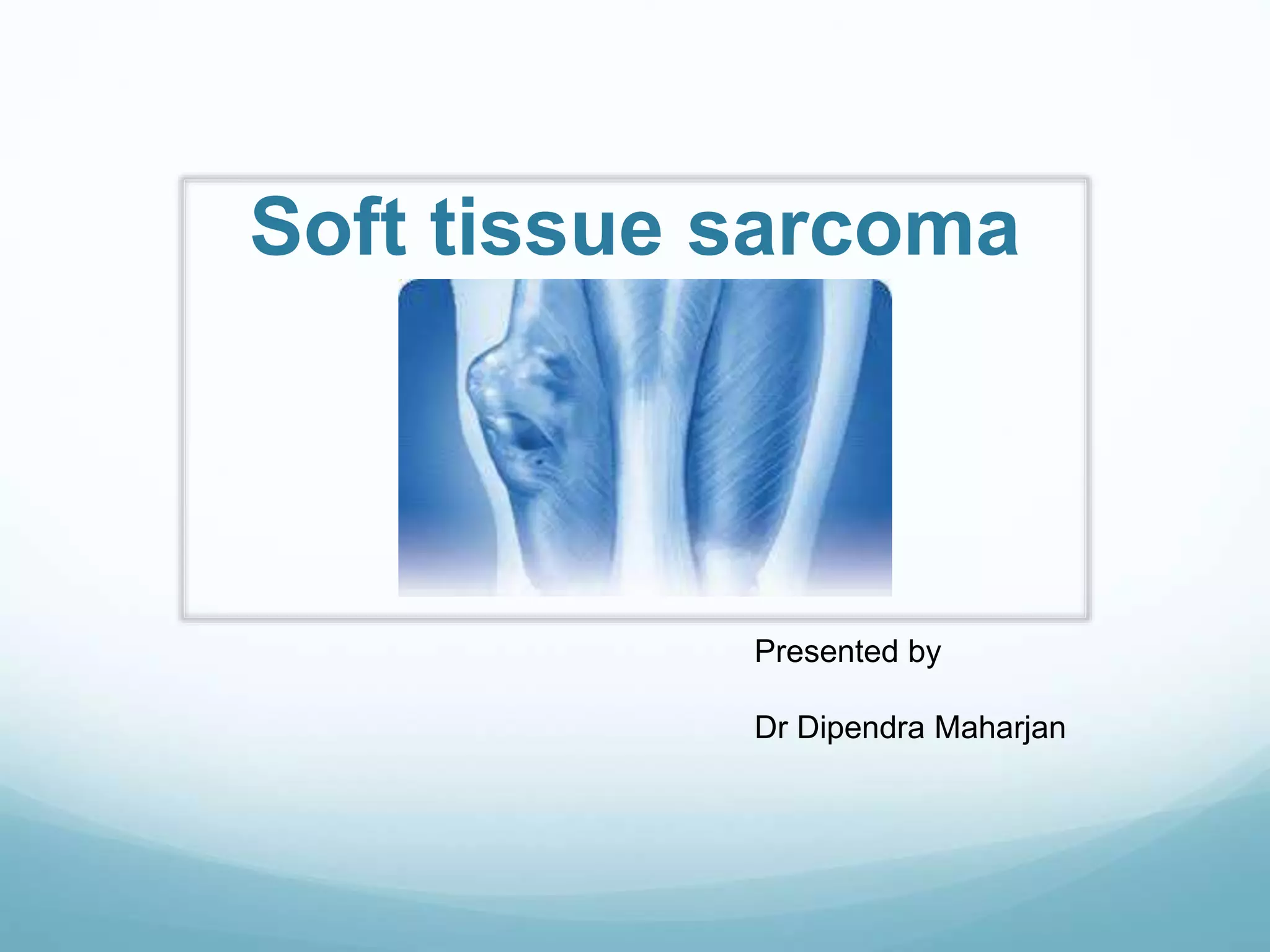

Soft tissue sarcoma
Presented by
Dr Dipendra Maharjan
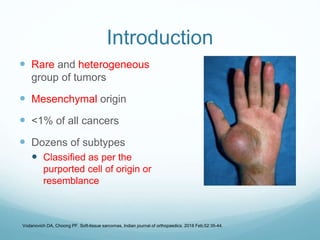
Introduction
 Rare and heterogeneous
group of tumors
 Mesenchymal origin
 <1% of all cancers
 Dozens of subtypes
 Classified as per the
purported cell of origin or
resemblance
Vodanovich DA, Choong PF. Soft-tissue sarcomas. Indian journal of orthopaedics. 2018 Feb;52:35-44.
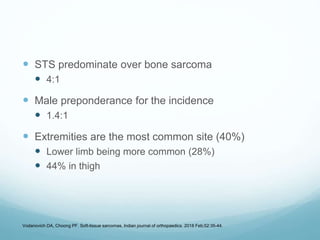
 STS predominate over bone sarcoma
 4:1
 Male preponderance for the incidence
 1.4:1
 Extremities are the most common site (40%)
 Lower limb being more common (28%)
 44% in thigh
Vodanovich DA, Choong PF. Soft-tissue sarcomas. Indian journal of orthopaedics. 2018 Feb;52:35-44.
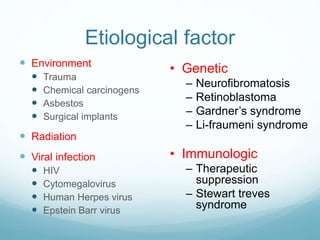
Etiological factor
 Environment
 Trauma
 Chemical carcinogens
 Asbestos
 Surgical implants
 Radiation
 Viral infection
 HIV
 Cytomegalovirus
 Human Herpes virus
 Epstein Barr virus
• Genetic
– Neurofibromatosis
– Retinoblastoma
– Gardner’s syndrome
– Li-fraumeni syndrome
• Immunologic
– Therapeutic
suppression
– Stewart treves
syndrome
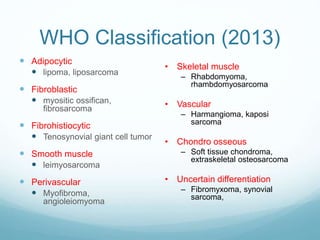
WHO Classification (2013)
 Adipocytic
 lipoma, liposarcoma
 Fibroblastic
 myositic ossifican,
fibrosarcoma
 Fibrohistiocytic
 Tenosynovial giant cell tumor
 Smooth muscle
 leimyosarcoma
 Perivascular
 Myofibroma,
angioleiomyoma
• Skeletal muscle
– Rhabdomyoma,
rhambdomyosarcoma
• Vascular
– Harmangioma, kaposi
sarcoma
• Chondro osseous
– Soft tissue chondroma,
extraskeletal osteosarcoma
• Uncertain differentiation
– Fibromyxoma, synovial
sarcoma,
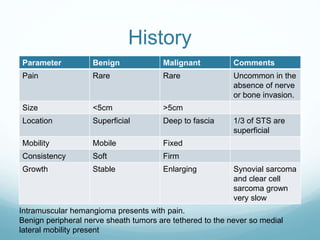
History
Parameter Benign Malignant Comments
Pain Rare Rare Uncommon in the
absence of nerve
or bone invasion.
Size <5cm >5cm
Location Superficial Deep to fascia 1/3 of STS are
superficial
Mobility Mobile Fixed
Consistency Soft Firm
Growth Stable Enlarging Synovial sarcoma
and clear cell
sarcoma grown
very slow
Intramuscular hemangioma presents with pain.
Benign peripheral nerve sheath tumors are tethered to the never so medial
lateral mobility present
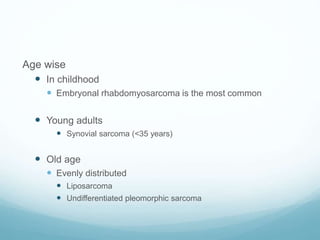
Age wise
 In childhood
 Embryonal rhabdomyosarcoma is the most common
 Young adults
 Synovial sarcoma (<35 years)
 Old age
 Evenly distributed
 Liposarcoma
 Undifferentiated pleomorphic sarcoma
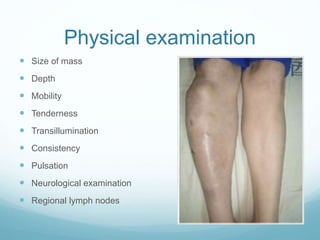
Physical examination
 Size of mass
 Depth
 Mobility
 Tenderness
 Transillumination
 Consistency
 Pulsation
 Neurological examination
 Regional lymph nodes
 Common features of malignant lump
 Lump>5cm
 Increasing in size
 Deep to fascia
 pain
Radiographic features
 Xray
 Soft tissue mineralization and bony involvement
 Myositis ossificans
 Hemangioma
 Synovial sarcoma
 Extraskeletal osteogenic sarcoma
 Chest xray
CT
 CT chest for staging
 Bony involvement
 Contraindication of MRI
 Pattern of mineralization
MRI
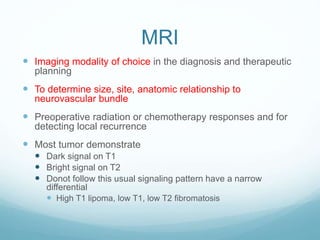
 Imaging modality of choice in the diagnosis and therapeutic
planning
 To determine size, site, anatomic relationship to
neurovascular bundle
 Preoperative radiation or chemotherapy responses and for
detecting local recurrence
 Most tumor demonstrate
 Dark signal on T1
 Bright signal on T2
 Donot follow this usual signaling pattern have a narrow
differential
 High T1 lipoma, low T1, low T2 fibromatosis
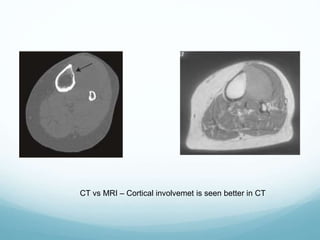
CT vs MRI – Cortical involvemet is seen better in CT
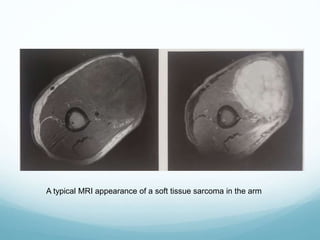
A typical MRI appearance of a soft tissue sarcoma in the arm
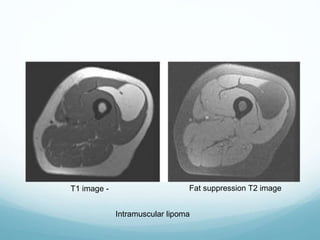
Intramuscular lipoma
T1 image - Fat suppression T2 image
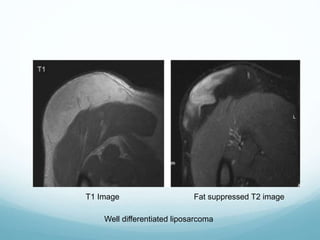
Well differentiated liposarcoma
T1 Image Fat suppressed T2 image
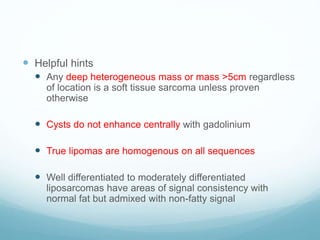
 Helpful hints
 Any deep heterogeneous mass or mass >5cm regardless
of location is a soft tissue sarcoma unless proven
otherwise
 Cysts do not enhance centrally with gadolinium
 True lipomas are homogenous on all sequences
 Well differentiated to moderately differentiated
liposarcomas have areas of signal consistency with
normal fat but admixed with non-fatty signal
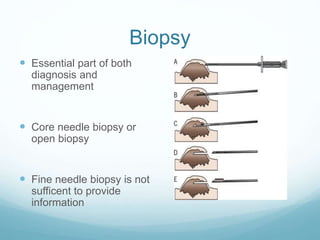
Biopsy
 Essential part of both
diagnosis and
management
 Core needle biopsy or
open biopsy
 Fine needle biopsy is not
sufficent to provide
information
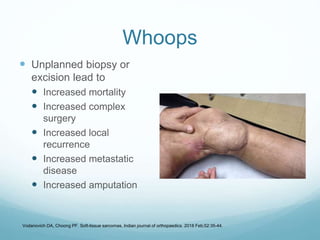
Whoops
 Unplanned biopsy or
excision lead to
 Increased mortality
 Increased complex
surgery
 Increased local
recurrence
 Increased metastatic
disease
 Increased amputation
Vodanovich DA, Choong PF. Soft-tissue sarcomas. Indian journal of orthopaedics. 2018 Feb;52:35-44.
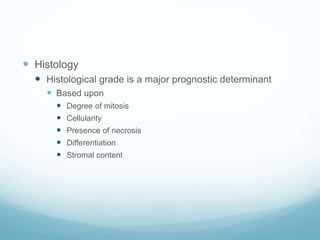
 Histology
 Histological grade is a major prognostic determinant
 Based upon
 Degree of mitosis
 Cellularity
 Presence of necrosis
 Differentiation
 Stromal content
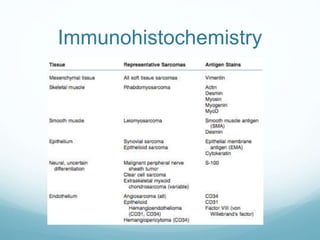
Immunohistochemistry
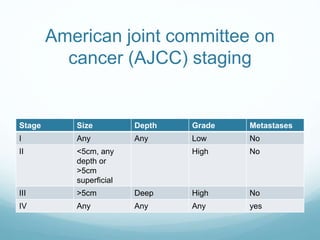
American joint committee on
cancer (AJCC) staging
Stage Size Depth Grade Metastases
I Any Any Low No
II <5cm, any
depth or
>5cm
superficial
High No
III >5cm Deep High No
IV Any Any Any yes
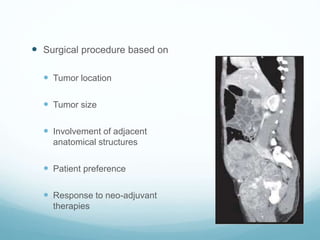
 Surgical procedure based on
 Tumor location
 Tumor size
 Involvement of adjacent
anatomical structures
 Patient preference
 Response to neo-adjuvant
therapies
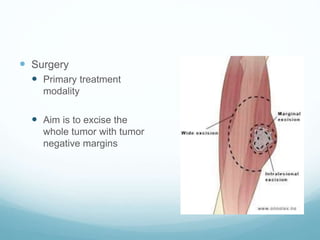
 Surgery
 Primary treatment
modality
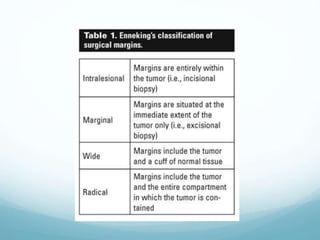
 Aim is to excise the
whole tumor with tumor
negative margins
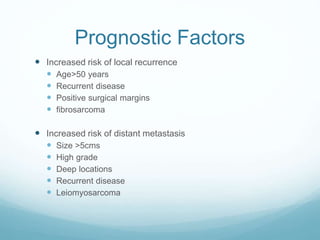
Prognostic Factors
 Increased risk of local recurrence
 Age>50 years
 Recurrent disease
 Positive surgical margins
 fibrosarcoma
 Increased risk of distant metastasis
 Size >5cms
 High grade
 Deep locations
 Recurrent disease
 Leiomyosarcoma
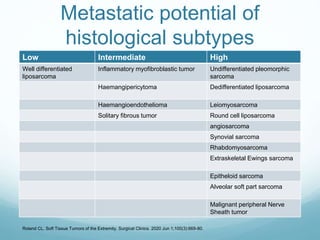
Metastatic potential of
histological subtypes
Low Intermediate High
Well differentiated
liposarcoma
Inflammatory myofibroblastic tumor Undifferentiated pleomorphic
sarcoma
Haemangipericytoma Dedifferentiated liposarcoma
Haemangioendothelioma Leiomyosarcoma
Solitary fibrous tumor Round cell liposarcoma
angiosarcoma
Synovial sarcoma
Rhabdomyosarcoma
Extraskeletal Ewings sarcoma
Epitheloid sarcoma
Alveolar soft part sarcoma
Malignant peripheral Nerve
Sheath tumor
Roland CL. Soft Tissue Tumors of the Extremity. Surgical Clinics. 2020 Jun 1;100(3):669-80.
Lymph Node spread
 An infrequent event
 Of total 10,731 2.1% had LN metastatis
 Poorer survival rate with LN spread
 Several variables
 Histologic subtypes
 Tumor grade
 Patient age
 Primary tumor size
1. Fong Y, Coit DG, Woodruff JM, Brennan MF. Lymph node metastasis from soft tissue sarcoma in adults. Analysis of data from a
prospective database of 1772 sarcoma patients. Annals of surgery. 1993 Jan;217(1):72.
2. Miccio JA, Jairam V, Gao S, Augustyn A, Oladeru OT, Onderdonk BE, Chowdhary M, Han D, Khan S, Friedlaender G, Lindskog DM.
Predictors of Lymph Node Involvement by Soft Tissue Sarcoma of the Trunk and Extremity: An Analysis of the National Cancer Database.
Cureus. 2019 Oct;11(10).
 Histological subtypes with increased Lymph node
metastases
 Rhabdomyosarcoma
 Synovial sarcoma
 Undifferentiated pleomorphic sarcoma
 Epitheloid sarcoma
 Angiosarcoma
 Clear cell sarcoma
 Neurofibrosarcoma
 Leiomyosarcoma
 fibrosarcoma
 Nodal disease has prognostic value
 Regional lymphadenectomy to improve survival rate
Miccio JA, Jairam V, Gao S, Augustyn A, Oladeru OT, Onderdonk BE, Chowdhary M, Han D, Khan S, Friedlaender G, Lindskog DM.
Predictors of Lymph Node Involvement by Soft Tissue Sarcoma of the Trunk and Extremity: An Analysis of the National Cancer Database.
Cureus. 2019 Oct;11(10).
Is resection enough?
 Half of patients with adequate local control of sarcoma
develop distant mets and die from disease
 Low cure rate
 Metastatic STS are rarely cured
 Systemic chemotherapy is the standard care in
pediatric sarcomas
 Chemotherapy in adult is controversial
 Whether or not there are small population of patients
truly benefit from adjuvant chemotherapy
Bajpai J, Susan D. Adjuvant chemotherapy in soft tissue sarcomas…Conflicts, consensus, and controversies. South Asian J Cancer.
2016;5(1):15-19. doi:10.4103/2278-330X.179687
Radiotherapy (RT)
 Small, low grade tumors <5 cms with 2 cm negative
margins may not require
 Should be added to
 If margin is close
 If extra muscular involvement is present
 If local recurrence would result neurovascular
involvement or amputation
 Improves local control but not survival
Tiong SS, Dickie C, Haas RL, O’Sullivan B. The role of radiotherapy in the management of localized soft tissue sarcomas. Cancer biology &
medicine. 2016 Sep;13(3):373.
Role of RT
 Downsizing prior to surgery
 Local control if surgery is impossible
 Due to medical comorbidities, surgery is
contraindicated
 Burden of metastatic disase
 Care must be taken to appropriately design fields to
exclude sensitive structures.
Tiong SS, Dickie C, Haas RL, O’Sullivan B. The role of radiotherapy in the management of localized soft tissue sarcomas. Cancer biology &
medicine. 2016 Sep;13(3):373.
Chemotherapy
 Cannot be used as a blanket therapy
 Can be used in size >5cm, high grade STS
 Chemo-sensitive STS
 Synovial sarcoma
 Leiomyosarcoma
 Angiosarcoma
Role of chemotherapy
 Downsizing
 Increase the rate of limb salvage surgery
 Acts as a surrogate marker of chemosensitivity of
disease
 Palliative care for metastatic STS
 Uncertain due to the limited randomized controlled trial
controversies
 Can radiotherapy be avoided?
 The appropriated time of radiotherapy in relation to
surgery
 The appropriate time of chemotherapy in relation to
surgery
Take home message
 Any lump >5cm should be treated as soft tissue
sarcoma unless proven otherwise
 Biopsy is the most to confirm the diagnosis
 Surgical resection is the standard treament modality
with negative surgical margins
 Adjuvant chemotherapy or radiotherapy can be given
for local control
Thank you.

Soft tissue sarcoma

  • 1.
    Soft tissue sarcoma Presentedby Dr Dipendra Maharjan
  • 2.
    Introduction  Rare andheterogeneous group of tumors  Mesenchymal origin  <1% of all cancers  Dozens of subtypes  Classified as per the purported cell of origin or resemblance Vodanovich DA, Choong PF. Soft-tissue sarcomas. Indian journal of orthopaedics. 2018 Feb;52:35-44.
  • 3.
     STS predominateover bone sarcoma  4:1  Male preponderance for the incidence  1.4:1  Extremities are the most common site (40%)  Lower limb being more common (28%)  44% in thigh Vodanovich DA, Choong PF. Soft-tissue sarcomas. Indian journal of orthopaedics. 2018 Feb;52:35-44.
  • 4.
    Etiological factor  Environment Trauma  Chemical carcinogens  Asbestos  Surgical implants  Radiation  Viral infection  HIV  Cytomegalovirus  Human Herpes virus  Epstein Barr virus • Genetic – Neurofibromatosis – Retinoblastoma – Gardner’s syndrome – Li-fraumeni syndrome • Immunologic – Therapeutic suppression – Stewart treves syndrome
  • 5.
    WHO Classification (2013) Adipocytic  lipoma, liposarcoma  Fibroblastic  myositic ossifican, fibrosarcoma  Fibrohistiocytic  Tenosynovial giant cell tumor  Smooth muscle  leimyosarcoma  Perivascular  Myofibroma, angioleiomyoma • Skeletal muscle – Rhabdomyoma, rhambdomyosarcoma • Vascular – Harmangioma, kaposi sarcoma • Chondro osseous – Soft tissue chondroma, extraskeletal osteosarcoma • Uncertain differentiation – Fibromyxoma, synovial sarcoma,
  • 6.
    History Parameter Benign MalignantComments Pain Rare Rare Uncommon in the absence of nerve or bone invasion. Size <5cm >5cm Location Superficial Deep to fascia 1/3 of STS are superficial Mobility Mobile Fixed Consistency Soft Firm Growth Stable Enlarging Synovial sarcoma and clear cell sarcoma grown very slow Intramuscular hemangioma presents with pain. Benign peripheral nerve sheath tumors are tethered to the never so medial lateral mobility present
  • 7.
    Age wise  Inchildhood  Embryonal rhabdomyosarcoma is the most common  Young adults  Synovial sarcoma (<35 years)  Old age  Evenly distributed  Liposarcoma  Undifferentiated pleomorphic sarcoma
  • 8.
    Physical examination  Sizeof mass  Depth  Mobility  Tenderness  Transillumination  Consistency  Pulsation  Neurological examination  Regional lymph nodes
  • 9.
     Common featuresof malignant lump  Lump>5cm  Increasing in size  Deep to fascia  pain
  • 10.
    Radiographic features  Xray Soft tissue mineralization and bony involvement  Myositis ossificans  Hemangioma  Synovial sarcoma  Extraskeletal osteogenic sarcoma  Chest xray
  • 11.
    CT  CT chestfor staging  Bony involvement  Contraindication of MRI  Pattern of mineralization
  • 12.
    MRI  Imaging modalityof choice in the diagnosis and therapeutic planning  To determine size, site, anatomic relationship to neurovascular bundle  Preoperative radiation or chemotherapy responses and for detecting local recurrence  Most tumor demonstrate  Dark signal on T1  Bright signal on T2  Donot follow this usual signaling pattern have a narrow differential  High T1 lipoma, low T1, low T2 fibromatosis
  • 13.
    CT vs MRI– Cortical involvemet is seen better in CT
  • 14.
    A typical MRIappearance of a soft tissue sarcoma in the arm
  • 15.
    Intramuscular lipoma T1 image- Fat suppression T2 image
  • 16.
    Well differentiated liposarcoma T1Image Fat suppressed T2 image
  • 17.
     Helpful hints Any deep heterogeneous mass or mass >5cm regardless of location is a soft tissue sarcoma unless proven otherwise  Cysts do not enhance centrally with gadolinium  True lipomas are homogenous on all sequences  Well differentiated to moderately differentiated liposarcomas have areas of signal consistency with normal fat but admixed with non-fatty signal
  • 18.
    Biopsy  Essential partof both diagnosis and management  Core needle biopsy or open biopsy  Fine needle biopsy is not sufficent to provide information
  • 19.
    Whoops  Unplanned biopsyor excision lead to  Increased mortality  Increased complex surgery  Increased local recurrence  Increased metastatic disease  Increased amputation Vodanovich DA, Choong PF. Soft-tissue sarcomas. Indian journal of orthopaedics. 2018 Feb;52:35-44.
  • 20.
     Histology  Histologicalgrade is a major prognostic determinant  Based upon  Degree of mitosis  Cellularity  Presence of necrosis  Differentiation  Stromal content
  • 21.
  • 22.
    American joint committeeon cancer (AJCC) staging Stage Size Depth Grade Metastases I Any Any Low No II <5cm, any depth or >5cm superficial High No III >5cm Deep High No IV Any Any Any yes
  • 24.
     Surgical procedurebased on  Tumor location  Tumor size  Involvement of adjacent anatomical structures  Patient preference  Response to neo-adjuvant therapies
  • 25.
     Surgery  Primarytreatment modality  Aim is to excise the whole tumor with tumor negative margins
  • 26.
    Prognostic Factors  Increasedrisk of local recurrence  Age>50 years  Recurrent disease  Positive surgical margins  fibrosarcoma  Increased risk of distant metastasis  Size >5cms  High grade  Deep locations  Recurrent disease  Leiomyosarcoma
  • 27.
    Metastatic potential of histologicalsubtypes Low Intermediate High Well differentiated liposarcoma Inflammatory myofibroblastic tumor Undifferentiated pleomorphic sarcoma Haemangipericytoma Dedifferentiated liposarcoma Haemangioendothelioma Leiomyosarcoma Solitary fibrous tumor Round cell liposarcoma angiosarcoma Synovial sarcoma Rhabdomyosarcoma Extraskeletal Ewings sarcoma Epitheloid sarcoma Alveolar soft part sarcoma Malignant peripheral Nerve Sheath tumor Roland CL. Soft Tissue Tumors of the Extremity. Surgical Clinics. 2020 Jun 1;100(3):669-80.
  • 28.
    Lymph Node spread An infrequent event  Of total 10,731 2.1% had LN metastatis  Poorer survival rate with LN spread  Several variables  Histologic subtypes  Tumor grade  Patient age  Primary tumor size 1. Fong Y, Coit DG, Woodruff JM, Brennan MF. Lymph node metastasis from soft tissue sarcoma in adults. Analysis of data from a prospective database of 1772 sarcoma patients. Annals of surgery. 1993 Jan;217(1):72. 2. Miccio JA, Jairam V, Gao S, Augustyn A, Oladeru OT, Onderdonk BE, Chowdhary M, Han D, Khan S, Friedlaender G, Lindskog DM. Predictors of Lymph Node Involvement by Soft Tissue Sarcoma of the Trunk and Extremity: An Analysis of the National Cancer Database. Cureus. 2019 Oct;11(10).
  • 29.
     Histological subtypeswith increased Lymph node metastases  Rhabdomyosarcoma  Synovial sarcoma  Undifferentiated pleomorphic sarcoma  Epitheloid sarcoma  Angiosarcoma  Clear cell sarcoma  Neurofibrosarcoma  Leiomyosarcoma  fibrosarcoma  Nodal disease has prognostic value  Regional lymphadenectomy to improve survival rate Miccio JA, Jairam V, Gao S, Augustyn A, Oladeru OT, Onderdonk BE, Chowdhary M, Han D, Khan S, Friedlaender G, Lindskog DM. Predictors of Lymph Node Involvement by Soft Tissue Sarcoma of the Trunk and Extremity: An Analysis of the National Cancer Database. Cureus. 2019 Oct;11(10).
  • 30.
    Is resection enough? Half of patients with adequate local control of sarcoma develop distant mets and die from disease  Low cure rate  Metastatic STS are rarely cured  Systemic chemotherapy is the standard care in pediatric sarcomas  Chemotherapy in adult is controversial  Whether or not there are small population of patients truly benefit from adjuvant chemotherapy Bajpai J, Susan D. Adjuvant chemotherapy in soft tissue sarcomas…Conflicts, consensus, and controversies. South Asian J Cancer. 2016;5(1):15-19. doi:10.4103/2278-330X.179687
  • 31.
    Radiotherapy (RT)  Small,low grade tumors <5 cms with 2 cm negative margins may not require  Should be added to  If margin is close  If extra muscular involvement is present  If local recurrence would result neurovascular involvement or amputation  Improves local control but not survival Tiong SS, Dickie C, Haas RL, O’Sullivan B. The role of radiotherapy in the management of localized soft tissue sarcomas. Cancer biology & medicine. 2016 Sep;13(3):373.
  • 32.
    Role of RT Downsizing prior to surgery  Local control if surgery is impossible  Due to medical comorbidities, surgery is contraindicated  Burden of metastatic disase  Care must be taken to appropriately design fields to exclude sensitive structures. Tiong SS, Dickie C, Haas RL, O’Sullivan B. The role of radiotherapy in the management of localized soft tissue sarcomas. Cancer biology & medicine. 2016 Sep;13(3):373.
  • 33.
    Chemotherapy  Cannot beused as a blanket therapy  Can be used in size >5cm, high grade STS  Chemo-sensitive STS  Synovial sarcoma  Leiomyosarcoma  Angiosarcoma
  • 34.
    Role of chemotherapy Downsizing  Increase the rate of limb salvage surgery  Acts as a surrogate marker of chemosensitivity of disease  Palliative care for metastatic STS  Uncertain due to the limited randomized controlled trial
  • 35.
    controversies  Can radiotherapybe avoided?  The appropriated time of radiotherapy in relation to surgery  The appropriate time of chemotherapy in relation to surgery
  • 36.
    Take home message Any lump >5cm should be treated as soft tissue sarcoma unless proven otherwise  Biopsy is the most to confirm the diagnosis  Surgical resection is the standard treament modality with negative surgical margins  Adjuvant chemotherapy or radiotherapy can be given for local control
  • 37.