Soft Tissue Sarcomas in Adolescents and Young Adults  Alberto S. Pappo, M.D.St Jude Children’s Research HospitalMemphis, TN
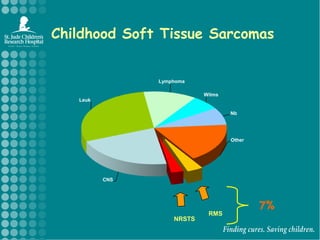
Childhood Soft Tissue Sarcomas7%RMSNRSTS
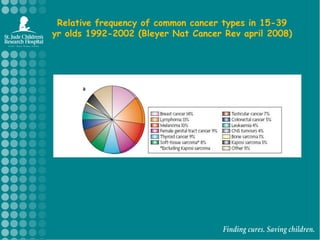
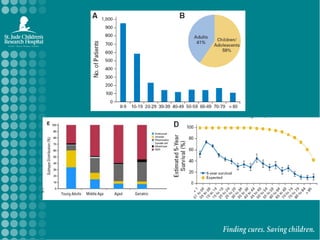
Relative frequency of common cancer types in 15-39 yr olds 1992-2002 (Bleyer Nat Cancer Rev april 2008)
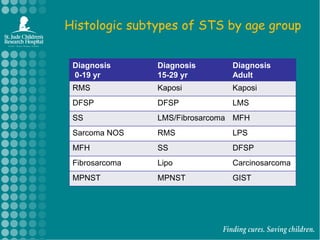
Histologic subtypes of STS by age group
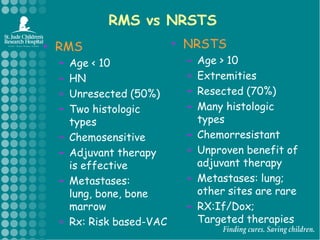
RMS vs NRSTSNRSTSAge > 10ExtremitiesResected (70%)Many histologic typesChemorresistantUnproven benefit of adjuvant therapy Metastases: lung; other sites are rareRX:If/Dox; Targeted therapiesRMSAge < 10HNUnresected (50%)Two histologic typesChemosensitiveAdjuvant therapy is effectiveMetastases: lung, bone, bone marrowRx: Risk based-VAC
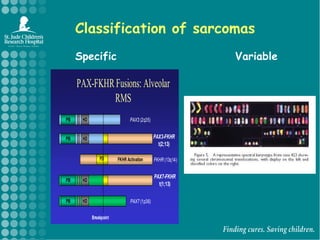
Classification of sarcomasSpecificVariable
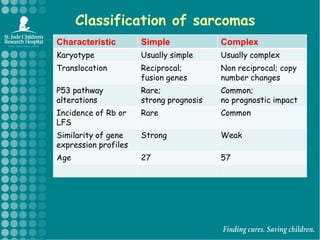
Classification of sarcomas
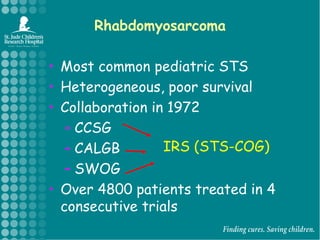
RhabdomyosarcomaMost common pediatric STS Heterogeneous, poor survivalCollaboration in 1972 CCSGCALGBSWOG  Over 4800 patients treated in 4 consecutive trialsIRS (STS-COG)
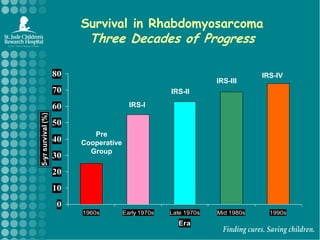
Survival in RhabdomyosarcomaThree Decades of ProgressIRS-IVIRS-IIIIRS-IIIRS-IPreCooperativeGroup
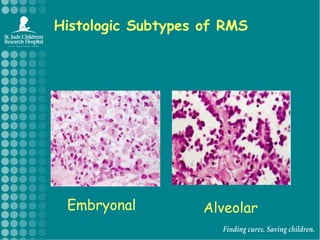
Histologic Subtypes of RMSEmbryonalAlveolar
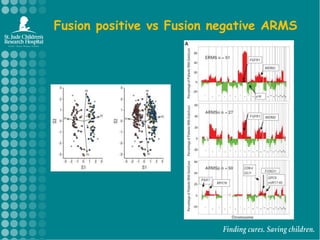
Fusion positive vs Fusion negative ARMS
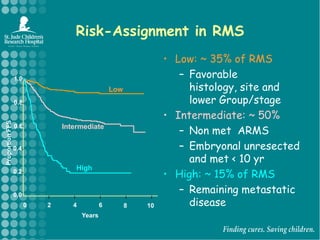
Risk-Assignment in RMSLow: ~ 35% of RMSFavorable histology, site and lower Group/stageIntermediate: ~ 50%Non met  ARMSEmbryonalunresected and met < 10 yr High: ~ 15% of RMSRemaining metastatic disease1.0Low0.8Intermediate0.6Proportion FFS0.4High0.20.08100246Years
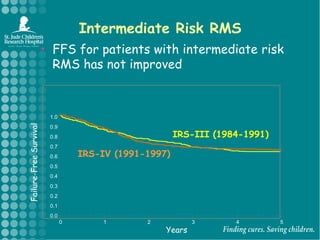
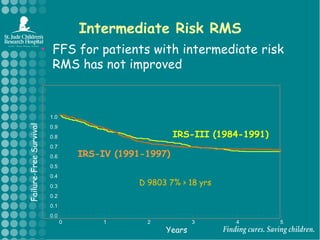
Intermediate Risk RMSFFS for patients with intermediate risk RMS has not improved1.00.9IRS-III (1984-1991)0.80.7IRS-IV (1991-1997)0.6Failure-Free Survival0.50.40.30.20.10.0012345Years
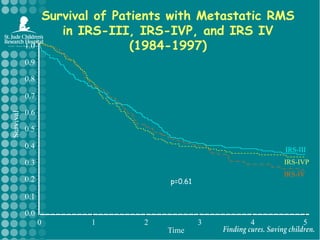
Survival of Patients with Metastatic RMS in IRS-III, IRS-IVP, and IRS IV(1984-1997)1.00.90.80.70.6 Survival0.50.4IRS-IIIIRS-IVP0.3IRS-IV0.2p=0.610.10.0012345 Time
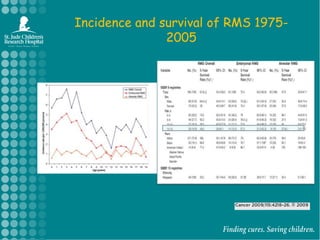
Incidence and survival of RMS 1975-2005
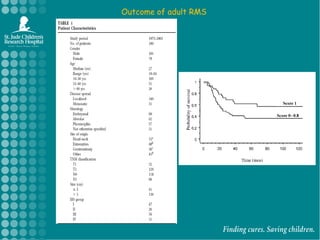
Outcome of adult RMS
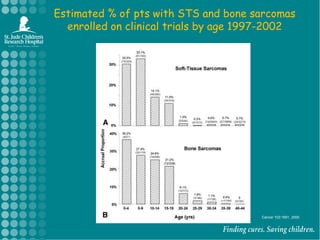
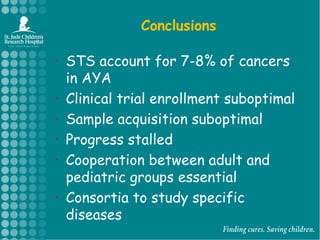
Estimated % of pts with STS and bone sarcomas enrolled on clinical trials by age 1997-2002Cancer 103:1891, 2005
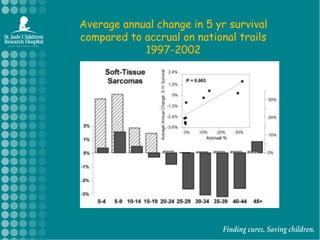
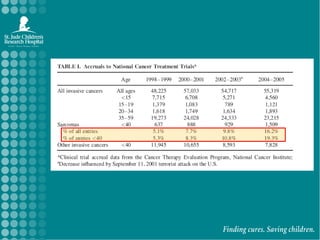
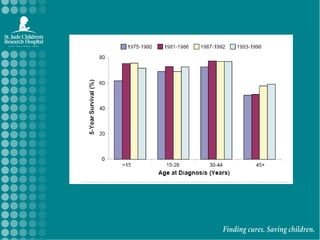
Average annual change in 5 yr survival compared to accrual on national trails 1997-2002
Intermediate Risk RMSFFS for patients with intermediate risk RMS has not improved1.00.9IRS-III (1984-1991)0.80.7IRS-IV (1991-1997)0.6Failure-Free Survival0.50.4D 9803 7% > 18 yrs0.30.20.10.0012345Years
NRSTS
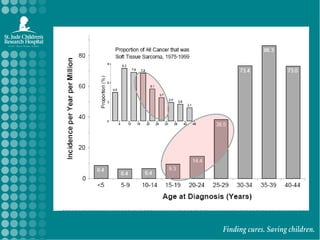
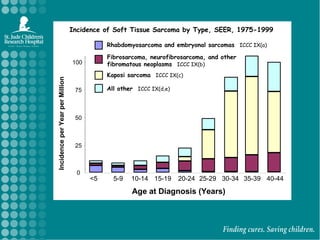
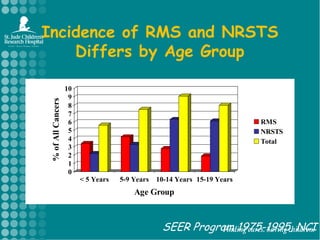
Incidence of RMS and NRSTS Differs by Age GroupSEER Program 1975-1995, NCI
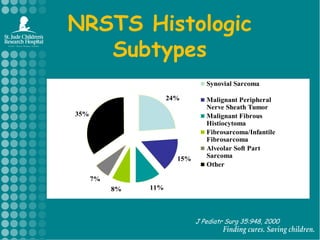
NRSTS Histologic SubtypesJ Pediatr Surg 35:948, 2000
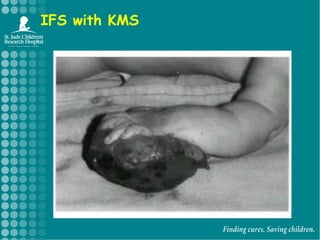
IFS with KMS
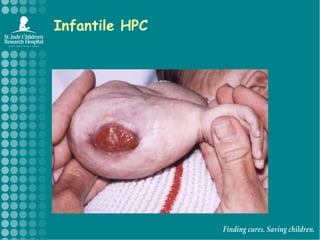
Infantile HPC
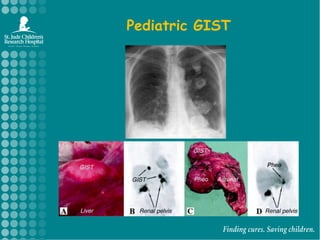
Pediatric GIST
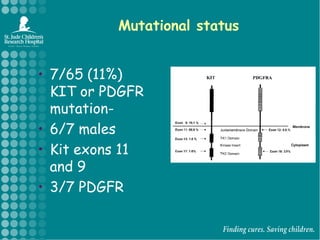
Mutational status7/65 (11%) KIT or PDGFR mutation-6/7 males Kit exons 11 and 9 3/7 PDGFR
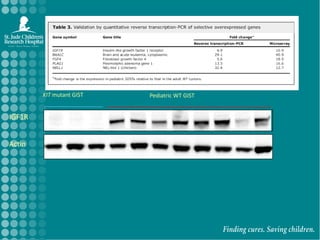
KIT mutant GISTPediatric WT GISTIGF1RActin
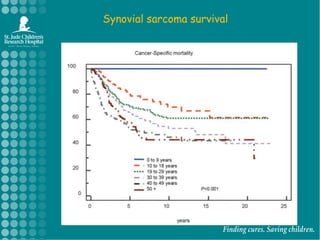
Synovial sarcoma survival
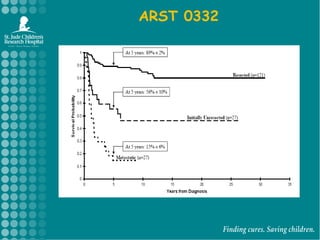
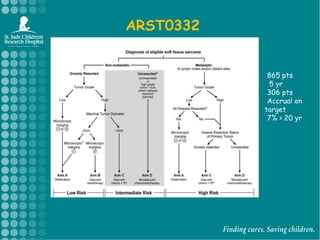
ARST 0332
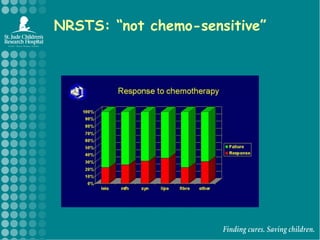
NRSTS: “not chemo-sensitive”
ARST0332865 pts
5 yr
306 pts
Accrual on target
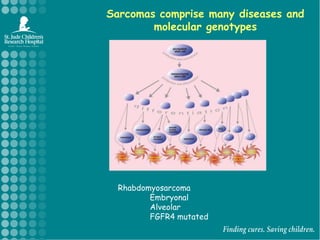
7% > 20 yrSarcomas comprise many diseases and molecular genotypesRhabdomyosarcomaEmbryonal	Alveolar	FGFR4 mutated
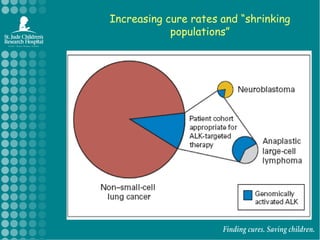
Increasing cure rates and “shrinking populations”
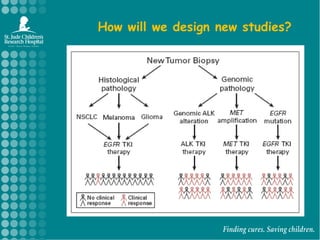
How will we design new studies?
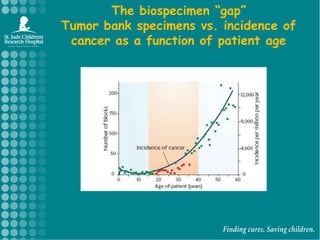
The biospecimen “gap”Tumor bank specimens vs. incidence of cancer as a function of patient age
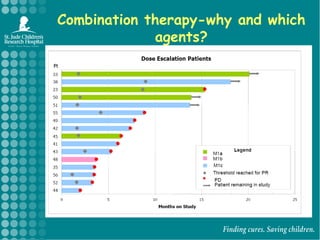
Combination therapy-why and which agents?One year, Dr. Flaherty thought, when he heard the news. Certainly no triumph. But it was something. Something to be built on.''We just need,'' Dr. Flaherty said, ''to find the right combination.''
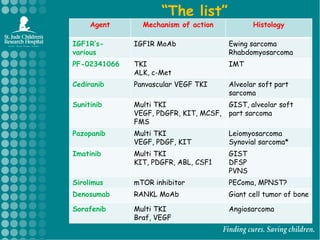
“The list”
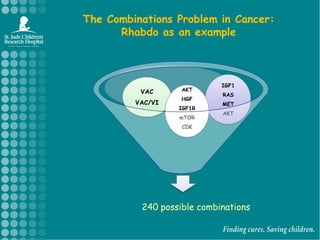
The Combinations Problem in Cancer: Rhabdo as an example
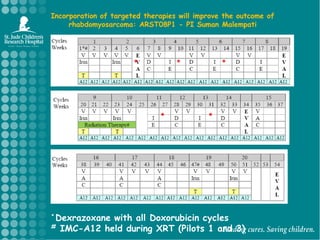
Incorporation of targeted therapies will improve the outcome of rhabdomyosarcoma: ARST08P1 - PI Suman Malempati****** Dexrazoxane with all Doxorubicin cycles# IMC-A12 held during XRT (Pilots 1 and 3)
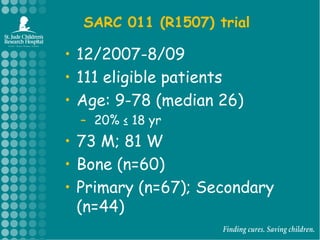
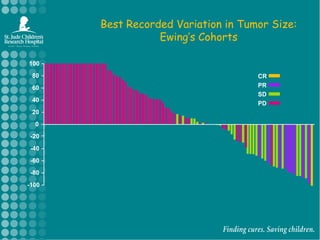
SARC 011 (R1507) trial12/2007-8/09111 eligible patientsAge: 9-78 (median 26) 20% ≤ 18 yr73 M; 81 WBone (n=60)Primary (n=67); Secondary (n=44)

Soft Tissue Sarcomas