Bone Tumors
Dr. Sudarshan Pandey
First year Resident
Department of Orthopaedics and Traumatology
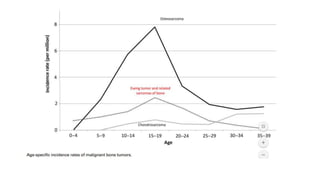
Epidemiology
• Bone and soft tissue sarcoma – derived from mesenchymal origin
• Bone sarcoma – 0.2%
• Male > Female
• Age – male >85 years , female- 50-60 years
Epidemiology
Classification
• Benign lesion
• Non ossifying fibroma
• Aneurysmal bone cyst
• Intermediate (locally aggressive) lesion
• Osteoblastoma
Classifications
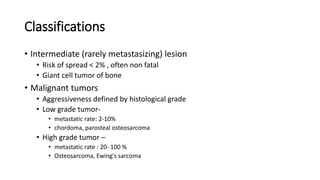
• Intermediate (rarely metastasizing) lesion
• Risk of spread < 2% , often non fatal
• Giant cell tumor of bone
• Malignant tumors
• Aggressiveness defined by histological grade
• Low grade tumor-
• metastatic rate: 2-10%
• chordoma, parosteal osteosarcoma
• High grade tumor –
• metastatic rate : 20- 100 %
• Osteosarcoma, Ewing's sarcoma
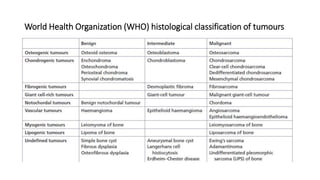
World Health Organization (WHO) histological classification of tumours
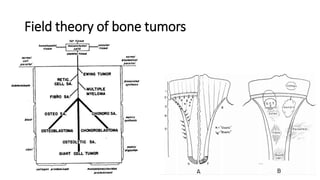
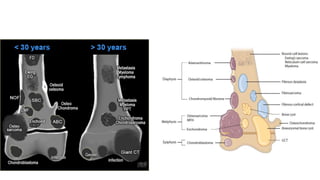
Field theory of bone tumors
General approach
• History- patient information, Pain , Mass
• Examination
• Investigation
• Imaging ( X rays , CT , MRI , Radionuclide scanning)
• Systemic evaluation ( in case of secondaries)
• PSA, Bence- Jones protein, Serum Calcium, ALP
• ESR , CRP
• Biopsy – gold standard
Clinical Presentation
• Asymptomatic
• Pain
• Swelling/mass
All superficial soft tissue lesions measuring >5cm and all deep seated lesions
should be considered a sarcoma until proven otherwise
• Pathological fractures
• Systemic findings
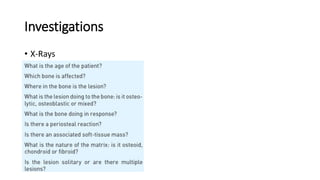
Investigations
• X-Rays
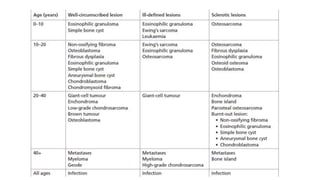
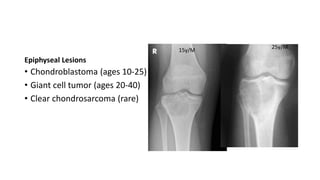
Epiphyseal Lesions
• Chondroblastoma (ages 10-25)
• Giant cell tumor (ages 20-40)
• Clear chondrosarcoma (rare)
15y/M
25y/M
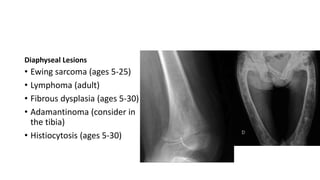
• Ewing sarcoma (ages 5-25)
• Lymphoma (adult)
• Fibrous dysplasia (ages 5-30)
• Adamantinoma (consider in
the tibia)
• Histiocytosis (ages 5-30)
Diaphyseal Lesions
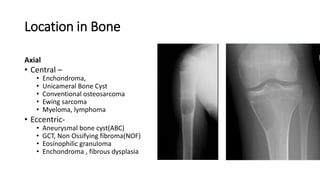
Location in Bone
Axial
• Central –
• Enchondroma,
• Unicameral Bone Cyst
• Conventional osteosarcoma
• Ewing sarcoma
• Myeloma, lymphoma
• Eccentric-
• Aneurysmal bone cyst(ABC)
• GCT, Non Ossifying fibroma(NOF)
• Eosinophilic granuloma
• Enchondroma , fibrous dysplasia
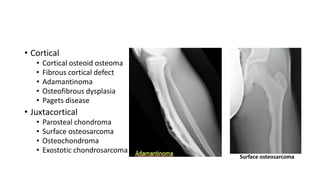
• Cortical
• Cortical osteoid osteoma
• Fibrous cortical defect
• Adamantinoma
• Osteofibrous dysplasia
• Pagets disease
• Juxtacortical
• Parosteal chondroma
• Surface osteosarcoma
• Osteochondroma
• Exostotic chondrosarcoma
Surface osteosarcoma
Radiographic features
• Lesion margin
• Periosteal reaction
• Mineralized matrix
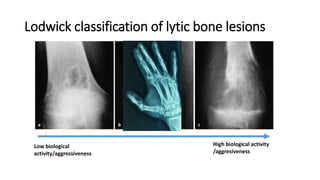
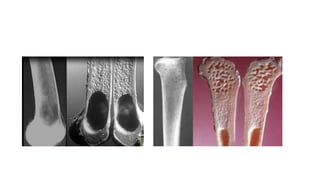
Lodwick classification of lytic bone lesions
Low biological
activity/aggressiveness
High biological activity
/aggresiveness
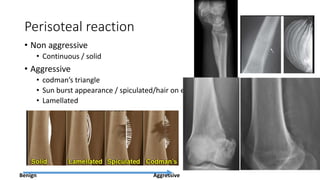
Perisoteal reaction
• Non aggressive
• Continuous / solid
• Aggressive
• codman’s triangle
• Sun burst appearance / spiculated/hair on end
• Lamellated
Benign Aggressive
Mineralized matrix
• Osteoid
• Chondroid
• Fibrous
Lesions of the Spine
Older than 40 Years
• Metastases
Vertebral body, pelvis
Proximal femur, proximal humerus
skull
• Multiple myeloma
• Hemangioma
• Chordoma (in sacrum)
Younger than 30 Years
Vertebral body
• Histiocytosis
• Hemangioma
Posterior elements
• Osteoid osteoma
• Osteoblastoma
• Aneurysmal bone cyst
Multiple Lesions
• Histiocytosis
• Enchondroma
• Osteochondroma
• Fibrous dysplasia
• Multiple myeloma
• Metastases
• Hemangioma
• Infection
• Hyperparathyroidism
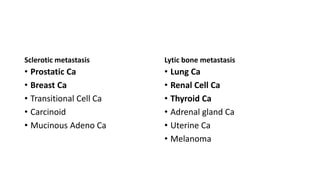
Sclerotic metastasis
• Prostatic Ca
• Breast Ca
• Transitional Cell Ca
• Carcinoid
• Mucinous Adeno Ca
Lytic bone metastasis
• Lung Ca
• Renal Cell Ca
• Thyroid Ca
• Adrenal gland Ca
• Uterine Ca
• Melanoma
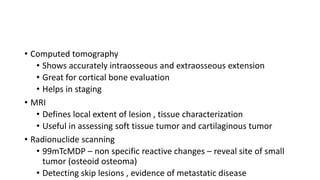
• Computed tomography
• Shows accurately intraosseous and extraosseous extension
• Great for cortical bone evaluation
• Helps in staging
• MRI
• Defines local extent of lesion , tissue characterization
• Useful in assessing soft tissue tumor and cartilaginous tumor
• Radionuclide scanning
• 99mTcMDP – non specific reactive changes – reveal site of small
tumor (osteoid osteoma)
• Detecting skip lesions , evidence of metastatic disease
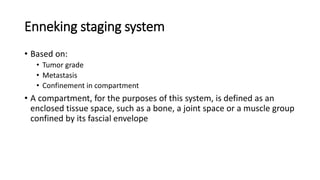
Enneking staging system
• Based on:
• Tumor grade
• Metastasis
• Confinement in compartment
• A compartment, for the purposes of this system, is defined as an
enclosed tissue space, such as a bone, a joint space or a muscle group
confined by its fascial envelope
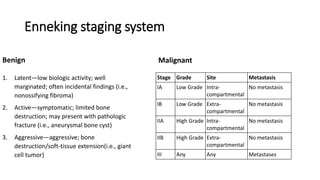
Enneking staging system
Malignant
Stage Grade Site Metastasis
IA Low Grade Intra-
compartmental
No metastasis
IB Low Grade Extra-
compartmental
No metastasis
IIA High Grade Intra-
compartmental
No metastasis
IIB High Grade Extra-
compartmental
No metastasis
III Any Any Metastases
Benign
1. Latent—low biologic activity; well
marginated; often incidental findings (i.e.,
nonossifying fibroma)
2. Active—symptomatic; limited bone
destruction; may present with pathologic
fracture (i.e., aneurysmal bone cyst)
3. Aggressive—aggressive; bone
destruction/soft-tissue extension(i.e., giant
cell tumor)
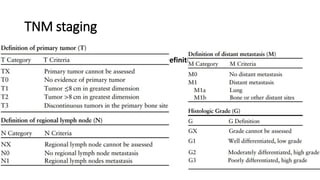
TNM staging
Definition of regional lymph node (N)
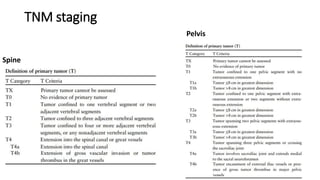
TNM staging
Spine
Pelvis
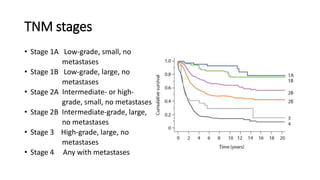
TNM stages
• Stage 1A Low-grade, small, no
metastases
• Stage 1B Low-grade, large, no
metastases
• Stage 2A Intermediate- or high-
grade, small, no metastases
• Stage 2B Intermediate-grade, large,
no metastases
• Stage 3 High-grade, large, no
metastases
• Stage 4 Any with metastases
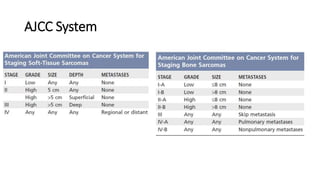
AJCC System
Biopsy-Principles
• Referred to the institution where definitive treatment will take place.
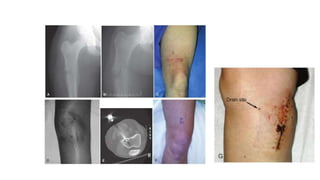
• Should be done after clinical, lab and radiographic examinations
• Planned placement of biopsy incision
• biopsy track should be considered contaminated with tumor cells
• biopsy track needs to be excised en bloc with the tumor
• The surgeon performing the biopsy should be familiar with incisions
for limb salvage surgery and standard and nonstandard amputation
flaps
Biopsy- Principles
• If a tourniquet is used, the limb elevated before inflation but should
not be exsanguinated by compression to prevent “squeezing” the
tumor’s cells into the systemic circulation
• Transverse incisions should be avoided
• The deep incision should go through single muscle compartment
• Avoid major neurovascular structure
• Soft tissue extension of bone lesion should be sampled
Biopsy- Principles
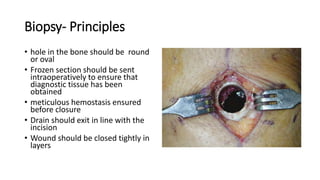
• hole in the bone should be round
or oval
• Frozen section should be sent
intraoperatively to ensure that
diagnostic tissue has been
obtained
• meticulous hemostasis ensured
before closure
• Drain should exit in line with the
incision
• Wound should be closed tightly in
layers
Biopsy- Principles
• Sample should be sent for microbiology as well as histology
• The pathologist reporting biopsy must have an appropriate level of
experience
• If risk of fracture following biopsy, bone must be splinted
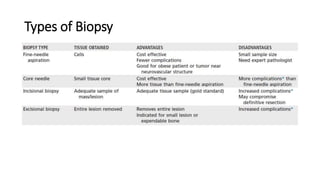
Types of Biopsy
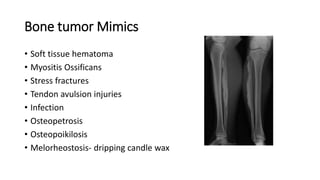
Bone tumor Mimics
• Soft tissue hematoma
• Myositis Ossificans
• Stress fractures
• Tendon avulsion injuries
• Infection
• Osteopetrosis
• Osteopoikilosis
• Melorheostosis- dripping candle wax
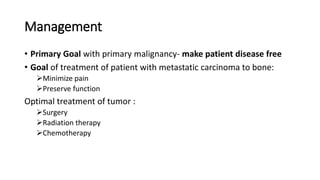
Management
• Primary Goal with primary malignancy- make patient disease free
• Goal of treatment of patient with metastatic carcinoma to bone:
Minimize pain
Preserve function
Optimal treatment of tumor :
Surgery
Radiation therapy
Chemotherapy
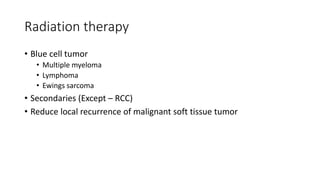
Radiation therapy
• Blue cell tumor
• Multiple myeloma
• Lymphoma
• Ewings sarcoma
• Secondaries (Except – RCC)
• Reduce local recurrence of malignant soft tissue tumor
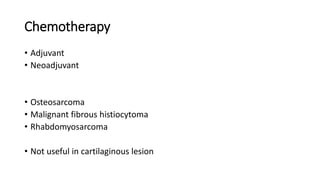
Chemotherapy
• Adjuvant
• Neoadjuvant
• Osteosarcoma
• Malignant fibrous histiocytoma
• Rhabdomyosarcoma
• Not useful in cartilaginous lesion
Principles of Surgery
• Amputation vs Limb salvage
1. Survival?
2. Morbidity ?
3. Salvaged limb vs prosthesis
4. Psychosocial conseuences
References
• Campbell’s Operative Orthopaedics -13th edition
• Apley and Solomon’s System of Orthopaedics and Trauma -10th
edition
• Millers Review of Orthopedics- 7th edition
Thank you

Bone tumor final

  • 1.
    Bone Tumors Dr. SudarshanPandey First year Resident Department of Orthopaedics and Traumatology
  • 2.
    Epidemiology • Bone andsoft tissue sarcoma – derived from mesenchymal origin • Bone sarcoma – 0.2% • Male > Female • Age – male >85 years , female- 50-60 years
  • 3.
  • 4.
    Classification • Benign lesion •Non ossifying fibroma • Aneurysmal bone cyst • Intermediate (locally aggressive) lesion • Osteoblastoma
  • 5.
    Classifications • Intermediate (rarelymetastasizing) lesion • Risk of spread < 2% , often non fatal • Giant cell tumor of bone • Malignant tumors • Aggressiveness defined by histological grade • Low grade tumor- • metastatic rate: 2-10% • chordoma, parosteal osteosarcoma • High grade tumor – • metastatic rate : 20- 100 % • Osteosarcoma, Ewing's sarcoma
  • 6.
    World Health Organization(WHO) histological classification of tumours
  • 8.
    Field theory ofbone tumors
  • 9.
    General approach • History-patient information, Pain , Mass • Examination • Investigation • Imaging ( X rays , CT , MRI , Radionuclide scanning) • Systemic evaluation ( in case of secondaries) • PSA, Bence- Jones protein, Serum Calcium, ALP • ESR , CRP • Biopsy – gold standard
  • 12.
    Clinical Presentation • Asymptomatic •Pain • Swelling/mass All superficial soft tissue lesions measuring >5cm and all deep seated lesions should be considered a sarcoma until proven otherwise • Pathological fractures • Systemic findings
  • 13.
  • 14.
    Epiphyseal Lesions • Chondroblastoma(ages 10-25) • Giant cell tumor (ages 20-40) • Clear chondrosarcoma (rare) 15y/M 25y/M
  • 15.
    • Ewing sarcoma(ages 5-25) • Lymphoma (adult) • Fibrous dysplasia (ages 5-30) • Adamantinoma (consider in the tibia) • Histiocytosis (ages 5-30) Diaphyseal Lesions
  • 16.
    Location in Bone Axial •Central – • Enchondroma, • Unicameral Bone Cyst • Conventional osteosarcoma • Ewing sarcoma • Myeloma, lymphoma • Eccentric- • Aneurysmal bone cyst(ABC) • GCT, Non Ossifying fibroma(NOF) • Eosinophilic granuloma • Enchondroma , fibrous dysplasia
  • 17.
    • Cortical • Corticalosteoid osteoma • Fibrous cortical defect • Adamantinoma • Osteofibrous dysplasia • Pagets disease • Juxtacortical • Parosteal chondroma • Surface osteosarcoma • Osteochondroma • Exostotic chondrosarcoma Surface osteosarcoma
  • 18.
    Radiographic features • Lesionmargin • Periosteal reaction • Mineralized matrix
  • 19.
    Lodwick classification oflytic bone lesions Low biological activity/aggressiveness High biological activity /aggresiveness
  • 21.
    Perisoteal reaction • Nonaggressive • Continuous / solid • Aggressive • codman’s triangle • Sun burst appearance / spiculated/hair on end • Lamellated Benign Aggressive
  • 22.
  • 23.
    Lesions of theSpine Older than 40 Years • Metastases Vertebral body, pelvis Proximal femur, proximal humerus skull • Multiple myeloma • Hemangioma • Chordoma (in sacrum) Younger than 30 Years Vertebral body • Histiocytosis • Hemangioma Posterior elements • Osteoid osteoma • Osteoblastoma • Aneurysmal bone cyst
  • 24.
    Multiple Lesions • Histiocytosis •Enchondroma • Osteochondroma • Fibrous dysplasia • Multiple myeloma • Metastases • Hemangioma • Infection • Hyperparathyroidism
  • 25.
    Sclerotic metastasis • ProstaticCa • Breast Ca • Transitional Cell Ca • Carcinoid • Mucinous Adeno Ca Lytic bone metastasis • Lung Ca • Renal Cell Ca • Thyroid Ca • Adrenal gland Ca • Uterine Ca • Melanoma
  • 26.
    • Computed tomography •Shows accurately intraosseous and extraosseous extension • Great for cortical bone evaluation • Helps in staging • MRI • Defines local extent of lesion , tissue characterization • Useful in assessing soft tissue tumor and cartilaginous tumor • Radionuclide scanning • 99mTcMDP – non specific reactive changes – reveal site of small tumor (osteoid osteoma) • Detecting skip lesions , evidence of metastatic disease
  • 27.
    Enneking staging system •Based on: • Tumor grade • Metastasis • Confinement in compartment • A compartment, for the purposes of this system, is defined as an enclosed tissue space, such as a bone, a joint space or a muscle group confined by its fascial envelope
  • 28.
    Enneking staging system Malignant StageGrade Site Metastasis IA Low Grade Intra- compartmental No metastasis IB Low Grade Extra- compartmental No metastasis IIA High Grade Intra- compartmental No metastasis IIB High Grade Extra- compartmental No metastasis III Any Any Metastases Benign 1. Latent—low biologic activity; well marginated; often incidental findings (i.e., nonossifying fibroma) 2. Active—symptomatic; limited bone destruction; may present with pathologic fracture (i.e., aneurysmal bone cyst) 3. Aggressive—aggressive; bone destruction/soft-tissue extension(i.e., giant cell tumor)
  • 29.
    TNM staging Definition ofregional lymph node (N)
  • 30.
  • 31.
    TNM stages • Stage1A Low-grade, small, no metastases • Stage 1B Low-grade, large, no metastases • Stage 2A Intermediate- or high- grade, small, no metastases • Stage 2B Intermediate-grade, large, no metastases • Stage 3 High-grade, large, no metastases • Stage 4 Any with metastases
  • 32.
  • 33.
    Biopsy-Principles • Referred tothe institution where definitive treatment will take place. • Should be done after clinical, lab and radiographic examinations • Planned placement of biopsy incision • biopsy track should be considered contaminated with tumor cells • biopsy track needs to be excised en bloc with the tumor • The surgeon performing the biopsy should be familiar with incisions for limb salvage surgery and standard and nonstandard amputation flaps
  • 34.
    Biopsy- Principles • Ifa tourniquet is used, the limb elevated before inflation but should not be exsanguinated by compression to prevent “squeezing” the tumor’s cells into the systemic circulation • Transverse incisions should be avoided • The deep incision should go through single muscle compartment • Avoid major neurovascular structure • Soft tissue extension of bone lesion should be sampled
  • 35.
    Biopsy- Principles • holein the bone should be round or oval • Frozen section should be sent intraoperatively to ensure that diagnostic tissue has been obtained • meticulous hemostasis ensured before closure • Drain should exit in line with the incision • Wound should be closed tightly in layers
  • 36.
    Biopsy- Principles • Sampleshould be sent for microbiology as well as histology • The pathologist reporting biopsy must have an appropriate level of experience • If risk of fracture following biopsy, bone must be splinted
  • 37.
  • 39.
    Bone tumor Mimics •Soft tissue hematoma • Myositis Ossificans • Stress fractures • Tendon avulsion injuries • Infection • Osteopetrosis • Osteopoikilosis • Melorheostosis- dripping candle wax
  • 40.
    Management • Primary Goalwith primary malignancy- make patient disease free • Goal of treatment of patient with metastatic carcinoma to bone: Minimize pain Preserve function Optimal treatment of tumor : Surgery Radiation therapy Chemotherapy
  • 41.
    Radiation therapy • Bluecell tumor • Multiple myeloma • Lymphoma • Ewings sarcoma • Secondaries (Except – RCC) • Reduce local recurrence of malignant soft tissue tumor
  • 42.
    Chemotherapy • Adjuvant • Neoadjuvant •Osteosarcoma • Malignant fibrous histiocytoma • Rhabdomyosarcoma • Not useful in cartilaginous lesion
  • 43.
    Principles of Surgery •Amputation vs Limb salvage 1. Survival? 2. Morbidity ? 3. Salvaged limb vs prosthesis 4. Psychosocial conseuences
  • 44.
    References • Campbell’s OperativeOrthopaedics -13th edition • Apley and Solomon’s System of Orthopaedics and Trauma -10th edition • Millers Review of Orthopedics- 7th edition
  • 45.

Editor's Notes

  • #3 Bone sarcoma – 0.2% of all new cancers diagnosed UK , Appleys
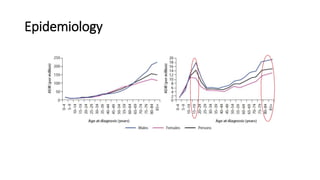
  • #4 Age-specific incidence rates (ASIR) for soft-tissue sarcomas and primary sarcomas of bone (a) Softtissue sarcomas in the UK 1996–2010; (b) primary bone sarcomas in the UK for the same period (National Cancer Intelligence Network (NICN) data). bone sarcomas demonstrate a bimodal distribution in both males and females, with peaks of incidence seen in both teenage/adolescent years and the elderly
  • #5 Benign – doesn’t invade and spread surrounding tissue, non destructive , surgical resection – curative Osteoblastoma – infiltrative and locally destructive growth pattern – en bloc resection – curative
  • #6 Higher grade tumor have > 25% chance of local recurrence and distant spread Low grade lesion< 25 % chance of local recurrence and mets
  • #9 IF tumors are analyzed, there is preferential sites of origin within each bone. A particular tumor of given cell type usually arises in the field where homologous normal cells are most active . Eg GCT
  • #10 Age , Sex (GCT: F>M), Race , Hereditary – Multiple hereditary exostosis AD
  • #11 Katanoda, K., Shibata, A., Matsuda, T., Hori, M., Nakata, K., Narita, Y., … Nishimoto, H. (2017). Childhood, adolescent and young adult cancer incidence in Japan in 2009–2011. Japanese Journal of Clinical Oncology, 47(8), 762–771
  • #12 CMF = Chondromyxoid fibroma SBC = Simple Bone Cyst EG = Eosinophilic Granuloma FD = Fibrous dysplasia HPT = Hyperparathyroidism with Brown tumor
  • #13 Pain – night pain referred pain Pathological fractures – 5-12% osteosarcoma , 21% in chondrosarcoma s/c # of femur in children, avulsion # of L/T in adults – bone tumors
  • #16 Very little trabecular bone in the diaphysis to provide an interface to allow the lesion to be seen
  • #17 Simple Bone Cyst /unicameral bone cyst
  • #21 If diaphyseal lesion is on radiograph cortex is involved , large medullary cavity diaphyseal lesion may be invisible d/t little trabecular bone in diaphysis to provide interface to allow lesion to be seen
  • #22 Osteoid osteoma
  • #27 99mTcMDP – methyl diphosphonate
  • #29 aid in treatment decision making, provide some determination of prognosis, and allow meaningful comparisons of treatment methods.
  • #30 A compartment, for the purposes of this system, is defined as an enclosed tissue space, such as a bone, a joint space or a muscle group confined by its fascial envelope Low grade : well differentiated , few mitoses and exibit moderate cytological atypia , risk of mets<25% High grade : high cell to matrix ratio A: well defined anatomical compartment (cortex, joint capsule , fascial septa)
  • #31 Tumor node metastasis staging- applied to primary sarcomas of bone
  • #34 AJCC System – based on prognostic variables Stage I- low grade , II high grade Skip metastasis – discontinuous lesion within the same bone Since the patient with non pulmonary metastasis from osteosarcoma and ewings sarcoma have worse prognosis than with pulmonary mets
  • #36 Raw area is covered with bone wax or methylmethacrylate cement to reduce bleeding , contamination from cut bone edge because they are extremely difficult or impossible to excise with the specimen single muscle compartment rather than contaminating an intermuscular plane
  • #37 round or oval to minimize stress concentration and prevent a subsequent fracture The hole should be plugged with methacrylate to limit hematoma formation. meticulous hemostasis ensured before closure, because a hematoma would be contaminated with tumor cells Drain should exit in line with the incision so that the drain track also can be easily excised en bloc with the tumor
  • #39 Complications : infection , bleeding/hematoma , pathological fracture , tumor contamination and seeding FNAC : 90% accurate in dx malignancy Core needle biopsy : accuracy 84-98% Excisional biopsy : <3cm , sc mass , unlikely malignant – osteoid osteoma , osteochondroma Painful lesion in proximal fibula and distal ulna
  • #41 Large opacification on medial thigh separate from femur Osteopetrosis – Marble bone disease- confused with sclerotic metastates from breasr and prostate ca , Pagets disease Osteopoikilosis- AD sclerosing bone dysplasia formation of multiple bone island Melorheostosis- mesenchymal dysplasia – widening and sclerosing of cortices in sclerotomal distribution
  • #44 Adjuvant chemotherapy refers to chemotherapy administered postoperatively to treat presumed micrometastases. Neoadjuvant chemotherapy refers to chemotherapy administered before surgical resection of the primary tumor