Tumor Board
20/02/2018
PATIENT DETAILS
• Age/Sex : 70/Male
• Hospital OP/ IP No: A18005479
• Biopsy No: 78/18
• Date Of Receiving Specimen : 9/1/2018
• Clinical Diagnosis : Soft tissue tumor right leg
• Nature of Specimen : Trucut Biopsy from lesion on
right leg.
.
Gross Examination
Received multiple (four) linear grey white soft
tissue fragments, each measuring 0.8cm in length.
All embedded.
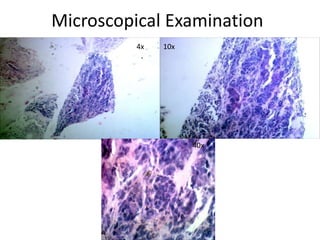
Microscopical Examination
4x 10x
40x
Microscopical Examination
4x
10x 40x
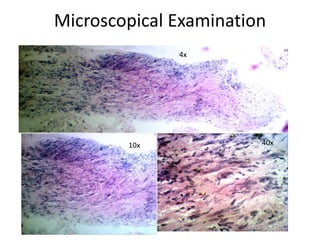
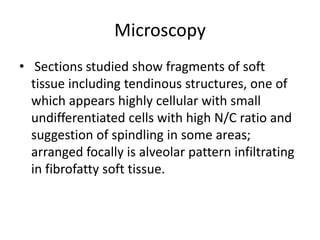
Microscopy
• Sections studied show fragments of soft
tissue including tendinous structures, one of
which appears highly cellular with small
undifferentiated cells with high N/C ratio and
suggestion of spindling in some areas;
arranged focally is alveolar pattern infiltrating
in fibrofatty soft tissue.
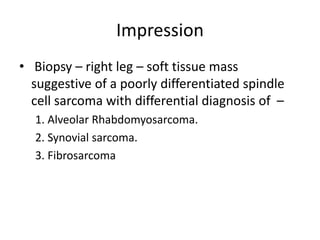
Impression
• Biopsy – right leg – soft tissue mass
suggestive of a poorly differentiated spindle
cell sarcoma with differential diagnosis of –
1. Alveolar Rhabdomyosarcoma.
2. Synovial sarcoma.
3. Fibrosarcoma
PATIENT DETAILS
• Age/Sex : 70/Male
• Hospital OP/ IP No: A18005479
• FNAC No: 12/18
• Date Of FNAC: 12/01/2018
• Clinical Diagnosis : Soft tissue sarcoma right leg
• Site of FNAC - Right inguinal lymph node.
.
Microscopical Examination
• Scanty cellular smear comprising of scattered
lymphocytes , eosinophils and occasional
polymorphs in the background of dense
hemorrhage.
Impression
• Inadequate smear for evaluation.
• No definite opinion possible.
• Advised USG Guided FNAC.
PATIENT DETAILS
• Age/Sex : 70/Male
• Hospital OP/ IP No: A18005479
• Biopsy No: Fro 1/18
• Date Of Receiving Specimen : 2/2/2018
• Clinical Diagnosis : Soft tissue sarcoma
• Nature of Specimen : Vertical group of right inguinal
lymph nodes
.
Gross Examination
• Received two lymph nodes, largest measuring
3 x 2 x 1 cm and the smallest measuring 1 x
0.5 x 0.5 cm.
Microscopical Examination
• Section studied from frozen section of lymph
nodes (A,B and C) appear free of tumor.
• The rest of the morphology of lymph node
will be commented on routine paraffin
embedded sections.
PATIENT DETAILS
• Age/Sex : 70/Male
• Hospital OP/ IP No: A18005479
• Biopsy No: Fro 2/18
• Date Of Biopsy : 2/2/2018
• Clinical Diagnosis : Soft Tissue Sarcoma
• Nature of Specimen - Wide local excision of tumor
from right leg.
.
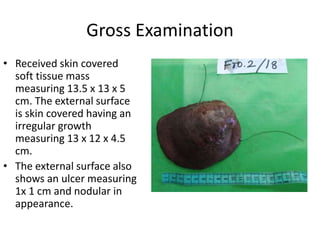
Gross Examination
• Received skin covered
soft tissue mass
measuring 13.5 x 13 x 5
cm. The external surface
is skin covered having an
irregular growth
measuring 13 x 12 x 4.5
cm.
• The external surface also
shows an ulcer measuring
1x 1 cm and nodular in
appearance.
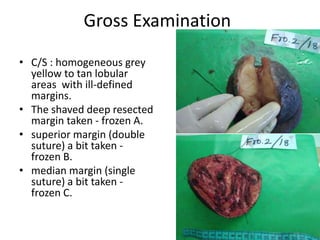
Gross Examination
• C/S : homogeneous grey
yellow to tan lobular
areas with ill-defined
margins.
• The shaved deep resected
margin taken - frozen A.
• superior margin (double
suture) a bit taken -
frozen B.
• median margin (single
suture) a bit taken -
frozen C.
Microscopical Examination
Sections studied from A, B and C show shaved deep resected,
superior and medial margins are respectively free of tumor.
PATIENT DETAILS
• Age/Sex : 70/Male
• Hospital OP/ IP No: A18005479
• Biopsy No: 272/18 and 273/18
• Date Of Receiving Specimen : 2/2/2018
• Clinical Diagnosis : Soft tissue sarcoma Right leg.
• Nature of Specimen : Wide local excision of soft
tissue Sarcoma Right leg.
.
Gross Examination
272/18 - Container labelled vertical group of inguinal
lymph nodes:
• Received two lymph nodes, the largest measuring
3x2x1cm and the smallest measuring 0.5x0.5cm.
• All embedded in A to H
Gross Examination
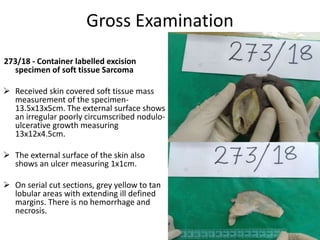
273/18 - Container labelled excision
specimen of soft tissue Sarcoma
 Received skin covered soft tissue mass
measurement of the specimen-
13.5x13x5cm. The external surface shows
an irregular poorly circumscribed nodulo-
ulcerative growth measuring
13x12x4.5cm.
 The external surface of the skin also
shows an ulcer measuring 1x1cm.
 On serial cut sections, grey yellow to tan
lobular areas with extending ill defined
margins. There is no hemorrhage and
necrosis.
Gross Examination
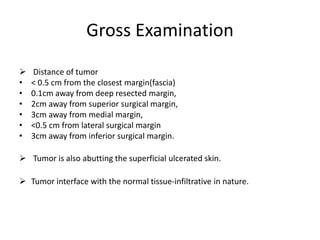
 Distance of tumor
• < 0.5 cm from the closest margin(fascia)
• 0.1cm away from deep resected margin,
• 2cm away from superior surgical margin,
• 3cm away from medial margin,
• <0.5 cm from lateral surgical margin
• 3cm away from inferior surgical margin.
 Tumor is also abutting the superficial ulcerated skin.
 Tumor interface with the normal tissue-infiltrative in nature.
Microscopical Examination
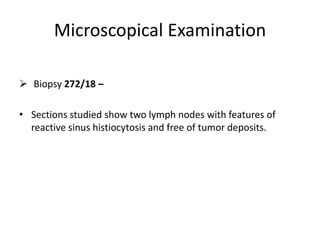
 Biopsy 272/18 –
• Sections studied show two lymph nodes with features of
reactive sinus histiocytosis and free of tumor deposits.
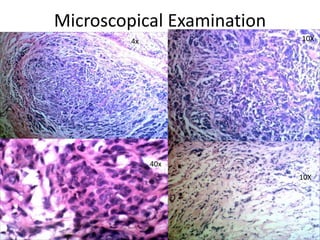
Microscopical Examination
4x 10X
40X
10X
40x
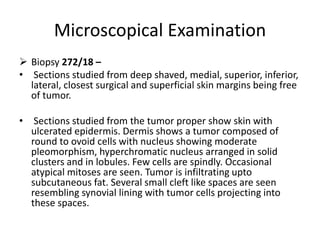
Microscopical Examination
 Biopsy 272/18 –
• Sections studied from deep shaved, medial, superior, inferior,
lateral, closest surgical and superficial skin margins being free
of tumor.
• Sections studied from the tumor proper show skin with
ulcerated epidermis. Dermis shows a tumor composed of
round to ovoid cells with nucleus showing moderate
pleomorphism, hyperchromatic nucleus arranged in solid
clusters and in lobules. Few cells are spindly. Occasional
atypical mitoses are seen. Tumor is infiltrating upto
subcutaneous fat. Several small cleft like spaces are seen
resembling synovial lining with tumor cells projecting into
these spaces.
Impression
•Excision biopsy from soft tissue of right leg are with features of
a Malignant Spindle cell Soft tissue Sarcoma. The pattern seen is
more in favour of Synovial Sarcoma than fibrosarcoma.
•Two vertical inguinal group of lymph nodes are free of tumor.
•All the surgical margins are free of tumor.
DISCUSSION
SYNOVIAL SARCOMA
• Typically found in adolescents or young adults but can occur
at any age.
• Presents as a deep-seated, often painful mass; has often been
present for years.
• Usually arises near the joint in close relation to tendons and
bursa but not in the joint space itself.
• Lower extremities are commonly affected.
• Synovial sarcoma has been described in virtually every
location, including viscera.
SYNOVIAL SARCOMA
Special Stains & IHC
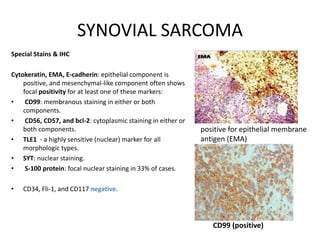
Cytokeratin, EMA, E-cadherin: epithelial component is
positive, and mesenchymal-like component often shows
focal positivity for at least one of these markers:
• CD99: membranous staining in either or both
components.
• CD56, CD57, and bcl-2: cytoplasmic staining in either or
both components.
• TLE1 - a highly sensitive (nuclear) marker for all
morphologic types.
• SYT: nuclear staining.
• S-100 protein: focal nuclear staining in 33% of cases.
• CD34, Fli-1, and CD117 negative.
CD99 (positive)
positive for epithelial membrane
antigen (EMA)
SYNOVIAL SARCOMA
Other Techniques for Diagnosis
Presence of t(X;18)(p11;q11) can be demonstrated in greater
than 90% of synovial sarcomas by cytogenetic or molecular
techniques; fusion genes are SYT-SSX1/SSX2 or SSX4.
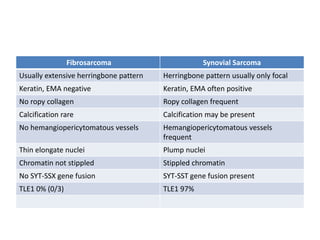
Fibrosarcoma Synovial Sarcoma
Usually extensive herringbone pattern Herringbone pattern usually only focal
Keratin, EMA negative Keratin, EMA often positive
No ropy collagen Ropy collagen frequent
Calcification rare Calcification may be present
No hemangiopericytomatous vessels Hemangiopericytomatous vessels
frequent
Thin elongate nuclei Plump nuclei
Chromatin not stippled Stippled chromatin
No SYT-SSX gene fusion SYT-SST gene fusion present
TLE1 0% (0/3) TLE1 97%
SYNOVIAL SARCOMA
Synovial sarcoma is an aggressive tumor that is frequently
complicated by distant metastasis to the lungs and lymph
nodes; which may be manifested late in the course of disease
Prognostic Factors
• Favorable prognostic characteristics include
• age younger than 25 years
• tumor size less than 5 cm.
• low mitotic rate.
• heavy calcification.
Prognostic Factors
The following factors indicate poor prognosis–
• More than 5 cm size.
• Presence of neurovascular invasion.
• Lower extremity tumour location.
• Grade 3 nuclei
• Presence of rhabdoid cells.
• More than 10 mitosis/ 10 HPF.
• Atleast 20% of tumour shows poorly differentiated areas.
• Overexpression of p53.
• High Ki-67 proliferation index.

Tumor board 20/02/2018

  • 1.
  • 2.
    PATIENT DETAILS • Age/Sex: 70/Male • Hospital OP/ IP No: A18005479 • Biopsy No: 78/18 • Date Of Receiving Specimen : 9/1/2018 • Clinical Diagnosis : Soft tissue tumor right leg • Nature of Specimen : Trucut Biopsy from lesion on right leg. .
  • 3.
    Gross Examination Received multiple(four) linear grey white soft tissue fragments, each measuring 0.8cm in length. All embedded.
  • 4.
  • 5.
  • 6.
    Microscopy • Sections studiedshow fragments of soft tissue including tendinous structures, one of which appears highly cellular with small undifferentiated cells with high N/C ratio and suggestion of spindling in some areas; arranged focally is alveolar pattern infiltrating in fibrofatty soft tissue.
  • 7.
    Impression • Biopsy –right leg – soft tissue mass suggestive of a poorly differentiated spindle cell sarcoma with differential diagnosis of – 1. Alveolar Rhabdomyosarcoma. 2. Synovial sarcoma. 3. Fibrosarcoma
  • 8.
    PATIENT DETAILS • Age/Sex: 70/Male • Hospital OP/ IP No: A18005479 • FNAC No: 12/18 • Date Of FNAC: 12/01/2018 • Clinical Diagnosis : Soft tissue sarcoma right leg • Site of FNAC - Right inguinal lymph node. .
  • 9.
    Microscopical Examination • Scantycellular smear comprising of scattered lymphocytes , eosinophils and occasional polymorphs in the background of dense hemorrhage.
  • 10.
    Impression • Inadequate smearfor evaluation. • No definite opinion possible. • Advised USG Guided FNAC.
  • 11.
    PATIENT DETAILS • Age/Sex: 70/Male • Hospital OP/ IP No: A18005479 • Biopsy No: Fro 1/18 • Date Of Receiving Specimen : 2/2/2018 • Clinical Diagnosis : Soft tissue sarcoma • Nature of Specimen : Vertical group of right inguinal lymph nodes .
  • 12.
    Gross Examination • Receivedtwo lymph nodes, largest measuring 3 x 2 x 1 cm and the smallest measuring 1 x 0.5 x 0.5 cm.
  • 13.
    Microscopical Examination • Sectionstudied from frozen section of lymph nodes (A,B and C) appear free of tumor. • The rest of the morphology of lymph node will be commented on routine paraffin embedded sections.
  • 14.
    PATIENT DETAILS • Age/Sex: 70/Male • Hospital OP/ IP No: A18005479 • Biopsy No: Fro 2/18 • Date Of Biopsy : 2/2/2018 • Clinical Diagnosis : Soft Tissue Sarcoma • Nature of Specimen - Wide local excision of tumor from right leg. .
  • 15.
    Gross Examination • Receivedskin covered soft tissue mass measuring 13.5 x 13 x 5 cm. The external surface is skin covered having an irregular growth measuring 13 x 12 x 4.5 cm. • The external surface also shows an ulcer measuring 1x 1 cm and nodular in appearance.
  • 16.
    Gross Examination • C/S: homogeneous grey yellow to tan lobular areas with ill-defined margins. • The shaved deep resected margin taken - frozen A. • superior margin (double suture) a bit taken - frozen B. • median margin (single suture) a bit taken - frozen C.
  • 17.
    Microscopical Examination Sections studiedfrom A, B and C show shaved deep resected, superior and medial margins are respectively free of tumor.
  • 18.
    PATIENT DETAILS • Age/Sex: 70/Male • Hospital OP/ IP No: A18005479 • Biopsy No: 272/18 and 273/18 • Date Of Receiving Specimen : 2/2/2018 • Clinical Diagnosis : Soft tissue sarcoma Right leg. • Nature of Specimen : Wide local excision of soft tissue Sarcoma Right leg. .
  • 19.
    Gross Examination 272/18 -Container labelled vertical group of inguinal lymph nodes: • Received two lymph nodes, the largest measuring 3x2x1cm and the smallest measuring 0.5x0.5cm. • All embedded in A to H
  • 20.
    Gross Examination 273/18 -Container labelled excision specimen of soft tissue Sarcoma  Received skin covered soft tissue mass measurement of the specimen- 13.5x13x5cm. The external surface shows an irregular poorly circumscribed nodulo- ulcerative growth measuring 13x12x4.5cm.  The external surface of the skin also shows an ulcer measuring 1x1cm.  On serial cut sections, grey yellow to tan lobular areas with extending ill defined margins. There is no hemorrhage and necrosis.
  • 21.
    Gross Examination  Distanceof tumor • < 0.5 cm from the closest margin(fascia) • 0.1cm away from deep resected margin, • 2cm away from superior surgical margin, • 3cm away from medial margin, • <0.5 cm from lateral surgical margin • 3cm away from inferior surgical margin.  Tumor is also abutting the superficial ulcerated skin.  Tumor interface with the normal tissue-infiltrative in nature.
  • 22.
    Microscopical Examination  Biopsy272/18 – • Sections studied show two lymph nodes with features of reactive sinus histiocytosis and free of tumor deposits.
  • 23.
  • 24.
    Microscopical Examination  Biopsy272/18 – • Sections studied from deep shaved, medial, superior, inferior, lateral, closest surgical and superficial skin margins being free of tumor. • Sections studied from the tumor proper show skin with ulcerated epidermis. Dermis shows a tumor composed of round to ovoid cells with nucleus showing moderate pleomorphism, hyperchromatic nucleus arranged in solid clusters and in lobules. Few cells are spindly. Occasional atypical mitoses are seen. Tumor is infiltrating upto subcutaneous fat. Several small cleft like spaces are seen resembling synovial lining with tumor cells projecting into these spaces.
  • 25.
    Impression •Excision biopsy fromsoft tissue of right leg are with features of a Malignant Spindle cell Soft tissue Sarcoma. The pattern seen is more in favour of Synovial Sarcoma than fibrosarcoma. •Two vertical inguinal group of lymph nodes are free of tumor. •All the surgical margins are free of tumor.
  • 26.
  • 27.
    SYNOVIAL SARCOMA • Typicallyfound in adolescents or young adults but can occur at any age. • Presents as a deep-seated, often painful mass; has often been present for years. • Usually arises near the joint in close relation to tendons and bursa but not in the joint space itself. • Lower extremities are commonly affected. • Synovial sarcoma has been described in virtually every location, including viscera.
  • 28.
    SYNOVIAL SARCOMA Special Stains& IHC Cytokeratin, EMA, E-cadherin: epithelial component is positive, and mesenchymal-like component often shows focal positivity for at least one of these markers: • CD99: membranous staining in either or both components. • CD56, CD57, and bcl-2: cytoplasmic staining in either or both components. • TLE1 - a highly sensitive (nuclear) marker for all morphologic types. • SYT: nuclear staining. • S-100 protein: focal nuclear staining in 33% of cases. • CD34, Fli-1, and CD117 negative. CD99 (positive) positive for epithelial membrane antigen (EMA)
  • 29.
    SYNOVIAL SARCOMA Other Techniquesfor Diagnosis Presence of t(X;18)(p11;q11) can be demonstrated in greater than 90% of synovial sarcomas by cytogenetic or molecular techniques; fusion genes are SYT-SSX1/SSX2 or SSX4.
  • 30.
    Fibrosarcoma Synovial Sarcoma Usuallyextensive herringbone pattern Herringbone pattern usually only focal Keratin, EMA negative Keratin, EMA often positive No ropy collagen Ropy collagen frequent Calcification rare Calcification may be present No hemangiopericytomatous vessels Hemangiopericytomatous vessels frequent Thin elongate nuclei Plump nuclei Chromatin not stippled Stippled chromatin No SYT-SSX gene fusion SYT-SST gene fusion present TLE1 0% (0/3) TLE1 97%
  • 31.
    SYNOVIAL SARCOMA Synovial sarcomais an aggressive tumor that is frequently complicated by distant metastasis to the lungs and lymph nodes; which may be manifested late in the course of disease
  • 32.
    Prognostic Factors • Favorableprognostic characteristics include • age younger than 25 years • tumor size less than 5 cm. • low mitotic rate. • heavy calcification.
  • 33.
    Prognostic Factors The followingfactors indicate poor prognosis– • More than 5 cm size. • Presence of neurovascular invasion. • Lower extremity tumour location. • Grade 3 nuclei • Presence of rhabdoid cells. • More than 10 mitosis/ 10 HPF. • Atleast 20% of tumour shows poorly differentiated areas. • Overexpression of p53. • High Ki-67 proliferation index.

Editor's Notes

  • #29 TLE1, an antibody derived from gene expression profiling studies, is emerging as a highly sensitive (nuclear) marker for synovial sarcoma of all morphologic types.