DIAGNOSTIC USE OF
SYNOPTOPHORE
Dr Azmat Khan
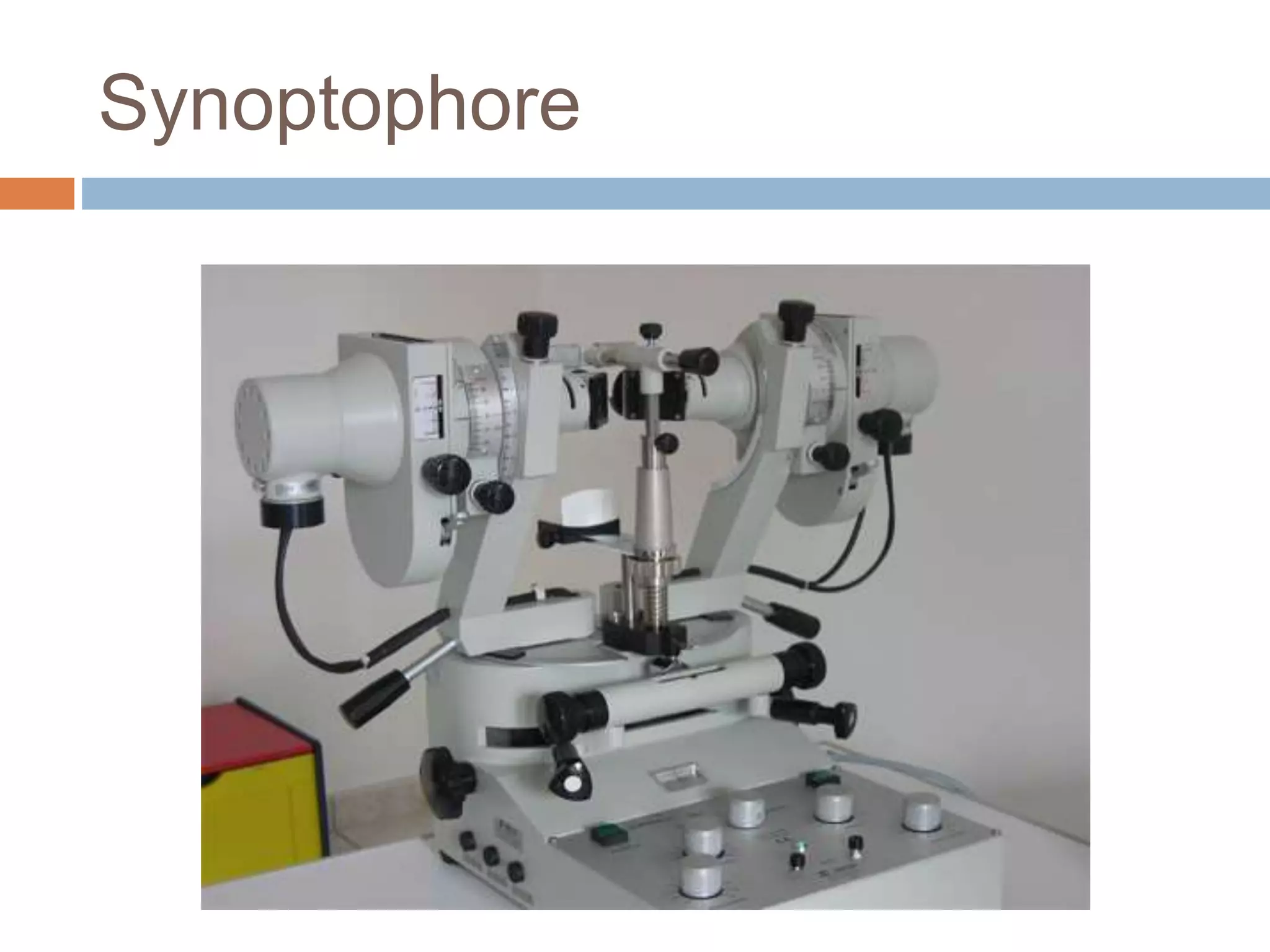
Synoptophore
SYNOPTOPHORE
A type of a telescope which both reflects and refracts
rays of light.
The optics are such that the instrument measures at
infinity
The instrument consists of two cylindrical tubes with a
mirrored right angle bend and containing in each eye
piece a + 6.50 D.S lens.
At the outer end of each tube there is a slide carrier into
which pictures are inserted, so that each eye is
stimulated by a separate image.
SYNOPTOPHORE optics
The total length of the tube is 15.5 cm which is
the focal length of a + 6.5 D.S. lens, therefore
the emergent rays are parallel giving the
appearance that the picture is at infinity.
No accommodation is required by the
patient when observing the pictures
SYNOPTOPHORE
The tubes are supported on columns in such a
way that the pictures may be moved in relation
to each other horizontally, vertically and
torsionally.
Therefore any horizontal, vertical or torsional
deviation can be measured in nine positions of
gaze.
The synoptophore can be converted to a near
test by adding – 3.00 D.S lenses to induce
accommodation
Synoptophore
 Used for both sensory and motor evaluation.
 To confirm three grades of BSV
 Make use of Hirschberg's method to measure
the deviation.
 With a cover test to measure the deviation.
Targets
 The test presents known target to each eye.
 Targets are pairs of slides that are placed in
slide holders and viewed through an internally
lighted optical system.
 Each eye sees one of the pair of slides.
Types of Targets/Slides
There are three sizes of slide:-
 Paramacula – subtends 5° at nodal point
 Macular – subtends 3° - 5° at nodal point
 Foveal – subtends 1° 3° at nodal point
Types of Targets/Slides
 The slides are divided into three types:-
1. Simultaneous perception (red bound)
2. Fusion (green bound)
3. Stereoscopic (yellow bound)
Slides
Diagnostic Uses
 Angle of deviation objectively and subjectively
 Assessment of retinal correspondence
 Fusional amplitudes
 Grades of BSV
 After image test
 Measurement of angle kappa
Measuring of deviation with
synoptophore
 Measured objectively and subjectively
 Simultaneous perception slides are used such
as lion and cage
Objective measurement
There are two methods of objective measurement
based on
a. Corneal reflections
b. Neutralization
a. Corneal Reflections
Indications for use
Amblyopia
Non central fixation
Non co-operation
Objective measurment
b.Neutralization
Indications for use: -
• Latent and manifest squint
• Central fixation
• In Cooperative pts
Objective measurement
 Tubes should be adjusted to zero
 Patient should be seated comfortably with IPD adjusted.
 Simultaneous slide should be placed in both slide carrier
 Now the examiner will start cover test with the help of
light control button by extinguishing and lightening
alternatively and neutralized the deviation.
 After this the deviation should be read out from the scale
Subjective measurement
Method
Subjective measurement is based on the patients
responses. The accuracy of the measurement depends
on the ability and cooperation of the patient
 Move tubes back to 0°, ask patient to move the tube in
front of the deviating eye with the handle until he sees
two dissimilar images superimposed e.g. lion in a
cage
 Deviation measurement read from scales
Retinal correspondence
 Harmonious abnormal retinal correspondence is present
where the angle of anomaly is equal to the objective
angle, and the subjective angle is zero.
 Unharmonious abnormal retinal correspondence is
present where the angle of anomaly is different from the
objective angle
 The angle of anomaly is the difference between the
objective and subjective angles of deviation
Fusional amplitude
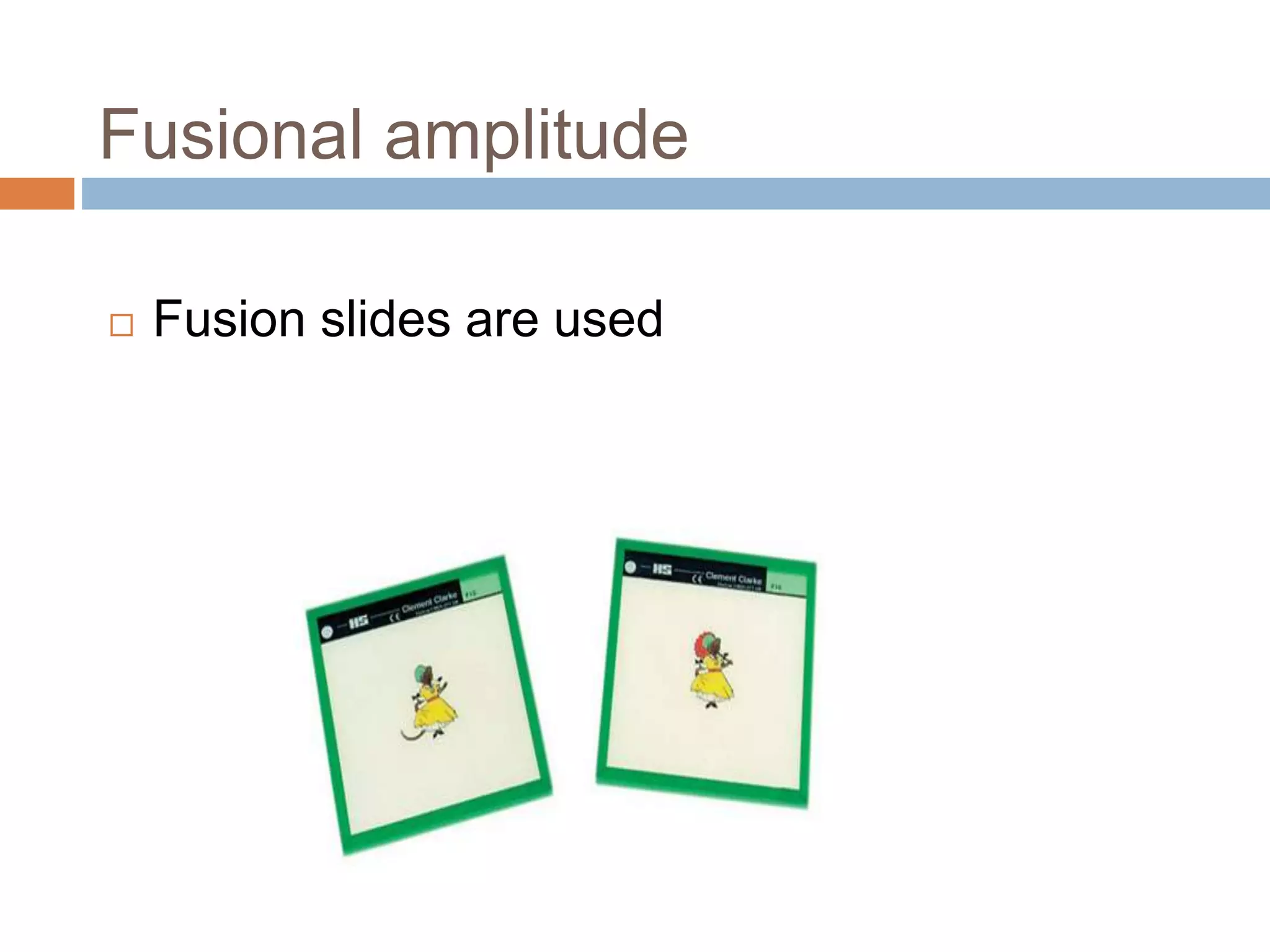
 Fusion slides are used
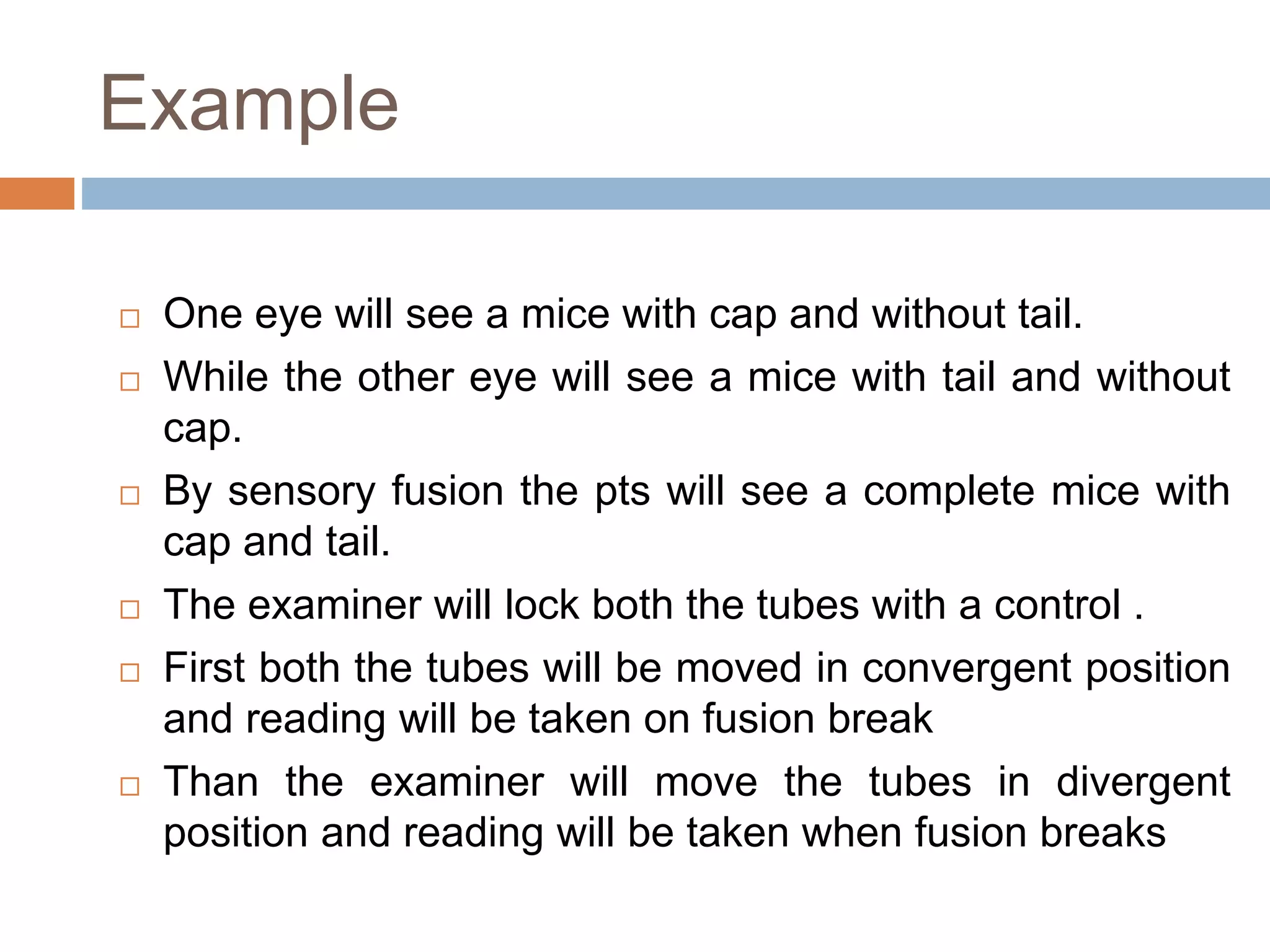
Example
 One eye will see a mice with cap and without tail.
 While the other eye will see a mice with tail and without
cap.
 By sensory fusion the pts will see a complete mice with
cap and tail.
 The examiner will lock both the tubes with a control .
 First both the tubes will be moved in convergent position
and reading will be taken on fusion break
 Than the examiner will move the tubes in divergent
position and reading will be taken when fusion breaks
BSV grades with synoptophore
 Simultaneous perception
 Fusion
 Stereopsis
G1.Simultaneous perception
 Grade (1): binocular vision requires
simultaneous perception (parafoveal, foveal, or
macular slides may be used; this choice
depends on V/A).
Dissimilar targets, such as a lion and cage, are
presented to each eye.
The patient who sees the lion in the cage is
seeing with each eye simultaneously and has
grade 1 binocular vision
G2. Fusion
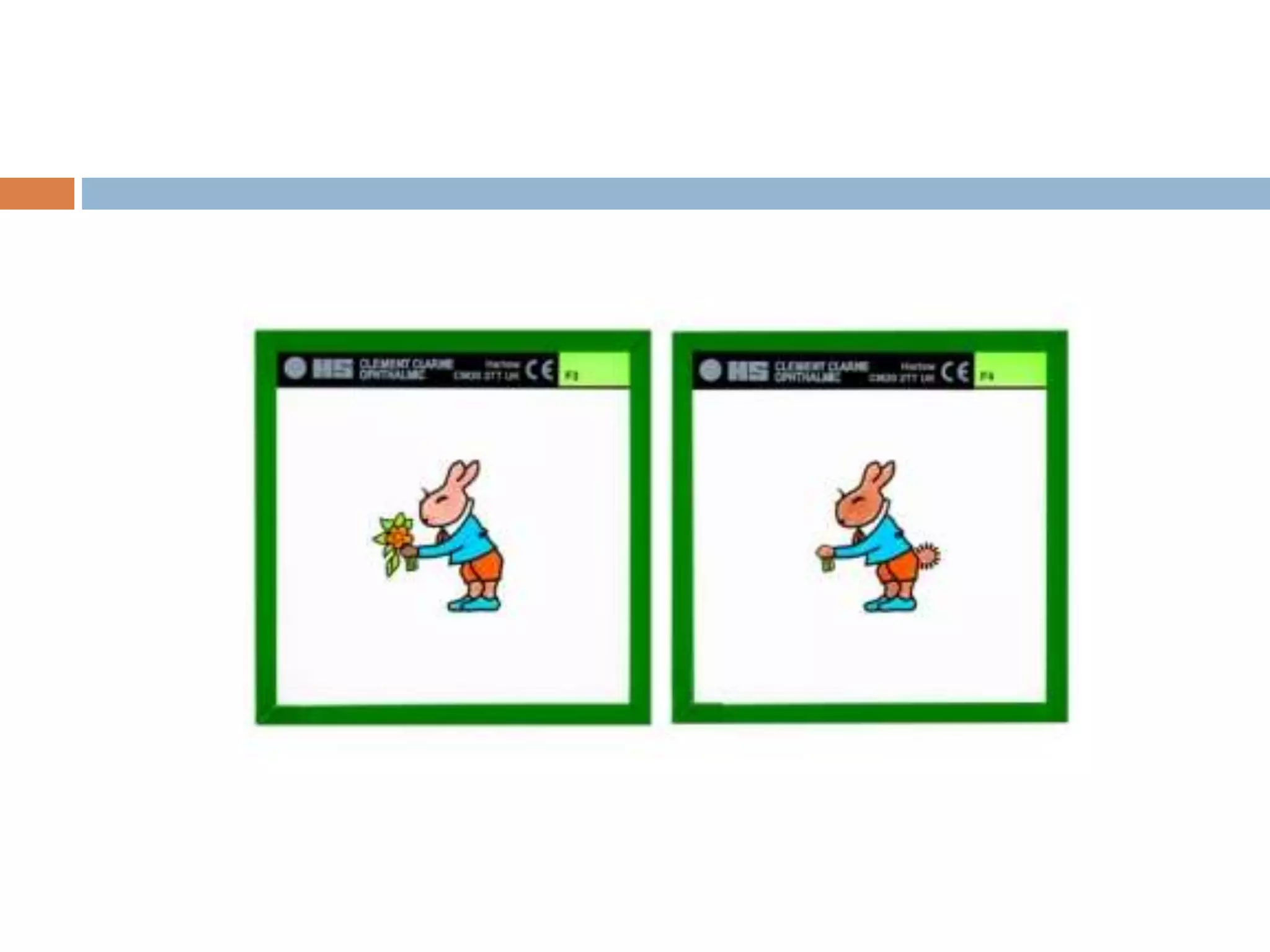
 Grade (2): binocular vision requires fusional ability.
Similar targets presented to each eye must be fused
before a complete picture is identified. a grade 2 target
may present to one eye a picture of a rabbit with no tail ,
clutching flowers , the other eye would be presented
with a picture of the same rabbit , but it would have a tail
, and geld in its hand would be a stem without flowers.
Grade 2 binocular vision is present if the patient fuses
these images and reports seeing a tailed rabbit clutching
a group of flowers by a stem.
G3. Stereopsis
 Grade (3): depth perception:
Binocular vision requires the coordinate use of the
two eyes together to yield the sensation of
stereopis.
Grade 3 slides present to the viewer pictures that
are not quite superimposable .the fusion of these
slightly disparate images by the brain creates the
sensation of depth, or stereopis .if fused correctly,
one of the seahorses will appear distinctly in front of
the others.
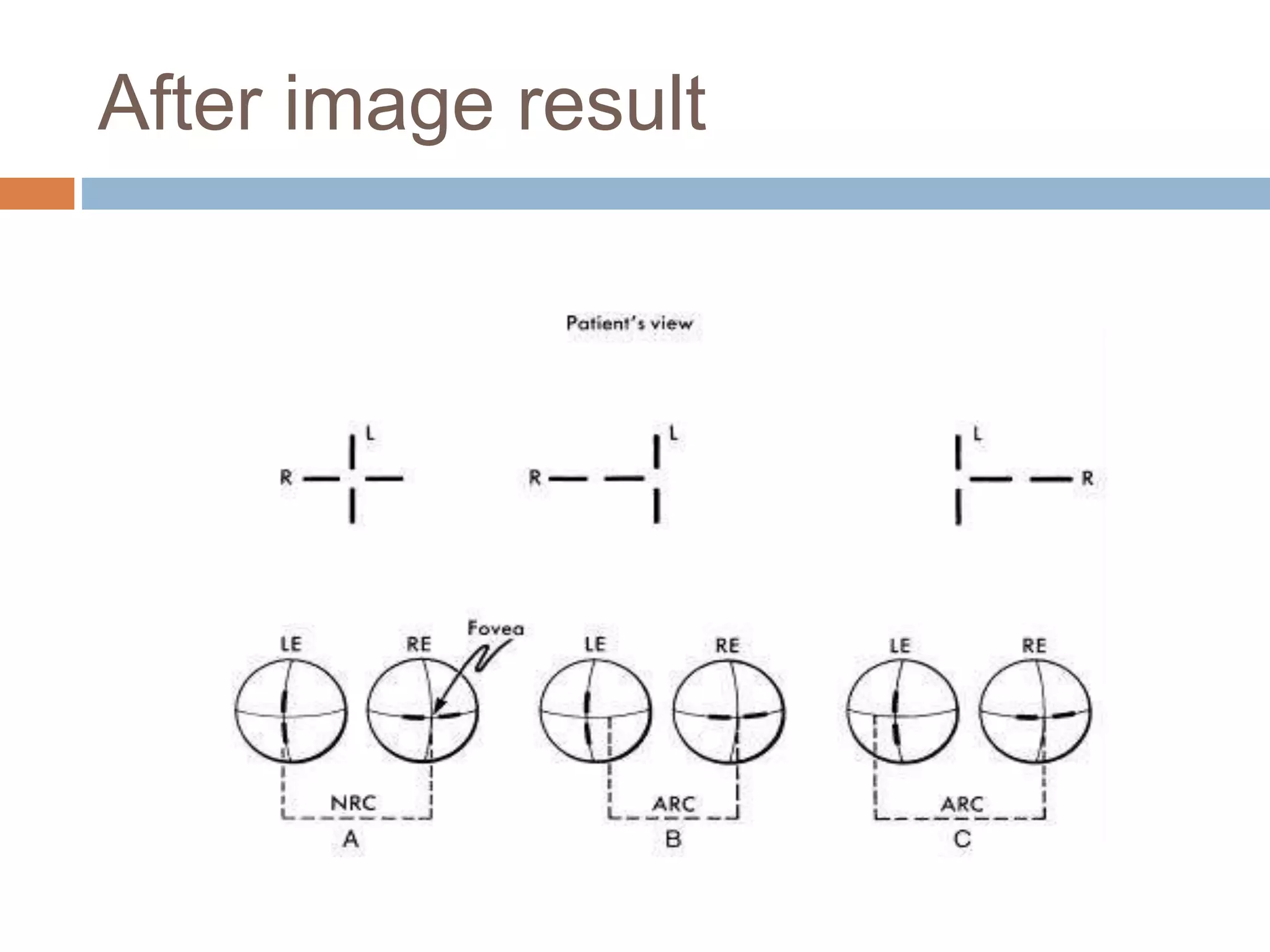
After image test
 Induces an after image in each eye
 It has special slides
 The slides are black except for a central clear bar with
small red fixation target at the center
 One bar is vertical and the other is horizental
 Vertical bar slide usually in front of deviating eye
 The examiner put on high intensity light on one eye for
10 second than switch off to other eye for 10 second
 Than the pts is asked to draw the cross as he/she
perceived.
After image result
Measuring Angle Kappa
 A special slide is placed in front of the eye under
observation.
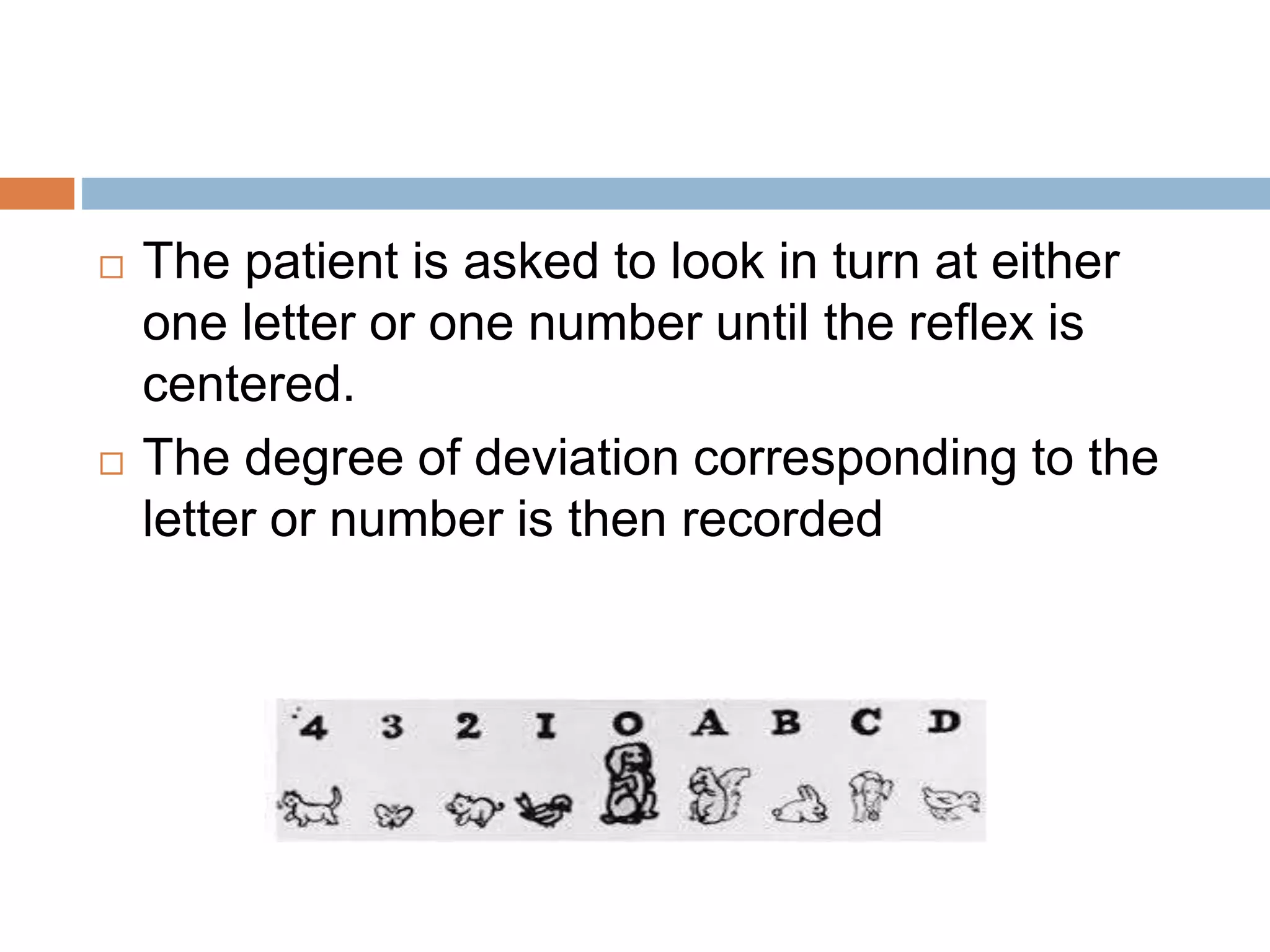
 It consists of a row of numbers and letters at 1Δ
intervals.
 The patient is asked to look at the zero.
 If the corneal reflex is on the nasal side of the
pupil the angle is positive
 If it is on the temporal side it is negative.
 The patient is asked to look in turn at either
one letter or one number until the reflex is
centered.
 The degree of deviation corresponding to the
letter or number is then recorded
 For instance, if the right eye is the one to be
tested and the corneal reflex is centered when
the patient looks at the letter C.
 The patient has a 3Pd negative angle kappa in
the right eye
Thank you

Synoptophore | Major amblyoscope

  • 1.
  • 2.
  • 3.
    SYNOPTOPHORE A type ofa telescope which both reflects and refracts rays of light. The optics are such that the instrument measures at infinity The instrument consists of two cylindrical tubes with a mirrored right angle bend and containing in each eye piece a + 6.50 D.S lens. At the outer end of each tube there is a slide carrier into which pictures are inserted, so that each eye is stimulated by a separate image.
  • 4.
    SYNOPTOPHORE optics The totallength of the tube is 15.5 cm which is the focal length of a + 6.5 D.S. lens, therefore the emergent rays are parallel giving the appearance that the picture is at infinity. No accommodation is required by the patient when observing the pictures
  • 5.
    SYNOPTOPHORE The tubes aresupported on columns in such a way that the pictures may be moved in relation to each other horizontally, vertically and torsionally. Therefore any horizontal, vertical or torsional deviation can be measured in nine positions of gaze. The synoptophore can be converted to a near test by adding – 3.00 D.S lenses to induce accommodation
  • 7.
    Synoptophore  Used forboth sensory and motor evaluation.  To confirm three grades of BSV  Make use of Hirschberg's method to measure the deviation.  With a cover test to measure the deviation.
  • 8.
    Targets  The testpresents known target to each eye.  Targets are pairs of slides that are placed in slide holders and viewed through an internally lighted optical system.  Each eye sees one of the pair of slides.
  • 9.
    Types of Targets/Slides Thereare three sizes of slide:-  Paramacula – subtends 5° at nodal point  Macular – subtends 3° - 5° at nodal point  Foveal – subtends 1° 3° at nodal point
  • 10.
    Types of Targets/Slides The slides are divided into three types:- 1. Simultaneous perception (red bound) 2. Fusion (green bound) 3. Stereoscopic (yellow bound)
  • 11.
  • 12.
    Diagnostic Uses  Angleof deviation objectively and subjectively  Assessment of retinal correspondence  Fusional amplitudes  Grades of BSV  After image test  Measurement of angle kappa
  • 13.
    Measuring of deviationwith synoptophore  Measured objectively and subjectively  Simultaneous perception slides are used such as lion and cage
  • 14.
    Objective measurement There aretwo methods of objective measurement based on a. Corneal reflections b. Neutralization
  • 15.
    a. Corneal Reflections Indicationsfor use Amblyopia Non central fixation Non co-operation
  • 16.
    Objective measurment b.Neutralization Indications foruse: - • Latent and manifest squint • Central fixation • In Cooperative pts
  • 17.
    Objective measurement  Tubesshould be adjusted to zero  Patient should be seated comfortably with IPD adjusted.  Simultaneous slide should be placed in both slide carrier  Now the examiner will start cover test with the help of light control button by extinguishing and lightening alternatively and neutralized the deviation.  After this the deviation should be read out from the scale
  • 18.
    Subjective measurement Method Subjective measurementis based on the patients responses. The accuracy of the measurement depends on the ability and cooperation of the patient  Move tubes back to 0°, ask patient to move the tube in front of the deviating eye with the handle until he sees two dissimilar images superimposed e.g. lion in a cage  Deviation measurement read from scales
  • 19.
    Retinal correspondence  Harmoniousabnormal retinal correspondence is present where the angle of anomaly is equal to the objective angle, and the subjective angle is zero.  Unharmonious abnormal retinal correspondence is present where the angle of anomaly is different from the objective angle  The angle of anomaly is the difference between the objective and subjective angles of deviation
  • 20.
  • 21.
    Example  One eyewill see a mice with cap and without tail.  While the other eye will see a mice with tail and without cap.  By sensory fusion the pts will see a complete mice with cap and tail.  The examiner will lock both the tubes with a control .  First both the tubes will be moved in convergent position and reading will be taken on fusion break  Than the examiner will move the tubes in divergent position and reading will be taken when fusion breaks
  • 22.
    BSV grades withsynoptophore  Simultaneous perception  Fusion  Stereopsis
  • 23.
    G1.Simultaneous perception  Grade(1): binocular vision requires simultaneous perception (parafoveal, foveal, or macular slides may be used; this choice depends on V/A). Dissimilar targets, such as a lion and cage, are presented to each eye. The patient who sees the lion in the cage is seeing with each eye simultaneously and has grade 1 binocular vision
  • 24.
    G2. Fusion  Grade(2): binocular vision requires fusional ability. Similar targets presented to each eye must be fused before a complete picture is identified. a grade 2 target may present to one eye a picture of a rabbit with no tail , clutching flowers , the other eye would be presented with a picture of the same rabbit , but it would have a tail , and geld in its hand would be a stem without flowers. Grade 2 binocular vision is present if the patient fuses these images and reports seeing a tailed rabbit clutching a group of flowers by a stem.
  • 26.
    G3. Stereopsis  Grade(3): depth perception: Binocular vision requires the coordinate use of the two eyes together to yield the sensation of stereopis. Grade 3 slides present to the viewer pictures that are not quite superimposable .the fusion of these slightly disparate images by the brain creates the sensation of depth, or stereopis .if fused correctly, one of the seahorses will appear distinctly in front of the others.
  • 27.
    After image test Induces an after image in each eye  It has special slides  The slides are black except for a central clear bar with small red fixation target at the center  One bar is vertical and the other is horizental  Vertical bar slide usually in front of deviating eye  The examiner put on high intensity light on one eye for 10 second than switch off to other eye for 10 second  Than the pts is asked to draw the cross as he/she perceived.
  • 28.
  • 30.
    Measuring Angle Kappa A special slide is placed in front of the eye under observation.  It consists of a row of numbers and letters at 1Δ intervals.  The patient is asked to look at the zero.  If the corneal reflex is on the nasal side of the pupil the angle is positive  If it is on the temporal side it is negative.
  • 31.
     The patientis asked to look in turn at either one letter or one number until the reflex is centered.  The degree of deviation corresponding to the letter or number is then recorded
  • 32.
     For instance,if the right eye is the one to be tested and the corneal reflex is centered when the patient looks at the letter C.  The patient has a 3Pd negative angle kappa in the right eye
  • 33.