SYNCOPE: WHAT HAPPENS WHEN YOUR LIGHTS GO OUT  ? Syed Raza MD,MRCP (UK),FCCP, Dip.Card (UK)
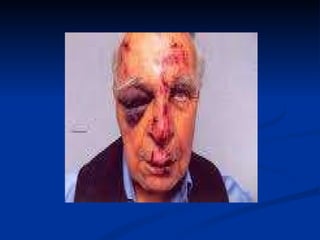
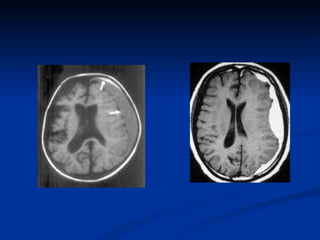
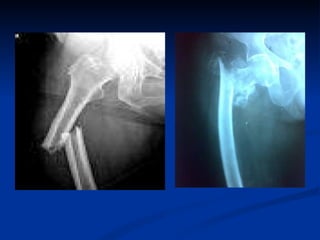
COMMON SCENARIO ! Elderly lady  Lives alone Collapse at home  ? LOC No eye witness Patient does not remember the event
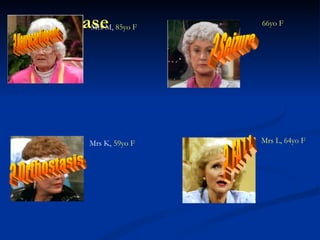
Case    Mrs L, 64yo F                 66yo F         ,        Mrs K,  59yo F               Mrs M,  85yo F           ? Seizure ?  FA L L ? Orthostasis ? Neurocardiogenic


Objectives Definition Prevalence Diagnostic Work Up Management Implications on driving
Syncope: A Symptom, Not a Diagnosis Self-limited loss of consciousness and postural tone Relatively rapid onset Variable warning symptoms Spontaneous, complete, and usually prompt recovery without medical or surgical intervention Lipsitz  1983 Underlying mechanism:  transient global cerebral hypoperfusion.
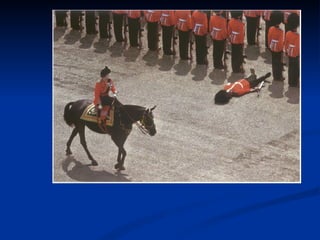
Impact of Syncope 1 Kenny RA, Kapoor WN. In: Benditt D, et al. eds.  The Evaluation and   Treatment of Syncope . Futura;2003:23-27. 2 Kapoor W.  Medicine . 1990;69:160-175. 3 Brignole M, et al.  Europace . 2003;5:293-298. 4  Blanc J-J, et al.  Eur Heart  J . 2002;23:815-820. 5 Campbell A, et al.  Age and Ageing . 1981;10:264-270. 40% will experience syncope  at least once in a lifetime 1 1-6% of hospital admissions 2 1% of emergency room visits  per year 3,4 10% of falls by elderly are due  to syncope 5 Major morbidity reported in 6% 1 eg, fractures, motor vehicle accidents Minor injury in 29% 1 eg, lacerations, bruises
THE  COST More than 1 billion pounds per year  spent by NHS  for managing falls  and syncope. Significant portion of the budget is spent on clinical conditions which have been misdiagnosed ( i.e. 10% of syncope diagnosed as epilepsy)
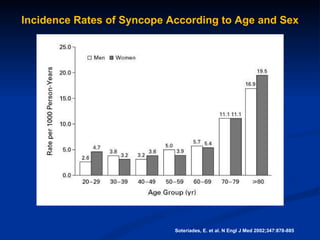
Incidence Rates of Syncope According to Age and Sex Soteriades, E. et al. N Engl J Med 2002;347:878-885
 
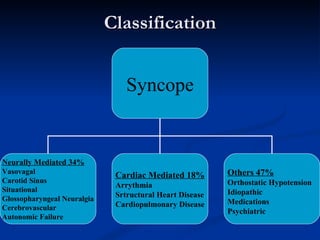
Classification Syncope Neurally Mediated 34% Vasovagal Carotid Sinus Situational Glossopharyngeal Neuralgia Cerebrovascular Autonomic Failure Cardiac Mediated 18% Arrythmia Srtructural Heart Disease Cardiopulmonary Disease Others 47% Orthostatic Hypotension Idiopathic Medications Psychiatric
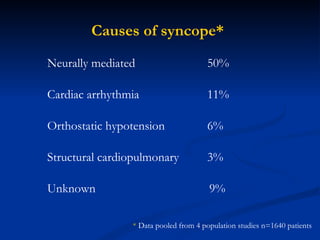
Causes of syncope*   Neurally mediated 50% Cardiac arrhythmia 11% Orthostatic hypotension 6% Structural cardiopulmonary 3% Unknown    9% *  Data pooled from 4 population studies n=1640 patients
Neurally Mediated Syncope Neuro cardiogenic syncope  Carotid sinus hypersensitivity Visceral syncope (micturition, cough, defecation etc.) Glossopharyngeal neuralgia
Neurally Mediated Syncope (autonomic failure) Orthostatic /Postural  Hypotension Postural  Orthostatic Tachycardia Syndrome (POTS)
Neuro-Cardiogenic Syncope Commonest cause of syncope  Most frequently in 30 - 50 age group Typical triggers - pain, fear, blood etc Prodromal symptoms- warmth, nausea, sweating Good history is key to diagnosis Usually does not require fancy investigations Patient may be discharged the same day
Pathophysiology Neuro-cardiovascular reflexes severely impaired or absent. Pooling of  500-800 ml blood in distensible blood vessels of legs on prolonged standing. Reduced venous return and cardiac output. Reduced brain perfusion. Warning signals to brain impaired Patient  presents with pre syncope or syncope
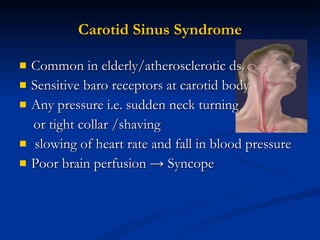
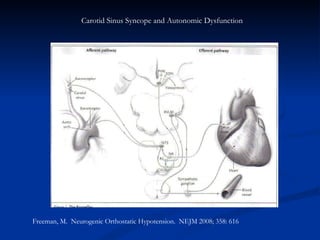
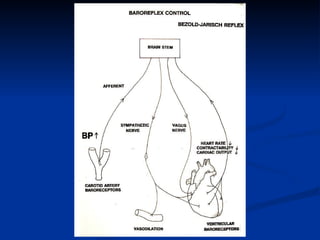
Carotid Sinus Syndrome Common in elderly/atherosclerotic ds. Sensitive baro receptors at carotid body Any pressure i.e. sudden neck turning or tight collar /shaving slowing of heart rate and fall in blood pressure Poor brain perfusion -> Syncope
Carotid Sinus Syncope and Autonomic Dysfunction Freeman, M.  Neurogenic Orthostatic Hypotension.  NEJM 2008; 358: 616
 
POSTURAL  BP
 
Postural Blood Pressure Sadly NOT  accurately measured Supine position –at least 10 minutes Standing/Sitting Measure BP  immediately, 1 minute , 3 minutes Symptoms of pre-syncope or syncope Fall in systolic BP by 30 mmHg AND  diastolic BP by 20  mmHg .
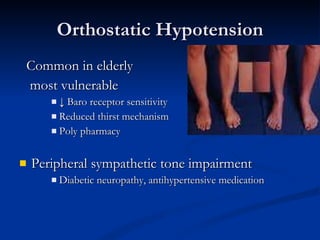
Orthostatic Hypotension Common in elderly most vulnerable ↓  Baro receptor sensitivity Reduced thirst mechanism Poly pharmacy Peripheral sympathetic tone impairment Diabetic neuropathy, antihypertensive medication
POSTURAL ORTHOSTATIC TACHYCARDIA  SYNDROME  (POTS) Patients ( women 15-50) dizziness or faint on acquiring sudden erect posture Reduced volume of blood reaches the heart Stimulation of mechano receptors causes tachycardia Heart rate increases by more than 30 beats/min. Heart rate usually above 120 /minute.
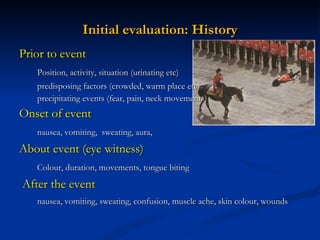
Initial evaluation: History Prior to event Position, activity, situation (urinating etc) predisposing factors (crowded, warm place etc) precipitating events (fear, pain, neck movements) Onset of event nausea, vomiting,  sweating, aura,  About event (eye witness) Colour, duration, movements, tongue biting After the event nausea, vomiting, sweating, confusion, muscle ache, skin colour, wounds
Diagnostic tests Carotid sinus massage Tilt testing Others; EP testing, signal averaged (V) ECG, Echocardiography, ETT, cardiac catheterisation, neurological/psychiatric evaluation,
Carotid Sinus Massage Protocol Massage longitudinally, site of maximal impulse, anterior margin SCM muscle level of cricoid cartilage 5 –10 seconds, right first, then left after 1-2 minute break ( Newcastle protocol 10secs ) Continuous  ECG and BP monitoring mandatory Neurological complication in 0.45% in a series of 1600 patients (5secs massage)
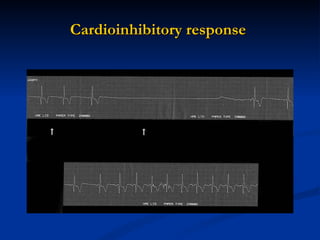
Carotid Sinus Massage Stimulation of hypersensitive carotid body can produce 3 main responses Cardio-inhibitory response (70%) Vasodepressor response (10%) Mixed (20%)
Positive CSM Test Significant brady /more  than 3 s pause  on the ECG  More than 50 mmHg fall in systolic BP  Mixed response
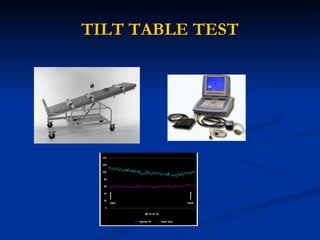
TILT TABLE TEST
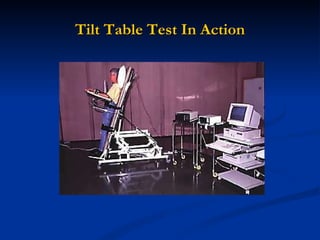
Tilt Table Test In Action
Indications for Tilt Table Testing Unexplained recurrent syncope Assessment of recurrent, unexplained fall Syncope  with suspected autonomic failure After a cardiac cause for syncope has been excluded
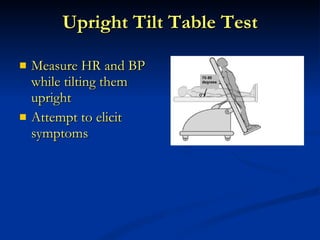
Upright Tilt Table Test Measure HR and BP while tilting them upright Attempt to elicit symptoms
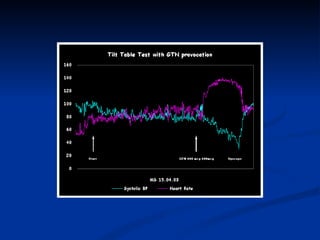
Tilt Table Testing Supine at least 20 minutes prior to tilt Tilt angle  70 degrees Passive phase min 20 to 45 minutes Use either intravenous isoprenaline  or sublingual GTN if passive phase is negative Pharmacological phase – 15 to 20 minutes End-point: induction syncope
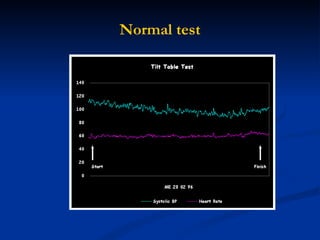
Normal test
Cardioinhibitory response
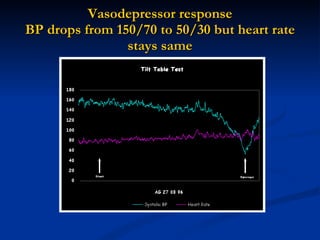
Vasodepressor response BP drops from 150/70 to 50/30 but heart rate stays same
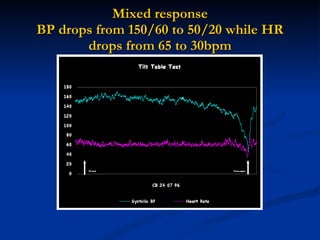
Mixed response BP drops from 150/60 to 50/20 while HR drops from 65 to 30bpm
 
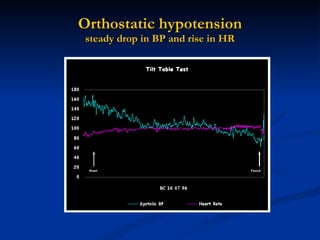
Orthostatic hypotension steady drop in BP and rise in HR
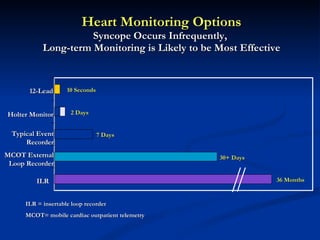
Heart Monitoring Options Syncope Occurs Infrequently,  Long-term Monitoring is Likely to be Most Effective ILR MCOT External Loop Recorder Typical Event Recorder Holter Monitor 12-Lead 2 Days 7 Days 30+ Days 36 Months 10 Seconds ILR = insertable loop recorder MCOT= mobile cardiac outpatient telemetry
 
Everything is spinning
MANAGEMENT Patient education and counselling Avoid triggers Increase in salt and fluid intake Sleeping with the head of the bed raised (6-12 inches. Elastic stockings Preventing LOC or Injury Assume supine position upon onset of prodrome Avoid driving or other activities that could lead to injury
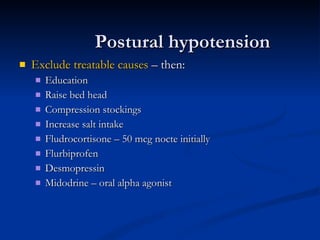
Postural hypotension Exclude treatable causes  – then: Education Raise bed head Compression stockings Increase salt intake Fludrocortisone – 50 mcg nocte initially Flurbiprofen Desmopressin Midodrine – oral alpha agonist
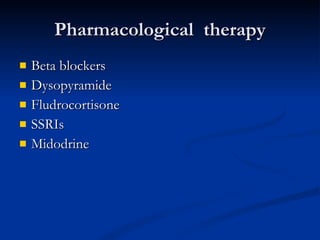
Pharmacological  therapy Beta blockers Dysopyramide Fludrocortisone SSRIs Midodrine
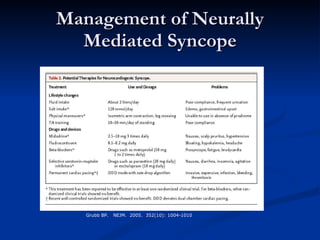
Management of Neurally Mediated Syncope Grubb BP.  NEJM.  2005.  352(10): 1004-1010
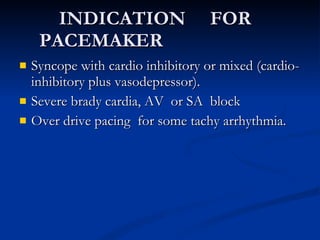
INDICATION  FOR  PACEMAKER  Syncope with cardio inhibitory or mixed (cardio-inhibitory plus vasodepressor). Severe brady cardia, AV  or SA  block Over drive pacing  for some tachy arrhythmia.
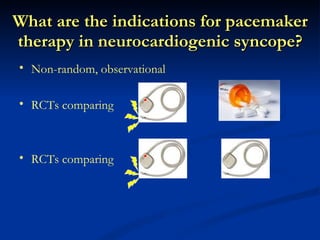
What are the indications for pacemaker therapy in neurocardiogenic syncope? Non-random, observational RCTs comparing  vs  RCTs comparing  vs
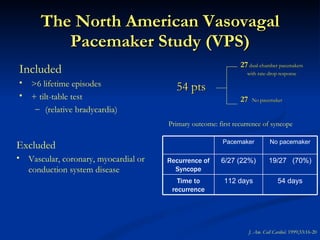
27  dual-chamber pacemakers   with rate-drop response 54 pts 27   No pacemaker The North American Vasovagal Pacemaker Study (VPS) Included >6 lifetime episodes + tilt-table test (relative bradycardia) Primary outcome: first recurrence of syncope Excluded Vascular, coronary, myocardial or conduction system disease J. Am. Coll Cardiol . 1999;33:16-20 Pacemaker No pacemaker Recurrence of Syncope 6/27 (22%) 19/27  (70%) Time to recurrence 112 days 54 days
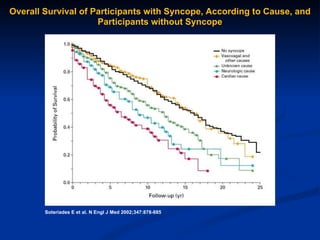
Soteriades E et al. N Engl J Med 2002;347:878-885 Overall Survival of Participants with Syncope, According to Cause, and Participants without Syncope
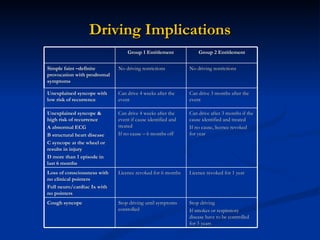
Driving Implications Group 1 Entitlement Group 2 Entitlement Simple faint –definite provocation with prodromal symptoms No driving restrictions No driving restrictions Unexplained syncope with low risk of recurrence Can drive 4 weeks after the event Can drive 3 months after the event Unexplained syncope & high risk of recurrence A abnormal ECG B structural heart disease C syncope at the wheel or results in injury D more than 1 episode in last 6 months Can drive 4 weeks after the event if cause identified and treated If no cause – 6 months off Can drive after 3 months if the cause identified and treated If no cause, licence revoked for year Loss of consciousness with no clinical pointers Full neuro/cardiac Ix with no pointers Licence revoked for 6 months Licence revoked for 1 year Cough syncope Stop driving until symptoms controlled Stop driving If smokes or respiratory disease have to be controlled for 5 years
SUMMARY Syncope is not an uncommon problem The diagnosis of syncope is often missed or  it is misdiagnosed Thorough history from eye witness can be very helpful Syncope can be fatal Further training to identify the problem and formulating a plan of management is needed.
 
ANY  QUESTION ??
 

Syncope

  • 1.
    SYNCOPE: WHAT HAPPENSWHEN YOUR LIGHTS GO OUT ? Syed Raza MD,MRCP (UK),FCCP, Dip.Card (UK)
  • 2.
    COMMON SCENARIO !Elderly lady Lives alone Collapse at home ? LOC No eye witness Patient does not remember the event
  • 3.
    Case Mrs L, 64yo F 66yo F , Mrs K, 59yo F Mrs M, 85yo F ? Seizure ? FA L L ? Orthostasis ? Neurocardiogenic
  • 4.
  • 5.
  • 6.
  • 7.
  • 8.
  • 9.
  • 10.
  • 11.
  • 12.
    Objectives Definition PrevalenceDiagnostic Work Up Management Implications on driving
  • 13.
    Syncope: A Symptom,Not a Diagnosis Self-limited loss of consciousness and postural tone Relatively rapid onset Variable warning symptoms Spontaneous, complete, and usually prompt recovery without medical or surgical intervention Lipsitz 1983 Underlying mechanism: transient global cerebral hypoperfusion.
  • 14.
    Impact of Syncope1 Kenny RA, Kapoor WN. In: Benditt D, et al. eds. The Evaluation and Treatment of Syncope . Futura;2003:23-27. 2 Kapoor W. Medicine . 1990;69:160-175. 3 Brignole M, et al. Europace . 2003;5:293-298. 4 Blanc J-J, et al. Eur Heart J . 2002;23:815-820. 5 Campbell A, et al. Age and Ageing . 1981;10:264-270. 40% will experience syncope at least once in a lifetime 1 1-6% of hospital admissions 2 1% of emergency room visits per year 3,4 10% of falls by elderly are due to syncope 5 Major morbidity reported in 6% 1 eg, fractures, motor vehicle accidents Minor injury in 29% 1 eg, lacerations, bruises
  • 15.
    THE COSTMore than 1 billion pounds per year spent by NHS for managing falls and syncope. Significant portion of the budget is spent on clinical conditions which have been misdiagnosed ( i.e. 10% of syncope diagnosed as epilepsy)
  • 16.
    Incidence Rates ofSyncope According to Age and Sex Soteriades, E. et al. N Engl J Med 2002;347:878-885
  • 17.
  • 18.
    Classification Syncope NeurallyMediated 34% Vasovagal Carotid Sinus Situational Glossopharyngeal Neuralgia Cerebrovascular Autonomic Failure Cardiac Mediated 18% Arrythmia Srtructural Heart Disease Cardiopulmonary Disease Others 47% Orthostatic Hypotension Idiopathic Medications Psychiatric
  • 19.
    Causes of syncope* Neurally mediated 50% Cardiac arrhythmia 11% Orthostatic hypotension 6% Structural cardiopulmonary 3% Unknown 9% * Data pooled from 4 population studies n=1640 patients
  • 20.
    Neurally Mediated SyncopeNeuro cardiogenic syncope Carotid sinus hypersensitivity Visceral syncope (micturition, cough, defecation etc.) Glossopharyngeal neuralgia
  • 21.
    Neurally Mediated Syncope(autonomic failure) Orthostatic /Postural Hypotension Postural Orthostatic Tachycardia Syndrome (POTS)
  • 22.
    Neuro-Cardiogenic Syncope Commonestcause of syncope Most frequently in 30 - 50 age group Typical triggers - pain, fear, blood etc Prodromal symptoms- warmth, nausea, sweating Good history is key to diagnosis Usually does not require fancy investigations Patient may be discharged the same day
  • 23.
    Pathophysiology Neuro-cardiovascular reflexesseverely impaired or absent. Pooling of 500-800 ml blood in distensible blood vessels of legs on prolonged standing. Reduced venous return and cardiac output. Reduced brain perfusion. Warning signals to brain impaired Patient presents with pre syncope or syncope
  • 24.
    Carotid Sinus SyndromeCommon in elderly/atherosclerotic ds. Sensitive baro receptors at carotid body Any pressure i.e. sudden neck turning or tight collar /shaving slowing of heart rate and fall in blood pressure Poor brain perfusion -> Syncope
  • 25.
    Carotid Sinus Syncopeand Autonomic Dysfunction Freeman, M. Neurogenic Orthostatic Hypotension. NEJM 2008; 358: 616
  • 26.
  • 27.
  • 28.
  • 29.
    Postural Blood PressureSadly NOT accurately measured Supine position –at least 10 minutes Standing/Sitting Measure BP immediately, 1 minute , 3 minutes Symptoms of pre-syncope or syncope Fall in systolic BP by 30 mmHg AND diastolic BP by 20 mmHg .
  • 30.
    Orthostatic Hypotension Commonin elderly most vulnerable ↓ Baro receptor sensitivity Reduced thirst mechanism Poly pharmacy Peripheral sympathetic tone impairment Diabetic neuropathy, antihypertensive medication
  • 31.
    POSTURAL ORTHOSTATIC TACHYCARDIA SYNDROME (POTS) Patients ( women 15-50) dizziness or faint on acquiring sudden erect posture Reduced volume of blood reaches the heart Stimulation of mechano receptors causes tachycardia Heart rate increases by more than 30 beats/min. Heart rate usually above 120 /minute.
  • 32.
    Initial evaluation: HistoryPrior to event Position, activity, situation (urinating etc) predisposing factors (crowded, warm place etc) precipitating events (fear, pain, neck movements) Onset of event nausea, vomiting, sweating, aura, About event (eye witness) Colour, duration, movements, tongue biting After the event nausea, vomiting, sweating, confusion, muscle ache, skin colour, wounds
  • 33.
    Diagnostic tests Carotidsinus massage Tilt testing Others; EP testing, signal averaged (V) ECG, Echocardiography, ETT, cardiac catheterisation, neurological/psychiatric evaluation,
  • 34.
    Carotid Sinus MassageProtocol Massage longitudinally, site of maximal impulse, anterior margin SCM muscle level of cricoid cartilage 5 –10 seconds, right first, then left after 1-2 minute break ( Newcastle protocol 10secs ) Continuous ECG and BP monitoring mandatory Neurological complication in 0.45% in a series of 1600 patients (5secs massage)
  • 35.
    Carotid Sinus MassageStimulation of hypersensitive carotid body can produce 3 main responses Cardio-inhibitory response (70%) Vasodepressor response (10%) Mixed (20%)
  • 36.
    Positive CSM TestSignificant brady /more than 3 s pause on the ECG More than 50 mmHg fall in systolic BP Mixed response
  • 37.
  • 38.
    Tilt Table TestIn Action
  • 39.
    Indications for TiltTable Testing Unexplained recurrent syncope Assessment of recurrent, unexplained fall Syncope with suspected autonomic failure After a cardiac cause for syncope has been excluded
  • 40.
    Upright Tilt TableTest Measure HR and BP while tilting them upright Attempt to elicit symptoms
  • 41.
    Tilt Table TestingSupine at least 20 minutes prior to tilt Tilt angle 70 degrees Passive phase min 20 to 45 minutes Use either intravenous isoprenaline or sublingual GTN if passive phase is negative Pharmacological phase – 15 to 20 minutes End-point: induction syncope
  • 42.
  • 43.
  • 44.
    Vasodepressor response BPdrops from 150/70 to 50/30 but heart rate stays same
  • 45.
    Mixed response BPdrops from 150/60 to 50/20 while HR drops from 65 to 30bpm
  • 46.
  • 47.
    Orthostatic hypotension steadydrop in BP and rise in HR
  • 48.
    Heart Monitoring OptionsSyncope Occurs Infrequently, Long-term Monitoring is Likely to be Most Effective ILR MCOT External Loop Recorder Typical Event Recorder Holter Monitor 12-Lead 2 Days 7 Days 30+ Days 36 Months 10 Seconds ILR = insertable loop recorder MCOT= mobile cardiac outpatient telemetry
  • 49.
  • 50.
  • 51.
    MANAGEMENT Patient educationand counselling Avoid triggers Increase in salt and fluid intake Sleeping with the head of the bed raised (6-12 inches. Elastic stockings Preventing LOC or Injury Assume supine position upon onset of prodrome Avoid driving or other activities that could lead to injury
  • 52.
    Postural hypotension Excludetreatable causes – then: Education Raise bed head Compression stockings Increase salt intake Fludrocortisone – 50 mcg nocte initially Flurbiprofen Desmopressin Midodrine – oral alpha agonist
  • 53.
    Pharmacological therapyBeta blockers Dysopyramide Fludrocortisone SSRIs Midodrine
  • 54.
    Management of NeurallyMediated Syncope Grubb BP. NEJM. 2005. 352(10): 1004-1010
  • 55.
    INDICATION FOR PACEMAKER Syncope with cardio inhibitory or mixed (cardio-inhibitory plus vasodepressor). Severe brady cardia, AV or SA block Over drive pacing for some tachy arrhythmia.
  • 56.
    What are theindications for pacemaker therapy in neurocardiogenic syncope? Non-random, observational RCTs comparing vs RCTs comparing vs
  • 57.
    27 dual-chamberpacemakers with rate-drop response 54 pts 27 No pacemaker The North American Vasovagal Pacemaker Study (VPS) Included >6 lifetime episodes + tilt-table test (relative bradycardia) Primary outcome: first recurrence of syncope Excluded Vascular, coronary, myocardial or conduction system disease J. Am. Coll Cardiol . 1999;33:16-20 Pacemaker No pacemaker Recurrence of Syncope 6/27 (22%) 19/27 (70%) Time to recurrence 112 days 54 days
  • 58.
    Soteriades E etal. N Engl J Med 2002;347:878-885 Overall Survival of Participants with Syncope, According to Cause, and Participants without Syncope
  • 59.
    Driving Implications Group1 Entitlement Group 2 Entitlement Simple faint –definite provocation with prodromal symptoms No driving restrictions No driving restrictions Unexplained syncope with low risk of recurrence Can drive 4 weeks after the event Can drive 3 months after the event Unexplained syncope & high risk of recurrence A abnormal ECG B structural heart disease C syncope at the wheel or results in injury D more than 1 episode in last 6 months Can drive 4 weeks after the event if cause identified and treated If no cause – 6 months off Can drive after 3 months if the cause identified and treated If no cause, licence revoked for year Loss of consciousness with no clinical pointers Full neuro/cardiac Ix with no pointers Licence revoked for 6 months Licence revoked for 1 year Cough syncope Stop driving until symptoms controlled Stop driving If smokes or respiratory disease have to be controlled for 5 years
  • 60.
    SUMMARY Syncope isnot an uncommon problem The diagnosis of syncope is often missed or it is misdiagnosed Thorough history from eye witness can be very helpful Syncope can be fatal Further training to identify the problem and formulating a plan of management is needed.
  • 61.
  • 62.
  • 63.

Editor's Notes

  • #15 1 Kenny RA, Kapoor WN. Epidemiology and social costs. In: Benditt D, Blanc J-J, et al. eds. The Evaluation and Treatment of Syncope . Elmsford, NY: Futura;2003:23-27. 2 Kapoor W. Evaluation and outcome of patients with syncope. Medicine . 1990;69:160-175. 3 Brignole M, Disertori M, Menozzi C, et al. Management of syncope referred urgently to general hospitals with and without syncope units. Europace . 2003;5:293-298. 4 Blanc J-J, L’ Her C, Touiza A, et al. Prospective evaluation and outcome of patients admitted for syncope over a 1 year period. Eur Heart J . 2002;23:815-820. 5 Campbell A, Reinken J, Allan B, et al. Falls in old age: A study of frequency and related clinical factors. Age and Ageing . 1981;10:264-270.
  • #24 There is severe impairment of neurocardiovascular reflex which leeds to pooling of a significant of blood in the leg vessels.
  • #26 Stimulation of baro receptors in the carotid body would send neuronal signals to NTS in the brain stem via glossopharyngeal nerve.This inturn would lead to increased parasympathetic nervous tone, inhibiting SA and AV node causing bradycardia.There is also sympathetic withdrawl leading to vasodilataion and hypotension.
  • #31 Common in elderly and they are most vulnerable due to .. Decreased baro receptor …
  • #32 Also known as POTS is seen in younger women who usually present dizzyness or faint on sudden standing.
  • #59 Figure 2. Overall Survival of Participants with Syncope, According to Cause, and Participants without Syncope. P<0.001 for the comparison between participants with and those without syncope. The category "Vasovagal and other causes" includes vasovagal, orthostatic, medication-induced, and other, infrequent causes of syncope.