Do Not Resuscitate Orders :
What They Mean ?
Dr Syed Raza
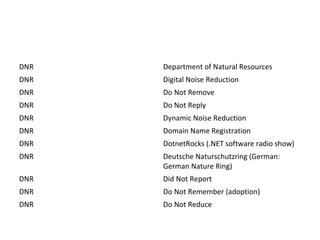
DNR Department of Natural Resources
DNR Digital Noise Reduction
DNR Do Not Remove
DNR Do Not Reply
DNR Dynamic Noise Reduction
DNR Domain Name Registration
DNR DotnetRocks (.NET software radio show)
DNR Deutsche Naturschutzring (German:
German Nature Ring)
DNR Did Not Report
DNR Do Not Remember (adoption)
DNR Do Not Reduce
A Do Not Attempt Resuscitation (DNAR) order,
also known as Do Not Resuscitate (DNR ) order
is written by a licensed physician in consultation
with a patient or surrogate decision maker.
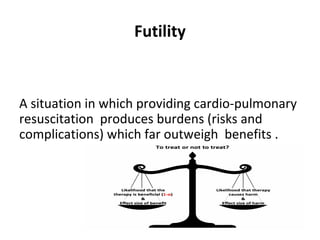
Futility
A situation in which providing cardio-pulmonary
resuscitation produces burdens (risks and
complications) which far outweigh benefits .
It is not a death sentence
CPR started by Anesthesiologists in 1960s
DNR introduced by AHA in 1974 as it was
recognized that many patients following CPR
survived but with significant comorbidities.
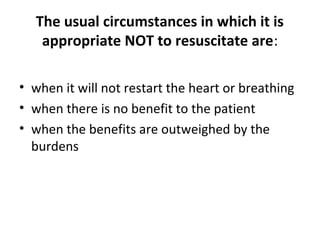
The usual circumstances in which it is
appropriate NOT to resuscitate are:
• when it will not restart the heart or breathing
• when there is no benefit to the patient
• when the benefits are outweighed by the
burdens
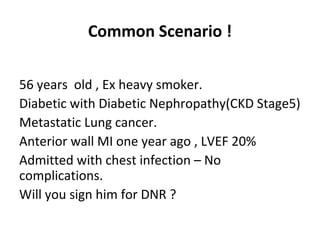
Common Scenario !
56 years old , Ex heavy smoker.
Diabetic with Diabetic Nephropathy(CKD Stage5)
Metastatic Lung cancer.
Anterior wall MI one year ago , LVEF 20%
Admitted with chest infection – No
complications.
Will you sign him for DNR ?
Another Scenario
78 years old
Type 2 DM, HPN
Admitted with chest infection that resulted in
septic shock.
Renal and liver function tests somewhat impaired.
Will you sign him for DNR ?
When should CPR be administered?
In absence of a valid physician’s order to forgo
CPR, if a patient experiences cardiac or
respiratory arrest.
Role of patient Autonomy
Rights of adult patients and their surrogate
decision maker to make medical decisions
should be respected.
This concept is reinforced legally in the Patient
Self Determination Act of 1991.
What if patients are unable to express
their wishes ?
1.Advance Care Planning (Advance Directive)
a. Living Will
b. Power of Attorney
2. Surrogate Decision Maker
When should CPR be withheld?
Two general situations when CPR does not
always provide direct medical benefit :
1. When CPR will likely be ineffective and has
minimal potential to provide direct medical
benefit to the patient.
2. When the patient with intact decision making
capacity or a surrogate decision maker explicitly
requests to forgo CPR.
How is DNR order written?
• Physicians should discuss the resuscitation
preferences with the patients /surrogate decision
maker.
• Take into account Advance Directive if any.
• Conversation should be documented in patient’s
notes.
• Final decision should be explicit.
• Indicate who were present during the conversation.
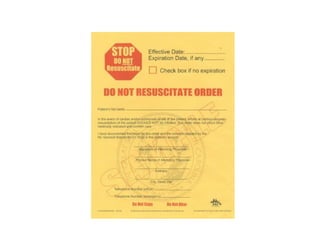
• DNR Form is filled and signed by all parties
concerned
If CPR is deemed futile, should a DNR
order be written despite patient
requests CPR.
Physician may over rule patient’s decision but
still patient to be involved in the decision
making conversation.
What if patient wants a DNR order
despite CPR is not futile ?
Patient’s decision should be respected and
honored.
This is respecting patient’s autonomy and is
supported by law in most countries that
recognize a competent patient’s right to refuse
treatment.
What if family disagrees with DNR
order ?
Conversation with family members in order to
clarify the benefits and risks of CPR and
reasonable explanation in most situation will
help to resolve the issue.
If not, this should be referred to the Ethics
committee.
What are ‘slow codes ‘ or ‘show
codes’?
Are forms of ‘symbolic resuscitation’.
‘Slow Code’ : Full effort of resuscitation is not
applied.
‘Show Code’ : A vigorous but short CPR is
performed to please the family.
They undermine the rights of patients to be
involved in clinical decisions, is deceptive and
violates the trust the patients have in healthcare
providers.
Why Bother?
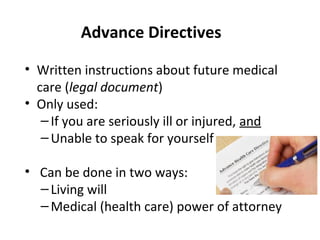
Advance Directives
• Written instructions about future medical
care (legal document)
• Only used:
–If you are seriously ill or injured, and
–Unable to speak for yourself
• Can be done in two ways:
–Living will
–Medical (health care) power of attorney
Why You Need Advance Directives
• Your wishes will be known
• Only used if you are unable to express your
decisions
• This can happen to anyone – at any age
• Give your loved ones the gift of peace of mind
– write down your wishes!
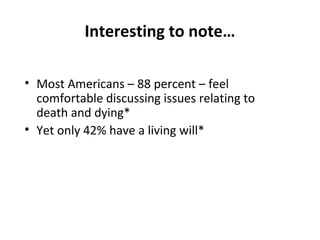
Interesting to note…
• Most Americans – 88 percent – feel
comfortable discussing issues relating to
death and dying*
• Yet only 42% have a living will*
*National Survey on Death, Dying, and Hospice
Care in America, VITAS Innovative
Healthcare, 2004
Factors Affecting Decision-Making
and Communication
• Cultural, ethnic and age-related differences
in approaches to decision-making.
• Capacity or ability to comprehend
information, contemplate options, evaluate
risks and consequences, and communicate
decisions as determined by clinicians
(articulate benefits and burdens).
• Competence or ability to make decisions as
determined legally by a court of law.
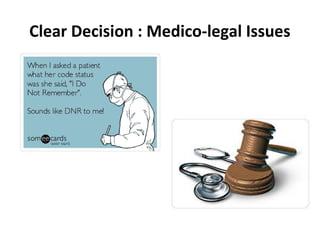
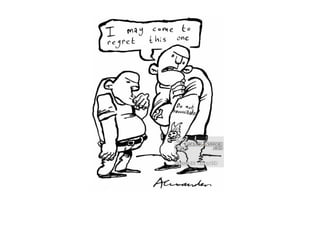
Clear Decision : Medico-legal Issues
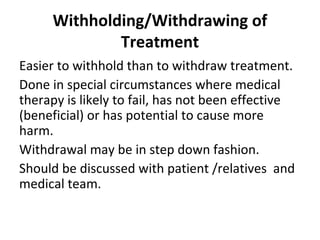
67 year-old Jill Baker found she had had a DNR order
written on her medical notes without her consent.
"She was understandably distressed by this as no
discussion had taken place with her or her next of
kin," said a doctor.
BBC News 27 June, 2000
Rule of Thumb
Rightness or wrongness of an action depends
on the merits of the justification underlying the
action, not the action itself.
Every situation needs to be evaluated in its own
context, so that patients, families and caregivers
can achieve comfort and trust in the final
decisions.
Withholding/Withdrawing of
Treatment
Easier to withhold than to withdraw treatment.
Done in special circumstances where medical
therapy is likely to fail, has not been effective
(beneficial) or has potential to cause more
harm.
Withdrawal may be in step down fashion.
Should be discussed with patient /relatives and
medical team.
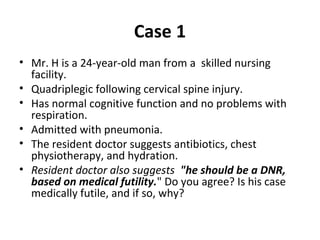
Case 1
• Mr. H is a 24-year-old man from a skilled nursing
facility.
• Quadriplegic following cervical spine injury.
• Has normal cognitive function and no problems with
respiration.
• Admitted with pneumonia.
• The resident doctor suggests antibiotics, chest
physiotherapy, and hydration.
• Resident doctor also suggests "he should be a DNR,
based on medical futility." Do you agree? Is his case
medically futile, and if so, why?
Case 2
• Mrs. W is an 81-year-old woman with colon
cancer with liver metastases admitted to the
hospital for chemotherapy.
• Because of her poor prognosis, you approach
her about a DNR order, but she requests to be
"a full code." Can you write a DNR order
anyway?
Case 2 contd:
• After a goal oriented conversation, Mrs. W
continues to request to be fully resuscitated in
the setting of cardiopulmonary arrest.
However, several days later, despite a
worsening clinical condition, Mrs. W still
requests to be a "full code."
• Your resident doctor suggests that you sign
her out as a "slow code." Should you do this?
Summary
• DNR is an important clinical decision.
• DNR order should ideally be made by a senior
clinician.
• Decision should be made in consultation with
the patient /relatives after a clear agreement
is reached (patient autonomy should be
respected.)
• Should be well documented. Can be revised
and reversed.
• It has medico-legal implications.
Do Not Resuscitate Orders : What They Mean ?

Do Not Resuscitate Orders : What They Mean ?

  • 1.
    Do Not ResuscitateOrders : What They Mean ? Dr Syed Raza
  • 3.
    DNR Department ofNatural Resources DNR Digital Noise Reduction DNR Do Not Remove DNR Do Not Reply DNR Dynamic Noise Reduction DNR Domain Name Registration DNR DotnetRocks (.NET software radio show) DNR Deutsche Naturschutzring (German: German Nature Ring) DNR Did Not Report DNR Do Not Remember (adoption) DNR Do Not Reduce
  • 4.
    A Do NotAttempt Resuscitation (DNAR) order, also known as Do Not Resuscitate (DNR ) order is written by a licensed physician in consultation with a patient or surrogate decision maker.
  • 5.
    Futility A situation inwhich providing cardio-pulmonary resuscitation produces burdens (risks and complications) which far outweigh benefits .
  • 8.
    It is nota death sentence
  • 10.
    CPR started byAnesthesiologists in 1960s DNR introduced by AHA in 1974 as it was recognized that many patients following CPR survived but with significant comorbidities.
  • 11.
    The usual circumstancesin which it is appropriate NOT to resuscitate are: • when it will not restart the heart or breathing • when there is no benefit to the patient • when the benefits are outweighed by the burdens
  • 16.
    Common Scenario ! 56years old , Ex heavy smoker. Diabetic with Diabetic Nephropathy(CKD Stage5) Metastatic Lung cancer. Anterior wall MI one year ago , LVEF 20% Admitted with chest infection – No complications. Will you sign him for DNR ?
  • 17.
    Another Scenario 78 yearsold Type 2 DM, HPN Admitted with chest infection that resulted in septic shock. Renal and liver function tests somewhat impaired. Will you sign him for DNR ?
  • 18.
    When should CPRbe administered? In absence of a valid physician’s order to forgo CPR, if a patient experiences cardiac or respiratory arrest.
  • 19.
    Role of patientAutonomy Rights of adult patients and their surrogate decision maker to make medical decisions should be respected. This concept is reinforced legally in the Patient Self Determination Act of 1991.
  • 20.
    What if patientsare unable to express their wishes ? 1.Advance Care Planning (Advance Directive) a. Living Will b. Power of Attorney 2. Surrogate Decision Maker
  • 21.
    When should CPRbe withheld? Two general situations when CPR does not always provide direct medical benefit : 1. When CPR will likely be ineffective and has minimal potential to provide direct medical benefit to the patient. 2. When the patient with intact decision making capacity or a surrogate decision maker explicitly requests to forgo CPR.
  • 22.
    How is DNRorder written? • Physicians should discuss the resuscitation preferences with the patients /surrogate decision maker. • Take into account Advance Directive if any. • Conversation should be documented in patient’s notes. • Final decision should be explicit. • Indicate who were present during the conversation. • DNR Form is filled and signed by all parties concerned
  • 23.
    If CPR isdeemed futile, should a DNR order be written despite patient requests CPR. Physician may over rule patient’s decision but still patient to be involved in the decision making conversation.
  • 24.
    What if patientwants a DNR order despite CPR is not futile ? Patient’s decision should be respected and honored. This is respecting patient’s autonomy and is supported by law in most countries that recognize a competent patient’s right to refuse treatment.
  • 25.
    What if familydisagrees with DNR order ? Conversation with family members in order to clarify the benefits and risks of CPR and reasonable explanation in most situation will help to resolve the issue. If not, this should be referred to the Ethics committee.
  • 26.
    What are ‘slowcodes ‘ or ‘show codes’? Are forms of ‘symbolic resuscitation’. ‘Slow Code’ : Full effort of resuscitation is not applied. ‘Show Code’ : A vigorous but short CPR is performed to please the family. They undermine the rights of patients to be involved in clinical decisions, is deceptive and violates the trust the patients have in healthcare providers.
  • 27.
  • 28.
    Advance Directives • Writteninstructions about future medical care (legal document) • Only used: –If you are seriously ill or injured, and –Unable to speak for yourself • Can be done in two ways: –Living will –Medical (health care) power of attorney
  • 29.
    Why You NeedAdvance Directives • Your wishes will be known • Only used if you are unable to express your decisions • This can happen to anyone – at any age • Give your loved ones the gift of peace of mind – write down your wishes!
  • 30.
    Interesting to note… •Most Americans – 88 percent – feel comfortable discussing issues relating to death and dying* • Yet only 42% have a living will* *National Survey on Death, Dying, and Hospice Care in America, VITAS Innovative Healthcare, 2004
  • 31.
    Factors Affecting Decision-Making andCommunication • Cultural, ethnic and age-related differences in approaches to decision-making. • Capacity or ability to comprehend information, contemplate options, evaluate risks and consequences, and communicate decisions as determined by clinicians (articulate benefits and burdens). • Competence or ability to make decisions as determined legally by a court of law.
  • 32.
    Clear Decision :Medico-legal Issues
  • 33.
    67 year-old JillBaker found she had had a DNR order written on her medical notes without her consent. "She was understandably distressed by this as no discussion had taken place with her or her next of kin," said a doctor. BBC News 27 June, 2000
  • 34.
    Rule of Thumb Rightnessor wrongness of an action depends on the merits of the justification underlying the action, not the action itself. Every situation needs to be evaluated in its own context, so that patients, families and caregivers can achieve comfort and trust in the final decisions.
  • 35.
    Withholding/Withdrawing of Treatment Easier towithhold than to withdraw treatment. Done in special circumstances where medical therapy is likely to fail, has not been effective (beneficial) or has potential to cause more harm. Withdrawal may be in step down fashion. Should be discussed with patient /relatives and medical team.
  • 36.
    Case 1 • Mr.H is a 24-year-old man from a skilled nursing facility. • Quadriplegic following cervical spine injury. • Has normal cognitive function and no problems with respiration. • Admitted with pneumonia. • The resident doctor suggests antibiotics, chest physiotherapy, and hydration. • Resident doctor also suggests "he should be a DNR, based on medical futility." Do you agree? Is his case medically futile, and if so, why?
  • 37.
    Case 2 • Mrs.W is an 81-year-old woman with colon cancer with liver metastases admitted to the hospital for chemotherapy. • Because of her poor prognosis, you approach her about a DNR order, but she requests to be "a full code." Can you write a DNR order anyway?
  • 38.
    Case 2 contd: •After a goal oriented conversation, Mrs. W continues to request to be fully resuscitated in the setting of cardiopulmonary arrest. However, several days later, despite a worsening clinical condition, Mrs. W still requests to be a "full code." • Your resident doctor suggests that you sign her out as a "slow code." Should you do this?
  • 39.
    Summary • DNR isan important clinical decision. • DNR order should ideally be made by a senior clinician. • Decision should be made in consultation with the patient /relatives after a clear agreement is reached (patient autonomy should be respected.) • Should be well documented. Can be revised and reversed. • It has medico-legal implications.
Editor's Notes

  • #28 (Use this photo and story as an example, or add your own slide and story as appropriate) Victor is a married business executive whose best friend was in a coma from a critical car accident. After his friend was in the intensive care unit for 4 weeks, he was diagnosed as “brain dead.” Victor witnessed the agonizing and difficult decisions his friend’s family had to make about whether to continue life-sustaining treatments or not. Victor’s friend had never talked about his end-of-life care wishes and had not completed his advance directives which left his family in a major crisis about what decisions to make. Victor knew that if he were in the same situation, he would not want to be kept alive on a ventilator and feeding tubes. Victor talked to his wife about what he would want if he were ever in a similar situation and completed his advance directives. Victor also discussed his advance directives with his primary doctor and gave him a copy to include in his medical records. Since Victor has talked about what health care he wants and does not want with his wife and doctor, he can now trust that his end-of-life care wishes will be honored. Victor’s example is one of many that highlights the need for all of us to think through and make a plan about our care at the end of life.
  • #29 Note: Each state regulates the use of advance directives differently. Generally advance directives are: Oral and written instructions about future medical care Only used if you are seriously ill or injured AND unable to speak for yourself Two documents that make up an advance directives: Living will Medical power of attorney
  • #30 Why YOU need advance directives: If you have a sudden accident or illness – your wishes will be known As long as you are able to express your decisions your advance directives will not be used You may lose the ability to participate in decisions about your own treatment Give your loved ones the gift of peace of mind – write down your wishes!
  • #31 According to a national survey done in 2004, Most Americans – 88 percent – feel comfortable discussing issues relating to death and dying, yet only 42% have a living will
  • #37 Medical futility means that an intervention, in this case CPR, offers no chance of meaningful medical benefit to the patient. Interventions can be considered futile if the probability of success (discharged alive from the hospital) is <1%, and/or if the CPR is successful, the quality of life is below the minimum acceptable to the patient.In this case, Mr. H would have a somewhat lower than normal chance of survival from CPR, based on his quadriplegia (homebound lifestyle is a poor prognostic factor). Furthermore, his quality of life, while not enviable, is not without value. Since he is fully awake and coherent, you could talk with Mr. H about his view of the quality of his life, particularly focusing on his goals and hopes for the future. You could share with him the likely scenarios should he have an arrest and the likely outcomes following CPR. After this discussion and clearly understanding Mr. H’s goals, you can partner with Mr. H to determine whether or not CPR is indicated in the event of an arrest. In this case, CPR is not necessarily futile. A decision about resuscitation should occur only after talking with the patient about his situation, goals, and hopes in his life in order to make a shared and mutual decision.
  • #38 As a competent adult, this patient has the right to make decisions about her medical care. You must respect her wish not to be treated until she gives you permission to do so. However, it is especially important under these circumstances to clarify with Mrs. W her understanding of what CPR means and what her likely outcomes will be. To ensure that there is a clear understanding, addressing Mrs. W’s hopes and goals is essential. Perhaps she wants to live to see her granddaughter graduate from high school in two months, knowing that she will die soon thereafter, however she does not want heroic measures to prolong her life forever. Additionally, she may not want to live on machines for a prolonged period of time, and hence, if she survives cardiopulmonary arrest yet is dependent on a ventilator to breathe, her decision may change. Understanding Mrs. W’s goals may help you partner with her to make meaningful medical decisions that address her concerns and wishes throughout the duration of her illness.
  • #39 Slow codes” are deceitful, and therefore are not ethically justifiable. During slow codes, health care providers act in such a manner that provides families with the perception that they respect patients’ decisions yet they knowingly do not provide a full resuscitative effort. This approach has the potential to disrupt the patient-physician relationship. Rather than acting in a deceitful manner, ongoing conversations regarding Mrs. W’s goals while remaining transparent regarding the limitations of medicine is essential to develop a mutual and shared care plan between the medical providers and Mrs. W.