Vasovagal Syncope (VVS) Catherine A. Lewis, RN © 2002
Objectives (1) After this nursing inservice, you should be able to: Differentiate between normal and abnormal autonomic nervous system regulation of cardiovascular hemodynamic responses Identify the patients who are at greatest risk for vasovagal reactions Identify the two major types of situations that trigger vasovagal reactions
Objectives (2) Take the appropriate steps to minimize the possibility of vasovagal reaction in patients known to have previously fainted Minimize the possibility of vasovagal reaction for previously NPO patients Identify patients experiencing vasovagal reactions Initiate appropriate nursing actions for patients having vasovagal reactions
Many Causes of Syncope Cardiac Syncope This type often results in hospitalization Noncardiac Syncope This type most often presents in the ER This type will most often be seen in Care Suites Syncope of Unknown Origin
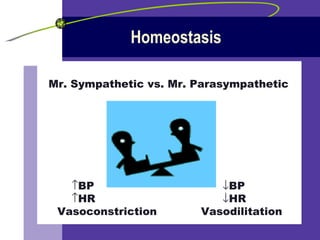
Homeostasis Mr. Sympathetic vs. Mr. Parasympathetic  BP  HR Vasoconstriction  BP  HR Vasodilitation
Vasovagal Presentation Hypotension that may be followed by paradoxic bradycardia May cause increased rate and depth of respirations Pulse may increase initially and then decrease Patients may be hypotensive without bradycardia
Normal Autonomic Nervous  System Regulation of Cardiovascular  Hemodynamic Responses ↓  venous return to heart triggers sympathetic nervous system Barrow receptors in carotid arteries and aortic arch and C-fibers in heart signal brain to produce more epinephrine ( ↑  HR and  ↑  BP) Anxiety also triggers this normal response
Abnormal Autonomic Nervous  System Regulation of Cardiovascular Hemodynamic Responses In some people, pain or emotional stress causes vigorous left ventricular contractions that activate cardiac mechanoreceptors and the vagus nerve, interrupting the normal sympathetic response This parasympathetic stimulation causes vasodilation and  ↓  HR, lowering BP further and causing syncope or near syncope Other vasovagal SSx include feeling hot or cold, shivering and vomiting
Vasovagal Syncope Also known as neurogenic or vasodepressor syncope or common faint Considered to be an abnormality in the complex neurocardiovascular interactions responsible for maintaining systemic and cerebral perfusion Although not completely understood there seem to be two categories of onset
Two Common Precipitating Situations Pain and Anxiety ↑   HR causes  ↑  BP Stretch receptors in ventricles activate the parasympathetic nervous system May be intended to be protective  Hypotension ↓   BP activates the negative feedback loop - a chain of events that is supposed to activate the sympathetic nervous system Instead parasympathetic nervous system is stimulated Both result in vasodilitation and possible bradycardia
Facts While standing, approximately 300-700 ml of blood pools in the lower extremities which decreases intravascular volume Strong vagal stimulations may induce 4-10 seconds of sinus arrest 15 seconds of asystole is necessary to produce unconsciousness in the recumbent position VVS can precede cardiac arrest and death Particularly in patients with coexisting heart disease
Precipitating and Aggravating  Factors for Vasovagal Syncope Precipitated by Sudden emotional stress Pain or threat of injury Sudden relief of anxiety Vascular cannulation Arterial decannulation Aggravated by Fasting Low volume Poor physical condition Warm environment Excessive fatigue
Patients At Higher  Risk for Vasovagal Syncope History of fainting  7.5 times more likely to vasovagal during venipuncture Sitting vs. lying during venipuncture Multiple venipuncture attempts Lengthy cannulation procedures < 40 years of age (not exclusively, however) Patients often have presyncope symptoms
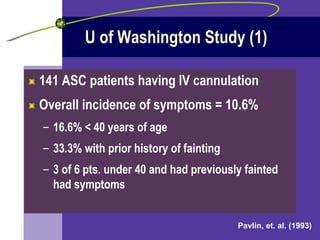
U of Washington Study (1) 141 ASC patients having IV cannulation Overall incidence of symptoms = 10.6% 16.6% < 40 years of age 33.3% with prior history of fainting 3 of 6 pts. under 40 and had previously fainted had symptoms Pavlin, et. al. (1993)
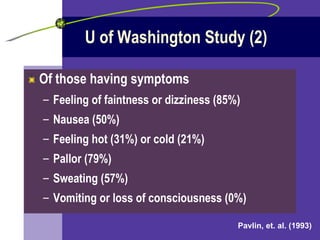
U of Washington Study (2) Of those having symptoms  Feeling of faintness or dizziness (85%) Nausea (50%) Feeling hot (31%) or cold (21%) Pallor (79%) Sweating (57%) Vomiting or loss of consciousness (0%) Pavlin, et. al. (1993)
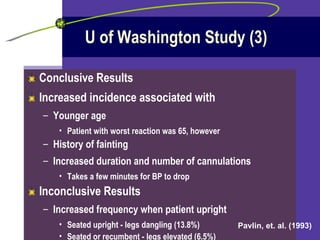
U of Washington Study (3) Conclusive Results Increased incidence associated with  Younger age Patient with worst reaction was 65, however History of fainting Increased duration and number of cannulations Takes a few minutes for BP to drop Inconclusive Results Increased frequency when patient upright Seated upright - legs dangling (13.8%)  Seated or recumbent - legs elevated (6.5%) Pavlin, et. al. (1993)
Faints Associated With  Removal of Stress 10 males were studied while they fainted immediately after blood donations Young, extremely anxious,  ↑  BP and  ↑  P  When procedure concluded, patients experienced sudden relief from anxiety. . . BP  ↓’d rapidly Some experienced profound bradycardia, junctional rhythms, or long sinus pauses associated with respiratory pauses Graham, et al. (1961)
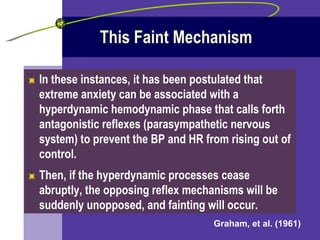
This Faint Mechanism In these instances, it has been postulated that extreme anxiety can be associated with a hyperdynamic hemodynamic phase that calls forth antagonistic reflexes (parasympathetic nervous system) to prevent the BP and HR from rising out of control. Then, if the hyperdynamic processes cease abruptly, the opposing reflex mechanisms will be suddenly unopposed, and fainting will occur. Graham, et al. (1961)
Cardiac Arrest Associated  With Venipuncture 44 y/o female, fasting for blood chemistry, history of fainting during venipuncture Placed in recumbent position on exam table for blood draw While blood being drawn, pt. c/o weakness, became diaphoretic, pale and went into cardiac arrest Regained consciousness after 2 minutes of CPR, IV epinephrine and hydrocortisone administered Tiezes (1976)
Vasovagal Reactions  Associated With Sheath Removal Cause is not fully understood Some efferent neurons present in the arterial wall that stimulate the parasympathetic nervous system or may be related to pain and anxiety End result is  ↓   BP or ↓   HR or  ↓   BP and  ↓  HR
Vasovagal vs. Orthostasis Take care to not confuse the two
Orthostatic Hypotension (1) 20 mmHg or greater drop in Systolic BP Lying to sitting or sitting to standing Compensatory rise in HR may occur if hypovolemic In procedure area, most often occurs because of volume depletion (NPO status) or antihypertensive medication (older patients) Observe for it and take precautions Encourage fluids after procedures and ensure that patients rise slowly Always wait for 2 minutes before taking orthostatic BP
Orthostatic Hypotension (2) Treatment Lie down Trendelenberg position NS Regulate medications
Historical Observation Sir Thomas Lewis (1932) Noted that bradycardia associated with a faint was reversed by atropine, but arterial pressure did not return to normal, nor did the subjects fully regain consciousness The term vasovagal was introduced to describe the circulatory alterations responsible for production of the syncopal reaction
Vasovagal Care First, assess your patient Decreased BP Decreased BP  Decreased HR Decreased HR Lie down Observe O 2 ± Trendelenberg ± NS Conscious Loss of Consciousness Lie down Trendelenberg O 2 NS Lie down Trendelenberg O 2 NS / Atropine Lie down Trendelenberg O 2 Atropine
FYI - Tilt Table Test Diagnostic test for patients with recurrent syncope Heart rate, rhythm, blood pressure and symptoms are monitored while the patient lies on the tilt table The table automatically changes body position from a lying to standing position at preset (10 and 25 minute) intervals If no symptoms occur while in the standing position, Isuprel may be used to provoke symptoms of fainting.  The test ends when symptoms are produced or the maximal tilt time is achieved Performed in the EP lab
Vasomotor Reaction Occurs when a large amount of unoxygenated radiological contrast agent is given as an IV bolus.  The IV bolus produces transient rise in pulmonary artery pressure and cardiac output and decrease in systemic vascular resistance.  It can also produce hemodynamic changes in the vein Patients may complain of burning, feelings of warmth or flushing, or a metallic taste in the mouth This is transient and requires no treatment
Review Treatment of orthostatic hypotension depends on symptoms Treatment of vasovagal reactions depends on symptoms, BP and HR No treatment is required for vasomotor contrast reactions
Review Question Which is normal? A. Increased heart rate and constricting, or narrowing of the arteries to force the blood back towards the heart – induced by stress or pain B. Decreased heart rate and widening or dilating of the arteries – induced by stress or pain.
Situation 1 Max walked a post cardiac cath patient to the rest room.  While walking  back to his room, the patient noticed an area of blood, about the size of a quarter, on his gown.  He promptly c/o lightheadedness. What is most likely happening with this patient? What are the immediate nursing actions? What will treatment most likely be?
Situation 2 You insert an IV into a 28 y/o M, no Hx of allergies or chronic illness, who is about to have a CT Pre IV insertion BP=120/70, P=84 Immediately post IV is insertion, pt. becomes diaphoretic and begins to shiver.  BP=90/40, P=50 What is happening? What are the immediate nursing actions? What will treatment most likely be?
Objectives (1) You should now be able to: Differentiate between normal and abnormal autonomic nervous system regulation of cardiovascular hemodynamic responses Identify the patients who are at greatest risk for vasovagal reactions Identify the two major types of situations that trigger vasovagal reactions
Objectives (2) You should also be able to: Take the appropriate steps to minimize the possibility of vasovagal reaction in patients known to have previously fainted Minimize the possibility of vasovagal reaction for previously NPO patients Identify patients experiencing vasovagal reactions Initiate appropriate nursing actions for patients having vasovagal reactions
The End!

Vasovagal Syncope

  • 1.
    Vasovagal Syncope (VVS)Catherine A. Lewis, RN © 2002
  • 2.
    Objectives (1) Afterthis nursing inservice, you should be able to: Differentiate between normal and abnormal autonomic nervous system regulation of cardiovascular hemodynamic responses Identify the patients who are at greatest risk for vasovagal reactions Identify the two major types of situations that trigger vasovagal reactions
  • 3.
    Objectives (2) Takethe appropriate steps to minimize the possibility of vasovagal reaction in patients known to have previously fainted Minimize the possibility of vasovagal reaction for previously NPO patients Identify patients experiencing vasovagal reactions Initiate appropriate nursing actions for patients having vasovagal reactions
  • 4.
    Many Causes ofSyncope Cardiac Syncope This type often results in hospitalization Noncardiac Syncope This type most often presents in the ER This type will most often be seen in Care Suites Syncope of Unknown Origin
  • 5.
    Homeostasis Mr. Sympatheticvs. Mr. Parasympathetic  BP  HR Vasoconstriction  BP  HR Vasodilitation
  • 6.
    Vasovagal Presentation Hypotensionthat may be followed by paradoxic bradycardia May cause increased rate and depth of respirations Pulse may increase initially and then decrease Patients may be hypotensive without bradycardia
  • 7.
    Normal Autonomic Nervous System Regulation of Cardiovascular Hemodynamic Responses ↓ venous return to heart triggers sympathetic nervous system Barrow receptors in carotid arteries and aortic arch and C-fibers in heart signal brain to produce more epinephrine ( ↑ HR and ↑ BP) Anxiety also triggers this normal response
  • 8.
    Abnormal Autonomic Nervous System Regulation of Cardiovascular Hemodynamic Responses In some people, pain or emotional stress causes vigorous left ventricular contractions that activate cardiac mechanoreceptors and the vagus nerve, interrupting the normal sympathetic response This parasympathetic stimulation causes vasodilation and ↓ HR, lowering BP further and causing syncope or near syncope Other vasovagal SSx include feeling hot or cold, shivering and vomiting
  • 9.
    Vasovagal Syncope Alsoknown as neurogenic or vasodepressor syncope or common faint Considered to be an abnormality in the complex neurocardiovascular interactions responsible for maintaining systemic and cerebral perfusion Although not completely understood there seem to be two categories of onset
  • 10.
    Two Common PrecipitatingSituations Pain and Anxiety ↑ HR causes ↑ BP Stretch receptors in ventricles activate the parasympathetic nervous system May be intended to be protective Hypotension ↓ BP activates the negative feedback loop - a chain of events that is supposed to activate the sympathetic nervous system Instead parasympathetic nervous system is stimulated Both result in vasodilitation and possible bradycardia
  • 11.
    Facts While standing,approximately 300-700 ml of blood pools in the lower extremities which decreases intravascular volume Strong vagal stimulations may induce 4-10 seconds of sinus arrest 15 seconds of asystole is necessary to produce unconsciousness in the recumbent position VVS can precede cardiac arrest and death Particularly in patients with coexisting heart disease
  • 12.
    Precipitating and Aggravating Factors for Vasovagal Syncope Precipitated by Sudden emotional stress Pain or threat of injury Sudden relief of anxiety Vascular cannulation Arterial decannulation Aggravated by Fasting Low volume Poor physical condition Warm environment Excessive fatigue
  • 13.
    Patients At Higher Risk for Vasovagal Syncope History of fainting 7.5 times more likely to vasovagal during venipuncture Sitting vs. lying during venipuncture Multiple venipuncture attempts Lengthy cannulation procedures < 40 years of age (not exclusively, however) Patients often have presyncope symptoms
  • 14.
    U of WashingtonStudy (1) 141 ASC patients having IV cannulation Overall incidence of symptoms = 10.6% 16.6% < 40 years of age 33.3% with prior history of fainting 3 of 6 pts. under 40 and had previously fainted had symptoms Pavlin, et. al. (1993)
  • 15.
    U of WashingtonStudy (2) Of those having symptoms Feeling of faintness or dizziness (85%) Nausea (50%) Feeling hot (31%) or cold (21%) Pallor (79%) Sweating (57%) Vomiting or loss of consciousness (0%) Pavlin, et. al. (1993)
  • 16.
    U of WashingtonStudy (3) Conclusive Results Increased incidence associated with Younger age Patient with worst reaction was 65, however History of fainting Increased duration and number of cannulations Takes a few minutes for BP to drop Inconclusive Results Increased frequency when patient upright Seated upright - legs dangling (13.8%) Seated or recumbent - legs elevated (6.5%) Pavlin, et. al. (1993)
  • 17.
    Faints Associated With Removal of Stress 10 males were studied while they fainted immediately after blood donations Young, extremely anxious, ↑ BP and ↑ P When procedure concluded, patients experienced sudden relief from anxiety. . . BP ↓’d rapidly Some experienced profound bradycardia, junctional rhythms, or long sinus pauses associated with respiratory pauses Graham, et al. (1961)
  • 18.
    This Faint MechanismIn these instances, it has been postulated that extreme anxiety can be associated with a hyperdynamic hemodynamic phase that calls forth antagonistic reflexes (parasympathetic nervous system) to prevent the BP and HR from rising out of control. Then, if the hyperdynamic processes cease abruptly, the opposing reflex mechanisms will be suddenly unopposed, and fainting will occur. Graham, et al. (1961)
  • 19.
    Cardiac Arrest Associated With Venipuncture 44 y/o female, fasting for blood chemistry, history of fainting during venipuncture Placed in recumbent position on exam table for blood draw While blood being drawn, pt. c/o weakness, became diaphoretic, pale and went into cardiac arrest Regained consciousness after 2 minutes of CPR, IV epinephrine and hydrocortisone administered Tiezes (1976)
  • 20.
    Vasovagal Reactions Associated With Sheath Removal Cause is not fully understood Some efferent neurons present in the arterial wall that stimulate the parasympathetic nervous system or may be related to pain and anxiety End result is ↓ BP or ↓ HR or ↓ BP and ↓ HR
  • 21.
    Vasovagal vs. OrthostasisTake care to not confuse the two
  • 22.
    Orthostatic Hypotension (1)20 mmHg or greater drop in Systolic BP Lying to sitting or sitting to standing Compensatory rise in HR may occur if hypovolemic In procedure area, most often occurs because of volume depletion (NPO status) or antihypertensive medication (older patients) Observe for it and take precautions Encourage fluids after procedures and ensure that patients rise slowly Always wait for 2 minutes before taking orthostatic BP
  • 23.
    Orthostatic Hypotension (2)Treatment Lie down Trendelenberg position NS Regulate medications
  • 24.
    Historical Observation SirThomas Lewis (1932) Noted that bradycardia associated with a faint was reversed by atropine, but arterial pressure did not return to normal, nor did the subjects fully regain consciousness The term vasovagal was introduced to describe the circulatory alterations responsible for production of the syncopal reaction
  • 25.
    Vasovagal Care First,assess your patient Decreased BP Decreased BP Decreased HR Decreased HR Lie down Observe O 2 ± Trendelenberg ± NS Conscious Loss of Consciousness Lie down Trendelenberg O 2 NS Lie down Trendelenberg O 2 NS / Atropine Lie down Trendelenberg O 2 Atropine
  • 26.
    FYI - TiltTable Test Diagnostic test for patients with recurrent syncope Heart rate, rhythm, blood pressure and symptoms are monitored while the patient lies on the tilt table The table automatically changes body position from a lying to standing position at preset (10 and 25 minute) intervals If no symptoms occur while in the standing position, Isuprel may be used to provoke symptoms of fainting. The test ends when symptoms are produced or the maximal tilt time is achieved Performed in the EP lab
  • 27.
    Vasomotor Reaction Occurswhen a large amount of unoxygenated radiological contrast agent is given as an IV bolus. The IV bolus produces transient rise in pulmonary artery pressure and cardiac output and decrease in systemic vascular resistance. It can also produce hemodynamic changes in the vein Patients may complain of burning, feelings of warmth or flushing, or a metallic taste in the mouth This is transient and requires no treatment
  • 28.
    Review Treatment oforthostatic hypotension depends on symptoms Treatment of vasovagal reactions depends on symptoms, BP and HR No treatment is required for vasomotor contrast reactions
  • 29.
    Review Question Whichis normal? A. Increased heart rate and constricting, or narrowing of the arteries to force the blood back towards the heart – induced by stress or pain B. Decreased heart rate and widening or dilating of the arteries – induced by stress or pain.
  • 30.
    Situation 1 Maxwalked a post cardiac cath patient to the rest room. While walking back to his room, the patient noticed an area of blood, about the size of a quarter, on his gown. He promptly c/o lightheadedness. What is most likely happening with this patient? What are the immediate nursing actions? What will treatment most likely be?
  • 31.
    Situation 2 Youinsert an IV into a 28 y/o M, no Hx of allergies or chronic illness, who is about to have a CT Pre IV insertion BP=120/70, P=84 Immediately post IV is insertion, pt. becomes diaphoretic and begins to shiver. BP=90/40, P=50 What is happening? What are the immediate nursing actions? What will treatment most likely be?
  • 32.
    Objectives (1) Youshould now be able to: Differentiate between normal and abnormal autonomic nervous system regulation of cardiovascular hemodynamic responses Identify the patients who are at greatest risk for vasovagal reactions Identify the two major types of situations that trigger vasovagal reactions
  • 33.
    Objectives (2) Youshould also be able to: Take the appropriate steps to minimize the possibility of vasovagal reaction in patients known to have previously fainted Minimize the possibility of vasovagal reaction for previously NPO patients Identify patients experiencing vasovagal reactions Initiate appropriate nursing actions for patients having vasovagal reactions
  • 34.