P. L. N. V. Aashrith Int. Journal of Engineering Research and Applications www.ijera.com 
ISSN : 2248-9622, Vol. 4, Issue 6( Version 1), June 2014, pp.70-79 
www.ijera.com 70 | P a g e 
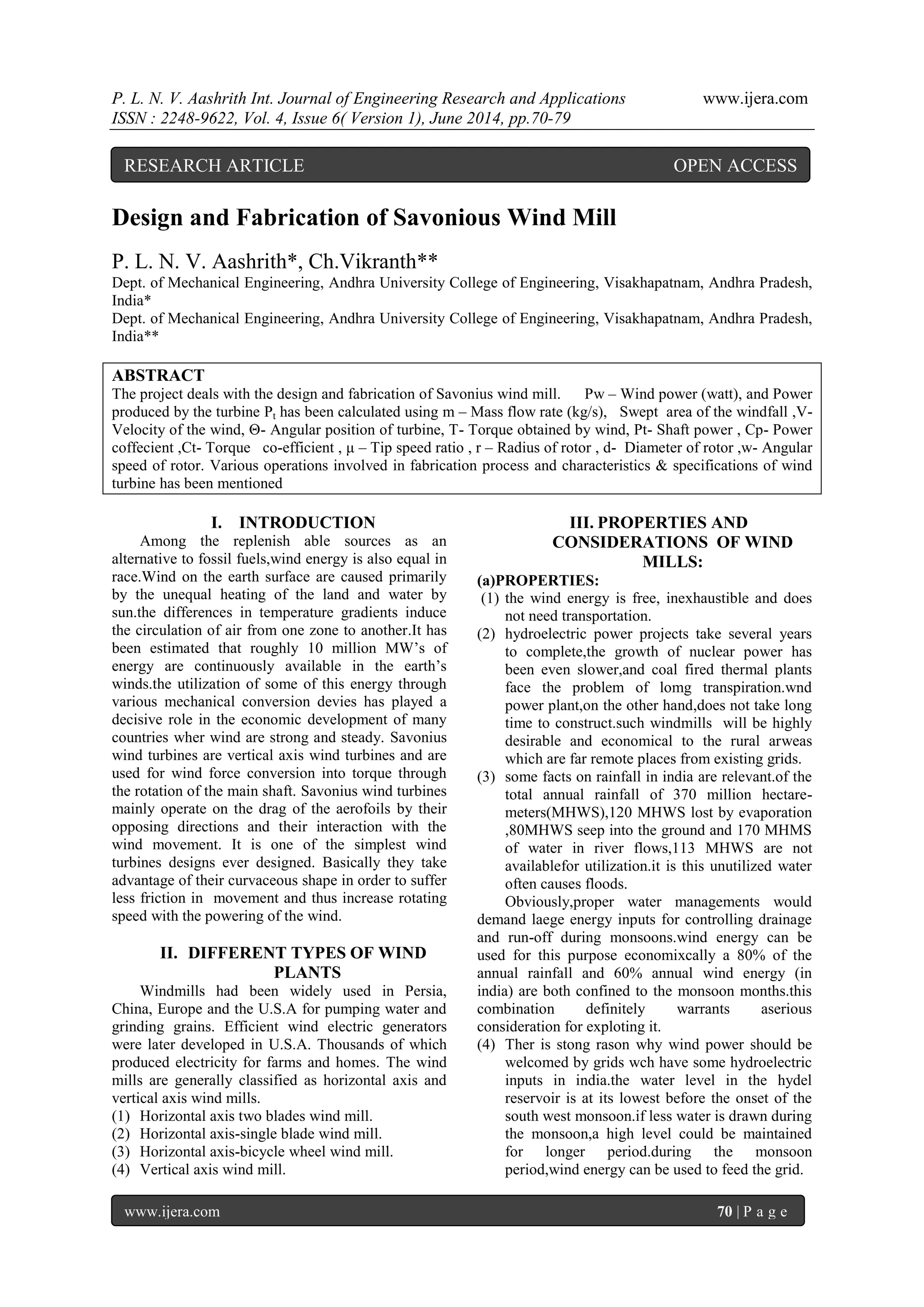
Design and Fabrication of Savonious Wind Mill P. L. N. V. Aashrith*, Ch.Vikranth** Dept. of Mechanical Engineering, Andhra University College of Engineering, Visakhapatnam, Andhra Pradesh, India* Dept. of Mechanical Engineering, Andhra University College of Engineering, Visakhapatnam, Andhra Pradesh, India** ABSTRACT 
The project deals with the design and fabrication of Savonius wind mill. Pw – Wind power (watt), and Power produced by the turbine Pt has been calculated using m – Mass flow rate (kg/s), Swept area of the windfall ,V- Velocity of the wind, Θ- Angular position of turbine, T- Torque obtained by wind, Pt- Shaft power , Cp- Power coffecient ,Ct- Torque co-efficient , μ – Tip speed ratio , r – Radius of rotor , d- Diameter of rotor ,w- Angular speed of rotor. Various operations involved in fabrication process and characteristics & specifications of wind turbine has been mentioned 
I. INTRODUCTION 
Among the replenish able sources as an alternative to fossil fuels,wind energy is also equal in race.Wind on the earth surface are caused primarily by the unequal heating of the land and water by sun.the differences in temperature gradients induce the circulation of air from one zone to another.It has been estimated that roughly 10 million MW’s of energy are continuously available in the earth’s winds.the utilization of some of this energy through various mechanical conversion devies has played a decisive role in the economic development of many countries wher wind are strong and steady. Savonius wind turbines are vertical axis wind turbines and are used for wind force conversion into torque through the rotation of the main shaft. Savonius wind turbines mainly operate on the drag of the aerofoils by their opposing directions and their interaction with the wind movement. It is one of the simplest wind turbines designs ever designed. Basically they take advantage of their curvaceous shape in order to suffer less friction in movement and thus increase rotating speed with the powering of the wind. 
II. DIFFERENT TYPES OF WIND PLANTS 
Windmills had been widely used in Persia, China, Europe and the U.S.A for pumping water and grinding grains. Efficient wind electric generators were later developed in U.S.A. Thousands of which produced electricity for farms and homes. The wind mills are generally classified as horizontal axis and vertical axis wind mills. 
(1) Horizontal axis two blades wind mill. 
(2) Horizontal axis-single blade wind mill. 
(3) Horizontal axis-bicycle wheel wind mill. 
(4) Vertical axis wind mill. 
III. PROPERTIES AND CONSIDERATIONS OF WIND MILLS: 
(a)PROPERTIES: (1) the wind energy is free, inexhaustible and does not need transportation. (2) hydroelectric power projects take several years to complete,the growth of nuclear power has been even slower,and coal fired thermal plants face the problem of lomg transpiration.wnd power plant,on the other hand,does not take long time to construct.such windmills will be highly desirable and economical to the rural arweas which are far remote places from existing grids. (3) some facts on rainfall in india are relevant.of the total annual rainfall of 370 million hectare- meters(MHWS),120 MHWS lost by evaporation ,80MHWS seep into the ground and 170 MHMS of water in river flows,113 MHWS are not availablefor utilization.it is this unutilized water often causes floods. Obviously,proper water managements would demand laege energy inputs for controlling drainage and run-off during monsoons.wind energy can be used for this purpose economixcally a 80% of the annual rainfall and 60% annual wind energy (in india) are both confined to the monsoon months.this combination definitely warrants aserious consideration for exploting it. 
(4) Ther is stong rason why wind power should be welcomed by grids wch have some hydroelectric inputs in india.the water level in the hydel reservoir is at its lowest before the onset of the south west monsoon.if less water is drawn during the monsoon,a high level could be maintained for longer period.during the monsoon period,wind energy can be used to feed the grid. 
RESEARCH ARTICLE OPEN ACCESS
P. L. N. V. Aashrith Int. Journal of Engineering Research and Applications www.ijera.com 
ISSN : 2248-9622, Vol. 4, Issue 6( Version 1), June 2014, pp.70-79 
www.ijera.com 71 | P a g e 
(b) CONSIDERATIONS: (1) the major disadvantage associated with the wind power is that it is not consistent and steady which makes the complications in designing the whole plant. (2) the wind is a very hazardous,treacherous and unpredictable commodity.blowing in strong gusts from varying directions and leaving account such phenomena as hurricanes and tornadoes-it can cause tremendous shear stresses which may smash the whole plant within no time.to avoid this,special and costly designs and controls are always required. (3) the power coffecient (ratio of the power actually delivered by the rotor to the power of the wind in the rotor disc) can be 0.593 maximum for aerodynamic rason.the machine developed to date (ERDA’S plum brook unit) has power coefficient of 0.4. (4) Among al the disadvantages mentioned above,the cost factor is major has restricted the development of wind power on large scale foe feeding to th existing grid.the estimated cost of wind electricity generation,storage and distribution system is over 1 lakh ruppes which may be considered beyond the means of the most villages. With all this disadvantages,this source of power has a bright future as the use of small aero generator producing 200 to 300 watts which is sufficient to power a house of one family at a reasonable cost will definitely attract the villages for the good standard of life. 
IV. FACTOR AFFECTING WIND POWER EXTRACTION 
Elevation of blade hub above ground-the higher above ground one is , the higher wind velocity and since the power is proportional to the cube of the velocity, an increase in hub elevation from 30 m to 50 m leads to an average wind seed 7.6% higher. This becomes a significant cost-benefit trade-off, since taller hubs become more expensive. Spacing of wind turbines on wind farms-too far spacing will prevent the maximum amount of wind to be intercepted. However, too close spacing will lead to interference and downwind units will be less productive. Sitting of wind turbine-naturally not all locations are suitable for placements of wind turbines. In order to be economical, most sites have to have average wind speeds of about 10 m/s. This speed usually increases with height above ground. Air density-the higher the density of air, the more power carried by the wind and as air density decreases with height above sea-level, usually sites in mountainous regions are less preferable than those at flat, sea-level locations. 
V. METHODOLOGY 
Savonius Wind Mill Model 
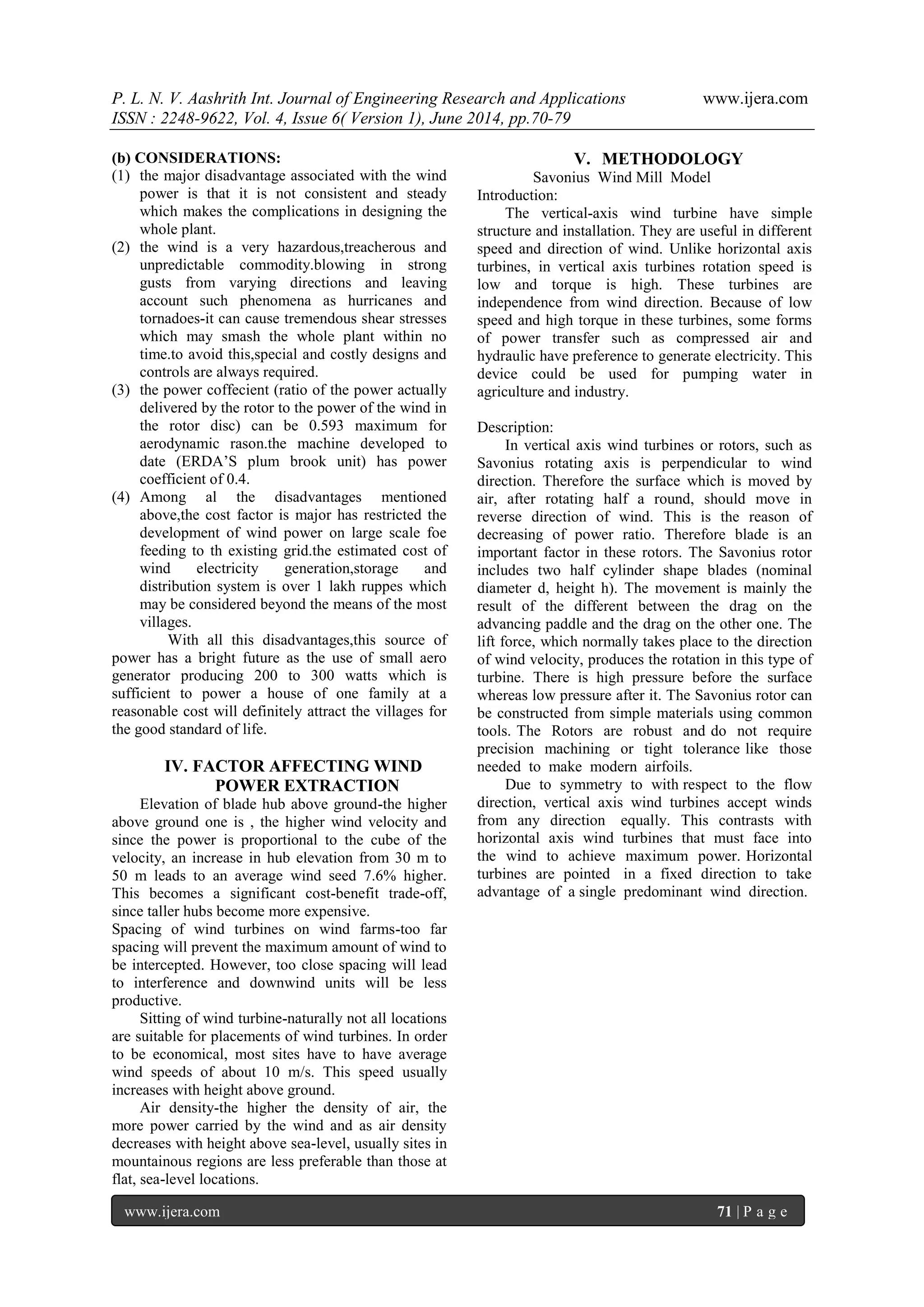
Introduction: The vertical-axis wind turbine have simple structure and installation. They are useful in different speed and direction of wind. Unlike horizontal axis turbines, in vertical axis turbines rotation speed is low and torque is high. These turbines are independence from wind direction. Because of low speed and high torque in these turbines, some forms of power transfer such as compressed air and hydraulic have preference to generate electricity. This device could be used for pumping water in agriculture and industry. Description: In vertical axis wind turbines or rotors, such as Savonius rotating axis is perpendicular to wind direction. Therefore the surface which is moved by air, after rotating half a round, should move in reverse direction of wind. This is the reason of decreasing of power ratio. Therefore blade is an important factor in these rotors. The Savonius rotor includes two half cylinder shape blades (nominal diameter d, height h). The movement is mainly the result of the different between the drag on the advancing paddle and the drag on the other one. The lift force, which normally takes place to the direction of wind velocity, produces the rotation in this type of turbine. There is high pressure before the surface whereas low pressure after it. The Savonius rotor can be constructed from simple materials using common tools. The Rotors are robust and do not require precision machining or tight tolerance like those needed to make modern airfoils. Due to symmetry to with respect to the flow direction, vertical axis wind turbines accept winds from any direction equally. This contrasts with horizontal axis wind turbines that must face into the wind to achieve maximum power. Horizontal turbines are pointed in a fixed direction to take advantage of a single predominant wind direction.
P. L. N. V. Aashrith Int. Journal of Engineering Research and Applications www.ijera.com 
ISSN : 2248-9622, Vol. 4, Issue 6( Version 1), June 2014, pp.70-79 
www.ijera.com 72 | P a g e 
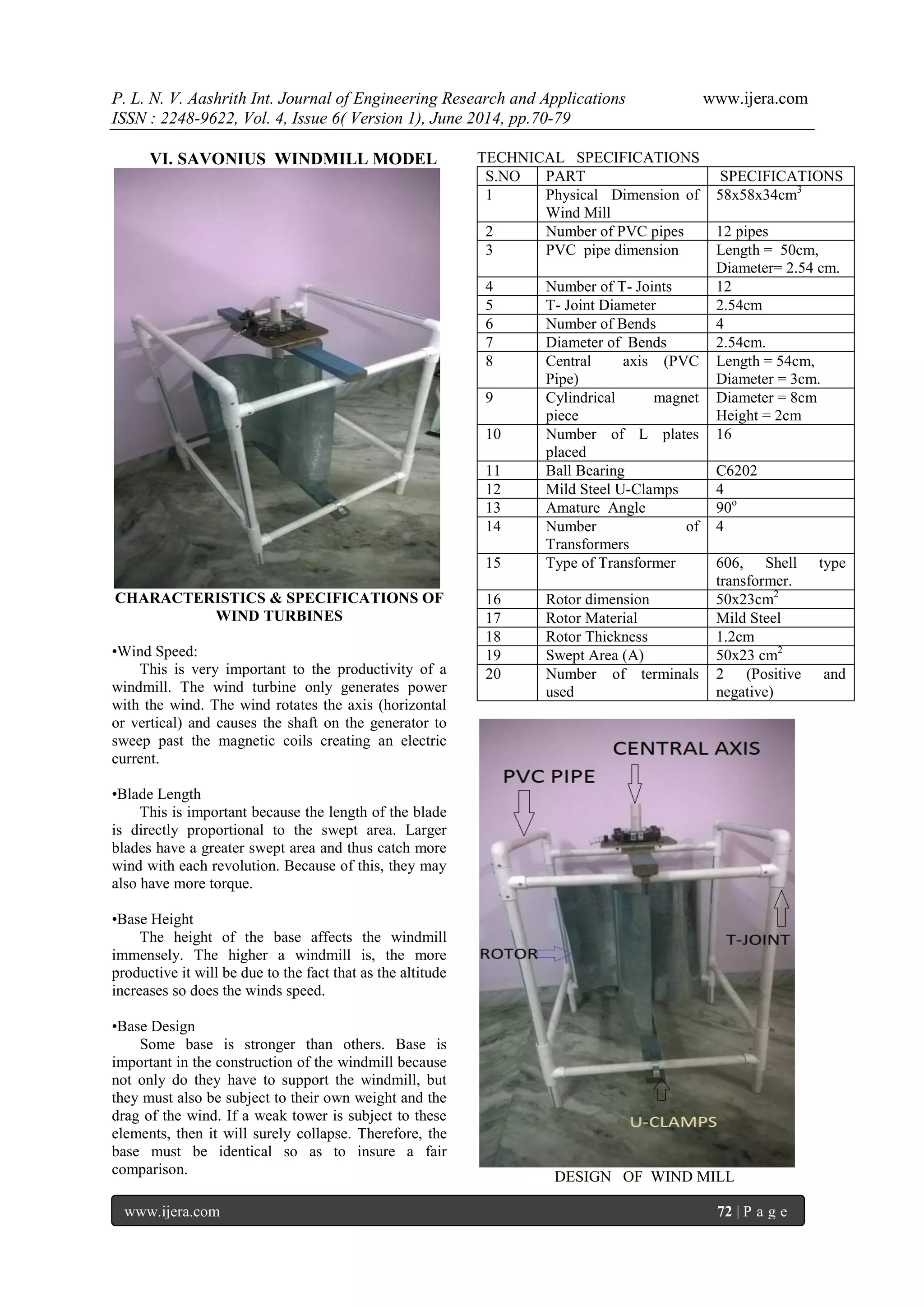
VI. SAVONIUS WINDMILL MODEL 
CHARACTERISTICS & SPECIFICATIONS OF WIND TURBINES •Wind Speed: This is very important to the productivity of a windmill. The wind turbine only generates power with the wind. The wind rotates the axis (horizontal or vertical) and causes the shaft on the generator to sweep past the magnetic coils creating an electric current. •Blade Length This is important because the length of the blade is directly proportional to the swept area. Larger blades have a greater swept area and thus catch more wind with each revolution. Because of this, they may also have more torque. •Base Height The height of the base affects the windmill immensely. The higher a windmill is, the more productive it will be due to the fact that as the altitude increases so does the winds speed. •Base Design Some base is stronger than others. Base is important in the construction of the windmill because not only do they have to support the windmill, but they must also be subject to their own weight and the drag of the wind. If a weak tower is subject to these elements, then it will surely collapse. Therefore, the base must be identical so as to insure a fair comparison. 
TECHNICAL SPECIFICATIONS 
S.NO 
PART 
SPECIFICATIONS 
1 
Physical Dimension of Wind Mill 
58x58x34cm3 
2 
Number of PVC pipes 
12 pipes 
3 
PVC pipe dimension 
Length = 50cm, Diameter= 2.54 cm. 
4 
Number of T- Joints 
12 
5 
T- Joint Diameter 
2.54cm 
6 
Number of Bends 
4 
7 
Diameter of Bends 
2.54cm. 
8 
Central axis (PVC Pipe) 
Length = 54cm, Diameter = 3cm. 
9 
Cylindrical magnet piece 
Diameter = 8cm Height = 2cm 
10 
Number of L plates placed 
16 
11 
Ball Bearing 
C6202 
12 
Mild Steel U-Clamps 
4 
13 
Amature Angle 
90o 
14 
Number of Transformers 
4 
15 
Type of Transformer 
606, Shell type transformer. 
16 
Rotor dimension 
50x23cm2 
17 
Rotor Material 
Mild Steel 
18 
Rotor Thickness 
1.2cm 
19 
Swept Area (A) 
50x23 cm2 
20 
Number of terminals used 
2 (Positive and negative) 
DESIGN OF WIND MILL
P. L. N. V. Aashrith Int. Journal of Engineering Research and Applications www.ijera.com 
ISSN : 2248-9622, Vol. 4, Issue 6( Version 1), June 2014, pp.70-79 
www.ijera.com 73 | P a g e 
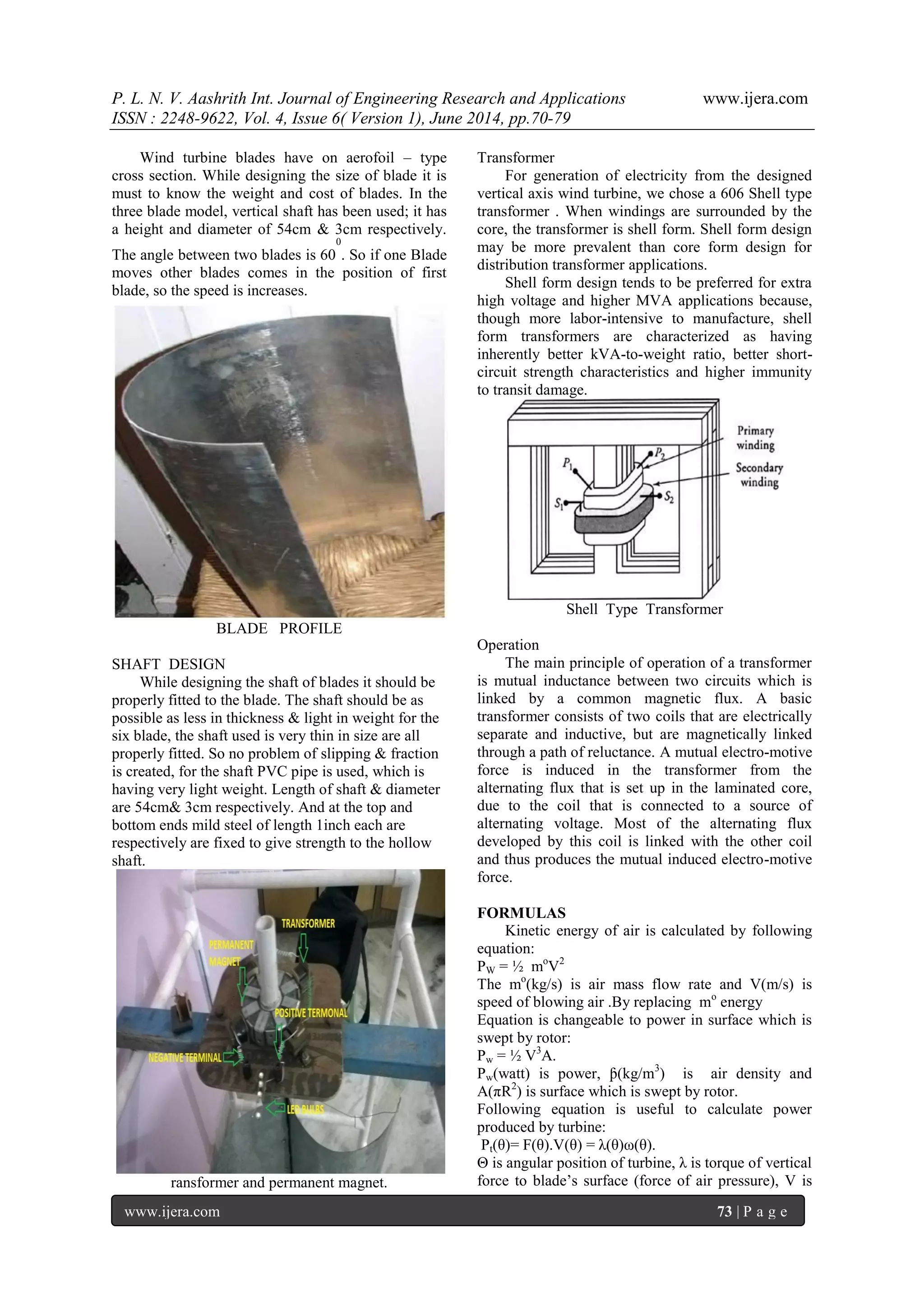
Wind turbine blades have on aerofoil – type 
cross section. While designing the size of blade it is 
must to know the weight and cost of blades. In the 
three blade model, vertical shaft has been used; it has 
a height and diameter of 54cm & 3cm respectively. 
The angle between two blades is 60 
0 
. So if one Blade 
moves other blades comes in the position of first 
blade, so the speed is increases. 
BLADE PROFILE 
SHAFT DESIGN 
While designing the shaft of blades it should be 
properly fitted to the blade. The shaft should be as 
possible as less in thickness & light in weight for the 
six blade, the shaft used is very thin in size are all 
properly fitted. So no problem of slipping & fraction 
is created, for the shaft PVC pipe is used, which is 
having very light weight. Length of shaft & diameter 
are 54cm& 3cm respectively. And at the top and 
bottom ends mild steel of length 1inch each are 
respectively are fixed to give strength to the hollow 
shaft. 
ransformer and permanent magnet. 
Transformer 
For generation of electricity from the designed 
vertical axis wind turbine, we chose a 606 Shell type 
transformer . When windings are surrounded by the 
core, the transformer is shell form. Shell form design 
may be more prevalent than core form design for 
distribution transformer applications. 
Shell form design tends to be preferred for extra 
high voltage and higher MVA applications because, 
though more labor-intensive to manufacture, shell 
form transformers are characterized as having 
inherently better kVA-to-weight ratio, better short-circuit 
strength characteristics and higher immunity 
to transit damage. 
Shell Type Transformer 
Operation 
The main principle of operation of a transformer 
is mutual inductance between two circuits which is 
linked by a common magnetic flux. A basic 
transformer consists of two coils that are electrically 
separate and inductive, but are magnetically linked 
through a path of reluctance. A mutual electro-motive 
force is induced in the transformer from the 
alternating flux that is set up in the laminated core, 
due to the coil that is connected to a source of 
alternating voltage. Most of the alternating flux 
developed by this coil is linked with the other coil 
and thus produces the mutual induced electro-motive 
force. 
FORMULAS 
Kinetic energy of air is calculated by following 
equation: 
PW = ½ moV2 
The mo(kg/s) is air mass flow rate and V(m/s) is 
speed of blowing air .By replacing mo energy 
Equation is changeable to power in surface which is 
swept by rotor: 
Pw = ½ V3A. 
Pw(watt) is power, ƥ(kg/m3) is air density and 
A(πR2) is surface which is swept by rotor. 
Following equation is useful to calculate power 
produced by turbine: 
Pt(θ)= F(θ).V(θ) = λ(θ)ω(θ). 
Θ is angular position of turbine, λ is torque of vertical 
force to blade’s surface (force of air pressure), V is
P. L. N. V. Aashrith Int. Journal of Engineering Research and Applications www.ijera.com 
ISSN : 2248-9622, Vol. 4, Issue 6( Version 1), June 2014, pp.70-79 
www.ijera.com 74 | P a g e 
speed vector in force point of F, and ω is rotating speed of blade. The power factor can be defined as the ratio between the power in turbine shaft (Pt) and the wind power (Pw) due to its kinetic energy right before the turbine plane, which yields: Cp =Pt/Pw When turning, the Savonius rotor presents the wind with a concave and a convex section, and derives most of its power from drag. The drag coefficient for a flow perpendicular to the convex face of a half pipe is 1.2, while the drag coefficient for the concave section is nearly twice as high at 2.3. Therefore, the force on the concave side of the rotor is higher, inducing a torque that turns the rotor. In addition to the torque due to drag, flow through the gap between the two rotor blades causes lift with thrust out the back face of the rotor helping it turn in the desired direction. Rotors of the torque coefficient, Ct, the power coefficient, Cp, and the wind speed to tip speed ratio, μ. For Savonius rotor, Ct = T/ (0.5V2Ad), Cp = P/ (0.5V3A) And μ = πlN/ (60V), μ is tip speed ratio, which is defined as the ratio between a blade’s speed at its tip and the faraway wind velocity. For a turbine of radius r, spinning at angular rate ω, in a wind with faraway velocity V, we have μ = r ω/V The Turbine efficiency, also known as its power coefficient, Cp, as the ratio between the power produced by the turbine and the power contained in the wind that passes through the reaches of the turbine blades. 
The maximum power of a Savonius rotor is given by, where and are the height and radius of the rotor and is the wind VARIOUS OPERATIONS INVOLVED IN FABRICATION PROCESS •Cutting PVC pipes and plywood of required dimensions are cut using bench vice and handsaw. The Shell type transformer is cut into two halves of 900 each. •Drilling The T- joints and Bends after assembled are drilled with 5mm diameter and 1 inch bolts are inserted. •Bending The Mild sheets of 12mm thickness sheets of length 30cm and breadth 32cm using mallet, 2cm round file and anvil. 
•Turning 
The main shaft is turned on the inner side using lathe up to 2mm thickness for fixing ball bearings. •Soldering The four transformers are joined in series by soldering wires and these are connected to positive and negative terminals. The four LED bulbs are joined by parallel connection by soldering. •Assembly The four transformers are bolted to the wooden plate; the wooden plate is joined to the main frame using U- clamps. The Three bended sheets are joined to the main axis by bolt and nut. The permanent magnet is fixed to the main axis by using glue. The 16 mild steels plates are placed and attached to the magnet by using glue, thereby creating sixteen poles. The four transformers are joined in series and this is connected to positive and negative terminals and to a parallel connection of four LED bulbs. AVERAGE WIND SPEEDS (Kmph) 
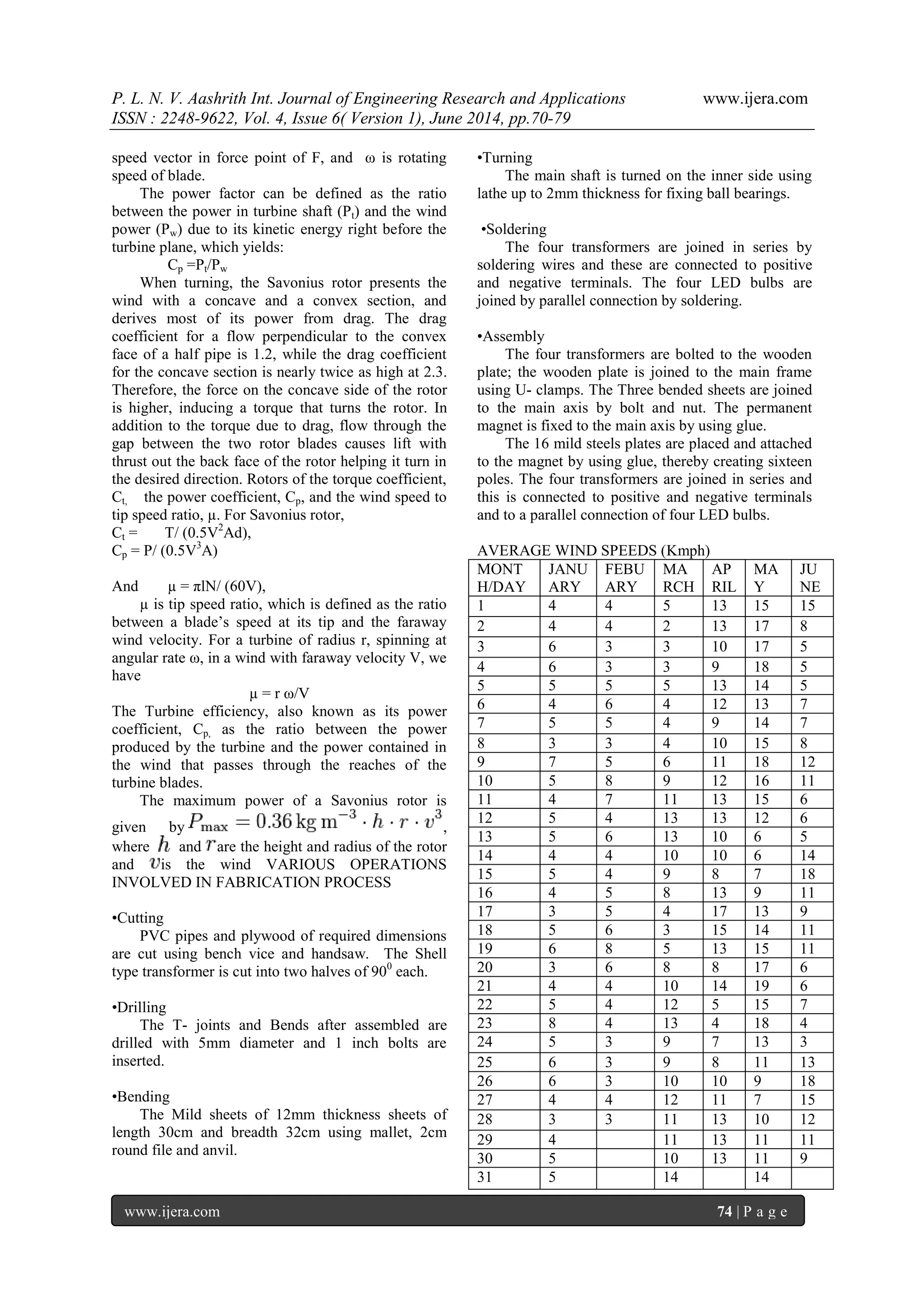
MONTH/DAY 
JANUARY 
FEBUARY 
MARCH 
APRIL 
MAY 
JUNE 
1 
4 
4 
5 
13 
15 
15 
2 
4 
4 
2 
13 
17 
8 
3 
6 
3 
3 
10 
17 
5 
4 
6 
3 
3 
9 
18 
5 
5 
5 
5 
5 
13 
14 
5 
6 
4 
6 
4 
12 
13 
7 
7 
5 
5 
4 
9 
14 
7 
8 
3 
3 
4 
10 
15 
8 
9 
7 
5 
6 
11 
18 
12 
10 
5 
8 
9 
12 
16 
11 
11 
4 
7 
11 
13 
15 
6 
12 
5 
4 
13 
13 
12 
6 
13 
5 
6 
13 
10 
6 
5 
14 
4 
4 
10 
10 
6 
14 
15 
5 
4 
9 
8 
7 
18 
16 
4 
5 
8 
13 
9 
11 
17 
3 
5 
4 
17 
13 
9 
18 
5 
6 
3 
15 
14 
11 
19 
6 
8 
5 
13 
15 
11 
20 
3 
6 
8 
8 
17 
6 
21 
4 
4 
10 
14 
19 
6 
22 
5 
4 
12 
5 
15 
7 
23 
8 
4 
13 
4 
18 
4 
24 
5 
3 
9 
7 
13 
3 
25 
6 
3 
9 
8 
11 
13 
26 
6 
3 
10 
10 
9 
18 
27 
4 
4 
12 
11 
7 
15 
28 
3 
3 
11 
13 
10 
12 
29 
4 
11 
13 
11 
11 
30 
5 
10 
13 
11 
9 
31 
5 
14 
14
P. L. N. V. Aashrith Int. Journal of Engineering Research and Applications www.ijera.com 
ISSN : 2248-9622, Vol. 4, Issue 6( Version 1), June 2014, pp.70-79 
www.ijera.com 75 | P a g e 
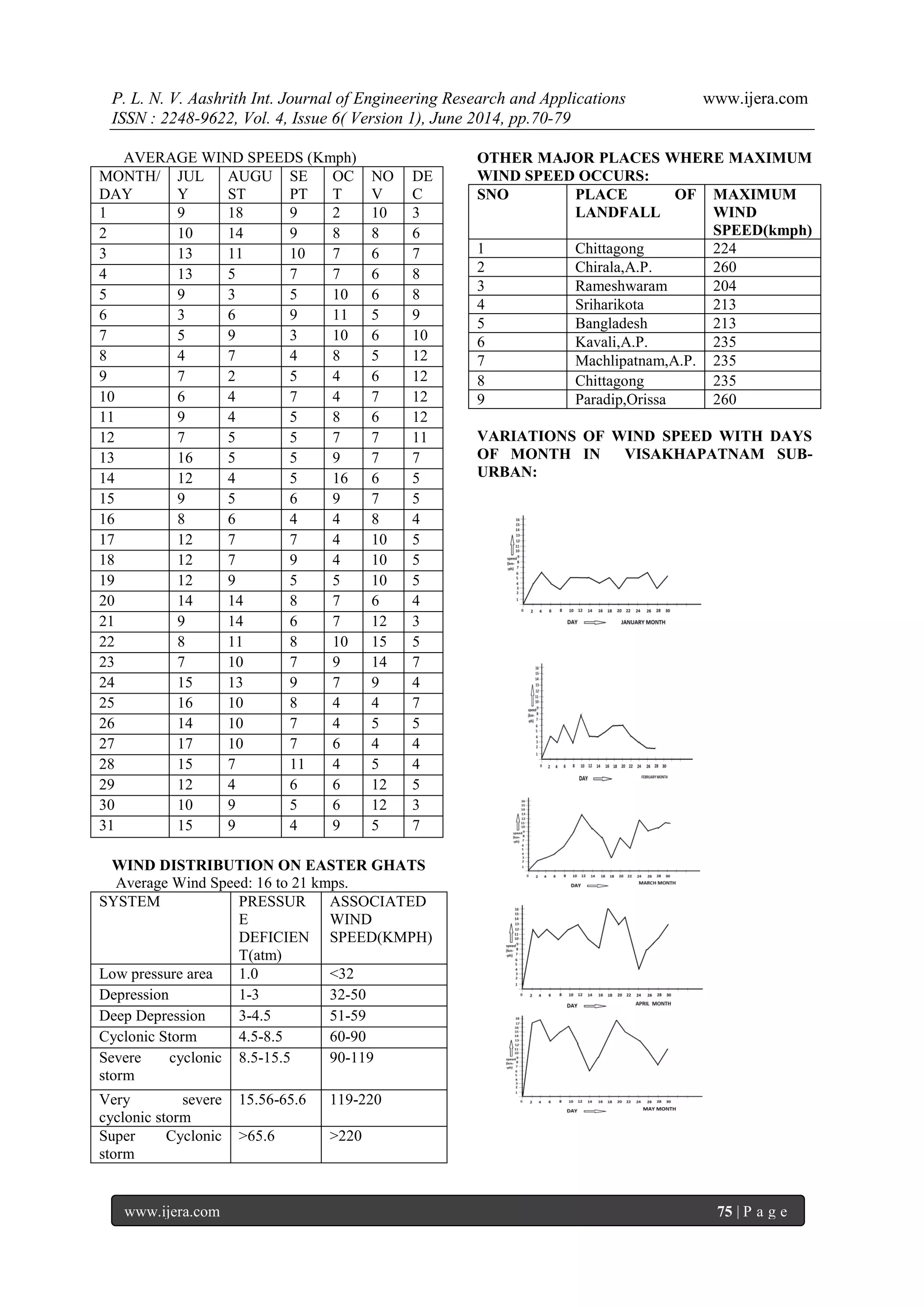
AVERAGE WIND SPEEDS (Kmph) 
MONTH/ DAY 
JULY 
AUGUST 
SEPT 
OCT 
NOV 
DEC 
1 
9 
18 
9 
2 
10 
3 
2 
10 
14 
9 
8 
8 
6 
3 
13 
11 
10 
7 
6 
7 
4 
13 
5 
7 
7 
6 
8 
5 
9 
3 
5 
10 
6 
8 
6 
3 
6 
9 
11 
5 
9 
7 
5 
9 
3 
10 
6 
10 
8 
4 
7 
4 
8 
5 
12 
9 
7 
2 
5 
4 
6 
12 
10 
6 
4 
7 
4 
7 
12 
11 
9 
4 
5 
8 
6 
12 
12 
7 
5 
5 
7 
7 
11 
13 
16 
5 
5 
9 
7 
7 
14 
12 
4 
5 
16 
6 
5 
15 
9 
5 
6 
9 
7 
5 
16 
8 
6 
4 
4 
8 
4 
17 
12 
7 
7 
4 
10 
5 
18 
12 
7 
9 
4 
10 
5 
19 
12 
9 
5 
5 
10 
5 
20 
14 
14 
8 
7 
6 
4 
21 
9 
14 
6 
7 
12 
3 
22 
8 
11 
8 
10 
15 
5 
23 
7 
10 
7 
9 
14 
7 
24 
15 
13 
9 
7 
9 
4 
25 
16 
10 
8 
4 
4 
7 
26 
14 
10 
7 
4 
5 
5 
27 
17 
10 
7 
6 
4 
4 
28 
15 
7 
11 
4 
5 
4 
29 
12 
4 
6 
6 
12 
5 
30 
10 
9 
5 
6 
12 
3 
31 
15 
9 
4 
9 
5 
7 
WIND DISTRIBUTION ON EASTER GHATS Average Wind Speed: 16 to 21 kmps. 
SYSTEM 
PRESSURE DEFICIENT(atm) 
ASSOCIATED WIND SPEED(KMPH) 
Low pressure area 
1.0 
<32 
Depression 
1-3 
32-50 
Deep Depression 
3-4.5 
51-59 
Cyclonic Storm 
4.5-8.5 
60-90 
Severe cyclonic storm 
8.5-15.5 
90-119 
Very severe cyclonic storm 
15.56-65.6 
119-220 
Super Cyclonic storm 
>65.6 
>220 
OTHER MAJOR PLACES WHERE MAXIMUM WIND SPEED OCCURS: 
SNO 
PLACE OF LANDFALL 
MAXIMUM WIND SPEED(kmph) 
1 
Chittagong 
224 
2 
Chirala,A.P. 
260 
3 
Rameshwaram 
204 
4 
Sriharikota 
213 
5 
Bangladesh 
213 
6 
Kavali,A.P. 
235 
7 
Machlipatnam,A.P. 
235 
8 
Chittagong 
235 
9 
Paradip,Orissa 
260 
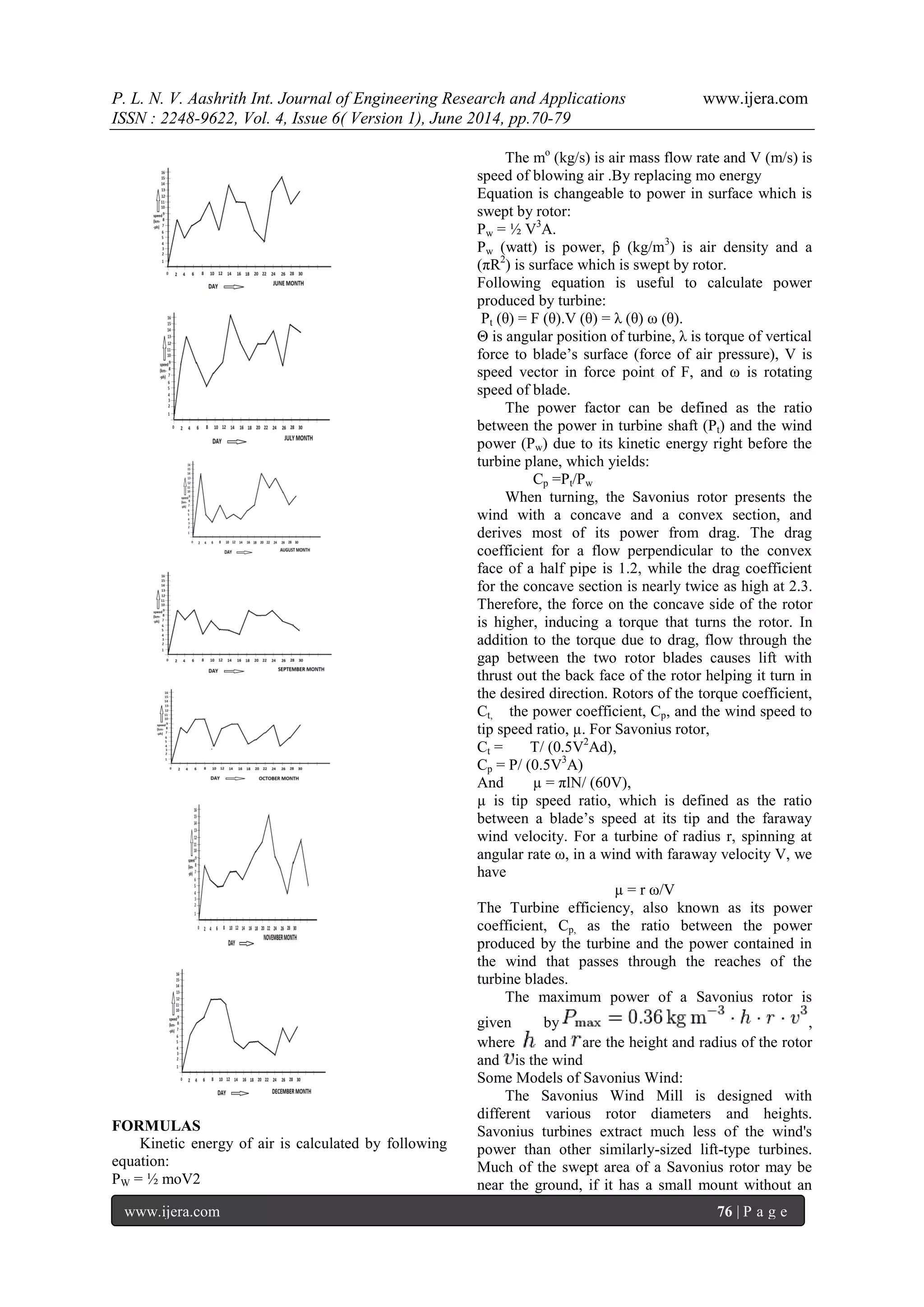
VARIATIONS OF WIND SPEED WITH DAYS OF MONTH IN VISAKHAPATNAM SUB- URBAN:
P. L. N. V. Aashrith Int. Journal of Engineering Research and Applications www.ijera.com 
ISSN : 2248-9622, Vol. 4, Issue 6( Version 1), June 2014, pp.70-79 
www.ijera.com 76 | P a g e 
FORMULAS Kinetic energy of air is calculated by following equation: PW = ½ moV2 
The mo (kg/s) is air mass flow rate and V (m/s) is speed of blowing air .By replacing mo energy 
Equation is changeable to power in surface which is swept by rotor: Pw = ½ V3A. Pw (watt) is power, ƥ (kg/m3) is air density and a (πR2) is surface which is swept by rotor. Following equation is useful to calculate power produced by turbine: Pt (θ) = F (θ).V (θ) = λ (θ) ω (θ). Θ is angular position of turbine, λ is torque of vertical force to blade’s surface (force of air pressure), V is speed vector in force point of F, and ω is rotating speed of blade. The power factor can be defined as the ratio between the power in turbine shaft (Pt) and the wind power (Pw) due to its kinetic energy right before the turbine plane, which yields: Cp =Pt/Pw When turning, the Savonius rotor presents the wind with a concave and a convex section, and derives most of its power from drag. The drag coefficient for a flow perpendicular to the convex face of a half pipe is 1.2, while the drag coefficient for the concave section is nearly twice as high at 2.3. Therefore, the force on the concave side of the rotor is higher, inducing a torque that turns the rotor. In addition to the torque due to drag, flow through the gap between the two rotor blades causes lift with thrust out the back face of the rotor helping it turn in the desired direction. Rotors of the torque coefficient, Ct, the power coefficient, Cp, and the wind speed to tip speed ratio, μ. For Savonius rotor, Ct = T/ (0.5V2Ad), Cp = P/ (0.5V3A) And μ = πlN/ (60V), μ is tip speed ratio, which is defined as the ratio between a blade’s speed at its tip and the faraway wind velocity. For a turbine of radius r, spinning at angular rate ω, in a wind with faraway velocity V, we have μ = r ω/V The Turbine efficiency, also known as its power coefficient, Cp, as the ratio between the power produced by the turbine and the power contained in the wind that passes through the reaches of the turbine blades. 
The maximum power of a Savonius rotor is given by, where and are the height and radius of the rotor and is the wind Some Models of Savonius Wind: 
The Savonius Wind Mill is designed with different various rotor diameters and heights. Savonius turbines extract much less of the wind's power than other similarly-sized lift-type turbines. Much of the swept area of a Savonius rotor may be near the ground, if it has a small mount without an
P. L. N. V. Aashrith Int. Journal of Engineering Research and Applications www.ijera.com 
ISSN : 2248-9622, Vol. 4, Issue 6( Version 1), June 2014, pp.70-79 
www.ijera.com 77 | P a g e 
extended post, making the overall energy extraction less effective due to the lower wind speeds found at lower heights Some of the standard models are listed below: 
1. Model1- General Household model 
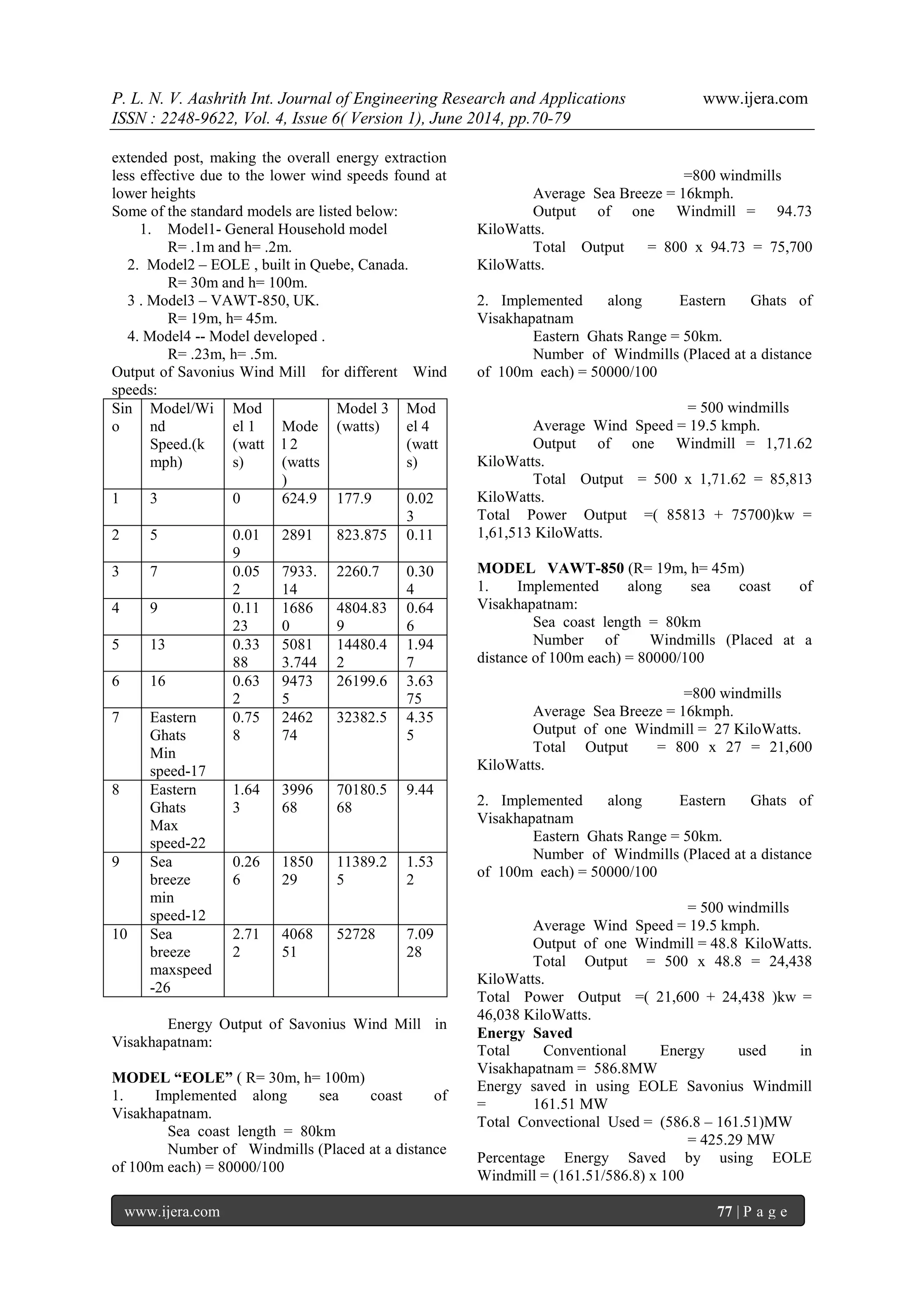
R= .1m and h= .2m. 2. Model2 – EOLE , built in Quebe, Canada. R= 30m and h= 100m. 3 . Model3 – VAWT-850, UK. R= 19m, h= 45m. 4. Model4 -- Model developed . R= .23m, h= .5m. Output of Savonius Wind Mill for different Wind speeds: 
Sino 
Model/Wind Speed.(kmph) 
Model 1 (watts) 
Model 2 (watts) 
Model 3 (watts) 
Model 4 (watts) 
1 
3 
0 
624.9 
177.9 
0.023 
2 
5 
0.019 
2891 
823.875 
0.11 
3 
7 
0.052 
7933.14 
2260.7 
0.304 
4 
9 
0.1123 
16860 
4804.839 
0.646 
5 
13 
0.3388 
50813.744 
14480.42 
1.947 
6 
16 
0.632 
94735 
26199.6 
3.6375 
7 
Eastern Ghats Min speed-17 
0.758 
246274 
32382.5 
4.355 
8 
Eastern Ghats Max speed-22 
1.643 
399668 
70180.568 
9.44 
9 
Sea breeze min speed-12 
0.266 
185029 
11389.25 
1.532 
10 
Sea breeze maxspeed-26 
2.712 
406851 
52728 
7.0928 
Energy Output of Savonius Wind Mill in Visakhapatnam: MODEL “EOLE” ( R= 30m, h= 100m) 1. Implemented along sea coast of Visakhapatnam. Sea coast length = 80km Number of Windmills (Placed at a distance of 100m each) = 80000/100 
=800 windmills 
Average Sea Breeze = 16kmph. 
Output of one Windmill = 94.73 KiloWatts. Total Output = 800 x 94.73 = 75,700 KiloWatts. 2. Implemented along Eastern Ghats of Visakhapatnam Eastern Ghats Range = 50km. Number of Windmills (Placed at a distance of 100m each) = 50000/100 = 500 windmills Average Wind Speed = 19.5 kmph. Output of one Windmill = 1,71.62 KiloWatts. Total Output = 500 x 1,71.62 = 85,813 KiloWatts. Total Power Output =( 85813 + 75700)kw = 1,61,513 KiloWatts. MODEL VAWT-850 (R= 19m, h= 45m) 1. Implemented along sea coast of Visakhapatnam: Sea coast length = 80km Number of Windmills (Placed at a distance of 100m each) = 80000/100 =800 windmills Average Sea Breeze = 16kmph. Output of one Windmill = 27 KiloWatts. Total Output = 800 x 27 = 21,600 KiloWatts. 2. Implemented along Eastern Ghats of Visakhapatnam Eastern Ghats Range = 50km. Number of Windmills (Placed at a distance of 100m each) = 50000/100 = 500 windmills Average Wind Speed = 19.5 kmph. Output of one Windmill = 48.8 KiloWatts. Total Output = 500 x 48.8 = 24,438 KiloWatts. Total Power Output =( 21,600 + 24,438 )kw = 46,038 KiloWatts. Energy Saved Total Conventional Energy used in Visakhapatnam = 586.8MW Energy saved in using EOLE Savonius Windmill = 161.51 MW Total Convectional Used = (586.8 – 161.51)MW = 425.29 MW Percentage Energy Saved by using EOLE Windmill = (161.51/586.8) x 100
P. L. N. V. Aashrith Int. Journal of Engineering Research and Applications www.ijera.com 
ISSN : 2248-9622, Vol. 4, Issue 6( Version 1), June 2014, pp.70-79 
www.ijera.com 78 | P a g e 
= 27.52% Energy saved in using VAWT-850 Savonius Windmill = 46.03 MW Total Convectional Used = (586.8-46.03) MW = 540.77 MW Percentage Energy Saved by using VAWT-850 Windmill = (46.03/586.8) x 100. = 7.8% 
VII. ADVANTAGES OF SAVONIUS WIND MILL 
a) It is a renewable source of energy. b) Wind power systems are non-polluting so it has no adverse influence on the environment. c) Wind energy systems avoid fuel provision and transport. d) On a small scale up to a few kilowatt system is less costly. e) On a large scale costs can be competitive conventional electricity and lower costs could be achieved by mass production. f) They are always facing the wind - no need for steering into the wind. g) Have greater surface area for energy capture -can be many times greater. h) Are more efficient in gusty winds – already facing the gust. i) Can be installed in more locations - on roofs, along highways, in parking lots. j) Can be scaled more easily - from mill watts to megawatts. 
VIII. ADVANTAGE OF SAVONIUS WIND TURBINE OVER HORIZONTAL AXIS WIND TURBINE 
There are several reasons why we would choose a vertical axis wind turbine over a horizontal axis windmill. 1. They are mounted lower to the ground making it easy for maintenance if needed. 2. They start creating electricity at speeds of only 6 mph. And 3. Third, they may be able to be built at locations where taller structures, such as the horizontal type, can't be. 4. Higher power utilization-- 20% higher than HAWT. 5. Lower noise level--only 27-37 DB, suitable for your living condition. 6. Safer operation--Spin at slower speeds than horizontal turbines, decreasing the risk of injuring birds and also decreasing noise level. 
IX. CONCLUSION 
Vertical axis wind energy conversion systems are practical and potentially very contributive to the production of clean renewable electricity from the wind even under less than ideal sitting conditions. It is hoped that they may be constructed used high- strength, low- weight materials for deployment in more developed nations and settings or with very low tech local materials and local skills in less developed countries. The Savonius wind turbine designed is ideal to be located on top of a bridge or bridges to generate electricity, powered by wind. The elevated altitude gives it an advantage for more wind opportunity. With the idea on top of a bridge, it will power up street lights and or commercial use. In most cities, bridges are a faster route for everyday commute and in need of constant lighting makes this an efficient way to produce natural energy. REFERENCES [1] Peter, C., Sheets, B. and Tablar, S. (2008): Emerging Technologies in the Wind Turbine Market, The Palace Hotel, San Francisco, CA. 19-20 November 2008. [2] Manwell, J.F., McGowan, J.G. and Rogers, A.L. (2009): Wind Energy Explained UK, John Wiley & Son Ltd. [3] Akwa, J.V., Junior, G.A.S. and Petry, A.P. (2012): Discussion on the Verification of the Overlap Ratio Influence on Performance Coefficients of a Savonius Wind Rotor Using Computational Fluid Dynamics. Renewable Energy, Vol.38, pp.141-149. [4] Halsey, N. (2011): Modeling the Twisted Savonius Wind Turbine Geometrically and Simplifying its Construction. Oregon Episcopal School. [5] D’Alessandro, V., Montelpare, S., Ricci, R. and Secchiaroli, A. (2010): Unsteady Aerodynamics of a Savonius Wind Rotor: A New Computational Approach for the Simulation of Energy Performance. Energy, Vol.35, pp. 3349-3363. [6] Islam, M.Q., Hasan, M.N. and Saha, S. (2005): Experimental Investigation of Aerodynamic Characteristics of Two, Three and Four Bladed S-Shaped Stationary Savonius Rotors. The Proceeding of International Conference on Mechanical Engineering 2005, 28-30 December 2005, Dhaka, Bangladesh. [7] Musgrove, P. (2010): Wind Power, UK: Cambridge University Press. 
[8] Hayashi, T., Yan, L. and Suzuki, K. (2004): Wind Tunnel Tests on a Three-stage Out- phase Savonius Rotor. [Online]. Available at: http://www.2004ewec.info/files/231400_tsuto
P. L. N. V. Aashrith Int. Journal of Engineering Research and Applications www.ijera.com 
ISSN : 2248-9622, Vol. 4, Issue 6( Version 1), June 2014, pp.70-79 
www.ijera.com 79 | P a g e 
muhayashii_01.pdf [Accessed on 13 November 2011]. [9] Jain, P. (2011): Wind Energy Engineering, McGraw-Hill, New York. [10] Johnson, C. (1998): Practical Wind- Generated Electricity. [Online]. Available at: http://mbsoft.com/public/wind.html [Accessed on 24 April 2012]. [11] Solanki, C.S. (2009): Renewable Energy Technologies: A Practical Guide for Beginners, PHI Learning Private Limited, New Delhi, pp.103-106. [12] Saha, U.K., Thotla, S. and Maity, D. (2008): Optimum Design Configuration of Savonius Rotor Through Wind Tunnel Experiments. Journal of Wind Engineering and Industrial Aerodynamics, Vol.96, pp.1359-1375.

M046017079

  • 1.
    P. L. N.V. Aashrith Int. Journal of Engineering Research and Applications www.ijera.com ISSN : 2248-9622, Vol. 4, Issue 6( Version 1), June 2014, pp.70-79 www.ijera.com 70 | P a g e Design and Fabrication of Savonious Wind Mill P. L. N. V. Aashrith*, Ch.Vikranth** Dept. of Mechanical Engineering, Andhra University College of Engineering, Visakhapatnam, Andhra Pradesh, India* Dept. of Mechanical Engineering, Andhra University College of Engineering, Visakhapatnam, Andhra Pradesh, India** ABSTRACT The project deals with the design and fabrication of Savonius wind mill. Pw – Wind power (watt), and Power produced by the turbine Pt has been calculated using m – Mass flow rate (kg/s), Swept area of the windfall ,V- Velocity of the wind, Θ- Angular position of turbine, T- Torque obtained by wind, Pt- Shaft power , Cp- Power coffecient ,Ct- Torque co-efficient , μ – Tip speed ratio , r – Radius of rotor , d- Diameter of rotor ,w- Angular speed of rotor. Various operations involved in fabrication process and characteristics & specifications of wind turbine has been mentioned I. INTRODUCTION Among the replenish able sources as an alternative to fossil fuels,wind energy is also equal in race.Wind on the earth surface are caused primarily by the unequal heating of the land and water by sun.the differences in temperature gradients induce the circulation of air from one zone to another.It has been estimated that roughly 10 million MW’s of energy are continuously available in the earth’s winds.the utilization of some of this energy through various mechanical conversion devies has played a decisive role in the economic development of many countries wher wind are strong and steady. Savonius wind turbines are vertical axis wind turbines and are used for wind force conversion into torque through the rotation of the main shaft. Savonius wind turbines mainly operate on the drag of the aerofoils by their opposing directions and their interaction with the wind movement. It is one of the simplest wind turbines designs ever designed. Basically they take advantage of their curvaceous shape in order to suffer less friction in movement and thus increase rotating speed with the powering of the wind. II. DIFFERENT TYPES OF WIND PLANTS Windmills had been widely used in Persia, China, Europe and the U.S.A for pumping water and grinding grains. Efficient wind electric generators were later developed in U.S.A. Thousands of which produced electricity for farms and homes. The wind mills are generally classified as horizontal axis and vertical axis wind mills. (1) Horizontal axis two blades wind mill. (2) Horizontal axis-single blade wind mill. (3) Horizontal axis-bicycle wheel wind mill. (4) Vertical axis wind mill. III. PROPERTIES AND CONSIDERATIONS OF WIND MILLS: (a)PROPERTIES: (1) the wind energy is free, inexhaustible and does not need transportation. (2) hydroelectric power projects take several years to complete,the growth of nuclear power has been even slower,and coal fired thermal plants face the problem of lomg transpiration.wnd power plant,on the other hand,does not take long time to construct.such windmills will be highly desirable and economical to the rural arweas which are far remote places from existing grids. (3) some facts on rainfall in india are relevant.of the total annual rainfall of 370 million hectare- meters(MHWS),120 MHWS lost by evaporation ,80MHWS seep into the ground and 170 MHMS of water in river flows,113 MHWS are not availablefor utilization.it is this unutilized water often causes floods. Obviously,proper water managements would demand laege energy inputs for controlling drainage and run-off during monsoons.wind energy can be used for this purpose economixcally a 80% of the annual rainfall and 60% annual wind energy (in india) are both confined to the monsoon months.this combination definitely warrants aserious consideration for exploting it. (4) Ther is stong rason why wind power should be welcomed by grids wch have some hydroelectric inputs in india.the water level in the hydel reservoir is at its lowest before the onset of the south west monsoon.if less water is drawn during the monsoon,a high level could be maintained for longer period.during the monsoon period,wind energy can be used to feed the grid. RESEARCH ARTICLE OPEN ACCESS
  • 2.
    P. L. N.V. Aashrith Int. Journal of Engineering Research and Applications www.ijera.com ISSN : 2248-9622, Vol. 4, Issue 6( Version 1), June 2014, pp.70-79 www.ijera.com 71 | P a g e (b) CONSIDERATIONS: (1) the major disadvantage associated with the wind power is that it is not consistent and steady which makes the complications in designing the whole plant. (2) the wind is a very hazardous,treacherous and unpredictable commodity.blowing in strong gusts from varying directions and leaving account such phenomena as hurricanes and tornadoes-it can cause tremendous shear stresses which may smash the whole plant within no time.to avoid this,special and costly designs and controls are always required. (3) the power coffecient (ratio of the power actually delivered by the rotor to the power of the wind in the rotor disc) can be 0.593 maximum for aerodynamic rason.the machine developed to date (ERDA’S plum brook unit) has power coefficient of 0.4. (4) Among al the disadvantages mentioned above,the cost factor is major has restricted the development of wind power on large scale foe feeding to th existing grid.the estimated cost of wind electricity generation,storage and distribution system is over 1 lakh ruppes which may be considered beyond the means of the most villages. With all this disadvantages,this source of power has a bright future as the use of small aero generator producing 200 to 300 watts which is sufficient to power a house of one family at a reasonable cost will definitely attract the villages for the good standard of life. IV. FACTOR AFFECTING WIND POWER EXTRACTION Elevation of blade hub above ground-the higher above ground one is , the higher wind velocity and since the power is proportional to the cube of the velocity, an increase in hub elevation from 30 m to 50 m leads to an average wind seed 7.6% higher. This becomes a significant cost-benefit trade-off, since taller hubs become more expensive. Spacing of wind turbines on wind farms-too far spacing will prevent the maximum amount of wind to be intercepted. However, too close spacing will lead to interference and downwind units will be less productive. Sitting of wind turbine-naturally not all locations are suitable for placements of wind turbines. In order to be economical, most sites have to have average wind speeds of about 10 m/s. This speed usually increases with height above ground. Air density-the higher the density of air, the more power carried by the wind and as air density decreases with height above sea-level, usually sites in mountainous regions are less preferable than those at flat, sea-level locations. V. METHODOLOGY Savonius Wind Mill Model Introduction: The vertical-axis wind turbine have simple structure and installation. They are useful in different speed and direction of wind. Unlike horizontal axis turbines, in vertical axis turbines rotation speed is low and torque is high. These turbines are independence from wind direction. Because of low speed and high torque in these turbines, some forms of power transfer such as compressed air and hydraulic have preference to generate electricity. This device could be used for pumping water in agriculture and industry. Description: In vertical axis wind turbines or rotors, such as Savonius rotating axis is perpendicular to wind direction. Therefore the surface which is moved by air, after rotating half a round, should move in reverse direction of wind. This is the reason of decreasing of power ratio. Therefore blade is an important factor in these rotors. The Savonius rotor includes two half cylinder shape blades (nominal diameter d, height h). The movement is mainly the result of the different between the drag on the advancing paddle and the drag on the other one. The lift force, which normally takes place to the direction of wind velocity, produces the rotation in this type of turbine. There is high pressure before the surface whereas low pressure after it. The Savonius rotor can be constructed from simple materials using common tools. The Rotors are robust and do not require precision machining or tight tolerance like those needed to make modern airfoils. Due to symmetry to with respect to the flow direction, vertical axis wind turbines accept winds from any direction equally. This contrasts with horizontal axis wind turbines that must face into the wind to achieve maximum power. Horizontal turbines are pointed in a fixed direction to take advantage of a single predominant wind direction.
  • 3.
    P. L. N.V. Aashrith Int. Journal of Engineering Research and Applications www.ijera.com ISSN : 2248-9622, Vol. 4, Issue 6( Version 1), June 2014, pp.70-79 www.ijera.com 72 | P a g e VI. SAVONIUS WINDMILL MODEL CHARACTERISTICS & SPECIFICATIONS OF WIND TURBINES •Wind Speed: This is very important to the productivity of a windmill. The wind turbine only generates power with the wind. The wind rotates the axis (horizontal or vertical) and causes the shaft on the generator to sweep past the magnetic coils creating an electric current. •Blade Length This is important because the length of the blade is directly proportional to the swept area. Larger blades have a greater swept area and thus catch more wind with each revolution. Because of this, they may also have more torque. •Base Height The height of the base affects the windmill immensely. The higher a windmill is, the more productive it will be due to the fact that as the altitude increases so does the winds speed. •Base Design Some base is stronger than others. Base is important in the construction of the windmill because not only do they have to support the windmill, but they must also be subject to their own weight and the drag of the wind. If a weak tower is subject to these elements, then it will surely collapse. Therefore, the base must be identical so as to insure a fair comparison. TECHNICAL SPECIFICATIONS S.NO PART SPECIFICATIONS 1 Physical Dimension of Wind Mill 58x58x34cm3 2 Number of PVC pipes 12 pipes 3 PVC pipe dimension Length = 50cm, Diameter= 2.54 cm. 4 Number of T- Joints 12 5 T- Joint Diameter 2.54cm 6 Number of Bends 4 7 Diameter of Bends 2.54cm. 8 Central axis (PVC Pipe) Length = 54cm, Diameter = 3cm. 9 Cylindrical magnet piece Diameter = 8cm Height = 2cm 10 Number of L plates placed 16 11 Ball Bearing C6202 12 Mild Steel U-Clamps 4 13 Amature Angle 90o 14 Number of Transformers 4 15 Type of Transformer 606, Shell type transformer. 16 Rotor dimension 50x23cm2 17 Rotor Material Mild Steel 18 Rotor Thickness 1.2cm 19 Swept Area (A) 50x23 cm2 20 Number of terminals used 2 (Positive and negative) DESIGN OF WIND MILL
  • 4.
    P. L. N.V. Aashrith Int. Journal of Engineering Research and Applications www.ijera.com ISSN : 2248-9622, Vol. 4, Issue 6( Version 1), June 2014, pp.70-79 www.ijera.com 73 | P a g e Wind turbine blades have on aerofoil – type cross section. While designing the size of blade it is must to know the weight and cost of blades. In the three blade model, vertical shaft has been used; it has a height and diameter of 54cm & 3cm respectively. The angle between two blades is 60 0 . So if one Blade moves other blades comes in the position of first blade, so the speed is increases. BLADE PROFILE SHAFT DESIGN While designing the shaft of blades it should be properly fitted to the blade. The shaft should be as possible as less in thickness & light in weight for the six blade, the shaft used is very thin in size are all properly fitted. So no problem of slipping & fraction is created, for the shaft PVC pipe is used, which is having very light weight. Length of shaft & diameter are 54cm& 3cm respectively. And at the top and bottom ends mild steel of length 1inch each are respectively are fixed to give strength to the hollow shaft. ransformer and permanent magnet. Transformer For generation of electricity from the designed vertical axis wind turbine, we chose a 606 Shell type transformer . When windings are surrounded by the core, the transformer is shell form. Shell form design may be more prevalent than core form design for distribution transformer applications. Shell form design tends to be preferred for extra high voltage and higher MVA applications because, though more labor-intensive to manufacture, shell form transformers are characterized as having inherently better kVA-to-weight ratio, better short-circuit strength characteristics and higher immunity to transit damage. Shell Type Transformer Operation The main principle of operation of a transformer is mutual inductance between two circuits which is linked by a common magnetic flux. A basic transformer consists of two coils that are electrically separate and inductive, but are magnetically linked through a path of reluctance. A mutual electro-motive force is induced in the transformer from the alternating flux that is set up in the laminated core, due to the coil that is connected to a source of alternating voltage. Most of the alternating flux developed by this coil is linked with the other coil and thus produces the mutual induced electro-motive force. FORMULAS Kinetic energy of air is calculated by following equation: PW = ½ moV2 The mo(kg/s) is air mass flow rate and V(m/s) is speed of blowing air .By replacing mo energy Equation is changeable to power in surface which is swept by rotor: Pw = ½ V3A. Pw(watt) is power, ƥ(kg/m3) is air density and A(πR2) is surface which is swept by rotor. Following equation is useful to calculate power produced by turbine: Pt(θ)= F(θ).V(θ) = λ(θ)ω(θ). Θ is angular position of turbine, λ is torque of vertical force to blade’s surface (force of air pressure), V is
  • 5.
    P. L. N.V. Aashrith Int. Journal of Engineering Research and Applications www.ijera.com ISSN : 2248-9622, Vol. 4, Issue 6( Version 1), June 2014, pp.70-79 www.ijera.com 74 | P a g e speed vector in force point of F, and ω is rotating speed of blade. The power factor can be defined as the ratio between the power in turbine shaft (Pt) and the wind power (Pw) due to its kinetic energy right before the turbine plane, which yields: Cp =Pt/Pw When turning, the Savonius rotor presents the wind with a concave and a convex section, and derives most of its power from drag. The drag coefficient for a flow perpendicular to the convex face of a half pipe is 1.2, while the drag coefficient for the concave section is nearly twice as high at 2.3. Therefore, the force on the concave side of the rotor is higher, inducing a torque that turns the rotor. In addition to the torque due to drag, flow through the gap between the two rotor blades causes lift with thrust out the back face of the rotor helping it turn in the desired direction. Rotors of the torque coefficient, Ct, the power coefficient, Cp, and the wind speed to tip speed ratio, μ. For Savonius rotor, Ct = T/ (0.5V2Ad), Cp = P/ (0.5V3A) And μ = πlN/ (60V), μ is tip speed ratio, which is defined as the ratio between a blade’s speed at its tip and the faraway wind velocity. For a turbine of radius r, spinning at angular rate ω, in a wind with faraway velocity V, we have μ = r ω/V The Turbine efficiency, also known as its power coefficient, Cp, as the ratio between the power produced by the turbine and the power contained in the wind that passes through the reaches of the turbine blades. The maximum power of a Savonius rotor is given by, where and are the height and radius of the rotor and is the wind VARIOUS OPERATIONS INVOLVED IN FABRICATION PROCESS •Cutting PVC pipes and plywood of required dimensions are cut using bench vice and handsaw. The Shell type transformer is cut into two halves of 900 each. •Drilling The T- joints and Bends after assembled are drilled with 5mm diameter and 1 inch bolts are inserted. •Bending The Mild sheets of 12mm thickness sheets of length 30cm and breadth 32cm using mallet, 2cm round file and anvil. •Turning The main shaft is turned on the inner side using lathe up to 2mm thickness for fixing ball bearings. •Soldering The four transformers are joined in series by soldering wires and these are connected to positive and negative terminals. The four LED bulbs are joined by parallel connection by soldering. •Assembly The four transformers are bolted to the wooden plate; the wooden plate is joined to the main frame using U- clamps. The Three bended sheets are joined to the main axis by bolt and nut. The permanent magnet is fixed to the main axis by using glue. The 16 mild steels plates are placed and attached to the magnet by using glue, thereby creating sixteen poles. The four transformers are joined in series and this is connected to positive and negative terminals and to a parallel connection of four LED bulbs. AVERAGE WIND SPEEDS (Kmph) MONTH/DAY JANUARY FEBUARY MARCH APRIL MAY JUNE 1 4 4 5 13 15 15 2 4 4 2 13 17 8 3 6 3 3 10 17 5 4 6 3 3 9 18 5 5 5 5 5 13 14 5 6 4 6 4 12 13 7 7 5 5 4 9 14 7 8 3 3 4 10 15 8 9 7 5 6 11 18 12 10 5 8 9 12 16 11 11 4 7 11 13 15 6 12 5 4 13 13 12 6 13 5 6 13 10 6 5 14 4 4 10 10 6 14 15 5 4 9 8 7 18 16 4 5 8 13 9 11 17 3 5 4 17 13 9 18 5 6 3 15 14 11 19 6 8 5 13 15 11 20 3 6 8 8 17 6 21 4 4 10 14 19 6 22 5 4 12 5 15 7 23 8 4 13 4 18 4 24 5 3 9 7 13 3 25 6 3 9 8 11 13 26 6 3 10 10 9 18 27 4 4 12 11 7 15 28 3 3 11 13 10 12 29 4 11 13 11 11 30 5 10 13 11 9 31 5 14 14
  • 6.
    P. L. N.V. Aashrith Int. Journal of Engineering Research and Applications www.ijera.com ISSN : 2248-9622, Vol. 4, Issue 6( Version 1), June 2014, pp.70-79 www.ijera.com 75 | P a g e AVERAGE WIND SPEEDS (Kmph) MONTH/ DAY JULY AUGUST SEPT OCT NOV DEC 1 9 18 9 2 10 3 2 10 14 9 8 8 6 3 13 11 10 7 6 7 4 13 5 7 7 6 8 5 9 3 5 10 6 8 6 3 6 9 11 5 9 7 5 9 3 10 6 10 8 4 7 4 8 5 12 9 7 2 5 4 6 12 10 6 4 7 4 7 12 11 9 4 5 8 6 12 12 7 5 5 7 7 11 13 16 5 5 9 7 7 14 12 4 5 16 6 5 15 9 5 6 9 7 5 16 8 6 4 4 8 4 17 12 7 7 4 10 5 18 12 7 9 4 10 5 19 12 9 5 5 10 5 20 14 14 8 7 6 4 21 9 14 6 7 12 3 22 8 11 8 10 15 5 23 7 10 7 9 14 7 24 15 13 9 7 9 4 25 16 10 8 4 4 7 26 14 10 7 4 5 5 27 17 10 7 6 4 4 28 15 7 11 4 5 4 29 12 4 6 6 12 5 30 10 9 5 6 12 3 31 15 9 4 9 5 7 WIND DISTRIBUTION ON EASTER GHATS Average Wind Speed: 16 to 21 kmps. SYSTEM PRESSURE DEFICIENT(atm) ASSOCIATED WIND SPEED(KMPH) Low pressure area 1.0 <32 Depression 1-3 32-50 Deep Depression 3-4.5 51-59 Cyclonic Storm 4.5-8.5 60-90 Severe cyclonic storm 8.5-15.5 90-119 Very severe cyclonic storm 15.56-65.6 119-220 Super Cyclonic storm >65.6 >220 OTHER MAJOR PLACES WHERE MAXIMUM WIND SPEED OCCURS: SNO PLACE OF LANDFALL MAXIMUM WIND SPEED(kmph) 1 Chittagong 224 2 Chirala,A.P. 260 3 Rameshwaram 204 4 Sriharikota 213 5 Bangladesh 213 6 Kavali,A.P. 235 7 Machlipatnam,A.P. 235 8 Chittagong 235 9 Paradip,Orissa 260 VARIATIONS OF WIND SPEED WITH DAYS OF MONTH IN VISAKHAPATNAM SUB- URBAN:
  • 7.
    P. L. N.V. Aashrith Int. Journal of Engineering Research and Applications www.ijera.com ISSN : 2248-9622, Vol. 4, Issue 6( Version 1), June 2014, pp.70-79 www.ijera.com 76 | P a g e FORMULAS Kinetic energy of air is calculated by following equation: PW = ½ moV2 The mo (kg/s) is air mass flow rate and V (m/s) is speed of blowing air .By replacing mo energy Equation is changeable to power in surface which is swept by rotor: Pw = ½ V3A. Pw (watt) is power, ƥ (kg/m3) is air density and a (πR2) is surface which is swept by rotor. Following equation is useful to calculate power produced by turbine: Pt (θ) = F (θ).V (θ) = λ (θ) ω (θ). Θ is angular position of turbine, λ is torque of vertical force to blade’s surface (force of air pressure), V is speed vector in force point of F, and ω is rotating speed of blade. The power factor can be defined as the ratio between the power in turbine shaft (Pt) and the wind power (Pw) due to its kinetic energy right before the turbine plane, which yields: Cp =Pt/Pw When turning, the Savonius rotor presents the wind with a concave and a convex section, and derives most of its power from drag. The drag coefficient for a flow perpendicular to the convex face of a half pipe is 1.2, while the drag coefficient for the concave section is nearly twice as high at 2.3. Therefore, the force on the concave side of the rotor is higher, inducing a torque that turns the rotor. In addition to the torque due to drag, flow through the gap between the two rotor blades causes lift with thrust out the back face of the rotor helping it turn in the desired direction. Rotors of the torque coefficient, Ct, the power coefficient, Cp, and the wind speed to tip speed ratio, μ. For Savonius rotor, Ct = T/ (0.5V2Ad), Cp = P/ (0.5V3A) And μ = πlN/ (60V), μ is tip speed ratio, which is defined as the ratio between a blade’s speed at its tip and the faraway wind velocity. For a turbine of radius r, spinning at angular rate ω, in a wind with faraway velocity V, we have μ = r ω/V The Turbine efficiency, also known as its power coefficient, Cp, as the ratio between the power produced by the turbine and the power contained in the wind that passes through the reaches of the turbine blades. The maximum power of a Savonius rotor is given by, where and are the height and radius of the rotor and is the wind Some Models of Savonius Wind: The Savonius Wind Mill is designed with different various rotor diameters and heights. Savonius turbines extract much less of the wind's power than other similarly-sized lift-type turbines. Much of the swept area of a Savonius rotor may be near the ground, if it has a small mount without an
  • 8.
    P. L. N.V. Aashrith Int. Journal of Engineering Research and Applications www.ijera.com ISSN : 2248-9622, Vol. 4, Issue 6( Version 1), June 2014, pp.70-79 www.ijera.com 77 | P a g e extended post, making the overall energy extraction less effective due to the lower wind speeds found at lower heights Some of the standard models are listed below: 1. Model1- General Household model R= .1m and h= .2m. 2. Model2 – EOLE , built in Quebe, Canada. R= 30m and h= 100m. 3 . Model3 – VAWT-850, UK. R= 19m, h= 45m. 4. Model4 -- Model developed . R= .23m, h= .5m. Output of Savonius Wind Mill for different Wind speeds: Sino Model/Wind Speed.(kmph) Model 1 (watts) Model 2 (watts) Model 3 (watts) Model 4 (watts) 1 3 0 624.9 177.9 0.023 2 5 0.019 2891 823.875 0.11 3 7 0.052 7933.14 2260.7 0.304 4 9 0.1123 16860 4804.839 0.646 5 13 0.3388 50813.744 14480.42 1.947 6 16 0.632 94735 26199.6 3.6375 7 Eastern Ghats Min speed-17 0.758 246274 32382.5 4.355 8 Eastern Ghats Max speed-22 1.643 399668 70180.568 9.44 9 Sea breeze min speed-12 0.266 185029 11389.25 1.532 10 Sea breeze maxspeed-26 2.712 406851 52728 7.0928 Energy Output of Savonius Wind Mill in Visakhapatnam: MODEL “EOLE” ( R= 30m, h= 100m) 1. Implemented along sea coast of Visakhapatnam. Sea coast length = 80km Number of Windmills (Placed at a distance of 100m each) = 80000/100 =800 windmills Average Sea Breeze = 16kmph. Output of one Windmill = 94.73 KiloWatts. Total Output = 800 x 94.73 = 75,700 KiloWatts. 2. Implemented along Eastern Ghats of Visakhapatnam Eastern Ghats Range = 50km. Number of Windmills (Placed at a distance of 100m each) = 50000/100 = 500 windmills Average Wind Speed = 19.5 kmph. Output of one Windmill = 1,71.62 KiloWatts. Total Output = 500 x 1,71.62 = 85,813 KiloWatts. Total Power Output =( 85813 + 75700)kw = 1,61,513 KiloWatts. MODEL VAWT-850 (R= 19m, h= 45m) 1. Implemented along sea coast of Visakhapatnam: Sea coast length = 80km Number of Windmills (Placed at a distance of 100m each) = 80000/100 =800 windmills Average Sea Breeze = 16kmph. Output of one Windmill = 27 KiloWatts. Total Output = 800 x 27 = 21,600 KiloWatts. 2. Implemented along Eastern Ghats of Visakhapatnam Eastern Ghats Range = 50km. Number of Windmills (Placed at a distance of 100m each) = 50000/100 = 500 windmills Average Wind Speed = 19.5 kmph. Output of one Windmill = 48.8 KiloWatts. Total Output = 500 x 48.8 = 24,438 KiloWatts. Total Power Output =( 21,600 + 24,438 )kw = 46,038 KiloWatts. Energy Saved Total Conventional Energy used in Visakhapatnam = 586.8MW Energy saved in using EOLE Savonius Windmill = 161.51 MW Total Convectional Used = (586.8 – 161.51)MW = 425.29 MW Percentage Energy Saved by using EOLE Windmill = (161.51/586.8) x 100
  • 9.
    P. L. N.V. Aashrith Int. Journal of Engineering Research and Applications www.ijera.com ISSN : 2248-9622, Vol. 4, Issue 6( Version 1), June 2014, pp.70-79 www.ijera.com 78 | P a g e = 27.52% Energy saved in using VAWT-850 Savonius Windmill = 46.03 MW Total Convectional Used = (586.8-46.03) MW = 540.77 MW Percentage Energy Saved by using VAWT-850 Windmill = (46.03/586.8) x 100. = 7.8% VII. ADVANTAGES OF SAVONIUS WIND MILL a) It is a renewable source of energy. b) Wind power systems are non-polluting so it has no adverse influence on the environment. c) Wind energy systems avoid fuel provision and transport. d) On a small scale up to a few kilowatt system is less costly. e) On a large scale costs can be competitive conventional electricity and lower costs could be achieved by mass production. f) They are always facing the wind - no need for steering into the wind. g) Have greater surface area for energy capture -can be many times greater. h) Are more efficient in gusty winds – already facing the gust. i) Can be installed in more locations - on roofs, along highways, in parking lots. j) Can be scaled more easily - from mill watts to megawatts. VIII. ADVANTAGE OF SAVONIUS WIND TURBINE OVER HORIZONTAL AXIS WIND TURBINE There are several reasons why we would choose a vertical axis wind turbine over a horizontal axis windmill. 1. They are mounted lower to the ground making it easy for maintenance if needed. 2. They start creating electricity at speeds of only 6 mph. And 3. Third, they may be able to be built at locations where taller structures, such as the horizontal type, can't be. 4. Higher power utilization-- 20% higher than HAWT. 5. Lower noise level--only 27-37 DB, suitable for your living condition. 6. Safer operation--Spin at slower speeds than horizontal turbines, decreasing the risk of injuring birds and also decreasing noise level. IX. CONCLUSION Vertical axis wind energy conversion systems are practical and potentially very contributive to the production of clean renewable electricity from the wind even under less than ideal sitting conditions. It is hoped that they may be constructed used high- strength, low- weight materials for deployment in more developed nations and settings or with very low tech local materials and local skills in less developed countries. The Savonius wind turbine designed is ideal to be located on top of a bridge or bridges to generate electricity, powered by wind. The elevated altitude gives it an advantage for more wind opportunity. With the idea on top of a bridge, it will power up street lights and or commercial use. In most cities, bridges are a faster route for everyday commute and in need of constant lighting makes this an efficient way to produce natural energy. REFERENCES [1] Peter, C., Sheets, B. and Tablar, S. (2008): Emerging Technologies in the Wind Turbine Market, The Palace Hotel, San Francisco, CA. 19-20 November 2008. [2] Manwell, J.F., McGowan, J.G. and Rogers, A.L. (2009): Wind Energy Explained UK, John Wiley & Son Ltd. [3] Akwa, J.V., Junior, G.A.S. and Petry, A.P. (2012): Discussion on the Verification of the Overlap Ratio Influence on Performance Coefficients of a Savonius Wind Rotor Using Computational Fluid Dynamics. Renewable Energy, Vol.38, pp.141-149. [4] Halsey, N. (2011): Modeling the Twisted Savonius Wind Turbine Geometrically and Simplifying its Construction. Oregon Episcopal School. [5] D’Alessandro, V., Montelpare, S., Ricci, R. and Secchiaroli, A. (2010): Unsteady Aerodynamics of a Savonius Wind Rotor: A New Computational Approach for the Simulation of Energy Performance. Energy, Vol.35, pp. 3349-3363. [6] Islam, M.Q., Hasan, M.N. and Saha, S. (2005): Experimental Investigation of Aerodynamic Characteristics of Two, Three and Four Bladed S-Shaped Stationary Savonius Rotors. The Proceeding of International Conference on Mechanical Engineering 2005, 28-30 December 2005, Dhaka, Bangladesh. [7] Musgrove, P. (2010): Wind Power, UK: Cambridge University Press. [8] Hayashi, T., Yan, L. and Suzuki, K. (2004): Wind Tunnel Tests on a Three-stage Out- phase Savonius Rotor. [Online]. Available at: http://www.2004ewec.info/files/231400_tsuto
  • 10.
    P. L. N.V. Aashrith Int. Journal of Engineering Research and Applications www.ijera.com ISSN : 2248-9622, Vol. 4, Issue 6( Version 1), June 2014, pp.70-79 www.ijera.com 79 | P a g e muhayashii_01.pdf [Accessed on 13 November 2011]. [9] Jain, P. (2011): Wind Energy Engineering, McGraw-Hill, New York. [10] Johnson, C. (1998): Practical Wind- Generated Electricity. [Online]. Available at: http://mbsoft.com/public/wind.html [Accessed on 24 April 2012]. [11] Solanki, C.S. (2009): Renewable Energy Technologies: A Practical Guide for Beginners, PHI Learning Private Limited, New Delhi, pp.103-106. [12] Saha, U.K., Thotla, S. and Maity, D. (2008): Optimum Design Configuration of Savonius Rotor Through Wind Tunnel Experiments. Journal of Wind Engineering and Industrial Aerodynamics, Vol.96, pp.1359-1375.