1
DESIGN AND ANALYSIS OF WIND
TURBINE FOR HIGHWAY
PROJECT ON
PRESENTED BY:
SABHAYA JAYESH -120870119201
SANDIP JOSHI -120870119202
IMMANUEL ALEXANDER -120870119203
SONANI RINKESH -120870119205
2
MOTIVATION
 A van carrying 2nd shift diploma students of
Parul overturned on national highway due to
lack of visibility at night.
 Driving on highways at night
is a difficult task due to improper lighting
facilities, resulting into high accidents rates.
The project aims at designing and
analysing vertical axis wind turbine for the
highways in India in order to recapture wind
energy from moving vehicles.
3
OVERVIEW
 Research Phase
 Data collection
 Design Phase
 Analysis phase
 Prototype
 Testing
 results
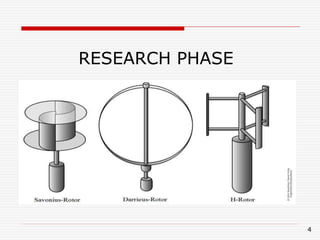
RESEARCH PHASE
4
Sr.
No
Title & Author publication Work Done
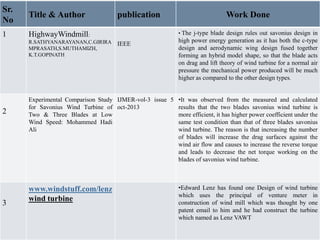
1 HighwayWindmill:
R.SATHYANARAYANAN,C.GIRIRA
MPRASATH,S.MUTHAMIZH,
K.T.GOPINATH
IEEE
• The j-type blade design rules out savonius design in
high power energy generation as it has both the c-type
design and aerodynamic wing design fused together
forming an hybrid model shape, so that the blade acts
on drag and lift theory of wind turbine for a normal air
pressure the mechanical power produced will be much
higher as compared to the other design types.
2
Experimental Comparison Study
for Savonius Wind Turbine of
Two & Three Blades at Low
Wind Speed: Mohammed Hadi
Ali
IJMER-vol-3 issue 5
oct-2013
•It was observed from the measured and calculated
results that the two blades savonius wind turbine is
more efficient, it has higher power coefficient under the
same test condition than that of three blades savonius
wind turbine. The reason is that increasing the number
of blades will increase the drag surfaces against the
wind air flow and causes to increase the reverse torque
and leads to decrease the net torque working on the
blades of savonius wind turbine.
3
www.windstuff.com/lenz
wind turbine
•Edward Lenz has found one Design of wind turbine
which uses the principal of venture meter in
construction of wind mill which was thought by one
patent email to him and he had construct the turbine
which named as Lenz VAWT
Sr. No Title & Author publication Work Done
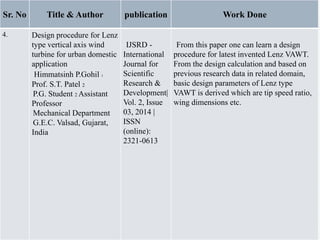
4. Design procedure for Lenz
type vertical axis wind
turbine for urban domestic
application
Himmatsinh P.Gohil 1
Prof. S.T. Patel 2
P.G. Student 2 Assistant
Professor
Mechanical Department
G.E.C. Valsad, Gujarat,
India
IJSRD -
International
Journal for
Scientific
Research &
Development|
Vol. 2, Issue
03, 2014 |
ISSN
(online):
2321-0613
From this paper one can learn a design
procedure for latest invented Lenz VAWT.
From the design calculation and based on
previous research data in related domain,
basic design parameters of Lenz type
VAWT is derived which are tip speed ratio,
wing dimensions etc.
DATA COLLECTION
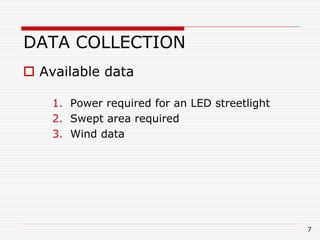
 Available data
1. Power required for an LED streetlight
2. Swept area required
3. Wind data
7
1. Power required
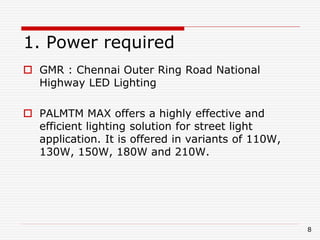
 GMR : Chennai Outer Ring Road National
Highway LED Lighting
 PALMTM MAX offers a highly effective and
efficient lighting solution for street light
application. It is offered in variants of 110W,
130W, 150W, 180W and 210W.
8
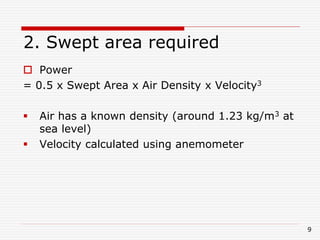
2. Swept area required
 Power
= 0.5 x Swept Area x Air Density x Velocity3
ļ‚§ Air has a known density (around 1.23 kg/m3 at
sea level)
ļ‚§ Velocity calculated using anemometer
9
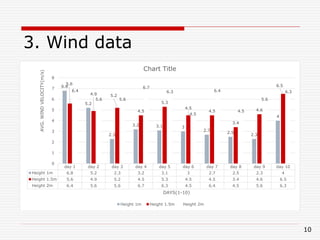
3. Wind data
10
day 1 day 2 day 3 day 4 day 5 day 6 day 7 day 8 day 9 day 10
Height 1m 6.8 5.2 2.3 3.2 3.1 3 2.7 2.5 2.3 4
Height 1.5m 5.6 4.9 5.2 4.5 5.3 4.5 4.5 3.4 4.6 6.5
Height 2m 6.4 5.6 5.6 6.7 6.3 4.5 6.4 4.5 5.6 6.3
6.8
5.2
2.3
3.2 3.1 3
2.7
2.5
2.3
4
5.6
4.9 5.2
4.5
5.3
4.5
4.5
3.4
4.6
6.5
6.4
5.6 5.6
6.7
6.3
4.5
6.4
4.5
5.6
6.3
0
1
2
3
4
5
6
7
8
AVG.WINDVELOCITY(m/s)
DAYS(1-10)
Chart Title
Height 1m Height 1.5m Height 2m
11
DESIGN PHASE
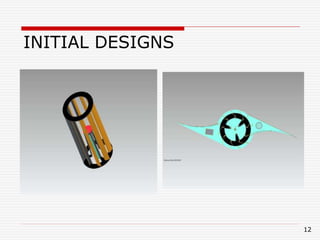
INITIAL DESIGNS
12
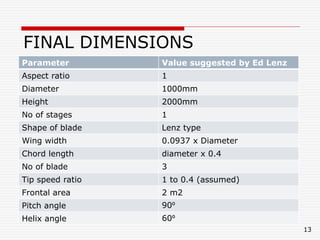
FINAL DIMENSIONS
Parameter Value suggested by Ed Lenz
Aspect ratio 1
Diameter 1000mm
Height 2000mm
No of stages 1
Shape of blade Lenz type
Wing width 0.0937 x Diameter
Chord length diameter x 0.4
No of blade 3
Tip speed ratio 1 to 0.4 (assumed)
Frontal area 2 m2
Pitch angle 90⁰
Helix angle 60⁰
13
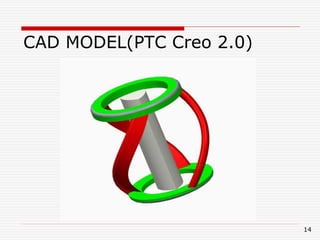
CAD MODEL(PTC Creo 2.0)
14
15
ANALYSIS PHASE
ANSYS CFX SIMULATION
 Introduction
 Objectives
 Boundary condition
 Mesh generation
 Assumptions
 Mathematical formula
 Results
 Conclusion
16
17
18
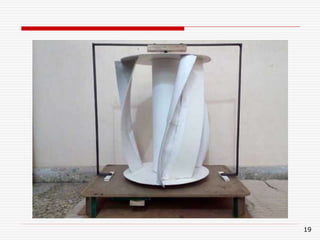
PROTOTYPE BUILDING PHASE
19
20
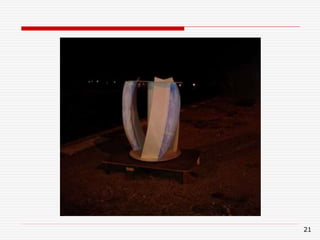
TESTING PHASE
21
22
RESULTS
23
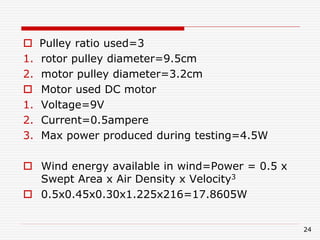
 Pulley ratio used=3
1. rotor pulley diameter=9.5cm
2. motor pulley diameter=3.2cm
 Motor used DC motor
1. Voltage=9V
2. Current=0.5ampere
3. Max power produced during testing=4.5W
 Wind energy available in wind=Power = 0.5 x
Swept Area x Air Density x Velocity3
 0.5x0.45x0.30x1.225x216=17.8605W
24
 Cp = Coefficient of performance
 š‘Ŗš’‘ = (the power extracted from wind)
(the power in wind)
 Therefore
(4.5/17.8605)=0.251959
š‘Ŗš’‘ = 0.251959
Our prototype helix Lenz vertical axis wind turbine
is 25% efficient
25
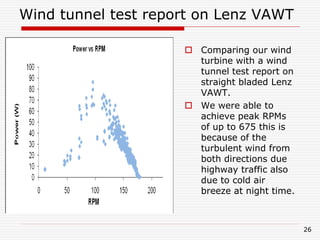
Wind tunnel test report on Lenz VAWT
 Comparing our wind
turbine with a wind
tunnel test report on
straight bladed Lenz
VAWT.
 We were able to
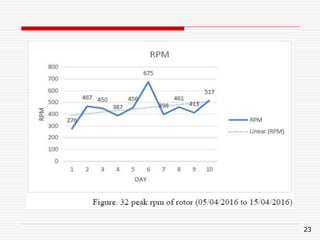
achieve peak RPMs
of up to 675 this is
because of the
turbulent wind from
both directions due
highway traffic also
due to cold air
breeze at night time.
26
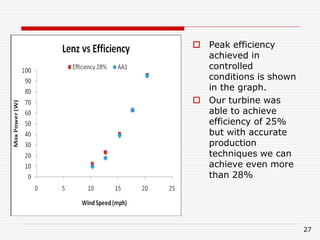
 Peak efficiency
achieved in
controlled
conditions is shown
in the graph.
 Our turbine was
able to achieve
efficiency of 25%
but with accurate
production
techniques we can
achieve even more
than 28%
27
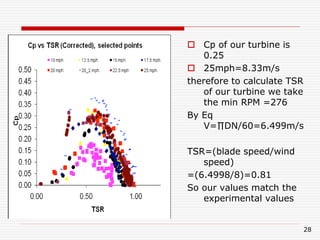
 Cp of our turbine is
0.25
 25mph=8.33m/s
therefore to calculate TSR
of our turbine we take
the min RPM =276
By Eq
V=āˆDN/60=6.499m/s
TSR=(blade speed/wind
speed)
=(6.4998/8)=0.81
So our values match the
experimental values
28
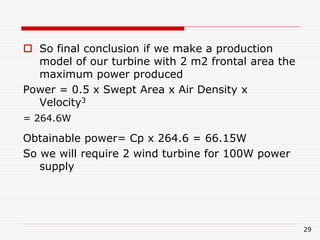
 So final conclusion if we make a production
model of our turbine with 2 m2 frontal area the
maximum power produced
Power = 0.5 x Swept Area x Air Density x
Velocity3
= 264.6W
Obtainable power= Cp x 264.6 = 66.15W
So we will require 2 wind turbine for 100W power
supply
29
PHOTO GALLERY
30
31

Wind turbine project presentation

  • 1.
    1 DESIGN AND ANALYSISOF WIND TURBINE FOR HIGHWAY PROJECT ON PRESENTED BY: SABHAYA JAYESH -120870119201 SANDIP JOSHI -120870119202 IMMANUEL ALEXANDER -120870119203 SONANI RINKESH -120870119205
  • 2.
    2 MOTIVATION  A vancarrying 2nd shift diploma students of Parul overturned on national highway due to lack of visibility at night.  Driving on highways at night is a difficult task due to improper lighting facilities, resulting into high accidents rates. The project aims at designing and analysing vertical axis wind turbine for the highways in India in order to recapture wind energy from moving vehicles.
  • 3.
    3 OVERVIEW  Research Phase Data collection  Design Phase  Analysis phase  Prototype  Testing  results
  • 4.
  • 5.
    Sr. No Title & Authorpublication Work Done 1 HighwayWindmill: R.SATHYANARAYANAN,C.GIRIRA MPRASATH,S.MUTHAMIZH, K.T.GOPINATH IEEE • The j-type blade design rules out savonius design in high power energy generation as it has both the c-type design and aerodynamic wing design fused together forming an hybrid model shape, so that the blade acts on drag and lift theory of wind turbine for a normal air pressure the mechanical power produced will be much higher as compared to the other design types. 2 Experimental Comparison Study for Savonius Wind Turbine of Two & Three Blades at Low Wind Speed: Mohammed Hadi Ali IJMER-vol-3 issue 5 oct-2013 •It was observed from the measured and calculated results that the two blades savonius wind turbine is more efficient, it has higher power coefficient under the same test condition than that of three blades savonius wind turbine. The reason is that increasing the number of blades will increase the drag surfaces against the wind air flow and causes to increase the reverse torque and leads to decrease the net torque working on the blades of savonius wind turbine. 3 www.windstuff.com/lenz wind turbine •Edward Lenz has found one Design of wind turbine which uses the principal of venture meter in construction of wind mill which was thought by one patent email to him and he had construct the turbine which named as Lenz VAWT
  • 6.
    Sr. No Title& Author publication Work Done 4. Design procedure for Lenz type vertical axis wind turbine for urban domestic application Himmatsinh P.Gohil 1 Prof. S.T. Patel 2 P.G. Student 2 Assistant Professor Mechanical Department G.E.C. Valsad, Gujarat, India IJSRD - International Journal for Scientific Research & Development| Vol. 2, Issue 03, 2014 | ISSN (online): 2321-0613 From this paper one can learn a design procedure for latest invented Lenz VAWT. From the design calculation and based on previous research data in related domain, basic design parameters of Lenz type VAWT is derived which are tip speed ratio, wing dimensions etc.
  • 7.
    DATA COLLECTION  Availabledata 1. Power required for an LED streetlight 2. Swept area required 3. Wind data 7
  • 8.
    1. Power required GMR : Chennai Outer Ring Road National Highway LED Lighting  PALMTM MAX offers a highly effective and efficient lighting solution for street light application. It is offered in variants of 110W, 130W, 150W, 180W and 210W. 8
  • 9.
    2. Swept arearequired  Power = 0.5 x Swept Area x Air Density x Velocity3 ļ‚§ Air has a known density (around 1.23 kg/m3 at sea level) ļ‚§ Velocity calculated using anemometer 9
  • 10.
    3. Wind data 10 day1 day 2 day 3 day 4 day 5 day 6 day 7 day 8 day 9 day 10 Height 1m 6.8 5.2 2.3 3.2 3.1 3 2.7 2.5 2.3 4 Height 1.5m 5.6 4.9 5.2 4.5 5.3 4.5 4.5 3.4 4.6 6.5 Height 2m 6.4 5.6 5.6 6.7 6.3 4.5 6.4 4.5 5.6 6.3 6.8 5.2 2.3 3.2 3.1 3 2.7 2.5 2.3 4 5.6 4.9 5.2 4.5 5.3 4.5 4.5 3.4 4.6 6.5 6.4 5.6 5.6 6.7 6.3 4.5 6.4 4.5 5.6 6.3 0 1 2 3 4 5 6 7 8 AVG.WINDVELOCITY(m/s) DAYS(1-10) Chart Title Height 1m Height 1.5m Height 2m
  • 11.
  • 12.
  • 13.
    FINAL DIMENSIONS Parameter Valuesuggested by Ed Lenz Aspect ratio 1 Diameter 1000mm Height 2000mm No of stages 1 Shape of blade Lenz type Wing width 0.0937 x Diameter Chord length diameter x 0.4 No of blade 3 Tip speed ratio 1 to 0.4 (assumed) Frontal area 2 m2 Pitch angle 90⁰ Helix angle 60⁰ 13
  • 14.
  • 15.
  • 16.
    ANSYS CFX SIMULATION Introduction  Objectives  Boundary condition  Mesh generation  Assumptions  Mathematical formula  Results  Conclusion 16
  • 17.
  • 18.
  • 19.
  • 20.
  • 21.
  • 22.
  • 23.
  • 24.
     Pulley ratioused=3 1. rotor pulley diameter=9.5cm 2. motor pulley diameter=3.2cm  Motor used DC motor 1. Voltage=9V 2. Current=0.5ampere 3. Max power produced during testing=4.5W  Wind energy available in wind=Power = 0.5 x Swept Area x Air Density x Velocity3  0.5x0.45x0.30x1.225x216=17.8605W 24
  • 25.
     Cp =Coefficient of performance  š‘Ŗš’‘ = (the power extracted from wind) (the power in wind)  Therefore (4.5/17.8605)=0.251959 š‘Ŗš’‘ = 0.251959 Our prototype helix Lenz vertical axis wind turbine is 25% efficient 25
  • 26.
    Wind tunnel testreport on Lenz VAWT  Comparing our wind turbine with a wind tunnel test report on straight bladed Lenz VAWT.  We were able to achieve peak RPMs of up to 675 this is because of the turbulent wind from both directions due highway traffic also due to cold air breeze at night time. 26
  • 27.
     Peak efficiency achievedin controlled conditions is shown in the graph.  Our turbine was able to achieve efficiency of 25% but with accurate production techniques we can achieve even more than 28% 27
  • 28.
     Cp ofour turbine is 0.25  25mph=8.33m/s therefore to calculate TSR of our turbine we take the min RPM =276 By Eq V=āˆDN/60=6.499m/s TSR=(blade speed/wind speed) =(6.4998/8)=0.81 So our values match the experimental values 28
  • 29.
     So finalconclusion if we make a production model of our turbine with 2 m2 frontal area the maximum power produced Power = 0.5 x Swept Area x Air Density x Velocity3 = 264.6W Obtainable power= Cp x 264.6 = 66.15W So we will require 2 wind turbine for 100W power supply 29
  • 30.
  • 31.