
Syllabus Design
EDUC 605
By: Amina Qatan
Outline
• Overview
• Grammatical Syllabus
• The “Organic” Approach to Grammar
• Needs Analysis
• Goal & Objective Setting
• CBLT
• The Standard Movement
• Quiz
Overview
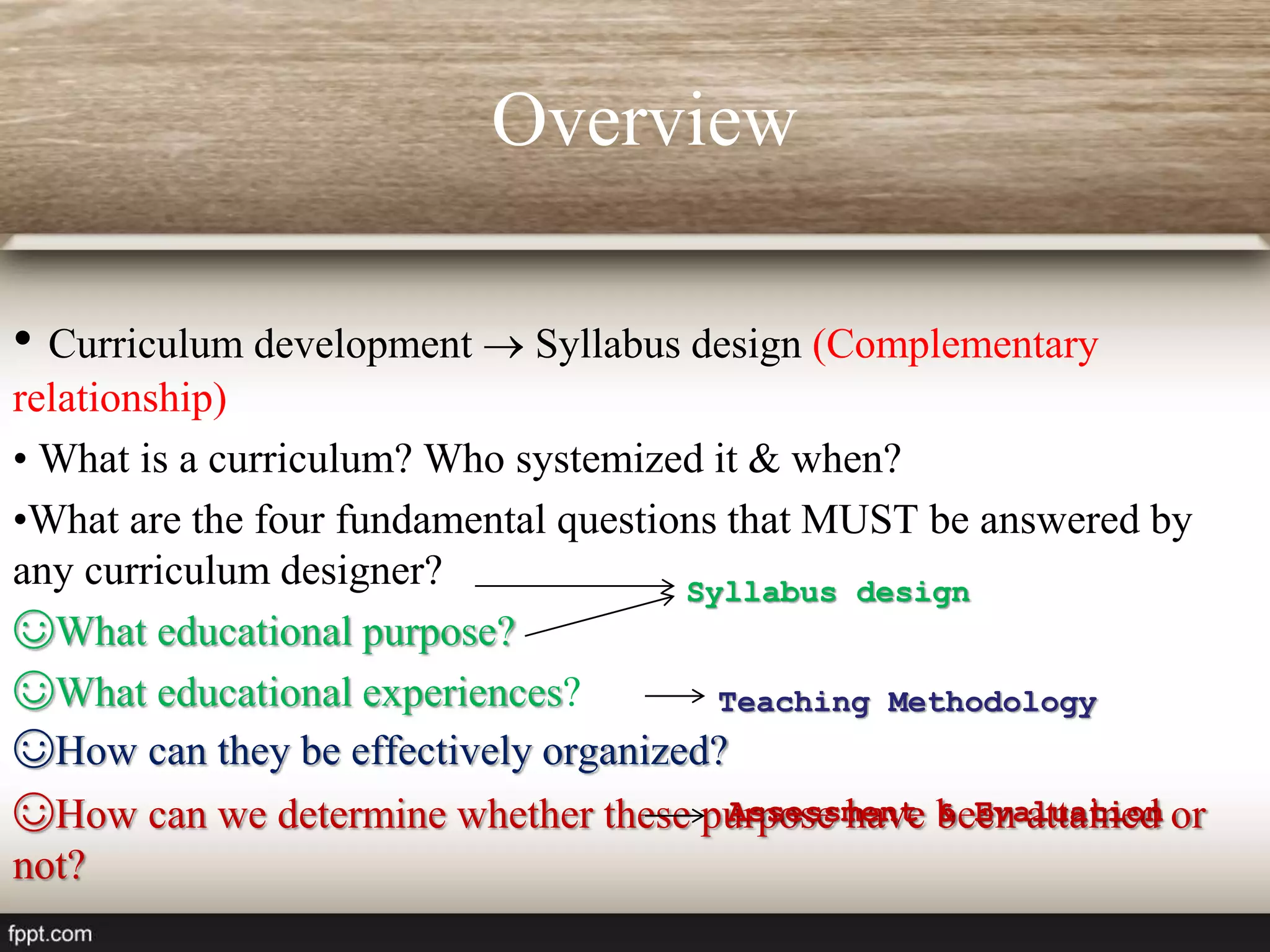
• Curriculum development  Syllabus design (Complementary
relationship)
• What is a curriculum? Who systemized it & when?
•What are the four fundamental questions that MUST be answered by
any curriculum designer?
☺What educational purpose?
☺What educational experiences?
☺How can they be effectively organized?
☺How can we determine whether these purpose have been attained or
not?
Syllabus design
Teaching Methodology
Assessment & Evaluation
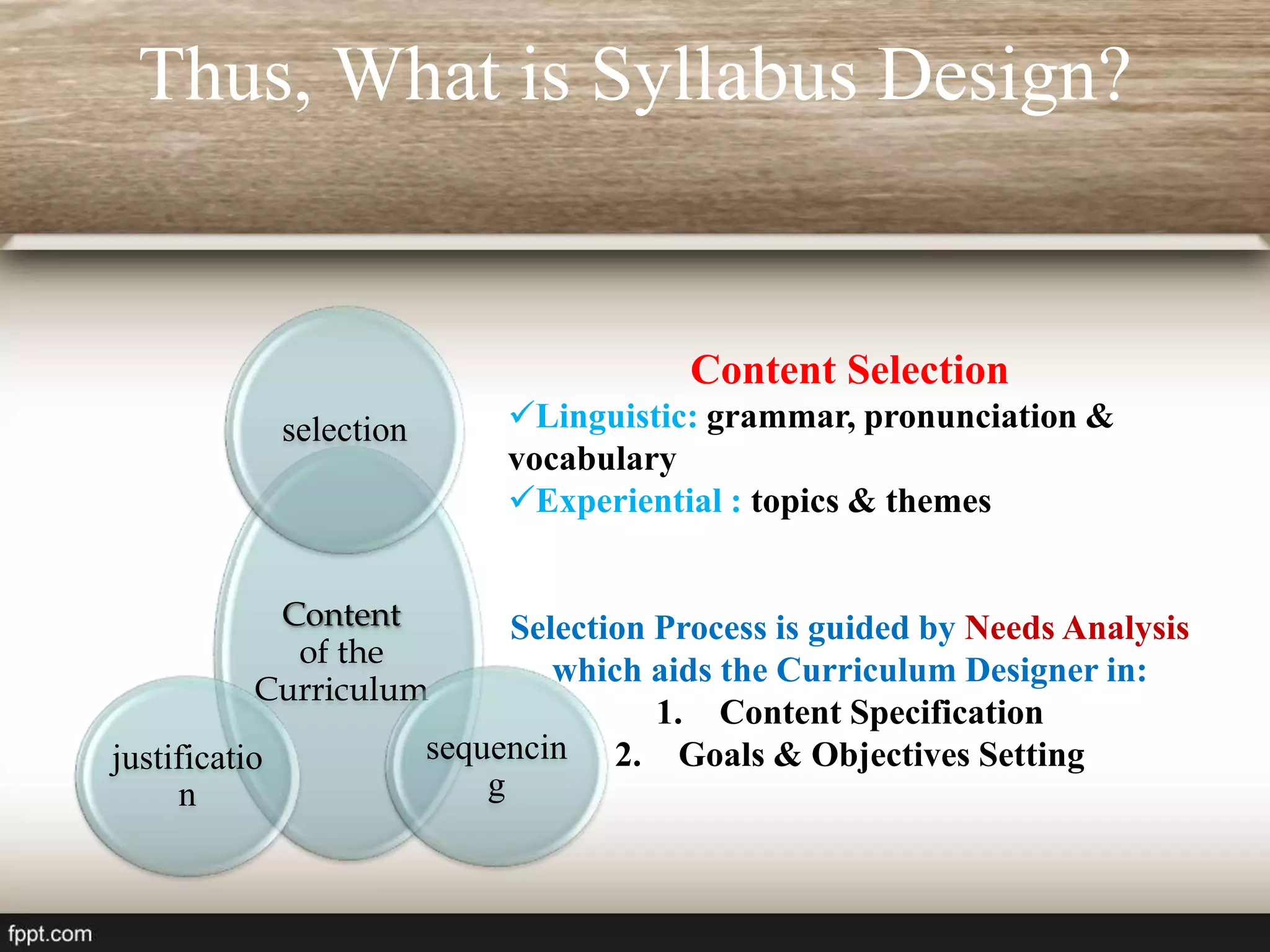
Thus, What is Syllabus Design?
Content
of the
Curriculum
selection
sequencin
g
justificatio
n
Content Selection
Linguistic: grammar, pronunciation &
vocabulary
Experiential : topics & themes
Selection Process is guided by Needs Analysis
which aids the Curriculum Designer in:
1. Content Specification
2. Goals & Objectives Setting
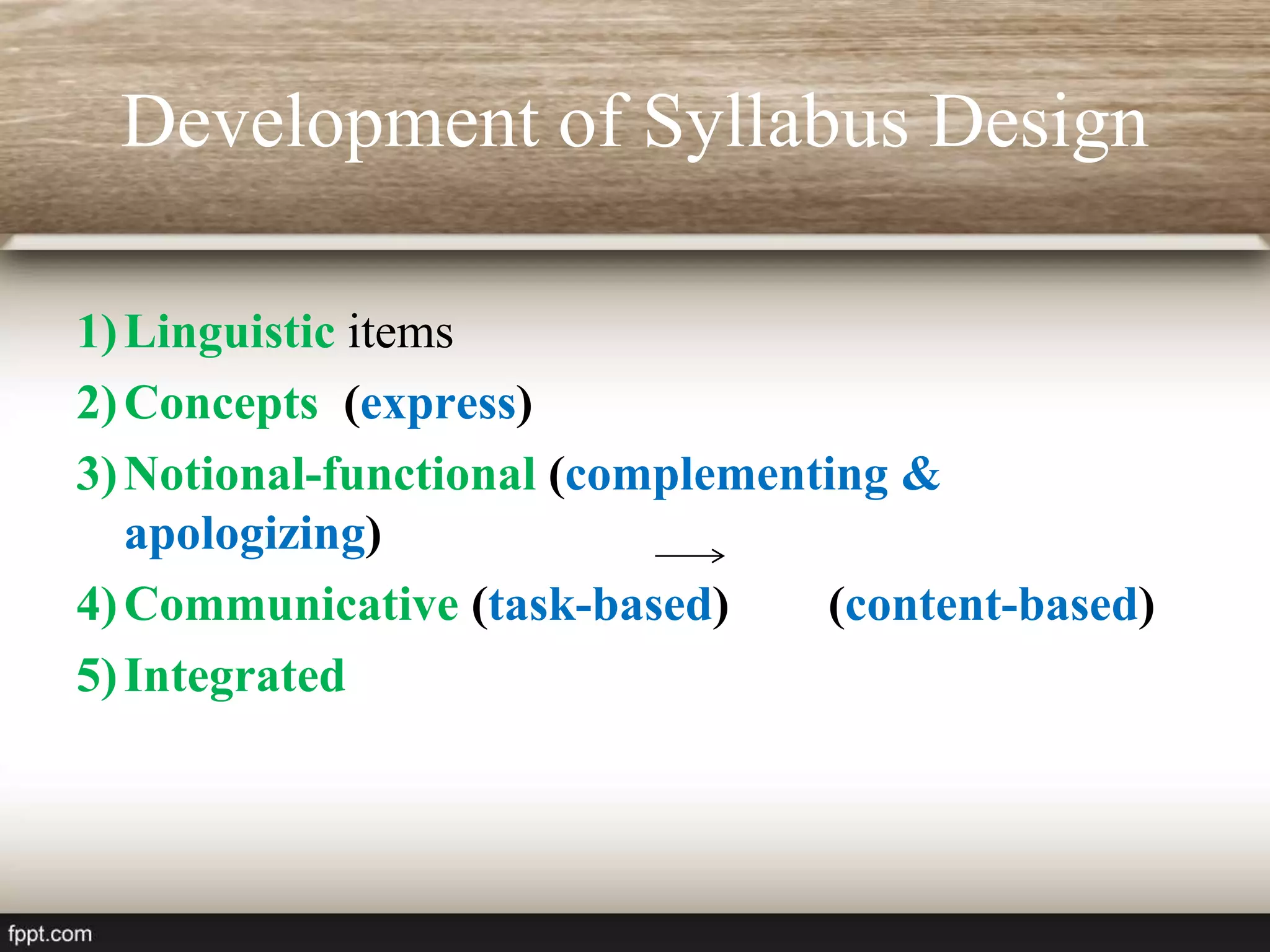
Development of Syllabus Design
1)Linguistic items
2)Concepts (express)
3)Notional-functional (complementing &
apologizing)
4)Communicative (task-based) (content-based)
5)Integrated
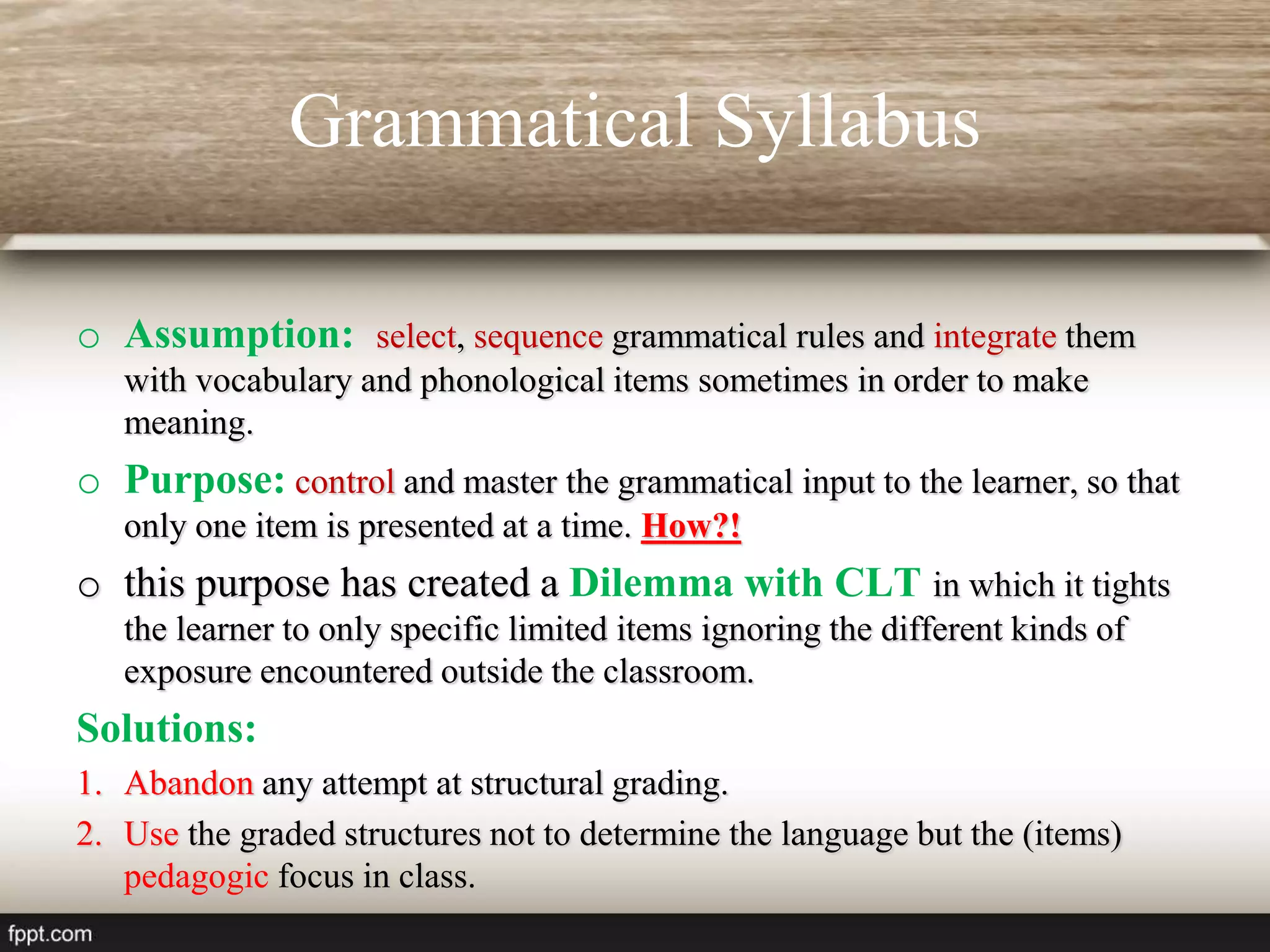
Grammatical Syllabus
o Assumption: select, sequence grammatical rules and integrate them
with vocabulary and phonological items sometimes in order to make
meaning.
o Purpose: control and master the grammatical input to the learner, so that
only one item is presented at a time. How?!
o this purpose has created a Dilemma with CLT in which it tights
the learner to only specific limited items ignoring the different kinds of
exposure encountered outside the classroom.
Solutions:
1. Abandon any attempt at structural grading.
2. Use the graded structures not to determine the language but the (items)
pedagogic focus in class.
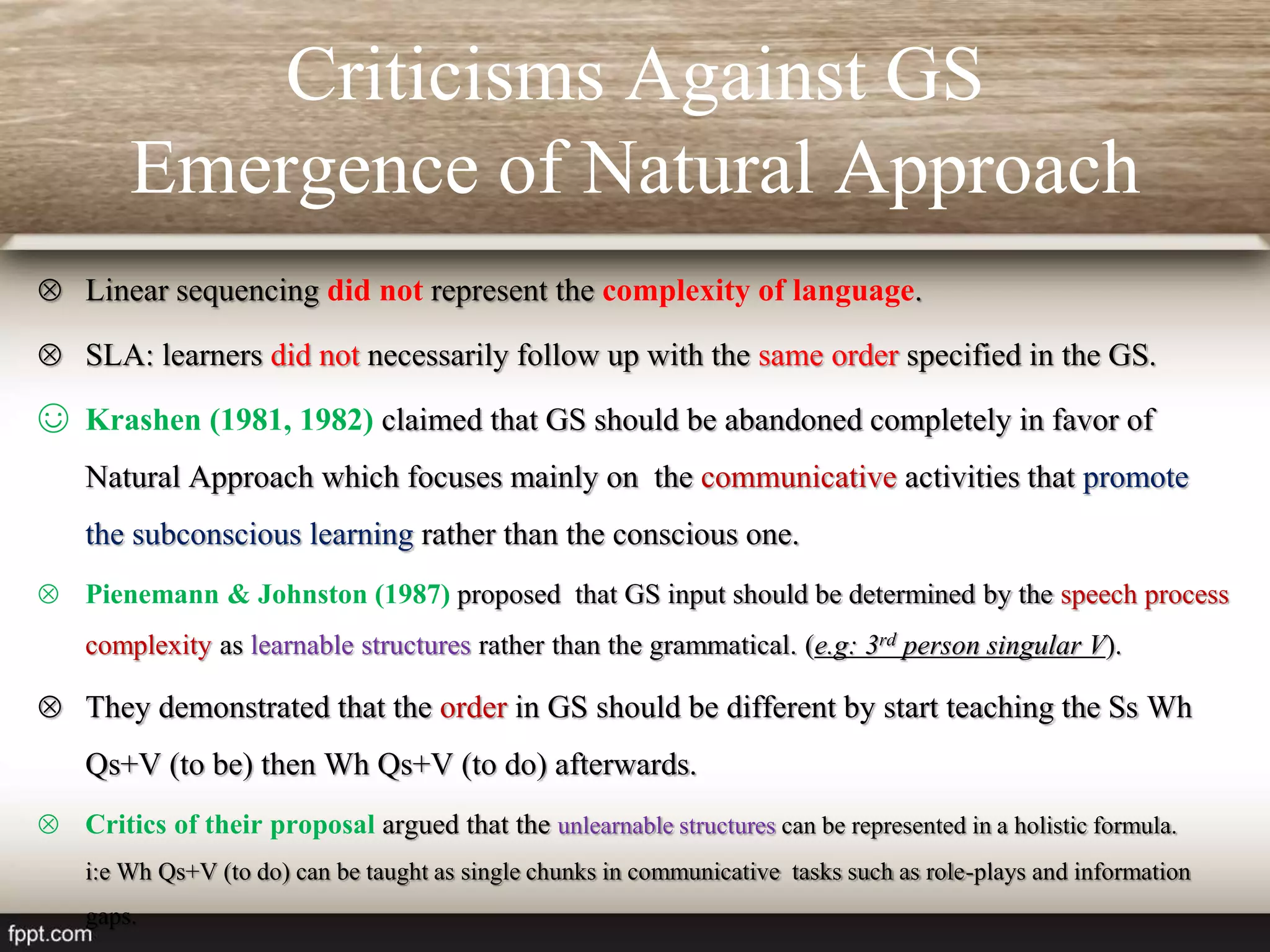
Criticisms Against GS
Emergence of Natural Approach
 Linear sequencing did not represent the complexity of language.
 SLA: learners did not necessarily follow up with the same order specified in the GS.
☺ Krashen (1981, 1982) claimed that GS should be abandoned completely in favor of
Natural Approach which focuses mainly on the communicative activities that promote
the subconscious learning rather than the conscious one.
 Pienemann & Johnston (1987) proposed that GS input should be determined by the speech process
complexity as learnable structures rather than the grammatical. (e.g: 3rd person singular V).
 They demonstrated that the order in GS should be different by start teaching the Ss Wh
Qs+V (to be) then Wh Qs+V (to do) afterwards.
 Critics of their proposal argued that the unlearnable structures can be represented in a holistic formula.
i:e Wh Qs+V (to do) can be taught as single chunks in communicative tasks such as role-plays and information
gaps.
Organic approach to Grammar
Metaphors
• In reflection to the purpose of the GS, it is believed that of language
acquisition development is like a building constructed brick by brick.
• However, SLA argued that language development is basically an organic
process.
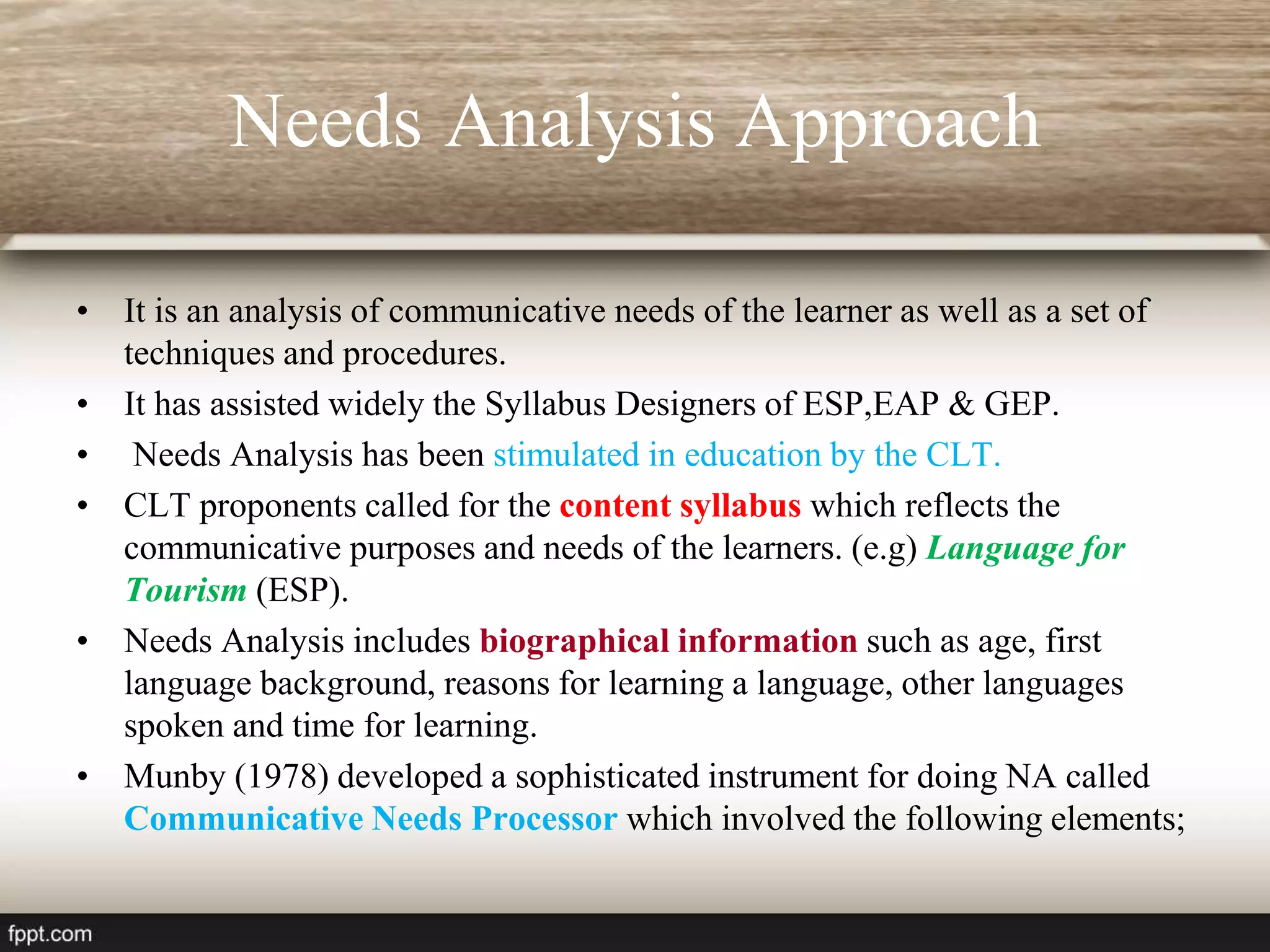
Needs Analysis Approach
• It is an analysis of communicative needs of the learner as well as a set of
techniques and procedures.
• It has assisted widely the Syllabus Designers of ESP,EAP & GEP.
• Needs Analysis has been stimulated in education by the CLT.
• CLT proponents called for the content syllabus which reflects the
communicative purposes and needs of the learners. (e.g) Language for
Tourism (ESP).
• Needs Analysis includes biographical information such as age, first
language background, reasons for learning a language, other languages
spoken and time for learning.
• Munby (1978) developed a sophisticated instrument for doing NA called
Communicative Needs Processor which involved the following elements;
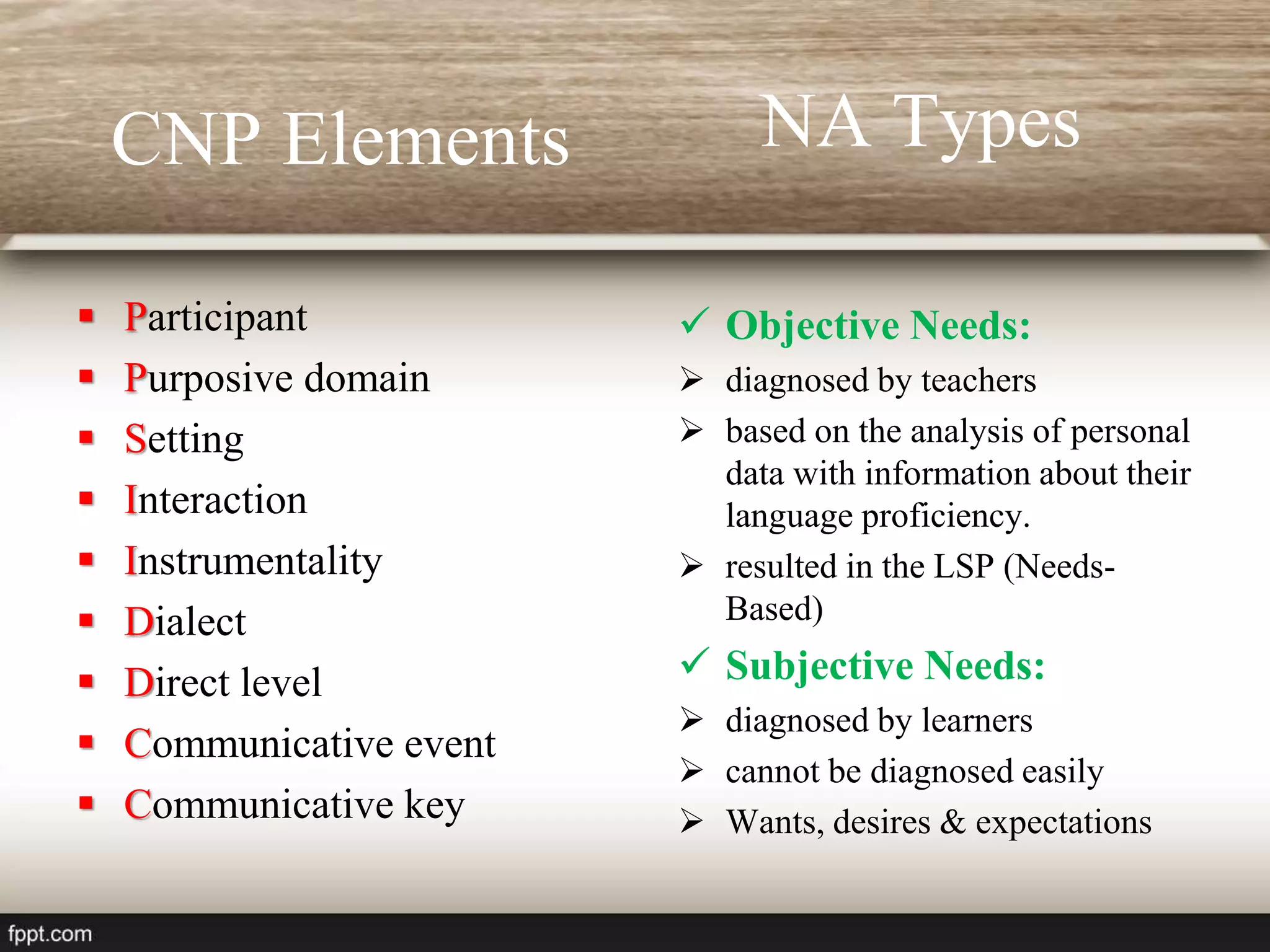
NA Types
 Participant
 Purposive domain
 Setting
 Interaction
 Instrumentality
 Dialect
 Direct level
 Communicative event
 Communicative key
 Objective Needs:
 diagnosed by teachers
 based on the analysis of personal
data with information about their
language proficiency.
 resulted in the LSP (Needs-
Based)
 Subjective Needs:
 diagnosed by learners
 cannot be diagnosed easily
 Wants, desires & expectations
CNP Elements
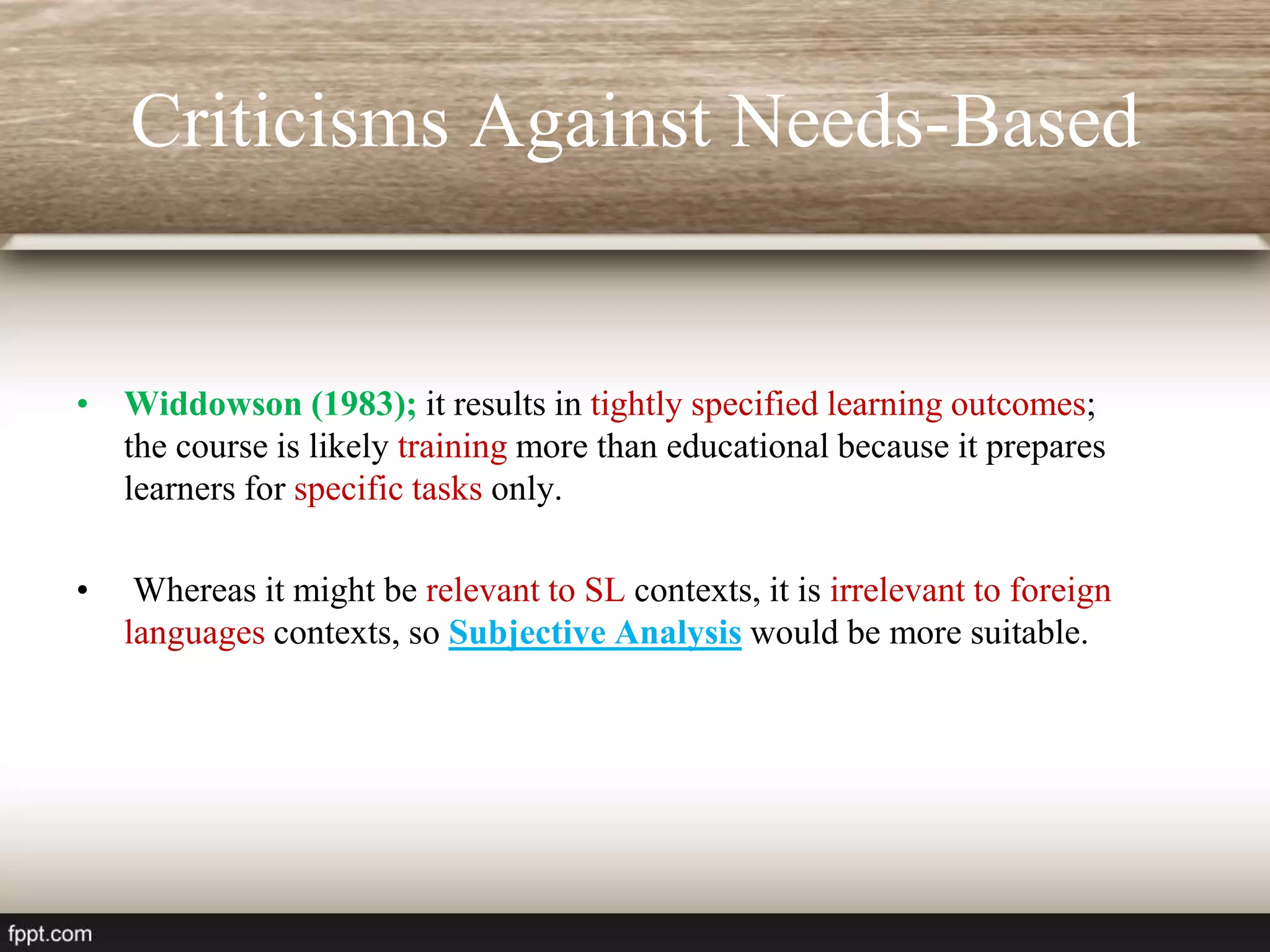
Criticisms Against Needs-Based
• Widdowson (1983); it results in tightly specified learning outcomes;
the course is likely training more than educational because it prepares
learners for specific tasks only.
• Whereas it might be relevant to SL contexts, it is irrelevant to foreign
languages contexts, so Subjective Analysis would be more suitable.
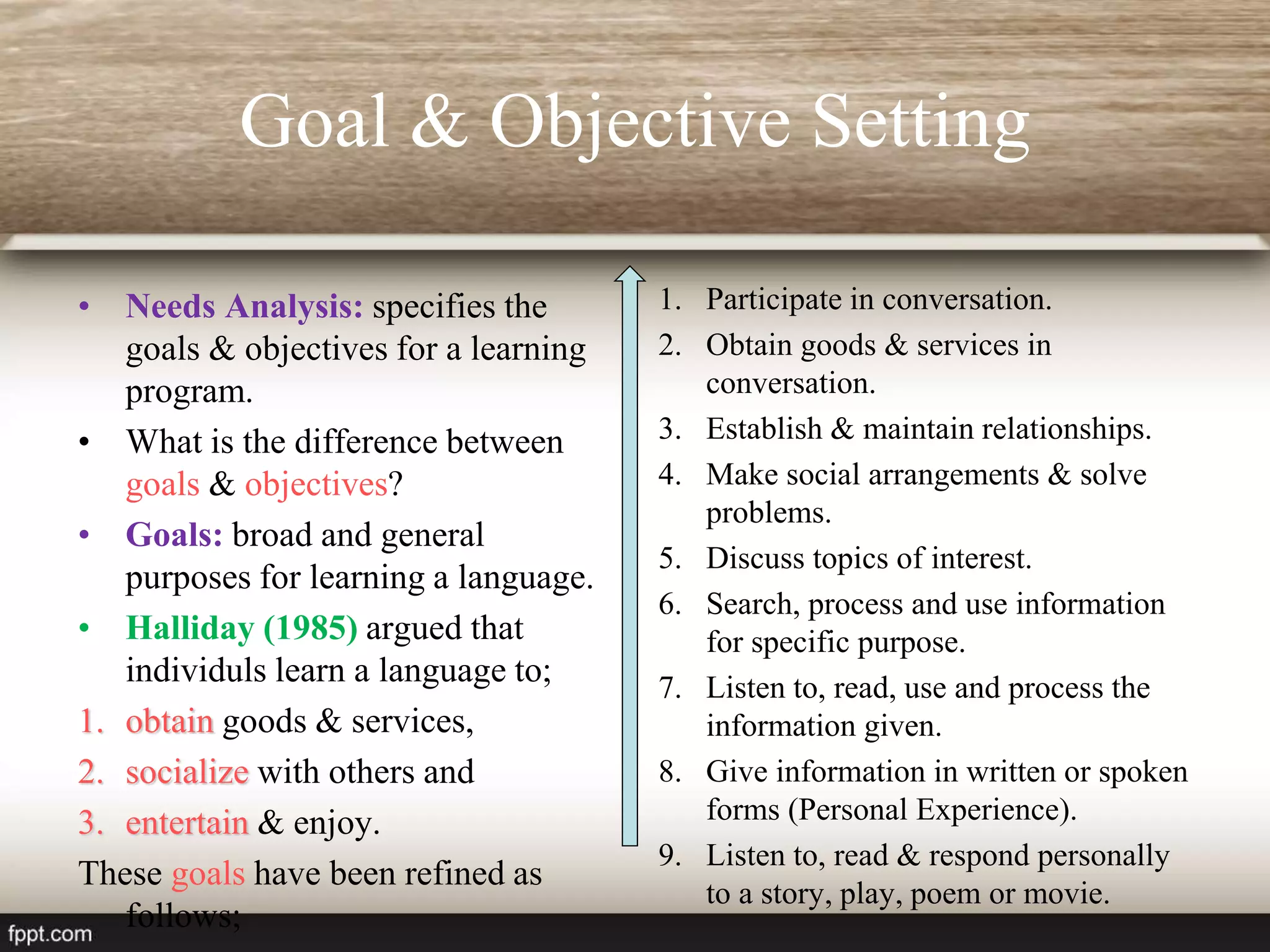
Goal & Objective Setting
• Needs Analysis: specifies the
goals & objectives for a learning
program.
• What is the difference between
goals & objectives?
• Goals: broad and general
purposes for learning a language.
• Halliday (1985) argued that
individuls learn a language to;
1. obtain goods & services,
2. socialize with others and
3. entertain & enjoy.
These goals have been refined as
follows;
1. Participate in conversation.
2. Obtain goods & services in
conversation.
3. Establish & maintain relationships.
4. Make social arrangements & solve
problems.
5. Discuss topics of interest.
6. Search, process and use information
for specific purpose.
7. Listen to, read, use and process the
information given.
8. Give information in written or spoken
forms (Personal Experience).
9. Listen to, read & respond personally
to a story, play, poem or movie.
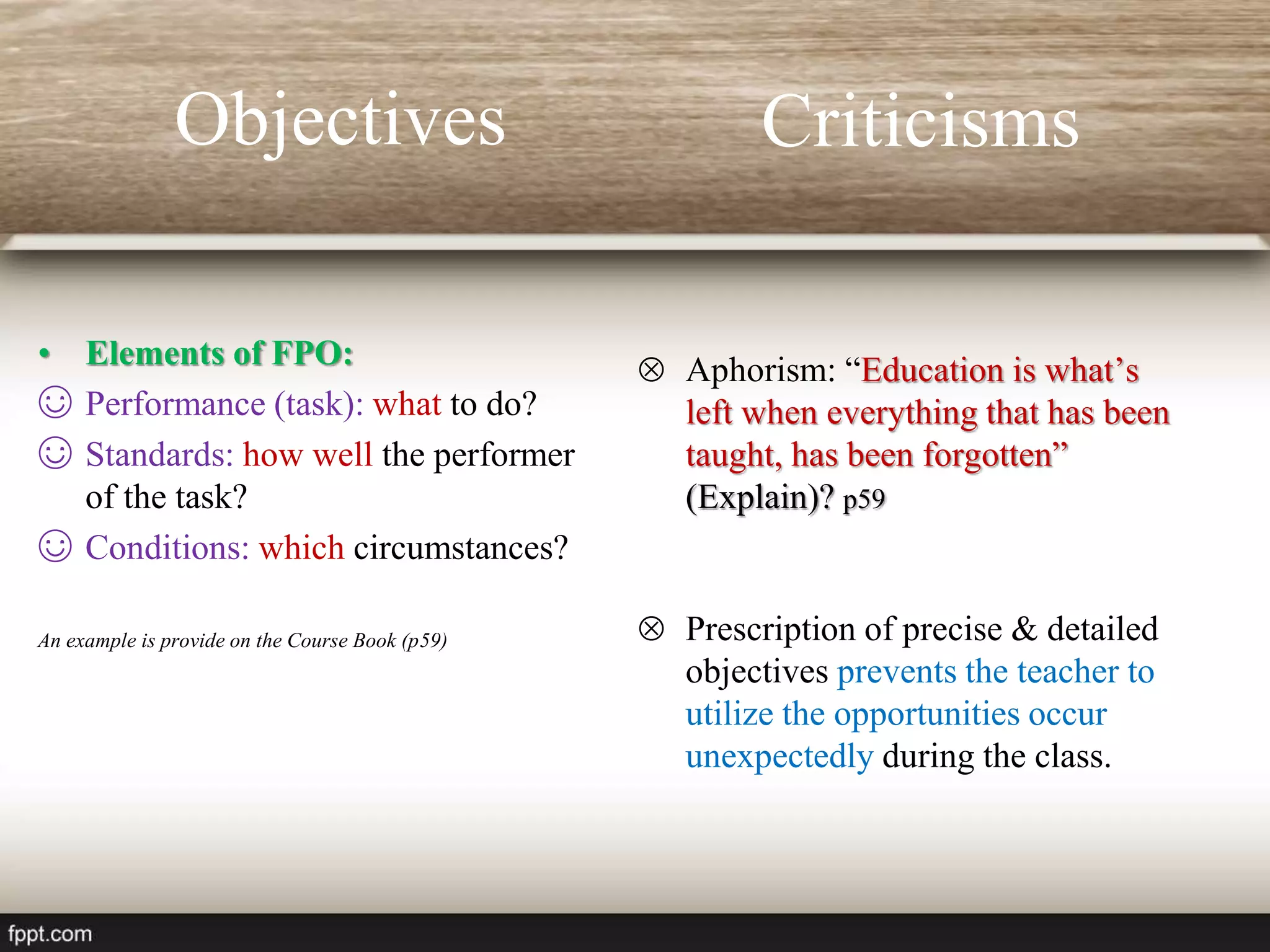
Criticisms
• Elements of FPO:
☺ Performance (task): what to do?
☺ Standards: how well the performer
of the task?
☺ Conditions: which circumstances?
An example is provide on the Course Book (p59)
 Aphorism: “Education is what’s
left when everything that has been
taught, has been forgotten”
(Explain)? p59
 Prescription of precise & detailed
objectives prevents the teacher to
utilize the opportunities occur
unexpectedly during the class.
Objectives
Objectives & CBLT
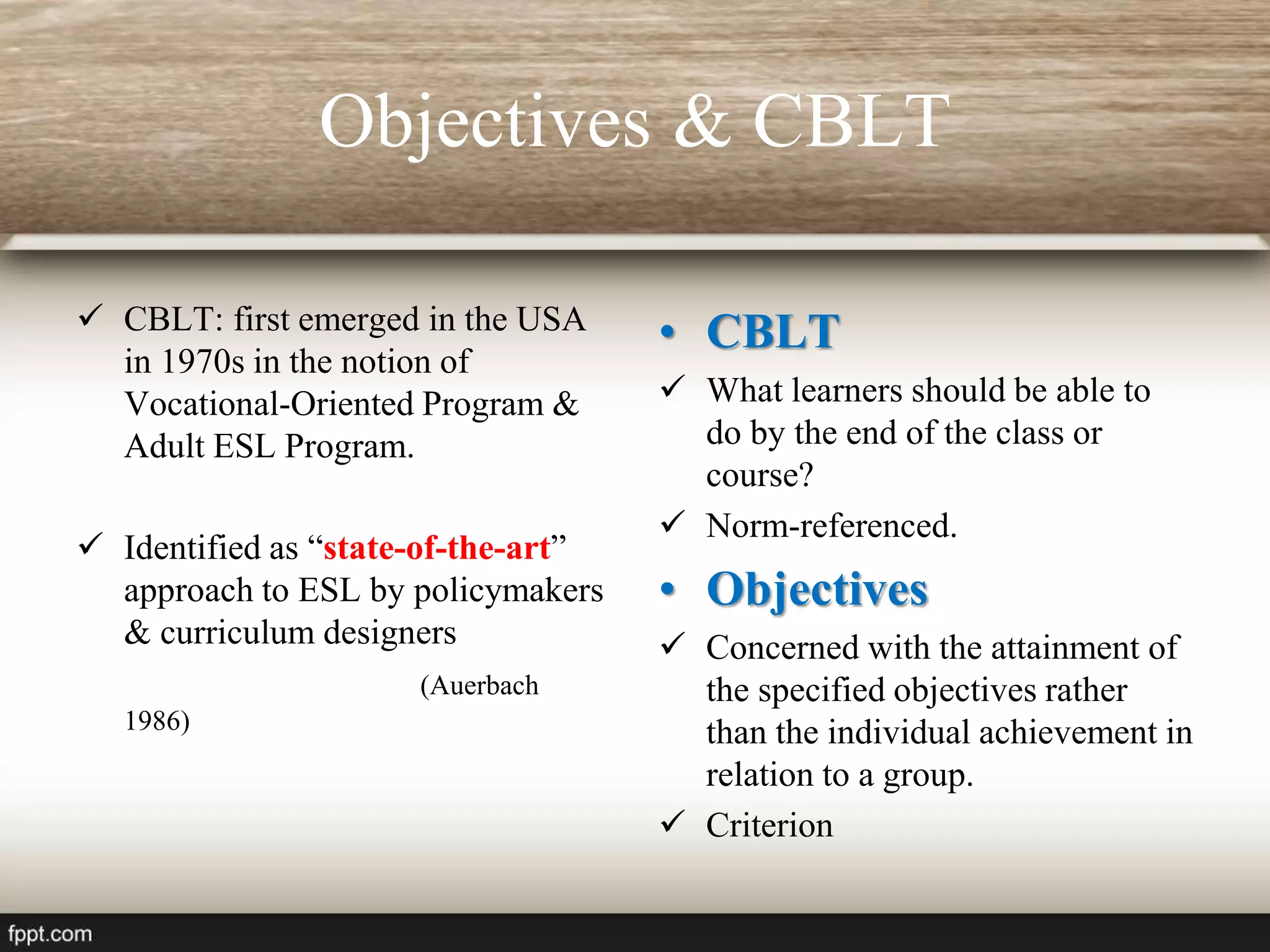
 CBLT: first emerged in the USA
in 1970s in the notion of
Vocational-Oriented Program &
Adult ESL Program.
 Identified as “state-of-the-art”
approach to ESL by policymakers
& curriculum designers
(Auerbach
1986)
• CBLT
 What learners should be able to
do by the end of the class or
course?
 Norm-referenced.
• Objectives
 Concerned with the attainment of
the specified objectives rather
than the individual achievement in
relation to a group.
 Criterion
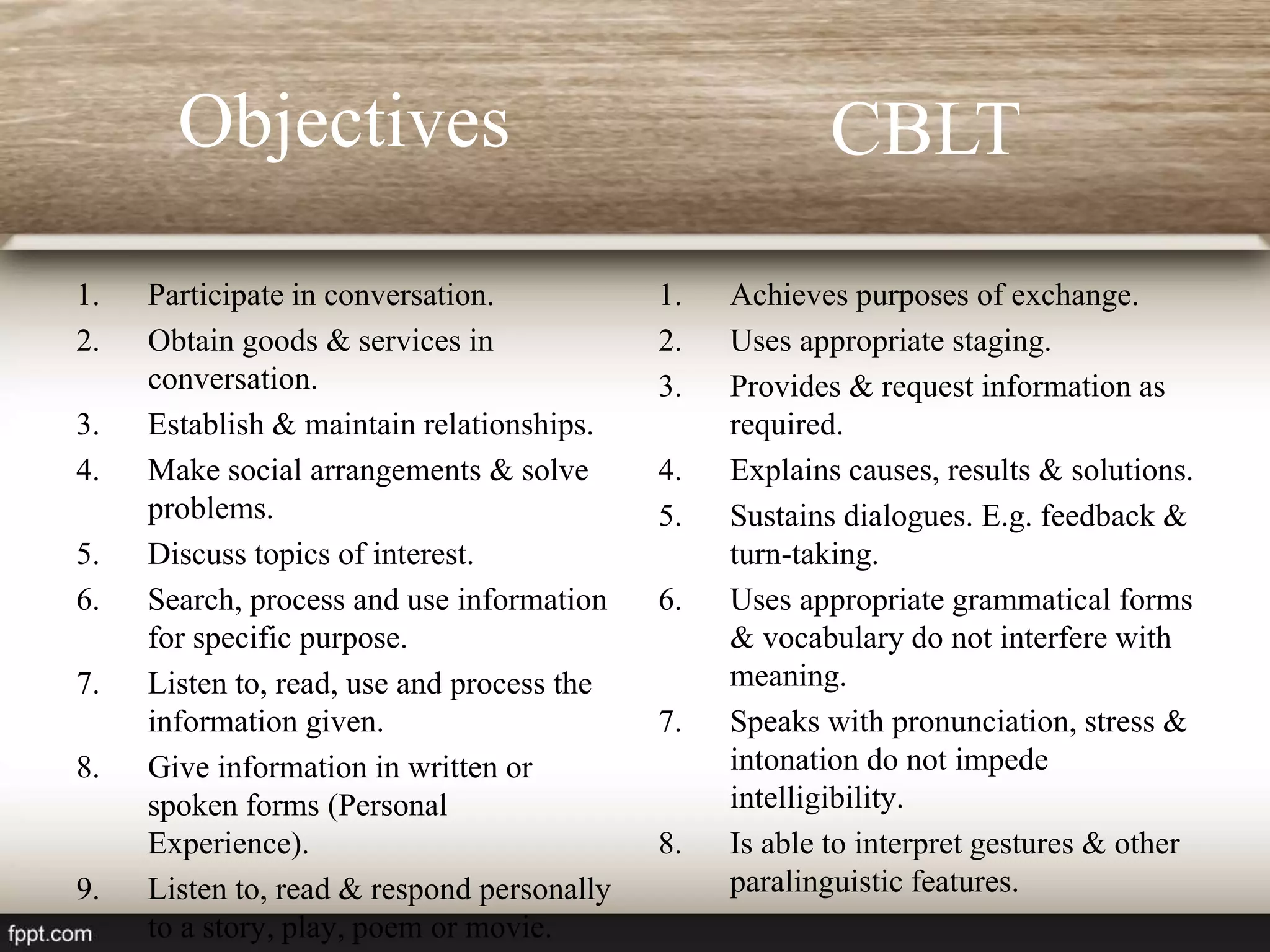
Objectives
1. Participate in conversation.
2. Obtain goods & services in
conversation.
3. Establish & maintain relationships.
4. Make social arrangements & solve
problems.
5. Discuss topics of interest.
6. Search, process and use information
for specific purpose.
7. Listen to, read, use and process the
information given.
8. Give information in written or
spoken forms (Personal
Experience).
9. Listen to, read & respond personally
to a story, play, poem or movie.
1. Achieves purposes of exchange.
2. Uses appropriate staging.
3. Provides & request information as
required.
4. Explains causes, results & solutions.
5. Sustains dialogues. E.g. feedback &
turn-taking.
6. Uses appropriate grammatical forms
& vocabulary do not interfere with
meaning.
7. Speaks with pronunciation, stress &
intonation do not impede
intelligibility.
8. Is able to interpret gestures & other
paralinguistic features.
CBLT
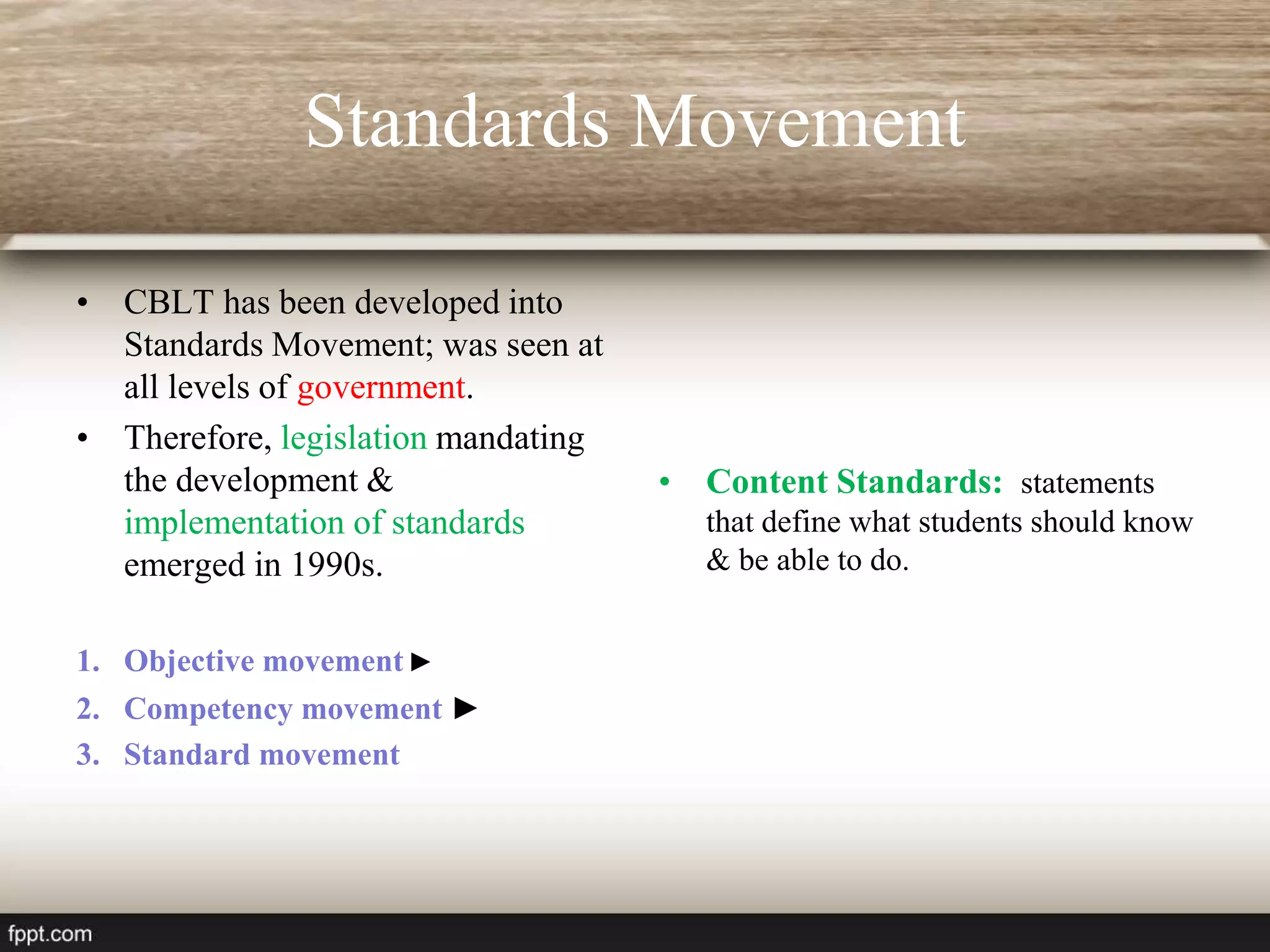
Standards Movement
• CBLT has been developed into
Standards Movement; was seen at
all levels of government.
• Therefore, legislation mandating
the development &
implementation of standards
emerged in 1990s.
1. Objective movement ►
2. Competency movement ►
3. Standard movement
• Content Standards: statements
that define what students should know
& be able to do.
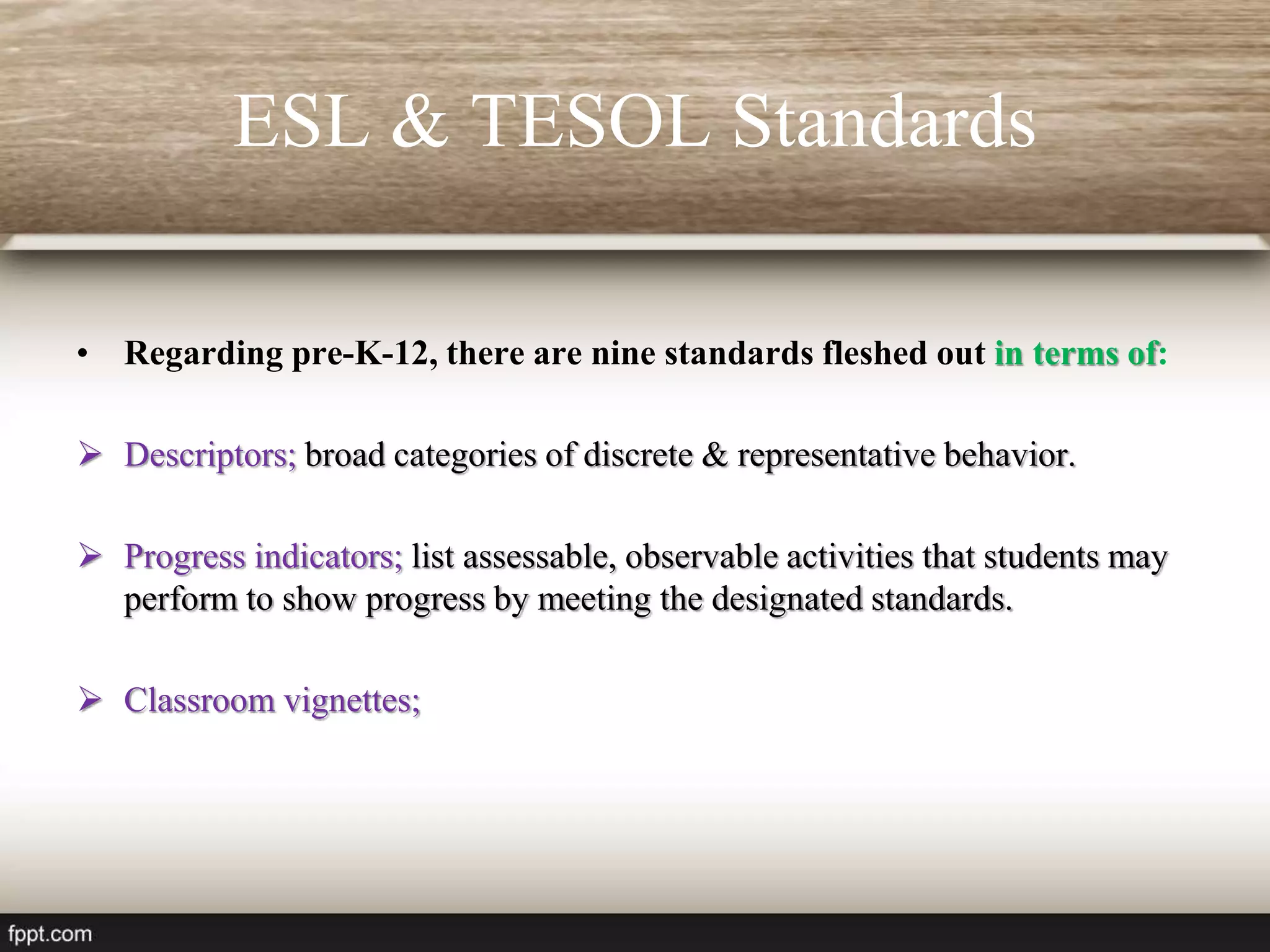
ESL & TESOL Standards
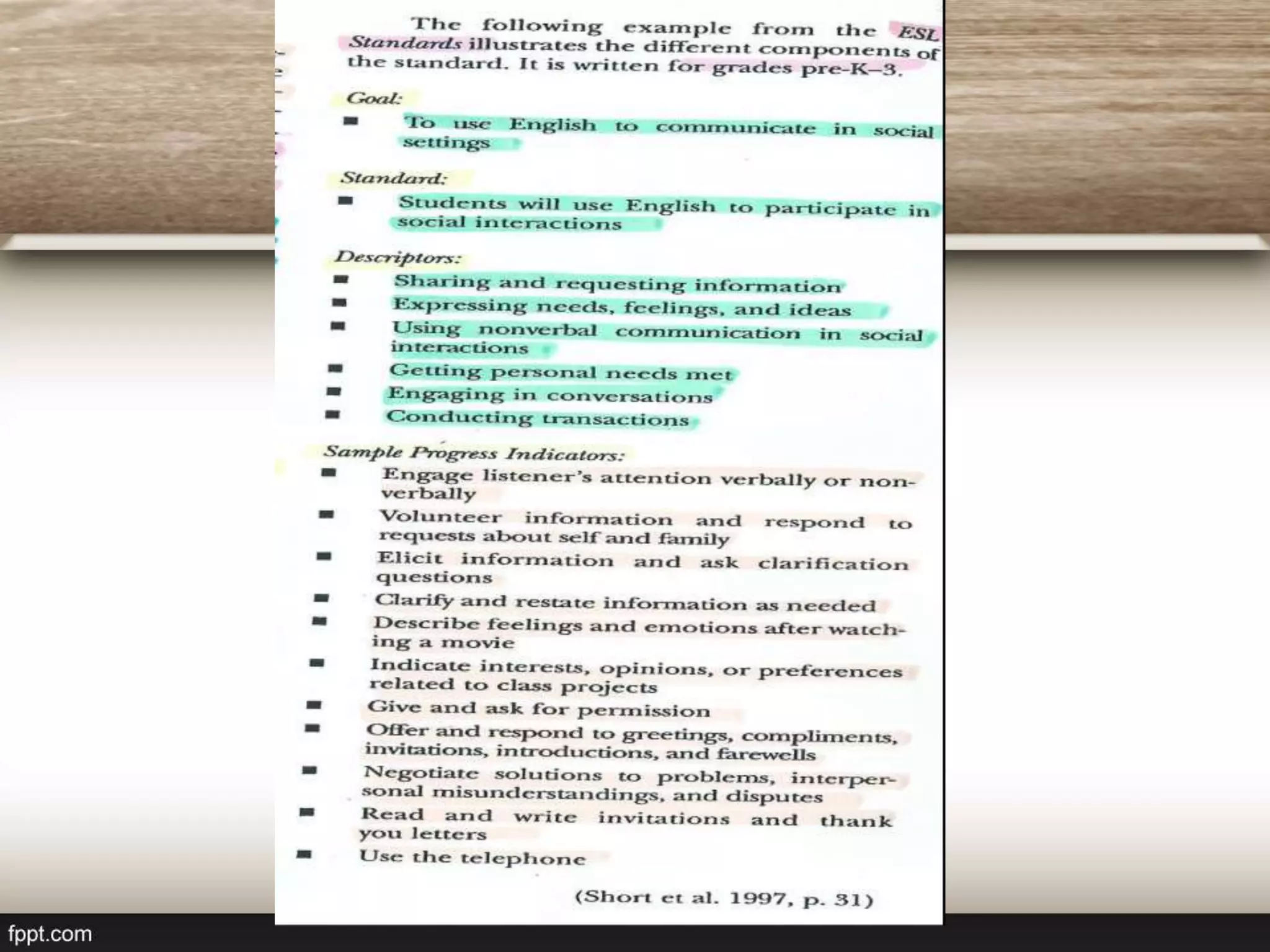
• Regarding pre-K-12, there are nine standards fleshed out in terms of:
 Descriptors; broad categories of discrete & representative behavior.
 Progress indicators; list assessable, observable activities that students may
perform to show progress by meeting the designated standards.
 Classroom vignettes;
Quiz
1
2
3 6
5
4 7
8
9

Syllabus design by amina qatan (part one)

  • 1.
  • 2.
    Outline • Overview • GrammaticalSyllabus • The “Organic” Approach to Grammar • Needs Analysis • Goal & Objective Setting • CBLT • The Standard Movement • Quiz
  • 3.
    Overview • Curriculum development Syllabus design (Complementary relationship) • What is a curriculum? Who systemized it & when? •What are the four fundamental questions that MUST be answered by any curriculum designer? ☺What educational purpose? ☺What educational experiences? ☺How can they be effectively organized? ☺How can we determine whether these purpose have been attained or not? Syllabus design Teaching Methodology Assessment & Evaluation
  • 4.
    Thus, What isSyllabus Design? Content of the Curriculum selection sequencin g justificatio n Content Selection Linguistic: grammar, pronunciation & vocabulary Experiential : topics & themes Selection Process is guided by Needs Analysis which aids the Curriculum Designer in: 1. Content Specification 2. Goals & Objectives Setting
  • 5.
    Development of SyllabusDesign 1)Linguistic items 2)Concepts (express) 3)Notional-functional (complementing & apologizing) 4)Communicative (task-based) (content-based) 5)Integrated
  • 6.
    Grammatical Syllabus o Assumption:select, sequence grammatical rules and integrate them with vocabulary and phonological items sometimes in order to make meaning. o Purpose: control and master the grammatical input to the learner, so that only one item is presented at a time. How?! o this purpose has created a Dilemma with CLT in which it tights the learner to only specific limited items ignoring the different kinds of exposure encountered outside the classroom. Solutions: 1. Abandon any attempt at structural grading. 2. Use the graded structures not to determine the language but the (items) pedagogic focus in class.
  • 7.
    Criticisms Against GS Emergenceof Natural Approach  Linear sequencing did not represent the complexity of language.  SLA: learners did not necessarily follow up with the same order specified in the GS. ☺ Krashen (1981, 1982) claimed that GS should be abandoned completely in favor of Natural Approach which focuses mainly on the communicative activities that promote the subconscious learning rather than the conscious one.  Pienemann & Johnston (1987) proposed that GS input should be determined by the speech process complexity as learnable structures rather than the grammatical. (e.g: 3rd person singular V).  They demonstrated that the order in GS should be different by start teaching the Ss Wh Qs+V (to be) then Wh Qs+V (to do) afterwards.  Critics of their proposal argued that the unlearnable structures can be represented in a holistic formula. i:e Wh Qs+V (to do) can be taught as single chunks in communicative tasks such as role-plays and information gaps.
  • 8.
    Organic approach toGrammar Metaphors • In reflection to the purpose of the GS, it is believed that of language acquisition development is like a building constructed brick by brick. • However, SLA argued that language development is basically an organic process.
  • 9.
    Needs Analysis Approach •It is an analysis of communicative needs of the learner as well as a set of techniques and procedures. • It has assisted widely the Syllabus Designers of ESP,EAP & GEP. • Needs Analysis has been stimulated in education by the CLT. • CLT proponents called for the content syllabus which reflects the communicative purposes and needs of the learners. (e.g) Language for Tourism (ESP). • Needs Analysis includes biographical information such as age, first language background, reasons for learning a language, other languages spoken and time for learning. • Munby (1978) developed a sophisticated instrument for doing NA called Communicative Needs Processor which involved the following elements;
  • 10.
    NA Types  Participant Purposive domain  Setting  Interaction  Instrumentality  Dialect  Direct level  Communicative event  Communicative key  Objective Needs:  diagnosed by teachers  based on the analysis of personal data with information about their language proficiency.  resulted in the LSP (Needs- Based)  Subjective Needs:  diagnosed by learners  cannot be diagnosed easily  Wants, desires & expectations CNP Elements
  • 11.
    Criticisms Against Needs-Based •Widdowson (1983); it results in tightly specified learning outcomes; the course is likely training more than educational because it prepares learners for specific tasks only. • Whereas it might be relevant to SL contexts, it is irrelevant to foreign languages contexts, so Subjective Analysis would be more suitable.
  • 12.
    Goal & ObjectiveSetting • Needs Analysis: specifies the goals & objectives for a learning program. • What is the difference between goals & objectives? • Goals: broad and general purposes for learning a language. • Halliday (1985) argued that individuls learn a language to; 1. obtain goods & services, 2. socialize with others and 3. entertain & enjoy. These goals have been refined as follows; 1. Participate in conversation. 2. Obtain goods & services in conversation. 3. Establish & maintain relationships. 4. Make social arrangements & solve problems. 5. Discuss topics of interest. 6. Search, process and use information for specific purpose. 7. Listen to, read, use and process the information given. 8. Give information in written or spoken forms (Personal Experience). 9. Listen to, read & respond personally to a story, play, poem or movie.
  • 13.
    Criticisms • Elements ofFPO: ☺ Performance (task): what to do? ☺ Standards: how well the performer of the task? ☺ Conditions: which circumstances? An example is provide on the Course Book (p59)  Aphorism: “Education is what’s left when everything that has been taught, has been forgotten” (Explain)? p59  Prescription of precise & detailed objectives prevents the teacher to utilize the opportunities occur unexpectedly during the class. Objectives
  • 14.
    Objectives & CBLT CBLT: first emerged in the USA in 1970s in the notion of Vocational-Oriented Program & Adult ESL Program.  Identified as “state-of-the-art” approach to ESL by policymakers & curriculum designers (Auerbach 1986) • CBLT  What learners should be able to do by the end of the class or course?  Norm-referenced. • Objectives  Concerned with the attainment of the specified objectives rather than the individual achievement in relation to a group.  Criterion
  • 15.
    Objectives 1. Participate inconversation. 2. Obtain goods & services in conversation. 3. Establish & maintain relationships. 4. Make social arrangements & solve problems. 5. Discuss topics of interest. 6. Search, process and use information for specific purpose. 7. Listen to, read, use and process the information given. 8. Give information in written or spoken forms (Personal Experience). 9. Listen to, read & respond personally to a story, play, poem or movie. 1. Achieves purposes of exchange. 2. Uses appropriate staging. 3. Provides & request information as required. 4. Explains causes, results & solutions. 5. Sustains dialogues. E.g. feedback & turn-taking. 6. Uses appropriate grammatical forms & vocabulary do not interfere with meaning. 7. Speaks with pronunciation, stress & intonation do not impede intelligibility. 8. Is able to interpret gestures & other paralinguistic features. CBLT
  • 16.
    Standards Movement • CBLThas been developed into Standards Movement; was seen at all levels of government. • Therefore, legislation mandating the development & implementation of standards emerged in 1990s. 1. Objective movement ► 2. Competency movement ► 3. Standard movement • Content Standards: statements that define what students should know & be able to do.
  • 17.
    ESL & TESOLStandards • Regarding pre-K-12, there are nine standards fleshed out in terms of:  Descriptors; broad categories of discrete & representative behavior.  Progress indicators; list assessable, observable activities that students may perform to show progress by meeting the designated standards.  Classroom vignettes;
  • 19.