Structural approach

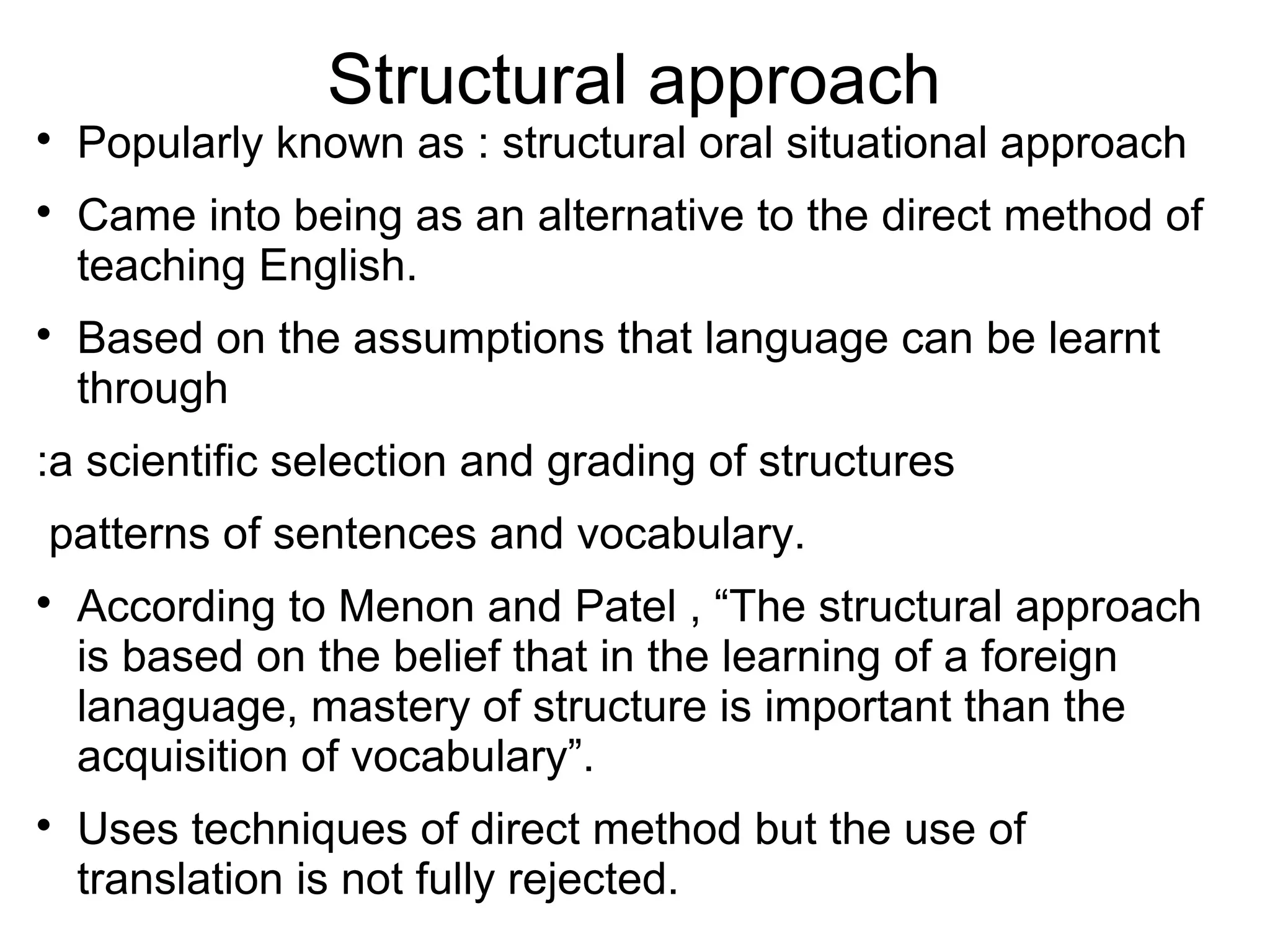
Popularly known as : structural oral situational approach

Came into being as an alternative to the direct method of
teaching English.

Based on the assumptions that language can be learnt
through
:a scientific selection and grading of structures
patterns of sentences and vocabulary.

According to Menon and Patel , “The structural approach
is based on the belief that in the learning of a foreign
lanaguage, mastery of structure is important than the
acquisition of vocabulary”.

Uses techniques of direct method but the use of
translation is not fully rejected.

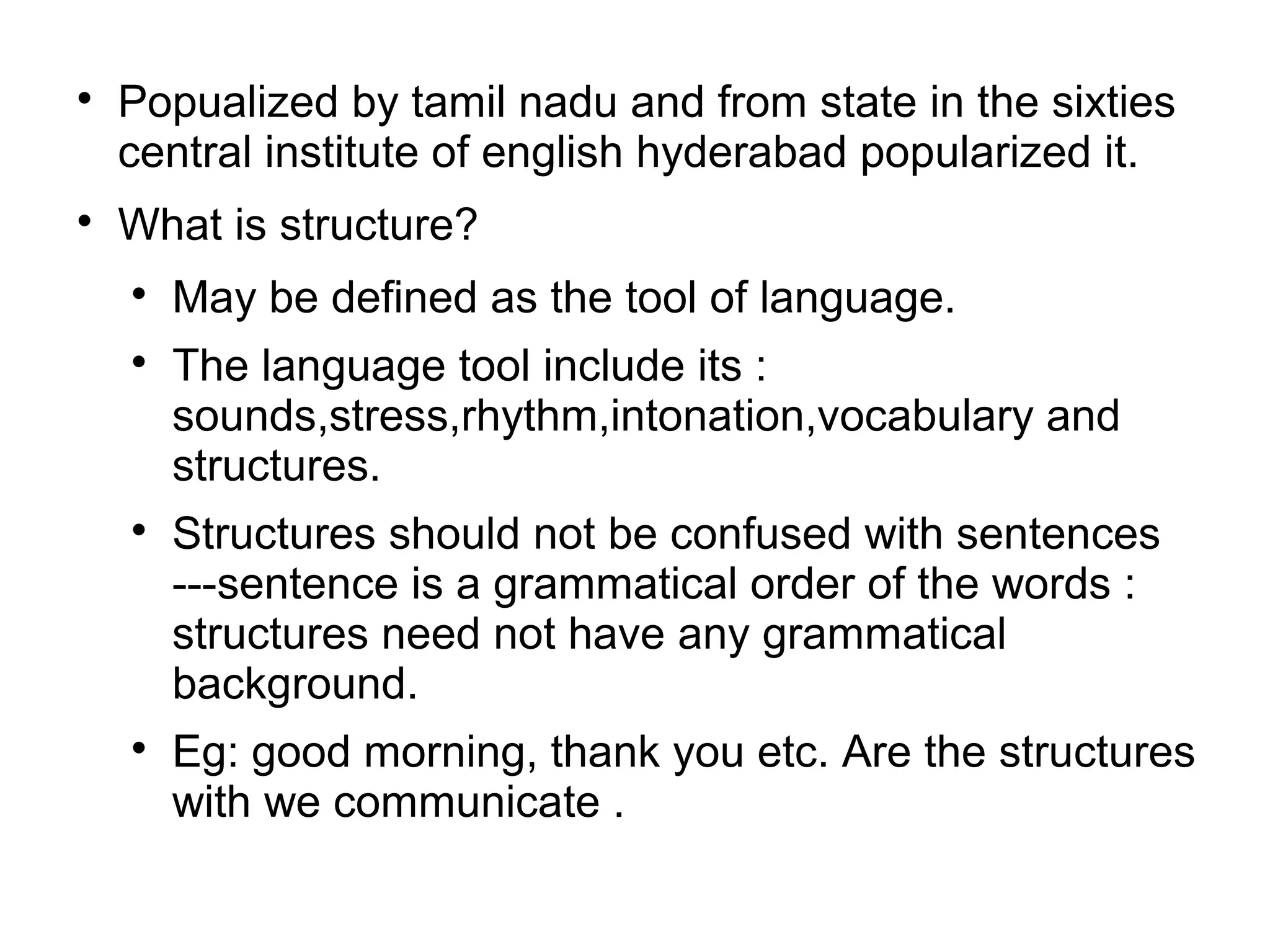
Popualized by tamil nadu and from state in the sixties
central institute of english hyderabad popularized it.

What is structure?

May be defined as the tool of language.

The language tool include its :
sounds,stress,rhythm,intonation,vocabulary and
structures.

Structures should not be confused with sentences
---sentence is a grammatical order of the words :
structures need not have any grammatical
background.

Eg: good morning, thank you etc. Are the structures
with we communicate .

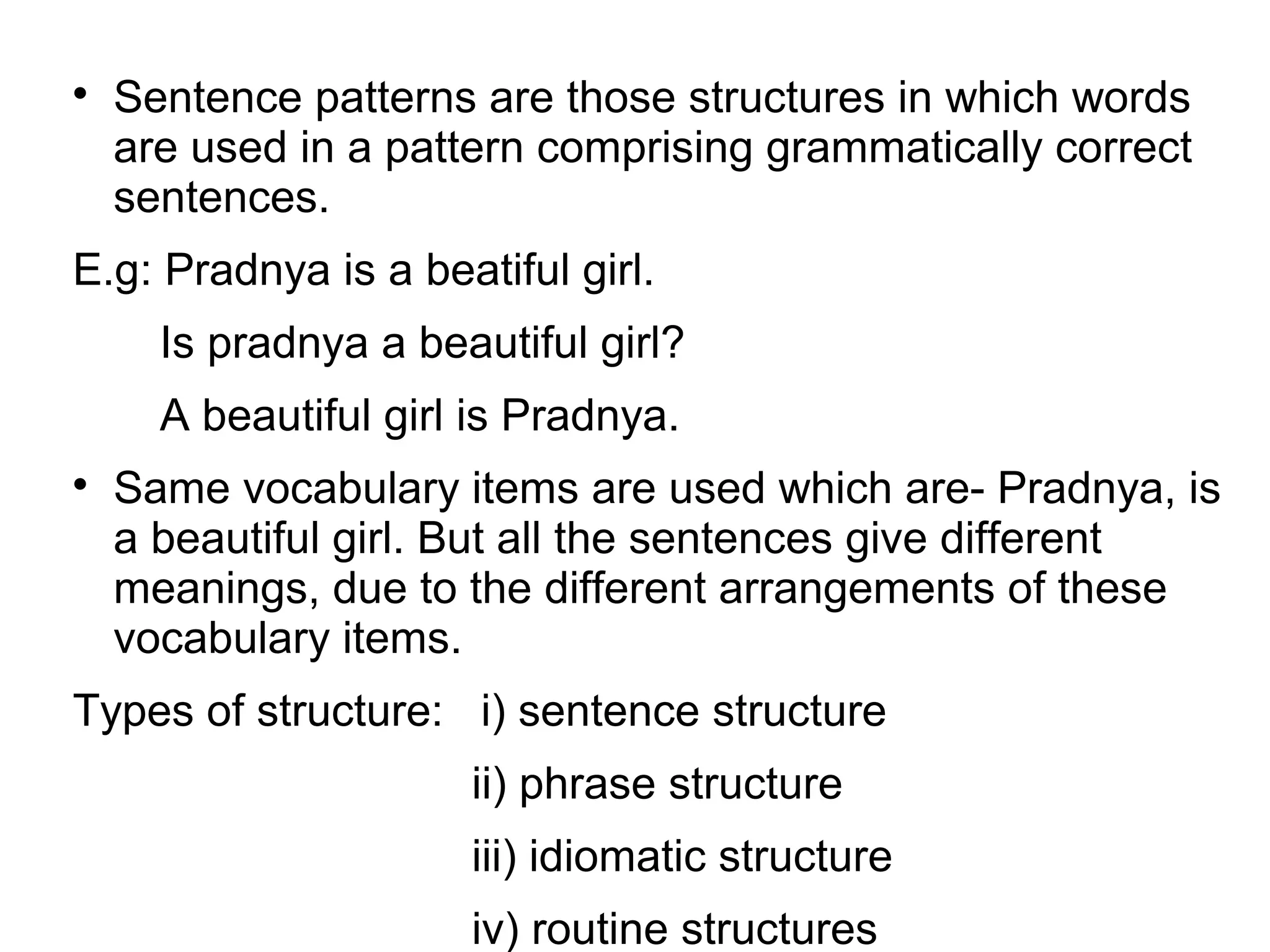
Sentence patterns are those structures in which words
are used in a pattern comprising grammatically correct
sentences.
E.g: Pradnya is a beatiful girl.
Is pradnya a beautiful girl?
A beautiful girl is Pradnya.

Same vocabulary items are used which are- Pradnya, is
a beautiful girl. But all the sentences give different
meanings, due to the different arrangements of these
vocabulary items.
Types of structure: i) sentence structure
ii) phrase structure
iii) idiomatic structure
iv) routine structures

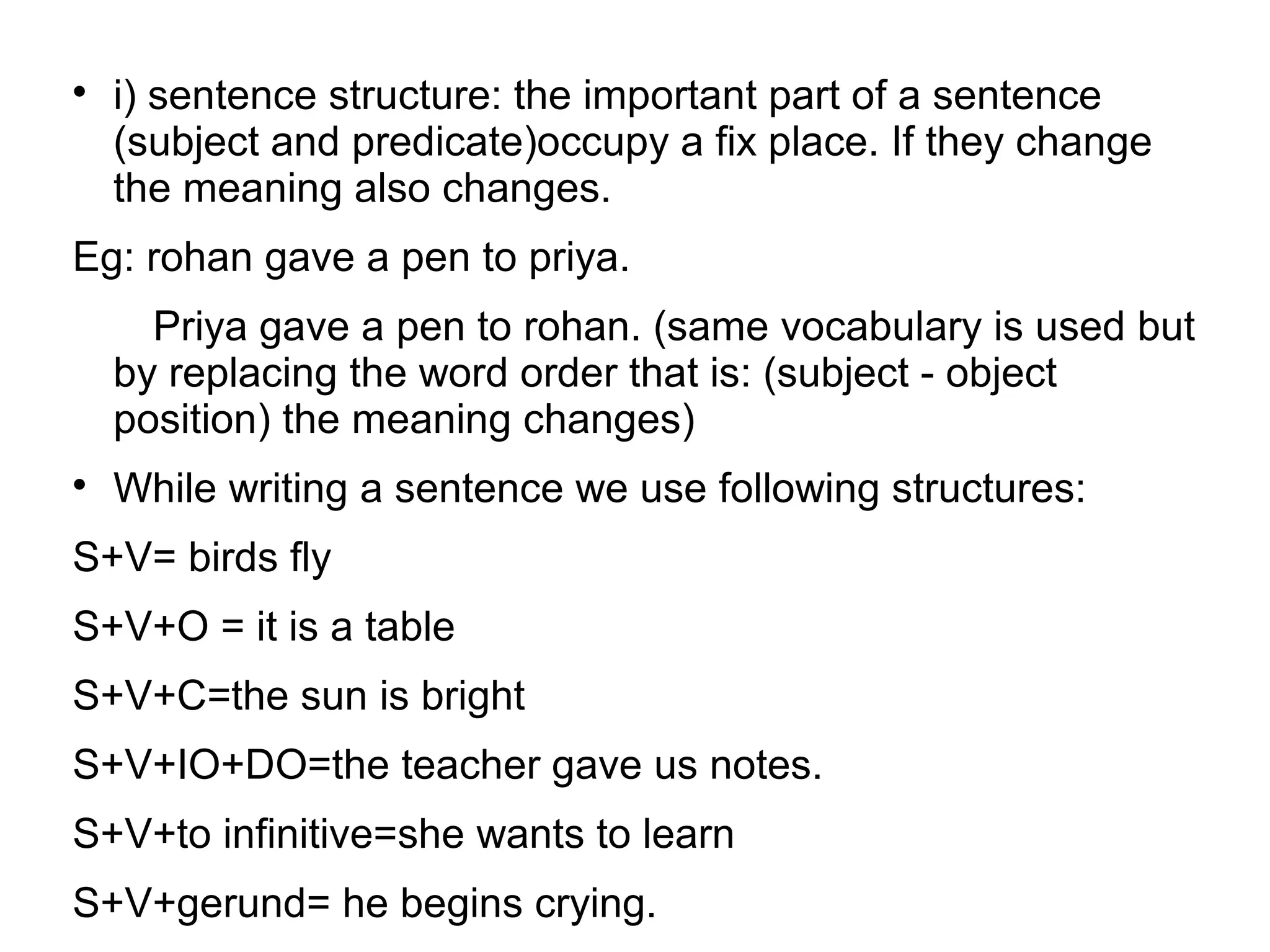
i) sentence structure: the important part of a sentence
(subject and predicate)occupy a fix place. If they change
the meaning also changes.
Eg: rohan gave a pen to priya.
Priya gave a pen to rohan. (same vocabulary is used but
by replacing the word order that is: (subject - object
position) the meaning changes)

While writing a sentence we use following structures:
S+V= birds fly
S+V+O = it is a table
S+V+C=the sun is bright
S+V+IO+DO=the teacher gave us notes.
S+V+to infinitive=she wants to learn
S+V+gerund= he begins crying.
ii) Phrase structure: A phrase is a group of words that
gives meaning even without its being a setence. Eg:
the pretty flower, the young boy
This order cannot be changed.
iii) Idiomatic structure: these structure contain their own
specific meanings. Idiomatic need not have
grammatical units.they are so composed that if we
split them they lose their meaning .
Eg: in vain,all of the sudden, in black and white etc.
iv) Routine structure: consists of such group of words
which are used by us in a day to day conversation or
on certain occasion. Proper word order is maintained.
Characteristics

There are 275 structure from the core of essential
english which students at seconde ary school stage
must know.

Structures are based on word orders.

Every structure expresses an important side of
grammar.

The structures are carefully graded to give a clear
picture of the form and meaning. Only meaning of one
word is taught at a time
eg: to as a directive and then as a part on infinitive.
To go, to post, to write etc.
Aims of structural approach

To lay the foundation of english by establishing drill
and repetition of 275 structures of the English
language.

To enable the learners attain the mastery of over an
essential vocabulary of 3000 root words.

To correlate the teaching of grammar and composition
with the reading.

To teach the four fundamental skills (LSRW) in the
oder named.

To lay emphasis on aural-oral approach and the
condemnation of formal grammar for its own sake.
Principles of structural approach

F.G.French has stated three principles of structural
approach :

Importance of child activity rathe than the activity of the
teacher.

Importance of speech for firmly fixing words.

Importance of the formation of the language habit to
arrange word in a suitable English sentence- patterns in
order to replace the sentence pattern of the child's mother
tongue.

The structural approach broadly rests on the following
aspects:
oral approach : lots of new learning takes place in an oral
way making this practice perfect.
Drill method : what ever is taught is drilled by the students.
Advantages

Facilitates the learning of English language by imparting the
knowledge of its structures.

Focus on sentence-pattern and a lot of practice. Learns a
language before read or write it.

By learning the Structure of sentences the learner automatically
learns some grammar, word order and use of words. The
common errors can be avoided in grammar and composition.

Enables learner to speak the language first.

Teaches all four skills-- listening,speaking reading and writing.

Based on scientific principles. At every stage the objective is
clearly defined

Habit of speaking English is developed right from the beginning.
Drilling helps in removal of hesitation.
Limitations

Does not solve the problems of teaching English.only
helps the teacher to know what he has taught and what he
should teach next.

Doesnot consider the capacity of learner and expects a
great deal from the teacher.

Doesnot guide the teacher how to present a content and
also no guidelines for written exercises.

The centre of interest is the content not the learner.
Continuous teaching of structures and drilling makes the
class mechanical and dull.Suitable for junior class only.

R.N.Ghosh – this approach neglects:
reading of all types, vocabulary expansion,exploitation of
pupils knowledge of mother tongue and any possibilities of
more flexible structure grading and production of
interesting reading materials.

Also in Indian schools we have problem of
over-crowded classrooms & rigid curriculum

Also it demands a great deal of dedication from
the teachers and many teachers dont have
proper training to apply these kind of
approaches.

Structural approach

  • 1.
    Structural approach  Popularly knownas : structural oral situational approach  Came into being as an alternative to the direct method of teaching English.  Based on the assumptions that language can be learnt through :a scientific selection and grading of structures patterns of sentences and vocabulary.  According to Menon and Patel , “The structural approach is based on the belief that in the learning of a foreign lanaguage, mastery of structure is important than the acquisition of vocabulary”.  Uses techniques of direct method but the use of translation is not fully rejected.
  • 2.
     Popualized by tamilnadu and from state in the sixties central institute of english hyderabad popularized it.  What is structure?  May be defined as the tool of language.  The language tool include its : sounds,stress,rhythm,intonation,vocabulary and structures.  Structures should not be confused with sentences ---sentence is a grammatical order of the words : structures need not have any grammatical background.  Eg: good morning, thank you etc. Are the structures with we communicate .
  • 3.
     Sentence patterns arethose structures in which words are used in a pattern comprising grammatically correct sentences. E.g: Pradnya is a beatiful girl. Is pradnya a beautiful girl? A beautiful girl is Pradnya.  Same vocabulary items are used which are- Pradnya, is a beautiful girl. But all the sentences give different meanings, due to the different arrangements of these vocabulary items. Types of structure: i) sentence structure ii) phrase structure iii) idiomatic structure iv) routine structures
  • 4.
     i) sentence structure:the important part of a sentence (subject and predicate)occupy a fix place. If they change the meaning also changes. Eg: rohan gave a pen to priya. Priya gave a pen to rohan. (same vocabulary is used but by replacing the word order that is: (subject - object position) the meaning changes)  While writing a sentence we use following structures: S+V= birds fly S+V+O = it is a table S+V+C=the sun is bright S+V+IO+DO=the teacher gave us notes. S+V+to infinitive=she wants to learn S+V+gerund= he begins crying.
  • 5.
    ii) Phrase structure:A phrase is a group of words that gives meaning even without its being a setence. Eg: the pretty flower, the young boy This order cannot be changed. iii) Idiomatic structure: these structure contain their own specific meanings. Idiomatic need not have grammatical units.they are so composed that if we split them they lose their meaning . Eg: in vain,all of the sudden, in black and white etc. iv) Routine structure: consists of such group of words which are used by us in a day to day conversation or on certain occasion. Proper word order is maintained.
  • 6.
    Characteristics  There are 275structure from the core of essential english which students at seconde ary school stage must know.  Structures are based on word orders.  Every structure expresses an important side of grammar.  The structures are carefully graded to give a clear picture of the form and meaning. Only meaning of one word is taught at a time eg: to as a directive and then as a part on infinitive. To go, to post, to write etc.
  • 7.
    Aims of structuralapproach  To lay the foundation of english by establishing drill and repetition of 275 structures of the English language.  To enable the learners attain the mastery of over an essential vocabulary of 3000 root words.  To correlate the teaching of grammar and composition with the reading.  To teach the four fundamental skills (LSRW) in the oder named.  To lay emphasis on aural-oral approach and the condemnation of formal grammar for its own sake.
  • 8.
    Principles of structuralapproach  F.G.French has stated three principles of structural approach :  Importance of child activity rathe than the activity of the teacher.  Importance of speech for firmly fixing words.  Importance of the formation of the language habit to arrange word in a suitable English sentence- patterns in order to replace the sentence pattern of the child's mother tongue.  The structural approach broadly rests on the following aspects: oral approach : lots of new learning takes place in an oral way making this practice perfect. Drill method : what ever is taught is drilled by the students.
  • 9.
    Advantages  Facilitates the learningof English language by imparting the knowledge of its structures.  Focus on sentence-pattern and a lot of practice. Learns a language before read or write it.  By learning the Structure of sentences the learner automatically learns some grammar, word order and use of words. The common errors can be avoided in grammar and composition.  Enables learner to speak the language first.  Teaches all four skills-- listening,speaking reading and writing.  Based on scientific principles. At every stage the objective is clearly defined  Habit of speaking English is developed right from the beginning. Drilling helps in removal of hesitation.
  • 10.
    Limitations  Does not solvethe problems of teaching English.only helps the teacher to know what he has taught and what he should teach next.  Doesnot consider the capacity of learner and expects a great deal from the teacher.  Doesnot guide the teacher how to present a content and also no guidelines for written exercises.  The centre of interest is the content not the learner. Continuous teaching of structures and drilling makes the class mechanical and dull.Suitable for junior class only.  R.N.Ghosh – this approach neglects: reading of all types, vocabulary expansion,exploitation of pupils knowledge of mother tongue and any possibilities of more flexible structure grading and production of interesting reading materials.
  • 11.
     Also in Indianschools we have problem of over-crowded classrooms & rigid curriculum  Also it demands a great deal of dedication from the teachers and many teachers dont have proper training to apply these kind of approaches.