







IN THE NAME OF ALLAH, THE MOST
BENIFICENT,
THE MOST MERCIFUL
3. JOHN SCHUMANN’S ACCULTURATION
MODEL FOR SECOND LANGUAGE
ACQUISITION
Definitions of acculturation
1. cultural modification of an individual, group, or people
by adapting to or borrowing traits from another culture
e.g. the acculturation of immigrants to American life.
2. a merging of cultures as a result of prolonged contact
3. the process by which a human being acquires the culture
of a particular society from infancy (Merriam-Webster)
Theoretical foundations of John Schumann’s
Acculturation Model
L2 learning is an aspect of acculturation and the
degree to which L2 learners acculturate to the
Target Language groups, (i.e. assimilate to the
target language culture), governs and controls L2
learning.
Schumann’s Famous Case Study Pertaining
to the Process of Acculturation
Schumann based much of his original work on the
language development of a 33 years old Costa Rican man
named Alberto. Alberto graduated from a Costa Rican
high school where he had studied English for six years. He
moved to Cambridge, at the age 33 where he lived with
another Costa Rican couple. Significantly, he socialized
with other Costa Ricans. According to the Acculturation
Model , it was Alberto’s lack of acculturation that resulted
in his lack of linguistic development (Gass & Selinker,
2008).
Schuman’s Approach with regard to the Role
of Social & Psychological Distances while
Learning L2
According to Schuman (1986), the process of acculturation
is influenced by social and psychological factors.
The aforementioned factors, according to him, determine
the level of Psychological Distance and Social Distance.
He further claimed that there are eight characteristics of
Social Distance and four characteristics of Psychological
Distance that effect the process of acculturation.
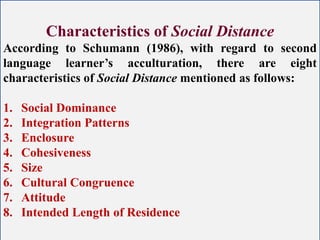
Characteristics of Social Distance
According to Schumann (1986), with regard to second
language learner’s acculturation, there are eight
characteristics of Social Distance mentioned as follows:
1. Social Dominance
2. Integration Patterns
3. Enclosure
4. Cohesiveness
5. Size
6. Cultural Congruence
7. Attitude
8. Intended Length of Residence
Characteristics of Psychological Distance
According to Schumann (1986), with regard to second
language learner’s acculturation, there are four
characteristics of Psychological Distance mentioned as
follows:
1. Language Shock
2. Cultural Shock
3. Motivation
4. Ego Permeability
BIBLIOGRAPHY
Ausubel, D.P. (1968). Educational Psychology: A Cognitive View. New York, NY:
Holt.
Brown, H. D. (2002). Principles of Language Learning and Teaching. NY: Longman.
Ellis, R. 1994: The study of second language acquisition. Oxford: Oxford University
Press.
Ellis, R. (1997). SLA research and language teaching. Oxford: Oxford University
Press.
Ellis, R. (1999). Item versus system learning: explaining free variation. Applied
Linguistics . 20, 460-80.
Gass & Selinker (2008). Second Language Acquisition. London: Routledge.
Schumann, J. (1986). Research on the Acculturation Model for Second Language
Acquisition. Journal of Multilingual & Multilingual development. 7 (5). pp.
379-392.
Schumann, John (1978). The pidginization process : a model for second language
acquisition. Rowley, Mass.: Newbury House Publishers. ISBN 978-
0883770962. OCLC 3203534
Troike, M. (2012). Introducing Second Language Acquisition. London: Cambridge
University Press.

John Schumann's Acculturation Model

  • 1.
    IN THE NAMEOF ALLAH, THE MOST BENIFICENT, THE MOST MERCIFUL
  • 2.
    3. JOHN SCHUMANN’SACCULTURATION MODEL FOR SECOND LANGUAGE ACQUISITION
  • 4.
    Definitions of acculturation 1.cultural modification of an individual, group, or people by adapting to or borrowing traits from another culture e.g. the acculturation of immigrants to American life. 2. a merging of cultures as a result of prolonged contact 3. the process by which a human being acquires the culture of a particular society from infancy (Merriam-Webster)
  • 5.
    Theoretical foundations ofJohn Schumann’s Acculturation Model L2 learning is an aspect of acculturation and the degree to which L2 learners acculturate to the Target Language groups, (i.e. assimilate to the target language culture), governs and controls L2 learning.
  • 6.
    Schumann’s Famous CaseStudy Pertaining to the Process of Acculturation Schumann based much of his original work on the language development of a 33 years old Costa Rican man named Alberto. Alberto graduated from a Costa Rican high school where he had studied English for six years. He moved to Cambridge, at the age 33 where he lived with another Costa Rican couple. Significantly, he socialized with other Costa Ricans. According to the Acculturation Model , it was Alberto’s lack of acculturation that resulted in his lack of linguistic development (Gass & Selinker, 2008).
  • 7.
    Schuman’s Approach withregard to the Role of Social & Psychological Distances while Learning L2 According to Schuman (1986), the process of acculturation is influenced by social and psychological factors. The aforementioned factors, according to him, determine the level of Psychological Distance and Social Distance. He further claimed that there are eight characteristics of Social Distance and four characteristics of Psychological Distance that effect the process of acculturation.
  • 8.
    Characteristics of SocialDistance According to Schumann (1986), with regard to second language learner’s acculturation, there are eight characteristics of Social Distance mentioned as follows: 1. Social Dominance 2. Integration Patterns 3. Enclosure 4. Cohesiveness 5. Size 6. Cultural Congruence 7. Attitude 8. Intended Length of Residence
  • 9.
    Characteristics of PsychologicalDistance According to Schumann (1986), with regard to second language learner’s acculturation, there are four characteristics of Psychological Distance mentioned as follows: 1. Language Shock 2. Cultural Shock 3. Motivation 4. Ego Permeability
  • 10.
    BIBLIOGRAPHY Ausubel, D.P. (1968).Educational Psychology: A Cognitive View. New York, NY: Holt. Brown, H. D. (2002). Principles of Language Learning and Teaching. NY: Longman. Ellis, R. 1994: The study of second language acquisition. Oxford: Oxford University Press. Ellis, R. (1997). SLA research and language teaching. Oxford: Oxford University Press. Ellis, R. (1999). Item versus system learning: explaining free variation. Applied Linguistics . 20, 460-80. Gass & Selinker (2008). Second Language Acquisition. London: Routledge. Schumann, J. (1986). Research on the Acculturation Model for Second Language Acquisition. Journal of Multilingual & Multilingual development. 7 (5). pp. 379-392. Schumann, John (1978). The pidginization process : a model for second language acquisition. Rowley, Mass.: Newbury House Publishers. ISBN 978- 0883770962. OCLC 3203534 Troike, M. (2012). Introducing Second Language Acquisition. London: Cambridge University Press.