Language Curriculum Design
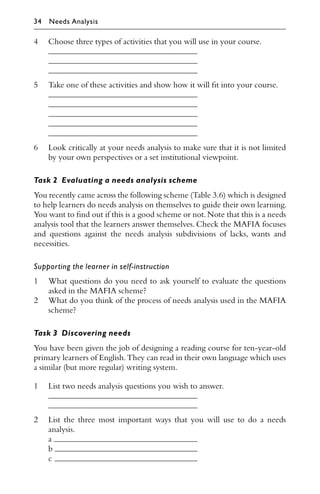
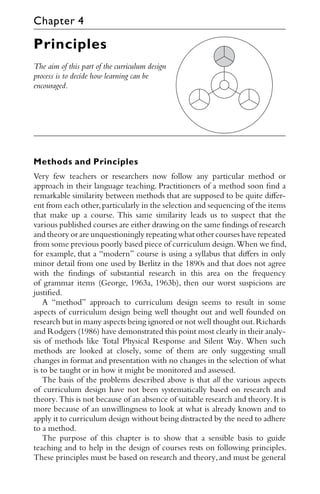
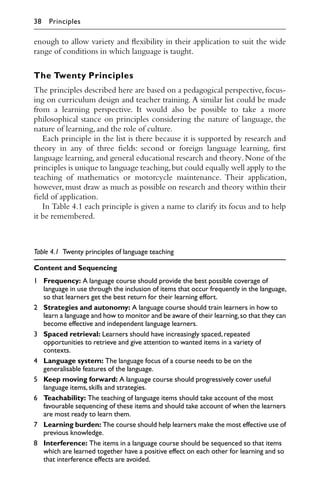
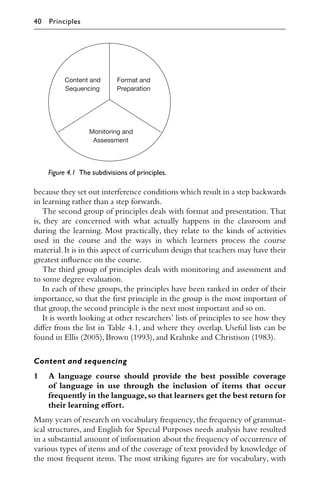
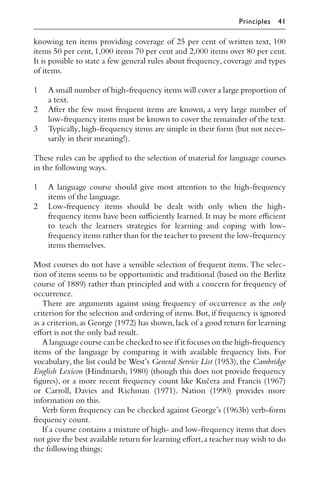
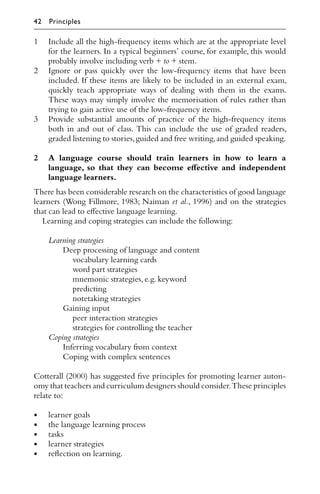
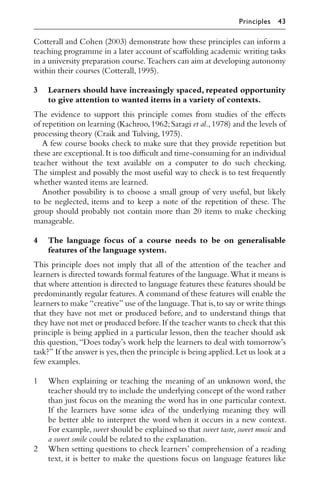
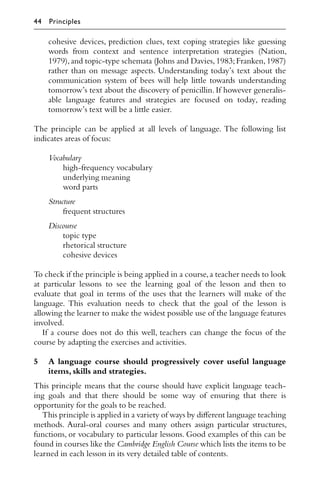
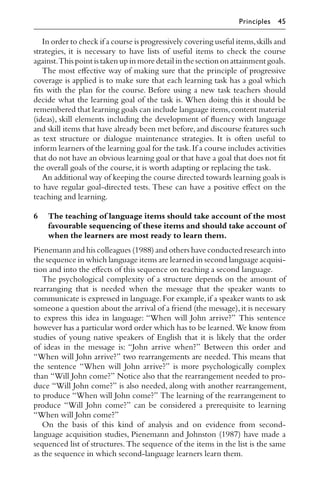
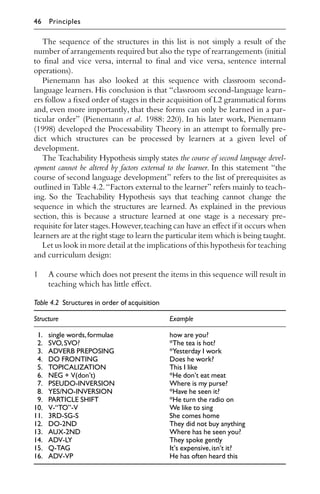
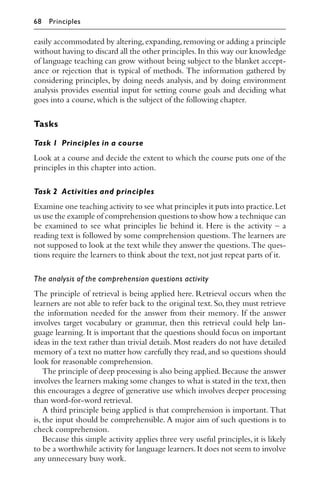
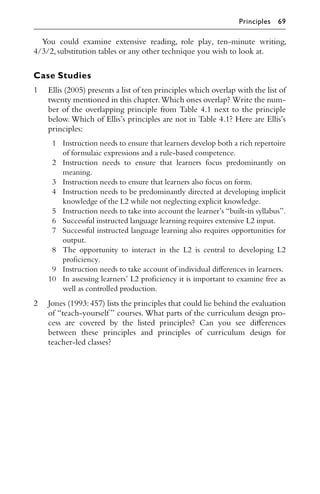
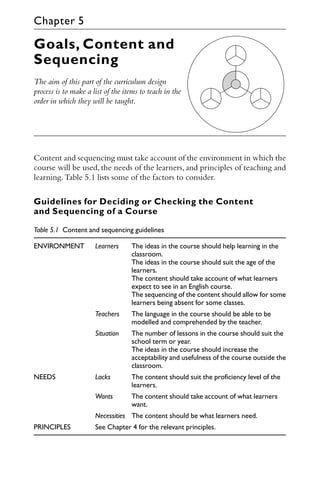
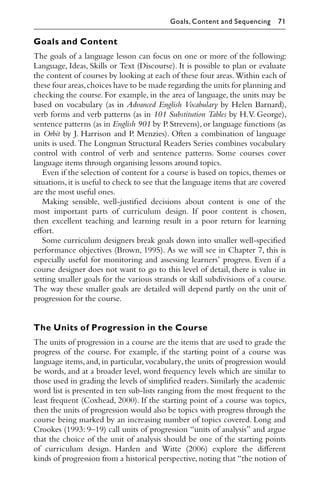
Crystal-clear and comprehensive yet concise, this text describes the steps
involved in the curriculum design process,elaborates and justifies these steps
and provides opportunities for practising and applying them. The descrip-
tion of the steps is done at a general level so that they can be applied in a wide
range of particular circumstances.The process comes to life through plentiful
examples of actual applications of the steps.Each chapter includes:
• Descriptions of examples from the authors’ experience and from pub-
lished research
• Tasks that encourage readers to relate the steps to their own experience
• Case studies and suggestions for further reading that put readers in touch
with others’ experience
Curriculum, or course, design is largely a “how-to-do-it” activity that
involves the integration of knowledge from many of the areas in the field of
Applied Linguistics, such as language acquisition research, teaching method-
ology, assessment, language description and materials production. Combin-
ing sound research/theory with state-of-the-art practice,Language Curriculum
Design is widely applicable for ESL/EFL language education courses around
the world.
I.S.P. Nation is Professor in Applied Linguistics at Victoria University of
Wellington,New Zealand.In addition to books,his extensive list of publica-
tions on teaching and learning vocabulary, language teaching methodology,
and curriculum design, includes journal articles, book chapters and book
reviews.He has taught in Indonesia,Thailand,the United States,Finland and
Japan.
John Macalister is Senior Lecturer at Victoria University of Wellington,
New Zealand.He specialises in the fields of language teaching methodology
and curriculum design and draws on experience in teacher education and
curriculum design in Thailand,Cambodia,Kiribati,Vanuatu and Namibia.
ESL & Applied Linguistics Professional Series
Eli Hinkel,Series Editor
Nation/Macalister · Language Curriculum Design
Birch · The English Language Teacher and Global Civil Society
Johnson · Second Language Teacher Education:A Sociocultural Perspective
Nation · Teaching ESL/EFL Reading and Writing
Nation/Newton · Teaching ESL/EFL Listening and Speaking
Kachru/Smith · Cultures,Contexts,and World Englishes
McKay/Bokhorst-Heng · International English in its Sociolinguistic Contexts:
Towards a Socially Sensitive EIL Pedagogy
Christison/Murray,Eds.· Leadership in English Language Education:Theoretical
Foundations and Practical Skills for Changing Times
McCafferty/Stam,Eds.· Gesture:Second Language Acquisition and Classroom
Research
Liu · Idioms:Description,Comprehension,Acquisition,and Pedagogy
Chapelle/Enright/Jamison,Eds.· Building a Validity Argument for the Test of
English as a Foreign Language
Kondo-Brown/Brown,Eds.· Teaching Chinese,Japanese,and Korean Heritage
Students:Curriculum Needs,Materials,and Assessments
Youmans · Chicano-Anglo Conversations:Truth,Honesty,and Politeness
Birch · English L2 Reading:Getting to the Bottom,Second Edition
Luk/Lin · Classroom Interactions as Cross-cultural Encounters:Native Speakers in
EFL Lessons
Levy/Stockwell · CALL Dimensions:Issues and Options in Computer Assisted
Language Learning
Nero,Ed.· Dialects,Englishes,Creoles,and Education
Basturkmen · Ideas and Options in English for Specific Purposes
Kumaravadivelu · Understanding Language Teaching:From Method to Postmethod
McKay · Researching Second Language Classrooms
Egbert/Petrie,Eds.· CALL Research Perspectives
Canagarajah,Ed.· Reclaiming the Local in Language Policy and Practice
Adamson · Language Minority Students in American Schools:An Education in
English
Fotos/Browne,Eds.· New Perspectives on CALL for Second Language Classrooms
Hinkel · Teaching Academic ESL Writing:Practical Techniques in Vocabulary and
Grammar
Hinkel/Fotos,Eds.· New Perspectives on Grammar Teaching in Second Language
Classrooms
Hinkel · Second Language Writers’ Text:Linguistic and Rhetorical Features
Visit www.routledge.com/education for additional information on titles in
the ESL and Applied Linguistics Professional Series
Language Curriculum Design
I.S.P.Nation and John Macalister
First published 2010
by Routledge
270 Madison Ave, New York, NY 10016
Simultaneously published in the UK
by Routledge
2 Park Square, Milton Park, Abingdon, Oxon OX14 4RN
Routledge is an imprint of the Taylor & Francis Group,
an informa business
© 2010 Taylor & Francis
All rights reserved. No part of this book may be reprinted or
reproduced or utilised in any form or by any electronic,
mechanical, or other means, now known or hereafter invented,
including photocopying and recording, or in any information
storage or retrieval system, without permission in writing from
the publishers.
Trademark Notice: Product or corporate names may be
trademarks or registered trademarks, and are used only for
identification and explanation without intent to infringe.
Library of Congress Cataloging-in-Publication Data
Nation, I.S.P.
Language curriculum design / I.S.P. Nation and John Macalister.
p. cm.—(ESL & applied linguistics professional series)
Includes bibliographical references and index.
1. English language—Study and teaching–Foreign speakers.
2. English teachers–Training of. I. Macalister, John, 1956–
II. Title.
PE1128.A2N38 2009
428.0071—dc22
2009010312
ISBN10: 0–415–80605–4 (hbk)
ISBN10: 0–415–80606–2 (pbk)
ISBN10: 0–203–87073–5 (ebk)
ISBN13: 978–0–415–80605–3 (hbk)
ISBN13: 978–0–415–80606–0 (pbk)
ISBN13: 978–0–203–87073–0 (ebk)
This edition published in the Taylor & Francis e-Library, 2009.
To purchase your own copy of this or any of Taylor & Francis or Routledge’s
collection of thousands of eBooks please go to www.eBookstore.tandf.co.uk.
ISBN 0-203-87073-5 Master e-book ISBN
Brief Contents
Preface xv
1 Language Curriculum Design:An Overview 1
2 Environment Analysis 14
3 Needs Analysis 24
4 Principles 37
5 Goals,Content and Sequencing 70
6 Format and Presentation 88
7 Monitoring and Assessment 107
8 Evaluation 123
9 Approaches to Curriculum Design 136
10 Negotiated Syllabuses 149
11 Adopting and Adapting an Existing
Course Book 159
12 Introducing Change 172
13 Planning an In-Service Course 183
14 Teaching and Curriculum Design 197
Appendix 208
References 210
Index 223
Contents
Preface xv
1 Language Curriculum Design:An Overview 1
Parts of the Curriculum Design Process 1
Considering the Environment 2
Discovering Needs 5
Following Principles 5
Goals 6
Content and Sequencing 7
Finding a Format and Presenting Material 9
Monitoring and Assessing 10
Evaluating a Course 11
Tasks 12
1 Examining a published course 12
2 Using the parts of the model to overview the planning of a course 12
Case Studies 12
2 Environment Analysis 14
An Example of Environment Analysis 15
Environment Constraints 16
Understanding the Constraints 18
The Constraint of Time 19
Steps in Environment Analysis 20
Tasks 21
1 The range of constraints 21
2 Examining your teaching environment 21
3 Comparing teaching environments 22
Case Studies 22
3 Needs Analysis 24
The Various Focuses of Needs Analysis 24
Discovering Needs 26
Needs Analysis Tools 27
Evaluating Needs Analysis 30
Issues in Needs Analysis 31
Tasks 33
1 Needs analysis for a writing course 33
2 Evaluating a needs analysis scheme 34
3 Discovering needs 34
Case Studies 36
4 Principles 37
Methods and Principles 37
The Twenty Principles 38
Content and Sequencing 40
Format and Presentation 50
Monitoring and Assessment 65
Using the List of Principles 67
Tasks 68
1 Principles in a course 68
2 Activities and principles 68
Case Studies 69
5 Goals,Content and Sequencing 70
Guidelines for Deciding or Checking the Content and Sequencing
of a Course 70
Goals and Content 71
The Units of Progression in the Course 71
What Will the Progression be Used For? 72
Vocabulary 73
Grammar 74
Functions 75
Discourse 76
Skills,Subskills and Strategies 76
Ideas 78
Task-based Syllabuses 80
Sequencing the Content in a Course 82
Linear Approaches to Sequencing 82
x Contents
A Modular Approach to Sequencing 85
Tasks 86
1 Verb form coverage in beginners’ course books 86
2 The ideas content of a course book 86
3 Describing the goals of a course 86
Case Studies 87
6 Format and Presentation 88
Format and Other Parts of the Curriculum Design Process 88
Guidelines for Deciding on a Format 88
Following a Set Format 96
Blocks and Threads 97
Techniques and Activities 100
Tasks and Presentation 103
Tasks 105
1 Examining the format of a lesson 105
2 Examining teaching techniques 105
Case Studies 106
7 Monitoring and Assessment 107
Guidelines for Monitoring and Assessment 107
Types of Monitoring and Assessment 107
Placement Assessment 109
Observation of Learning 111
Short-Term Achievement Assessment 112
Diagnostic Assessment 113
Achievement Assessment 114
Proficiency Assessment 116
Good Assessment:Reliability,Validity and Practicality 117
Tasks 120
1 Planning the assessment in a course 120
2 Evaluating a test 121
3 Designing a placement test 121
Case Studies 122
8 Evaluation 123
What is an Evaluation? 123
Steps in an Evaluation 123
Purpose and Audience of the Evaluation 124
Contents xi
The Type and Focus of the Evaluation 125
Gaining Support for the Evaluation 127
Gathering the Information 128
Formative Evaluation as a Part of a Course 132
The Results of an Evaluation 133
Tasks 135
1 Focus of evaluation 135
2 An evaluation checklist 135
3 An evaluation plan 135
Case Studies 135
9 Approaches to Curriculum Design 136
Models of Curriculum Design 136
Doing Curriculum Design 138
Starting Points 140
The Process of Curriculum Design 142
Deciding on an Approach 146
Tasks 147
1 Your curriculum design process 147
2 Choosing an appropriate approach 147
3 Comparing models 148
Case Studies 148
10 Negotiated Syllabuses 149
Negotiated Syllabuses 149
An Example of a Negotiated Syllabus 151
Requirements for a Negotiated Syllabus 152
Syllabuses with Some Elements Negotiated 153
Negotiating Assessment 154
Disadvantages and Advantages of a Negotiated Syllabus 155
Tasks 157
1 Problems in implementing a negotiated syllabus 157
2 Partly negotiated syllabuses 157
3 Developing a negotiated approach to syllabus design 157
Case Studies 158
11 Adopting and Adapting an Existing
Course Book 159
The Course Book,the Learners and the Teacher 159
xii Contents
Dividing the Parts of the Process 159
The Teacher and the Course Material 160
Evaluating a Course Book 165
Evaluating the Evaluation Forms 168
Presenting the Results 168
Tasks 169
1 Designing a course book evaluation form 169
2 Evaluating a course book 170
3 Course book evaluation schedules 170
4 Using a course book 171
Case Studies 171
12 Introducing Change 172
Steps in Introducing Change 173
Seeing the Need for Change 174
Deciding on the Size of the Change 174
Realistic Change 175
Teacher Beliefs 176
Using a Variety of Change Strategies 177
Innovation,Management and Long-Term Support 179
Tasks 181
1 Change that failed 181
2 Change in a school’s programme 181
3 Investigating teacher beliefs 182
Case Studies 182
13 Planning an In-Service Course 183
Features of an Effective Workshop 183
Procedures and Activities for Reaching the Goals 185
Understanding and Remembering Ideas 186
Experiencing and Evaluating 188
Making Material 188
Planning Lessons and Units of Work 190
Problem Solving 190
Sequencing the Components of a Workshop 191
Evaluating Workshops 193
Tasks 194
1 Principles for in-service courses 194
2 Designing an in-service course 194
Contents xiii
3 The conference workshop 195
Case Studies 196
14 Teaching and Curriculum Design 197
Environment Analysis 197
Needs Analysis 198
Principles 199
Goals 200
Content and Sequencing 202
Format and Presentation 203
Monitoring and Assessment 205
Evaluation 205
Curriculum Design and Learner Autonomy 207
Tasks 207
Appendix 208
A Verb-Form Frequency Count 208
References 210
Index 223
xiv Contents
Preface
There is nothing more difficult to plan, more doubtful of success, nor more danger-
ous to manage than the creation of a new system. For the initiator has the enmity
of all who would profit by the preservation of the old system and merely lukewarm
defenders in those who would gain from the new one.
(Machiavelli (1513) The Prince)
Curriculum, or course, design is largely a “how-to-do-it” activity and so a
large part of this book involves description of the steps involved in the
curriculum design process and the elaboration and justification of these steps.
The book also provides opportunities for practising and applying the steps.
Chapter 1 provides an overview of Chapters 2 to 8 which are the major
steps in the curriculum design process. Chapter 9 describes several ways in
which these steps can be covered.Chapters 10 to 14 take up important issues
in curriculum design,namely involving learners in curriculum design,choos-
ing and modifying course books, innovation theory, retraining teachers and
helping teachers and learners make use of a course.
Although curriculum design is a “how-to-do-it” activity, the description
of the steps needs to be done at a general level in order that they can be
applied in a wide range of particular circumstances. Such a description will
only come to life if there are plenty of examples of actual applications of the
steps.In this book this is done in the following ways in each chapter.
1 Examples from the writers’ experience and from published research are
described.
2 Tasks are provided which encourage the users of the book to relate the
steps to their own experience.
3 Case studies are described and further reading is suggested that will put
the users of this book in touch with others’ experience.
Curriculum design involves the integration of knowledge from many of the
areas in the field of Applied Linguistics,such as language acquisition research,
teaching methodology, assessment, language description and materials pro-
duction.In many ways,the study of curriculum design is central to the study
of Applied Linguistics.Combining sound research/theory with state-of-the-
art practice, Language Curriculum Design is widely applicable for ESL/EFL
language education courses around the world.
xvi Preface
Language Curriculum Design
An Overview
Parts of the Curriculum Design Process
Curriculum design can be seen as a kind of writing activity and as such it can
usefully be studied as a process. The typical sub-processes of the writing
process (gathering ideas, ordering ideas, ideas to text, reviewing, editing)
can be applied to curriculum design,but it makes it easier to draw on current
curriculum design theory and practice if a different set of parts is used. The
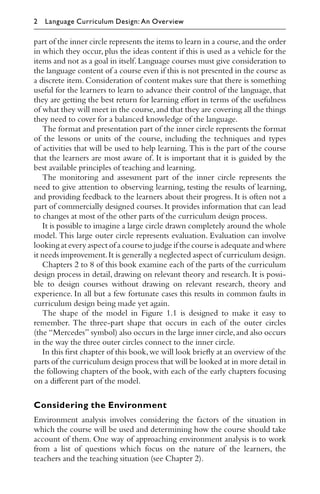
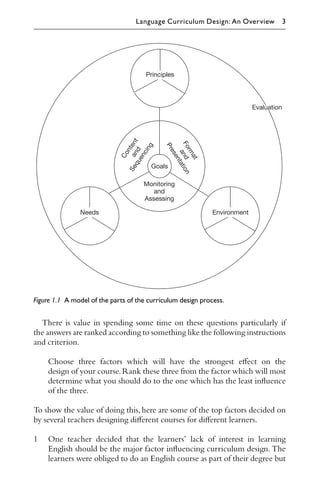
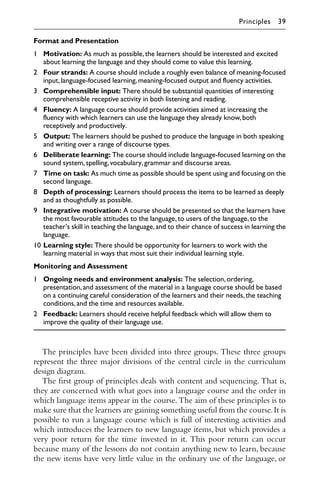
curriculum design model in Figure 1.1 consists of three outside circles and a
subdivided inner circle. The outer circles (principles, environment, needs)
involve practical and theoretical considerations that will have a major effect
in guiding the actual process of course production. There is a wide range of
factors to consider when designing a course. These include the learners’
present knowledge and lacks, the resources available including time, the
skill of the teachers, the curriculum designer’s strengths and limitations, and
principles of teaching and learning.If factors such as these are not considered
then the course may be unsuited to the situation and learners for which it
is used, and may be ineffective and inefficient as a means of encouraging
learning. In the curriculum design process these factors are considered in
three sub-processes, environment analysis, needs analysis and the application
of principles. The result of environment analysis is a ranked list of factors
and a consideration of the effects of these factors on the design.The result of
needs analysis is a realistic list of language, ideas or skill items, as a result of
considering the present proficiency, future needs and wants of the learners.
The application of principles involves first of all deciding on the most impor-
tant principles to apply and monitoring their application through the whole
design process.The result of applying principles is a course where learning is
given the greatest support.
Some curriculum designers distinguish curriculum from syllabus. In the
model, both the outer circles and the inner circle make up the curriculum.
The inner circle represents the syllabus.
The inner circle has goals as its centre.This is meant to reflect the import-
ance of having clear general goals for a course. The content and sequencing
Chapter 1
part of the inner circle represents the items to learn in a course,and the order
in which they occur, plus the ideas content if this is used as a vehicle for the
items and not as a goal in itself.Language courses must give consideration to
the language content of a course even if this is not presented in the course as
a discrete item. Consideration of content makes sure that there is something
useful for the learners to learn to advance their control of the language, that
they are getting the best return for learning effort in terms of the usefulness
of what they will meet in the course,and that they are covering all the things
they need to cover for a balanced knowledge of the language.
The format and presentation part of the inner circle represents the format
of the lessons or units of the course, including the techniques and types
of activities that will be used to help learning. This is the part of the course
that the learners are most aware of. It is important that it is guided by the
best available principles of teaching and learning.
The monitoring and assessment part of the inner circle represents the
need to give attention to observing learning, testing the results of learning,
and providing feedback to the learners about their progress. It is often not a
part of commercially designed courses. It provides information that can lead
to changes at most of the other parts of the curriculum design process.
It is possible to imagine a large circle drawn completely around the whole
model. This large outer circle represents evaluation. Evaluation can involve
looking at every aspect of a course to judge if the course is adequate and where
it needs improvement.It is generally a neglected aspect of curriculum design.
Chapters 2 to 8 of this book examine each of the parts of the curriculum
design process in detail, drawing on relevant theory and research. It is possi-
ble to design courses without drawing on relevant research, theory and
experience. In all but a few fortunate cases this results in common faults in
curriculum design being made yet again.
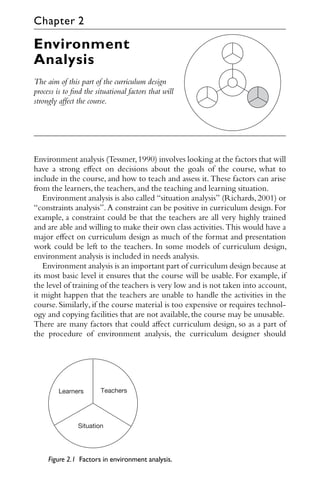
The shape of the model in Figure 1.1 is designed to make it easy to
remember. The three-part shape that occurs in each of the outer circles
(the “Mercedes” symbol) also occurs in the large inner circle,and also occurs
in the way the three outer circles connect to the inner circle.
In this first chapter of this book,we will look briefly at an overview of the
parts of the curriculum design process that will be looked at in more detail in
the following chapters of the book, with each of the early chapters focusing
on a different part of the model.
Considering the Environment
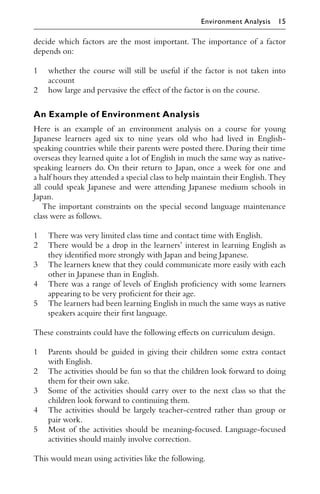
Environment analysis involves considering the factors of the situation in
which the course will be used and determining how the course should take
account of them. One way of approaching environment analysis is to work
from a list of questions which focus on the nature of the learners, the
teachers and the teaching situation (see Chapter 2).
2 Language Curriculum Design: An Overview
There is value in spending some time on these questions particularly if
the answers are ranked according to something like the following instructions
and criterion.
Choose three factors which will have the strongest effect on the
design of your course.Rank these three from the factor which will most
determine what you should do to the one which has the least influence
of the three.
To show the value of doing this, here are some of the top factors decided on
by several teachers designing different courses for different learners.
1 One teacher decided that the learners’ lack of interest in learning
English should be the major factor influencing curriculum design. The
learners were obliged to do an English course as part of their degree but
Figure 1.1 A model of the parts of the curriculum design process.
Language Curriculum Design: An Overview 3
received no credit for it. This meant that the teacher’s goal of making
the course as interesting and motivating as possible guided the design of
the course,particularly the format and presentation of lessons.
2 One teacher decided that the learners’ plan to move on to academic
study in university or technical institute courses should have the greatest
effect on design of the English course. This had a far-reaching effect
on the language items and the language skills focused on,and the type of
learning activity.
3 One teacher decided that the externally designed and administered test
at the end of the course should be the major factor. This meant that the
course book always had to make it obvious to the learners that the work
they were doing was directly related to the test.
Here is a short list of some of the other factors that teachers considered
most important.
• The small amount of time available for the course
• The large size of the classes
• The wide range of proficiency in the class
• The immediate survival needs of the learners
• The lack of appropriate reading materials
• The teachers’ lack of experience and training
• The learners’ use of the first language in the classroom
• The need for the learners to be more autonomous
There are many examples of unsuccessful curriculum design where the
background questions were not considered.Here are some examples.
1 The communicatively based course which was deserted by its
Vietnamese learners because they were not getting the grammar teach-
ing that they expected.They set up their own grammar-based course.
2 The course for Agricultural students which had a simplified version of
The Moonstone by Wilkie Collins as its main reading text. Some of the
learners produced their own translation of it which they copied and sold
to other learners.They saw no value in coming to grips with its content
through English.
3 The adult conversation course which began with the game “Simon
Says”. Half the students stopped attending after the first lesson. There is
no conversation in “Simon Says”.
Each important factor needs to be accompanied by one or more effects. For
example, the factor “the large size of the class” could have the following
effects on the curriculum design.
4 Language Curriculum Design: An Overview
1 A large amount of group work.
2 Use of special large class techniques like oral reproduction, blackboard
reproduction, the pyramid procedure involving the individual–pair–
group–class sequence (Nation and Newton,2009).
3 Independent work or individualised tasks.
The importance of environment analysis is that it makes sure that the course
will really be suitable,practical and realistic.
Discovering Needs
Hutchinson and Waters (1987) make a useful division of learners’ needs into
necessities (what the learner has to know to function effectively), lacks
(what the learner knows and does not know already) and wants (what the
learners think they need). These are discovered by a variety of means: by
testing, by questioning and interviewing, by recalling previous performance,
by consulting employers, teachers and others involved, by collecting data
such as textbooks and manuals that the learners will have to read and analys-
ing them, and by investigating the situations where the learners will need to
use the language. Ways of doing needs analysis can be evaluated by the same
general criteria used to evaluate tests – reliability,validity and practicality.
Necessities, lacks and wants may all involve some kind of comparison or
reference to lists of items which can act as the learning goals of the course.
An exception to this is to base the course on what the learners request. In
this case the lists are created by the learners. This is effective if the learners
have very clear purposes for learning English which they are aware of. For
example, a course for immigrants who have been in the country a few
months could very effectively be based on a list of things that they suggest
they want to be able to do in English.We will look more closely at this in the
chapter on negotiated syllabuses.
Following Principles
Research on language teaching and learning should be used to guide
decisions on curriculum design.There is considerable research on the nature
of language and language acquisition which can guide the choice of what to
teach and how to sequence it. There is also a lot of research on how to
encouragelearningingeneralandlanguagelearninginparticularwhichcanbe
used to guide the presentation of items to be learned.The principles derived
from this research include principles on the importance of repetition and
thoughtfulprocessingofmaterial,ontheimportanceoftakingaccountofindi-
vidual differences and learning style,and on learner attitudes and motivation.
It is very important that curriculum design makes the connection between
the research and theory of language learning and the practice of designing
Language Curriculum Design: An Overview 5
lessons and courses. There is a tendency for this connection not to be made,
with the result that curriculum design and therefore learners do not benefit
from developments in knowledge gained from research. A striking example
of this is the failure of courses to take account of the findings regarding
the interference that occurs when semantically and formally related items,
such as opposites, near synonyms and lexical sets, are presented together
(Higa, 1963; Tinkham, 1993). In spite of the clear findings of this research,
which is supported by a large body of research less firmly in the area of
language learning, course books continue to present names of the parts of
the body, items in the kitchen, opposites such as hot–cold, long–short, old–new,
numbers, days of the week and articles of clothing in the same lesson. As
Tinkham (1993) and Higa (1963) show, this will have the effect of making
learning more difficult than it should be.
Chapter 4 of this book describes a list of 20 principles that can be used to
guide curriculum design. It is not an exhaustive list and is based to some
degree on the personal prejudices of the writers. Curriculum designers may
wish to create their own lists (see Brown, 1993; Ellis, 2005 and Jones, 1993
for examples of other short lists;see also Richards,2001 and Tomlinson,2003
for discussion of the application of principles in materials development).
What is important is that curriculum design is treated as a normal part of the
field of applied linguistics and thus draws on available knowledge to guide it.
Goals
The curriculum design model in Figure 1.1 has goals as its centre. This is
because it is essential to decide why a course is being taught and what the
learners need to get from it.
Goals can be expressed in general terms and be given more detail when
considering the content of the course. Here are some examples of goals
that have been set for language courses.
1 The aim of communicative teaching is to encourage students to exploit
all the elements of the language that they know in order to make their
meanings clear. Students cannot be expected to master every aspect of
the language before they are allowed to use it for communicative
purposes.
(Orbit,Harrison and Menzies,1986)
2 Trio aims to
(a) encourage students to communicate in a wide range of everyday
situations.
(b) sustain interest and motivation . . .
(c) help students understand and formulate the grammatical rules of
English.
6 Language Curriculum Design: An Overview
(d) develop students’ receptive skills beyond those of their productive
skills.
(e) give students insights into daily life in Britain.
(f) develop specific skills, including skills required for examination
purposes.
(g) contribute to the students’ personal,social and educational develop-
ment.
(Trio,Radley and Sharley,1987)
3 Passages extends students’ communicative competence by developing
their ability to:
• expand the range of topics they can discuss and comprehend in
English
• speak English fluently (express a wide range of ideas without
unnecessary pauses or breakdowns in communication)
• speak English accurately (use an acceptable standard of pronunci-
ation and grammar when communicating).
(Passages,Richards and Sandy,1998)
4 Students continue to develop speaking and listening skills necessary
for participating in classroom discussions with an introduction to oral
presentation and critical listening skills.
(College Oral Communication,Roemer,2006)
Having a clear statement of goals is important for determining the content
of the course, for deciding on the focus in presentation, and in guiding
assessment.
Content and Sequencing
The content of language courses consists of the language items, ideas, skills
and strategies that meet the goals of the course. The viewpoint taken in this
book is that even though the units of progression in a course might be tasks,
topics or themes, it is important for the curriculum designer to keep some
check on vocabulary, grammar and discourse to make sure that important
items are being covered and repeated.If there is no check being made,it may
happen that learners are not meeting items that are important for their later
use of the language. It may also happen that items are not being met often
enough to establish them.
One way to provide a systematic and well-researched basis for a course is
to make use of frequency lists and other lists of language items or skills.These
lists should be chosen and adapted as a result of the needs analysis in order to
set the language learning content of the course.A list may be used as a way of
checking or determining the content of a course,but this does not mean that
the lessons have to consist of item by item teaching. A conversation course
Language Curriculum Design: An Overview 7
for example could be carefully planned to cover the important high-
frequency vocabulary and structures, and still consist of a series of very
free task-based conversation activities (Joe, Nation and Newton, 1996).
Working from lists makes sure that what should be covered is covered and is
not left to chance.
Typical lists include:
1 Frequency-based vocabulary lists. These consist of lists of words with
indicators of their frequency of occurrence. Perhaps the best known is
Michael West’s (1953) General Service List of English Words which con-
tains 2,000 high-frequency word families. This is a good source for
courses at the beginner and intermediate level. Other lists include The
Cambridge English Lexicon (Hindmarsh, 1980) and the First 1,000,
Second 1,000, and Third 1,000 lists produced by the English Language
Institute (Nation, 1984). The COBUILD dictionary (1995) indicates
the frequency levels of higher-frequency vocabulary. At a more special-
ised and advanced level, the academic word list (Coxhead, 2000)
contains 570 word families useful for study in the upper levels of
English-medium secondary schools and at university.
2 Frequency lists of verb forms and verb groups.These contain items such
as simple past, present continuous, verb + to + stem (where the stem is
dominant) going to + stem, and can + stem (ability) along with informa-
tion about their frequency of occurrence, mainly in written text. The
most striking feature of these lists is the very high frequency of a small
number of items,such as simple past,verb + to + stem,and the very low
frequency of most of the items studied (many of which are given
unjustified prominence in many course books and grading schemes
for simplified readers). These lists can be found in George 1963a,
1963b, and 1972; see also Appendix 1 of this book. The more recent
Biber et al. (1999) grammar contains frequency information. Com-
parison of beginners’ books of published courses with these lists shows
that the course books contain a mixture of high-frequency and low-
frequency items and could be considerably improved with more
informed selection.
3 Lists of functions and topics.These lists are not frequency-based and as a
result selection of items must be based on perceived need which is less
reliable than frequency evidence. The most useful of the available lists is
Van Ek and Alexander (1980).
4 Lists of subskills and strategies. These include the subskills of listen-
ing, speaking, reading and writing, and language coping and learning
strategies.
5 There are lists of tasks, topics and themes that curriculum designers
can refer to (Munby, 1978; Van Ek and Alexander, 1980; Prabhu, 1987),
but it is better for curriculum designers to develop their own lists
8 Language Curriculum Design: An Overview
taking account of the background factors of their learners and their
needs.
One important aspect of using lists is that they not only check or determine
the items that should be in the course,but they can be used to exclude those
that should not be there, that is, those that are not in the list. The result of
analyses based on lists of language items is a set of items that represent
sensible and achievable language goals for the course.
Needs analysis can play a major role in determining the content of
courses, particularly for language items. As well as using needs analysis to
set language goals, it is useful to decide the basis for the ideas content of
the course.
An important decision at this stage involves choosing the form the syllabus
will take. Dubin and Olshtain (1986) describe several syllabus forms includ-
ing linear,modular,cyclical and matrix.Whatever form is chosen will have a
marked effect on the opportunity for repetition of items to be learned.
Finding a Format and Presenting Material
The material in a course needs to be presented to learners in a form that will
help learning. This presentation will involve the use of suitable teaching
techniques and procedures, and these need to be put together in lessons.
Some lessons might consist of an unpredictable series of activities, while
others might be based on a set format,where the same sequence of activities
occurs in all or most of the lessons.
There are several advantages to having a set format for lessons. Firstly, the
lessons are easier to make because each one does not have to be planned
separately. It also makes the course easier to monitor, to check if all that
should be included is there and that accepted principles are being followed.
Finally, it makes the lessons easier to learn from because the learners can
predict what will occur and are soon familiar with the learning procedures
required by different parts of the lesson.
The sources of the material used as a basis for the lessons will have decisive
effects on the ease of making the lessons and of the possibility of future
distribution or publication of the course. A shortcut here is simply to take
suitable material from other courses,adapting it as required.
There is a substantial set of principles that need to be applied at this stage
(see Chapter 4). These concern not only presentation but also selection
aspects,such as sequencing and the amount of time given to fluency work.
The lesson format needs to be checked against the environment analysis of
the course to make sure that the major environmental factors are being
considered.
Because curriculum design is not a linear process, it may be necessary to
alter the content or sequencing to suit the lesson format and to reorder the
Language Curriculum Design: An Overview 9
list of environmental factors. The lessons may still require adjustment as a
result of consideration of other stages of the curriculum design. Perhaps the
most difficult task at this stage is making sure that the learning goals of the
course are met. That is, that the wanted language items are well-represented
and well-presented in the course.
It can be argued that the first presentation of an item is not as important as
the later repetitions of that item. This is often neglected in courses, but it is
crucial to learning. It is through repeated meetings that items are enriched
and established.
Monitoring and Assessing
The aims of curriculum design are to make a course that has useful goals,that
achieves its goals, that satisfies its users, and that does all this in an efficient
way. An important recurring part of the design process is to assess how well
these aims are achieved.
Assessing generally involves the use of tests. An important distinction in
testing is between proficiency tests which measure what a learner knows of
the language, and achievement tests which measure what has been learned
from a particular course.Proficiency tests may be used to measure a learner’s
level of language knowledge before entering a course and after a course is
completed and has been assessed. Achievement tests are closely related to a
course and the items in the tests are based on the content of the course and
the learning goals of the course. Short-term achievement tests are tests that
occur at the end of each lesson or at the end of a group of lessons. They
provide the teacher and learners with information about how much has been
learned.They can have a strong effect on motivation,on the speed of move-
ment through the lessons, and on adapting and supplementing the course.
Well-designed courses should include short-term achievement tests in the
curriculum design.
Larger achievement tests can occur at the end of a course and perhaps
halfway through the course. The information gained from such tests can be
useful in evaluating the course.
Other kinds of tests include placement tests (to see if the course is suitable
for a prospective learner or to see where in the course the learner should
begin) and diagnostic tests (to see if learners have particular gaps in their
knowledge).
But testing is only one way of gaining information about the progress of
learners and the effectiveness of the course. Other ways include observing
and monitoring using checklists and report forms, getting learners to keep
diaries and learning logs, getting learners to collect samples of their work in
folders, and getting learners to talk about their learning. Curriculum design
can include planned opportunity for this kind of data gathering.
10 Language Curriculum Design: An Overview
Evaluating a Course
Information gained from assessment is a useful source of data about the
effectiveness of a course, but it is only one of the sources of information
that can contribute to the evaluation of a course.Basically,evaluation tries to
answer the question “Is this a good course?”.The range of meanings that can
be attached to “good” determines the range of sources of information for
carrying out an evaluation.
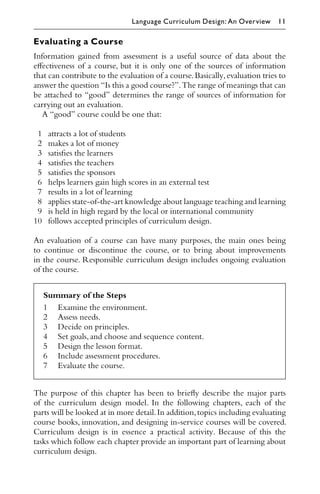
A “good” course could be one that:
1 attracts a lot of students
2 makes a lot of money
3 satisfies the learners
4 satisfies the teachers
5 satisfies the sponsors
6 helps learners gain high scores in an external test
7 results in a lot of learning
8 applies state-of-the-art knowledge about language teaching and learning
9 is held in high regard by the local or international community
10 follows accepted principles of curriculum design.
An evaluation of a course can have many purposes, the main ones being
to continue or discontinue the course, or to bring about improvements
in the course. Responsible curriculum design includes ongoing evaluation
of the course.
Summary of the Steps
1 Examine the environment.
2 Assess needs.
3 Decide on principles.
4 Set goals,and choose and sequence content.
5 Design the lesson format.
6 Include assessment procedures.
7 Evaluate the course.
The purpose of this chapter has been to briefly describe the major parts
of the curriculum design model. In the following chapters, each of the
parts will be looked at in more detail.In addition,topics including evaluating
course books, innovation, and designing in-service courses will be covered.
Curriculum design is in essence a practical activity. Because of this the
tasks which follow each chapter provide an important part of learning about
curriculum design.
Language Curriculum Design: An Overview 11
Tasks
Task 1 Examining a published course
Look at a published course book and see what decisions were made for each
of the parts of the model in Figure 1.1. Choose one feature for each part of
the curriculum design model. For example, find one example of the effects
of environment analysis.
Task 2 Using the parts of the model to overview the
planning of a course
Quickly decide what kind of course you wish to design. For each of the
parts of the curriculum design model, write two questions you will need
to answer to plan a course.
Case Studies
An important way to make use of this book on curriculum design is to
examine case studies using the model introduced in this chapter. Choose a
short case study of curriculum design (about three to six pages long).Look in
the list of references at the back of this book for the items marked [20]
and choose one of them, or choose a case study report in journals such as
English Teaching Forum, Guidelines, ELT Journal, System or English for Specific
Purposes. Analyse it to see how the parts of the curriculum design model
described in Chapter 1 fit with the case study. See what is in the model and
not in the case study. See what is in the case study and not covered by the
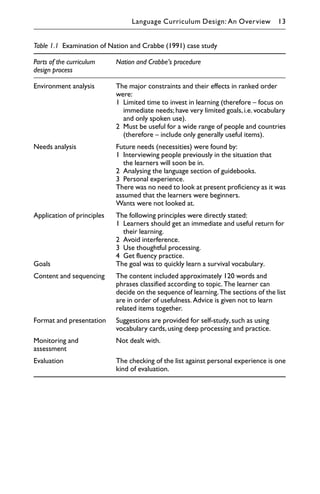
model. Table 1.1 provides an example analysis based on the Nation and
Crabbe (1991) article (available at I.S.P.Nation’s web site).
12 Language Curriculum Design: An Overview
Table 1.1 Examination of Nation and Crabbe (1991) case study
Parts of the curriculum
design process
Nation and Crabbe’s procedure
Environment analysis The major constraints and their effects in ranked order
were:
1 Limited time to invest in learning (therefore – focus on
immediate needs;have very limited goals,i.e.vocabulary
and only spoken use).
2 Must be useful for a wide range of people and countries
(therefore – include only generally useful items).
Needs analysis Future needs (necessities) were found by:
1 Interviewing people previously in the situation that
the learners will soon be in.
2 Analysing the language section of guidebooks.
3 Personal experience.
There was no need to look at present proficiency as it was
assumed that the learners were beginners.
Wants were not looked at.
Application of principles The following principles were directly stated:
1 Learners should get an immediate and useful return for
their learning.
2 Avoid interference.
3 Use thoughtful processing.
4 Get fluency practice.
Goals The goal was to quickly learn a survival vocabulary.
Content and sequencing The content included approximately 120 words and
phrases classified according to topic.The learner can
decide on the sequence of learning.The sections of the list
are in order of usefulness.Advice is given not to learn
related items together.
Format and presentation Suggestions are provided for self-study,such as using
vocabulary cards,using deep processing and practice.
Monitoring and
assessment
Not dealt with.
Evaluation The checking of the list against personal experience is one
kind of evaluation.
Language Curriculum Design: An Overview 13
Environment
Analysis
The aim of this part of the curriculum design
process is to find the situational factors that will
strongly affect the course.
Environment analysis (Tessmer,1990) involves looking at the factors that will
have a strong effect on decisions about the goals of the course, what to
include in the course, and how to teach and assess it. These factors can arise
from the learners,the teachers,and the teaching and learning situation.
Environment analysis is also called “situation analysis” (Richards,2001) or
“constraints analysis”.A constraint can be positive in curriculum design.For
example, a constraint could be that the teachers are all very highly trained
and are able and willing to make their own class activities.This would have a
major effect on curriculum design as much of the format and presentation
work could be left to the teachers. In some models of curriculum design,
environment analysis is included in needs analysis.
Environment analysis is an important part of curriculum design because at
its most basic level it ensures that the course will be usable. For example, if
the level of training of the teachers is very low and is not taken into account,
it might happen that the teachers are unable to handle the activities in the
course. Similarly, if the course material is too expensive or requires technol-
ogy and copying facilities that are not available,the course may be unusable.
There are many factors that could affect curriculum design, so as a part of
the procedure of environment analysis, the curriculum designer should
Figure 2.1 Factors in environment analysis.
Chapter 2
decide which factors are the most important. The importance of a factor
depends on:
1 whether the course will still be useful if the factor is not taken into
account
2 how large and pervasive the effect of the factor is on the course.
An Example of Environment Analysis
Here is an example of an environment analysis on a course for young
Japanese learners aged six to nine years old who had lived in English-
speaking countries while their parents were posted there. During their time
overseas they learned quite a lot of English in much the same way as native-
speaking learners do. On their return to Japan, once a week for one and
a half hours they attended a special class to help maintain their English.They
all could speak Japanese and were attending Japanese medium schools in
Japan.
The important constraints on the special second language maintenance
class were as follows.
1 There was very limited class time and contact time with English.
2 There would be a drop in the learners’ interest in learning English as
they identified more strongly with Japan and being Japanese.
3 The learners knew that they could communicate more easily with each
other in Japanese than in English.
4 There was a range of levels of English proficiency with some learners
appearing to be very proficient for their age.
5 The learners had been learning English in much the same ways as native
speakers acquire their first language.
These constraints could have the following effects on curriculum design.
1 Parents should be guided in giving their children some extra contact
with English.
2 The activities should be fun so that the children look forward to doing
them for their own sake.
3 Some of the activities should carry over to the next class so that the
children look forward to continuing them.
4 The activities should be largely teacher-centred rather than group or
pair work.
5 Most of the activities should be meaning-focused. Language-focused
activities should mainly involve correction.
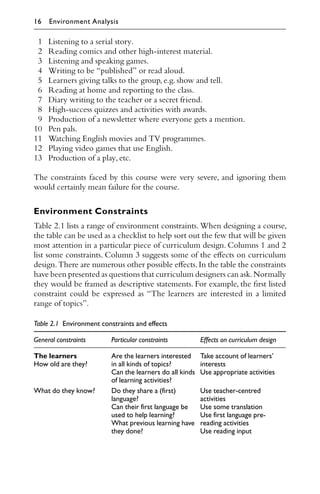
This would mean using activities like the following.
Environment Analysis 15
1 Listening to a serial story.
2 Reading comics and other high-interest material.
3 Listening and speaking games.
4 Writing to be “published” or read aloud.
5 Learners giving talks to the group,e.g.show and tell.
6 Reading at home and reporting to the class.
7 Diary writing to the teacher or a secret friend.
8 High-success quizzes and activities with awards.
9 Production of a newsletter where everyone gets a mention.
10 Pen pals.
11 Watching English movies and TV programmes.
12 Playing video games that use English.
13 Production of a play,etc.
The constraints faced by this course were very severe, and ignoring them
would certainly mean failure for the course.
Environment Constraints
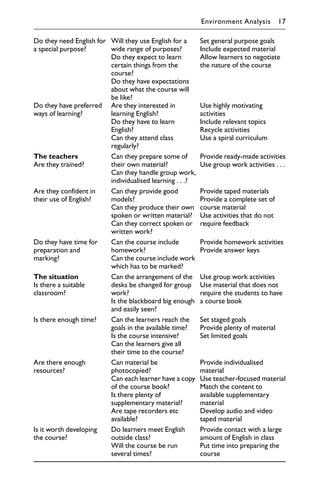
Table 2.1 lists a range of environment constraints. When designing a course,
the table can be used as a checklist to help sort out the few that will be given
most attention in a particular piece of curriculum design. Columns 1 and 2
list some constraints. Column 3 suggests some of the effects on curriculum
design.There are numerous other possible effects.In the table the constraints
have been presented as questions that curriculum designers can ask.Normally
they would be framed as descriptive statements. For example, the first listed
constraint could be expressed as “The learners are interested in a limited
range of topics”.
Table 2.1 Environment constraints and effects
General constraints Particular constraints Effects on curriculum design
The learners
How old are they?
Are the learners interested
in all kinds of topics?
Can the learners do all kinds
of learning activities?
Take account of learners’
interests
Use appropriate activities
What do they know? Do they share a (first)
language?
Can their first language be
used to help learning?
What previous learning have
they done?
Use teacher-centred
activities
Use some translation
Use first language pre-
reading activities
Use reading input
16 Environment Analysis
Do they need English for
a special purpose?
Will they use English for a
wide range of purposes?
Do they expect to learn
certain things from the
course?
Do they have expectations
about what the course will
be like?
Set general purpose goals
Include expected material
Allow learners to negotiate
the nature of the course
Do they have preferred
ways of learning?
Are they interested in
learning English?
Do they have to learn
English?
Can they attend class
regularly?
Use highly motivating
activities
Include relevant topics
Recycle activities
Use a spiral curriculum
The teachers
Are they trained?
Can they prepare some of
their own material?
Can they handle group work,
individualised learning . . .?
Provide ready-made activities
Use group work activities . . .
Are they confident in
their use of English?
Can they provide good
models?
Can they produce their own
spoken or written material?
Can they correct spoken or
written work?
Provide taped materials
Provide a complete set of
course material
Use activities that do not
require feedback
Do they have time for
preparation and
marking?
Can the course include
homework?
Can the course include work
which has to be marked?
Provide homework activities
Provide answer keys
The situation
Is there a suitable
classroom?
Can the arrangement of the
desks be changed for group
work?
Is the blackboard big enough
and easily seen?
Use group work activities
Use material that does not
require the students to have
a course book
Is there enough time? Can the learners reach the
goals in the available time?
Is the course intensive?
Can the learners give all
their time to the course?
Set staged goals
Provide plenty of material
Set limited goals
Are there enough
resources?
Can material be
photocopied?
Can each learner have a copy
of the course book?
Is there plenty of
supplementary material?
Are tape recorders etc
available?
Provide individualised
material
Use teacher-focused material
Match the content to
available supplementary
material
Develop audio and video
taped material
Is it worth developing
the course?
Do learners meet English
outside class?
Will the course be run
several times?
Provide contact with a large
amount of English in class
Put time into preparing the
course
Environment Analysis 17
Sometimes it is necessary to consider wider aspects of the situation when
carrying out an environment analysis. There may, for example, be insti-
tutional or government policies requiring the use of the target language in
schools (Liu et al.,2004),or there may be negative attitudes towards the target
language among learners in post-colonial societies (Asmah, 1992). Dubin
and Olshtain (1986) suggest a useful way of thinking about the wider
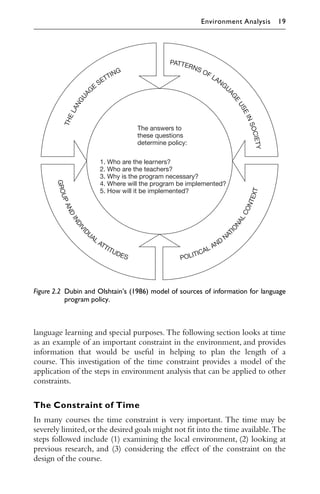
environment (Figure 2.2) that can have implications for language curriculum
design.For example,the language curriculum in a situation where:
– the target language is recognised as one of a country’s official languages
(the political and national context)
– there are relatively few native speakers (the language setting)
– there are relatively few opportunities to use the language outside the
classroom (patterns of language use in society)
– majority-language speakers doubt the target language has contemporary
relevance (group and individual attitudes)
will differ greatly from that in a situation where:
– the target language is recognised as one of a country’s official languages
– there are relatively few native speakers
– there are many opportunities to use the target language outside the
classroom
– the target language provides employment and educational opportunities.
Understanding the Constraints
In order to understand a constraint fully, it is usually necessary to examine
the nature of the constraint in the environment you are working in, and to
examine previous research on the constraint.For example,let us look briefly
at the constraint of class size. If this constraint is considered to be important
for the particular course being designed, it is useful to know exactly how
large the classes are. Do they contain 40 students or 140 students? Is it
possible to change class sizes?
There has been considerable research on and examination of teaching
large classes. This research has looked at the relative merits of group work
and teacher-centred activities, the effect of class size on learning, and indi-
vidualisation. There have been many articles and books on activities and
techniques for large classes (Coleman, 1989; Hess, 2001), and on the prin-
ciples of group work.Good curriculum design must take account of research
and theory so that it provides the best possible conditions for learning that
the state of the art allows.
Some of the major constraints investigated by research and analysis include
the time available, cultural background, the effect of the first language on
18 Environment Analysis
language learning and special purposes. The following section looks at time
as an example of an important constraint in the environment, and provides
information that would be useful in helping to plan the length of a
course. This investigation of the time constraint provides a model of the
application of the steps in environment analysis that can be applied to other
constraints.
The Constraint of Time
In many courses the time constraint is very important. The time may be
severely limited,or the desired goals might not fit into the time available.The
steps followed include (1) examining the local environment, (2) looking at
previous research, and (3) considering the effect of the constraint on the
design of the course.
Figure 2.2 Dubin and Olshtain’s (1986) model of sources of information for language
program policy.
Environment Analysis 19
Local information from the environment
Useful information to gather about the constraint is how much class time is
available, how much time out of class could be given to learning, and what
the goals of the course are.
Research information
Useful research information would reveal what could be achieved within
certain time periods. Pimsleur (1980), for example, presents estimates of the
time taken to reach various levels of proficiency for learners of particular
languages.The estimates are based on the idea that some languages are more
difficult than others for native speakers of English to begin to learn.To reach
an elementary level of proficiency in French or Indonesian for example
would take approximately 240 hours of study, according to Pimsleur. To
reach the same level for a more difficult language such as Hebrew or Japanese
would take approximately 360 hours. These estimates derive from the con-
siderable experience of teachers at the Foreign Service Institute of the
Department of State in the United States. For further research on the time
constraint see Collier (1987,1989,1995).
The effect of the time constraint on the design of
the course
An environmental constraint can be approached in two ways – working
within the constraint, and overcoming the constraint. To work within the
constraint the curriculum designer could limit the goals of the course to fit
the available time. This is what is suggested in the Pimsleur data. Another
way of limiting would be to try to cover most of the language items and skills
but at a rather superficial level,relying on later experience to make up for the
quick coverage.Alternatively,very intensive study procedures could be used.
To overcome the constraint the curriculum designer might try to provide
self-study options for work to be done outside of class time or if possible the
time available for the course could be increased.
Steps in Environment Analysis
The steps in environment analysis can be as follows.
1 Brainstorm and then systematically consider the range of environment
factors that will affect the course. Table 2.1 can be used as a starting
point.
2 Choose the most important factors (no more than five) and rank them,
putting the most important first.
20 Environment Analysis
3 Decide what information you need to fully take account of the factor.
The information can come from investigation of the environment and
from research and theory.
4 Consider the effects of each factor on the design of the course.
5 Go through steps 1,2,3,and 4 again.
Environment analysis involves looking at the local and wider situation to
make sure that the course will fit and will meet local requirements. There is
considerable research data on many of the important environment factors,
including class size, motivation, learners of mixed proficiency and special
purpose goals. Good environment analysis draws on both analysis of the
environment and application of previous research and theory. In some
models of curriculum design, environment analysis is included in needs
analysis.Needs analysis is the subject of the next chapter.
Tasks
Task 1 The range of constraints
Brainstorm to create a list of constraints that may significantly affect the
design of courses.
Task 2 Examining your teaching environment
1 List five important constraints facing you in your teaching situation.Use
Table 2.1 at the beginning of this chapter to help you. Rank your
constraints according to the strength of the effect that they will have on
your course.
2 Very briefly describe the most important constraint or strength and say
why it is important.
3 What do you know or need to know about the constraint or strength?
You may wish to know about the present situation and previous research.
Environment Analysis 21
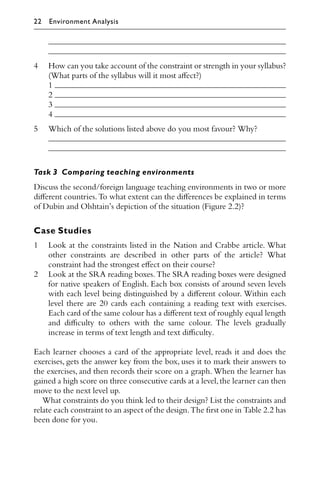
4 How can you take account of the constraint or strength in your syllabus?
(What parts of the syllabus will it most affect?)
1
2
3
4
5 Which of the solutions listed above do you most favour? Why?
Task 3 Comparing teaching environments
Discuss the second/foreign language teaching environments in two or more
different countries.To what extent can the differences be explained in terms
of Dubin and Olshtain’s depiction of the situation (Figure 2.2)?
Case Studies
1 Look at the constraints listed in the Nation and Crabbe article. What
other constraints are described in other parts of the article? What
constraint had the strongest effect on their course?
2 Look at the SRA reading boxes. The SRA reading boxes were designed
for native speakers of English. Each box consists of around seven levels
with each level being distinguished by a different colour. Within each
level there are 20 cards each containing a reading text with exercises.
Each card of the same colour has a different text of roughly equal length
and difficulty to others with the same colour. The levels gradually
increase in terms of text length and text difficulty.
Each learner chooses a card of the appropriate level, reads it and does the
exercises, gets the answer key from the box, uses it to mark their answers to
the exercises, and then records their score on a graph. When the learner has
gained a high score on three consecutive cards at a level,the learner can then
move to the next level up.
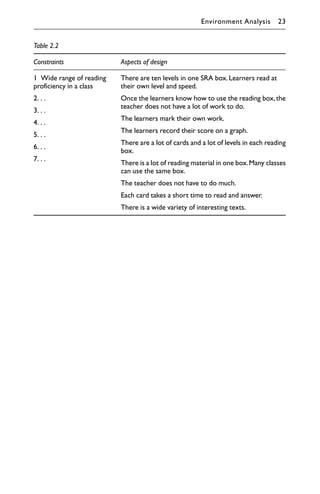
What constraints do you think led to their design? List the constraints and
relate each constraint to an aspect of the design.The first one in Table 2.2 has
been done for you.
22 Environment Analysis
Table 2.2
Constraints Aspects of design
1 Wide range of reading
proficiency in a class
2. . .
3. . .
4. . .
5. . .
6. . .
7. . .
There are ten levels in one SRA box.Learners read at
their own level and speed.
Once the learners know how to use the reading box,the
teacher does not have a lot of work to do.
The learners mark their own work.
The learners record their score on a graph.
There are a lot of cards and a lot of levels in each reading
box.
There is a lot of reading material in one box.Many classes
can use the same box.
The teacher does not have to do much.
Each card takes a short time to read and answer.
There is a wide variety of interesting texts.
Environment Analysis 23
Needs Analysis
The aim of this part of the curriculum design
process is to discover what needs to be learned and
what the learners want to learn.
Needs analysis is directed mainly at the goals and content of a course. It
examines what the learners know already and what they need to know.
Needs analysis makes sure that the course will contain relevant and useful
things to learn. Good needs analysis involves asking the right questions and
finding the answers in the most effective way.
The Various Focuses of Needs Analysis
The aim of this section of the chapter is to look at the range of information
that can be gathered in needs analysis.
Hutchinson and Waters (1987) divide needs into target needs (i.e. what the
learner needs to do in the target situation) and learning needs (i.e. what
the learner needs to do in order to learn). The analysis of target needs can
look at:
1 Necessities What is necessary in the learners’ use of language? For
example, do the learners have to write answers to exam
questions?
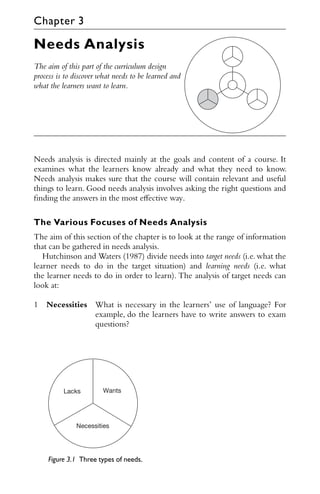
Figure 3.1 Three types of needs.
Chapter 3
2 Lacks What do the learners lack? For example, are there aspects
of writing that were not practised in their previous
learning (L1,L2)?
3 Wants What do the learners wish to learn?
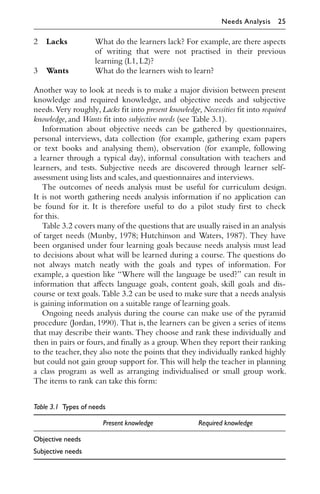
Another way to look at needs is to make a major division between present
knowledge and required knowledge, and objective needs and subjective
needs.Very roughly,Lacks fit into present knowledge,Necessities fit into required
knowledge,and Wants fit into subjective needs (see Table 3.1).
Information about objective needs can be gathered by questionnaires,
personal interviews, data collection (for example, gathering exam papers
or text books and analysing them), observation (for example, following
a learner through a typical day), informal consultation with teachers and
learners, and tests. Subjective needs are discovered through learner self-
assessment using lists and scales,and questionnaires and interviews.
The outcomes of needs analysis must be useful for curriculum design.
It is not worth gathering needs analysis information if no application can
be found for it. It is therefore useful to do a pilot study first to check
for this.
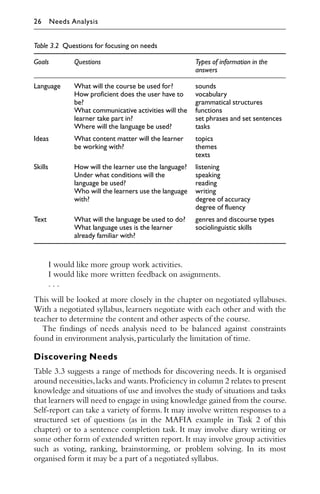
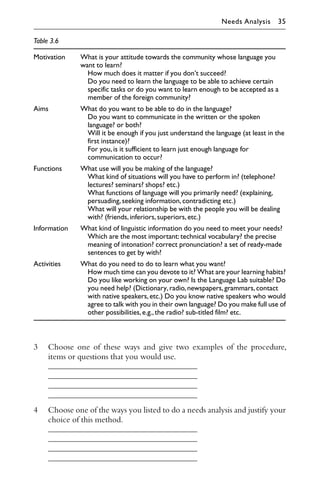
Table 3.2 covers many of the questions that are usually raised in an analysis
of target needs (Munby, 1978; Hutchinson and Waters, 1987). They have
been organised under four learning goals because needs analysis must lead
to decisions about what will be learned during a course. The questions do
not always match neatly with the goals and types of information. For
example, a question like “Where will the language be used?” can result in
information that affects language goals, content goals, skill goals and dis-
course or text goals. Table 3.2 can be used to make sure that a needs analysis
is gaining information on a suitable range of learning goals.
Ongoing needs analysis during the course can make use of the pyramid
procedure (Jordan, 1990). That is, the learners can be given a series of items
that may describe their wants. They choose and rank these individually and
then in pairs or fours, and finally as a group. When they report their ranking
to the teacher, they also note the points that they individually ranked highly
but could not gain group support for. This will help the teacher in planning
a class program as well as arranging individualised or small group work.
The items to rank can take this form:
Table 3.1 Types of needs
Present knowledge Required knowledge
Objective needs
Subjective needs
Needs Analysis 25
I would like more group work activities.
I would like more written feedback on assignments.
. . .
This will be looked at more closely in the chapter on negotiated syllabuses.
With a negotiated syllabus, learners negotiate with each other and with the
teacher to determine the content and other aspects of the course.
The findings of needs analysis need to be balanced against constraints
found in environment analysis,particularly the limitation of time.
Discovering Needs
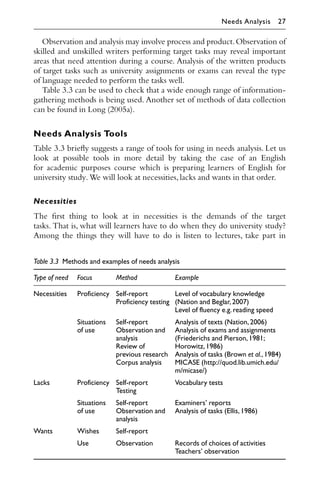
Table 3.3 suggests a range of methods for discovering needs. It is organised
around necessities,lacks and wants.Proficiency in column 2 relates to present
knowledge and situations of use and involves the study of situations and tasks
that learners will need to engage in using knowledge gained from the course.
Self-report can take a variety of forms. It may involve written responses to a
structured set of questions (as in the MAFIA example in Task 2 of this
chapter) or to a sentence completion task. It may involve diary writing or
some other form of extended written report. It may involve group activities
such as voting, ranking, brainstorming, or problem solving. In its most
organised form it may be a part of a negotiated syllabus.
Table 3.2 Questions for focusing on needs
Goals Questions Types of information in the
answers
Language What will the course be used for?
How proficient does the user have to
be?
What communicative activities will the
learner take part in?
Where will the language be used?
sounds
vocabulary
grammatical structures
functions
set phrases and set sentences
tasks
Ideas What content matter will the learner
be working with?
topics
themes
texts
Skills How will the learner use the language?
Under what conditions will the
language be used?
Who will the learners use the language
with?
listening
speaking
reading
writing
degree of accuracy
degree of fluency
Text What will the language be used to do?
What language uses is the learner
already familiar with?
genres and discourse types
sociolinguistic skills
26 Needs Analysis
Observation and analysis may involve process and product.Observation of
skilled and unskilled writers performing target tasks may reveal important
areas that need attention during a course. Analysis of the written products
of target tasks such as university assignments or exams can reveal the type
of language needed to perform the tasks well.
Table 3.3 can be used to check that a wide enough range of information-
gathering methods is being used. Another set of methods of data collection
can be found in Long (2005a).
Needs Analysis Tools
Table 3.3 briefly suggests a range of tools for using in needs analysis. Let us
look at possible tools in more detail by taking the case of an English
for academic purposes course which is preparing learners of English for
university study.We will look at necessities,lacks and wants in that order.
Necessities
The first thing to look at in necessities is the demands of the target
tasks. That is, what will learners have to do when they do university study?
Among the things they will have to do is listen to lectures, take part in
Table 3.3 Methods and examples of needs analysis
Type of need Focus Method Example
Necessities Proficiency Self-report
Proficiency testing
Level of vocabulary knowledge
(Nation and Beglar,2007)
Level of fluency e.g.reading speed
Situations
of use
Self-report
Observation and
analysis
Review of
previous research
Corpus analysis
Analysis of texts (Nation,2006)
Analysis of exams and assignments
(Friederichs and Pierson,1981;
Horowitz,1986)
Analysis of tasks (Brown et al.,1984)
MICASE (http://quod.lib.umich.edu/
m/micase/)
Lacks Proficiency Self-report
Testing
Vocabulary tests
Situations
of use
Self-report
Observation and
analysis
Examiners’ reports
Analysis of tasks (Ellis,1986)
Wants Wishes Self-report
Use Observation Records of choices of activities
Teachers’ observation
Needs Analysis 27
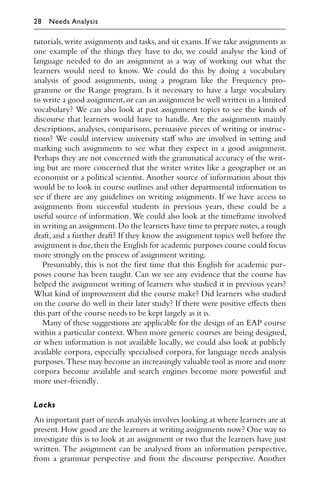
tutorials,write assignments and tasks,and sit exams.If we take assignments as
one example of the things they have to do, we could analyse the kind of
language needed to do an assignment as a way of working out what the
learners would need to know. We could do this by doing a vocabulary
analysis of good assignments, using a program like the Frequency pro-
gramme or the Range program. Is it necessary to have a large vocabulary
to write a good assignment,or can an assignment be well written in a limited
vocabulary? We can also look at past assignment topics to see the kinds of
discourse that learners would have to handle. Are the assignments mainly
descriptions, analyses, comparisons, persuasive pieces of writing or instruc-
tions? We could interview university staff who are involved in setting and
marking such assignments to see what they expect in a good assignment.
Perhaps they are not concerned with the grammatical accuracy of the writ-
ing but are more concerned that the writer writes like a geographer or an
economist or a political scientist. Another source of information about this
would be to look in course outlines and other departmental information to
see if there are any guidelines on writing assignments. If we have access to
assignments from successful students in previous years, these could be a
useful source of information. We could also look at the timeframe involved
in writing an assignment.Do the learners have time to prepare notes,a rough
draft, and a further draft? If they know the assignment topics well before the
assignment is due,then the English for academic purposes course could focus
more strongly on the process of assignment writing.
Presumably, this is not the first time that this English for academic pur-
poses course has been taught. Can we see any evidence that the course has
helped the assignment writing of learners who studied it in previous years?
What kind of improvement did the course make? Did learners who studied
on the course do well in their later study? If there were positive effects then
this part of the course needs to be kept largely as it is.
Many of these suggestions are applicable for the design of an EAP course
within a particular context. When more generic courses are being designed,
or when information is not available locally, we could also look at publicly
available corpora, especially specialised corpora, for language needs analysis
purposes.These may become an increasingly valuable tool as more and more
corpora become available and search engines become more powerful and
more user-friendly.
Lacks
An important part of needs analysis involves looking at where learners are at
present.How good are the learners at writing assignments now? One way to
investigate this is to look at an assignment or two that the learners have just
written. The assignment can be analysed from an information perspective,
from a grammar perspective and from the discourse perspective. Another
28 Needs Analysis
way to look at an assignment is to look at the parts of the writing process and
to see what degree of skill in each part is reflected in the assignment (see
Nation (2009) for such an analysis).Yet another way is to look at the learners
in the process of writing an assignment. The quality of an assignment often
depends on the conditions under which it was written. Observing students
writing can give some insight into these conditions and the learners’ control
over parts of the writing process. There is however always the danger of the
observer paradox where the observation changes the nature of the task.
Another source of information about lacks could come from the uni-
versity lecturer who marks such assignments. What do they see as the
strengths and weaknesses of the assignment that the learner has written? This
information could be gathered using a think-aloud protocol as the examiner
marks the assignment, or it could be gathered by getting the examiner to
reflect on the assignment they have just marked.
The learners themselves are also a very useful source of information
about lacks.How does the learner interpret the assignment task? One way of
gathering information about this is to question the learner about the assign-
ment task using a carefully prepared set of interview questions.Another way
is to get the learner to talk about the assignment task encouraging them to
say what they think they have to do to answer the assignment.
The ways of investigating lacks which have been described above focus on
an assignment task.However,learners’ general proficiency contributes to the
way they handle any language task.To gather data about the learners’ general
proficiency, we can interview them, get them to sit tests such as vocabulary
tests,grammar tests,writing tests and comprehension tests,or we can get them
to do self-assessment using a specially prepared checklist.Learners’ scores on
standardised proficiency tests like the TOEFL test or the IELTS test can be a
very useful source of information particularly when they provide information
about separate aspects of language proficiency such as writing or speaking.
Wants
Learners have their own views about what they think is useful for them. At
the very least, information about this is useful in working out whether the
learners’ views and the needs analyst’s views are the same or not. If they are
not the same, then the curriculum designer may need to rethink the results
of the needs analysis or persuade the learners that there is a more useful view
of what they need.We can gather such information through an interview or
a questionnaire. Questionnaires are notoriously difficult to design well.
However a well-designed questionnaire can be a very useful source of
information which can be reused for later courses.We could ask the learners
what they think will improve their assignment writing and what they want
to be able to do regarding assignment writing by the end of the English for
academic purposes course.
Needs Analysis 29
The main point behind looking at this example is to show that there is a
wide range of tools that can be used to analyse needs.They include text analy-
sis, talking with students both past and present, surveying the environment,
looking at pieces of work, talking with teachers, employers and assessors,
and using personal experience and commonsense. Because needs analysis is
basically a kind of research it is important to get the research questions
right as soon as possible and use these to guide the choice of methods of data
gathering.
Good needs analysis thus covers a range of needs using a range of data-
getting tools. Needs are not always clear and are always changing so it is
important that needs are looked at from a variety of perspectives at a variety
of times. The perspectives can vary according to the type of need (lack,
necessities, wants; or present knowledge, required knowledge, objective and
subjective needs), the source of information (present learners, past learners,
teachers, present tasks and materials, future tasks and materials, future col-
leagues or future assessors or teachers), the data-gathering tools (text and
discourse analysis, frequency counts, interviews, questionnaires, observation,
negotiation and discussion, reflection on experience), and the type of infor-
mation (learning goals, preferred styles of learning, learners’ commitment to
learning).
The times of needs analysis can include needs analysis before a course
begins, needs analysis in the initial stages of a course, and ongoing needs
analysis during the running of the course. If a course is to be repeated with
different learners,then needs analysis at the end of a course is useful.
Evaluating Needs Analysis
Needs analysis is a kind of assessment and thus can be evaluated by consider-
ing its reliability,validity and practicality.
Reliable needs analysis involves using well-thought-out,standardised tools
that are applied systematically.Rather than just observing people performing
tasks that learners will have to do after the course, it is better to systematise
the observation by using a checklist, or by recording and apply standardised
analysis procedures. The more pieces of observation and the more people
who are studied, the more reliable the results.
Valid needs analysis involves looking at what is relevant and important.
Consideration of the type of need that is being looked at and the type of
information that is being gathered is important.Before needs analysis begins
it may be necessary to do a ranking activity to decide what type of need
should get priority in the needs analysis investigation. The worst decision
would be to let practicality dominate by deciding to investigate what is
easiest to investigate!
Practical needs analysis is not expensive,does not occupy too much of the
learners’ and teacher’s time, provides clear, easy-to-understand results and
30 Needs Analysis
can easily be incorporated into the curriculum design process. There will
always be a tension between reliable and valid needs analysis and practical
needs analysis.A compromise is necessary but validity should always be given
priority.
Issues in Needs Analysis
There are several issues in needs analysis that have been the focus of
continuing debate.Three are briefly discussed here.
1 Common core and specialised language What are the content
selection stages that a special purposes language course should follow?
From a vocabulary point of view (Nation and Hwang, 1995; Sutarsyah
et al., 1994) there is evidence to support the idea that learners should
first focus on a common core of 2,000 words, then focus on general
academic vocabulary common to a wide range of disciplines (Coxhead,
2000) if their goal is academic reading and writing, and then focus on
the specialised vocabulary of their particular disciplines (Chung and
Nation,2004).
Study of vocabulary occurrence shows that this sequence of goals is
sensible and generally gives the best return for learning effort. If goals
are very focused, it is possible to shorten each step a little, focusing
on around 1,600 word families of the common core and about 650
general academic words (Sutarsyah, 1993). It is likely that there is a
similar progression for grammatical items, perhaps of two stages with
stage 1 consisting of high-frequency widely used grammatical items,
and stage 2 focusing on those particular to the text types of the discipline
(Biber,1990).This kind of progression should not be rigidly kept to.It is
possible to focus on the content of the discipline using common core
vocabulary and a few general academic and technical items. Most of the
very-high-frequency content words in a particular discipline are from the
common core and general academic vocabulary, for example price, cost,
demand,curve,supply,quantity in Economics (Sutarsyah et al.,1994).
Table 3.4 Vocabulary stages
Specialised/Technical
(approximately 1,000 word families)
Stage 3
General academic
(570 word families)
Stage 2
Common core
(2,000 word families)
Stage 1
Needs Analysis 31
2 Narrow focus – wide focus Detailed systems of needs analysis have
been set up to determine precisely what language a particular language
learner with clear needs should learn (Munby, 1978). The arguments in
favour of a narrow focus include the faster meeting of needs, the reduc-
tion of the quantity of learning needed, and the motivation that comes
from getting an immediate return from being able to apply learning.
Hyland (2002) finds support for a narrow focus in social constructionist
theory, arguing for the importance of successful communication within
a specific discourse community. Such a focus, however, runs the risk of
teaching “parole” and not “langue” (De Saussure, 1983), that is, of not
teaching the language system so that learners can be flexible and creative
in their language use. If language learners have more than very short-
term goals for language learning, it is important that their language
learning not only satisfies immediate needs but also provides the basis for
the development of control of the wider language system.
3 Critical needs analysis Benesch (1996) points out with some striking
examples that needs analysis is affected by the ideology of those in
control of the analysis. That is, the questions they ask, the areas they
investigate, and the conclusions they draw are inevitably influenced by
their attitudes to change and the status quo. For this reason, it is worth
considering a wide range of possible viewpoints when deciding on the
focus of needs analysis, and seeking others’ views on where change
could be made.
Needs analysis makes sure that a course will be relevant and satisfying to the
learners. This is such a basic requirement that it is worth giving careful
thought to needs analysis procedures. To neglect them is to run the risk of
producing a course that does not meet the needs of its users.
Summary of the Steps
1 Discover learner needs by considering lacks,wants and necessities
or some other framework.
2 Decide what course content and presentation features will meet
these needs.
Needs analysis makes sure the course meets the learners’ needs.Environment
analysis looks at the way the course needs to fit the situation in
which it occurs. Looking at principles makes sure that the course fits with
what we know about teaching and learning. That is the subject of the next
chapter.
32 Needs Analysis
Tasks
Task 1 Needs analysis for a writing course
You have been asked to design a writing course for learners of English who
intend to go on to university study in English. As a part of the fact-finding
stage you have decided to carry out a needs analysis (Table 3.5).
(a) Decide what kind of information you are looking for and classify it into
necessities,lacks or wants.
(b) Decide where you will look to find the information.
(c) List three ways that you will use to gather the information for the
writing course (questionnaires etc.).
(d) For each of these three ways prepare some sample items or describe the
procedure you will use.
You have now done your needs analysis and have decided how to gather
the information you need.
1 List your findings here.
2 List three important principles about how you think writing should
be learned.
3 Write the general goal for your course.
Table 3.5
Type of information Source of the information How the information will be
gathered
Needs Analysis 33
4 Choose three types of activities that you will use in your course.
5 Take one of these activities and show how it will fit into your course.
6 Look critically at your needs analysis to make sure that it is not limited
by your own perspectives or a set institutional viewpoint.
Task 2 Evaluating a needs analysis scheme
You recently came across the following scheme (Table 3.6) which is designed
to help learners do needs analysis on themselves to guide their own learning.
You want to find out if this is a good scheme or not.Note that this is a needs
analysis tool that the learners answer themselves. Check the MAFIA focuses
and questions against the needs analysis subdivisions of lacks, wants and
necessities.
Supporting the learner in self-instruction
1 What questions do you need to ask yourself to evaluate the questions
asked in the MAFIA scheme?
2 What do you think of the process of needs analysis used in the MAFIA
scheme?
Task 3 Discovering needs
You have been given the job of designing a reading course for ten-year-old
primary learners of English.They can read in their own language which uses
a similar (but more regular) writing system.
1 List two needs analysis questions you wish to answer.
2 List the three most important ways that you will use to do a needs
analysis.
a
b
c
34 Needs Analysis
3 Choose one of these ways and give two examples of the procedure,
items or questions that you would use.
4 Choose one of the ways you listed to do a needs analysis and justify your
choice of this method.
Table 3.6
Motivation What is your attitude towards the community whose language you
want to learn?
How much does it matter if you don’t succeed?
Do you need to learn the language to be able to achieve certain
specific tasks or do you want to learn enough to be accepted as a
member of the foreign community?
Aims What do you want to be able to do in the language?
Do you want to communicate in the written or the spoken
language? or both?
Will it be enough if you just understand the language (at least in the
first instance)?
For you,is it sufficient to learn just enough language for
communication to occur?
Functions What use will you be making of the language?
What kind of situations will you have to perform in? (telephone?
lectures? seminars? shops? etc.)
What functions of language will you primarily need? (explaining,
persuading,seeking information,contradicting etc.)
What will your relationship be with the people you will be dealing
with? (friends,inferiors,superiors,etc.)
Information What kind of linguistic information do you need to meet your needs?
Which are the most important:technical vocabulary? the precise
meaning of intonation? correct pronunciation? a set of ready-made
sentences to get by with?
Activities What do you need to do to learn what you want?
How much time can you devote to it? What are your learning habits?
Do you like working on your own? Is the Language Lab suitable? Do
you need help? (Dictionary,radio,newspapers,grammars,contact
with native speakers,etc.) Do you know native speakers who would
agree to talk with you in their own language? Do you make full use of
other possibilities,e.g.,the radio? sub-titled film? etc.
Needs Analysis 35
Case Studies
1 Case studies of needs analysis can be evaluated by looking at (1) the
range of types of information gathered in the needs analysis (for
example, were objective and subjective needs examined?), (2) the reli-
ability, validity and practicality of the needs analysis procedures, and (3)
the quality of the application of the findings of the needs analysis to the
other parts of the curriculum design process (that is, were the results of
the needs analysis used effectively?).Look at a case study of needs analy-
sis and using the three aspects just mentioned evaluate the quality of
the needs analysis. Here are some sample case studies: Bawcom (1995),
Bello (1994),Sharkey (1994).
2 Necessities:examples of needs analysis for a writing course
(a) Friederichs and Pierson (1981) collected 507 distinct question pat-
terns from Science exam papers and classified them into 27 categor-
ies such as Discuss,Explain,Describe,List,Show by what manner/means.
This was used to guide the making of writing exercises for EFL
university students.
(b) Horowitz (1986) gathered actual writing assignment handouts and
essay examinations given to students in their classes. The 54 tasks
gathered were classified into 7 categories:
1 summary of reaction to reading [9 items]
2 annotated bibliography [1 item]
3 report on a special participatory experience [9 items]
4 connection of theory and data [10 items]
5 case study [5 samples]
6 synthesis of multiple sources [15 items]
7 research project [5 items].
The information was used to create procedures, strategies and tasks
to help ESL students with academic writing.
(c) Shaw (1991) and Parkhurst (1990) examined the writing processes
of science writers through the use of interviews and questionnaires.
36 Needs Analysis
Principles
The aim of this part of the curriculum design
process is to decide how learning can be
encouraged.
Methods and Principles
Very few teachers or researchers now follow any particular method or
approach in their language teaching. Practitioners of a method soon find a
remarkable similarity between methods that are supposed to be quite differ-
ent from each other,particularly in the selection and sequencing of the items
that make up a course. This same similarity leads us to suspect that the
various published courses are either drawing on the same findings of research
and theory or are unquestioningly repeating what other courses have repeated
from some previous poorly based piece of curriculum design.When we find,
for example, that a “modern” course is using a syllabus that differs in only
minor detail from one used by Berlitz in the 1890s and that does not agree
with the findings of substantial research in this area on the frequency
of grammar items (George, 1963a, 1963b), then our worst suspicions are
justified.
A “method” approach to curriculum design seems to result in some
aspects of curriculum design being well thought out and well founded on
research but in many aspects being ignored or not well thought out.Richards
and Rodgers (1986) have demonstrated this point most clearly in their analy-
sis of methods like Total Physical Response and Silent Way. When such
methods are looked at closely, some of them are only suggesting small
changes in format and presentation with no changes in the selection of what
is to be taught or in how it might be monitored and assessed.
The basis of the problems described above is that all the various aspects
of curriculum design have not been systematically based on research and
theory.This is not because of an absence of suitable research and theory.It is
more because of an unwillingness to look at what is already known and to
apply it to curriculum design without being distracted by the need to adhere
to a method.
The purpose of this chapter is to show that a sensible basis to guide
teaching and to help in the design of courses rests on following principles.
These principles must be based on research and theory, and must be general
Chapter 4
enough to allow variety and flexibility in their application to suit the wide
range of conditions in which language is taught.
The Twenty Principles
The principles described here are based on a pedagogical perspective, focus-
ing on curriculum design and teacher training. A similar list could be made
from a learning perspective. It would also be possible to take a more
philosophical stance on principles considering the nature of language, the
nature of learning,and the role of culture.
Each principle in the list is there because it is supported by research and
theory in any of three fields: second or foreign language learning, first
language learning,and general educational research and theory.None of the
principles is unique to language teaching,but could equally well apply to the
teaching of mathematics or motorcycle maintenance. Their application,
however, must draw as much as possible on research and theory within their
field of application.
In Table 4.1 each principle is given a name to clarify its focus and to help
it be remembered.
Table 4.1 Twenty principles of language teaching
Content and Sequencing
1 Frequency: A language course should provide the best possible coverage of
language in use through the inclusion of items that occur frequently in the language,
so that learners get the best return for their learning effort.
2 Strategies and autonomy: A language course should train learners in how to
learn a language and how to monitor and be aware of their learning,so that they can
become effective and independent language learners.
3 Spaced retrieval: Learners should have increasingly spaced,repeated
opportunities to retrieve and give attention to wanted items in a variety of
contexts.
4 Language system: The language focus of a course needs to be on the
generalisable features of the language.
5 Keep moving forward: A language course should progressively cover useful
language items,skills and strategies.
6 Teachability: The teaching of language items should take account of the most
favourable sequencing of these items and should take account of when the learners
are most ready to learn them.
7 Learning burden: The course should help learners make the most effective use of
previous knowledge.
8 Interference: The items in a language course should be sequenced so that items
which are learned together have a positive effect on each other for learning and so
that interference effects are avoided.
38 Principles
The principles have been divided into three groups. These three groups
represent the three major divisions of the central circle in the curriculum
design diagram.
The first group of principles deals with content and sequencing. That is,
they are concerned with what goes into a language course and the order in
which language items appear in the course. The aim of these principles is to
make sure that the learners are gaining something useful from the course.It is
possible to run a language course which is full of interesting activities and
which introduces the learners to new language items, but which provides a
very poor return for the time invested in it. This poor return can occur
because many of the lessons do not contain anything new to learn, because
the new items have very little value in the ordinary use of the language, or
Format and Presentation
1 Motivation: As much as possible,the learners should be interested and excited
about learning the language and they should come to value this learning.
2 Four strands: A course should include a roughly even balance of meaning-focused
input,language-focused learning,meaning-focused output and fluency activities.
3 Comprehensible input: There should be substantial quantities of interesting
comprehensible receptive activity in both listening and reading.
4 Fluency: A language course should provide activities aimed at increasing the
fluency with which learners can use the language they already know,both
receptively and productively.
5 Output: The learners should be pushed to produce the language in both speaking
and writing over a range of discourse types.
6 Deliberate learning: The course should include language-focused learning on the
sound system,spelling,vocabulary,grammar and discourse areas.
7 Time on task: As much time as possible should be spent using and focusing on the
second language.
8 Depth of processing: Learners should process the items to be learned as deeply
and as thoughtfully as possible.
9 Integrative motivation: A course should be presented so that the learners have
the most favourable attitudes to the language,to users of the language,to the
teacher’s skill in teaching the language,and to their chance of success in learning the
language.
10 Learning style: There should be opportunity for learners to work with the
learning material in ways that most suit their individual learning style.
Monitoring and Assessment
1 Ongoing needs and environment analysis: The selection,ordering,
presentation,and assessment of the material in a language course should be based
on a continuing careful consideration of the learners and their needs,the teaching
conditions,and the time and resources available.
2 Feedback: Learners should receive helpful feedback which will allow them to
improve the quality of their language use.
Principles 39
because they set out interference conditions which result in a step backwards
in learning rather than a step forwards.
The second group of principles deals with format and presentation. That
is, they are concerned with what actually happens in the classroom and
during the learning. Most practically, they relate to the kinds of activities
used in the course and the ways in which learners process the course
material.It is in this aspect of curriculum design that teachers may have their
greatest influence on the course.
The third group of principles deals with monitoring and assessment and
to some degree evaluation.
In each of these groups, the principles have been ranked in order of their
importance, so that the first principle in the group is the most important of
that group,the second principle is the next most important and so on.
It is worth looking at other researchers’ lists of principles to see how they
differ from the list in Table 4.1, and where they overlap. Useful lists can be
found in Ellis (2005),Brown (1993),and Krahnke and Christison (1983).
Content and sequencing
1 A language course should provide the best possible coverage
of language in use through the inclusion of items that occur
frequently in the language,so that learners get the best return for
their learning effort.
Many years of research on vocabulary frequency,the frequency of grammat-
ical structures, and English for Special Purposes needs analysis have resulted
in a substantial amount of information about the frequency of occurrence of
various types of items and of the coverage of text provided by knowledge of
the most frequent items. The most striking figures are for vocabulary, with
Figure 4.1 The subdivisions of principles.
40 Principles
knowing ten items providing coverage of 25 per cent of written text, 100
items 50 per cent, 1,000 items 70 per cent and 2,000 items over 80 per cent.
It is possible to state a few general rules about frequency, coverage and types
of items.
1 A small number of high-frequency items will cover a large proportion of
a text.
2 After the few most frequent items are known, a very large number of
low-frequency items must be known to cover the remainder of the text.
3 Typically,high-frequency items are simple in their form (but not neces-
sarily in their meaning!).
These rules can be applied to the selection of material for language courses
in the following ways.
1 A language course should give most attention to the high-frequency
items of the language.
2 Low-frequency items should be dealt with only when the high-
frequency items have been sufficiently learned. It may be more efficient
to teach the learners strategies for learning and coping with low-
frequency items rather than for the teacher to present the low-frequency
items themselves.
Most courses do not have a sensible selection of frequent items. The selec-
tion of items seems to be opportunistic and traditional (based on the Berlitz
course of 1889) rather than principled and with a concern for frequency of
occurrence.
There are arguments against using frequency of occurrence as the only
criterion for the selection and ordering of items.But,if frequency is ignored
as a criterion,as George (1972) has shown,lack of a good return for learning
effort is not the only bad result.
A language course can be checked to see if it focuses on the high-frequency
items of the language by comparing it with available frequency lists. For
vocabulary, the list could be West’s General Service List (1953), the Cambridge
English Lexicon (Hindmarsh, 1980) (though this does not provide frequency
figures), or a more recent frequency count like Kučera and Francis (1967)
or Carroll, Davies and Richman (1971). Nation (1990) provides more
information on this.
Verb form frequency can be checked against George’s (1963b) verb-form
frequency count.
If a course contains a mixture of high- and low-frequency items that does
not give the best available return for learning effort,a teacher may wish to do
the following things:
Principles 41
1 Include all the high-frequency items which are at the appropriate level
for the learners. In a typical beginners’ course, for example, this would
probably involve including verb + to + stem.
2 Ignore or pass quickly over the low-frequency items that have been
included. If these items are likely to be included in an external exam,
quickly teach appropriate ways of dealing with them in the exams.
These ways may simply involve the memorisation of rules rather than
trying to gain active use of the low-frequency items.
3 Provide substantial amounts of practice of the high-frequency items
both in and out of class. This can include the use of graded readers,
graded listening to stories,guided and free writing,and guided speaking.
2 A language course should train learners in how to learn a
language, so that they can become effective and independent
language learners.
There has been considerable research on the characteristics of good language
learners (Wong Fillmore, 1983; Naiman et al., 1996) and on the strategies
that can lead to effective language learning.
Learning and coping strategies can include the following:
Learning strategies
Deep processing of language and content
vocabulary learning cards
word part strategies
mnemonic strategies,e.g.keyword
predicting
notetaking strategies
Gaining input
peer interaction strategies
strategies for controlling the teacher
Coping strategies
Inferring vocabulary from context
Coping with complex sentences
Cotterall (2000) has suggested five principles for promoting learner auton-
omy that teachers and curriculum designers should consider.These principles
relate to:
• learner goals
• the language learning process
• tasks
• learner strategies
• reflection on learning.
42 Principles
Cotterall and Cohen (2003) demonstrate how these principles can inform a
teaching programme in a later account of scaffolding academic writing tasks
in a university preparation course.Teachers can aim at developing autonomy
within their courses (Cotterall,1995).
3 Learners should have increasingly spaced, repeated opportunity
to give attention to wanted items in a variety of contexts.
The evidence to support this principle comes from studies of the effects
of repetition on learning (Kachroo,1962;Saragi et al.,1978) and the levels of
processing theory (Craik and Tulving,1975).
A few course books check to make sure that they provide repetition but
these are exceptional.It is too difficult and time-consuming for an individual
teacher without the text available on a computer to do such checking.
The simplest and possibly the most useful way to check is to test frequently
whether wanted items are learned.
Another possibility is to choose a small group of very useful, but likely
to be neglected, items and to keep a note of the repetition of these. The
group should probably not contain more than 20 items to make checking
manageable.
4 The language focus of a course needs to be on generalisable
features of the language system.
This principle does not imply that all of the attention of the teacher and
learners is directed towards formal features of the language.What it means is
that where attention is directed to language features these features should be
predominantly regular features.A command of these features will enable the
learners to make “creative” use of the language.That is,to say or write things
that they have not met or produced before, and to understand things that
they have not met or produced before.If the teacher wants to check that this
principle is being applied in a particular lesson, then the teacher should ask
this question, “Does today’s work help the learners to deal with tomorrow’s
task?” If the answer is yes,then the principle is being applied.Let us look at a
few examples.
1 When explaining or teaching the meaning of an unknown word, the
teacher should try to include the underlying concept of the word rather
than just focus on the meaning the word has in one particular context.
If the learners have some idea of the underlying meaning they will
be better able to interpret the word when it occurs in a new context.
For example,sweet should be explained so that sweet taste,sweet music and
a sweet smile could be related to the explanation.
2 When setting questions to check learners’ comprehension of a reading
text, it is better to make the questions focus on language features like
Principles 43
cohesive devices, prediction clues, text coping strategies like guessing
words from context and sentence interpretation strategies (Nation,
1979),and topic-type schemata (Johns and Davies,1983;Franken,1987)
rather than on message aspects. Understanding today’s text about the
communication system of bees will help little towards understanding
tomorrow’s text about the discovery of penicillin. If however generalis-
able language features and strategies are focused on today, reading
tomorrow’s text will be a little easier.
The principle can be applied at all levels of language. The following list
indicates areas of focus:
Vocabulary
high-frequency vocabulary
underlying meaning
word parts
Structure
frequent structures
Discourse
topic type
rhetorical structure
cohesive devices
To check if the principle is being applied in a course,a teacher needs to look
at particular lessons to see the learning goal of the lesson and then to
evaluate that goal in terms of the uses that the learners will make of the
language. This evaluation needs to check that the goal of the lesson is
allowing the learner to make the widest possible use of the language features
involved.
If a course does not do this well, teachers can change the focus of the
course by adapting the exercises and activities.
5 A language course should progressively cover useful language
items,skills and strategies.
This principle means that the course should have explicit language teach-
ing goals and that there should be some way of ensuring that there is
opportunity for the goals to be reached.
This principle is applied in a variety of ways by different language teaching
methods. Aural-oral courses and many others assign particular structures,
functions, or vocabulary to particular lessons. Good examples of this can be
found in courses like the Cambridge English Course which lists the items to be
learned in each lesson in its very detailed table of contents.
44 Principles
In order to check if a course is progressively covering useful items,skills and
strategies, it is necessary to have lists of useful items to check the course
against.This point is taken up in more detail in the section on attainment goals.
The most effective way of making sure that the principle of progressive
coverage is applied is to make sure that each learning task has a goal which
fits with the plan for the course. Before using a new task teachers should
decide what the learning goal of the task is. When doing this it should be
remembered that learning goals can include language items,content material
(ideas), skill elements including the development of fluency with language
and skill items that have already been met before,and discourse features such
as text structure or dialogue maintenance strategies. It is often useful to
inform learners of the learning goal for the task.If a course includes activities
that do not have an obvious learning goal or that have a goal that does not fit
the overall goals of the course,it is worth adapting or replacing the task.
An additional way of keeping the course directed towards learning goals is
to have regular goal-directed tests. These can have a positive effect on the
teaching and learning.
6 The teaching of language items should take account of the most
favourable sequencing of these items and should take account of
when the learners are most ready to learn them.
Pienemann and his colleagues (1988) and others have conducted research into
the sequence in which language items are learned in second language acquisi-
tion and into the effects of this sequence on teaching a second language.
The psychological complexity of a structure depends on the amount of
rearranging that is needed when the message that the speaker wants to
communicate is expressed in language.For example,if a speaker wants to ask
someone a question about the arrival of a friend (the message),it is necessary
to express this idea in language: “When will John arrive?” This sentence
however has a particular word order which has to be learned.We know from
studies of young native speakers of English that it is likely that the order
of ideas in the message is: “John arrive when?” Between this order and
“When will John arrive?” two rearrangements are needed. This means that
the sentence “When will John arrive?” is more psychologically complex
than “Will John come?” Notice also that the rearrangement needed to pro-
duce “Will John come?” is also needed, along with another rearrangement,
to produce “When will John come?” The learning of the rearrangement to
produce “Will John come?” can be considered a prerequisite to learning
“When will John come?”
On the basis of this kind of analysis and on evidence from second-
language acquisition studies, Pienemann and Johnston (1987) have made a
sequenced list of structures. The sequence of the items in the list is the same
as the sequence in which second-language learners learn them.
Principles 45
The sequence of the structures in this list is not simply a result of the
number of arrangements required but also the type of rearrangements (initial
to final and vice versa, internal to final and vice versa, sentence internal
operations).
Pienemann has also looked at this sequence with classroom second-
language learners. His conclusion is that “classroom second-language learn-
ers follow a fixed order of stages in their acquisition of L2 grammatical forms
and, even more importantly, that these forms can only be learned in a par-
ticular order” (Pienemann et al. 1988: 220). In his later work, Pienemann
(1998) developed the Processability Theory in an attempt to formally pre-
dict which structures can be processed by learners at a given level of
development.
The Teachability Hypothesis simply states the course of second language devel-
opment cannot be altered by factors external to the learner. In this statement “the
course of second language development” refers to the list of prerequisites as
outlined in Table 4.2.“Factors external to the learner” refers mainly to teach-
ing. So the Teachability Hypothesis says that teaching cannot change the
sequence in which the structures are learned. As explained in the previous
section, this is because a structure learned at one stage is a necessary pre-
requisite for later stages.However,teaching can have an effect if it occurs when
learners are at the right stage to learn the particular item which is being taught.
Let us look in more detail at the implications of this hypothesis for teaching
and curriculum design:
1 A course which does not present the items in this sequence will result in
teaching which has little effect.
Table 4.2 Structures in order of acquisition
Structure Example
1. single words,formulae how are you?
2. SVO,SVO? *The tea is hot?
3. ADVERB PREPOSING *Yesterday I work
4. DO FRONTING Does he work?
5. TOPICALIZATION This I like
6. NEG + V(don’t) *He don’t eat meat
7. PSEUDO-INVERSION Where is my purse?
8. YES/NO-INVERSION *Have he seen it?
9. PARTICLE SHIFT *He turn the radio on
10. V-“TO”-V We like to sing
11. 3RD-SG-S She comes home
12. DO-2ND They did not buy anything
13. AUX-2ND Where has he seen you?
14. ADV-LY They spoke gently
15. Q-TAG It’s expensive,isn’t it?
16. ADV-VP He has often heard this
46 Principles
2 It is important to know what stage in the sequence a learner is at
because,to be effective,teaching has to be directed at the next stage.
Ellis (1985) includes most of these ideas in his 11 hypotheses about second-
language acquisition. Research by Eckman, Bell and Nelson (1988) con-
cludes that the order of grammatical items in the sequence need not be finely
detailed for teaching purposes. They found that by teaching relative clauses
in one position in the sentence this learning was generalised to other
positions.
The importance of all this research is that it provides a theoretical, logical
and testable basis for syllabus construction, and that it indicates an effective,
though restricted, role for teaching. The research is still ongoing (Gold-
schneider and DeKeyser, 2005), with continuing debate about, for example,
the influence of first-language background on acquisition order (Izumi and
Isahara, 2005). We still have only an elementary list of sequenced grammat-
ical items to guide teaching and do not have easily applied tests to indicate
the learners’ stage in the sequence of development (Pienemann et al.,1988).
7 The course should help the learners to make the most effective
use of previous knowledge.
Much of the previous knowledge that is brought to second-language learn-
ing comes from the learners’ first language. The effect of this knowledge on
second-language learning has been a matter of debate with some arguing
that the first language has a major effect on second-language learning (Lado,
1957; Ringbom, 1987) and others arguing that second-language learning
like first-language learning occurs without the influence of other languages.
Part of the reason for the debate has been that second-language learning
occurs in a variety of circumstances. Where the language is learned as a
foreign language with little opportunity for contact and use outside the
classroom, the effect of the first language is more noticeable. Where the
classroom is only one of a range of sources for second-language input as with
second-language learning of English in countries such as New Zealand,
Australia, Britain and the United States, first-language influence is less
noticeable.
There is plenty of evidence however that aspects of the first language can
help learning. This help can occur at all levels within the language, with
pronunciation, grammar, vocabulary and discourse. It can also occur with
aspects of language skill and with content knowledge.
The principle is most obvious in relation to vocabulary. A splendid
example of this occurs in the course book for learning Italian for English-
speaking learners entitled Teach Yourself Italian (L. Vellaccio and M. Elston,
Hodder and Stoughton, 1986, pp. 6–7). From the earliest lessons of the
course each lesson contains a reading text in Italian which is at a level far
Principles 47
beyond the material presented for spoken production. The vocabulary of
the reading text,however,has been carefully chosen so that it is cognate with
English vocabulary. As a result the reading is easily manageable. A few ques-
tions at the beginning of the text are designed to stimulate relevant know-
ledge.Here is an example.
Before reading this passage, look at the questions carefully, since they
will give you some clues about the subject matter.
1 What sort of activities can an Italian engage in when he goes to a
square?
2 What buildings might you find around the square?
3 Which Italian cities are mentioned as famous for their squares?
4 Which square has fountains on either side of it?
5 What is noteworthy about the square in Florence?
La piazza
In Italia la piazza rappresenta una parte integrante della vita,e una bella
status o una bella fontana contribuiscono spesso alla sua bellezza. Per
un caffe, per un appuntamento, per una discussione o per un po’ di
musica,un italiano va generalmente in piazza dove c’e spesso un teatro
famoso, un monumento, una status importante, un bar o un ristorante
con un’orchestra. Famosa in tutto il mondo e Piazza San Pietro a
Roma, con il Vaticano e con una fontana a destra e una fontana a
sinistra. A Venezia, Piazza San Marco e stupenda, e a Firenze Piazzale
Michelangelo offre un magnifico panorama di tutta la citta.
If cognate vocabulary is included in a course, learners can make a lot of
progress in a short time which is good for motivation. Further information
on the relationship between vocabulary learning and previous knowledge
can be found in Nation 1990,Chapter 3.
8 The items in a language course should be sequenced so that
items which are learned together have a positive effect on each
other for learning,and so that interference effects are avoided.
Research has shown that items which have loose indirect connections with
each other (indirect free associates) are learned more effectively if they are
learned at the same time. Items which have strong meaning relationships
(opposites,near synonyms,free associates) interfere with each other and thus
make learning more difficult (George, 1962; Higa, 1963; Nation, 2000). In
view of this evidence and the very large body of evidence on paired associate
learning, it is surprising that courses still present opposites and alternative
48 Principles
expressions of the same idea (near synonyms) together. Unfortunately the
order of items within the course reflects the associations in the curriculum
designer’s mind rather than what will help learning.
The easiest solution to this sequencing problem is to let the occurrence of
items in naturally occurring spoken or written texts determine the order in
which they occur in the course. This takes the control of sequencing away
from the curriculum designer and thus avoids the word association that the
curriculum designer may bring to sequencing.
An additional solution is to check the sequence of items in the course,
particularly to see that strongly related items are not presented together. A
further solution is to let frequency of occurrence guide sequencing. West
(1955), in an interesting article related to this topic, referred to the tendency
of putting related items together to teach as “catenizing”. Some examples of
catenizing are teaching all the parts of the body together,teaching a range of
colours together,teaching the series of numbers together.West criticises this
tendency of curriculum designers from several aspects but he focused mainly
on frequency. In a very sensible, but controversial, example he showed that
the frequency of occurrence of numbers is very different. The frequency of
occurrence of ten, one and five in normal language use is much higher than
the frequency of occurrence of seven, nine and eleven. If frequency was fol-
lowed as the criterion for sequencing, then ten, one and five would be pre-
sented earlier in a course than seven, nine and eleven. This frequency-based
approach to grading would help to avoid most interference problems. For
example,with opposites such as hot and cold,one item is much more frequent
than the other.
If a course book presents closely related items together, a teacher can
attempt to overcome this by helping the learners master the most useful of
these before the pairs or groups of items are met. So if hot and cold are
presented together in the course book, the teacher can help the learners
master hot before the book introduces hot and cold. If one item in a pair is
already well known, interference is unlikely to occur. The longer the time
between learning for example the two items in a pair of opposites,the better.
The more secure the learning of the first item, the less chance there is of
interference when the second item is met.
The general rule which underlies this kind of interference can be stated
in this way. If two items have some similarities in meaning or in form and yet are
different in some ways from each other, and are presented for learning at the same
time, the similarities between them will encourage their association and the differences
between them will interfere with each other. Let us look at an example to see
how this rule works.Here is a particularly difficult example from the Indone-
sian language. On some toilets the men’s and women’s toilets are dis-
tinguished by the words putra (for men) and putri (for women). Let us list the
similarities:
Principles 49
1 Similar form : putr
2 Related meaning : they both refer to sex
3 They are presented for learning at the same time.
These similarities encourage the association of these items in the minds of
the learners.
Let us now list the differences:
1 Different ending : i a
2 Different meaning : men women
These differences will interfere with each other so that most learners will be
very uncertain about whether the i ending indicates men or indicates women.
The results of such interference can be embarrassing. One way of trying to
remedy it once it has occurred is to find some mnemonic trick to distinguish
them, for example the i of putri rhymes with she. Most examples are not as
difficult as this one, that is they do not share similarities of both form and
meaning. However, interference of related items can be easily avoided with
sensible curriculum design and teaching.
Format and presentation
1 As much as possible, the learners should be interested and
excited about learning the language and they should come to
value this learning.
This principle stresses the importance of the learners’ attitude to what they
are studying. Motivation is a very important determinant of the amount of
time, involvement and effect that learners give to learning. The best motiv-
ation is “intrinsic”, springing from within the learner, rather than
“extrinsic”, coming from some outside integrative or instrumental reward.
Intrinsic motivation can develop as a result of extrinsic motivation.Learning
for reasons of gain can result in a genuine love of learning and involvement
in the activity.
If learners are not interested in learning, it is worthwhile beginning by
looking at ways to attract them and involve them in learning.
1 Make the subject matter of the lessons relevant and interesting to them.
Surveys of wants and attitudes can help gather information to guide this.
2 Give the learners some control and decision-making over what they do.
A negotiated or partly negotiated syllabus (see Chapter 10) is one way to
do this.
3 Set tasks with clear outcomes and with a high possibility of the learners
completing them successfully.
50 Principles
4 Set many short achievement tests to encourage the learners to work and
to show them that they can be successful learners.
5 Show the learners how to keep records of their progress so that they can
see their continuing success. These records can include speed reading
graphs, standardised dictation scores, number of graded readers com-
pleted and movement through the levels, scores on split-information
tasks and writing-accuracy graphs.
6 Help the learners become autonomous learners (Crabbe, 1993;
Cotterall,2000) by explaining the rationale and goals of particular class-
room activities,by the teacher modelling autonomous behaviour and by
learners modelling autonomous behaviour for each other.
7 Reward learners’ efforts through publication in a class newsletter,
through praise and through attention from the teacher.
8 Use tasks that contain built-in challenges such as competition,
time pressure, memory and hidden puzzle-like solutions (Nation,
1989a).
9 Encourage learners to set achievable and realistic individual goals (Boon,
2007).
2 A course should include a roughly even balance of the four
strands of meaning-focused input, language-focused learning,
meaning-focused output and fluency activities.
This principle is concerned with the relative amount of time given to the
four main strands of a language course – meaning-focused input, language-
focused learning,meaning-focused output and fluency development.
The rough rule of thumb is that on average roughly equal time should be
given to each of these four strands in the total language experience of the
learner. That means that time in class and out of class can be considered
if,during these times,the learner is gaining appropriate language activity that
can be classified as fitting into these strands.For example,if a learner is doing
a lot of graded reading outside class time and is gaining truly comprehensible
input outside of class time, this would mean that the time allocation for
meaning-focused input could be met outside class and so the time in class
could be given to language-focused learning, meaning-focused output and
fluency development.
At different stages of a language course the proportions of the strands may
change, but not by a large amount. In the early stages of a language course
about 30 per cent of the time may be given to meaning-focused input,about
30 per cent to language-focused learning, about 20 per cent to meaning-
focused output and about 20 per cent to fluency development.
At an advanced stage it may become too difficult to separate meaning-
focused input from meaning-focused output (“One person’s output is
another person’s input”) and about 50 per cent of time may be given to
Principles 51
them.Language-focused learning may get around 20 per cent,while fluency
development may get 30 per cent.
It is worth checking the relative proportions of these four strands to make
sure that one strand is not dominating the course.Language-focused learning
dominates classroom activity in some countries. In others every effort is
made to exclude it.A balance is preferable.
Some classroom activities or language contact outside the classroom may
not fit into any of these four strands, for example listening to foreign lan-
guage television with minimal comprehension.Such activities should not be
included in the time allocation.
If a course does not contain a suitable balance of the four strands,it may be
necessary to change the nature of existing activities,convince teachers of the
need to include neglected activities, and inform teachers and learners of the
defining characteristics of the strands.Some teachers may think that an activ-
ity is meaning-focused when it is really a language-focused activity.
Balancing the four strands is a very important part of curriculum design.
The neglect or over-emphasis of a strand is a major failing in many language
courses.
3 There should be substantial quantities of interesting com-
prehensible receptive activity in both listening and reading.
In a very practical and well-conducted experiment, Elley and Mangubhai
(1981) replaced part of drill-based English lessons for Fijian learners of
English with self-directed reading of interesting children’s books. Eight
months later, with four English classes per week, it was found that the
learners in the experimental group had made 15 months’ progress on a
variety of proficiency measures of English. The large amounts of reading
that the learners did was not in addition to their usual English course. It
replaced about one-third of the usual course. Other experiments, although
not as large-scale or as well-designed as the Elley and Mangubhai study,
indicate a similar effect for large quantities of listening. The theoretical
justification for such an approach to language learning rests on the idea that
learners need to build up and are capable of building up an understanding of
the language system before they are called on to produce language (Nord,
1980).
The requirements of such an approach to learning are that the learners
have access to large quantities of interesting reading or listening material at a
roughly suitable level and that although the use of such material may be
monitored by the teacher it is not the excuse for quantities of carefully
checked follow-up exercises. Basically the learners read and listen for pleas-
ure.Day and Bamford (2002) suggest ten principles to guide this approach to
reading. In the Elley and Mangubhai study the learners’ interest in reading
was stimulated by using the shared book technique where the teacher reads
52 Principles
an enlarged copy of an attractive book with the class. The Elley and
Mangubhai study used children’s books that were popular with native
speakers of English. Incidentally, the ones that proved popular with the
learners were ones that native speakers also find interesting. There are hun-
dreds of titles of graded readers now available that are written and presented
in attractive ways. Useful surveys of graded reader schemes can be found in
Day and Bamford (1998) and Hill (1997, 2001, 2008). Further information
can also be accessed through the Extensive Reading website at http://
www.extensivereading.net/er/.
There are various ways in which teachers can build up class sets (not all of
the same title) of reading texts.Here are some of them:
1 Seek funding from an embassy of an English-speaking country to
finance such a library. A request like this has more chance of being
successful if it contains a list of the required books, their total cost, and
information about where they can be obtained.
2 Get each learner to buy one text each and then organise a system for
temporarily exchanging the books amongst the members of the class so
that each learner can read the books belonging to other learners in
the class.
3 Build up a reading box of material taken from newspapers, written by
learners, written by a group of co-operating teachers, and put on cards
or in plastic bags.
4 Place a book in a glass-covered case. Each day turn one page so that the
learners can read more of the story each day. (We are grateful to Tony
Howe for this suggestion.)
Elley (1989) also conducted research on reading stories aloud to learners to
see what effect this would have on vocabulary learning. He found that there
was substantial learning of vocabulary from listening especially if the teacher
briefly singled out a word for attention by writing it on the blackboard or by
quickly giving its meaning.
Advocates of the comprehension approach to language learning (Winitz,
1981) and the natural approach (Terrell, 1982) stress the importance of
large quantities of suitably graded listening. There are several ways of
incorporating this into a language course.
1 Set aside a regular time in each language class for listening to a short
story or a continuing story read by the teacher.
2 Provide taped stories that learners can take home or listen to in class.
3 Use quantity-based listening techniques like listening to pictures
(McComish, 1982), listen and draw, padded questions (Nation and
Newton,2009).
Principles 53
It is easy to check if a course is providing enough interesting quantity-based
receptive activity simply by calculating what proportion of class time is spent
on such activity and by adding this to the amount of time learners regularly
do such activity at home.It may be useful to get another teacher to calculate
this for a class to make sure that the class teacher is not misled.At least 25 per
cent of class time should be spent on such activity unless the learners are
clearly doing a large amount outside of class time. This proportion could be
greater in the early stages of learning.
If a course does not provide enough quantity-based activity, it is worth
looking carefully at the causes of this.Here are some possible causes:
1 The teacher is not aware or convinced of the value of such activity.
2 The teacher does not know how to encourage such activity.
3 The teacher does not have the necessary reading or listening material.
4 The teacher has not set up organisational systems to make sure that such
activity runs smoothly.
All of these causes can be overcome.
4 A language course should provide activities aimed at increasing
the fluency with which the learners can use the language they
already know,both receptively and productively.
Fluency is a part of the skill goal of language learning. Fluency activities do
not aim to teach new language items but aim to give the learner ready access
to what is already known.
The importance of fluency in language use is highlighted in first-language
research on the relationship between vocabulary learning and reading com-
prehension. One of the several possible explanations for a lack of success of
many studies in showing that pre-teaching vocabulary results in improved
comprehension is that it is not sufficient just to know the meanings of new
words in a text. It is also necessary to be able to retrieve these meanings
quickly and fluently when their forms are met in the text. Many learners of
English as a foreign language experience this difficulty. Their language
knowledge of vocabulary and sentence patterns may be substantial,the result
of several years’ learning, but their ability to access and use this knowledge
fluently is extremely low.
Fluency is often contrasted with accuracy (Brumfit,1984),and is seen as a
way of making consciously studied material become available for less con-
scious use. Ellis (1987) sees fluency activities as a way of making features
of learners’ “careful” style of language use become available in other less-
monitored styles.
Fluency activities depend on several conditions to achieve their goal. In
the 4/3/2 technique, learners work in pairs with one acting as the speaker
54 Principles
and the other as listener. The speaker talks for four minutes on a topic while
her partner listens.Then the pairs change with each speaker giving the same
information to a new partner in three minutes,followed by a further change
and a two-minute talk.
From the point of view of fluency, this activity has these important fea-
tures. First, the user is encouraged to process a large quantity of language. In
4/3/2 this is done by allowing the speaker to perform without interruption
and by having the speaker make three deliveries of the talk. Second, the
demands of the activity are limited to a much smaller set than would occur in
most uncontrolled learning activities. This can be done by control by the
teacher as is the case in most receptive fluency activities such as reading
graded readers or listening to stories, or can be done by choice, planning or
repetition by the learner. In the 4/3/2 activity the speaker chooses the ideas,
language items and way of organising the talk. The four- and three-minute
deliveries allow the speaker to bring these aspects well under control,so that
fluency can become the learning goal of the activity. Third, the learner is
helped to reach a high level of performance. Usually this level would be
measured in terms of quantity and rate of production rather than quality.
However the research by Nation (1989a) and Arevart and Nation (1991)
shows that,in the case of 4/3/2,increase in rate is accompanied by improve-
ments in the quality of the talk as measured by hesitations, grammatical
accuracy and grammatical complexity. This is a very important effect of
fluency activities. Improvement in fluency is not simply improvement in
speed of access. Speed of access to be of value must be able to occur under a
variety of conditions and contexts and this means that the development of
fluency will also involve the enrichment of knowledge of language items as
known items are processed in new situations.
Fluency is important in the receptive skills of listening and reading as well
as in the productive skills of speaking and writing. Table 4.3 indicates how
fluency activities can be made across the four skills.
A teacher can check to see if a course gives sufficient attention to fluency
by looking at the amount of time given to fluency activities.
Research on vocabulary statistics shows that only a relatively small amount
of knowledge is needed for successful language use. It is important that this
knowledge is available for use and therefore a part of class time should be
given to fluency activities. Brumfit (1985) suggests that “Right from the
beginning of the course,about a third of the total time could be spent on this
sort of fluency activity, and the proportion will inevitably increase as time
goes on.”
How can fluency activities be included in a course? If fluency activities
are included in each lesson and make use of new language items taught in
that lesson, then these items should occur at a low density in the fluency
material. In reading material this means that at least 85 per cent of the
words (Dowhower, 1989) should be very familiar to the learners. A second
Principles 55
alternative is to include fluency activities in each lesson that make use of
items learned several days or weeks before.It is likely that the optimal spacing
of fluency activities agrees with Pimsleur’s (1967) memory schedule, where
repetitions are spaced further and further apart. A third alternative is to
periodically give large blocks of time to fluency activities. This suggestion
corresponds to Brumfit’s (1985) “syllabus with holes in it”. These holes or
gaps are times when no new material is presented and there are fluency-
directed activities.Extensive reading for fluency development,rather than for
language growth (Hu and Nation,2000),is an example of such an activity.
This alternative corresponds most closely to Ellis’s (1987) suggestion of a
parallel syllabus approach. A parallel syllabus has “two separate strands, one
for ‘products’ and the other for tasks,each graded and sequenced separately”
(p.188).
One of the biggest obstacles to fluency in a foreign language situation is
the lack of opportunity outside the class room to use the foreign language to
communicate. As teachers we should believe that every problem can be
solved through informed and imaginative pedagogy. Teachers can not only
help learners learn the language but can also help them reach a high degree
of fluency in using it.
5 The learners should be pushed to produce the language in both
speaking and writing over a range of discourse types.
While no writer about language learning would deny the value of large quan-
tities of comprehensible input,there are several who say that it is not sufficient
in itself for language learning.While input is undoubtedly very important and
should precede output,there are strong arguments for making sure that learn-
ers are given the chance to produce language. Swain (1985) argues that the
language knowledge needed to comprehend language is not the same as the
Table 4.3 Features of fluency tasks
Features Ways of producing the features
Quantity (processing a large amount of
language)
Set a goal of time or quantity
Limited demands (focusing only on fluency
without having to cope with too many new
language items or unfamiliar ideas)
Learner control:choice of topic,language,
organisation
Teacher control:controlled or supported
material
Preparation,planning,seeking feedback Set a goal
Repetition by the learner A new audience
A new goal
High rate of processing Limited time
A running record,e.g.a graph
56 Principles
language knowledge needed to produce language. For example, a learner of
English needs only minimal knowledge of the article and preposition systems
of English in order to gain a satisfactory understanding of spoken or written
English.If the learner wants to speak or write however,then there are decisions
about the choice of articles (or their omission) and the choice of appropriate
prepositions that need to be made.These decisions require much more knowl-
edge for language production than they do for language reception. Swain
describes this difference as having to move “from a purely semantic analysis of
the language to a syntactic analysis of it” (1985:252).
There are clearly other differences too. Speaking and writing require the
retrieval of form and the development of productive skills.
Biber’s (1990) research shows the different occurrences and clusterings of
formal features in different text types. To gain a balanced coverage of the
formal features of the language it is necessary to make use of language across
a representative range of discourse types.
Courses which aim at all four skills can be checked to see that about
25 per cent of the total learning time is given to activities involving language
production. It is also worthwhile checking that either writing or speaking is
not being neglected at the expense of the other.It is also worth checking that
learners are having to produce language in both formal and informal settings,
for transactional and interactional purposes and in a variety of social roles
and power relationships.Munby (1978:72) provides a useful list of equal and
unequal relationships.
6 The course should include language-focused learning in the
sound system,vocabulary,grammar and discourse areas.
Language-focused learning can occur when the learners’ attention is on
language items not because the learner wants to receive or communicate a
message in a normal way but because the learner wants to learn some part of
the language system.
Language-focused attention can be directed towards the sound system,the
spelling system,the vocabulary,the grammar system and discourse patterns.
Reviews of research on language-focused learning (Long, 1988; Ellis,
1990; Spada, 1997) show that some language-focused learning in a language
course has the following effects:
1 It can speed up learning.
2 It can help learners overcome barriers to their language development.
3 It can have a positive effect on meaning-focused learning.
In general, courses containing appropriate amounts and types of language-
focused learning achieve better results than courses which do not include
such learning.
Principles 57
Language-focused learning requires certain conditions to be effective.
1 The language features focused on must be reasonably simple.
2 The language features should not be influenced by developmental
sequences or, if they are, the learners should be at the appropriate stage
of development to benefit from the attention.
3 If the purpose of the learning is to make learning from meaning-focused
input more effective, then it is sufficient to raise learners’ awareness of
the item and its use (Ellis,1995).
The following activities are all examples of language-focused learning:
Dictation
Listening for particular words or phrases
Repetition and substitution drills
Memorizing dialogues and poems
Analysing cohesive devices
Learning to guess from context clues
Sentence-completion activities
Sentence combining and transformation
Guided composition
Distinguishing minimal pairs
Focusing on sounds,intonation and stress
Learning vocabulary on cards
Parsing
Re-arranging words in the right order to make sentences
Getting feedback on errors
Most courses need to reduce the amount of language-focused learning
rather than increase it. Generally it should take up about 25 per cent of the
time in a language course.
For most items, language-focused practice does not lead directly to the
implicit knowledge of language that is needed for normal communication.It
is therefore very important in a language course that language-focused learn-
ing is seen as a support rather than a substitute for learning through
meaning-focused activities.
7 As much time as possible should be spent using and focusing on
the second language.
This principle is based on the research finding that one of the best indicators
of how much will be learned is how long the learners spend on appropriate
learning activities. The more time learners spend on language learning, the
more they learn. The principle gains some support from the correlation
58 Principles
between length of time spent living in a country where the foreign language
is spoken and proficiency in the language.
Research on the proportion of time the teacher uses the foreign language
in the classroom shows that (1) teachers have an inaccurate idea of how
much information they give in the foreign language and how much in the
first language, (2) learners are not worried by having all the lessons com-
pletely in the foreign language, (3) if there is a policy to maximise the use of
the foreign language and if teachers receive some training on how to do this,
then teachers can devote all of the class time to the foreign language without
having to make use of the first language.
Research on individual differences in language learning (Wong Fillmore,
1982) indicates that learners who are oriented to the source of language
input tend to learn a lot of the language. In Wong Fillmore’s study most of
the input came from the teacher and so children who were adult-oriented
learned more. In a classroom where the only common language shared by
the learners was the second language,peer-oriented learners would presum-
ably learn more.
How can a teacher check to see that learners are spending sufficient
time “on task”? The usual way of measuring this in an experiment is to
observe particular learners at set time intervals, say every 30 seconds dur-
ing a lesson, and to note on a schedule if they are on task or not. It is
difficult for a teacher to do formal observation of this kind while hand-
ling the lesson, so it may be useful to have a colleague come in and
observe a few learners, or at least for the teacher to note briefly after each
lesson how much time was spent with learners actually reading, writing,
speaking or usefully listening.
If the learners are not spending a lot of time on task,there could be several
reasons for this:
1 The teacher uses such a variety of techniques and lesson formats that
learners are uncertain about what they should do. If the organisation of
each lesson was more predictable and if familiar procedures or tech-
niques were more regularly used,the learners could get on with the job.
2 The tasks that the learners are asked to do do not interest them. If the
content of a task is not attractive to the learners and it cannot be
changed,the teacher can try the following things:
(a) Add a competitive or a score-keeping element to the task. Learners
may compete against each other or against their previous achieve-
ment. Graphs are one way of recording this achievement. For
example, when doing a cloze exercise, the class can be divided into
half.The learners in each half do the exercise individually,and then
reach a group consensus on the answers. The correct score of each
half of the class is then compared.
Principles 59
(b) Explain the learning goal and the way this goal is achieved to the
learners. One way of classifying learning tasks is on a blind–
informed–controlling scale. In a blind task, learners do the task
without knowing why they are doing it and what it is supposed to
achieve. In an informed task, the learners understand the goals of
the task.In a controlling task,the learners know how to manipulate
the task to suit their own requirements. For example, when doing a
cloze exercise learners can be told of the role of cloze in developing
prediction skills. Where the learners could not guess an item they
could note what they could predict, such as part of speech, positive
or negative meaning,cause of prediction difficulty.
(c) Provide a choice of activities by developing equivalents to a reading
box for other aspects of language learning.
3 Individual learners have difficulty maintaining attention on one task.
Such learners may need some special practice in remaining on task. As
they often tend to interfere with the work of other learners, it is worth
making some special supervised tasks for these learners and rewarding
them for increased attention.
The “time on task” principle is important at all levels. Even with absolute
beginners there are many opportunities to establish the target language as the
main classroom language, by using it for greetings and farewells, instructions
and other naturally recurring interactions (Davis and Pearse,2000).This will
help the learners to view the target language as a means of communication
rather than an object of study. Also where English is learned for specific
purposes, which may involve solely the development of a reading knowl-
edge,substantial time needs to be spent on the reading skill.
8 Learners should process the items to be learned as deeply and as
thoughtfully as possible.
The “levels of processing” hypothesis (Craik and Lockhart, 1972) proposes
that the single most important factor in learning is the quality of mental
activity in the mind of the learners at the moment that learning takes place.
Items that are repeated without thoughtful attention will not be learned as
quickly or retained as long as those that are related to past experience, result
in some meaning-directed effort, or are thoughtfully analysed. Another way
of expressing this principle is to say that “the quantity of learning depends on
the quality of mental activity at the moment of learning”.
Many teachers apply this principle without really being aware of it. They
do it to keep the attention and interest of their learners. Applying the prin-
ciple only requires a small change to normal teaching procedures. Here are
some examples:
60 Principles
1 Instead of translating the meaning of a useful unknown word, the
teacher describes its meaning using foreign-language explanations.So,to
describe allow the teacher might say,“I will not allow my children to eat
dirty food”. While listening, the learners have to find the appropriate
first-language translation.So instead of the teacher providing the transla-
tion and the learners making little effort, the learners make the effort
and work to find the translation. This also gives the teacher useful feed-
back.Variations of this technique are described in Nation (1978).
2 While doing a substitution table activity,the teacher writes the items on
the board.The teacher gives a spoken model and points to the appropri-
ate parts of the table. The learners repeat. As the exercise continues, the
teacher gradually rubs out words and phrases from the table so that the
learners are repeating parts from memory.
3 Before the learners read a text the teacher shows them the first sentence
of each paragraph. The learners look at each sentence and discuss it in
groups in order to anticipate what will come next in the paragraph.
After guessing, they then read the paragraph. Reading thus becomes a
more thoughtful and informed activity.
It is possible to check how much a course applies the levels of processing
principle by looking at the various exercise types that it uses and ranking
them according to the depth of processing they require from the learners.
Most courses regularly make use of only a small range of techniques and
these are the ones that should be considered rather than the “one-off ” activ-
ities. It is not straightforward to rank diverse activities according to a single
scale of depth but it is worth doing so, particularly if one considers that each
activity used takes time that might be more profitably spent doing some
other activity. The following scale for depth of processing (Table 4.4) is
offered as a starting point for such ranking.The learners’ level of proficiency
and the relevance of their first-language knowledge will have a strong effect
on the positions of items on the scale.
If a course does not allow for adequate depth of processing, a teacher can
make up for this lack by making use of a new range of teaching techniques
Table 4.4 Continuum of depth of processing with techniques
Type of processing Techniques
Superficial
processing
formal repetition
normal language processing at I+1
drill
reading graded readers
deduction to examples relating to experience
reproduction involving long-term memory dicto-comp
inductive analysis What is it?
prediction self-questioning scales
Deep processing use of mnemonic devices keyword
Principles 61
that encourage such processing, and by training the learners to apply depth
of processing strategies to their own learning.
Here is a list of useful learner strategies that add quality to vocabulary
learning:
1 Mnemonic devices such as the use of word parts or the keyword
technique
2 The guessing from context strategy
3 The use of cards with the foreign-language word on one side and the
first-language translation on the other.
9 The course should be presented so that the learners have the
most favourable attitudes to the language, users of the language,
use of the language, the teacher’s skill in teaching the language
and their chances of success in learning the language.
Recent research and thinking about second-language learning have given an
important role to “affective” factors. Affective factors refer to feelings and
attitudes and include such things as motivation, shyness about speaking a
strange language (or “language anxiety”), opinions about native speakers of
the second language and attitudes towards the teacher.If learners have nega-
tive attitudes towards the language and its users, or if they feel personally
threatened by having to use the language, this will make it difficult for them
to progress in learning the language.
Some of these affective factors may be influenced by the teacher and by
the way the course is organised. For example, if the learners are confident
users of current technology but the teacher does not make use of this tech-
nology, learners may develop unfavourable attitudes to the course. This may
be one reason for the teacher to adapt the course book (see Chapter 11).
Among the range of motivation factors, the two that have received the
most attention from researchers are integrative motivation and instrumental
motivation.While the interests of researchers have not always had immediate
relevance to teachers,Dörnyei (2001) addresses the question of how teachers
can motivate learners and suggests that motivational teaching practice has
four principal aspects:
1 Creating basic motivational conditions
2 Generating initial student motivation
3 Maintaining and promoting motivation
4 Encouraging positive retrospective self-evaluation.
Dörnyei identifies specific strategies and techniques for each of these aspects
(Figure 4.2). A number of these can be seen operating in a classroom where
the teacher sets up small groups in which each member has a clearly defined
62 Principles
Figure 4.2 The components of motivational teaching practice in the L2 classroom
(Dörnyei,2001:29).
Principles 63
role (creating the basic motivational conditions).The groups are given a task
with a desired outcome, which the learners can expect to achieve through
working together (generating initial motivation). This in turn promotes co-
operation among the learners and makes learning stimulating and enjoyable
(maintaining and protecting motivation). The teacher moves among the
groups, offering advice and encouragement as they work towards the goal,
and the learners experience feelings of satisfaction when they complete the
task (encouraging positive retrospective self-evaluation).
10 There should be opportunity for learners to work with the learn-
ing material in ways that most suit their individual learning
style.
Learners approach activities in a variety or ways depending on their person-
ality, their previous learning experience, their expectations of how they will
be tested on what they learn, and their view of the nature of the learn-
ing task.
Not all learners will feel comfortable with the same way of learning, and
learners may learn more effectively if they can choose a style of learning that
most suits them. An effectively designed language course allows for these
individual differences and provides choices and flexibility in the way activ-
ities can be done. The following list suggests some of the choices that could
be made available:
• group size:learning individually or with other learners
• speed and intensity: learning at a slow, thoughtful pace or at a fast,
intensive pace
• medium:learning through aural input or written input
• representation of information: learning through language or through
pictorial or diagrammatic representation
• mental process:learning holistically or through analysis
• understanding:learning through doing or through understanding
• use of first language:learning through translation or through the second
language
• source of control: learning through activities planned and provided by
the teacher or through self-access and negotiated procedures.
A course should take account of individual differences and learning styles in
two ways: (1) by providing opportunities for learners to work to their
strengths, and (2) by providing opportunity and training for learners to try
other ways of learning. An effective language course not only produces
effective learning but also produces effective learners.
64 Principles
Monitoring and assessment
1 The selection, gradation, presentation and assessment of the
material in a language course should be based on a careful
consideration of the learners and their needs, the teaching
conditions,and the time and resources available.
This principle stresses the importance of doing environment analysis and
needs analysis during the planning of a course.
2 Learners should receive helpful feedback which will allow them
to improve the quality of their language use.
Feedback is a term from communication theory. After a message has been
sent, the sender may receive information about various aspects of the
message. Did the message say what it was supposed to say? Was it clearly
received? Did it bring about the required action or response in the person
who received it? All this information going back to the sender is called
feedback. The receiver of a message may also get feedback about the degree
of success of his understanding of the message.
Feedback from language use can come from the sender herself, from the
people who receive the message,and from an observer of the communication
process.Let us look at each of these three sources.
1 Learners can improve the quality of their language use by monitoring
themselves. As Krashen (1981) has observed, this monitoring requires
certain conditions. These conditions can exist during most reading and
writing activities,and in the “careful” style of spoken language use (Ellis,
1987). Teachers can help learners with this monitoring in several ways.
One way is to provide the learners with monitoring goals, namely par-
ticular points to monitor. This can be done simply as a suggestion,
“When you present your talk, be particularly careful about . . .”, or it
can be a list or scale of points to look for in written work. Hillocks
(1984) found that the use of monitoring scales had a significant effect on
the improvement of written work. Another way that teachers can help
learners with monitoring is to model the monitoring process for them.
So, as well as providing lists of items for learners to monitor, the teacher
can spend some time demonstrating the use of the lists on sample
material.
2 Learners can provide helpful feedback in their communication with
each other. One process involving feedback which is given great
importance in some theories of second-language learning is called
“negotiation”. Negotiation occurs when the sender and receiver of a
message exchange information about problems they have with the send-
ing or receiving of the message. For example, the speaker may not be
Principles 65
able to find the right word needed to say something and may appeal to
the receiver for help. Or, the receiver may not understand a word or
expression in the message and may ask the sender to repeat or explain.
Some negotiation like this can lead to language learning and to
improvement in the skills of language use.
3 An observer of the communication process can provide useful feedback
to those involved. Often this observer is the teacher. This feedback can
focus on the result or product of communication, or it can focus on the
process of communication.
Focus on the product of communication,particularly in reading and writing,
can have a positive effect on language use. Feedback about the process of
communication can bring about valuable improvement in formal speaking,
and in writing (Franken, 1987). The giving and receiving of feedback,
usually from all three sources, is an integral part of the process approach
to writing. A key point for teachers to remember, however, is that the
learners are required to do something with the feedback they receive
(Chandler,2003).
So far we have looked at focusing feedback on qualitative aspects of lan-
guage. There is some evidence that providing positive feedback about quan-
tity of language use can result in qualitative improvement.Feedback can have
both positive and negative effects. The negative effects of feedback are
reluctance by the learner to use the language because of fear of error (or
feedback!),an overconcern with the form of the message so that the content
of the message suffers,and the use of avoidance strategies so that language use
is restricted to those parts of the language the learner feels secure with. It
is thus very important that feedback is provided in ways that avoid these
negative effects.
What can a teacher do to check that there is sufficient feedback in a
course? The following checklist is intended as a guide to do this:
1 Do the learners have regular opportunities for careful language
production?
2 Do the learners have appropriate checklists or scales to monitor their
written work? Has the teacher set up a peer checking system to make
sure that the scales are used?
3 Does the teacher have a realistic list of aspects of language use that
learners can be encouraged to monitor?
4 Do the learners regularly do information gap or opinion gap activities
which encourage peer negotiation?
5 Do the learners wish to receive feedback about their language use from
the teacher?
6 Does the teacher make use of a process approach to writing and formal
speaking?
66 Principles
7 Is the teacher aware of the aspects of the writing and speaking processes
where the learners most need help?
8 Does the teacher make regular use of an informative and acceptable
marking system for written work?
9 Do learners understand the marking system and make use of the
feedback?
Using the List of Principles
The previous discussion of the twenty principles has attempted to explain
the principles and to indicate their application in curriculum design.The list
of principles however has a much wider range of uses.
1 It can be used to guide the design of language teaching courses and
lessons.
2 It can be used to evaluate existing courses and lessons.
3 It can be used to help teachers integrate and contextualise information
gained from keeping up with developments in their field. For example,
when reading articles from journals such as TESOL Quarterly, Language
Learning, Applied Linguistics or RELC Journal, teachers can try to decide
what principle is being addressed by the article and how the article helps
in the application of a principle.
4 It can provide a basis for teachers to use to reflect on their practice and
professional development. It may provide a basis for action research
within their classrooms.It can help them answer questions like “Is this a
good technique?”, “Should I use group work?”, and “Do my learners
need to speak a lot in class?”.
5 It can act as one of many possible reference points in teacher training
courses.
Summary of the Steps
1 Choose the most important teaching and learning principles.
2 Decide how you will incorporate them in the course.
This chapter has suggested twenty principles of teaching and learning that
can provide a basis for curriculum design and evaluation, and teacher devel-
opment.The selection and ranking of these principles reflect a personal view
of language teaching. We have tried to balance this by seeking suggestions
from colleagues and by comparing the list with points made in articles in
professional journals and with overviews of curriculum design and language
teaching and learning.One of the values in using a principle-based approach
to language teaching is that developments in theory and research can be
Principles 67
easily accommodated by altering,expanding,removing or adding a principle
without having to discard all the other principles.In this way our knowledge
of language teaching can grow without being subject to the blanket accept-
ance or rejection that is typical of methods. The information gathered by
considering principles, by doing needs analysis, and by doing environment
analysis provides essential input for setting course goals and deciding what
goes into a course,which is the subject of the following chapter.
Tasks
Task 1 Principles in a course
Look at a course and decide the extent to which the course puts one of the
principles in this chapter into action.
Task 2 Activities and principles
Examine one teaching activity to see what principles it puts into practice.Let
us use the example of comprehension questions to show how a technique can
be examined to see what principles lie behind it. Here is the activity – a
reading text is followed by some comprehension questions. The learners are
not supposed to look at the text while they answer the questions. The ques-
tions require the learners to think about the text,not just repeat parts of it.
The analysis of the comprehension questions activity
The principle of retrieval is being applied here. Retrieval occurs when the
learners are not able to refer back to the original text. So, they must retrieve
the information needed for the answer from their memory. If the answer
involves target vocabulary or grammar, then this retrieval could help lan-
guage learning. It is important that the questions should focus on important
ideas in the text rather than trivial details. Most readers do not have detailed
memory of a text no matter how carefully they read,and so questions should
look for reasonable comprehension.
The principle of deep processing is also being applied.Because the answer
involves the learners making some changes to what is stated in the text,then
this encourages a degree of generative use which involves deeper processing
than word-for-word retrieval.
A third principle being applied is that comprehension is important. That
is, the input should be comprehensible. A major aim of such questions is to
check comprehension.
Because this simple activity applies three very useful principles, it is likely
to be a worthwhile activity for language learners.It does not seem to involve
any unnecessary busy work.
68 Principles
You could examine extensive reading, role play, ten-minute writing,
4/3/2,substitution tables or any other technique you wish to look at.
Case Studies
1 Ellis (2005) presents a list of ten principles which overlap with the list of
twenty mentioned in this chapter.Which ones overlap? Write the num-
ber of the overlapping principle from Table 4.1 next to the principle
below. Which of Ellis’s principles are not in Table 4.1? Here are Ellis’s
principles:
1 Instruction needs to ensure that learners develop both a rich repertoire
of formulaic expressions and a rule-based competence.
2 Instruction needs to ensure that learners focus predominantly on
meaning.
3 Instruction needs to ensure that learners also focus on form.
4 Instruction needs to be predominantly directed at developing implicit
knowledge of the L2 while not neglecting explicit knowledge.
5 Instruction needs to take into account the learner’s “built-in syllabus”.
6 Successful instructed language learning requires extensive L2 input.
7 Successful instructed language learning also requires opportunities for
output.
8 The opportunity to interact in the L2 is central to developing L2
proficiency.
9 Instruction needs to take account of individual differences in learners.
10 In assessing learners’ L2 proficiency it is important to examine free as
well as controlled production.
2 Jones (1993:457) lists the principles that could lie behind the evaluation
of “teach-yourself ” courses. What parts of the curriculum design pro-
cess are covered by the listed principles? Can you see differences
between these principles and principles of curriculum design for
teacher-led classes?
Principles 69
Goals, Content and
Sequencing
The aim of this part of the curriculum design
process is to make a list of the items to teach in the
order in which they will be taught.
Content and sequencing must take account of the environment in which the
course will be used, the needs of the learners, and principles of teaching and
learning.Table 5.1 lists some of the factors to consider.
Guidelines for Deciding or Checking the Content
and Sequencing of a Course
Table 5.1 Content and sequencing guidelines
ENVIRONMENT Learners The ideas in the course should help learning in the
classroom.
The ideas in the course should suit the age of the
learners.
The content should take account of what learners
expect to see in an English course.
The sequencing of the content should allow for some
learners being absent for some classes.
Teachers The language in the course should be able to be
modelled and comprehended by the teacher.
Situation The number of lessons in the course should suit the
school term or year.
The ideas in the course should increase the
acceptability and usefulness of the course outside the
classroom.
NEEDS Lacks The content should suit the proficiency level of the
learners.
Wants The content should take account of what learners
want.
Necessities The content should be what learners need.
PRINCIPLES See Chapter 4 for the relevant principles.
Chapter 5
Goals and Content
The goals of a language lesson can focus on one or more of the following:
Language, Ideas, Skills or Text (Discourse). It is possible to plan or evaluate
the content of courses by looking at each of these four areas. Within each of
these four areas,choices have to be made regarding the units for planning and
checking the course. For example, in the area of language, the units may be
based on vocabulary (as in Advanced English Vocabulary by Helen Barnard),
verb forms and verb patterns (as in 101 Substitution Tables by H.V. George),
sentence patterns (as in English 901 by P. Strevens), or language functions (as
in Orbit by J. Harrison and P. Menzies). Often a combination of language
units is used. The Longman Structural Readers Series combines vocabulary
control with control of verb and sentence patterns. Some courses cover
language items through organising lessons around topics.
Even if the selection of content for a course is based on topics, themes or
situations,it is useful to check to see that the language items that are covered
are the most useful ones.
Making sensible, well-justified decisions about content is one of the
most important parts of curriculum design. If poor content is chosen,
then excellent teaching and learning result in a poor return for learning
effort.
Some curriculum designers break goals down into smaller well-specified
performance objectives (Brown, 1995). As we will see in Chapter 7, this is
especially useful for monitoring and assessing learners’ progress. Even if a
course designer does not want to go to this level of detail, there is value in
setting smaller goals for the various strands or skill subdivisions of a course.
The way these smaller goals are detailed will depend partly on the unit of
progression for the course.
The Units of Progression in the Course
The units of progression in a course are the items that are used to grade the
progress of the course. For example, if the starting point of a course was
language items, and, in particular, vocabulary, the units of progression would
be words, and at a broader level, word frequency levels which are similar to
those used in grading the levels of simplified readers. Similarly the academic
word list is presented in ten sub-lists ranging from the most frequent to the
least frequent (Coxhead, 2000). If the starting point of a course was topics,
then the units of progression would also be topics with progress through the
course being marked by an increasing number of topics covered. Long and
Crookes (1993: 9–19) call units of progression “units of analysis” and argue
that the choice of the unit of analysis should be one of the starting points
of curriculum design. Harden and Witte (2006) explore the different
kinds of progression from a historical perspective, noting that “the notion of
Goals, Content and Sequencing 71
progression has undergone remarkable changes throughout the history of
foreign language teaching methodologies” (p.11).
The units of progression can be classified into two types – those that
progress in a definite series,such as vocabulary levels,and those that represent
a field of knowledge that could be covered in any order, such as topics.
Table 5.2 shows units of progression for a range of starting points.The order
of items within a field is determined by pedagogical considerations and
constraints such as keeping the learners’ interest, making use of available
resources, and allowing for recycling of material. Harden notes (2006: 29)
that there is a big difference between progress (learning) and progression
(how the course moves forward) – “there seems to exist an enormous gap
between the structure underlying a course and the one that individuals
subjectively create for themselves.”
Although certain units of progression may be used to select and sequence
the material in a course, it is useful to check that other units are covered in
the course and that other units are at an appropriate level. For example, a
course that uses topics as its units of progression should also be checked to
see that vocabulary is at the appropriate level for the learners and that there is
reasonable coverage of useful vocabulary. It is not easy to check all these
things in a course,so teachers must decide which are most important for the
goals of the course and check on those.
What Will the Progression be Used For?
So far we have looked at designing a course as the aim for deciding on the
units of progression in a course. However, units of progression can be used
for a variety of purposes:
1 Units of progression can be used to set targets and paths to those targets.
2 Units of progression can be used to check the adequacy of selection and
ordering in a course.
3 Units of progression can be used to monitor and report on learners’
progress and achievement in the course.
Although a course may seem to have several units of progression, there is
usually one on which the others are dependent. Thus a course may seem to
have both a grammar and function progression, but a careful study of what
changes in each lesson and what reoccurs may show that it is, for example,
the grammar points that determine what functions will occur.
Let us now look briefly at units of progression to see what information is
available to guide in the choice and sequencing of the items.
72 Goals, Content and Sequencing
Vocabulary
There is considerable frequency-based research that provides clear indica-
tions of what vocabulary learners would gain most benefit from knowing.
This research shows strikingly the value of ensuring that learners have good
control of the high-frequency vocabulary of the language.Typically,
• the first 1,000 words account for 75 per cent of the successive words
in a text
• the second 1,000 words account for 5 per cent of the successive words
in a text
• 570 academic words account for 10 per cent of the successive words in
an academic text.
Nation (2001) argues that the low-frequency vocabulary of the language
(vocabulary not in the most frequent 2,000 words or in the academic word
list) does not deserve teaching effort. Rather, strategies for dealing with and
learning this vocabulary should receive the teacher’s attention. A list of the
2,000 most frequent words in English can be found in West (1953), and in
the rank list of frequency counts, such as Kučera and Francis (1967). As
mentioned earlier, a list of the most frequent wide-range academic vocabu-
lary can be found in Coxhead (2000).
Table 5.2 Units of progression
Starting point Type Units of progression Determinants of
progression
Vocabulary Series Words Frequency levels
Occurrence in tasks
Grammar Series Grammatical
constructions
Frequency
Acquisition stages
Complexity
Language use Field Functions
Ideas Field Topics
Themes
Discourse Field Topic types
Genre
Situations and roles Field Situations
Roles
Component skills Series Subskills Order of complexity
Strategies Field Strategies
Outcomes Field Real life outcomes
Task outcomes
Goals, Content and Sequencing 73
Tải bản FULL (241 trang): https://bit.ly/3qkKMpz
Dự phòng: fb.com/TaiHo123doc.net
The sequencing of vocabulary in a course can be loosely based on
frequency levels as it is in series of graded readers such as the Longman
Structural Readers or the Oxford Bookworms Library. The COBUILD
course (Willis and Willis, 1989), as another example, consists of three books
covering 700,850,and 950 words apiece,making a total of 2,500 words.
The sequencing of vocabulary should not be based on lexical sets or the
grouping together of opposites or near synonyms (Higa, 1963; Tinkham,
1993) (see Chapter 4 of this book for discussion of this).There should also be
the opportunity for learners to meet the same vocabulary in a variety of
contexts and across the four strands of a course.
Grammar
There are several frequency counts of verb form usage in English which can
act as the basis for the selection and sequencing of items in a course (George,
1963b; Joos, 1964; Dušková and Urbanová, 1967). Appendix 1 contains a list
from H.V.George’s Verb Form Frequency Count.
George (1963b) suggests that a reasonable basis for Stage 1 of a course
(1,500 to 2,000 words over roughly two years of five periods of English per
week) would consist of the following verbs.
• Imperative
• Don’t + stem (Imperative)
• Simple Present Actual and Neutral
• Verb + to + stem
• Simple Past Narrative and Actual
• Past Participle
This group of items accounts for 575 of every 1,000 successive verb forms in
written English.
Stage 2 of a course could add the following items.
• Simple Past Neutral and Habitual
• Past Perfect from Simple Past Narrative
• Stem+ing in Free Adjuncts
• Noun + to + Stem
• Simple Present Iterative and Future
• Verb + to + Stem (Stem dominant)
• Verb + Noun + to + Stem
• Noun + Preposition + Stem+ing
• Stem+ed = Adjective in a Noun Group
• Stem+ing = Adjective in a Noun Group
• Stem+ing = Noun
• Can + Stem (immediately and characteristically able)
• May + Stem (possibility and uncertainty)
74 Goals, Content and Sequencing
• ’ll + Stem
• Must + Stem (necessity from circumstances)
Stage 1 and Stage 2 items together account for 756 of every 1,000 successive
verb forms. Stage 2 verb forms occur more often than once in two pages of
text and less often than once per page (George,1963a).
Items for Stage 3 of a course do not occur frequently and their frequency
depends on the type of material the learner is going to read.Many would be
learned only for receptive use. Items like verb + to + stem occur early in the
sequence because they allow learners to fulfil language needs (I like to sing;
I want to go).
Many courses use grammar as the major unit of progression.Unfortunately
the selection and sequencing of the items is at the best opportunistic and
gives no consideration of the value of learning particular items.Courses thus
include a strange mixture of very useful items and items that occur relatively
infrequently in normal language use. Infrequent items can be usefully
introduced in courses where they are needed to be learned as memorised
phrases (lexicalised sentence stems) rather than as structures to focus on.
Functions
There is no standard list of language functions that is accompanied by
frequency data. The most widely available list of functions can be found in
Van Ek and Alexander (1980) and is organised under the six headings of:
1 Imparting and seeking factual information
2 Expressing and finding out intellectual attitudes
3 Expressing and finding out emotional attitudes
4 Expressing and finding out moral attitudes
5 Getting things done (suasion)
6 Socialising.
Dobson (1979) presents a similar brief list. Council of Europe (2001) builds
on the earlier list,adding new emphases.
1 Imparting and seeking factual information
2 Expressing and finding out attitudes
3 Suasion
4 Socialising
5 Structuring discourse
6 Communication repair.
Some courses use functions as their unit of progression with each lesson
focusing on a different function or set of functions. Often however courses
are called “functional” but really have grammatical structures as their units of
Goals, Content and Sequencing 75
progression. Each new structure is described in functional terms but it is the
sequence of structures determining the sequence of the lessons.
The danger with functionally based courses is that curriculum designers
sometimes feel the need to present several different ways of expressing the
same function, for example, several ways of refusing something. This can
result in interference between these somewhat similar expressions, making
them more difficult to learn because they keep getting mixed up in the
learner’s mind.In addition,learners usually feel little motivation for learning
to say the same thing in several ways. This interference trap is easily avoided
by initially presenting only the most useful way of expressing a function.
Discourse
Discourse as the basis for units of progression is more likely to be used in pre-
university courses where learners systematically cover a range of relevant
genres such as recounts, information reports and arguments. Attention to
elements of spoken discourse, such as ellipsis between speakers and negoti-
ation of discourse, may occur early in language courses but is rarely the unit
of progression for a course.
Biber’s (1990) work on the co-occurrence of language features in differ-
ent types of texts indicates that curriculum designers should check the
genres that are covered in their courses to make sure that learners are not
getting a distorted view of language features. Biber found that certain text
types are rich in certain language features, but contain few instances of
others.If a learner is to gain a useful coverage of language features,the genres
that occur in the course should match the genres that the learner will need to
work with outside the course. For example, are learners getting plenty of
narrative but very little of information report even though they will need to
work with information report texts a lot in their academic study? Table 5.3
contains Biber’s text types and these may serve as a simple checklist for a
course. Biber (1990) also describes the grammatical features that cluster in
these various groups.
Skills, Subskills and Strategies
Some courses use skills and subskills as their units of progression. Reading
courses for example may focus on skills such as finding the main idea,reading
for detail, notetaking, skimming, reading faster, and reading for inferences.
There are three major ways of defining subskills. One is to look at the range
of activities covered by a skill such as speaking and to use these as a starting
point for defining subskills (see Munby, 1978: 176–184; Alderson, 1990;
Weir et al., 1990). For example, speaking can be divided into interactional
speaking and transactional speaking (Brown, 1978). Transactional speaking
can be divided into monologue,dialogue etc.
76 Goals, Content and Sequencing
Another way is to look at the skill as a process and to divide it into the
parts of the process.This is a typical way of approaching writing,dividing the
writing process into parts.One possible division of the process is:(1) having a
model of the reader,(2) having writing goals,(3) gathering ideas,(4) organis-
ing ideas,(5) turning ideas into written text,(6) reviewing what has just been
written, and (7) editing the written text. Process divisions can be applied in
other skills.
A third way of dividing up a skill is to use levels of cognitive activity.
The most well-known approach of this kind can be found in what is
popularly known as Bloom’s taxonomy (Bloom, 1956). Bloom divides cog-
nitive activity into six levels of increasing complexity: (1) knowledge, (2)
comprehension, (3) application, (4) analysis, (5) synthesis, (6) evaluation.
These levels have often been applied to the construction of reading
Table 5.3 Text types and texts from Biber (1990)
Text type Texts
Intimate interpersonal
interaction
Telephone with friends
Face-to-face conversation
Informational interaction Telephone about business
Face-to-face conversation
Telephone with less close friends
Spontaneous speeches
Interviews
Personal letters
Scientific exposition Academic prose
Official documents
Learned exposition Official documents
Press reviews
Popular magazines
Academic prose
Imaginative narrative Fiction – romance,mystery,adventure,general
Prepared speeches
General narrative exposition Humour
Press editorials
Press reportage
Non-sports broadcasts
Religion
Biographies
Science fiction
Situated reportage Sports broadcasts
Involved persuasion Spontaneous speeches,interviews,professional letters
Popular magazines
Goals, Content and Sequencing 77
Tải bản FULL (241 trang): https://bit.ly/3qkKMpz
Dự phòng: fb.com/TaiHo123doc.net
comprehension activities (see Kraus-Srebic et al., 1981; Chikalanga, 1992;
Day and Park,2005).
There are now comprehensive lists of strategies for language learning and
language use (Oxford,1990;Brown,2006:Chapter 5).
Ideas
A good language course not only develops the learners’ control of the lan-
guage but also puts the learners in contact with ideas that help the learning
of language and are useful to the learners. The ideas content of a course can
take many forms. The following list is adapted from Cook (1983). The ideas
content of a course can be about:
1 imaginary happenings. The course could follow the typical activities or
adventures of a group of learners or native speakers.
2 an academic subject. Examples would be linguistics or the special
purpose of the learners such as agriculture, tourism, commerce or
computing.
3 learner survival needs. These can arise from suggestions by the learners
or investigation by the teacher. They may include topics like shopping,
going to the doctor, getting a driver’s licence, and making friends. Van
Ek and Alexander (1980) provide a detailed list of topics under 14 main
headings covering daily use of language.
4 interesting facts.These might include topics like the discovery of penicil-
lin,whales and solar power.
5 culture. Adaskou, Britten and Fahsi (1990) divide culture into aesthetic
which includes the study of literature, sociological which looks at norms
of behaviour and cultural values, semantic which looks at word meaning
and the classification and organisation of experience, and sociolinguistic
which involves the appropriate use of language. Adaskou et al. see the
greatest threat to the local culture coming from the sociological focus.
However, all four aspects of culture could contradict and threaten the
local culture. See Witte (2006) for a description of seven stages of “cul-
tural progression” (sociological) moving from explicit knowledge of
inter-related aspects of the native and non-native cultures (such as hous-
ing,eating,school) to markedly different conceptualisations between the
cultures (such as notions of cleanliness and politeness) to understanding
the culture from an insider’s view and gaining a distanced view of one’s
own culture.
The following list of criteria can be used to guide and evaluate the choice of
ideas in a language course.The criteria are in two groups,those that help the
learning within the classroom, and those that make the language course
acceptable and useful outside the classroom.
78 Goals, Content and Sequencing
A The ideas content of the course helps learning in the classroom because:
1 the ideas content makes the learners interested and motivated in their
study of the language.
2 the ideas content encourages normal language use. That is, it involves
ideas that can be talked about in a natural way in the classroom.
3 it makes learning easier because the ideas are already familiar to the
learners and they can thus give full attention to language items.
4 the ideas content is familiar to the teacher and thus allows the teacher to
work from a position of strength. For example, teachers of ESP courses
in agriculture who are not trained in agriculture work from a position of
weakness.
B The ideas content of the course increases the acceptability and useful-
ness of the course outside the classroom because:
1 the ideas content helps in the learner’s job, study or living. ESP, study
skills and language survival courses aim to do this.
2 the ideas content develops awareness of another culture or cultures.
It may promote international understanding and it may encourage
learners to accept the norms and values of other cultures.
3 the ideas content maintains and supports the learners’ own culture.This
criterion and the preceding one (awareness of other cultures) are some-
times seen to be in conflict (see Adaskou et al., 1990; Alptekin and
Alptekin, 1984), particularly where parents and teachers see the norms
and behaviour of native speakers of English as a threat to the local
culture.
4 the ideas content helps learners develop intellectually by making them
aware of important and challenging ideas.Courses which focus on issues
like conservation or on important discoveries try to do this.
5 the ideas content helps learners develop emotionally and socially.
Courses which use a humanistic approach or make use of values clarifi-
cation activities have this goal.
6 the ideas content of the course meets the expectations of the learners
and their parents.
The justifications listed above can be reclassified according to the parts of the
curriculum design model. For example, the last justification listed above
regarding learners’ and teachers’ expectations relates to constraints. The
second to last justification regarding emotional and social development
relates to needs.
The choice of the ideas content of a course will have a major effect on the
marketability and acceptability of the course. It needs very careful consider-
ation and application of the findings of needs analysis and environment
analysis.
Goals, Content and Sequencing 79
Task-based Syllabuses
With the shift to communicative language teaching in the 1970s there was an
increasing emphasis on using language to convey a message, and as a result
increasing attention was given to the use of tasks in the classroom. The
realisation that many so-called communicative language courses were still
largely based upon a sequence of language forms in turn generated interest in
task-based,rather than task-supported,syllabuses.Published experimentation
with task-based syllabuses largely began with the work of Prabhu (1987),and
the interest in this type of syllabus may be a result of the links that teachers
and curriculum designers see between this approach and their own teaching
and planning activity. All the same, the use of task-based syllabuses remains
the exception rather than the rule,although tasks themselves are widely used.
One of the questions that arises is:what is a task? Many different definitions
have been proposed. Ellis (2003b: 4–5) provides nine different definitions,
one of which is especially succinct and useful for teachers: “A task is an
activity which requires learners to use language, with emphasis on meaning,
to attain an objective” (Bygate et al., 2001). Here is a sample task from
Prabhu (1987) which demonstrates how the learner needs to focus on and
understand the meaning of the language in order to complete the task
successfully.
1 Name the top corners of the square:B on the left and C on the right.
2 Name the corners at the bottom:D on the right and A on the left.
3 Continue AB and call the end of the line E.
4 Continue CD and write F at the end of the line.
5 Join EC.
6 What should be joined next?
In the on-going debate about the nature of a task,Willis and Willis (2007:13)
have provided six questions that can help the teacher and the curriculum
designer determine the extent to which an activity is task-like.
80 Goals, Content and Sequencing
• Does the activity engage learners’ interest?
• Is there a primary focus on meaning?
• Is there an outcome?
• Is success judged in terms of outcome?
• Is completion a priority?
• Does the activity relate to real world activities?
These questions could be used in both task-based and task-supported
syllabuses.
Advocates of a task-based syllabus, particularly Long and Crookes (1992),
argue that pedagogic tasks provide a vehicle for presentation of appropriate
language samples to learners and allow negotiation of difficulty (p.43).They
suggest that the most appropriate tasks are those that a needs analysis
determines are most useful for the learners. The order of tasks should be
determined by the difficulty and complexity of the tasks. Ellis (2003b:
220–229) draws together earlier suggestions relating to task complexity
and suggests criteria that could be used for determining the sequencing of
tasks. These criteria relate to the nature of the input, the conditions under
which the task is performed, the cognitive operations required, and the task
outcomes. Applying these criteria, a task using written input employing
high-frequency vocabulary about a familiar topic and requiring a pictorial
output would be easier (and therefore more likely to occur before) than a
similar task requiring written output.
The adoption of a task-based syllabus is usually argued on the basis of the
inadequacy of other types of syllabus (see Sheen, 1994, and the Bruton–
Skehan exchange in ELT Journal 2002 vol. 56 no. 3 for discussion of the
quality of the arguments). One of the concerns about task-based syllabuses,
however, is that they focus on fluency at the expense of accuracy. This
concern has been addressed by advocates of task-based learning.Ellis (2003a)
suggests that tasks can either be focused or unfocused on form. A focused
task would target a particular language feature in meaning-based communi-
cation. Willis and Willis (2007) point out that opportunities to focus on
language arise naturally during a task cycle.The teacher may highlight neces-
sary vocabulary at the outset, learners may focus on the language used to
convey their meaning during the task, and the teacher may close the cycle
with a focus on form. All the same, if a task-based syllabus is used it is
particularly important that there are other ways of checking the coverage of
content, particularly vocabulary, grammatical items and types of discourse.
Good curriculum design involves the checking of courses against a range of
types of content.
The choice of units of progression in a course is very important for
curriculum design and the decisions regarding the selection and sequencing
of these units must be guided by well-justified principles and the best possible
research information – there is plenty of it available. Once the units of
Goals, Content and Sequencing 81
progression have been chosen and applied, it is important that the course
material is checked against other units of analysis to ensure that a sensible
coverage is made of the other aspects that go to make up knowledge of a
language.
Sequencing the Content in a Course
The lessons or units of a course can fit together in a variety of ways.The two
major divisions are whether the material in one lesson depends on the learn-
ing that has occurred in previous lessons (a linear development) or whether
each lesson is separate from the others so that the lessons can be done in any
order and need not all be done (a modular arrangement).
Linear Approaches to Sequencing
Most language courses involve linear development, beginning with simple
frequent items that prepare for later more complex items. Such a develop-
ment has the disadvantages of not easily taking account of absenteeism,learn-
ers with different styles and speeds of learning, and the need for recycling
material.The worst kind of linear development assumes that once an item has
been presented in a lesson, it has been learned and does not need focused
revision. This view does not agree with the findings of research on memory
(Baddeley, 1990) and there are variations of linear progressions which try to
take account of the need for repetition. These include a spiral curriculum,
matrix models,revision units and field approaches to sequencing.
1 The best known advocate of a spiral curriculum is Bruner (1962).
Developing a spiral curriculum involves deciding on the major items to
cover, and then covering them several times over a period of time at
increasing levels of detail.In the following diagram,the spiral line repre-
sents the progression of the curriculum and the radial blocks represent
the material to be learned, with the starting point at the centre of the
spiral (Figure 5.1).
If we apply this model to a language curriculum, the blocks of
material could be:
(a) lexical sets or areas of vocabulary with less frequent members
occurring later in the spiral;
(b) high-frequency grammatical patterns and their elaborations with
the elaborations occurring later in the spiral;
(c) groups of language functions with less useful alternative ways of
expressing the function occurring later in the spiral;
(d) genres with longer and more complex examples of the genre
occurring later in the spiral.
82 Goals, Content and Sequencing
The advantages of a spiral model are that it provides easily monitored
recycling of material,it allows for learners who were left behind to catch
up at the next cycle, and it makes sure that the full value of the most
important aspects of the language are dealt with.
2 A matrix model (Table 5.4) is somewhat similar to a spiral curriculum,
the main difference being that the change when meeting old material
again is one of diversity rather than complexity. In a matrix model one
unit of progression is systematically varied against another, so that the
same items are met with different contexts. For example the same
grammatical items are focused on across a variety of topics.
Alternative matchings could include grammatical items and func-
tions,vocabulary and genre,and vocabulary and grammatical items.
A matrix model has similar advantages to a spiral curriculum in that
there are repeated opportunities to meet and enrich important items.
3 Revision units (Table 5.5) are simply an addition to a linear model. At
certain points in the linear progression, time is spent revising previously
met material. Logically, the relative amount of time given to revision
should increase as the course progresses. This is because there will be
increasingly more material to revise and material needs to be revised
several times not just once.Ideally the revision activities should do more
than just repeat previously met items but should enrich them in some
Figure 5.1 A spiral curriculum.
Goals, Content and Sequencing 83
5130348

Language Curriculum Design

  • 2.
    Language Curriculum Design Crystal-clearand comprehensive yet concise, this text describes the steps involved in the curriculum design process,elaborates and justifies these steps and provides opportunities for practising and applying them. The descrip- tion of the steps is done at a general level so that they can be applied in a wide range of particular circumstances.The process comes to life through plentiful examples of actual applications of the steps.Each chapter includes: • Descriptions of examples from the authors’ experience and from pub- lished research • Tasks that encourage readers to relate the steps to their own experience • Case studies and suggestions for further reading that put readers in touch with others’ experience Curriculum, or course, design is largely a “how-to-do-it” activity that involves the integration of knowledge from many of the areas in the field of Applied Linguistics, such as language acquisition research, teaching method- ology, assessment, language description and materials production. Combin- ing sound research/theory with state-of-the-art practice,Language Curriculum Design is widely applicable for ESL/EFL language education courses around the world. I.S.P. Nation is Professor in Applied Linguistics at Victoria University of Wellington,New Zealand.In addition to books,his extensive list of publica- tions on teaching and learning vocabulary, language teaching methodology, and curriculum design, includes journal articles, book chapters and book reviews.He has taught in Indonesia,Thailand,the United States,Finland and Japan. John Macalister is Senior Lecturer at Victoria University of Wellington, New Zealand.He specialises in the fields of language teaching methodology and curriculum design and draws on experience in teacher education and curriculum design in Thailand,Cambodia,Kiribati,Vanuatu and Namibia.
  • 3.
    ESL & AppliedLinguistics Professional Series Eli Hinkel,Series Editor Nation/Macalister · Language Curriculum Design Birch · The English Language Teacher and Global Civil Society Johnson · Second Language Teacher Education:A Sociocultural Perspective Nation · Teaching ESL/EFL Reading and Writing Nation/Newton · Teaching ESL/EFL Listening and Speaking Kachru/Smith · Cultures,Contexts,and World Englishes McKay/Bokhorst-Heng · International English in its Sociolinguistic Contexts: Towards a Socially Sensitive EIL Pedagogy Christison/Murray,Eds.· Leadership in English Language Education:Theoretical Foundations and Practical Skills for Changing Times McCafferty/Stam,Eds.· Gesture:Second Language Acquisition and Classroom Research Liu · Idioms:Description,Comprehension,Acquisition,and Pedagogy Chapelle/Enright/Jamison,Eds.· Building a Validity Argument for the Test of English as a Foreign Language Kondo-Brown/Brown,Eds.· Teaching Chinese,Japanese,and Korean Heritage Students:Curriculum Needs,Materials,and Assessments Youmans · Chicano-Anglo Conversations:Truth,Honesty,and Politeness Birch · English L2 Reading:Getting to the Bottom,Second Edition Luk/Lin · Classroom Interactions as Cross-cultural Encounters:Native Speakers in EFL Lessons Levy/Stockwell · CALL Dimensions:Issues and Options in Computer Assisted Language Learning Nero,Ed.· Dialects,Englishes,Creoles,and Education Basturkmen · Ideas and Options in English for Specific Purposes Kumaravadivelu · Understanding Language Teaching:From Method to Postmethod McKay · Researching Second Language Classrooms Egbert/Petrie,Eds.· CALL Research Perspectives Canagarajah,Ed.· Reclaiming the Local in Language Policy and Practice Adamson · Language Minority Students in American Schools:An Education in English Fotos/Browne,Eds.· New Perspectives on CALL for Second Language Classrooms
  • 4.
    Hinkel · TeachingAcademic ESL Writing:Practical Techniques in Vocabulary and Grammar Hinkel/Fotos,Eds.· New Perspectives on Grammar Teaching in Second Language Classrooms Hinkel · Second Language Writers’ Text:Linguistic and Rhetorical Features Visit www.routledge.com/education for additional information on titles in the ESL and Applied Linguistics Professional Series
  • 6.
  • 7.
    First published 2010 byRoutledge 270 Madison Ave, New York, NY 10016 Simultaneously published in the UK by Routledge 2 Park Square, Milton Park, Abingdon, Oxon OX14 4RN Routledge is an imprint of the Taylor & Francis Group, an informa business © 2010 Taylor & Francis All rights reserved. No part of this book may be reprinted or reproduced or utilised in any form or by any electronic, mechanical, or other means, now known or hereafter invented, including photocopying and recording, or in any information storage or retrieval system, without permission in writing from the publishers. Trademark Notice: Product or corporate names may be trademarks or registered trademarks, and are used only for identification and explanation without intent to infringe. Library of Congress Cataloging-in-Publication Data Nation, I.S.P. Language curriculum design / I.S.P. Nation and John Macalister. p. cm.—(ESL & applied linguistics professional series) Includes bibliographical references and index. 1. English language—Study and teaching–Foreign speakers. 2. English teachers–Training of. I. Macalister, John, 1956– II. Title. PE1128.A2N38 2009 428.0071—dc22 2009010312 ISBN10: 0–415–80605–4 (hbk) ISBN10: 0–415–80606–2 (pbk) ISBN10: 0–203–87073–5 (ebk) ISBN13: 978–0–415–80605–3 (hbk) ISBN13: 978–0–415–80606–0 (pbk) ISBN13: 978–0–203–87073–0 (ebk) This edition published in the Taylor & Francis e-Library, 2009. To purchase your own copy of this or any of Taylor & Francis or Routledge’s collection of thousands of eBooks please go to www.eBookstore.tandf.co.uk. ISBN 0-203-87073-5 Master e-book ISBN
  • 8.
    Brief Contents Preface xv 1Language Curriculum Design:An Overview 1 2 Environment Analysis 14 3 Needs Analysis 24 4 Principles 37 5 Goals,Content and Sequencing 70 6 Format and Presentation 88 7 Monitoring and Assessment 107 8 Evaluation 123 9 Approaches to Curriculum Design 136 10 Negotiated Syllabuses 149 11 Adopting and Adapting an Existing Course Book 159 12 Introducing Change 172 13 Planning an In-Service Course 183 14 Teaching and Curriculum Design 197 Appendix 208 References 210 Index 223
  • 10.
    Contents Preface xv 1 LanguageCurriculum Design:An Overview 1 Parts of the Curriculum Design Process 1 Considering the Environment 2 Discovering Needs 5 Following Principles 5 Goals 6 Content and Sequencing 7 Finding a Format and Presenting Material 9 Monitoring and Assessing 10 Evaluating a Course 11 Tasks 12 1 Examining a published course 12 2 Using the parts of the model to overview the planning of a course 12 Case Studies 12 2 Environment Analysis 14 An Example of Environment Analysis 15 Environment Constraints 16 Understanding the Constraints 18 The Constraint of Time 19 Steps in Environment Analysis 20 Tasks 21 1 The range of constraints 21 2 Examining your teaching environment 21 3 Comparing teaching environments 22 Case Studies 22
  • 11.
    3 Needs Analysis24 The Various Focuses of Needs Analysis 24 Discovering Needs 26 Needs Analysis Tools 27 Evaluating Needs Analysis 30 Issues in Needs Analysis 31 Tasks 33 1 Needs analysis for a writing course 33 2 Evaluating a needs analysis scheme 34 3 Discovering needs 34 Case Studies 36 4 Principles 37 Methods and Principles 37 The Twenty Principles 38 Content and Sequencing 40 Format and Presentation 50 Monitoring and Assessment 65 Using the List of Principles 67 Tasks 68 1 Principles in a course 68 2 Activities and principles 68 Case Studies 69 5 Goals,Content and Sequencing 70 Guidelines for Deciding or Checking the Content and Sequencing of a Course 70 Goals and Content 71 The Units of Progression in the Course 71 What Will the Progression be Used For? 72 Vocabulary 73 Grammar 74 Functions 75 Discourse 76 Skills,Subskills and Strategies 76 Ideas 78 Task-based Syllabuses 80 Sequencing the Content in a Course 82 Linear Approaches to Sequencing 82 x Contents
  • 12.
    A Modular Approachto Sequencing 85 Tasks 86 1 Verb form coverage in beginners’ course books 86 2 The ideas content of a course book 86 3 Describing the goals of a course 86 Case Studies 87 6 Format and Presentation 88 Format and Other Parts of the Curriculum Design Process 88 Guidelines for Deciding on a Format 88 Following a Set Format 96 Blocks and Threads 97 Techniques and Activities 100 Tasks and Presentation 103 Tasks 105 1 Examining the format of a lesson 105 2 Examining teaching techniques 105 Case Studies 106 7 Monitoring and Assessment 107 Guidelines for Monitoring and Assessment 107 Types of Monitoring and Assessment 107 Placement Assessment 109 Observation of Learning 111 Short-Term Achievement Assessment 112 Diagnostic Assessment 113 Achievement Assessment 114 Proficiency Assessment 116 Good Assessment:Reliability,Validity and Practicality 117 Tasks 120 1 Planning the assessment in a course 120 2 Evaluating a test 121 3 Designing a placement test 121 Case Studies 122 8 Evaluation 123 What is an Evaluation? 123 Steps in an Evaluation 123 Purpose and Audience of the Evaluation 124 Contents xi
  • 13.
    The Type andFocus of the Evaluation 125 Gaining Support for the Evaluation 127 Gathering the Information 128 Formative Evaluation as a Part of a Course 132 The Results of an Evaluation 133 Tasks 135 1 Focus of evaluation 135 2 An evaluation checklist 135 3 An evaluation plan 135 Case Studies 135 9 Approaches to Curriculum Design 136 Models of Curriculum Design 136 Doing Curriculum Design 138 Starting Points 140 The Process of Curriculum Design 142 Deciding on an Approach 146 Tasks 147 1 Your curriculum design process 147 2 Choosing an appropriate approach 147 3 Comparing models 148 Case Studies 148 10 Negotiated Syllabuses 149 Negotiated Syllabuses 149 An Example of a Negotiated Syllabus 151 Requirements for a Negotiated Syllabus 152 Syllabuses with Some Elements Negotiated 153 Negotiating Assessment 154 Disadvantages and Advantages of a Negotiated Syllabus 155 Tasks 157 1 Problems in implementing a negotiated syllabus 157 2 Partly negotiated syllabuses 157 3 Developing a negotiated approach to syllabus design 157 Case Studies 158 11 Adopting and Adapting an Existing Course Book 159 The Course Book,the Learners and the Teacher 159 xii Contents
  • 14.
    Dividing the Partsof the Process 159 The Teacher and the Course Material 160 Evaluating a Course Book 165 Evaluating the Evaluation Forms 168 Presenting the Results 168 Tasks 169 1 Designing a course book evaluation form 169 2 Evaluating a course book 170 3 Course book evaluation schedules 170 4 Using a course book 171 Case Studies 171 12 Introducing Change 172 Steps in Introducing Change 173 Seeing the Need for Change 174 Deciding on the Size of the Change 174 Realistic Change 175 Teacher Beliefs 176 Using a Variety of Change Strategies 177 Innovation,Management and Long-Term Support 179 Tasks 181 1 Change that failed 181 2 Change in a school’s programme 181 3 Investigating teacher beliefs 182 Case Studies 182 13 Planning an In-Service Course 183 Features of an Effective Workshop 183 Procedures and Activities for Reaching the Goals 185 Understanding and Remembering Ideas 186 Experiencing and Evaluating 188 Making Material 188 Planning Lessons and Units of Work 190 Problem Solving 190 Sequencing the Components of a Workshop 191 Evaluating Workshops 193 Tasks 194 1 Principles for in-service courses 194 2 Designing an in-service course 194 Contents xiii
  • 15.
    3 The conferenceworkshop 195 Case Studies 196 14 Teaching and Curriculum Design 197 Environment Analysis 197 Needs Analysis 198 Principles 199 Goals 200 Content and Sequencing 202 Format and Presentation 203 Monitoring and Assessment 205 Evaluation 205 Curriculum Design and Learner Autonomy 207 Tasks 207 Appendix 208 A Verb-Form Frequency Count 208 References 210 Index 223 xiv Contents
  • 16.
    Preface There is nothingmore difficult to plan, more doubtful of success, nor more danger- ous to manage than the creation of a new system. For the initiator has the enmity of all who would profit by the preservation of the old system and merely lukewarm defenders in those who would gain from the new one. (Machiavelli (1513) The Prince) Curriculum, or course, design is largely a “how-to-do-it” activity and so a large part of this book involves description of the steps involved in the curriculum design process and the elaboration and justification of these steps. The book also provides opportunities for practising and applying the steps. Chapter 1 provides an overview of Chapters 2 to 8 which are the major steps in the curriculum design process. Chapter 9 describes several ways in which these steps can be covered.Chapters 10 to 14 take up important issues in curriculum design,namely involving learners in curriculum design,choos- ing and modifying course books, innovation theory, retraining teachers and helping teachers and learners make use of a course. Although curriculum design is a “how-to-do-it” activity, the description of the steps needs to be done at a general level in order that they can be applied in a wide range of particular circumstances. Such a description will only come to life if there are plenty of examples of actual applications of the steps.In this book this is done in the following ways in each chapter. 1 Examples from the writers’ experience and from published research are described. 2 Tasks are provided which encourage the users of the book to relate the steps to their own experience. 3 Case studies are described and further reading is suggested that will put the users of this book in touch with others’ experience. Curriculum design involves the integration of knowledge from many of the areas in the field of Applied Linguistics,such as language acquisition research,
  • 17.
    teaching methodology, assessment,language description and materials pro- duction.In many ways,the study of curriculum design is central to the study of Applied Linguistics.Combining sound research/theory with state-of-the- art practice, Language Curriculum Design is widely applicable for ESL/EFL language education courses around the world. xvi Preface
  • 18.
    Language Curriculum Design AnOverview Parts of the Curriculum Design Process Curriculum design can be seen as a kind of writing activity and as such it can usefully be studied as a process. The typical sub-processes of the writing process (gathering ideas, ordering ideas, ideas to text, reviewing, editing) can be applied to curriculum design,but it makes it easier to draw on current curriculum design theory and practice if a different set of parts is used. The curriculum design model in Figure 1.1 consists of three outside circles and a subdivided inner circle. The outer circles (principles, environment, needs) involve practical and theoretical considerations that will have a major effect in guiding the actual process of course production. There is a wide range of factors to consider when designing a course. These include the learners’ present knowledge and lacks, the resources available including time, the skill of the teachers, the curriculum designer’s strengths and limitations, and principles of teaching and learning.If factors such as these are not considered then the course may be unsuited to the situation and learners for which it is used, and may be ineffective and inefficient as a means of encouraging learning. In the curriculum design process these factors are considered in three sub-processes, environment analysis, needs analysis and the application of principles. The result of environment analysis is a ranked list of factors and a consideration of the effects of these factors on the design.The result of needs analysis is a realistic list of language, ideas or skill items, as a result of considering the present proficiency, future needs and wants of the learners. The application of principles involves first of all deciding on the most impor- tant principles to apply and monitoring their application through the whole design process.The result of applying principles is a course where learning is given the greatest support. Some curriculum designers distinguish curriculum from syllabus. In the model, both the outer circles and the inner circle make up the curriculum. The inner circle represents the syllabus. The inner circle has goals as its centre.This is meant to reflect the import- ance of having clear general goals for a course. The content and sequencing Chapter 1
  • 19.
    part of theinner circle represents the items to learn in a course,and the order in which they occur, plus the ideas content if this is used as a vehicle for the items and not as a goal in itself.Language courses must give consideration to the language content of a course even if this is not presented in the course as a discrete item. Consideration of content makes sure that there is something useful for the learners to learn to advance their control of the language, that they are getting the best return for learning effort in terms of the usefulness of what they will meet in the course,and that they are covering all the things they need to cover for a balanced knowledge of the language. The format and presentation part of the inner circle represents the format of the lessons or units of the course, including the techniques and types of activities that will be used to help learning. This is the part of the course that the learners are most aware of. It is important that it is guided by the best available principles of teaching and learning. The monitoring and assessment part of the inner circle represents the need to give attention to observing learning, testing the results of learning, and providing feedback to the learners about their progress. It is often not a part of commercially designed courses. It provides information that can lead to changes at most of the other parts of the curriculum design process. It is possible to imagine a large circle drawn completely around the whole model. This large outer circle represents evaluation. Evaluation can involve looking at every aspect of a course to judge if the course is adequate and where it needs improvement.It is generally a neglected aspect of curriculum design. Chapters 2 to 8 of this book examine each of the parts of the curriculum design process in detail, drawing on relevant theory and research. It is possi- ble to design courses without drawing on relevant research, theory and experience. In all but a few fortunate cases this results in common faults in curriculum design being made yet again. The shape of the model in Figure 1.1 is designed to make it easy to remember. The three-part shape that occurs in each of the outer circles (the “Mercedes” symbol) also occurs in the large inner circle,and also occurs in the way the three outer circles connect to the inner circle. In this first chapter of this book,we will look briefly at an overview of the parts of the curriculum design process that will be looked at in more detail in the following chapters of the book, with each of the early chapters focusing on a different part of the model. Considering the Environment Environment analysis involves considering the factors of the situation in which the course will be used and determining how the course should take account of them. One way of approaching environment analysis is to work from a list of questions which focus on the nature of the learners, the teachers and the teaching situation (see Chapter 2). 2 Language Curriculum Design: An Overview
  • 20.
    There is valuein spending some time on these questions particularly if the answers are ranked according to something like the following instructions and criterion. Choose three factors which will have the strongest effect on the design of your course.Rank these three from the factor which will most determine what you should do to the one which has the least influence of the three. To show the value of doing this, here are some of the top factors decided on by several teachers designing different courses for different learners. 1 One teacher decided that the learners’ lack of interest in learning English should be the major factor influencing curriculum design. The learners were obliged to do an English course as part of their degree but Figure 1.1 A model of the parts of the curriculum design process. Language Curriculum Design: An Overview 3
  • 21.
    received no creditfor it. This meant that the teacher’s goal of making the course as interesting and motivating as possible guided the design of the course,particularly the format and presentation of lessons. 2 One teacher decided that the learners’ plan to move on to academic study in university or technical institute courses should have the greatest effect on design of the English course. This had a far-reaching effect on the language items and the language skills focused on,and the type of learning activity. 3 One teacher decided that the externally designed and administered test at the end of the course should be the major factor. This meant that the course book always had to make it obvious to the learners that the work they were doing was directly related to the test. Here is a short list of some of the other factors that teachers considered most important. • The small amount of time available for the course • The large size of the classes • The wide range of proficiency in the class • The immediate survival needs of the learners • The lack of appropriate reading materials • The teachers’ lack of experience and training • The learners’ use of the first language in the classroom • The need for the learners to be more autonomous There are many examples of unsuccessful curriculum design where the background questions were not considered.Here are some examples. 1 The communicatively based course which was deserted by its Vietnamese learners because they were not getting the grammar teach- ing that they expected.They set up their own grammar-based course. 2 The course for Agricultural students which had a simplified version of The Moonstone by Wilkie Collins as its main reading text. Some of the learners produced their own translation of it which they copied and sold to other learners.They saw no value in coming to grips with its content through English. 3 The adult conversation course which began with the game “Simon Says”. Half the students stopped attending after the first lesson. There is no conversation in “Simon Says”. Each important factor needs to be accompanied by one or more effects. For example, the factor “the large size of the class” could have the following effects on the curriculum design. 4 Language Curriculum Design: An Overview
  • 22.
    1 A largeamount of group work. 2 Use of special large class techniques like oral reproduction, blackboard reproduction, the pyramid procedure involving the individual–pair– group–class sequence (Nation and Newton,2009). 3 Independent work or individualised tasks. The importance of environment analysis is that it makes sure that the course will really be suitable,practical and realistic. Discovering Needs Hutchinson and Waters (1987) make a useful division of learners’ needs into necessities (what the learner has to know to function effectively), lacks (what the learner knows and does not know already) and wants (what the learners think they need). These are discovered by a variety of means: by testing, by questioning and interviewing, by recalling previous performance, by consulting employers, teachers and others involved, by collecting data such as textbooks and manuals that the learners will have to read and analys- ing them, and by investigating the situations where the learners will need to use the language. Ways of doing needs analysis can be evaluated by the same general criteria used to evaluate tests – reliability,validity and practicality. Necessities, lacks and wants may all involve some kind of comparison or reference to lists of items which can act as the learning goals of the course. An exception to this is to base the course on what the learners request. In this case the lists are created by the learners. This is effective if the learners have very clear purposes for learning English which they are aware of. For example, a course for immigrants who have been in the country a few months could very effectively be based on a list of things that they suggest they want to be able to do in English.We will look more closely at this in the chapter on negotiated syllabuses. Following Principles Research on language teaching and learning should be used to guide decisions on curriculum design.There is considerable research on the nature of language and language acquisition which can guide the choice of what to teach and how to sequence it. There is also a lot of research on how to encouragelearningingeneralandlanguagelearninginparticularwhichcanbe used to guide the presentation of items to be learned.The principles derived from this research include principles on the importance of repetition and thoughtfulprocessingofmaterial,ontheimportanceoftakingaccountofindi- vidual differences and learning style,and on learner attitudes and motivation. It is very important that curriculum design makes the connection between the research and theory of language learning and the practice of designing Language Curriculum Design: An Overview 5
  • 23.
    lessons and courses.There is a tendency for this connection not to be made, with the result that curriculum design and therefore learners do not benefit from developments in knowledge gained from research. A striking example of this is the failure of courses to take account of the findings regarding the interference that occurs when semantically and formally related items, such as opposites, near synonyms and lexical sets, are presented together (Higa, 1963; Tinkham, 1993). In spite of the clear findings of this research, which is supported by a large body of research less firmly in the area of language learning, course books continue to present names of the parts of the body, items in the kitchen, opposites such as hot–cold, long–short, old–new, numbers, days of the week and articles of clothing in the same lesson. As Tinkham (1993) and Higa (1963) show, this will have the effect of making learning more difficult than it should be. Chapter 4 of this book describes a list of 20 principles that can be used to guide curriculum design. It is not an exhaustive list and is based to some degree on the personal prejudices of the writers. Curriculum designers may wish to create their own lists (see Brown, 1993; Ellis, 2005 and Jones, 1993 for examples of other short lists;see also Richards,2001 and Tomlinson,2003 for discussion of the application of principles in materials development). What is important is that curriculum design is treated as a normal part of the field of applied linguistics and thus draws on available knowledge to guide it. Goals The curriculum design model in Figure 1.1 has goals as its centre. This is because it is essential to decide why a course is being taught and what the learners need to get from it. Goals can be expressed in general terms and be given more detail when considering the content of the course. Here are some examples of goals that have been set for language courses. 1 The aim of communicative teaching is to encourage students to exploit all the elements of the language that they know in order to make their meanings clear. Students cannot be expected to master every aspect of the language before they are allowed to use it for communicative purposes. (Orbit,Harrison and Menzies,1986) 2 Trio aims to (a) encourage students to communicate in a wide range of everyday situations. (b) sustain interest and motivation . . . (c) help students understand and formulate the grammatical rules of English. 6 Language Curriculum Design: An Overview
  • 24.
    (d) develop students’receptive skills beyond those of their productive skills. (e) give students insights into daily life in Britain. (f) develop specific skills, including skills required for examination purposes. (g) contribute to the students’ personal,social and educational develop- ment. (Trio,Radley and Sharley,1987) 3 Passages extends students’ communicative competence by developing their ability to: • expand the range of topics they can discuss and comprehend in English • speak English fluently (express a wide range of ideas without unnecessary pauses or breakdowns in communication) • speak English accurately (use an acceptable standard of pronunci- ation and grammar when communicating). (Passages,Richards and Sandy,1998) 4 Students continue to develop speaking and listening skills necessary for participating in classroom discussions with an introduction to oral presentation and critical listening skills. (College Oral Communication,Roemer,2006) Having a clear statement of goals is important for determining the content of the course, for deciding on the focus in presentation, and in guiding assessment. Content and Sequencing The content of language courses consists of the language items, ideas, skills and strategies that meet the goals of the course. The viewpoint taken in this book is that even though the units of progression in a course might be tasks, topics or themes, it is important for the curriculum designer to keep some check on vocabulary, grammar and discourse to make sure that important items are being covered and repeated.If there is no check being made,it may happen that learners are not meeting items that are important for their later use of the language. It may also happen that items are not being met often enough to establish them. One way to provide a systematic and well-researched basis for a course is to make use of frequency lists and other lists of language items or skills.These lists should be chosen and adapted as a result of the needs analysis in order to set the language learning content of the course.A list may be used as a way of checking or determining the content of a course,but this does not mean that the lessons have to consist of item by item teaching. A conversation course Language Curriculum Design: An Overview 7
  • 25.
    for example couldbe carefully planned to cover the important high- frequency vocabulary and structures, and still consist of a series of very free task-based conversation activities (Joe, Nation and Newton, 1996). Working from lists makes sure that what should be covered is covered and is not left to chance. Typical lists include: 1 Frequency-based vocabulary lists. These consist of lists of words with indicators of their frequency of occurrence. Perhaps the best known is Michael West’s (1953) General Service List of English Words which con- tains 2,000 high-frequency word families. This is a good source for courses at the beginner and intermediate level. Other lists include The Cambridge English Lexicon (Hindmarsh, 1980) and the First 1,000, Second 1,000, and Third 1,000 lists produced by the English Language Institute (Nation, 1984). The COBUILD dictionary (1995) indicates the frequency levels of higher-frequency vocabulary. At a more special- ised and advanced level, the academic word list (Coxhead, 2000) contains 570 word families useful for study in the upper levels of English-medium secondary schools and at university. 2 Frequency lists of verb forms and verb groups.These contain items such as simple past, present continuous, verb + to + stem (where the stem is dominant) going to + stem, and can + stem (ability) along with informa- tion about their frequency of occurrence, mainly in written text. The most striking feature of these lists is the very high frequency of a small number of items,such as simple past,verb + to + stem,and the very low frequency of most of the items studied (many of which are given unjustified prominence in many course books and grading schemes for simplified readers). These lists can be found in George 1963a, 1963b, and 1972; see also Appendix 1 of this book. The more recent Biber et al. (1999) grammar contains frequency information. Com- parison of beginners’ books of published courses with these lists shows that the course books contain a mixture of high-frequency and low- frequency items and could be considerably improved with more informed selection. 3 Lists of functions and topics.These lists are not frequency-based and as a result selection of items must be based on perceived need which is less reliable than frequency evidence. The most useful of the available lists is Van Ek and Alexander (1980). 4 Lists of subskills and strategies. These include the subskills of listen- ing, speaking, reading and writing, and language coping and learning strategies. 5 There are lists of tasks, topics and themes that curriculum designers can refer to (Munby, 1978; Van Ek and Alexander, 1980; Prabhu, 1987), but it is better for curriculum designers to develop their own lists 8 Language Curriculum Design: An Overview
  • 26.
    taking account ofthe background factors of their learners and their needs. One important aspect of using lists is that they not only check or determine the items that should be in the course,but they can be used to exclude those that should not be there, that is, those that are not in the list. The result of analyses based on lists of language items is a set of items that represent sensible and achievable language goals for the course. Needs analysis can play a major role in determining the content of courses, particularly for language items. As well as using needs analysis to set language goals, it is useful to decide the basis for the ideas content of the course. An important decision at this stage involves choosing the form the syllabus will take. Dubin and Olshtain (1986) describe several syllabus forms includ- ing linear,modular,cyclical and matrix.Whatever form is chosen will have a marked effect on the opportunity for repetition of items to be learned. Finding a Format and Presenting Material The material in a course needs to be presented to learners in a form that will help learning. This presentation will involve the use of suitable teaching techniques and procedures, and these need to be put together in lessons. Some lessons might consist of an unpredictable series of activities, while others might be based on a set format,where the same sequence of activities occurs in all or most of the lessons. There are several advantages to having a set format for lessons. Firstly, the lessons are easier to make because each one does not have to be planned separately. It also makes the course easier to monitor, to check if all that should be included is there and that accepted principles are being followed. Finally, it makes the lessons easier to learn from because the learners can predict what will occur and are soon familiar with the learning procedures required by different parts of the lesson. The sources of the material used as a basis for the lessons will have decisive effects on the ease of making the lessons and of the possibility of future distribution or publication of the course. A shortcut here is simply to take suitable material from other courses,adapting it as required. There is a substantial set of principles that need to be applied at this stage (see Chapter 4). These concern not only presentation but also selection aspects,such as sequencing and the amount of time given to fluency work. The lesson format needs to be checked against the environment analysis of the course to make sure that the major environmental factors are being considered. Because curriculum design is not a linear process, it may be necessary to alter the content or sequencing to suit the lesson format and to reorder the Language Curriculum Design: An Overview 9
  • 27.
    list of environmentalfactors. The lessons may still require adjustment as a result of consideration of other stages of the curriculum design. Perhaps the most difficult task at this stage is making sure that the learning goals of the course are met. That is, that the wanted language items are well-represented and well-presented in the course. It can be argued that the first presentation of an item is not as important as the later repetitions of that item. This is often neglected in courses, but it is crucial to learning. It is through repeated meetings that items are enriched and established. Monitoring and Assessing The aims of curriculum design are to make a course that has useful goals,that achieves its goals, that satisfies its users, and that does all this in an efficient way. An important recurring part of the design process is to assess how well these aims are achieved. Assessing generally involves the use of tests. An important distinction in testing is between proficiency tests which measure what a learner knows of the language, and achievement tests which measure what has been learned from a particular course.Proficiency tests may be used to measure a learner’s level of language knowledge before entering a course and after a course is completed and has been assessed. Achievement tests are closely related to a course and the items in the tests are based on the content of the course and the learning goals of the course. Short-term achievement tests are tests that occur at the end of each lesson or at the end of a group of lessons. They provide the teacher and learners with information about how much has been learned.They can have a strong effect on motivation,on the speed of move- ment through the lessons, and on adapting and supplementing the course. Well-designed courses should include short-term achievement tests in the curriculum design. Larger achievement tests can occur at the end of a course and perhaps halfway through the course. The information gained from such tests can be useful in evaluating the course. Other kinds of tests include placement tests (to see if the course is suitable for a prospective learner or to see where in the course the learner should begin) and diagnostic tests (to see if learners have particular gaps in their knowledge). But testing is only one way of gaining information about the progress of learners and the effectiveness of the course. Other ways include observing and monitoring using checklists and report forms, getting learners to keep diaries and learning logs, getting learners to collect samples of their work in folders, and getting learners to talk about their learning. Curriculum design can include planned opportunity for this kind of data gathering. 10 Language Curriculum Design: An Overview
  • 28.
    Evaluating a Course Informationgained from assessment is a useful source of data about the effectiveness of a course, but it is only one of the sources of information that can contribute to the evaluation of a course.Basically,evaluation tries to answer the question “Is this a good course?”.The range of meanings that can be attached to “good” determines the range of sources of information for carrying out an evaluation. A “good” course could be one that: 1 attracts a lot of students 2 makes a lot of money 3 satisfies the learners 4 satisfies the teachers 5 satisfies the sponsors 6 helps learners gain high scores in an external test 7 results in a lot of learning 8 applies state-of-the-art knowledge about language teaching and learning 9 is held in high regard by the local or international community 10 follows accepted principles of curriculum design. An evaluation of a course can have many purposes, the main ones being to continue or discontinue the course, or to bring about improvements in the course. Responsible curriculum design includes ongoing evaluation of the course. Summary of the Steps 1 Examine the environment. 2 Assess needs. 3 Decide on principles. 4 Set goals,and choose and sequence content. 5 Design the lesson format. 6 Include assessment procedures. 7 Evaluate the course. The purpose of this chapter has been to briefly describe the major parts of the curriculum design model. In the following chapters, each of the parts will be looked at in more detail.In addition,topics including evaluating course books, innovation, and designing in-service courses will be covered. Curriculum design is in essence a practical activity. Because of this the tasks which follow each chapter provide an important part of learning about curriculum design. Language Curriculum Design: An Overview 11
  • 29.
    Tasks Task 1 Examininga published course Look at a published course book and see what decisions were made for each of the parts of the model in Figure 1.1. Choose one feature for each part of the curriculum design model. For example, find one example of the effects of environment analysis. Task 2 Using the parts of the model to overview the planning of a course Quickly decide what kind of course you wish to design. For each of the parts of the curriculum design model, write two questions you will need to answer to plan a course. Case Studies An important way to make use of this book on curriculum design is to examine case studies using the model introduced in this chapter. Choose a short case study of curriculum design (about three to six pages long).Look in the list of references at the back of this book for the items marked [20] and choose one of them, or choose a case study report in journals such as English Teaching Forum, Guidelines, ELT Journal, System or English for Specific Purposes. Analyse it to see how the parts of the curriculum design model described in Chapter 1 fit with the case study. See what is in the model and not in the case study. See what is in the case study and not covered by the model. Table 1.1 provides an example analysis based on the Nation and Crabbe (1991) article (available at I.S.P.Nation’s web site). 12 Language Curriculum Design: An Overview
  • 30.
    Table 1.1 Examinationof Nation and Crabbe (1991) case study Parts of the curriculum design process Nation and Crabbe’s procedure Environment analysis The major constraints and their effects in ranked order were: 1 Limited time to invest in learning (therefore – focus on immediate needs;have very limited goals,i.e.vocabulary and only spoken use). 2 Must be useful for a wide range of people and countries (therefore – include only generally useful items). Needs analysis Future needs (necessities) were found by: 1 Interviewing people previously in the situation that the learners will soon be in. 2 Analysing the language section of guidebooks. 3 Personal experience. There was no need to look at present proficiency as it was assumed that the learners were beginners. Wants were not looked at. Application of principles The following principles were directly stated: 1 Learners should get an immediate and useful return for their learning. 2 Avoid interference. 3 Use thoughtful processing. 4 Get fluency practice. Goals The goal was to quickly learn a survival vocabulary. Content and sequencing The content included approximately 120 words and phrases classified according to topic.The learner can decide on the sequence of learning.The sections of the list are in order of usefulness.Advice is given not to learn related items together. Format and presentation Suggestions are provided for self-study,such as using vocabulary cards,using deep processing and practice. Monitoring and assessment Not dealt with. Evaluation The checking of the list against personal experience is one kind of evaluation. Language Curriculum Design: An Overview 13
  • 31.
    Environment Analysis The aim ofthis part of the curriculum design process is to find the situational factors that will strongly affect the course. Environment analysis (Tessmer,1990) involves looking at the factors that will have a strong effect on decisions about the goals of the course, what to include in the course, and how to teach and assess it. These factors can arise from the learners,the teachers,and the teaching and learning situation. Environment analysis is also called “situation analysis” (Richards,2001) or “constraints analysis”.A constraint can be positive in curriculum design.For example, a constraint could be that the teachers are all very highly trained and are able and willing to make their own class activities.This would have a major effect on curriculum design as much of the format and presentation work could be left to the teachers. In some models of curriculum design, environment analysis is included in needs analysis. Environment analysis is an important part of curriculum design because at its most basic level it ensures that the course will be usable. For example, if the level of training of the teachers is very low and is not taken into account, it might happen that the teachers are unable to handle the activities in the course. Similarly, if the course material is too expensive or requires technol- ogy and copying facilities that are not available,the course may be unusable. There are many factors that could affect curriculum design, so as a part of the procedure of environment analysis, the curriculum designer should Figure 2.1 Factors in environment analysis. Chapter 2
  • 32.
    decide which factorsare the most important. The importance of a factor depends on: 1 whether the course will still be useful if the factor is not taken into account 2 how large and pervasive the effect of the factor is on the course. An Example of Environment Analysis Here is an example of an environment analysis on a course for young Japanese learners aged six to nine years old who had lived in English- speaking countries while their parents were posted there. During their time overseas they learned quite a lot of English in much the same way as native- speaking learners do. On their return to Japan, once a week for one and a half hours they attended a special class to help maintain their English.They all could speak Japanese and were attending Japanese medium schools in Japan. The important constraints on the special second language maintenance class were as follows. 1 There was very limited class time and contact time with English. 2 There would be a drop in the learners’ interest in learning English as they identified more strongly with Japan and being Japanese. 3 The learners knew that they could communicate more easily with each other in Japanese than in English. 4 There was a range of levels of English proficiency with some learners appearing to be very proficient for their age. 5 The learners had been learning English in much the same ways as native speakers acquire their first language. These constraints could have the following effects on curriculum design. 1 Parents should be guided in giving their children some extra contact with English. 2 The activities should be fun so that the children look forward to doing them for their own sake. 3 Some of the activities should carry over to the next class so that the children look forward to continuing them. 4 The activities should be largely teacher-centred rather than group or pair work. 5 Most of the activities should be meaning-focused. Language-focused activities should mainly involve correction. This would mean using activities like the following. Environment Analysis 15
  • 33.
    1 Listening toa serial story. 2 Reading comics and other high-interest material. 3 Listening and speaking games. 4 Writing to be “published” or read aloud. 5 Learners giving talks to the group,e.g.show and tell. 6 Reading at home and reporting to the class. 7 Diary writing to the teacher or a secret friend. 8 High-success quizzes and activities with awards. 9 Production of a newsletter where everyone gets a mention. 10 Pen pals. 11 Watching English movies and TV programmes. 12 Playing video games that use English. 13 Production of a play,etc. The constraints faced by this course were very severe, and ignoring them would certainly mean failure for the course. Environment Constraints Table 2.1 lists a range of environment constraints. When designing a course, the table can be used as a checklist to help sort out the few that will be given most attention in a particular piece of curriculum design. Columns 1 and 2 list some constraints. Column 3 suggests some of the effects on curriculum design.There are numerous other possible effects.In the table the constraints have been presented as questions that curriculum designers can ask.Normally they would be framed as descriptive statements. For example, the first listed constraint could be expressed as “The learners are interested in a limited range of topics”. Table 2.1 Environment constraints and effects General constraints Particular constraints Effects on curriculum design The learners How old are they? Are the learners interested in all kinds of topics? Can the learners do all kinds of learning activities? Take account of learners’ interests Use appropriate activities What do they know? Do they share a (first) language? Can their first language be used to help learning? What previous learning have they done? Use teacher-centred activities Use some translation Use first language pre- reading activities Use reading input 16 Environment Analysis
  • 34.
    Do they needEnglish for a special purpose? Will they use English for a wide range of purposes? Do they expect to learn certain things from the course? Do they have expectations about what the course will be like? Set general purpose goals Include expected material Allow learners to negotiate the nature of the course Do they have preferred ways of learning? Are they interested in learning English? Do they have to learn English? Can they attend class regularly? Use highly motivating activities Include relevant topics Recycle activities Use a spiral curriculum The teachers Are they trained? Can they prepare some of their own material? Can they handle group work, individualised learning . . .? Provide ready-made activities Use group work activities . . . Are they confident in their use of English? Can they provide good models? Can they produce their own spoken or written material? Can they correct spoken or written work? Provide taped materials Provide a complete set of course material Use activities that do not require feedback Do they have time for preparation and marking? Can the course include homework? Can the course include work which has to be marked? Provide homework activities Provide answer keys The situation Is there a suitable classroom? Can the arrangement of the desks be changed for group work? Is the blackboard big enough and easily seen? Use group work activities Use material that does not require the students to have a course book Is there enough time? Can the learners reach the goals in the available time? Is the course intensive? Can the learners give all their time to the course? Set staged goals Provide plenty of material Set limited goals Are there enough resources? Can material be photocopied? Can each learner have a copy of the course book? Is there plenty of supplementary material? Are tape recorders etc available? Provide individualised material Use teacher-focused material Match the content to available supplementary material Develop audio and video taped material Is it worth developing the course? Do learners meet English outside class? Will the course be run several times? Provide contact with a large amount of English in class Put time into preparing the course Environment Analysis 17
  • 35.
    Sometimes it isnecessary to consider wider aspects of the situation when carrying out an environment analysis. There may, for example, be insti- tutional or government policies requiring the use of the target language in schools (Liu et al.,2004),or there may be negative attitudes towards the target language among learners in post-colonial societies (Asmah, 1992). Dubin and Olshtain (1986) suggest a useful way of thinking about the wider environment (Figure 2.2) that can have implications for language curriculum design.For example,the language curriculum in a situation where: – the target language is recognised as one of a country’s official languages (the political and national context) – there are relatively few native speakers (the language setting) – there are relatively few opportunities to use the language outside the classroom (patterns of language use in society) – majority-language speakers doubt the target language has contemporary relevance (group and individual attitudes) will differ greatly from that in a situation where: – the target language is recognised as one of a country’s official languages – there are relatively few native speakers – there are many opportunities to use the target language outside the classroom – the target language provides employment and educational opportunities. Understanding the Constraints In order to understand a constraint fully, it is usually necessary to examine the nature of the constraint in the environment you are working in, and to examine previous research on the constraint.For example,let us look briefly at the constraint of class size. If this constraint is considered to be important for the particular course being designed, it is useful to know exactly how large the classes are. Do they contain 40 students or 140 students? Is it possible to change class sizes? There has been considerable research on and examination of teaching large classes. This research has looked at the relative merits of group work and teacher-centred activities, the effect of class size on learning, and indi- vidualisation. There have been many articles and books on activities and techniques for large classes (Coleman, 1989; Hess, 2001), and on the prin- ciples of group work.Good curriculum design must take account of research and theory so that it provides the best possible conditions for learning that the state of the art allows. Some of the major constraints investigated by research and analysis include the time available, cultural background, the effect of the first language on 18 Environment Analysis
  • 36.
    language learning andspecial purposes. The following section looks at time as an example of an important constraint in the environment, and provides information that would be useful in helping to plan the length of a course. This investigation of the time constraint provides a model of the application of the steps in environment analysis that can be applied to other constraints. The Constraint of Time In many courses the time constraint is very important. The time may be severely limited,or the desired goals might not fit into the time available.The steps followed include (1) examining the local environment, (2) looking at previous research, and (3) considering the effect of the constraint on the design of the course. Figure 2.2 Dubin and Olshtain’s (1986) model of sources of information for language program policy. Environment Analysis 19
  • 37.
    Local information fromthe environment Useful information to gather about the constraint is how much class time is available, how much time out of class could be given to learning, and what the goals of the course are. Research information Useful research information would reveal what could be achieved within certain time periods. Pimsleur (1980), for example, presents estimates of the time taken to reach various levels of proficiency for learners of particular languages.The estimates are based on the idea that some languages are more difficult than others for native speakers of English to begin to learn.To reach an elementary level of proficiency in French or Indonesian for example would take approximately 240 hours of study, according to Pimsleur. To reach the same level for a more difficult language such as Hebrew or Japanese would take approximately 360 hours. These estimates derive from the con- siderable experience of teachers at the Foreign Service Institute of the Department of State in the United States. For further research on the time constraint see Collier (1987,1989,1995). The effect of the time constraint on the design of the course An environmental constraint can be approached in two ways – working within the constraint, and overcoming the constraint. To work within the constraint the curriculum designer could limit the goals of the course to fit the available time. This is what is suggested in the Pimsleur data. Another way of limiting would be to try to cover most of the language items and skills but at a rather superficial level,relying on later experience to make up for the quick coverage.Alternatively,very intensive study procedures could be used. To overcome the constraint the curriculum designer might try to provide self-study options for work to be done outside of class time or if possible the time available for the course could be increased. Steps in Environment Analysis The steps in environment analysis can be as follows. 1 Brainstorm and then systematically consider the range of environment factors that will affect the course. Table 2.1 can be used as a starting point. 2 Choose the most important factors (no more than five) and rank them, putting the most important first. 20 Environment Analysis
  • 38.
    3 Decide whatinformation you need to fully take account of the factor. The information can come from investigation of the environment and from research and theory. 4 Consider the effects of each factor on the design of the course. 5 Go through steps 1,2,3,and 4 again. Environment analysis involves looking at the local and wider situation to make sure that the course will fit and will meet local requirements. There is considerable research data on many of the important environment factors, including class size, motivation, learners of mixed proficiency and special purpose goals. Good environment analysis draws on both analysis of the environment and application of previous research and theory. In some models of curriculum design, environment analysis is included in needs analysis.Needs analysis is the subject of the next chapter. Tasks Task 1 The range of constraints Brainstorm to create a list of constraints that may significantly affect the design of courses. Task 2 Examining your teaching environment 1 List five important constraints facing you in your teaching situation.Use Table 2.1 at the beginning of this chapter to help you. Rank your constraints according to the strength of the effect that they will have on your course. 2 Very briefly describe the most important constraint or strength and say why it is important. 3 What do you know or need to know about the constraint or strength? You may wish to know about the present situation and previous research. Environment Analysis 21
  • 39.
    4 How canyou take account of the constraint or strength in your syllabus? (What parts of the syllabus will it most affect?) 1 2 3 4 5 Which of the solutions listed above do you most favour? Why? Task 3 Comparing teaching environments Discuss the second/foreign language teaching environments in two or more different countries.To what extent can the differences be explained in terms of Dubin and Olshtain’s depiction of the situation (Figure 2.2)? Case Studies 1 Look at the constraints listed in the Nation and Crabbe article. What other constraints are described in other parts of the article? What constraint had the strongest effect on their course? 2 Look at the SRA reading boxes. The SRA reading boxes were designed for native speakers of English. Each box consists of around seven levels with each level being distinguished by a different colour. Within each level there are 20 cards each containing a reading text with exercises. Each card of the same colour has a different text of roughly equal length and difficulty to others with the same colour. The levels gradually increase in terms of text length and text difficulty. Each learner chooses a card of the appropriate level, reads it and does the exercises, gets the answer key from the box, uses it to mark their answers to the exercises, and then records their score on a graph. When the learner has gained a high score on three consecutive cards at a level,the learner can then move to the next level up. What constraints do you think led to their design? List the constraints and relate each constraint to an aspect of the design.The first one in Table 2.2 has been done for you. 22 Environment Analysis
  • 40.
    Table 2.2 Constraints Aspectsof design 1 Wide range of reading proficiency in a class 2. . . 3. . . 4. . . 5. . . 6. . . 7. . . There are ten levels in one SRA box.Learners read at their own level and speed. Once the learners know how to use the reading box,the teacher does not have a lot of work to do. The learners mark their own work. The learners record their score on a graph. There are a lot of cards and a lot of levels in each reading box. There is a lot of reading material in one box.Many classes can use the same box. The teacher does not have to do much. Each card takes a short time to read and answer. There is a wide variety of interesting texts. Environment Analysis 23
  • 41.
    Needs Analysis The aimof this part of the curriculum design process is to discover what needs to be learned and what the learners want to learn. Needs analysis is directed mainly at the goals and content of a course. It examines what the learners know already and what they need to know. Needs analysis makes sure that the course will contain relevant and useful things to learn. Good needs analysis involves asking the right questions and finding the answers in the most effective way. The Various Focuses of Needs Analysis The aim of this section of the chapter is to look at the range of information that can be gathered in needs analysis. Hutchinson and Waters (1987) divide needs into target needs (i.e. what the learner needs to do in the target situation) and learning needs (i.e. what the learner needs to do in order to learn). The analysis of target needs can look at: 1 Necessities What is necessary in the learners’ use of language? For example, do the learners have to write answers to exam questions? Figure 3.1 Three types of needs. Chapter 3
  • 42.
    2 Lacks Whatdo the learners lack? For example, are there aspects of writing that were not practised in their previous learning (L1,L2)? 3 Wants What do the learners wish to learn? Another way to look at needs is to make a major division between present knowledge and required knowledge, and objective needs and subjective needs.Very roughly,Lacks fit into present knowledge,Necessities fit into required knowledge,and Wants fit into subjective needs (see Table 3.1). Information about objective needs can be gathered by questionnaires, personal interviews, data collection (for example, gathering exam papers or text books and analysing them), observation (for example, following a learner through a typical day), informal consultation with teachers and learners, and tests. Subjective needs are discovered through learner self- assessment using lists and scales,and questionnaires and interviews. The outcomes of needs analysis must be useful for curriculum design. It is not worth gathering needs analysis information if no application can be found for it. It is therefore useful to do a pilot study first to check for this. Table 3.2 covers many of the questions that are usually raised in an analysis of target needs (Munby, 1978; Hutchinson and Waters, 1987). They have been organised under four learning goals because needs analysis must lead to decisions about what will be learned during a course. The questions do not always match neatly with the goals and types of information. For example, a question like “Where will the language be used?” can result in information that affects language goals, content goals, skill goals and dis- course or text goals. Table 3.2 can be used to make sure that a needs analysis is gaining information on a suitable range of learning goals. Ongoing needs analysis during the course can make use of the pyramid procedure (Jordan, 1990). That is, the learners can be given a series of items that may describe their wants. They choose and rank these individually and then in pairs or fours, and finally as a group. When they report their ranking to the teacher, they also note the points that they individually ranked highly but could not gain group support for. This will help the teacher in planning a class program as well as arranging individualised or small group work. The items to rank can take this form: Table 3.1 Types of needs Present knowledge Required knowledge Objective needs Subjective needs Needs Analysis 25
  • 43.
    I would likemore group work activities. I would like more written feedback on assignments. . . . This will be looked at more closely in the chapter on negotiated syllabuses. With a negotiated syllabus, learners negotiate with each other and with the teacher to determine the content and other aspects of the course. The findings of needs analysis need to be balanced against constraints found in environment analysis,particularly the limitation of time. Discovering Needs Table 3.3 suggests a range of methods for discovering needs. It is organised around necessities,lacks and wants.Proficiency in column 2 relates to present knowledge and situations of use and involves the study of situations and tasks that learners will need to engage in using knowledge gained from the course. Self-report can take a variety of forms. It may involve written responses to a structured set of questions (as in the MAFIA example in Task 2 of this chapter) or to a sentence completion task. It may involve diary writing or some other form of extended written report. It may involve group activities such as voting, ranking, brainstorming, or problem solving. In its most organised form it may be a part of a negotiated syllabus. Table 3.2 Questions for focusing on needs Goals Questions Types of information in the answers Language What will the course be used for? How proficient does the user have to be? What communicative activities will the learner take part in? Where will the language be used? sounds vocabulary grammatical structures functions set phrases and set sentences tasks Ideas What content matter will the learner be working with? topics themes texts Skills How will the learner use the language? Under what conditions will the language be used? Who will the learners use the language with? listening speaking reading writing degree of accuracy degree of fluency Text What will the language be used to do? What language uses is the learner already familiar with? genres and discourse types sociolinguistic skills 26 Needs Analysis
  • 44.
    Observation and analysismay involve process and product.Observation of skilled and unskilled writers performing target tasks may reveal important areas that need attention during a course. Analysis of the written products of target tasks such as university assignments or exams can reveal the type of language needed to perform the tasks well. Table 3.3 can be used to check that a wide enough range of information- gathering methods is being used. Another set of methods of data collection can be found in Long (2005a). Needs Analysis Tools Table 3.3 briefly suggests a range of tools for using in needs analysis. Let us look at possible tools in more detail by taking the case of an English for academic purposes course which is preparing learners of English for university study.We will look at necessities,lacks and wants in that order. Necessities The first thing to look at in necessities is the demands of the target tasks. That is, what will learners have to do when they do university study? Among the things they will have to do is listen to lectures, take part in Table 3.3 Methods and examples of needs analysis Type of need Focus Method Example Necessities Proficiency Self-report Proficiency testing Level of vocabulary knowledge (Nation and Beglar,2007) Level of fluency e.g.reading speed Situations of use Self-report Observation and analysis Review of previous research Corpus analysis Analysis of texts (Nation,2006) Analysis of exams and assignments (Friederichs and Pierson,1981; Horowitz,1986) Analysis of tasks (Brown et al.,1984) MICASE (http://quod.lib.umich.edu/ m/micase/) Lacks Proficiency Self-report Testing Vocabulary tests Situations of use Self-report Observation and analysis Examiners’ reports Analysis of tasks (Ellis,1986) Wants Wishes Self-report Use Observation Records of choices of activities Teachers’ observation Needs Analysis 27
  • 45.
    tutorials,write assignments andtasks,and sit exams.If we take assignments as one example of the things they have to do, we could analyse the kind of language needed to do an assignment as a way of working out what the learners would need to know. We could do this by doing a vocabulary analysis of good assignments, using a program like the Frequency pro- gramme or the Range program. Is it necessary to have a large vocabulary to write a good assignment,or can an assignment be well written in a limited vocabulary? We can also look at past assignment topics to see the kinds of discourse that learners would have to handle. Are the assignments mainly descriptions, analyses, comparisons, persuasive pieces of writing or instruc- tions? We could interview university staff who are involved in setting and marking such assignments to see what they expect in a good assignment. Perhaps they are not concerned with the grammatical accuracy of the writ- ing but are more concerned that the writer writes like a geographer or an economist or a political scientist. Another source of information about this would be to look in course outlines and other departmental information to see if there are any guidelines on writing assignments. If we have access to assignments from successful students in previous years, these could be a useful source of information. We could also look at the timeframe involved in writing an assignment.Do the learners have time to prepare notes,a rough draft, and a further draft? If they know the assignment topics well before the assignment is due,then the English for academic purposes course could focus more strongly on the process of assignment writing. Presumably, this is not the first time that this English for academic pur- poses course has been taught. Can we see any evidence that the course has helped the assignment writing of learners who studied it in previous years? What kind of improvement did the course make? Did learners who studied on the course do well in their later study? If there were positive effects then this part of the course needs to be kept largely as it is. Many of these suggestions are applicable for the design of an EAP course within a particular context. When more generic courses are being designed, or when information is not available locally, we could also look at publicly available corpora, especially specialised corpora, for language needs analysis purposes.These may become an increasingly valuable tool as more and more corpora become available and search engines become more powerful and more user-friendly. Lacks An important part of needs analysis involves looking at where learners are at present.How good are the learners at writing assignments now? One way to investigate this is to look at an assignment or two that the learners have just written. The assignment can be analysed from an information perspective, from a grammar perspective and from the discourse perspective. Another 28 Needs Analysis
  • 46.
    way to lookat an assignment is to look at the parts of the writing process and to see what degree of skill in each part is reflected in the assignment (see Nation (2009) for such an analysis).Yet another way is to look at the learners in the process of writing an assignment. The quality of an assignment often depends on the conditions under which it was written. Observing students writing can give some insight into these conditions and the learners’ control over parts of the writing process. There is however always the danger of the observer paradox where the observation changes the nature of the task. Another source of information about lacks could come from the uni- versity lecturer who marks such assignments. What do they see as the strengths and weaknesses of the assignment that the learner has written? This information could be gathered using a think-aloud protocol as the examiner marks the assignment, or it could be gathered by getting the examiner to reflect on the assignment they have just marked. The learners themselves are also a very useful source of information about lacks.How does the learner interpret the assignment task? One way of gathering information about this is to question the learner about the assign- ment task using a carefully prepared set of interview questions.Another way is to get the learner to talk about the assignment task encouraging them to say what they think they have to do to answer the assignment. The ways of investigating lacks which have been described above focus on an assignment task.However,learners’ general proficiency contributes to the way they handle any language task.To gather data about the learners’ general proficiency, we can interview them, get them to sit tests such as vocabulary tests,grammar tests,writing tests and comprehension tests,or we can get them to do self-assessment using a specially prepared checklist.Learners’ scores on standardised proficiency tests like the TOEFL test or the IELTS test can be a very useful source of information particularly when they provide information about separate aspects of language proficiency such as writing or speaking. Wants Learners have their own views about what they think is useful for them. At the very least, information about this is useful in working out whether the learners’ views and the needs analyst’s views are the same or not. If they are not the same, then the curriculum designer may need to rethink the results of the needs analysis or persuade the learners that there is a more useful view of what they need.We can gather such information through an interview or a questionnaire. Questionnaires are notoriously difficult to design well. However a well-designed questionnaire can be a very useful source of information which can be reused for later courses.We could ask the learners what they think will improve their assignment writing and what they want to be able to do regarding assignment writing by the end of the English for academic purposes course. Needs Analysis 29
  • 47.
    The main pointbehind looking at this example is to show that there is a wide range of tools that can be used to analyse needs.They include text analy- sis, talking with students both past and present, surveying the environment, looking at pieces of work, talking with teachers, employers and assessors, and using personal experience and commonsense. Because needs analysis is basically a kind of research it is important to get the research questions right as soon as possible and use these to guide the choice of methods of data gathering. Good needs analysis thus covers a range of needs using a range of data- getting tools. Needs are not always clear and are always changing so it is important that needs are looked at from a variety of perspectives at a variety of times. The perspectives can vary according to the type of need (lack, necessities, wants; or present knowledge, required knowledge, objective and subjective needs), the source of information (present learners, past learners, teachers, present tasks and materials, future tasks and materials, future col- leagues or future assessors or teachers), the data-gathering tools (text and discourse analysis, frequency counts, interviews, questionnaires, observation, negotiation and discussion, reflection on experience), and the type of infor- mation (learning goals, preferred styles of learning, learners’ commitment to learning). The times of needs analysis can include needs analysis before a course begins, needs analysis in the initial stages of a course, and ongoing needs analysis during the running of the course. If a course is to be repeated with different learners,then needs analysis at the end of a course is useful. Evaluating Needs Analysis Needs analysis is a kind of assessment and thus can be evaluated by consider- ing its reliability,validity and practicality. Reliable needs analysis involves using well-thought-out,standardised tools that are applied systematically.Rather than just observing people performing tasks that learners will have to do after the course, it is better to systematise the observation by using a checklist, or by recording and apply standardised analysis procedures. The more pieces of observation and the more people who are studied, the more reliable the results. Valid needs analysis involves looking at what is relevant and important. Consideration of the type of need that is being looked at and the type of information that is being gathered is important.Before needs analysis begins it may be necessary to do a ranking activity to decide what type of need should get priority in the needs analysis investigation. The worst decision would be to let practicality dominate by deciding to investigate what is easiest to investigate! Practical needs analysis is not expensive,does not occupy too much of the learners’ and teacher’s time, provides clear, easy-to-understand results and 30 Needs Analysis
  • 48.
    can easily beincorporated into the curriculum design process. There will always be a tension between reliable and valid needs analysis and practical needs analysis.A compromise is necessary but validity should always be given priority. Issues in Needs Analysis There are several issues in needs analysis that have been the focus of continuing debate.Three are briefly discussed here. 1 Common core and specialised language What are the content selection stages that a special purposes language course should follow? From a vocabulary point of view (Nation and Hwang, 1995; Sutarsyah et al., 1994) there is evidence to support the idea that learners should first focus on a common core of 2,000 words, then focus on general academic vocabulary common to a wide range of disciplines (Coxhead, 2000) if their goal is academic reading and writing, and then focus on the specialised vocabulary of their particular disciplines (Chung and Nation,2004). Study of vocabulary occurrence shows that this sequence of goals is sensible and generally gives the best return for learning effort. If goals are very focused, it is possible to shorten each step a little, focusing on around 1,600 word families of the common core and about 650 general academic words (Sutarsyah, 1993). It is likely that there is a similar progression for grammatical items, perhaps of two stages with stage 1 consisting of high-frequency widely used grammatical items, and stage 2 focusing on those particular to the text types of the discipline (Biber,1990).This kind of progression should not be rigidly kept to.It is possible to focus on the content of the discipline using common core vocabulary and a few general academic and technical items. Most of the very-high-frequency content words in a particular discipline are from the common core and general academic vocabulary, for example price, cost, demand,curve,supply,quantity in Economics (Sutarsyah et al.,1994). Table 3.4 Vocabulary stages Specialised/Technical (approximately 1,000 word families) Stage 3 General academic (570 word families) Stage 2 Common core (2,000 word families) Stage 1 Needs Analysis 31
  • 49.
    2 Narrow focus– wide focus Detailed systems of needs analysis have been set up to determine precisely what language a particular language learner with clear needs should learn (Munby, 1978). The arguments in favour of a narrow focus include the faster meeting of needs, the reduc- tion of the quantity of learning needed, and the motivation that comes from getting an immediate return from being able to apply learning. Hyland (2002) finds support for a narrow focus in social constructionist theory, arguing for the importance of successful communication within a specific discourse community. Such a focus, however, runs the risk of teaching “parole” and not “langue” (De Saussure, 1983), that is, of not teaching the language system so that learners can be flexible and creative in their language use. If language learners have more than very short- term goals for language learning, it is important that their language learning not only satisfies immediate needs but also provides the basis for the development of control of the wider language system. 3 Critical needs analysis Benesch (1996) points out with some striking examples that needs analysis is affected by the ideology of those in control of the analysis. That is, the questions they ask, the areas they investigate, and the conclusions they draw are inevitably influenced by their attitudes to change and the status quo. For this reason, it is worth considering a wide range of possible viewpoints when deciding on the focus of needs analysis, and seeking others’ views on where change could be made. Needs analysis makes sure that a course will be relevant and satisfying to the learners. This is such a basic requirement that it is worth giving careful thought to needs analysis procedures. To neglect them is to run the risk of producing a course that does not meet the needs of its users. Summary of the Steps 1 Discover learner needs by considering lacks,wants and necessities or some other framework. 2 Decide what course content and presentation features will meet these needs. Needs analysis makes sure the course meets the learners’ needs.Environment analysis looks at the way the course needs to fit the situation in which it occurs. Looking at principles makes sure that the course fits with what we know about teaching and learning. That is the subject of the next chapter. 32 Needs Analysis
  • 50.
    Tasks Task 1 Needsanalysis for a writing course You have been asked to design a writing course for learners of English who intend to go on to university study in English. As a part of the fact-finding stage you have decided to carry out a needs analysis (Table 3.5). (a) Decide what kind of information you are looking for and classify it into necessities,lacks or wants. (b) Decide where you will look to find the information. (c) List three ways that you will use to gather the information for the writing course (questionnaires etc.). (d) For each of these three ways prepare some sample items or describe the procedure you will use. You have now done your needs analysis and have decided how to gather the information you need. 1 List your findings here. 2 List three important principles about how you think writing should be learned. 3 Write the general goal for your course. Table 3.5 Type of information Source of the information How the information will be gathered Needs Analysis 33
  • 51.
    4 Choose threetypes of activities that you will use in your course. 5 Take one of these activities and show how it will fit into your course. 6 Look critically at your needs analysis to make sure that it is not limited by your own perspectives or a set institutional viewpoint. Task 2 Evaluating a needs analysis scheme You recently came across the following scheme (Table 3.6) which is designed to help learners do needs analysis on themselves to guide their own learning. You want to find out if this is a good scheme or not.Note that this is a needs analysis tool that the learners answer themselves. Check the MAFIA focuses and questions against the needs analysis subdivisions of lacks, wants and necessities. Supporting the learner in self-instruction 1 What questions do you need to ask yourself to evaluate the questions asked in the MAFIA scheme? 2 What do you think of the process of needs analysis used in the MAFIA scheme? Task 3 Discovering needs You have been given the job of designing a reading course for ten-year-old primary learners of English.They can read in their own language which uses a similar (but more regular) writing system. 1 List two needs analysis questions you wish to answer. 2 List the three most important ways that you will use to do a needs analysis. a b c 34 Needs Analysis
  • 52.
    3 Choose oneof these ways and give two examples of the procedure, items or questions that you would use. 4 Choose one of the ways you listed to do a needs analysis and justify your choice of this method. Table 3.6 Motivation What is your attitude towards the community whose language you want to learn? How much does it matter if you don’t succeed? Do you need to learn the language to be able to achieve certain specific tasks or do you want to learn enough to be accepted as a member of the foreign community? Aims What do you want to be able to do in the language? Do you want to communicate in the written or the spoken language? or both? Will it be enough if you just understand the language (at least in the first instance)? For you,is it sufficient to learn just enough language for communication to occur? Functions What use will you be making of the language? What kind of situations will you have to perform in? (telephone? lectures? seminars? shops? etc.) What functions of language will you primarily need? (explaining, persuading,seeking information,contradicting etc.) What will your relationship be with the people you will be dealing with? (friends,inferiors,superiors,etc.) Information What kind of linguistic information do you need to meet your needs? Which are the most important:technical vocabulary? the precise meaning of intonation? correct pronunciation? a set of ready-made sentences to get by with? Activities What do you need to do to learn what you want? How much time can you devote to it? What are your learning habits? Do you like working on your own? Is the Language Lab suitable? Do you need help? (Dictionary,radio,newspapers,grammars,contact with native speakers,etc.) Do you know native speakers who would agree to talk with you in their own language? Do you make full use of other possibilities,e.g.,the radio? sub-titled film? etc. Needs Analysis 35
  • 53.
    Case Studies 1 Casestudies of needs analysis can be evaluated by looking at (1) the range of types of information gathered in the needs analysis (for example, were objective and subjective needs examined?), (2) the reli- ability, validity and practicality of the needs analysis procedures, and (3) the quality of the application of the findings of the needs analysis to the other parts of the curriculum design process (that is, were the results of the needs analysis used effectively?).Look at a case study of needs analy- sis and using the three aspects just mentioned evaluate the quality of the needs analysis. Here are some sample case studies: Bawcom (1995), Bello (1994),Sharkey (1994). 2 Necessities:examples of needs analysis for a writing course (a) Friederichs and Pierson (1981) collected 507 distinct question pat- terns from Science exam papers and classified them into 27 categor- ies such as Discuss,Explain,Describe,List,Show by what manner/means. This was used to guide the making of writing exercises for EFL university students. (b) Horowitz (1986) gathered actual writing assignment handouts and essay examinations given to students in their classes. The 54 tasks gathered were classified into 7 categories: 1 summary of reaction to reading [9 items] 2 annotated bibliography [1 item] 3 report on a special participatory experience [9 items] 4 connection of theory and data [10 items] 5 case study [5 samples] 6 synthesis of multiple sources [15 items] 7 research project [5 items]. The information was used to create procedures, strategies and tasks to help ESL students with academic writing. (c) Shaw (1991) and Parkhurst (1990) examined the writing processes of science writers through the use of interviews and questionnaires. 36 Needs Analysis
  • 54.
    Principles The aim ofthis part of the curriculum design process is to decide how learning can be encouraged. Methods and Principles Very few teachers or researchers now follow any particular method or approach in their language teaching. Practitioners of a method soon find a remarkable similarity between methods that are supposed to be quite differ- ent from each other,particularly in the selection and sequencing of the items that make up a course. This same similarity leads us to suspect that the various published courses are either drawing on the same findings of research and theory or are unquestioningly repeating what other courses have repeated from some previous poorly based piece of curriculum design.When we find, for example, that a “modern” course is using a syllabus that differs in only minor detail from one used by Berlitz in the 1890s and that does not agree with the findings of substantial research in this area on the frequency of grammar items (George, 1963a, 1963b), then our worst suspicions are justified. A “method” approach to curriculum design seems to result in some aspects of curriculum design being well thought out and well founded on research but in many aspects being ignored or not well thought out.Richards and Rodgers (1986) have demonstrated this point most clearly in their analy- sis of methods like Total Physical Response and Silent Way. When such methods are looked at closely, some of them are only suggesting small changes in format and presentation with no changes in the selection of what is to be taught or in how it might be monitored and assessed. The basis of the problems described above is that all the various aspects of curriculum design have not been systematically based on research and theory.This is not because of an absence of suitable research and theory.It is more because of an unwillingness to look at what is already known and to apply it to curriculum design without being distracted by the need to adhere to a method. The purpose of this chapter is to show that a sensible basis to guide teaching and to help in the design of courses rests on following principles. These principles must be based on research and theory, and must be general Chapter 4
  • 55.
    enough to allowvariety and flexibility in their application to suit the wide range of conditions in which language is taught. The Twenty Principles The principles described here are based on a pedagogical perspective, focus- ing on curriculum design and teacher training. A similar list could be made from a learning perspective. It would also be possible to take a more philosophical stance on principles considering the nature of language, the nature of learning,and the role of culture. Each principle in the list is there because it is supported by research and theory in any of three fields: second or foreign language learning, first language learning,and general educational research and theory.None of the principles is unique to language teaching,but could equally well apply to the teaching of mathematics or motorcycle maintenance. Their application, however, must draw as much as possible on research and theory within their field of application. In Table 4.1 each principle is given a name to clarify its focus and to help it be remembered. Table 4.1 Twenty principles of language teaching Content and Sequencing 1 Frequency: A language course should provide the best possible coverage of language in use through the inclusion of items that occur frequently in the language, so that learners get the best return for their learning effort. 2 Strategies and autonomy: A language course should train learners in how to learn a language and how to monitor and be aware of their learning,so that they can become effective and independent language learners. 3 Spaced retrieval: Learners should have increasingly spaced,repeated opportunities to retrieve and give attention to wanted items in a variety of contexts. 4 Language system: The language focus of a course needs to be on the generalisable features of the language. 5 Keep moving forward: A language course should progressively cover useful language items,skills and strategies. 6 Teachability: The teaching of language items should take account of the most favourable sequencing of these items and should take account of when the learners are most ready to learn them. 7 Learning burden: The course should help learners make the most effective use of previous knowledge. 8 Interference: The items in a language course should be sequenced so that items which are learned together have a positive effect on each other for learning and so that interference effects are avoided. 38 Principles
  • 56.
    The principles havebeen divided into three groups. These three groups represent the three major divisions of the central circle in the curriculum design diagram. The first group of principles deals with content and sequencing. That is, they are concerned with what goes into a language course and the order in which language items appear in the course. The aim of these principles is to make sure that the learners are gaining something useful from the course.It is possible to run a language course which is full of interesting activities and which introduces the learners to new language items, but which provides a very poor return for the time invested in it. This poor return can occur because many of the lessons do not contain anything new to learn, because the new items have very little value in the ordinary use of the language, or Format and Presentation 1 Motivation: As much as possible,the learners should be interested and excited about learning the language and they should come to value this learning. 2 Four strands: A course should include a roughly even balance of meaning-focused input,language-focused learning,meaning-focused output and fluency activities. 3 Comprehensible input: There should be substantial quantities of interesting comprehensible receptive activity in both listening and reading. 4 Fluency: A language course should provide activities aimed at increasing the fluency with which learners can use the language they already know,both receptively and productively. 5 Output: The learners should be pushed to produce the language in both speaking and writing over a range of discourse types. 6 Deliberate learning: The course should include language-focused learning on the sound system,spelling,vocabulary,grammar and discourse areas. 7 Time on task: As much time as possible should be spent using and focusing on the second language. 8 Depth of processing: Learners should process the items to be learned as deeply and as thoughtfully as possible. 9 Integrative motivation: A course should be presented so that the learners have the most favourable attitudes to the language,to users of the language,to the teacher’s skill in teaching the language,and to their chance of success in learning the language. 10 Learning style: There should be opportunity for learners to work with the learning material in ways that most suit their individual learning style. Monitoring and Assessment 1 Ongoing needs and environment analysis: The selection,ordering, presentation,and assessment of the material in a language course should be based on a continuing careful consideration of the learners and their needs,the teaching conditions,and the time and resources available. 2 Feedback: Learners should receive helpful feedback which will allow them to improve the quality of their language use. Principles 39
  • 57.
    because they setout interference conditions which result in a step backwards in learning rather than a step forwards. The second group of principles deals with format and presentation. That is, they are concerned with what actually happens in the classroom and during the learning. Most practically, they relate to the kinds of activities used in the course and the ways in which learners process the course material.It is in this aspect of curriculum design that teachers may have their greatest influence on the course. The third group of principles deals with monitoring and assessment and to some degree evaluation. In each of these groups, the principles have been ranked in order of their importance, so that the first principle in the group is the most important of that group,the second principle is the next most important and so on. It is worth looking at other researchers’ lists of principles to see how they differ from the list in Table 4.1, and where they overlap. Useful lists can be found in Ellis (2005),Brown (1993),and Krahnke and Christison (1983). Content and sequencing 1 A language course should provide the best possible coverage of language in use through the inclusion of items that occur frequently in the language,so that learners get the best return for their learning effort. Many years of research on vocabulary frequency,the frequency of grammat- ical structures, and English for Special Purposes needs analysis have resulted in a substantial amount of information about the frequency of occurrence of various types of items and of the coverage of text provided by knowledge of the most frequent items. The most striking figures are for vocabulary, with Figure 4.1 The subdivisions of principles. 40 Principles
  • 58.
    knowing ten itemsproviding coverage of 25 per cent of written text, 100 items 50 per cent, 1,000 items 70 per cent and 2,000 items over 80 per cent. It is possible to state a few general rules about frequency, coverage and types of items. 1 A small number of high-frequency items will cover a large proportion of a text. 2 After the few most frequent items are known, a very large number of low-frequency items must be known to cover the remainder of the text. 3 Typically,high-frequency items are simple in their form (but not neces- sarily in their meaning!). These rules can be applied to the selection of material for language courses in the following ways. 1 A language course should give most attention to the high-frequency items of the language. 2 Low-frequency items should be dealt with only when the high- frequency items have been sufficiently learned. It may be more efficient to teach the learners strategies for learning and coping with low- frequency items rather than for the teacher to present the low-frequency items themselves. Most courses do not have a sensible selection of frequent items. The selec- tion of items seems to be opportunistic and traditional (based on the Berlitz course of 1889) rather than principled and with a concern for frequency of occurrence. There are arguments against using frequency of occurrence as the only criterion for the selection and ordering of items.But,if frequency is ignored as a criterion,as George (1972) has shown,lack of a good return for learning effort is not the only bad result. A language course can be checked to see if it focuses on the high-frequency items of the language by comparing it with available frequency lists. For vocabulary, the list could be West’s General Service List (1953), the Cambridge English Lexicon (Hindmarsh, 1980) (though this does not provide frequency figures), or a more recent frequency count like Kučera and Francis (1967) or Carroll, Davies and Richman (1971). Nation (1990) provides more information on this. Verb form frequency can be checked against George’s (1963b) verb-form frequency count. If a course contains a mixture of high- and low-frequency items that does not give the best available return for learning effort,a teacher may wish to do the following things: Principles 41
  • 59.
    1 Include allthe high-frequency items which are at the appropriate level for the learners. In a typical beginners’ course, for example, this would probably involve including verb + to + stem. 2 Ignore or pass quickly over the low-frequency items that have been included. If these items are likely to be included in an external exam, quickly teach appropriate ways of dealing with them in the exams. These ways may simply involve the memorisation of rules rather than trying to gain active use of the low-frequency items. 3 Provide substantial amounts of practice of the high-frequency items both in and out of class. This can include the use of graded readers, graded listening to stories,guided and free writing,and guided speaking. 2 A language course should train learners in how to learn a language, so that they can become effective and independent language learners. There has been considerable research on the characteristics of good language learners (Wong Fillmore, 1983; Naiman et al., 1996) and on the strategies that can lead to effective language learning. Learning and coping strategies can include the following: Learning strategies Deep processing of language and content vocabulary learning cards word part strategies mnemonic strategies,e.g.keyword predicting notetaking strategies Gaining input peer interaction strategies strategies for controlling the teacher Coping strategies Inferring vocabulary from context Coping with complex sentences Cotterall (2000) has suggested five principles for promoting learner auton- omy that teachers and curriculum designers should consider.These principles relate to: • learner goals • the language learning process • tasks • learner strategies • reflection on learning. 42 Principles
  • 60.
    Cotterall and Cohen(2003) demonstrate how these principles can inform a teaching programme in a later account of scaffolding academic writing tasks in a university preparation course.Teachers can aim at developing autonomy within their courses (Cotterall,1995). 3 Learners should have increasingly spaced, repeated opportunity to give attention to wanted items in a variety of contexts. The evidence to support this principle comes from studies of the effects of repetition on learning (Kachroo,1962;Saragi et al.,1978) and the levels of processing theory (Craik and Tulving,1975). A few course books check to make sure that they provide repetition but these are exceptional.It is too difficult and time-consuming for an individual teacher without the text available on a computer to do such checking. The simplest and possibly the most useful way to check is to test frequently whether wanted items are learned. Another possibility is to choose a small group of very useful, but likely to be neglected, items and to keep a note of the repetition of these. The group should probably not contain more than 20 items to make checking manageable. 4 The language focus of a course needs to be on generalisable features of the language system. This principle does not imply that all of the attention of the teacher and learners is directed towards formal features of the language.What it means is that where attention is directed to language features these features should be predominantly regular features.A command of these features will enable the learners to make “creative” use of the language.That is,to say or write things that they have not met or produced before, and to understand things that they have not met or produced before.If the teacher wants to check that this principle is being applied in a particular lesson, then the teacher should ask this question, “Does today’s work help the learners to deal with tomorrow’s task?” If the answer is yes,then the principle is being applied.Let us look at a few examples. 1 When explaining or teaching the meaning of an unknown word, the teacher should try to include the underlying concept of the word rather than just focus on the meaning the word has in one particular context. If the learners have some idea of the underlying meaning they will be better able to interpret the word when it occurs in a new context. For example,sweet should be explained so that sweet taste,sweet music and a sweet smile could be related to the explanation. 2 When setting questions to check learners’ comprehension of a reading text, it is better to make the questions focus on language features like Principles 43
  • 61.
    cohesive devices, predictionclues, text coping strategies like guessing words from context and sentence interpretation strategies (Nation, 1979),and topic-type schemata (Johns and Davies,1983;Franken,1987) rather than on message aspects. Understanding today’s text about the communication system of bees will help little towards understanding tomorrow’s text about the discovery of penicillin. If however generalis- able language features and strategies are focused on today, reading tomorrow’s text will be a little easier. The principle can be applied at all levels of language. The following list indicates areas of focus: Vocabulary high-frequency vocabulary underlying meaning word parts Structure frequent structures Discourse topic type rhetorical structure cohesive devices To check if the principle is being applied in a course,a teacher needs to look at particular lessons to see the learning goal of the lesson and then to evaluate that goal in terms of the uses that the learners will make of the language. This evaluation needs to check that the goal of the lesson is allowing the learner to make the widest possible use of the language features involved. If a course does not do this well, teachers can change the focus of the course by adapting the exercises and activities. 5 A language course should progressively cover useful language items,skills and strategies. This principle means that the course should have explicit language teach- ing goals and that there should be some way of ensuring that there is opportunity for the goals to be reached. This principle is applied in a variety of ways by different language teaching methods. Aural-oral courses and many others assign particular structures, functions, or vocabulary to particular lessons. Good examples of this can be found in courses like the Cambridge English Course which lists the items to be learned in each lesson in its very detailed table of contents. 44 Principles
  • 62.
    In order tocheck if a course is progressively covering useful items,skills and strategies, it is necessary to have lists of useful items to check the course against.This point is taken up in more detail in the section on attainment goals. The most effective way of making sure that the principle of progressive coverage is applied is to make sure that each learning task has a goal which fits with the plan for the course. Before using a new task teachers should decide what the learning goal of the task is. When doing this it should be remembered that learning goals can include language items,content material (ideas), skill elements including the development of fluency with language and skill items that have already been met before,and discourse features such as text structure or dialogue maintenance strategies. It is often useful to inform learners of the learning goal for the task.If a course includes activities that do not have an obvious learning goal or that have a goal that does not fit the overall goals of the course,it is worth adapting or replacing the task. An additional way of keeping the course directed towards learning goals is to have regular goal-directed tests. These can have a positive effect on the teaching and learning. 6 The teaching of language items should take account of the most favourable sequencing of these items and should take account of when the learners are most ready to learn them. Pienemann and his colleagues (1988) and others have conducted research into the sequence in which language items are learned in second language acquisi- tion and into the effects of this sequence on teaching a second language. The psychological complexity of a structure depends on the amount of rearranging that is needed when the message that the speaker wants to communicate is expressed in language.For example,if a speaker wants to ask someone a question about the arrival of a friend (the message),it is necessary to express this idea in language: “When will John arrive?” This sentence however has a particular word order which has to be learned.We know from studies of young native speakers of English that it is likely that the order of ideas in the message is: “John arrive when?” Between this order and “When will John arrive?” two rearrangements are needed. This means that the sentence “When will John arrive?” is more psychologically complex than “Will John come?” Notice also that the rearrangement needed to pro- duce “Will John come?” is also needed, along with another rearrangement, to produce “When will John come?” The learning of the rearrangement to produce “Will John come?” can be considered a prerequisite to learning “When will John come?” On the basis of this kind of analysis and on evidence from second- language acquisition studies, Pienemann and Johnston (1987) have made a sequenced list of structures. The sequence of the items in the list is the same as the sequence in which second-language learners learn them. Principles 45
  • 63.
    The sequence ofthe structures in this list is not simply a result of the number of arrangements required but also the type of rearrangements (initial to final and vice versa, internal to final and vice versa, sentence internal operations). Pienemann has also looked at this sequence with classroom second- language learners. His conclusion is that “classroom second-language learn- ers follow a fixed order of stages in their acquisition of L2 grammatical forms and, even more importantly, that these forms can only be learned in a par- ticular order” (Pienemann et al. 1988: 220). In his later work, Pienemann (1998) developed the Processability Theory in an attempt to formally pre- dict which structures can be processed by learners at a given level of development. The Teachability Hypothesis simply states the course of second language devel- opment cannot be altered by factors external to the learner. In this statement “the course of second language development” refers to the list of prerequisites as outlined in Table 4.2.“Factors external to the learner” refers mainly to teach- ing. So the Teachability Hypothesis says that teaching cannot change the sequence in which the structures are learned. As explained in the previous section, this is because a structure learned at one stage is a necessary pre- requisite for later stages.However,teaching can have an effect if it occurs when learners are at the right stage to learn the particular item which is being taught. Let us look in more detail at the implications of this hypothesis for teaching and curriculum design: 1 A course which does not present the items in this sequence will result in teaching which has little effect. Table 4.2 Structures in order of acquisition Structure Example 1. single words,formulae how are you? 2. SVO,SVO? *The tea is hot? 3. ADVERB PREPOSING *Yesterday I work 4. DO FRONTING Does he work? 5. TOPICALIZATION This I like 6. NEG + V(don’t) *He don’t eat meat 7. PSEUDO-INVERSION Where is my purse? 8. YES/NO-INVERSION *Have he seen it? 9. PARTICLE SHIFT *He turn the radio on 10. V-“TO”-V We like to sing 11. 3RD-SG-S She comes home 12. DO-2ND They did not buy anything 13. AUX-2ND Where has he seen you? 14. ADV-LY They spoke gently 15. Q-TAG It’s expensive,isn’t it? 16. ADV-VP He has often heard this 46 Principles
  • 64.
    2 It isimportant to know what stage in the sequence a learner is at because,to be effective,teaching has to be directed at the next stage. Ellis (1985) includes most of these ideas in his 11 hypotheses about second- language acquisition. Research by Eckman, Bell and Nelson (1988) con- cludes that the order of grammatical items in the sequence need not be finely detailed for teaching purposes. They found that by teaching relative clauses in one position in the sentence this learning was generalised to other positions. The importance of all this research is that it provides a theoretical, logical and testable basis for syllabus construction, and that it indicates an effective, though restricted, role for teaching. The research is still ongoing (Gold- schneider and DeKeyser, 2005), with continuing debate about, for example, the influence of first-language background on acquisition order (Izumi and Isahara, 2005). We still have only an elementary list of sequenced grammat- ical items to guide teaching and do not have easily applied tests to indicate the learners’ stage in the sequence of development (Pienemann et al.,1988). 7 The course should help the learners to make the most effective use of previous knowledge. Much of the previous knowledge that is brought to second-language learn- ing comes from the learners’ first language. The effect of this knowledge on second-language learning has been a matter of debate with some arguing that the first language has a major effect on second-language learning (Lado, 1957; Ringbom, 1987) and others arguing that second-language learning like first-language learning occurs without the influence of other languages. Part of the reason for the debate has been that second-language learning occurs in a variety of circumstances. Where the language is learned as a foreign language with little opportunity for contact and use outside the classroom, the effect of the first language is more noticeable. Where the classroom is only one of a range of sources for second-language input as with second-language learning of English in countries such as New Zealand, Australia, Britain and the United States, first-language influence is less noticeable. There is plenty of evidence however that aspects of the first language can help learning. This help can occur at all levels within the language, with pronunciation, grammar, vocabulary and discourse. It can also occur with aspects of language skill and with content knowledge. The principle is most obvious in relation to vocabulary. A splendid example of this occurs in the course book for learning Italian for English- speaking learners entitled Teach Yourself Italian (L. Vellaccio and M. Elston, Hodder and Stoughton, 1986, pp. 6–7). From the earliest lessons of the course each lesson contains a reading text in Italian which is at a level far Principles 47
  • 65.
    beyond the materialpresented for spoken production. The vocabulary of the reading text,however,has been carefully chosen so that it is cognate with English vocabulary. As a result the reading is easily manageable. A few ques- tions at the beginning of the text are designed to stimulate relevant know- ledge.Here is an example. Before reading this passage, look at the questions carefully, since they will give you some clues about the subject matter. 1 What sort of activities can an Italian engage in when he goes to a square? 2 What buildings might you find around the square? 3 Which Italian cities are mentioned as famous for their squares? 4 Which square has fountains on either side of it? 5 What is noteworthy about the square in Florence? La piazza In Italia la piazza rappresenta una parte integrante della vita,e una bella status o una bella fontana contribuiscono spesso alla sua bellezza. Per un caffe, per un appuntamento, per una discussione o per un po’ di musica,un italiano va generalmente in piazza dove c’e spesso un teatro famoso, un monumento, una status importante, un bar o un ristorante con un’orchestra. Famosa in tutto il mondo e Piazza San Pietro a Roma, con il Vaticano e con una fontana a destra e una fontana a sinistra. A Venezia, Piazza San Marco e stupenda, e a Firenze Piazzale Michelangelo offre un magnifico panorama di tutta la citta. If cognate vocabulary is included in a course, learners can make a lot of progress in a short time which is good for motivation. Further information on the relationship between vocabulary learning and previous knowledge can be found in Nation 1990,Chapter 3. 8 The items in a language course should be sequenced so that items which are learned together have a positive effect on each other for learning,and so that interference effects are avoided. Research has shown that items which have loose indirect connections with each other (indirect free associates) are learned more effectively if they are learned at the same time. Items which have strong meaning relationships (opposites,near synonyms,free associates) interfere with each other and thus make learning more difficult (George, 1962; Higa, 1963; Nation, 2000). In view of this evidence and the very large body of evidence on paired associate learning, it is surprising that courses still present opposites and alternative 48 Principles
  • 66.
    expressions of thesame idea (near synonyms) together. Unfortunately the order of items within the course reflects the associations in the curriculum designer’s mind rather than what will help learning. The easiest solution to this sequencing problem is to let the occurrence of items in naturally occurring spoken or written texts determine the order in which they occur in the course. This takes the control of sequencing away from the curriculum designer and thus avoids the word association that the curriculum designer may bring to sequencing. An additional solution is to check the sequence of items in the course, particularly to see that strongly related items are not presented together. A further solution is to let frequency of occurrence guide sequencing. West (1955), in an interesting article related to this topic, referred to the tendency of putting related items together to teach as “catenizing”. Some examples of catenizing are teaching all the parts of the body together,teaching a range of colours together,teaching the series of numbers together.West criticises this tendency of curriculum designers from several aspects but he focused mainly on frequency. In a very sensible, but controversial, example he showed that the frequency of occurrence of numbers is very different. The frequency of occurrence of ten, one and five in normal language use is much higher than the frequency of occurrence of seven, nine and eleven. If frequency was fol- lowed as the criterion for sequencing, then ten, one and five would be pre- sented earlier in a course than seven, nine and eleven. This frequency-based approach to grading would help to avoid most interference problems. For example,with opposites such as hot and cold,one item is much more frequent than the other. If a course book presents closely related items together, a teacher can attempt to overcome this by helping the learners master the most useful of these before the pairs or groups of items are met. So if hot and cold are presented together in the course book, the teacher can help the learners master hot before the book introduces hot and cold. If one item in a pair is already well known, interference is unlikely to occur. The longer the time between learning for example the two items in a pair of opposites,the better. The more secure the learning of the first item, the less chance there is of interference when the second item is met. The general rule which underlies this kind of interference can be stated in this way. If two items have some similarities in meaning or in form and yet are different in some ways from each other, and are presented for learning at the same time, the similarities between them will encourage their association and the differences between them will interfere with each other. Let us look at an example to see how this rule works.Here is a particularly difficult example from the Indone- sian language. On some toilets the men’s and women’s toilets are dis- tinguished by the words putra (for men) and putri (for women). Let us list the similarities: Principles 49
  • 67.
    1 Similar form: putr 2 Related meaning : they both refer to sex 3 They are presented for learning at the same time. These similarities encourage the association of these items in the minds of the learners. Let us now list the differences: 1 Different ending : i a 2 Different meaning : men women These differences will interfere with each other so that most learners will be very uncertain about whether the i ending indicates men or indicates women. The results of such interference can be embarrassing. One way of trying to remedy it once it has occurred is to find some mnemonic trick to distinguish them, for example the i of putri rhymes with she. Most examples are not as difficult as this one, that is they do not share similarities of both form and meaning. However, interference of related items can be easily avoided with sensible curriculum design and teaching. Format and presentation 1 As much as possible, the learners should be interested and excited about learning the language and they should come to value this learning. This principle stresses the importance of the learners’ attitude to what they are studying. Motivation is a very important determinant of the amount of time, involvement and effect that learners give to learning. The best motiv- ation is “intrinsic”, springing from within the learner, rather than “extrinsic”, coming from some outside integrative or instrumental reward. Intrinsic motivation can develop as a result of extrinsic motivation.Learning for reasons of gain can result in a genuine love of learning and involvement in the activity. If learners are not interested in learning, it is worthwhile beginning by looking at ways to attract them and involve them in learning. 1 Make the subject matter of the lessons relevant and interesting to them. Surveys of wants and attitudes can help gather information to guide this. 2 Give the learners some control and decision-making over what they do. A negotiated or partly negotiated syllabus (see Chapter 10) is one way to do this. 3 Set tasks with clear outcomes and with a high possibility of the learners completing them successfully. 50 Principles
  • 68.
    4 Set manyshort achievement tests to encourage the learners to work and to show them that they can be successful learners. 5 Show the learners how to keep records of their progress so that they can see their continuing success. These records can include speed reading graphs, standardised dictation scores, number of graded readers com- pleted and movement through the levels, scores on split-information tasks and writing-accuracy graphs. 6 Help the learners become autonomous learners (Crabbe, 1993; Cotterall,2000) by explaining the rationale and goals of particular class- room activities,by the teacher modelling autonomous behaviour and by learners modelling autonomous behaviour for each other. 7 Reward learners’ efforts through publication in a class newsletter, through praise and through attention from the teacher. 8 Use tasks that contain built-in challenges such as competition, time pressure, memory and hidden puzzle-like solutions (Nation, 1989a). 9 Encourage learners to set achievable and realistic individual goals (Boon, 2007). 2 A course should include a roughly even balance of the four strands of meaning-focused input, language-focused learning, meaning-focused output and fluency activities. This principle is concerned with the relative amount of time given to the four main strands of a language course – meaning-focused input, language- focused learning,meaning-focused output and fluency development. The rough rule of thumb is that on average roughly equal time should be given to each of these four strands in the total language experience of the learner. That means that time in class and out of class can be considered if,during these times,the learner is gaining appropriate language activity that can be classified as fitting into these strands.For example,if a learner is doing a lot of graded reading outside class time and is gaining truly comprehensible input outside of class time, this would mean that the time allocation for meaning-focused input could be met outside class and so the time in class could be given to language-focused learning, meaning-focused output and fluency development. At different stages of a language course the proportions of the strands may change, but not by a large amount. In the early stages of a language course about 30 per cent of the time may be given to meaning-focused input,about 30 per cent to language-focused learning, about 20 per cent to meaning- focused output and about 20 per cent to fluency development. At an advanced stage it may become too difficult to separate meaning- focused input from meaning-focused output (“One person’s output is another person’s input”) and about 50 per cent of time may be given to Principles 51
  • 69.
    them.Language-focused learning mayget around 20 per cent,while fluency development may get 30 per cent. It is worth checking the relative proportions of these four strands to make sure that one strand is not dominating the course.Language-focused learning dominates classroom activity in some countries. In others every effort is made to exclude it.A balance is preferable. Some classroom activities or language contact outside the classroom may not fit into any of these four strands, for example listening to foreign lan- guage television with minimal comprehension.Such activities should not be included in the time allocation. If a course does not contain a suitable balance of the four strands,it may be necessary to change the nature of existing activities,convince teachers of the need to include neglected activities, and inform teachers and learners of the defining characteristics of the strands.Some teachers may think that an activ- ity is meaning-focused when it is really a language-focused activity. Balancing the four strands is a very important part of curriculum design. The neglect or over-emphasis of a strand is a major failing in many language courses. 3 There should be substantial quantities of interesting com- prehensible receptive activity in both listening and reading. In a very practical and well-conducted experiment, Elley and Mangubhai (1981) replaced part of drill-based English lessons for Fijian learners of English with self-directed reading of interesting children’s books. Eight months later, with four English classes per week, it was found that the learners in the experimental group had made 15 months’ progress on a variety of proficiency measures of English. The large amounts of reading that the learners did was not in addition to their usual English course. It replaced about one-third of the usual course. Other experiments, although not as large-scale or as well-designed as the Elley and Mangubhai study, indicate a similar effect for large quantities of listening. The theoretical justification for such an approach to language learning rests on the idea that learners need to build up and are capable of building up an understanding of the language system before they are called on to produce language (Nord, 1980). The requirements of such an approach to learning are that the learners have access to large quantities of interesting reading or listening material at a roughly suitable level and that although the use of such material may be monitored by the teacher it is not the excuse for quantities of carefully checked follow-up exercises. Basically the learners read and listen for pleas- ure.Day and Bamford (2002) suggest ten principles to guide this approach to reading. In the Elley and Mangubhai study the learners’ interest in reading was stimulated by using the shared book technique where the teacher reads 52 Principles
  • 70.
    an enlarged copyof an attractive book with the class. The Elley and Mangubhai study used children’s books that were popular with native speakers of English. Incidentally, the ones that proved popular with the learners were ones that native speakers also find interesting. There are hun- dreds of titles of graded readers now available that are written and presented in attractive ways. Useful surveys of graded reader schemes can be found in Day and Bamford (1998) and Hill (1997, 2001, 2008). Further information can also be accessed through the Extensive Reading website at http:// www.extensivereading.net/er/. There are various ways in which teachers can build up class sets (not all of the same title) of reading texts.Here are some of them: 1 Seek funding from an embassy of an English-speaking country to finance such a library. A request like this has more chance of being successful if it contains a list of the required books, their total cost, and information about where they can be obtained. 2 Get each learner to buy one text each and then organise a system for temporarily exchanging the books amongst the members of the class so that each learner can read the books belonging to other learners in the class. 3 Build up a reading box of material taken from newspapers, written by learners, written by a group of co-operating teachers, and put on cards or in plastic bags. 4 Place a book in a glass-covered case. Each day turn one page so that the learners can read more of the story each day. (We are grateful to Tony Howe for this suggestion.) Elley (1989) also conducted research on reading stories aloud to learners to see what effect this would have on vocabulary learning. He found that there was substantial learning of vocabulary from listening especially if the teacher briefly singled out a word for attention by writing it on the blackboard or by quickly giving its meaning. Advocates of the comprehension approach to language learning (Winitz, 1981) and the natural approach (Terrell, 1982) stress the importance of large quantities of suitably graded listening. There are several ways of incorporating this into a language course. 1 Set aside a regular time in each language class for listening to a short story or a continuing story read by the teacher. 2 Provide taped stories that learners can take home or listen to in class. 3 Use quantity-based listening techniques like listening to pictures (McComish, 1982), listen and draw, padded questions (Nation and Newton,2009). Principles 53
  • 71.
    It is easyto check if a course is providing enough interesting quantity-based receptive activity simply by calculating what proportion of class time is spent on such activity and by adding this to the amount of time learners regularly do such activity at home.It may be useful to get another teacher to calculate this for a class to make sure that the class teacher is not misled.At least 25 per cent of class time should be spent on such activity unless the learners are clearly doing a large amount outside of class time. This proportion could be greater in the early stages of learning. If a course does not provide enough quantity-based activity, it is worth looking carefully at the causes of this.Here are some possible causes: 1 The teacher is not aware or convinced of the value of such activity. 2 The teacher does not know how to encourage such activity. 3 The teacher does not have the necessary reading or listening material. 4 The teacher has not set up organisational systems to make sure that such activity runs smoothly. All of these causes can be overcome. 4 A language course should provide activities aimed at increasing the fluency with which the learners can use the language they already know,both receptively and productively. Fluency is a part of the skill goal of language learning. Fluency activities do not aim to teach new language items but aim to give the learner ready access to what is already known. The importance of fluency in language use is highlighted in first-language research on the relationship between vocabulary learning and reading com- prehension. One of the several possible explanations for a lack of success of many studies in showing that pre-teaching vocabulary results in improved comprehension is that it is not sufficient just to know the meanings of new words in a text. It is also necessary to be able to retrieve these meanings quickly and fluently when their forms are met in the text. Many learners of English as a foreign language experience this difficulty. Their language knowledge of vocabulary and sentence patterns may be substantial,the result of several years’ learning, but their ability to access and use this knowledge fluently is extremely low. Fluency is often contrasted with accuracy (Brumfit,1984),and is seen as a way of making consciously studied material become available for less con- scious use. Ellis (1987) sees fluency activities as a way of making features of learners’ “careful” style of language use become available in other less- monitored styles. Fluency activities depend on several conditions to achieve their goal. In the 4/3/2 technique, learners work in pairs with one acting as the speaker 54 Principles
  • 72.
    and the otheras listener. The speaker talks for four minutes on a topic while her partner listens.Then the pairs change with each speaker giving the same information to a new partner in three minutes,followed by a further change and a two-minute talk. From the point of view of fluency, this activity has these important fea- tures. First, the user is encouraged to process a large quantity of language. In 4/3/2 this is done by allowing the speaker to perform without interruption and by having the speaker make three deliveries of the talk. Second, the demands of the activity are limited to a much smaller set than would occur in most uncontrolled learning activities. This can be done by control by the teacher as is the case in most receptive fluency activities such as reading graded readers or listening to stories, or can be done by choice, planning or repetition by the learner. In the 4/3/2 activity the speaker chooses the ideas, language items and way of organising the talk. The four- and three-minute deliveries allow the speaker to bring these aspects well under control,so that fluency can become the learning goal of the activity. Third, the learner is helped to reach a high level of performance. Usually this level would be measured in terms of quantity and rate of production rather than quality. However the research by Nation (1989a) and Arevart and Nation (1991) shows that,in the case of 4/3/2,increase in rate is accompanied by improve- ments in the quality of the talk as measured by hesitations, grammatical accuracy and grammatical complexity. This is a very important effect of fluency activities. Improvement in fluency is not simply improvement in speed of access. Speed of access to be of value must be able to occur under a variety of conditions and contexts and this means that the development of fluency will also involve the enrichment of knowledge of language items as known items are processed in new situations. Fluency is important in the receptive skills of listening and reading as well as in the productive skills of speaking and writing. Table 4.3 indicates how fluency activities can be made across the four skills. A teacher can check to see if a course gives sufficient attention to fluency by looking at the amount of time given to fluency activities. Research on vocabulary statistics shows that only a relatively small amount of knowledge is needed for successful language use. It is important that this knowledge is available for use and therefore a part of class time should be given to fluency activities. Brumfit (1985) suggests that “Right from the beginning of the course,about a third of the total time could be spent on this sort of fluency activity, and the proportion will inevitably increase as time goes on.” How can fluency activities be included in a course? If fluency activities are included in each lesson and make use of new language items taught in that lesson, then these items should occur at a low density in the fluency material. In reading material this means that at least 85 per cent of the words (Dowhower, 1989) should be very familiar to the learners. A second Principles 55
  • 73.
    alternative is toinclude fluency activities in each lesson that make use of items learned several days or weeks before.It is likely that the optimal spacing of fluency activities agrees with Pimsleur’s (1967) memory schedule, where repetitions are spaced further and further apart. A third alternative is to periodically give large blocks of time to fluency activities. This suggestion corresponds to Brumfit’s (1985) “syllabus with holes in it”. These holes or gaps are times when no new material is presented and there are fluency- directed activities.Extensive reading for fluency development,rather than for language growth (Hu and Nation,2000),is an example of such an activity. This alternative corresponds most closely to Ellis’s (1987) suggestion of a parallel syllabus approach. A parallel syllabus has “two separate strands, one for ‘products’ and the other for tasks,each graded and sequenced separately” (p.188). One of the biggest obstacles to fluency in a foreign language situation is the lack of opportunity outside the class room to use the foreign language to communicate. As teachers we should believe that every problem can be solved through informed and imaginative pedagogy. Teachers can not only help learners learn the language but can also help them reach a high degree of fluency in using it. 5 The learners should be pushed to produce the language in both speaking and writing over a range of discourse types. While no writer about language learning would deny the value of large quan- tities of comprehensible input,there are several who say that it is not sufficient in itself for language learning.While input is undoubtedly very important and should precede output,there are strong arguments for making sure that learn- ers are given the chance to produce language. Swain (1985) argues that the language knowledge needed to comprehend language is not the same as the Table 4.3 Features of fluency tasks Features Ways of producing the features Quantity (processing a large amount of language) Set a goal of time or quantity Limited demands (focusing only on fluency without having to cope with too many new language items or unfamiliar ideas) Learner control:choice of topic,language, organisation Teacher control:controlled or supported material Preparation,planning,seeking feedback Set a goal Repetition by the learner A new audience A new goal High rate of processing Limited time A running record,e.g.a graph 56 Principles
  • 74.
    language knowledge neededto produce language. For example, a learner of English needs only minimal knowledge of the article and preposition systems of English in order to gain a satisfactory understanding of spoken or written English.If the learner wants to speak or write however,then there are decisions about the choice of articles (or their omission) and the choice of appropriate prepositions that need to be made.These decisions require much more knowl- edge for language production than they do for language reception. Swain describes this difference as having to move “from a purely semantic analysis of the language to a syntactic analysis of it” (1985:252). There are clearly other differences too. Speaking and writing require the retrieval of form and the development of productive skills. Biber’s (1990) research shows the different occurrences and clusterings of formal features in different text types. To gain a balanced coverage of the formal features of the language it is necessary to make use of language across a representative range of discourse types. Courses which aim at all four skills can be checked to see that about 25 per cent of the total learning time is given to activities involving language production. It is also worthwhile checking that either writing or speaking is not being neglected at the expense of the other.It is also worth checking that learners are having to produce language in both formal and informal settings, for transactional and interactional purposes and in a variety of social roles and power relationships.Munby (1978:72) provides a useful list of equal and unequal relationships. 6 The course should include language-focused learning in the sound system,vocabulary,grammar and discourse areas. Language-focused learning can occur when the learners’ attention is on language items not because the learner wants to receive or communicate a message in a normal way but because the learner wants to learn some part of the language system. Language-focused attention can be directed towards the sound system,the spelling system,the vocabulary,the grammar system and discourse patterns. Reviews of research on language-focused learning (Long, 1988; Ellis, 1990; Spada, 1997) show that some language-focused learning in a language course has the following effects: 1 It can speed up learning. 2 It can help learners overcome barriers to their language development. 3 It can have a positive effect on meaning-focused learning. In general, courses containing appropriate amounts and types of language- focused learning achieve better results than courses which do not include such learning. Principles 57
  • 75.
    Language-focused learning requirescertain conditions to be effective. 1 The language features focused on must be reasonably simple. 2 The language features should not be influenced by developmental sequences or, if they are, the learners should be at the appropriate stage of development to benefit from the attention. 3 If the purpose of the learning is to make learning from meaning-focused input more effective, then it is sufficient to raise learners’ awareness of the item and its use (Ellis,1995). The following activities are all examples of language-focused learning: Dictation Listening for particular words or phrases Repetition and substitution drills Memorizing dialogues and poems Analysing cohesive devices Learning to guess from context clues Sentence-completion activities Sentence combining and transformation Guided composition Distinguishing minimal pairs Focusing on sounds,intonation and stress Learning vocabulary on cards Parsing Re-arranging words in the right order to make sentences Getting feedback on errors Most courses need to reduce the amount of language-focused learning rather than increase it. Generally it should take up about 25 per cent of the time in a language course. For most items, language-focused practice does not lead directly to the implicit knowledge of language that is needed for normal communication.It is therefore very important in a language course that language-focused learn- ing is seen as a support rather than a substitute for learning through meaning-focused activities. 7 As much time as possible should be spent using and focusing on the second language. This principle is based on the research finding that one of the best indicators of how much will be learned is how long the learners spend on appropriate learning activities. The more time learners spend on language learning, the more they learn. The principle gains some support from the correlation 58 Principles
  • 76.
    between length oftime spent living in a country where the foreign language is spoken and proficiency in the language. Research on the proportion of time the teacher uses the foreign language in the classroom shows that (1) teachers have an inaccurate idea of how much information they give in the foreign language and how much in the first language, (2) learners are not worried by having all the lessons com- pletely in the foreign language, (3) if there is a policy to maximise the use of the foreign language and if teachers receive some training on how to do this, then teachers can devote all of the class time to the foreign language without having to make use of the first language. Research on individual differences in language learning (Wong Fillmore, 1982) indicates that learners who are oriented to the source of language input tend to learn a lot of the language. In Wong Fillmore’s study most of the input came from the teacher and so children who were adult-oriented learned more. In a classroom where the only common language shared by the learners was the second language,peer-oriented learners would presum- ably learn more. How can a teacher check to see that learners are spending sufficient time “on task”? The usual way of measuring this in an experiment is to observe particular learners at set time intervals, say every 30 seconds dur- ing a lesson, and to note on a schedule if they are on task or not. It is difficult for a teacher to do formal observation of this kind while hand- ling the lesson, so it may be useful to have a colleague come in and observe a few learners, or at least for the teacher to note briefly after each lesson how much time was spent with learners actually reading, writing, speaking or usefully listening. If the learners are not spending a lot of time on task,there could be several reasons for this: 1 The teacher uses such a variety of techniques and lesson formats that learners are uncertain about what they should do. If the organisation of each lesson was more predictable and if familiar procedures or tech- niques were more regularly used,the learners could get on with the job. 2 The tasks that the learners are asked to do do not interest them. If the content of a task is not attractive to the learners and it cannot be changed,the teacher can try the following things: (a) Add a competitive or a score-keeping element to the task. Learners may compete against each other or against their previous achieve- ment. Graphs are one way of recording this achievement. For example, when doing a cloze exercise, the class can be divided into half.The learners in each half do the exercise individually,and then reach a group consensus on the answers. The correct score of each half of the class is then compared. Principles 59
  • 77.
    (b) Explain thelearning goal and the way this goal is achieved to the learners. One way of classifying learning tasks is on a blind– informed–controlling scale. In a blind task, learners do the task without knowing why they are doing it and what it is supposed to achieve. In an informed task, the learners understand the goals of the task.In a controlling task,the learners know how to manipulate the task to suit their own requirements. For example, when doing a cloze exercise learners can be told of the role of cloze in developing prediction skills. Where the learners could not guess an item they could note what they could predict, such as part of speech, positive or negative meaning,cause of prediction difficulty. (c) Provide a choice of activities by developing equivalents to a reading box for other aspects of language learning. 3 Individual learners have difficulty maintaining attention on one task. Such learners may need some special practice in remaining on task. As they often tend to interfere with the work of other learners, it is worth making some special supervised tasks for these learners and rewarding them for increased attention. The “time on task” principle is important at all levels. Even with absolute beginners there are many opportunities to establish the target language as the main classroom language, by using it for greetings and farewells, instructions and other naturally recurring interactions (Davis and Pearse,2000).This will help the learners to view the target language as a means of communication rather than an object of study. Also where English is learned for specific purposes, which may involve solely the development of a reading knowl- edge,substantial time needs to be spent on the reading skill. 8 Learners should process the items to be learned as deeply and as thoughtfully as possible. The “levels of processing” hypothesis (Craik and Lockhart, 1972) proposes that the single most important factor in learning is the quality of mental activity in the mind of the learners at the moment that learning takes place. Items that are repeated without thoughtful attention will not be learned as quickly or retained as long as those that are related to past experience, result in some meaning-directed effort, or are thoughtfully analysed. Another way of expressing this principle is to say that “the quantity of learning depends on the quality of mental activity at the moment of learning”. Many teachers apply this principle without really being aware of it. They do it to keep the attention and interest of their learners. Applying the prin- ciple only requires a small change to normal teaching procedures. Here are some examples: 60 Principles
  • 78.
    1 Instead oftranslating the meaning of a useful unknown word, the teacher describes its meaning using foreign-language explanations.So,to describe allow the teacher might say,“I will not allow my children to eat dirty food”. While listening, the learners have to find the appropriate first-language translation.So instead of the teacher providing the transla- tion and the learners making little effort, the learners make the effort and work to find the translation. This also gives the teacher useful feed- back.Variations of this technique are described in Nation (1978). 2 While doing a substitution table activity,the teacher writes the items on the board.The teacher gives a spoken model and points to the appropri- ate parts of the table. The learners repeat. As the exercise continues, the teacher gradually rubs out words and phrases from the table so that the learners are repeating parts from memory. 3 Before the learners read a text the teacher shows them the first sentence of each paragraph. The learners look at each sentence and discuss it in groups in order to anticipate what will come next in the paragraph. After guessing, they then read the paragraph. Reading thus becomes a more thoughtful and informed activity. It is possible to check how much a course applies the levels of processing principle by looking at the various exercise types that it uses and ranking them according to the depth of processing they require from the learners. Most courses regularly make use of only a small range of techniques and these are the ones that should be considered rather than the “one-off ” activ- ities. It is not straightforward to rank diverse activities according to a single scale of depth but it is worth doing so, particularly if one considers that each activity used takes time that might be more profitably spent doing some other activity. The following scale for depth of processing (Table 4.4) is offered as a starting point for such ranking.The learners’ level of proficiency and the relevance of their first-language knowledge will have a strong effect on the positions of items on the scale. If a course does not allow for adequate depth of processing, a teacher can make up for this lack by making use of a new range of teaching techniques Table 4.4 Continuum of depth of processing with techniques Type of processing Techniques Superficial processing formal repetition normal language processing at I+1 drill reading graded readers deduction to examples relating to experience reproduction involving long-term memory dicto-comp inductive analysis What is it? prediction self-questioning scales Deep processing use of mnemonic devices keyword Principles 61
  • 79.
    that encourage suchprocessing, and by training the learners to apply depth of processing strategies to their own learning. Here is a list of useful learner strategies that add quality to vocabulary learning: 1 Mnemonic devices such as the use of word parts or the keyword technique 2 The guessing from context strategy 3 The use of cards with the foreign-language word on one side and the first-language translation on the other. 9 The course should be presented so that the learners have the most favourable attitudes to the language, users of the language, use of the language, the teacher’s skill in teaching the language and their chances of success in learning the language. Recent research and thinking about second-language learning have given an important role to “affective” factors. Affective factors refer to feelings and attitudes and include such things as motivation, shyness about speaking a strange language (or “language anxiety”), opinions about native speakers of the second language and attitudes towards the teacher.If learners have nega- tive attitudes towards the language and its users, or if they feel personally threatened by having to use the language, this will make it difficult for them to progress in learning the language. Some of these affective factors may be influenced by the teacher and by the way the course is organised. For example, if the learners are confident users of current technology but the teacher does not make use of this tech- nology, learners may develop unfavourable attitudes to the course. This may be one reason for the teacher to adapt the course book (see Chapter 11). Among the range of motivation factors, the two that have received the most attention from researchers are integrative motivation and instrumental motivation.While the interests of researchers have not always had immediate relevance to teachers,Dörnyei (2001) addresses the question of how teachers can motivate learners and suggests that motivational teaching practice has four principal aspects: 1 Creating basic motivational conditions 2 Generating initial student motivation 3 Maintaining and promoting motivation 4 Encouraging positive retrospective self-evaluation. Dörnyei identifies specific strategies and techniques for each of these aspects (Figure 4.2). A number of these can be seen operating in a classroom where the teacher sets up small groups in which each member has a clearly defined 62 Principles
  • 80.
    Figure 4.2 Thecomponents of motivational teaching practice in the L2 classroom (Dörnyei,2001:29). Principles 63
  • 81.
    role (creating thebasic motivational conditions).The groups are given a task with a desired outcome, which the learners can expect to achieve through working together (generating initial motivation). This in turn promotes co- operation among the learners and makes learning stimulating and enjoyable (maintaining and protecting motivation). The teacher moves among the groups, offering advice and encouragement as they work towards the goal, and the learners experience feelings of satisfaction when they complete the task (encouraging positive retrospective self-evaluation). 10 There should be opportunity for learners to work with the learn- ing material in ways that most suit their individual learning style. Learners approach activities in a variety or ways depending on their person- ality, their previous learning experience, their expectations of how they will be tested on what they learn, and their view of the nature of the learn- ing task. Not all learners will feel comfortable with the same way of learning, and learners may learn more effectively if they can choose a style of learning that most suits them. An effectively designed language course allows for these individual differences and provides choices and flexibility in the way activ- ities can be done. The following list suggests some of the choices that could be made available: • group size:learning individually or with other learners • speed and intensity: learning at a slow, thoughtful pace or at a fast, intensive pace • medium:learning through aural input or written input • representation of information: learning through language or through pictorial or diagrammatic representation • mental process:learning holistically or through analysis • understanding:learning through doing or through understanding • use of first language:learning through translation or through the second language • source of control: learning through activities planned and provided by the teacher or through self-access and negotiated procedures. A course should take account of individual differences and learning styles in two ways: (1) by providing opportunities for learners to work to their strengths, and (2) by providing opportunity and training for learners to try other ways of learning. An effective language course not only produces effective learning but also produces effective learners. 64 Principles
  • 82.
    Monitoring and assessment 1The selection, gradation, presentation and assessment of the material in a language course should be based on a careful consideration of the learners and their needs, the teaching conditions,and the time and resources available. This principle stresses the importance of doing environment analysis and needs analysis during the planning of a course. 2 Learners should receive helpful feedback which will allow them to improve the quality of their language use. Feedback is a term from communication theory. After a message has been sent, the sender may receive information about various aspects of the message. Did the message say what it was supposed to say? Was it clearly received? Did it bring about the required action or response in the person who received it? All this information going back to the sender is called feedback. The receiver of a message may also get feedback about the degree of success of his understanding of the message. Feedback from language use can come from the sender herself, from the people who receive the message,and from an observer of the communication process.Let us look at each of these three sources. 1 Learners can improve the quality of their language use by monitoring themselves. As Krashen (1981) has observed, this monitoring requires certain conditions. These conditions can exist during most reading and writing activities,and in the “careful” style of spoken language use (Ellis, 1987). Teachers can help learners with this monitoring in several ways. One way is to provide the learners with monitoring goals, namely par- ticular points to monitor. This can be done simply as a suggestion, “When you present your talk, be particularly careful about . . .”, or it can be a list or scale of points to look for in written work. Hillocks (1984) found that the use of monitoring scales had a significant effect on the improvement of written work. Another way that teachers can help learners with monitoring is to model the monitoring process for them. So, as well as providing lists of items for learners to monitor, the teacher can spend some time demonstrating the use of the lists on sample material. 2 Learners can provide helpful feedback in their communication with each other. One process involving feedback which is given great importance in some theories of second-language learning is called “negotiation”. Negotiation occurs when the sender and receiver of a message exchange information about problems they have with the send- ing or receiving of the message. For example, the speaker may not be Principles 65
  • 83.
    able to findthe right word needed to say something and may appeal to the receiver for help. Or, the receiver may not understand a word or expression in the message and may ask the sender to repeat or explain. Some negotiation like this can lead to language learning and to improvement in the skills of language use. 3 An observer of the communication process can provide useful feedback to those involved. Often this observer is the teacher. This feedback can focus on the result or product of communication, or it can focus on the process of communication. Focus on the product of communication,particularly in reading and writing, can have a positive effect on language use. Feedback about the process of communication can bring about valuable improvement in formal speaking, and in writing (Franken, 1987). The giving and receiving of feedback, usually from all three sources, is an integral part of the process approach to writing. A key point for teachers to remember, however, is that the learners are required to do something with the feedback they receive (Chandler,2003). So far we have looked at focusing feedback on qualitative aspects of lan- guage. There is some evidence that providing positive feedback about quan- tity of language use can result in qualitative improvement.Feedback can have both positive and negative effects. The negative effects of feedback are reluctance by the learner to use the language because of fear of error (or feedback!),an overconcern with the form of the message so that the content of the message suffers,and the use of avoidance strategies so that language use is restricted to those parts of the language the learner feels secure with. It is thus very important that feedback is provided in ways that avoid these negative effects. What can a teacher do to check that there is sufficient feedback in a course? The following checklist is intended as a guide to do this: 1 Do the learners have regular opportunities for careful language production? 2 Do the learners have appropriate checklists or scales to monitor their written work? Has the teacher set up a peer checking system to make sure that the scales are used? 3 Does the teacher have a realistic list of aspects of language use that learners can be encouraged to monitor? 4 Do the learners regularly do information gap or opinion gap activities which encourage peer negotiation? 5 Do the learners wish to receive feedback about their language use from the teacher? 6 Does the teacher make use of a process approach to writing and formal speaking? 66 Principles
  • 84.
    7 Is theteacher aware of the aspects of the writing and speaking processes where the learners most need help? 8 Does the teacher make regular use of an informative and acceptable marking system for written work? 9 Do learners understand the marking system and make use of the feedback? Using the List of Principles The previous discussion of the twenty principles has attempted to explain the principles and to indicate their application in curriculum design.The list of principles however has a much wider range of uses. 1 It can be used to guide the design of language teaching courses and lessons. 2 It can be used to evaluate existing courses and lessons. 3 It can be used to help teachers integrate and contextualise information gained from keeping up with developments in their field. For example, when reading articles from journals such as TESOL Quarterly, Language Learning, Applied Linguistics or RELC Journal, teachers can try to decide what principle is being addressed by the article and how the article helps in the application of a principle. 4 It can provide a basis for teachers to use to reflect on their practice and professional development. It may provide a basis for action research within their classrooms.It can help them answer questions like “Is this a good technique?”, “Should I use group work?”, and “Do my learners need to speak a lot in class?”. 5 It can act as one of many possible reference points in teacher training courses. Summary of the Steps 1 Choose the most important teaching and learning principles. 2 Decide how you will incorporate them in the course. This chapter has suggested twenty principles of teaching and learning that can provide a basis for curriculum design and evaluation, and teacher devel- opment.The selection and ranking of these principles reflect a personal view of language teaching. We have tried to balance this by seeking suggestions from colleagues and by comparing the list with points made in articles in professional journals and with overviews of curriculum design and language teaching and learning.One of the values in using a principle-based approach to language teaching is that developments in theory and research can be Principles 67
  • 85.
    easily accommodated byaltering,expanding,removing or adding a principle without having to discard all the other principles.In this way our knowledge of language teaching can grow without being subject to the blanket accept- ance or rejection that is typical of methods. The information gathered by considering principles, by doing needs analysis, and by doing environment analysis provides essential input for setting course goals and deciding what goes into a course,which is the subject of the following chapter. Tasks Task 1 Principles in a course Look at a course and decide the extent to which the course puts one of the principles in this chapter into action. Task 2 Activities and principles Examine one teaching activity to see what principles it puts into practice.Let us use the example of comprehension questions to show how a technique can be examined to see what principles lie behind it. Here is the activity – a reading text is followed by some comprehension questions. The learners are not supposed to look at the text while they answer the questions. The ques- tions require the learners to think about the text,not just repeat parts of it. The analysis of the comprehension questions activity The principle of retrieval is being applied here. Retrieval occurs when the learners are not able to refer back to the original text. So, they must retrieve the information needed for the answer from their memory. If the answer involves target vocabulary or grammar, then this retrieval could help lan- guage learning. It is important that the questions should focus on important ideas in the text rather than trivial details. Most readers do not have detailed memory of a text no matter how carefully they read,and so questions should look for reasonable comprehension. The principle of deep processing is also being applied.Because the answer involves the learners making some changes to what is stated in the text,then this encourages a degree of generative use which involves deeper processing than word-for-word retrieval. A third principle being applied is that comprehension is important. That is, the input should be comprehensible. A major aim of such questions is to check comprehension. Because this simple activity applies three very useful principles, it is likely to be a worthwhile activity for language learners.It does not seem to involve any unnecessary busy work. 68 Principles
  • 86.
    You could examineextensive reading, role play, ten-minute writing, 4/3/2,substitution tables or any other technique you wish to look at. Case Studies 1 Ellis (2005) presents a list of ten principles which overlap with the list of twenty mentioned in this chapter.Which ones overlap? Write the num- ber of the overlapping principle from Table 4.1 next to the principle below. Which of Ellis’s principles are not in Table 4.1? Here are Ellis’s principles: 1 Instruction needs to ensure that learners develop both a rich repertoire of formulaic expressions and a rule-based competence. 2 Instruction needs to ensure that learners focus predominantly on meaning. 3 Instruction needs to ensure that learners also focus on form. 4 Instruction needs to be predominantly directed at developing implicit knowledge of the L2 while not neglecting explicit knowledge. 5 Instruction needs to take into account the learner’s “built-in syllabus”. 6 Successful instructed language learning requires extensive L2 input. 7 Successful instructed language learning also requires opportunities for output. 8 The opportunity to interact in the L2 is central to developing L2 proficiency. 9 Instruction needs to take account of individual differences in learners. 10 In assessing learners’ L2 proficiency it is important to examine free as well as controlled production. 2 Jones (1993:457) lists the principles that could lie behind the evaluation of “teach-yourself ” courses. What parts of the curriculum design pro- cess are covered by the listed principles? Can you see differences between these principles and principles of curriculum design for teacher-led classes? Principles 69
  • 87.
    Goals, Content and Sequencing Theaim of this part of the curriculum design process is to make a list of the items to teach in the order in which they will be taught. Content and sequencing must take account of the environment in which the course will be used, the needs of the learners, and principles of teaching and learning.Table 5.1 lists some of the factors to consider. Guidelines for Deciding or Checking the Content and Sequencing of a Course Table 5.1 Content and sequencing guidelines ENVIRONMENT Learners The ideas in the course should help learning in the classroom. The ideas in the course should suit the age of the learners. The content should take account of what learners expect to see in an English course. The sequencing of the content should allow for some learners being absent for some classes. Teachers The language in the course should be able to be modelled and comprehended by the teacher. Situation The number of lessons in the course should suit the school term or year. The ideas in the course should increase the acceptability and usefulness of the course outside the classroom. NEEDS Lacks The content should suit the proficiency level of the learners. Wants The content should take account of what learners want. Necessities The content should be what learners need. PRINCIPLES See Chapter 4 for the relevant principles. Chapter 5
  • 88.
    Goals and Content Thegoals of a language lesson can focus on one or more of the following: Language, Ideas, Skills or Text (Discourse). It is possible to plan or evaluate the content of courses by looking at each of these four areas. Within each of these four areas,choices have to be made regarding the units for planning and checking the course. For example, in the area of language, the units may be based on vocabulary (as in Advanced English Vocabulary by Helen Barnard), verb forms and verb patterns (as in 101 Substitution Tables by H.V. George), sentence patterns (as in English 901 by P. Strevens), or language functions (as in Orbit by J. Harrison and P. Menzies). Often a combination of language units is used. The Longman Structural Readers Series combines vocabulary control with control of verb and sentence patterns. Some courses cover language items through organising lessons around topics. Even if the selection of content for a course is based on topics, themes or situations,it is useful to check to see that the language items that are covered are the most useful ones. Making sensible, well-justified decisions about content is one of the most important parts of curriculum design. If poor content is chosen, then excellent teaching and learning result in a poor return for learning effort. Some curriculum designers break goals down into smaller well-specified performance objectives (Brown, 1995). As we will see in Chapter 7, this is especially useful for monitoring and assessing learners’ progress. Even if a course designer does not want to go to this level of detail, there is value in setting smaller goals for the various strands or skill subdivisions of a course. The way these smaller goals are detailed will depend partly on the unit of progression for the course. The Units of Progression in the Course The units of progression in a course are the items that are used to grade the progress of the course. For example, if the starting point of a course was language items, and, in particular, vocabulary, the units of progression would be words, and at a broader level, word frequency levels which are similar to those used in grading the levels of simplified readers. Similarly the academic word list is presented in ten sub-lists ranging from the most frequent to the least frequent (Coxhead, 2000). If the starting point of a course was topics, then the units of progression would also be topics with progress through the course being marked by an increasing number of topics covered. Long and Crookes (1993: 9–19) call units of progression “units of analysis” and argue that the choice of the unit of analysis should be one of the starting points of curriculum design. Harden and Witte (2006) explore the different kinds of progression from a historical perspective, noting that “the notion of Goals, Content and Sequencing 71
  • 89.
    progression has undergoneremarkable changes throughout the history of foreign language teaching methodologies” (p.11). The units of progression can be classified into two types – those that progress in a definite series,such as vocabulary levels,and those that represent a field of knowledge that could be covered in any order, such as topics. Table 5.2 shows units of progression for a range of starting points.The order of items within a field is determined by pedagogical considerations and constraints such as keeping the learners’ interest, making use of available resources, and allowing for recycling of material. Harden notes (2006: 29) that there is a big difference between progress (learning) and progression (how the course moves forward) – “there seems to exist an enormous gap between the structure underlying a course and the one that individuals subjectively create for themselves.” Although certain units of progression may be used to select and sequence the material in a course, it is useful to check that other units are covered in the course and that other units are at an appropriate level. For example, a course that uses topics as its units of progression should also be checked to see that vocabulary is at the appropriate level for the learners and that there is reasonable coverage of useful vocabulary. It is not easy to check all these things in a course,so teachers must decide which are most important for the goals of the course and check on those. What Will the Progression be Used For? So far we have looked at designing a course as the aim for deciding on the units of progression in a course. However, units of progression can be used for a variety of purposes: 1 Units of progression can be used to set targets and paths to those targets. 2 Units of progression can be used to check the adequacy of selection and ordering in a course. 3 Units of progression can be used to monitor and report on learners’ progress and achievement in the course. Although a course may seem to have several units of progression, there is usually one on which the others are dependent. Thus a course may seem to have both a grammar and function progression, but a careful study of what changes in each lesson and what reoccurs may show that it is, for example, the grammar points that determine what functions will occur. Let us now look briefly at units of progression to see what information is available to guide in the choice and sequencing of the items. 72 Goals, Content and Sequencing
  • 90.
    Vocabulary There is considerablefrequency-based research that provides clear indica- tions of what vocabulary learners would gain most benefit from knowing. This research shows strikingly the value of ensuring that learners have good control of the high-frequency vocabulary of the language.Typically, • the first 1,000 words account for 75 per cent of the successive words in a text • the second 1,000 words account for 5 per cent of the successive words in a text • 570 academic words account for 10 per cent of the successive words in an academic text. Nation (2001) argues that the low-frequency vocabulary of the language (vocabulary not in the most frequent 2,000 words or in the academic word list) does not deserve teaching effort. Rather, strategies for dealing with and learning this vocabulary should receive the teacher’s attention. A list of the 2,000 most frequent words in English can be found in West (1953), and in the rank list of frequency counts, such as Kučera and Francis (1967). As mentioned earlier, a list of the most frequent wide-range academic vocabu- lary can be found in Coxhead (2000). Table 5.2 Units of progression Starting point Type Units of progression Determinants of progression Vocabulary Series Words Frequency levels Occurrence in tasks Grammar Series Grammatical constructions Frequency Acquisition stages Complexity Language use Field Functions Ideas Field Topics Themes Discourse Field Topic types Genre Situations and roles Field Situations Roles Component skills Series Subskills Order of complexity Strategies Field Strategies Outcomes Field Real life outcomes Task outcomes Goals, Content and Sequencing 73 Tải bản FULL (241 trang): https://bit.ly/3qkKMpz Dự phòng: fb.com/TaiHo123doc.net
  • 91.
    The sequencing ofvocabulary in a course can be loosely based on frequency levels as it is in series of graded readers such as the Longman Structural Readers or the Oxford Bookworms Library. The COBUILD course (Willis and Willis, 1989), as another example, consists of three books covering 700,850,and 950 words apiece,making a total of 2,500 words. The sequencing of vocabulary should not be based on lexical sets or the grouping together of opposites or near synonyms (Higa, 1963; Tinkham, 1993) (see Chapter 4 of this book for discussion of this).There should also be the opportunity for learners to meet the same vocabulary in a variety of contexts and across the four strands of a course. Grammar There are several frequency counts of verb form usage in English which can act as the basis for the selection and sequencing of items in a course (George, 1963b; Joos, 1964; Dušková and Urbanová, 1967). Appendix 1 contains a list from H.V.George’s Verb Form Frequency Count. George (1963b) suggests that a reasonable basis for Stage 1 of a course (1,500 to 2,000 words over roughly two years of five periods of English per week) would consist of the following verbs. • Imperative • Don’t + stem (Imperative) • Simple Present Actual and Neutral • Verb + to + stem • Simple Past Narrative and Actual • Past Participle This group of items accounts for 575 of every 1,000 successive verb forms in written English. Stage 2 of a course could add the following items. • Simple Past Neutral and Habitual • Past Perfect from Simple Past Narrative • Stem+ing in Free Adjuncts • Noun + to + Stem • Simple Present Iterative and Future • Verb + to + Stem (Stem dominant) • Verb + Noun + to + Stem • Noun + Preposition + Stem+ing • Stem+ed = Adjective in a Noun Group • Stem+ing = Adjective in a Noun Group • Stem+ing = Noun • Can + Stem (immediately and characteristically able) • May + Stem (possibility and uncertainty) 74 Goals, Content and Sequencing
  • 92.
    • ’ll +Stem • Must + Stem (necessity from circumstances) Stage 1 and Stage 2 items together account for 756 of every 1,000 successive verb forms. Stage 2 verb forms occur more often than once in two pages of text and less often than once per page (George,1963a). Items for Stage 3 of a course do not occur frequently and their frequency depends on the type of material the learner is going to read.Many would be learned only for receptive use. Items like verb + to + stem occur early in the sequence because they allow learners to fulfil language needs (I like to sing; I want to go). Many courses use grammar as the major unit of progression.Unfortunately the selection and sequencing of the items is at the best opportunistic and gives no consideration of the value of learning particular items.Courses thus include a strange mixture of very useful items and items that occur relatively infrequently in normal language use. Infrequent items can be usefully introduced in courses where they are needed to be learned as memorised phrases (lexicalised sentence stems) rather than as structures to focus on. Functions There is no standard list of language functions that is accompanied by frequency data. The most widely available list of functions can be found in Van Ek and Alexander (1980) and is organised under the six headings of: 1 Imparting and seeking factual information 2 Expressing and finding out intellectual attitudes 3 Expressing and finding out emotional attitudes 4 Expressing and finding out moral attitudes 5 Getting things done (suasion) 6 Socialising. Dobson (1979) presents a similar brief list. Council of Europe (2001) builds on the earlier list,adding new emphases. 1 Imparting and seeking factual information 2 Expressing and finding out attitudes 3 Suasion 4 Socialising 5 Structuring discourse 6 Communication repair. Some courses use functions as their unit of progression with each lesson focusing on a different function or set of functions. Often however courses are called “functional” but really have grammatical structures as their units of Goals, Content and Sequencing 75
  • 93.
    progression. Each newstructure is described in functional terms but it is the sequence of structures determining the sequence of the lessons. The danger with functionally based courses is that curriculum designers sometimes feel the need to present several different ways of expressing the same function, for example, several ways of refusing something. This can result in interference between these somewhat similar expressions, making them more difficult to learn because they keep getting mixed up in the learner’s mind.In addition,learners usually feel little motivation for learning to say the same thing in several ways. This interference trap is easily avoided by initially presenting only the most useful way of expressing a function. Discourse Discourse as the basis for units of progression is more likely to be used in pre- university courses where learners systematically cover a range of relevant genres such as recounts, information reports and arguments. Attention to elements of spoken discourse, such as ellipsis between speakers and negoti- ation of discourse, may occur early in language courses but is rarely the unit of progression for a course. Biber’s (1990) work on the co-occurrence of language features in differ- ent types of texts indicates that curriculum designers should check the genres that are covered in their courses to make sure that learners are not getting a distorted view of language features. Biber found that certain text types are rich in certain language features, but contain few instances of others.If a learner is to gain a useful coverage of language features,the genres that occur in the course should match the genres that the learner will need to work with outside the course. For example, are learners getting plenty of narrative but very little of information report even though they will need to work with information report texts a lot in their academic study? Table 5.3 contains Biber’s text types and these may serve as a simple checklist for a course. Biber (1990) also describes the grammatical features that cluster in these various groups. Skills, Subskills and Strategies Some courses use skills and subskills as their units of progression. Reading courses for example may focus on skills such as finding the main idea,reading for detail, notetaking, skimming, reading faster, and reading for inferences. There are three major ways of defining subskills. One is to look at the range of activities covered by a skill such as speaking and to use these as a starting point for defining subskills (see Munby, 1978: 176–184; Alderson, 1990; Weir et al., 1990). For example, speaking can be divided into interactional speaking and transactional speaking (Brown, 1978). Transactional speaking can be divided into monologue,dialogue etc. 76 Goals, Content and Sequencing
  • 94.
    Another way isto look at the skill as a process and to divide it into the parts of the process.This is a typical way of approaching writing,dividing the writing process into parts.One possible division of the process is:(1) having a model of the reader,(2) having writing goals,(3) gathering ideas,(4) organis- ing ideas,(5) turning ideas into written text,(6) reviewing what has just been written, and (7) editing the written text. Process divisions can be applied in other skills. A third way of dividing up a skill is to use levels of cognitive activity. The most well-known approach of this kind can be found in what is popularly known as Bloom’s taxonomy (Bloom, 1956). Bloom divides cog- nitive activity into six levels of increasing complexity: (1) knowledge, (2) comprehension, (3) application, (4) analysis, (5) synthesis, (6) evaluation. These levels have often been applied to the construction of reading Table 5.3 Text types and texts from Biber (1990) Text type Texts Intimate interpersonal interaction Telephone with friends Face-to-face conversation Informational interaction Telephone about business Face-to-face conversation Telephone with less close friends Spontaneous speeches Interviews Personal letters Scientific exposition Academic prose Official documents Learned exposition Official documents Press reviews Popular magazines Academic prose Imaginative narrative Fiction – romance,mystery,adventure,general Prepared speeches General narrative exposition Humour Press editorials Press reportage Non-sports broadcasts Religion Biographies Science fiction Situated reportage Sports broadcasts Involved persuasion Spontaneous speeches,interviews,professional letters Popular magazines Goals, Content and Sequencing 77 Tải bản FULL (241 trang): https://bit.ly/3qkKMpz Dự phòng: fb.com/TaiHo123doc.net
  • 95.
    comprehension activities (seeKraus-Srebic et al., 1981; Chikalanga, 1992; Day and Park,2005). There are now comprehensive lists of strategies for language learning and language use (Oxford,1990;Brown,2006:Chapter 5). Ideas A good language course not only develops the learners’ control of the lan- guage but also puts the learners in contact with ideas that help the learning of language and are useful to the learners. The ideas content of a course can take many forms. The following list is adapted from Cook (1983). The ideas content of a course can be about: 1 imaginary happenings. The course could follow the typical activities or adventures of a group of learners or native speakers. 2 an academic subject. Examples would be linguistics or the special purpose of the learners such as agriculture, tourism, commerce or computing. 3 learner survival needs. These can arise from suggestions by the learners or investigation by the teacher. They may include topics like shopping, going to the doctor, getting a driver’s licence, and making friends. Van Ek and Alexander (1980) provide a detailed list of topics under 14 main headings covering daily use of language. 4 interesting facts.These might include topics like the discovery of penicil- lin,whales and solar power. 5 culture. Adaskou, Britten and Fahsi (1990) divide culture into aesthetic which includes the study of literature, sociological which looks at norms of behaviour and cultural values, semantic which looks at word meaning and the classification and organisation of experience, and sociolinguistic which involves the appropriate use of language. Adaskou et al. see the greatest threat to the local culture coming from the sociological focus. However, all four aspects of culture could contradict and threaten the local culture. See Witte (2006) for a description of seven stages of “cul- tural progression” (sociological) moving from explicit knowledge of inter-related aspects of the native and non-native cultures (such as hous- ing,eating,school) to markedly different conceptualisations between the cultures (such as notions of cleanliness and politeness) to understanding the culture from an insider’s view and gaining a distanced view of one’s own culture. The following list of criteria can be used to guide and evaluate the choice of ideas in a language course.The criteria are in two groups,those that help the learning within the classroom, and those that make the language course acceptable and useful outside the classroom. 78 Goals, Content and Sequencing
  • 96.
    A The ideascontent of the course helps learning in the classroom because: 1 the ideas content makes the learners interested and motivated in their study of the language. 2 the ideas content encourages normal language use. That is, it involves ideas that can be talked about in a natural way in the classroom. 3 it makes learning easier because the ideas are already familiar to the learners and they can thus give full attention to language items. 4 the ideas content is familiar to the teacher and thus allows the teacher to work from a position of strength. For example, teachers of ESP courses in agriculture who are not trained in agriculture work from a position of weakness. B The ideas content of the course increases the acceptability and useful- ness of the course outside the classroom because: 1 the ideas content helps in the learner’s job, study or living. ESP, study skills and language survival courses aim to do this. 2 the ideas content develops awareness of another culture or cultures. It may promote international understanding and it may encourage learners to accept the norms and values of other cultures. 3 the ideas content maintains and supports the learners’ own culture.This criterion and the preceding one (awareness of other cultures) are some- times seen to be in conflict (see Adaskou et al., 1990; Alptekin and Alptekin, 1984), particularly where parents and teachers see the norms and behaviour of native speakers of English as a threat to the local culture. 4 the ideas content helps learners develop intellectually by making them aware of important and challenging ideas.Courses which focus on issues like conservation or on important discoveries try to do this. 5 the ideas content helps learners develop emotionally and socially. Courses which use a humanistic approach or make use of values clarifi- cation activities have this goal. 6 the ideas content of the course meets the expectations of the learners and their parents. The justifications listed above can be reclassified according to the parts of the curriculum design model. For example, the last justification listed above regarding learners’ and teachers’ expectations relates to constraints. The second to last justification regarding emotional and social development relates to needs. The choice of the ideas content of a course will have a major effect on the marketability and acceptability of the course. It needs very careful consider- ation and application of the findings of needs analysis and environment analysis. Goals, Content and Sequencing 79
  • 97.
    Task-based Syllabuses With theshift to communicative language teaching in the 1970s there was an increasing emphasis on using language to convey a message, and as a result increasing attention was given to the use of tasks in the classroom. The realisation that many so-called communicative language courses were still largely based upon a sequence of language forms in turn generated interest in task-based,rather than task-supported,syllabuses.Published experimentation with task-based syllabuses largely began with the work of Prabhu (1987),and the interest in this type of syllabus may be a result of the links that teachers and curriculum designers see between this approach and their own teaching and planning activity. All the same, the use of task-based syllabuses remains the exception rather than the rule,although tasks themselves are widely used. One of the questions that arises is:what is a task? Many different definitions have been proposed. Ellis (2003b: 4–5) provides nine different definitions, one of which is especially succinct and useful for teachers: “A task is an activity which requires learners to use language, with emphasis on meaning, to attain an objective” (Bygate et al., 2001). Here is a sample task from Prabhu (1987) which demonstrates how the learner needs to focus on and understand the meaning of the language in order to complete the task successfully. 1 Name the top corners of the square:B on the left and C on the right. 2 Name the corners at the bottom:D on the right and A on the left. 3 Continue AB and call the end of the line E. 4 Continue CD and write F at the end of the line. 5 Join EC. 6 What should be joined next? In the on-going debate about the nature of a task,Willis and Willis (2007:13) have provided six questions that can help the teacher and the curriculum designer determine the extent to which an activity is task-like. 80 Goals, Content and Sequencing
  • 98.
    • Does theactivity engage learners’ interest? • Is there a primary focus on meaning? • Is there an outcome? • Is success judged in terms of outcome? • Is completion a priority? • Does the activity relate to real world activities? These questions could be used in both task-based and task-supported syllabuses. Advocates of a task-based syllabus, particularly Long and Crookes (1992), argue that pedagogic tasks provide a vehicle for presentation of appropriate language samples to learners and allow negotiation of difficulty (p.43).They suggest that the most appropriate tasks are those that a needs analysis determines are most useful for the learners. The order of tasks should be determined by the difficulty and complexity of the tasks. Ellis (2003b: 220–229) draws together earlier suggestions relating to task complexity and suggests criteria that could be used for determining the sequencing of tasks. These criteria relate to the nature of the input, the conditions under which the task is performed, the cognitive operations required, and the task outcomes. Applying these criteria, a task using written input employing high-frequency vocabulary about a familiar topic and requiring a pictorial output would be easier (and therefore more likely to occur before) than a similar task requiring written output. The adoption of a task-based syllabus is usually argued on the basis of the inadequacy of other types of syllabus (see Sheen, 1994, and the Bruton– Skehan exchange in ELT Journal 2002 vol. 56 no. 3 for discussion of the quality of the arguments). One of the concerns about task-based syllabuses, however, is that they focus on fluency at the expense of accuracy. This concern has been addressed by advocates of task-based learning.Ellis (2003a) suggests that tasks can either be focused or unfocused on form. A focused task would target a particular language feature in meaning-based communi- cation. Willis and Willis (2007) point out that opportunities to focus on language arise naturally during a task cycle.The teacher may highlight neces- sary vocabulary at the outset, learners may focus on the language used to convey their meaning during the task, and the teacher may close the cycle with a focus on form. All the same, if a task-based syllabus is used it is particularly important that there are other ways of checking the coverage of content, particularly vocabulary, grammatical items and types of discourse. Good curriculum design involves the checking of courses against a range of types of content. The choice of units of progression in a course is very important for curriculum design and the decisions regarding the selection and sequencing of these units must be guided by well-justified principles and the best possible research information – there is plenty of it available. Once the units of Goals, Content and Sequencing 81
  • 99.
    progression have beenchosen and applied, it is important that the course material is checked against other units of analysis to ensure that a sensible coverage is made of the other aspects that go to make up knowledge of a language. Sequencing the Content in a Course The lessons or units of a course can fit together in a variety of ways.The two major divisions are whether the material in one lesson depends on the learn- ing that has occurred in previous lessons (a linear development) or whether each lesson is separate from the others so that the lessons can be done in any order and need not all be done (a modular arrangement). Linear Approaches to Sequencing Most language courses involve linear development, beginning with simple frequent items that prepare for later more complex items. Such a develop- ment has the disadvantages of not easily taking account of absenteeism,learn- ers with different styles and speeds of learning, and the need for recycling material.The worst kind of linear development assumes that once an item has been presented in a lesson, it has been learned and does not need focused revision. This view does not agree with the findings of research on memory (Baddeley, 1990) and there are variations of linear progressions which try to take account of the need for repetition. These include a spiral curriculum, matrix models,revision units and field approaches to sequencing. 1 The best known advocate of a spiral curriculum is Bruner (1962). Developing a spiral curriculum involves deciding on the major items to cover, and then covering them several times over a period of time at increasing levels of detail.In the following diagram,the spiral line repre- sents the progression of the curriculum and the radial blocks represent the material to be learned, with the starting point at the centre of the spiral (Figure 5.1). If we apply this model to a language curriculum, the blocks of material could be: (a) lexical sets or areas of vocabulary with less frequent members occurring later in the spiral; (b) high-frequency grammatical patterns and their elaborations with the elaborations occurring later in the spiral; (c) groups of language functions with less useful alternative ways of expressing the function occurring later in the spiral; (d) genres with longer and more complex examples of the genre occurring later in the spiral. 82 Goals, Content and Sequencing
  • 100.
    The advantages ofa spiral model are that it provides easily monitored recycling of material,it allows for learners who were left behind to catch up at the next cycle, and it makes sure that the full value of the most important aspects of the language are dealt with. 2 A matrix model (Table 5.4) is somewhat similar to a spiral curriculum, the main difference being that the change when meeting old material again is one of diversity rather than complexity. In a matrix model one unit of progression is systematically varied against another, so that the same items are met with different contexts. For example the same grammatical items are focused on across a variety of topics. Alternative matchings could include grammatical items and func- tions,vocabulary and genre,and vocabulary and grammatical items. A matrix model has similar advantages to a spiral curriculum in that there are repeated opportunities to meet and enrich important items. 3 Revision units (Table 5.5) are simply an addition to a linear model. At certain points in the linear progression, time is spent revising previously met material. Logically, the relative amount of time given to revision should increase as the course progresses. This is because there will be increasingly more material to revise and material needs to be revised several times not just once.Ideally the revision activities should do more than just repeat previously met items but should enrich them in some Figure 5.1 A spiral curriculum. Goals, Content and Sequencing 83 5130348